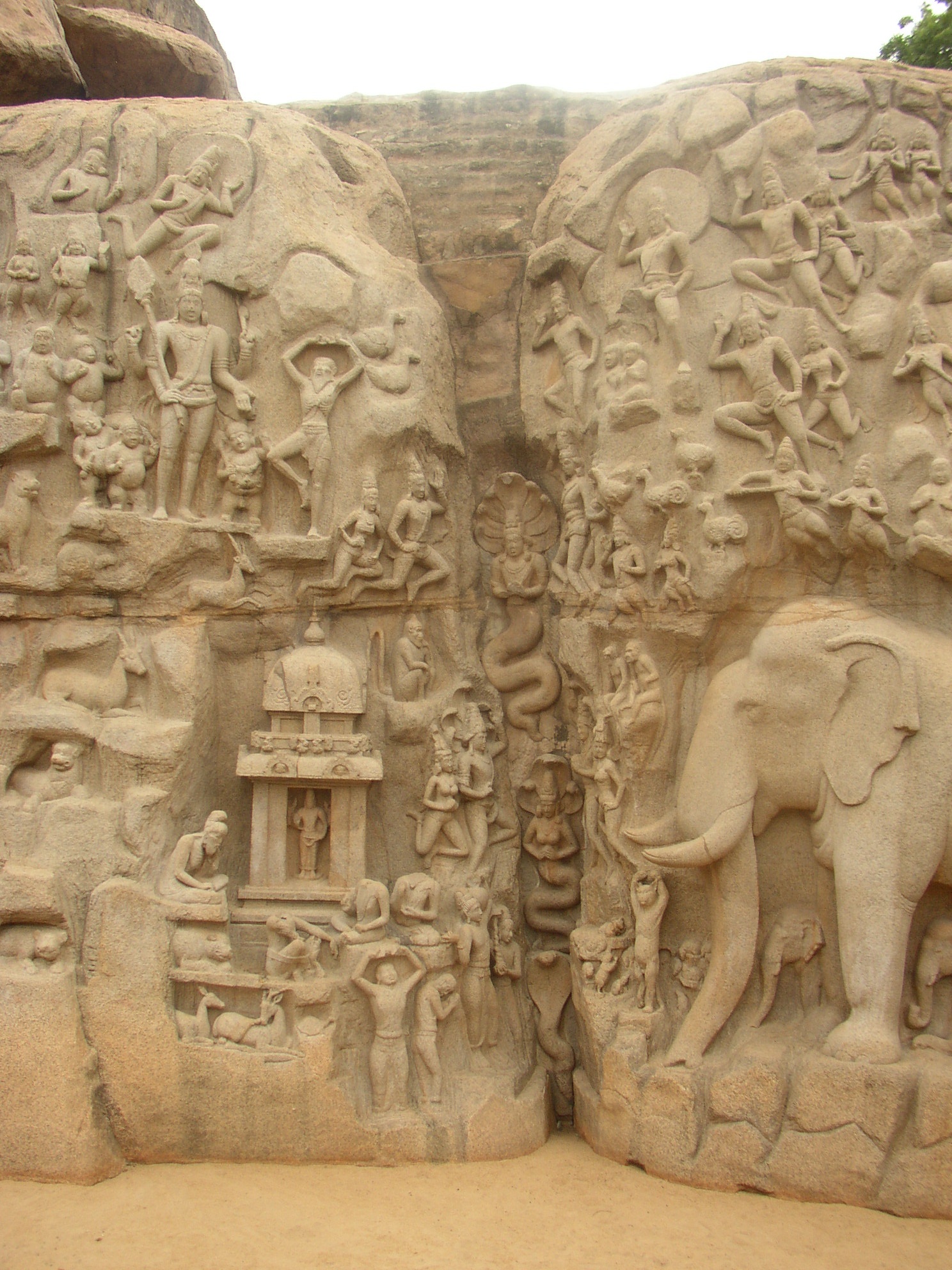
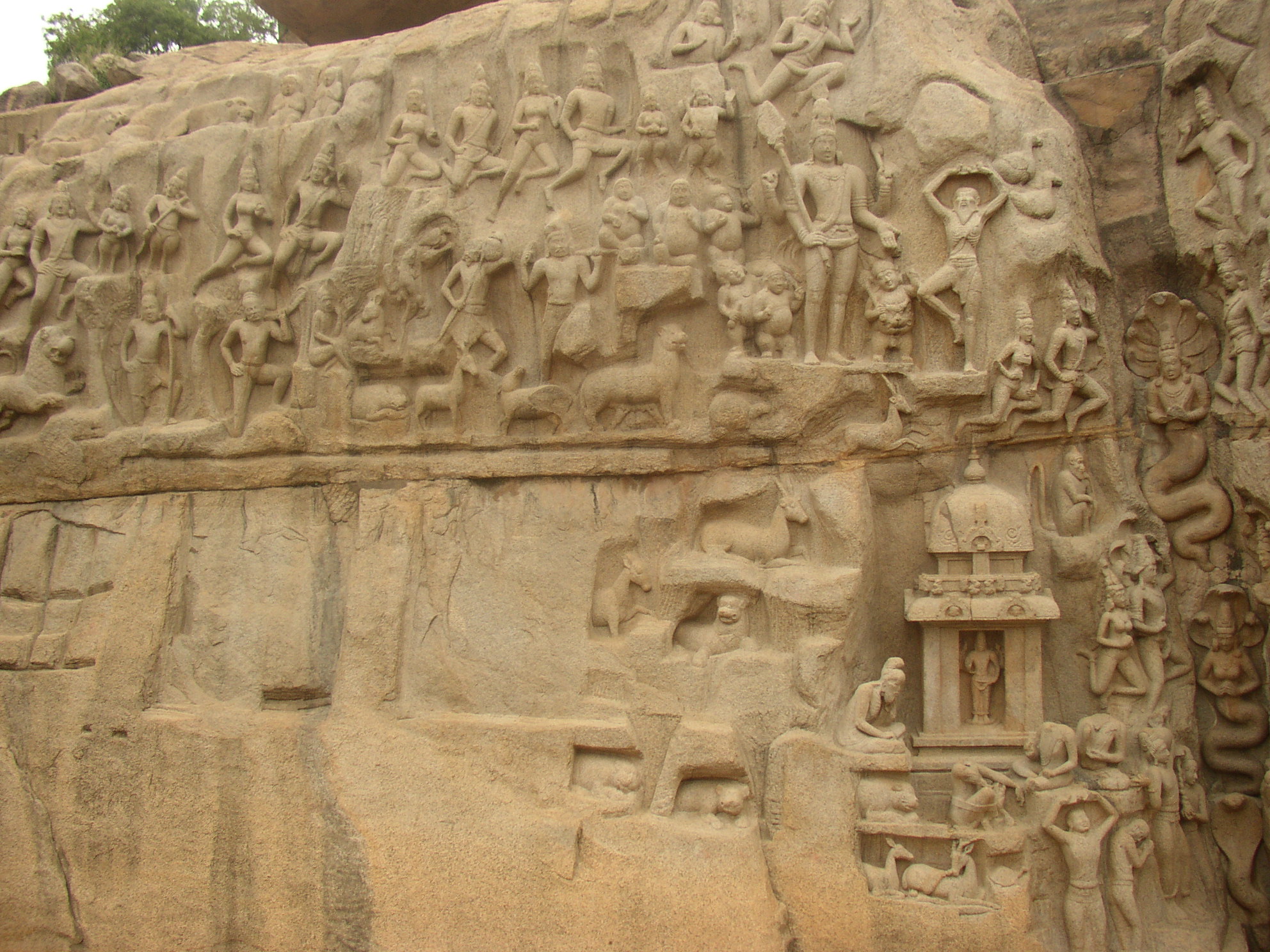
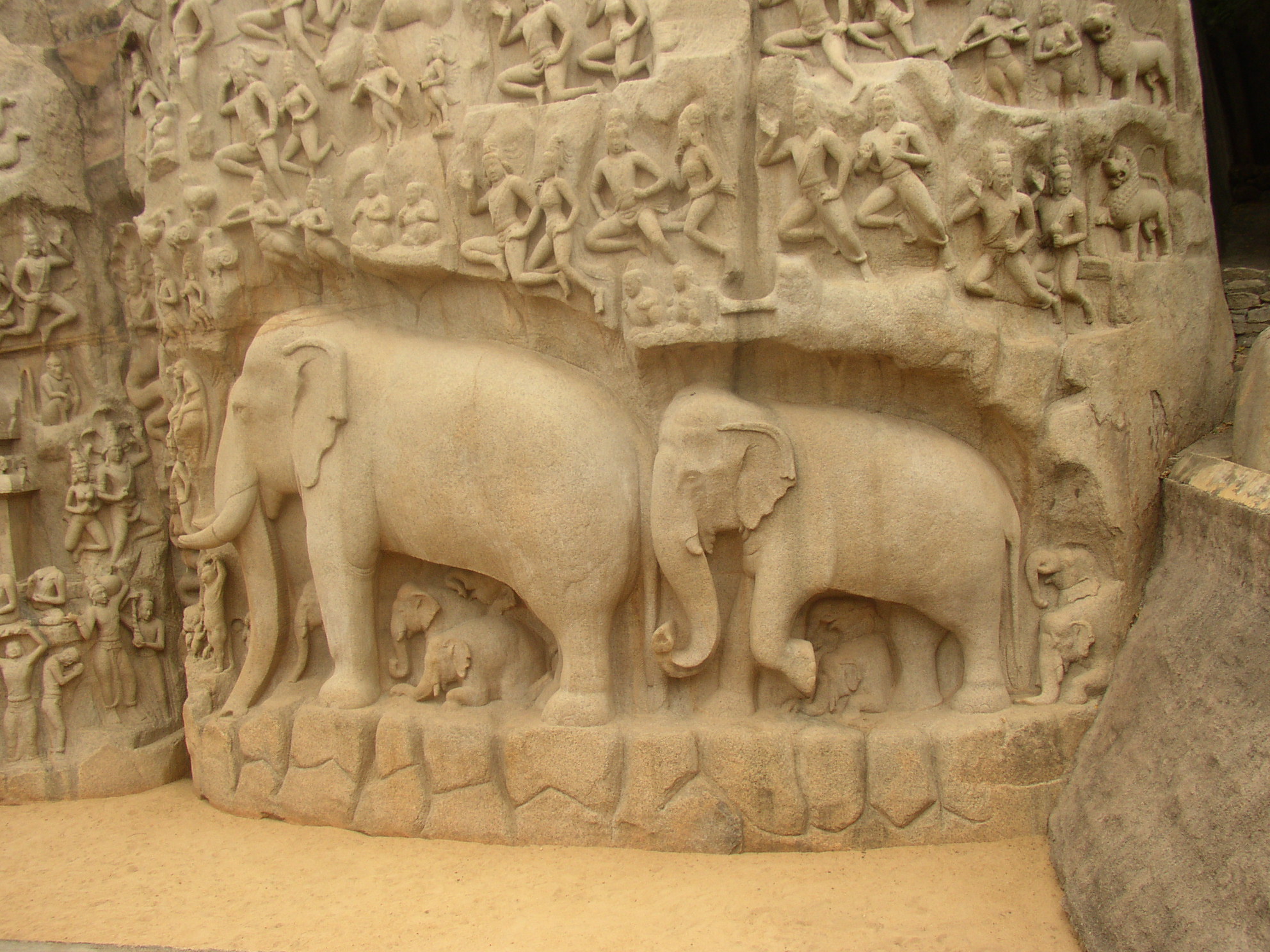
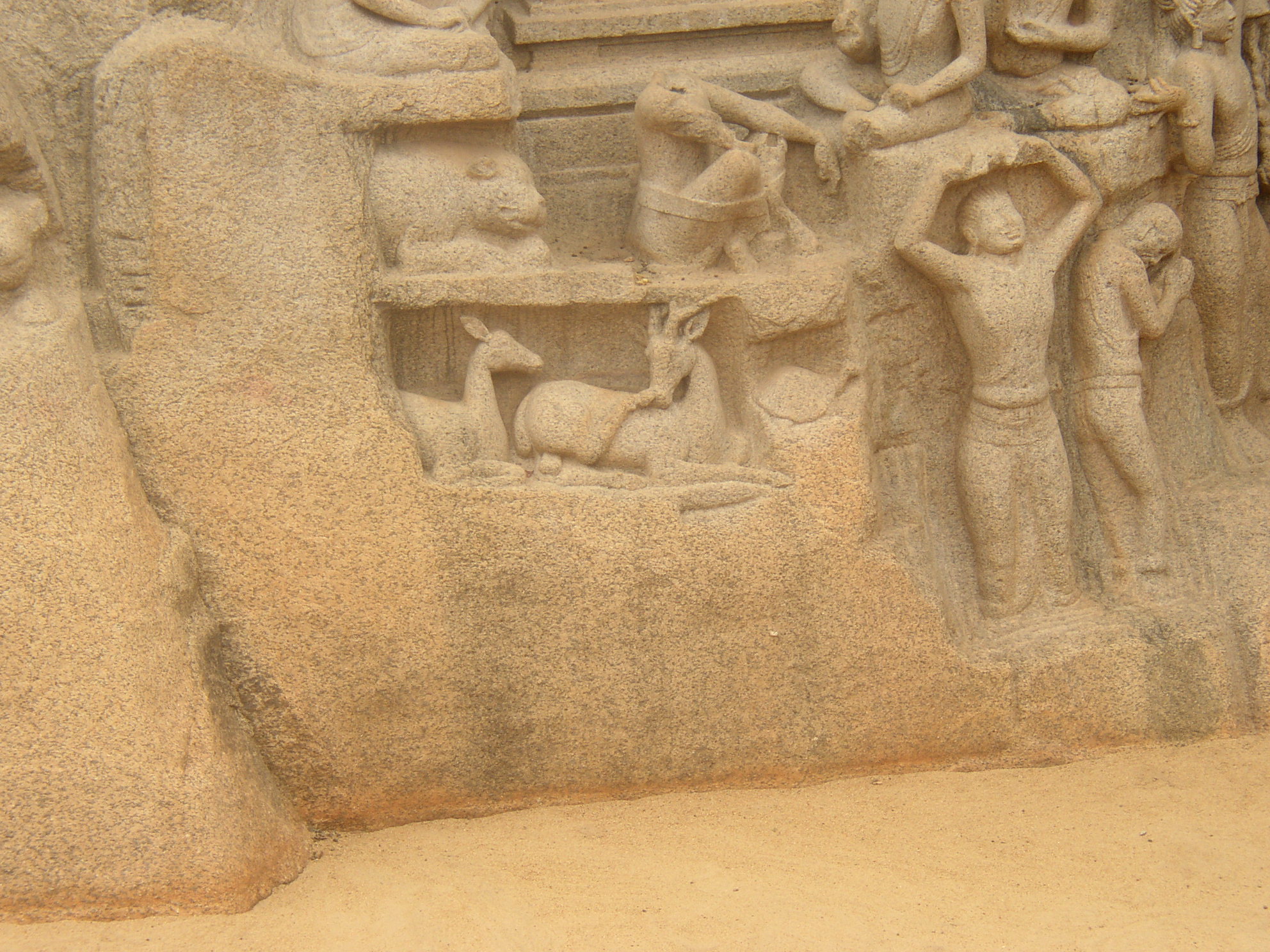
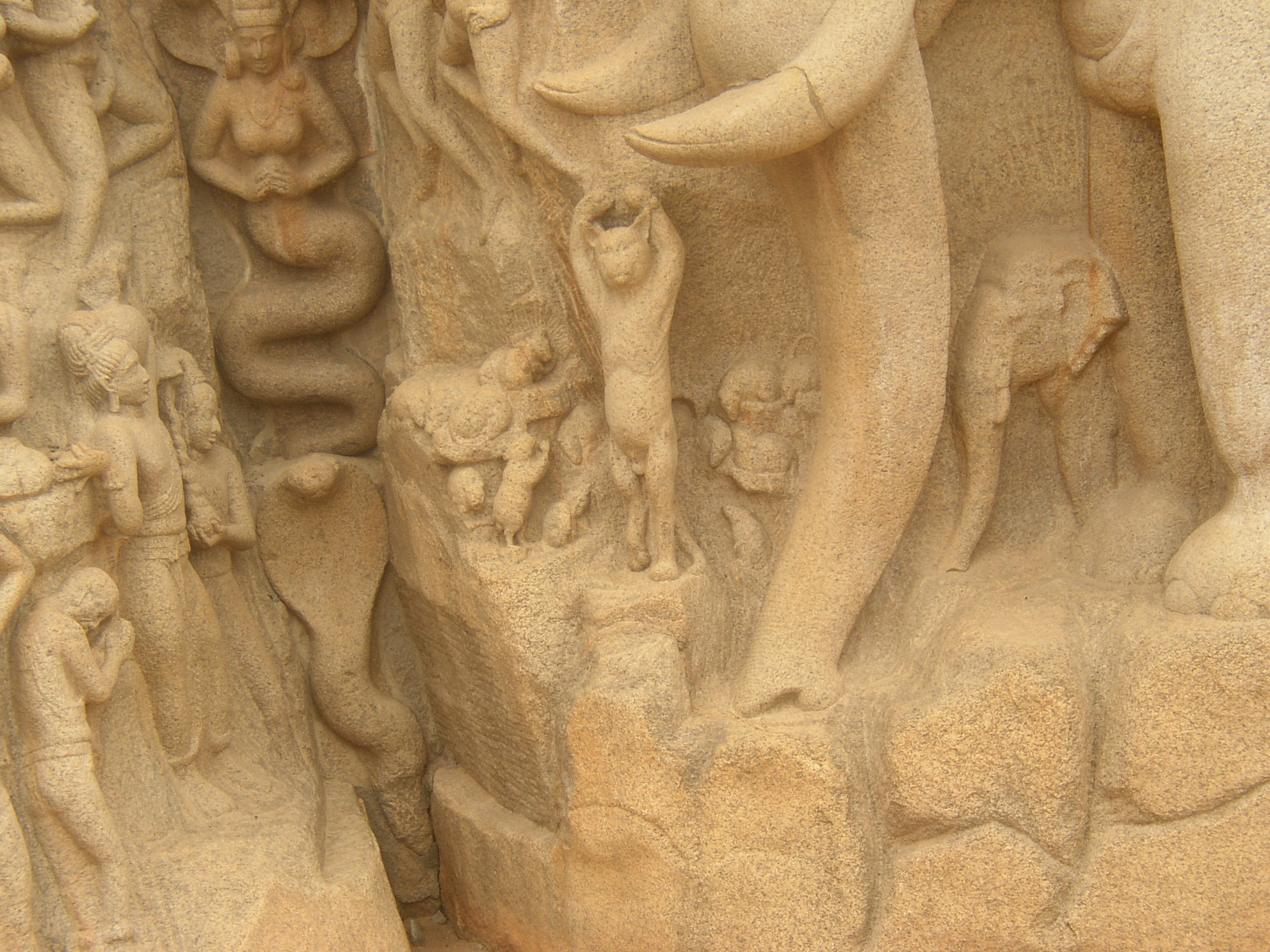
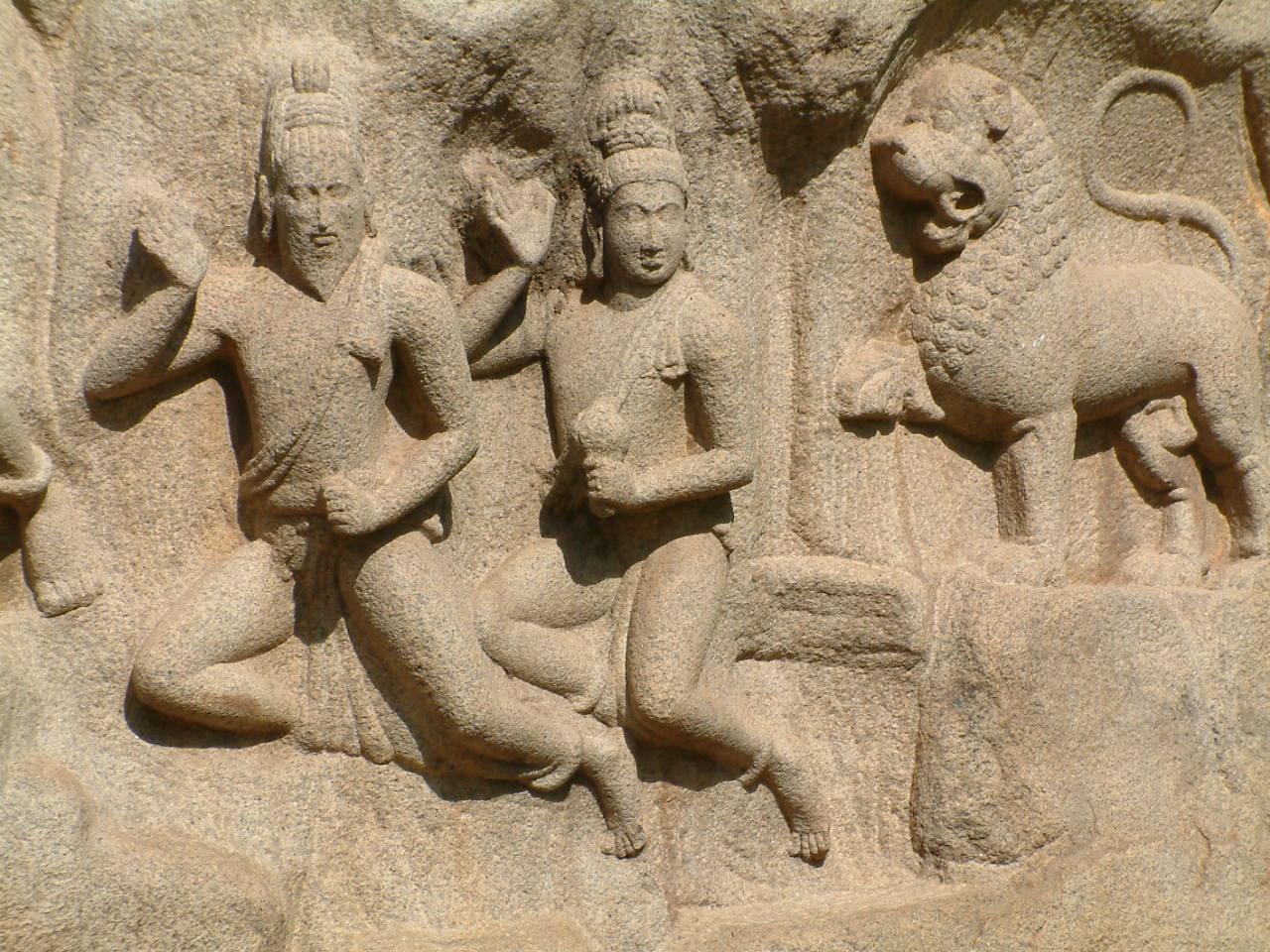
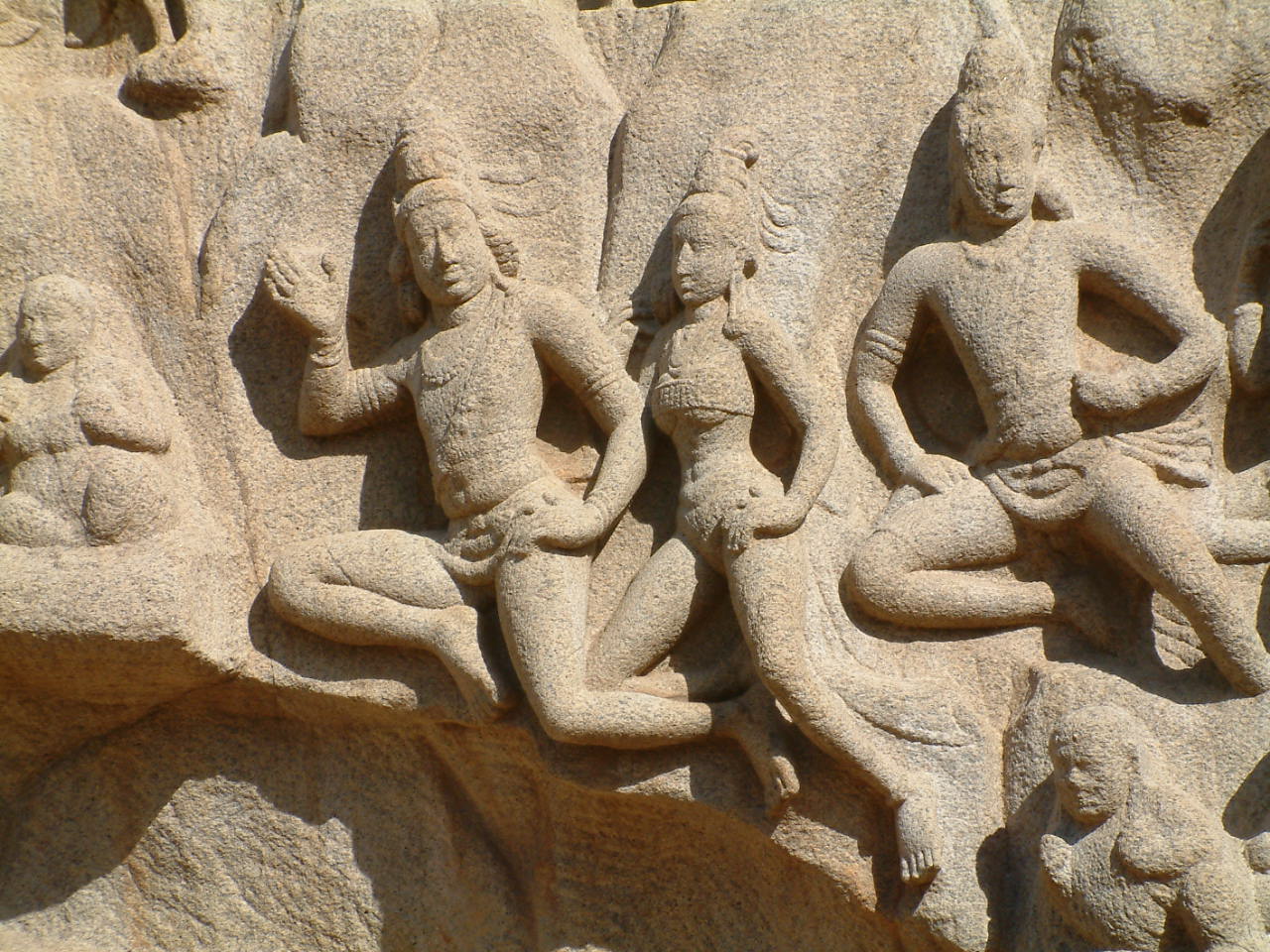
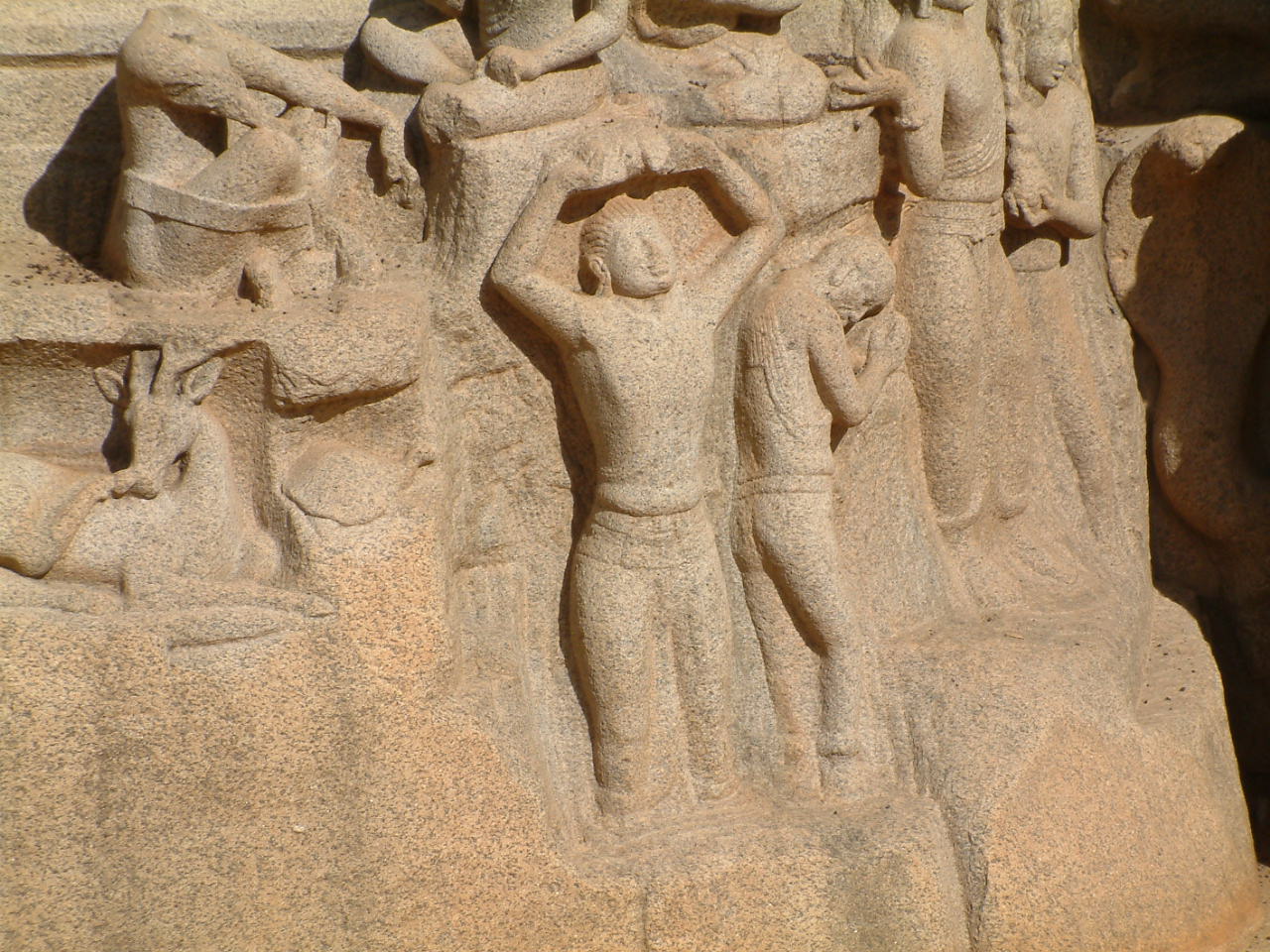
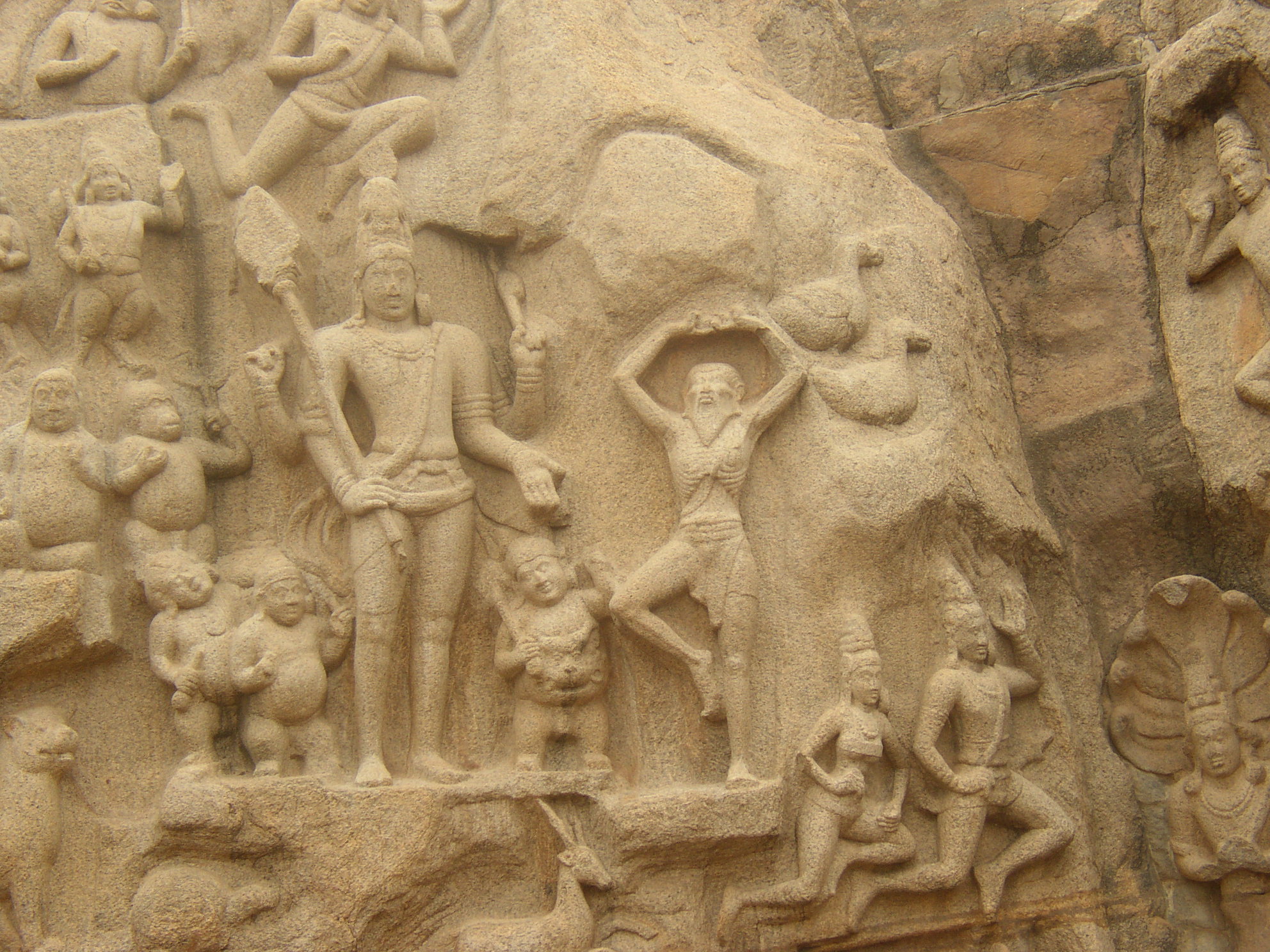
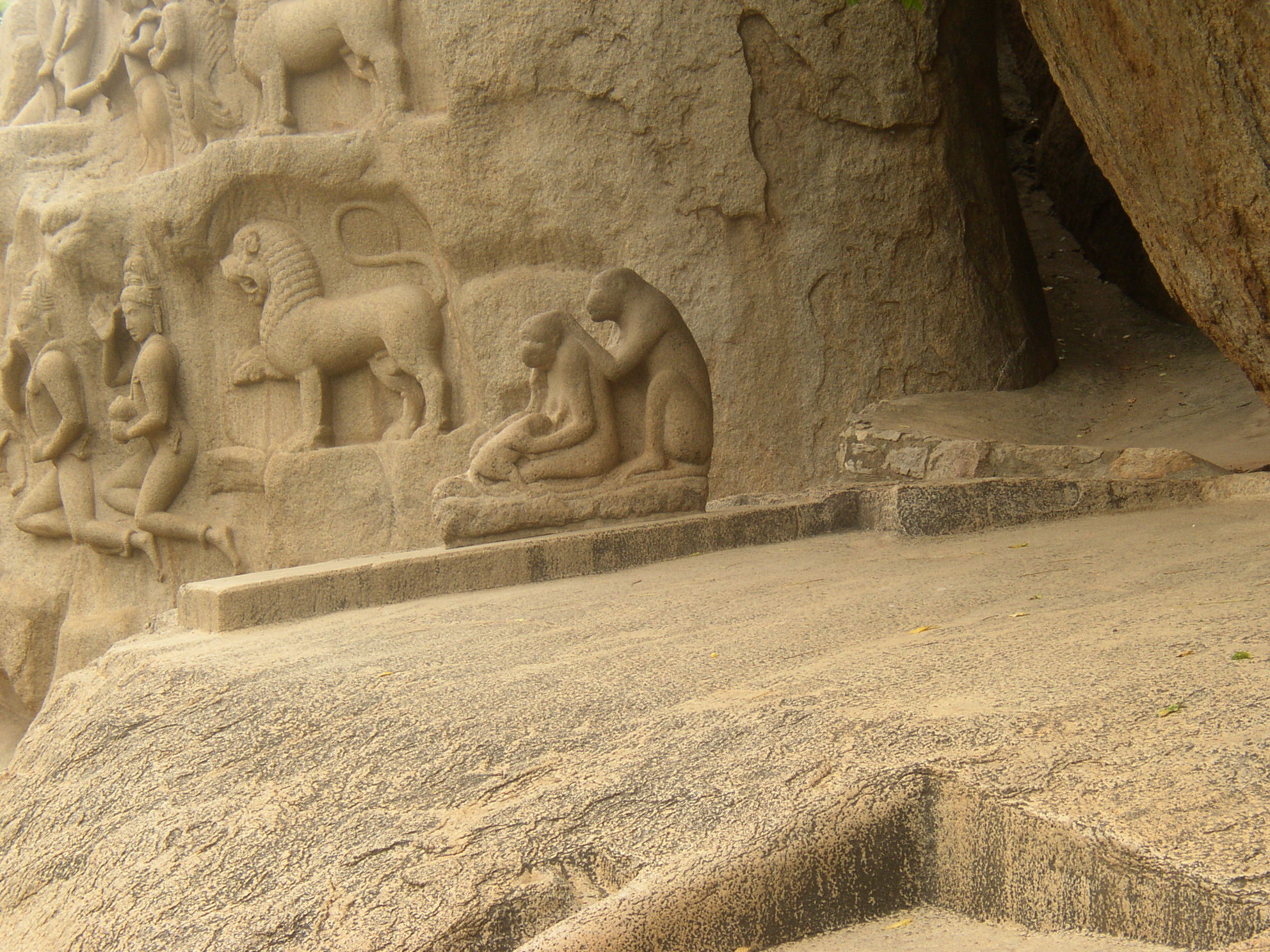
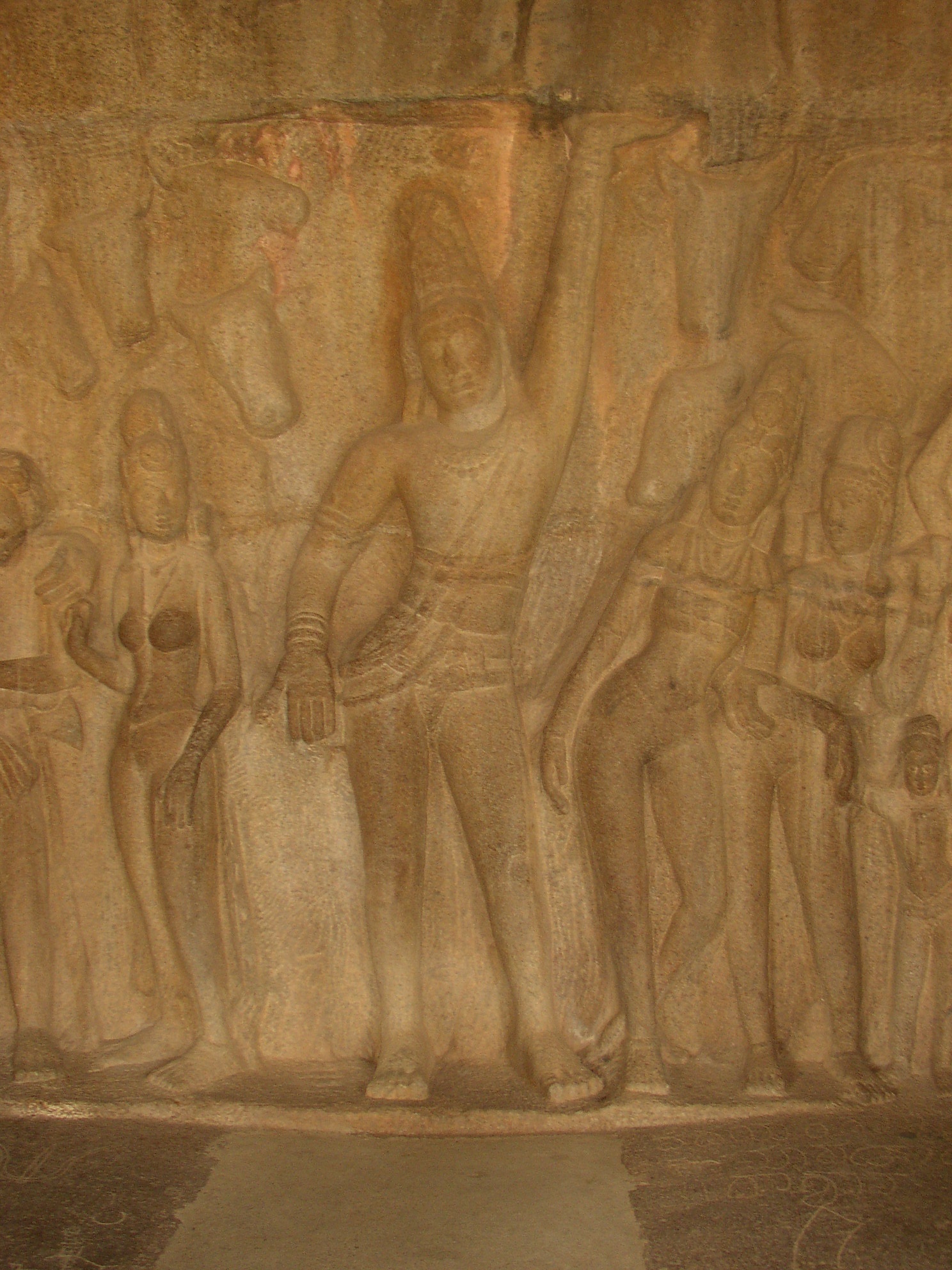
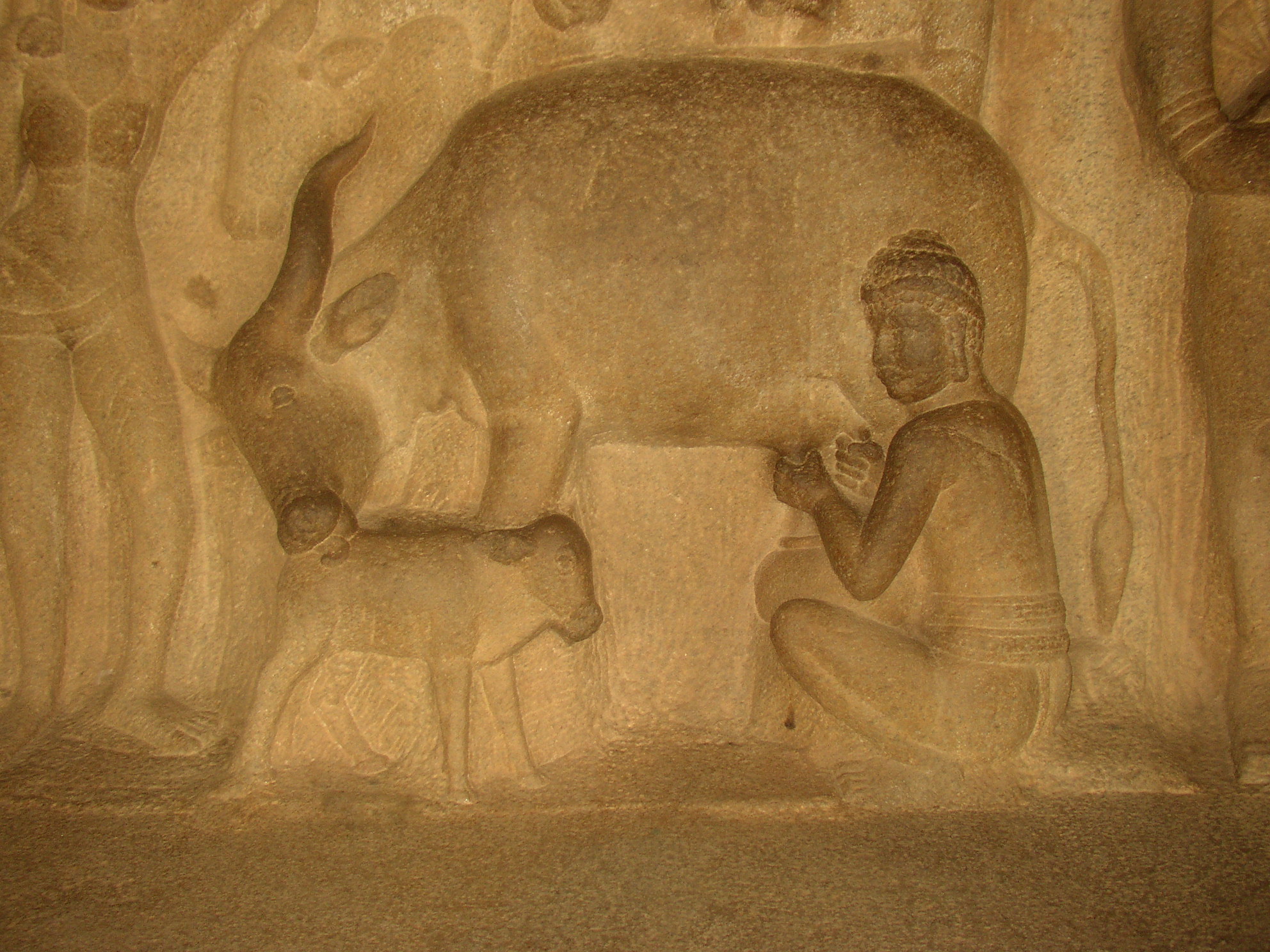
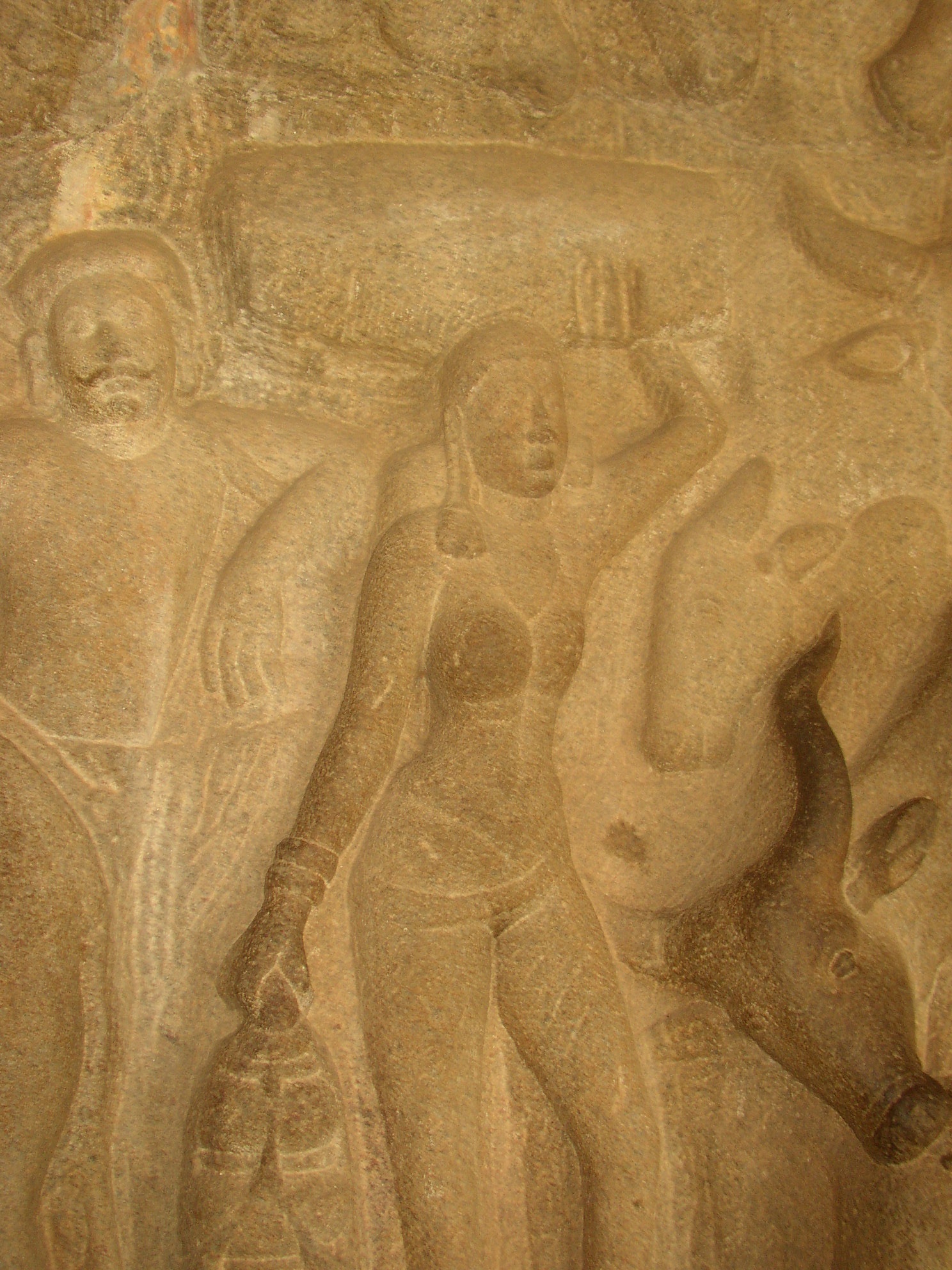
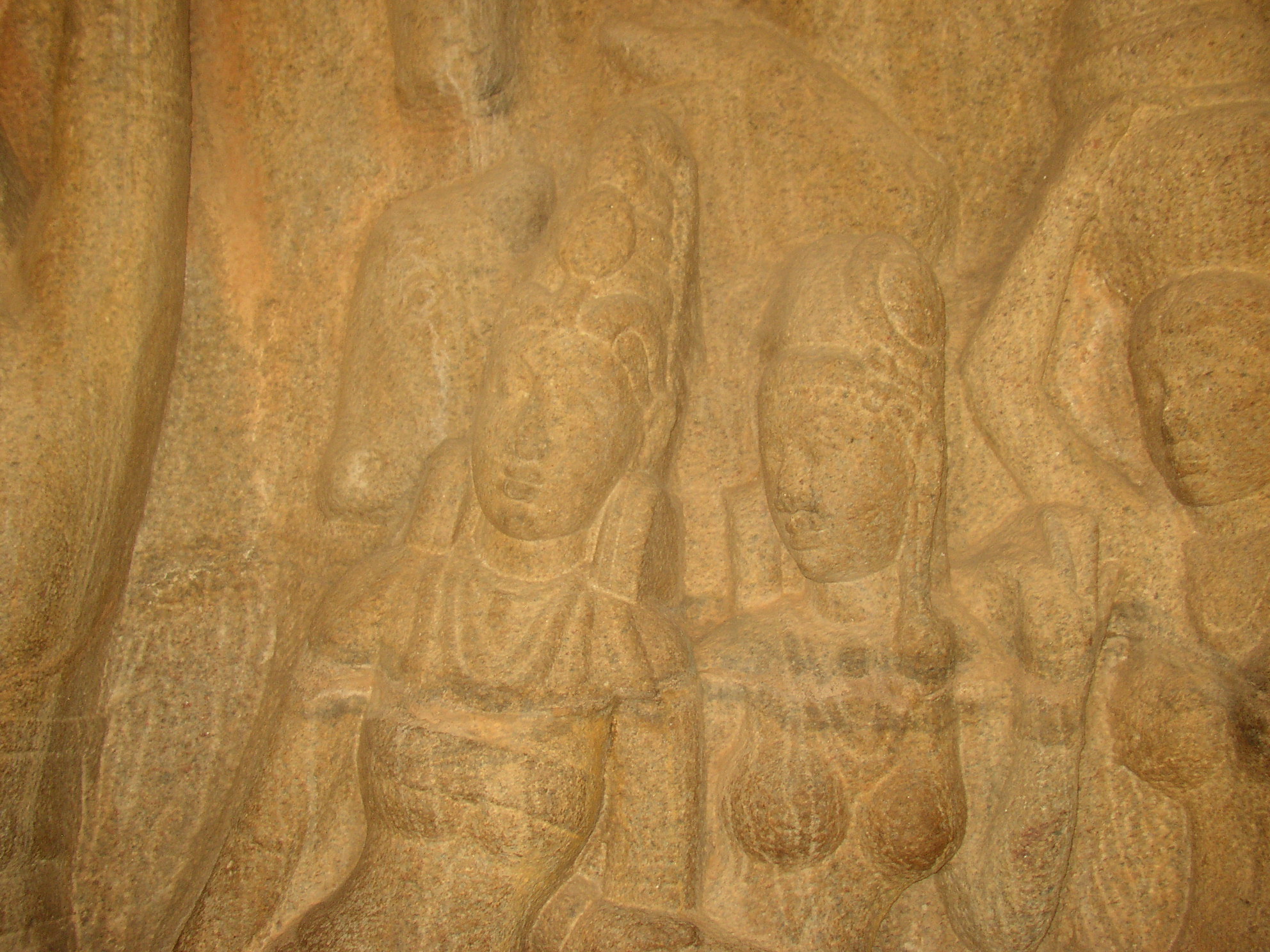
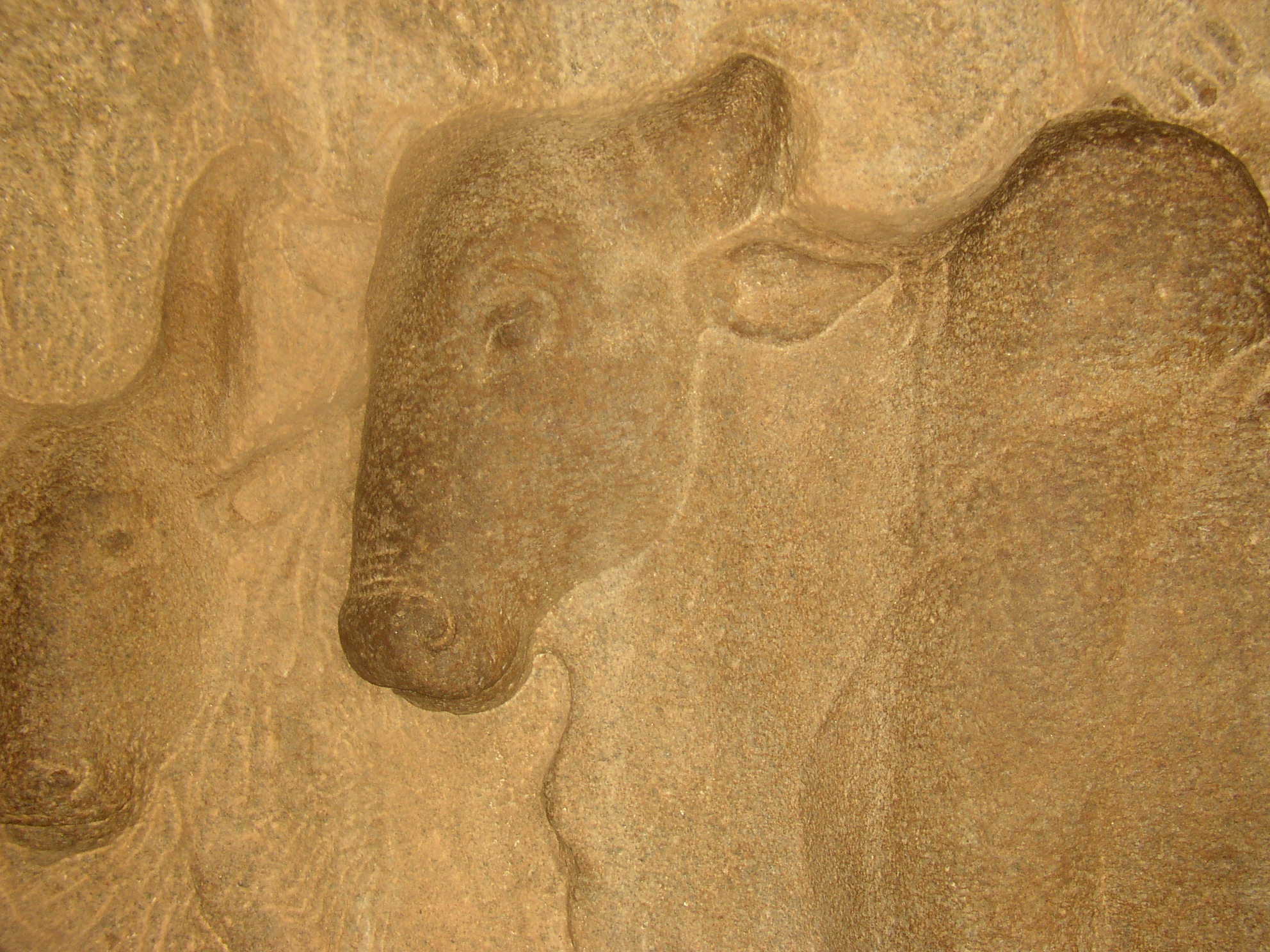
8. Bas-ReliefsArjuna’s PenanceArjuna’s Penance (Descent of the Gaṅgā) bas-relief, MāmallapuramNorthern half of Arjuna’s Penance bas-reliefElephant family detail, Arjuna’s Penance bas-reliefDeer pair detail, Arjuna’s Penance bas-reliefPenance of the Cat detail, Arjuna’s Penance bas-reliefFlying Gandharvas detail, Arjuna’s PenanceKinnaras detail, Arjuna’s PenanceAscetics performing madhyāhnikam, Arjuna’s PenanceŚiva bestowing Pāśupatāstra on Arjuna, Arjuna’s PenanceMonolithic monkey family sculpture, MāmallapuramAmong the most dramatic presentation of scultptural art are two bas reliefs in Māmallapuram considered the foremost.in conception and execution. The first is what is popularly called Arjuna’s penance and the other is Kṛṣṇa Govardhanadhārī.The Arjuna’s penance is found behind the central temple of the village and covers a huge rocky surface which is approximately 100 feet in length and 50 feet in height. This has an impressive fissure in the centre that seems to play a crucial role in delineation of the episode depicted. A large number of divine and celestials, terrestrial men and animals are portrayed. More than 90 sculptures are to be seen in the whole panel. All those figures are moving to the centre from the sides towards the fissure, presenting a picture of a great river coming down from heavenly heights, passing through the earth and entering the nether world. The rock is vertically divided into almost two halves as north and south. At the top most part of them are seen two flying divinities holding their hands in adoration one on either side. They are adorned with circular halo behind their head and represent Sūrya (sun) and Chandra (moon). That sphere represents the heavenly region.Down below on either side are shown Gandharvas, and Vidyādharas, who are among the 18 group of gaṇas moving through the intermediate space. They are known for their beauty and accomplishments in art, music and dance. There are also Ṛṣis, Siddhas and Cāraṇas with matted locks of hairs and beards who are men of wisdom assoiated with slopes of hills and flower gardens. There are dwarfs some shown with their heads covered with cloth and with long ears. They are called Kim-purushas. Another group called Kinnara pairs, shown as half human beings above the waist and birds below, the males shown with stringed instruments and the females with cymbals in their hands. The Sanskrit tradition ascribes the origin of music to birds. The panel a;so portrays hunters in the forest and villagers settled on the banks of rivers. The hunters are portrayed as well built men, sturdy, bearded, fierce looking and holding long bow and arrow, seen moving through woods. Around them are portrayed wild animals like lions, tigers, boars, monkeys ant-eaters etc. Down below is seen a temple of Viṣṇu on the banks of the river, surrounded by men, seen some taking bath, some offering their daily prayers and yet others seated in Yogic postures.Two lovely elephants are seen one a male and the other female moving majestically towards the waters., A numner of calves are shown playing beneath the legs of the elephants. The representation of these elephants invariably attract all the visitors for their realism and movement. A pretentious cat doing false penance surrounded by rats is a contrast to the eal penance shown above. Other animals portrayed include lions, tigers, boars, wild goats, monkeys, rabbits, turtles, deers, rats and cats etc. In the middle are seen a row of swans flying in formation. Further beyond are shown water ducks. From the middle of the fissure emerge Nāgarāja, Nāginīs and snakes representing the nether world.The central theme of the episode is on the southern wing. Śiva majestically standing surrounded by his dwarfs and is presenting a weapon. By his side is shown an ematiated person with long beards, with both his hands raised and joined above the head and standing on one leg performing a severe penance.There are differences of opinion about the identification of this scene. The earliest accounts call this Arjuna’s penance. The central cleft fascinated some other writers who found in it the descend of the great river Gaṅgā (Gaṅgā-avataraṇa). According to the story the celestial river Gaṅgā came down to the earth with tremendous force and at the request of Bhagīratha, Śiva agreed to receive the force of the falling Gaṅgā. This episode has been a favourite theme of the artist from early times.According to the legend the ancestors of king Bhagīratha were burnt to ashes and they could attain salvation only on being washed with the waters of sacred Gaṅgā. Bhagīratha undertook severe penance on the slopes of the Himalayas, Gaṅgā agreed to descend to earth but as she would fall with a tremendous force. The earth would not be able to bear her fall. Bhagīratha did penance and requested Śiva who received the falling Gaṅgā on his forehead. The waters of the Gaṅgā after circumambulating the jatas of Śiva fell to the ground from Śiva’s head. This episode which is described in the great epic Mahābhārata fascinated great poets and thinkers.There is another story also narrated in the Mahābhārata in which Arjuna the hero of Mahābhārata, undertook severe penance at the suggestion of Indra on the slopes of the Himalayas to obtain the Pāśupata weapon from Śiva. Pleased with his devotion and at the same time to test Arjuna Śiva appeared as a hunter. Both Arjuna and Śiva as a hunter killed at the same time a wild boar. A fight ensued between Śiva and Arjuna. Finally Śiva blessed Arjuna with the weapon.Both the episodes as given in the Mahābhārata took place on the slopes of the Himalayas. The description of the slopes is identical in both the instances except that the case of Bhagīratha’s penance is somewhat more detailed.The story of Arjuna receiving the weapon called Pāśupata has fascinated an early great poet Bhāravi. An elder contemporary of Mahendra Pallava, he wrote a beautiful poem on the story named Kirātārjunīyaṁ. Sri T.N Ramachandran who examined the scene in detail suggested that the work of Bhāravi has directly influenced the Pallava artists of Māmallapuram to portray this scene which is not unlikely. Other scholars like Ānanda Coomaraswamy have argued for the descent of the river Gaṅgā episode.There is no doubt that the fissure in the centre of the Māmallapuram bas relief is overwhelming and shows a great descent of a river from the outer space. However the theme of the descent of the Gaṅgā river should be that the river should fall on the jatas of Śiva and should descend to earth from his jatas. This is the most crucial part of the story of Gaṅgāvataraṇa. But in the panel depicted the river does not fall on the head of Śiva nor does it fall from his jata. Śiva stands on one side of the river with no connection with it whatsoever. In the case of Arjuna’s penance the central point of the episode is Śiva presenting the weapon on the slopes of the Himalayas. That is what is portrayed in the panel in which Śiva’s gift is the central theme. The most acceptable interpretation of the theme is Arjuna’s Penance.Kṛṣṇa MaṇḍapaKṛṣṇa lifting Mount Govardhana, Kṛṣṇa MaṇḍapaPastoral milking scene, Kṛṣṇa MaṇḍapaMilkmaid carrying pots, Kṛṣṇa MaṇḍapaGopīs and cowherds, Kṛṣṇa MaṇḍapaSeated bull detail, Kṛṣṇa MaṇḍapaA few yards south of “Arjuna’s penance” is the famous Kṛṣṇa Maṇḍapa now a pillared pavilion with remarkable sculptures carved on the rock at the back. It is behind the living temple in the centre of the village. As it contains the sculpture of Kṛṣṇa, the Vaiṣṇavas built the maṇḍapa in front in the 16th cent for celebrating festivals for Kṛṣṇa. Originally there was no maṇḍapa and the carved reliefs remained visible as a bas relief in the open air like Arjuna’s penance. In its original condition it should have been another fascinating group.The sculptures portrayed represent a long row of men and women, shepherds and cowherds with Kṛṣṇa lifting the hill Govardhana with one hand. All the scultptures are life size and are carved with exceptional care. Kṛṣṇa stands majestically as the leader of the group surrounded by Gopis and cowherds, some carry children on their shoulders, and others lead them by hand.Near Kṛṣṇa stands another royal figure who is identified with Balarāma, the brother of Kṛṣṇa. By his side stands a Gopī in delightful pose The cowherds are shown in different postures, one playing on his flute with a good number of cows, standing around him listening to his music. Beneath is shown a cow with its calf standing close to it and fondling it with its tongue affectionately even as the cowherd is milking it. It is a remarkable scene where the filial affection of the mother cow is brought out in a memorable way. This scene is a great attraction among all the visitors as a picture of tender affection. Cow is venerated in India as the embodiment of motherhood. Nowhere Indian artist has achieved this height in depicting the motherly affection as in this animal. In front of it is another scene as a contrast showing a majestic bull moving very pompously with a little calf preceding it self-importantly. There is a milkmaid carrying milk in pots as is seen even to this day in country side. She also carries a rolled mat on her head. By her side is a bearded cowherd carrying cutting axe with a long handle. In front of the bull is a cowherd couple with their hands clasped and perhaps in an ebullient mood. The whole face of the rock portrays only pastoral scene with cows and cowherds with Kṛṣṇa their protector. On the side face of the rock are shown lions one of which is shown with human head and lion’s body recalling the epithet of the Pallava Nara-siṃha (Man-lion). It is surprising that this portrayal has deliberately contrasts with the figure sculptures of Arjuna’s penance where celestials, forest hunters, asnd villagers but not a cowherd or cow is portrayed whereas in the Kṛṣṇa scene no other clan except Cowherds is displayed showing thereby that there has been conscientious selection of portrayals in both together. The second point that needs attention is that in Arjuna’s penance the downward force of the river is taken as the central theme, while in the Kṛṣṇa Govardhanadhārī scene it is the upward force of lifting the mountain that is the central point of attraction.According to the legend Indra the king of gods sent devastating rains and storm to punish the cowherds as they stopped the customary offerings they were rendering him annually at the instance of Kṛṣṇa,. But Kṛṣṇa came to their succour and lifted the hill with one of his hands which served as an umbrella and all the cowherds joyfully played and moved around beneath it. Indra was brought to his senses. This episode is shown in a very natural manner with the whole hill at the back shown as the Govardhana hill that Kṛṣṇa lifted.The last but not the least important aspect is that there was no preceding maṇḍapa originally. The artist has taken the whole hill behind Kṛṣṇa and portrayed it as the Govardhana hill. Without the front maṇḍapa the visitor would have seen Kṛṣṇa standing and lifting the hill behind him a fantastic integration of the natural formation with the theme of the portrayal. It would have presented one of the most beautifully figured Govardhana episodes in bas relief a sight which unfortunately the visitor has been robbed now. When visualized the greatness of the Māmallapuram artists would be ever remembered.Unfinished Arjuna’s PenanceA few steps further south is seen another rocky surface where another attempt has been made to carve Arjuna’s Penance. This is unfortunately in the rudimentary stage of cutting. Though the outline of large number of figures are carved the work has not advanced and the whole presents a crude stage. But there s no doubt it would have been another great work.