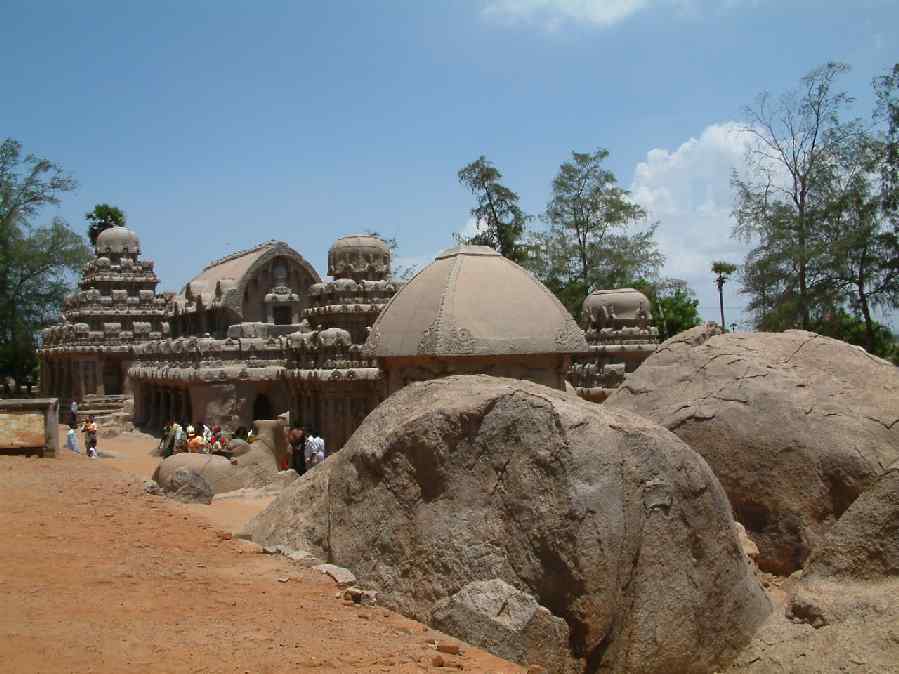
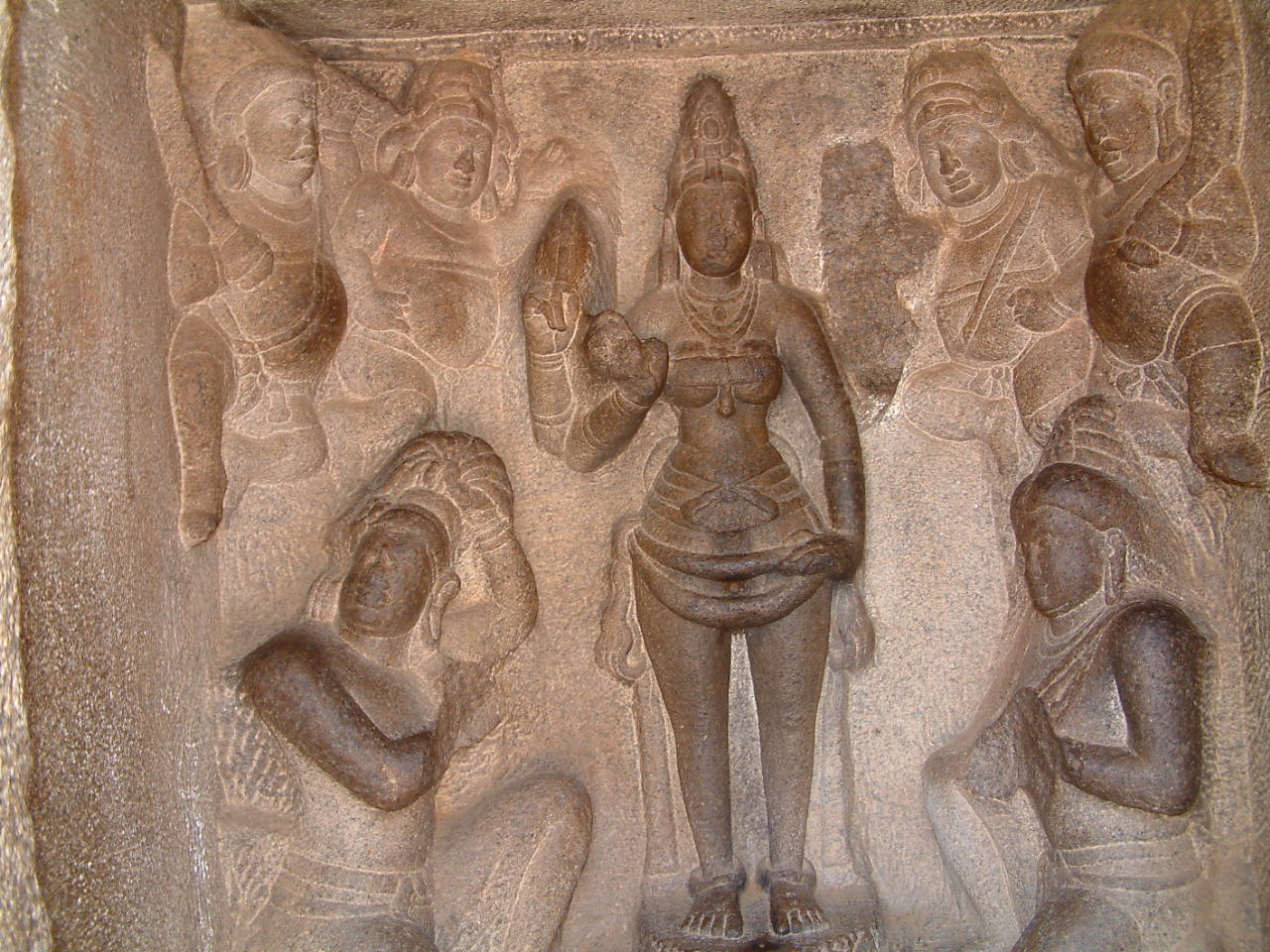
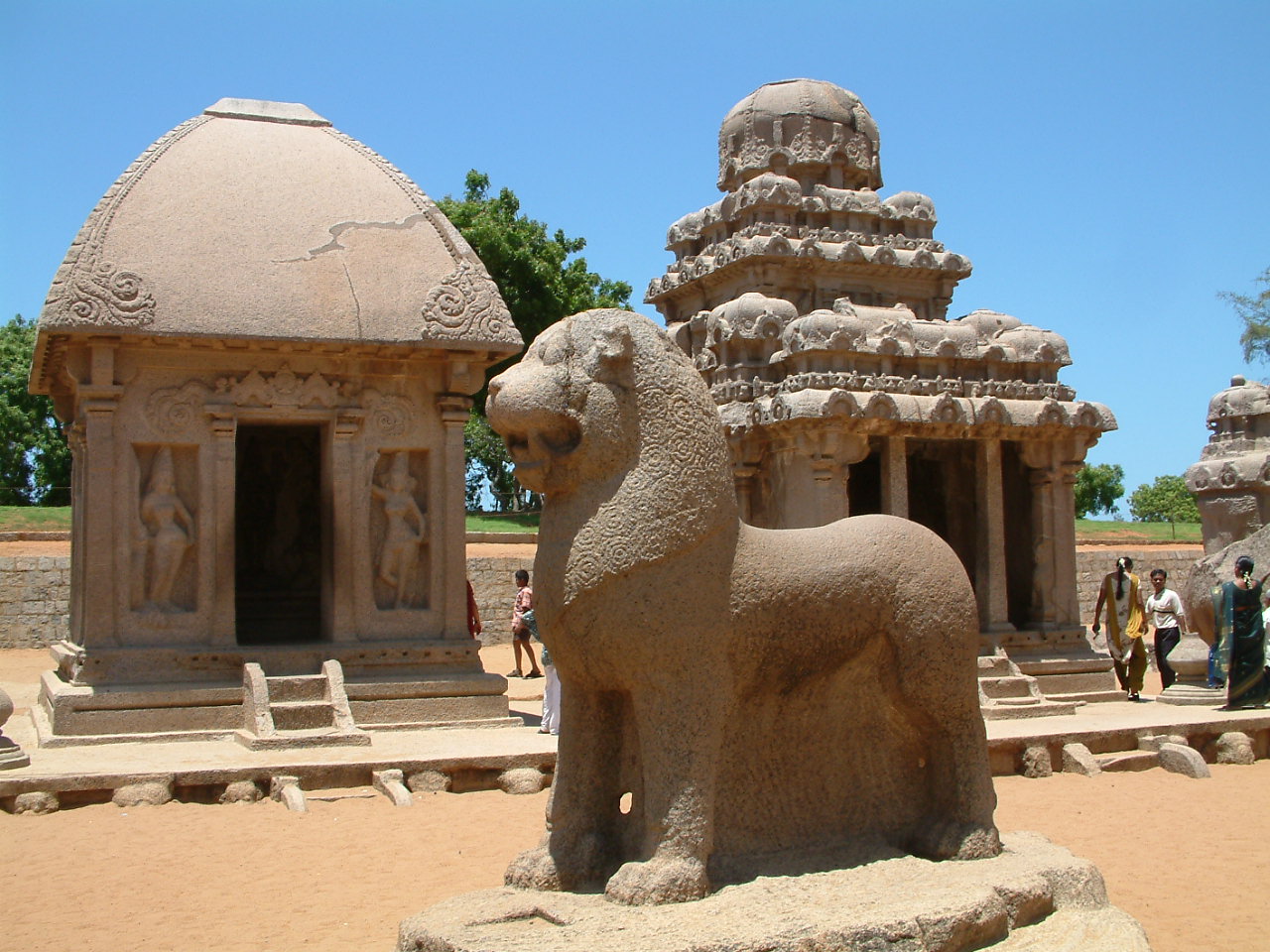
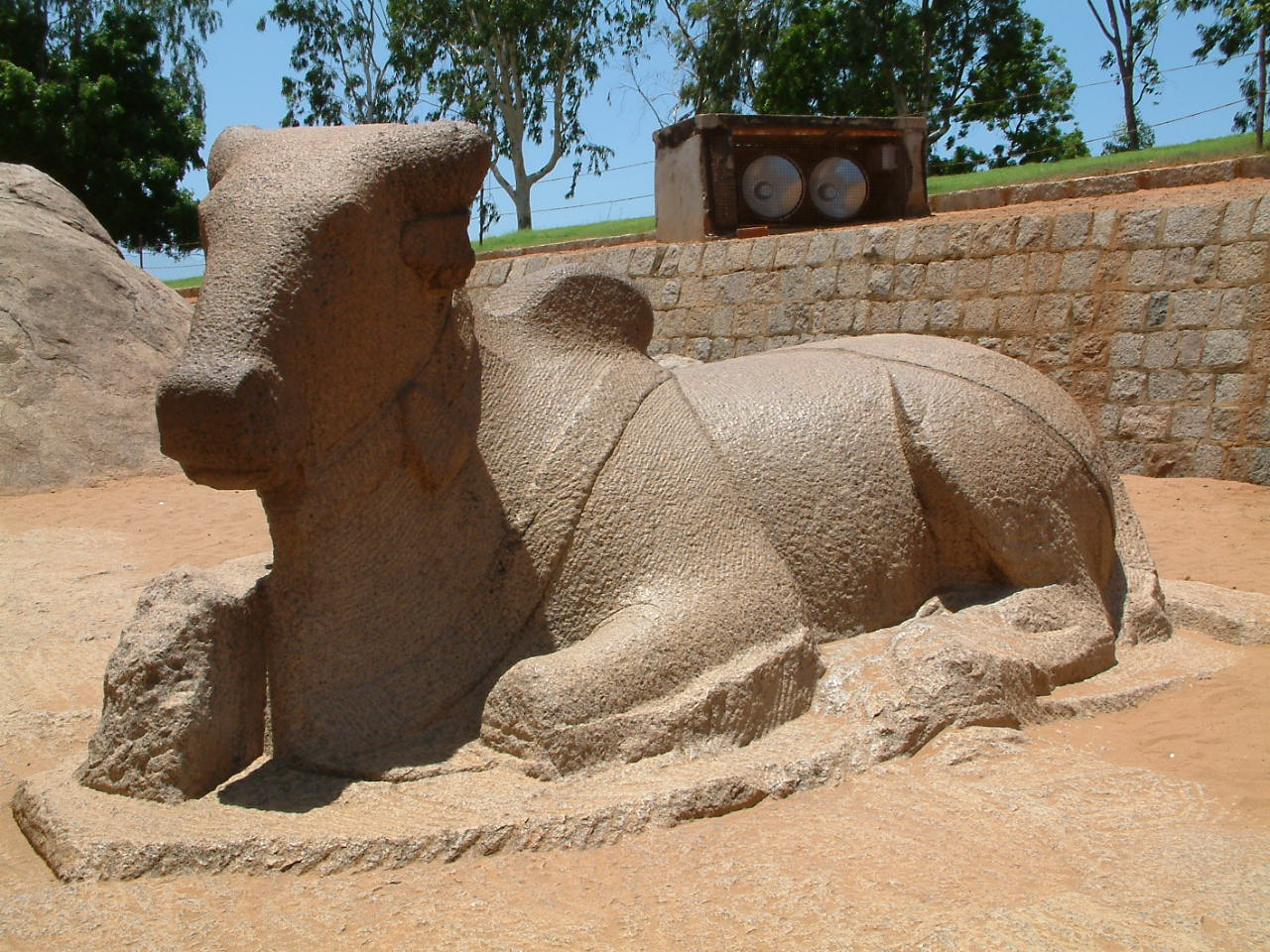
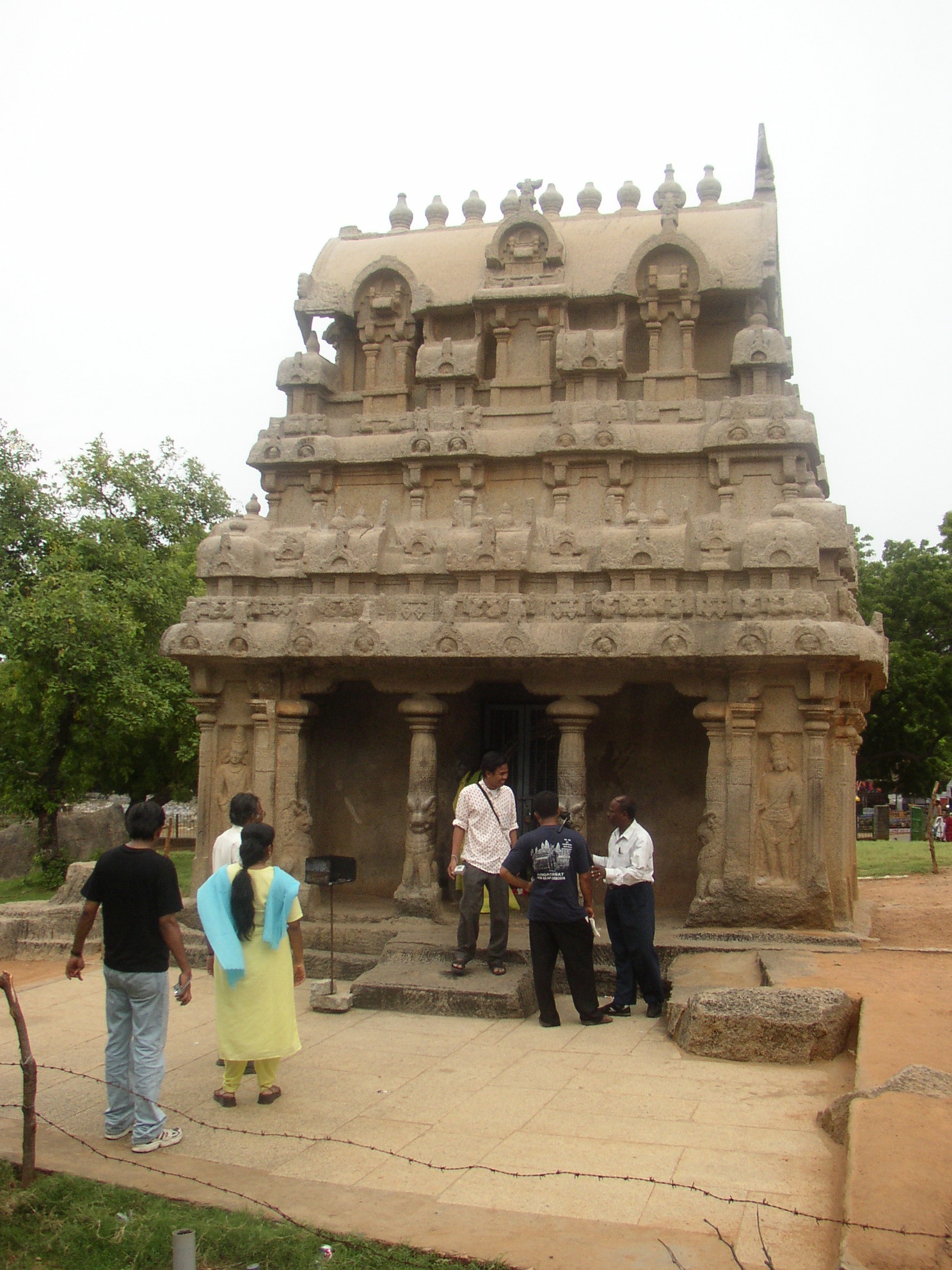
7. The RathasThe Five Rathas (Pañca Pāṇḍava Rathas), MāmallapuramThere are all together ten monolith temples (Rathas) cut out of single rocks in different parts of Māmallapuram. The famous and most beautiful monolithic temples are found as a group in the southern end of the village and these go by the term - “The Five Rathas” or more popularly “Pañca Pāṇḍava Rathas”. There are three at the western end of the village. One is behind the great bas relief – Arjuna’s Penance, and the last, which is in rudimentary stage of cutting in front of the Mahiṣāsuramardinī cave, near the modern light house.The temples that are the abodes of gods, are generally called Vimāna – i.e celestial vehicles. The tradition of connecting the temple structure with the shape of celestial chariots is popular, The calling of the Vimānas or the temples of Māmallapuram chariots-rathas by the people is in tune with this public perception.The group of five temples at the southern end of the village is called “Five Rathas”. Pañca Pāṇḍavas are the five Pāṇḍava brothers - named Dharmarāja, Bhīma, Arjuna, Nakula and Sahadeva. They were virtually the heroes of the great epic Mahābhārata, the most popular epic. Every village, till very recent times, had regular meetings where the Mahabarata episode will be told or read to the public, that moulded their personality. As such anything grouped into five used to be named after the Pañca Pāṇḍava brothers. The group of five rathas were named Pañca Pāṇḍava Rathas in this manner, otherwise they are all temples and had nothing to do with the five brothers. In an ideal way these five monoliths suited this name. First of all they are five in numbers Among the five rathas, one on the extreme south is the tallest, with three stories and presents a dignified look and so was called by the people Dharmarāja-ratha, after the eldest brother. The second is a rectangular, wagon roofed ratha, which presents a bulky body and look which, came to be called Bhīma ratha. The third from the south is slightly shorter than the earlier two, but has a charm of its own. It was therefore named after the third brother Arjuna and is called Arjuna-ratha. The fourth one at the northern end, resembling a simple thatched hut, houses an image of the goddess Durgā, in its sanctum and is called Draupadī-ratha. These four rathas are in one line running north to south. The other one, that stands to the west of this group,is an apsidal temple called after the last of the five brothers, as Sahadeva-ratha. The temple of the goddess is called after the name of the wife of the five brothers Draupadī. The five monoliths named Pañca Pandva rathas has a poetie charm rooted in Indian ethos.Draupadī RathaKoṟṟavai (Durgā) in Draupadī RathaMonolithic lion beside Draupadī RathaAmong the five rathas, the first that one encounters is the Draupadī ratha, in the form of thatched hut, with a square slopping roof, beautified at its corners with lovely creeper design. The temple is on a rock cut platform, which is common to its adjacent temple known as Arjuna ratha. This platform is supported by figures of lions and elephants.Inside the garbha gṛha (sanctum) stands Durgā on a lotus pedestal with four hands, the upper arms holding cakra and śaṅkha, and front arms held in abhaya and placed on thigh. The devī wears a breast band.There are two gaṇas on either side of the goddess both with pot bellies but with a grim look. At the ground level we have two heroes one on either side seated, the hero on the right is in the pose of offering his own head, by severing it with a sword, while the other offers a flower. It seems the goddess is here portrayed as an embodiment of knowledge, in which aspect she would stand erect as a motionless flame in space. The Tamil literature assigned to 3rd - 4th cent eulogise Durgā as the Supreme Goddess, adored by Brahmā, Viṣṇu and Śiva, in their heart that are the lotus seat of the goddess. Durgā is adored as a primordial goddess in Tamilnāḍu, even from the beginning of the current era.The temple faces west. The outer walls of this temple carry one niche in each direction. namely north, east and south containing an image of Durgā standing on the head of buffalo (Mahiṣa) in some. On the platform of this temple is seen a big lotus bud like carving which represent the finial - called stupi, that would go on top of the tower. Obviously this was made separately and fitted into a socket.In front of this temple, stands a lion nearly six feet high on a rocky seat. The whole figure is carved in situ, on a rock that stood there. It is thus a monolithic figure. Lion is the mount of Durgā and in most Durgā temples, the lion mount is placed in front of the sanctum of the goddess. The artist has cleverly visualized a standing rock in front to carve this lovely standing lion.Arjuna RathaArjuna Ratha and monolithic NandiNext to Draupadī ratha in the same line is Arjuna ratha that stands on the same platform as Draupadī ratha. The same decoration seen in the Draupadī ratha is noticed in the sub-base of the Arjuna ratha as well. The temple also facing west is a two storied structure topped by an octagonal śikhara. Such śikharas are called “Drāviḍa śikharas” The temple has a square sanctum, proceeded by a small projecting maṇḍapa. The sanctum is now empty, but the images on the external walls indicate it was dedicated to Śiva.The northern wall has sculptures that are cut only roughly. The central riche houses Śiva standing by the side of his attendant. The central riche at the ground level of the rear wall shows Subrahmaṇya seated on an elephant with a prominent garland of flowers over his bead. There are generally two deities seen in this quarter, both shown seated on an elephant, one is Indra, seated on his elephant Airāvata and the second is Subrahmaṇya/Muruga seated on his elephant. To the left of Subrahmaṇya are shown a bearded priest and his attendant. On to his right are two superb Apsaras. Particularly the one closer to the God is an unparalleled depiction of perfect feminine beauty standing in a delightful three bends, stimulating a flowing creeper. Her face is absolutely charming. Especially when seen in the sun light falling at an angle in the morning her face is brightened up and the eyebrows and eyelids still fresh after nearly 1300 years, are seen delineated beautifully. This sculpture of Apsara is an unparalleled creation in the Māmallapuram art. On the south wall in the central niche stands Śiva, leaning on his mount Bull (Vrishbha) in his manifestation called Vṛṣabhāntika-mūrti. Flanking him on either side are portrayed, two couples one on either side which are again creations of a good artist. The stance of both the man and the woman are excellent depiction and are well proportioned. There is an inviting charm in both the pairs, that may represent Gandharvas. At the corners are shown attendants on all the sides. Dr. Minakshi, who wrote on Pallavas, considered one of the couple as portraying Rājasiṃha Pallava and his queen.On the walls of the first floor may be seen eight couples of beautiful forms two on each direction, and in probability they represent the directional deities. The large sized lotus bud that goes into a socket on top of the śikhara is seen placed on the platform as in the case of Draupadī ratha.At the back of this ratha is seen a huge reclining bull carved in situ. Though final finish is yet to be given this bull has a charm of its own and is a great attraction for children to play.Bhīma RathaAdjacent to Arjuna ratha, is the huge oblong, monolithic ratha - known as Bhīma ratha, that derives the name Bhīma Ratha on account of its size as mentioned earlier. An oblong sanctum was planned, with a passage to go around in circumambulation. It was planned to leave corner walls and provide pillars supported by squatting lions, at the ground floor. The work at that level remains unfinished. But the upper story with sloping roofs and other architectural embellishments are in advance stages of finish. The side gable ends are very interesting. They show imitation of wood works particularly the rafter ends. In the centre is seen a niche topped by a tower like ornamentation. It looks like a small vimāna, square from base to the neck and above shown as a circular śikhara. Already the five rathas show five different varieties of Vimāna towers. This miniature tower, square upto the neck and circular on top is the sixth variety. Also at the front facade of the Sahadeva Ratha, a miniature tower is shown, which is octagonal from base to the top, which is another variety. While describing four other monolith, it will be seen that each is different. Thus there are ten monoliths in which 12 different varieties of temple towers are shown, which show that there was a deliberate attempt to show a variety, which is the hallmark of Māmallapuram.The Bhīma ratha remains an unfinished monument. No sculpture is found that is worth the mention. There is also no inscription but it clearly suggest a western oritented shrine. From rectangular formation it has been suggested that it might have been intended for the reclining form of Viṣṇu, familiarly known as Ananta-shayi Viṣṇu, with other secondary deities portrayed.Dharmarāja RathaThe tallest monolith majesties in its appearance and stands at the extreme south of the group is the three storied monolith called Dharmarāja ratha. This temple has three floors, the ground floor, first loor and the second floor. It faces west like the other three in line. From inscription it is known as a Śiva temple of Atyantakāma-pallava (Atyanta kama Pallaveśvara-gṛham). This name is found on the entrance to a central cell, in the top floor on the western side and again on the eastern side-entrance lintel of the same floor. Evidently it is the creation of the king who had the title Atyantakāma. In all the three floors various manifestations of Śiva are portrayed. Besides some forms of other gods are also seen. The three floors represent the three spaces earth, outer space and heaven (Bhur-Bhuvaḥ- Suvaḥ).At the Ground floor the following manifestations are seen from the north eastern corner.ArdhanariSubrahmaṇyaŚiva TrimukhaViṣṇuCandraśekharaBhairavaBrahmāHariharaThe following forms of Śiva are figured in this monolith that would interest students of Hindu Iconography. Besides there are other forms also Dvārapālas, Brahmā, Viṣṇu, Sūrya, Soma, Nandikeśvara and Caṇḍikeśvara in the the three floors of the monolith.Kaṅkālamūrti, Vīṇādhara–Ardhanari, Tandava–Śiva, teaching dance to sage Tandu, Caṇḍeśānugraha, Gaṅgādhara, Kalari, Harihara, Vrshabhantika, Bhiksatana, Andhakāsuravadha, Vīṇādhara Dakṣiṇāmūrti,, Nandīśānugraha, Somāskanda, Kevala-candrasekhara, Viṣāpaharaṇa, Bhairava and Kshetrapala.The Dharmarāja ratha is a three storied square, pyramidal tower, the ground floor being taller, the first floor a little shorter and the second floor further shorter that gave architectural stability. The base of the ground floor is somewhat higher than the other rathas in the series. Originally, it was planned to provide lateral steps on all the four cardinal directions for the visitors to climb up. The available rock on the northern side is cut to provide steps. Where there was no rock, it suggests a plan and to provide structural steps as seen in the east.At the ground floor, end walls were provided at the corners, with a central opening supported by seated lion bases. Two such lions and two pilasters were provided on each direction. It seems it was intended to provide a sanctum in each floor but such a sanctum were not fully scooped at the ground floor and first floor whereas, a sanctum has been nearly completed on the second floor.Each corner wall of the ground floor was provided with a niche which houses a standing, almost life size image of Śiva. Above the sculptures, various titles of King Rājasiṃha were engraved in Sanskrit language in Pallava-grantha script. These labels are quite deeply and legibly inscribed but they are not related to the sculptures, below. Iconographically these sculptures breath freshness and mostly do not confirm to later conventional portrayals. On account of their interest, they are listed above. All these images exhibit tall and linear appearance, qualitatively they are very good examples of Pallava art.The temple is a Sarvato-bhadra variety with a square plan with opening on all the four sides. When completed, the ratha ought to have had provision by way of wooden ladders to chimb to the first floor. The ceiling ends of the ground floor are decorated with a row of miniature square and rectangular towers, that go all around as a garland and act as parapets. The wall of the first floor is recessed, leaving about 1½ to 2 feet space for circumambulation. At the western end a half finished central shrine with a small projecting maṇḍapa is seen. Of the four sculptures on the western side the pair immediately flanking the sanctum, are images of Dvarapala. The one on the extreme south end, houses a lady carrying some offering in a pot. The other on the north is certainly Śiva’s attendant Nandikeśvara who holds a long sword across his body.The walls on the side, have niches each housing an image, mostly that of Śiva. They provide most interesting information about iconographical theme and in their distribution some early and rare forms are found. All of them are in standing posture and are about 3 feet in height. As pieces of art they are very great aesthetic creations and are to be ranked among the most outstanding creations. Their proportions, flexions of the body and above all, the facial bhavas are superb. Due to narrow space adequate attempt has not been made to illustrate them suitably.The top floor has a number of sculptures of superb quality. A glimpse of these sculptures could be had from the south end side. There is a central shrine, cubical in shape that carrices a delightful sculpture of Somāskanda in the centre. Brahmā is shown on the right of Śiva and Viṣṇu on the left and in the centre of the sanctum is a square socket for installing a liṅga.It may be seen that all the central niches in the top floor carry significant sculptures. The west has Somāskanda. The north is the direction of Soma (Moon), where he is positioned; Similarly the east is the direction of Sūrya(Sun). Judging from this distribution it is seen that Śiva’s manifestations as Sun, Moon, Agni, and Supreme like Somāskanda occupy their position in the top floor. The sculpture in the south would therefore represent Kalā, the death - also identified with Kālāgnirudra - Bhariava. Thus the whole personality of the temple is revealed by this distribution.It has also been mentioned earlier than this temple has a label inscription, which reads Atyantakāma Pallaveśvara gṛham. As there are titles of Rājasiṃha inscribed above the sculptures on the ground floor, so also the titles of the king are written above some of sculptures in both the first and the top floors. All these titles are found for Rājasiṃha Pallava at Kāñcī, Paṉamalai and other places, indicating that this monolithi is a creation of Rājasiṃha.The temple has an octagonal śikhara and is considered an illustration of Drāviḍa Śikhara. The big lotus bud like carving, that goes on top of the śikhara is also found on the ground, in the eastern side of the ratha.Sahadeva RathaIt has been noted that these four rathas are in a line. In front of the Arjuna ratha is a lovely monolith, facing south almost nearing completion, but in a horse shoe plan. Such a plan is technically called in Indian architectural treatises as Gajaprishta i.e. back of the elephant. As if to suggest this, a standing elephant is carved by its side. From the back of the elephant it may be seen that the tower of the Sahadeva ratha also looks like a back of an elephant.Mention has been made earlier that these five rathas, were mainly intended to portray five different varieties of architecture, and with two miniature temple towers approaching as ornamental motif, one in the gable end of Bhīma ratha and the other on the facade of Sahadevaratha, the author of these monuments, have created seven different kinds of architecture at this place itself.Gaṇeśa RathaGaṇeśa Ratha, MāmallapuramBehind the great relief of Arjuna’s penance, is situated what is now called Gaṇeśa ratha. A nearly perfect example of almost fully finished monolith, it presents a beautiful picture and any onlooker would refuse to believe that it is cut out of a single rock. Its proportion and articulation are so fine, it shows the perfection of planning, cutting monolith and the skill achieved in converting a rock into a delightful imagery. It is a rectangular temple, facing west. As it houses an image of Gaṇeśa in the sanctum it goes by the name Gaṇeśa ratha. The Gaṇeśa sculpture was installed about 125 years ago, but said to have had a liṅga earlier, with a Nandi facing it outside.There are no such sculptures of merit in this temple but of great significance is a long inscription, in Pallava grantha script, written in Sanskrit. The record is a repetition of the same verses found in the cave temple, named Dharmarāja ratha, and the cave at Saluwankuppam named Atiraṇacaṇḍa cave. This inscription says that this temple was called Atyantakāma Pallaveśvara gṛham (Śiva temple of Atyantakāma Pallava) and that he caused this to be made. One of the verses that extoles the greatness of Rudra found in the Rāmānuja maṇḍapa, Ādivarāha cave and Dharmarāja maṇḍapa is also found here. Thus it is clear that it was a foundation of Atyantakāma alias Rājasiṃha Pallava.Valayaṅkuṭṭai and Piḍāri RathasThere are three rathas at the western end of the village, one is near a pond named Valaiyan-kuttai (fisherman pond) and the other two are near the temple of village goddess called Piḍāri temple. All the three are unfinished. The work on them have even started at the top level and reached upto the ground floor when the work has been abandoned. Two of them face east and the third face south. Further two of them have square śikharas from the neck, but the third has an octagonal śikhara. The square śikharas are seen only here. There are no sculptures or inscriptions but the work and their shape again show the desire on the part of the patron to create new forms. They are certainly different forms of temple architecture.Unfinished RathaIn front of the Mahiṣāsura-mardinī cave (near the modern light house) may be seen an attempt to cut another monolith. The cutting has started from the top, that shows the technique of carving rock cut temples, started from the top. That shows another attempt to carve a different monolith.