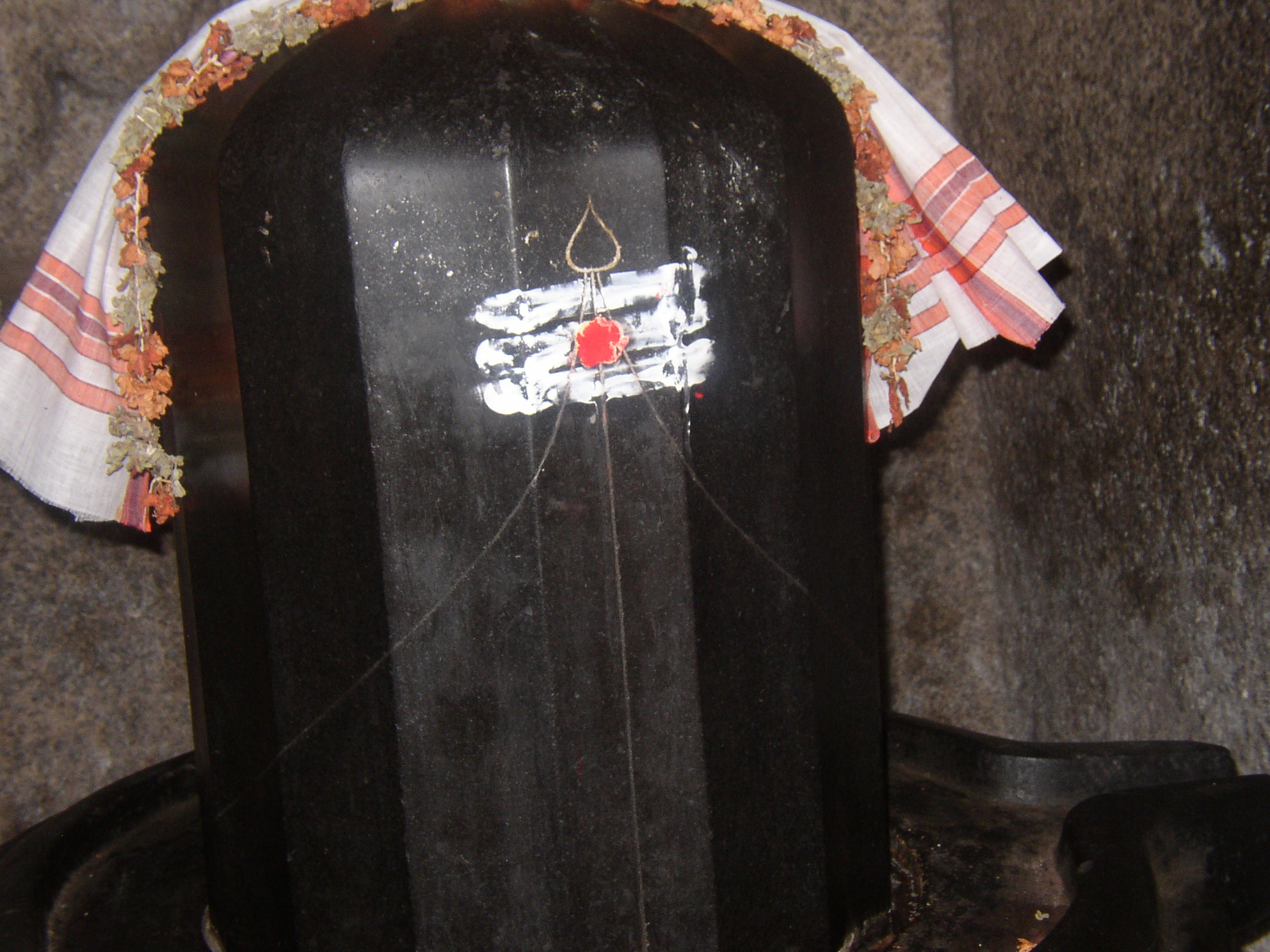
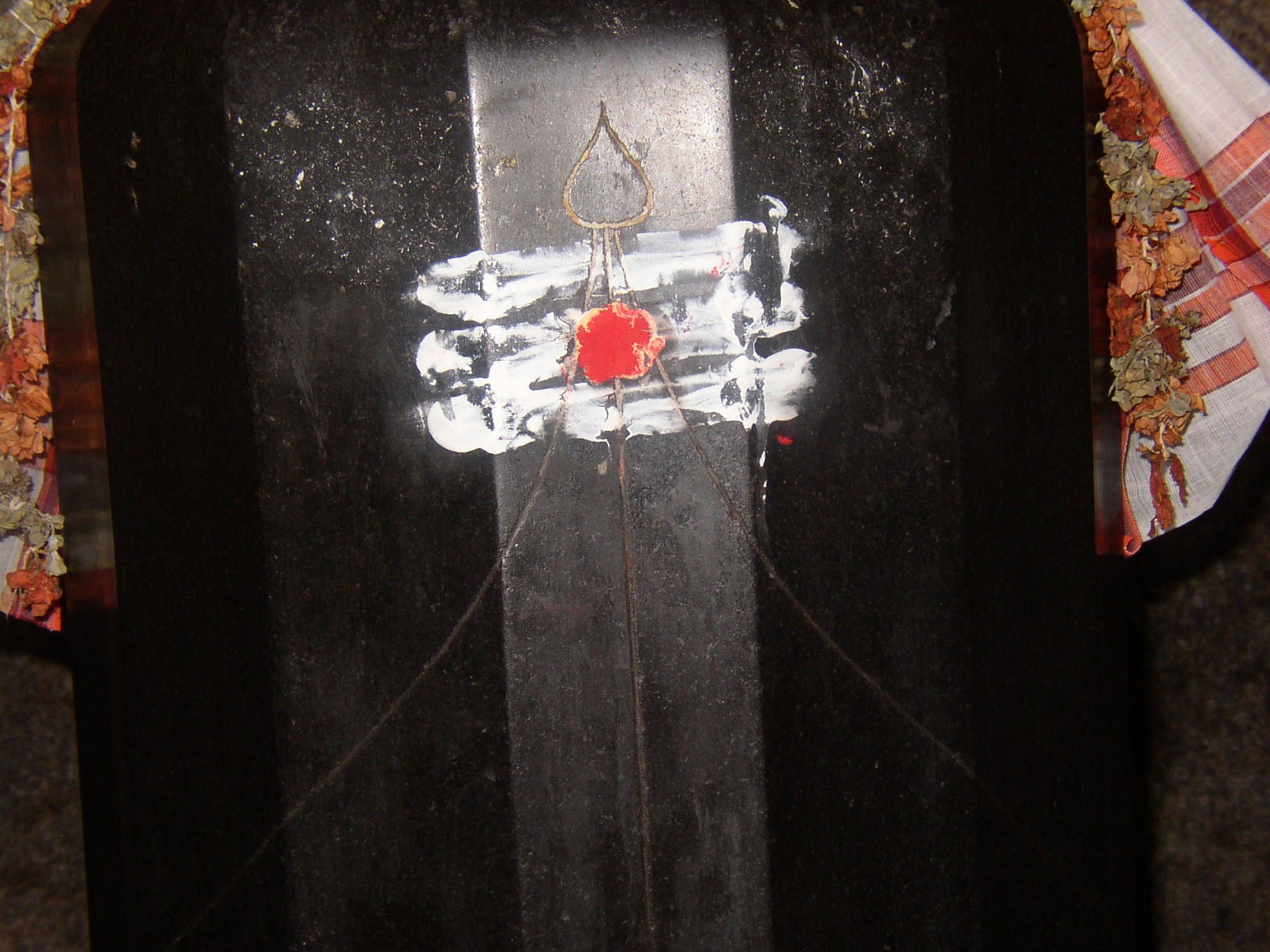
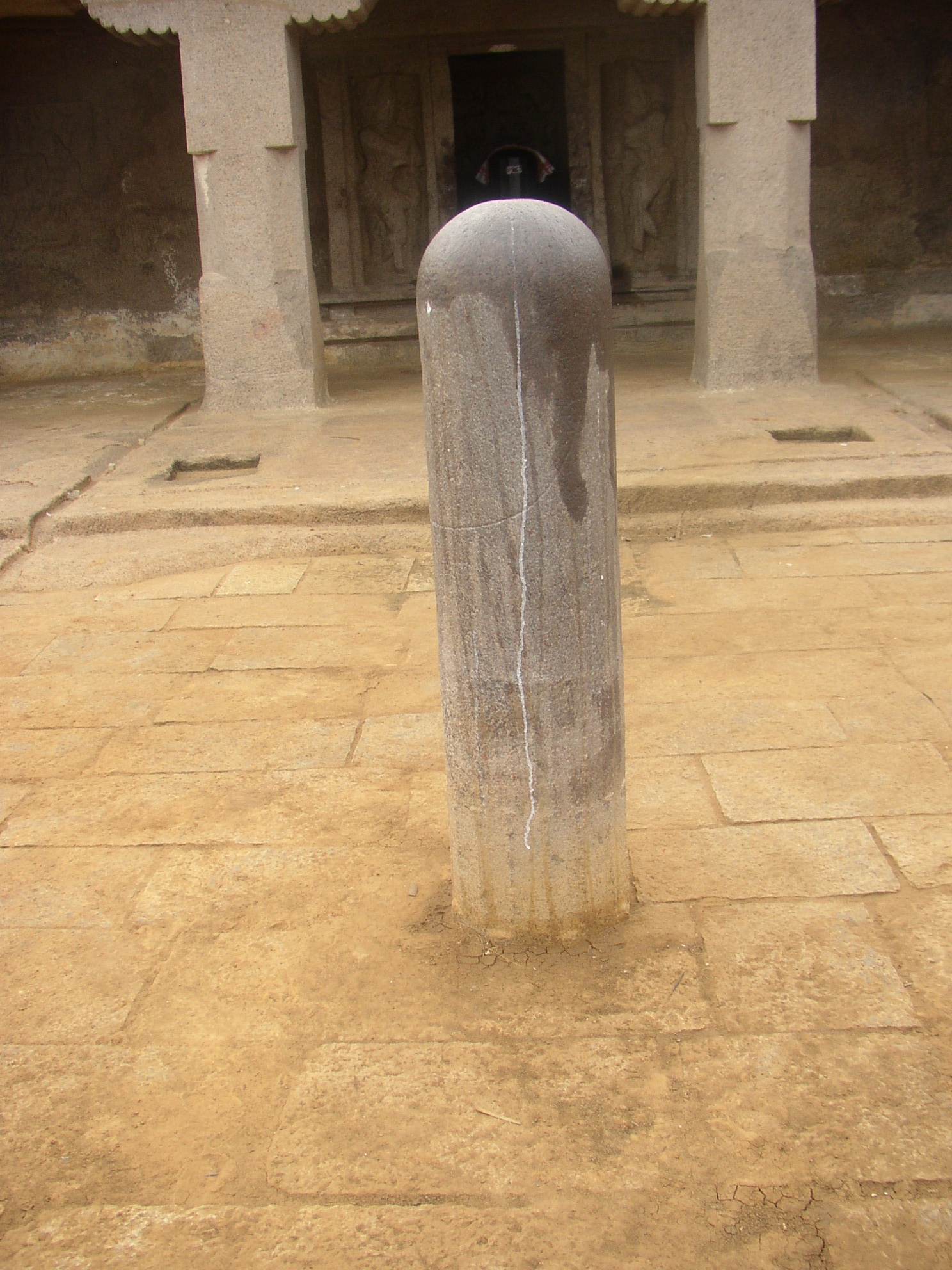
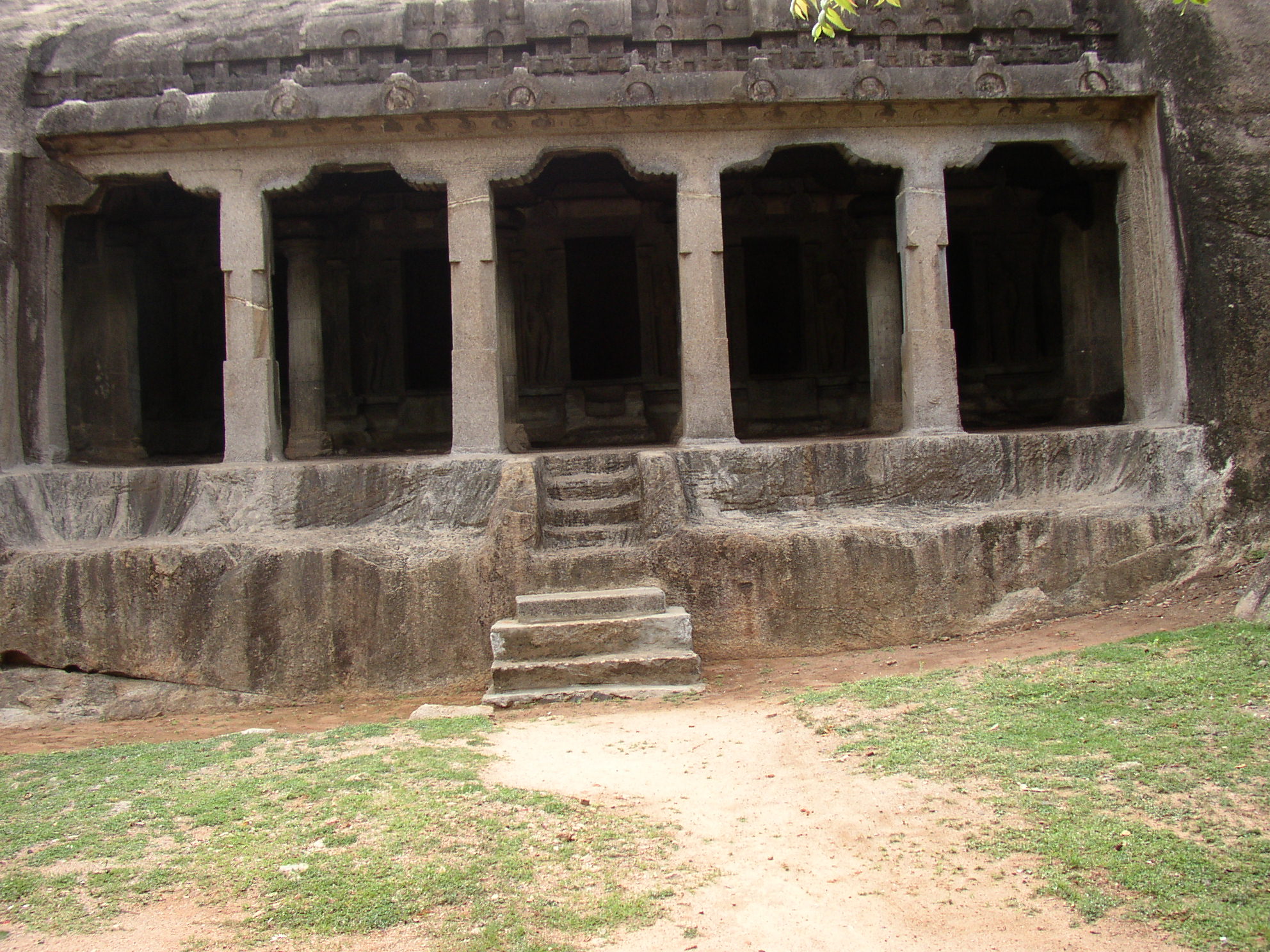
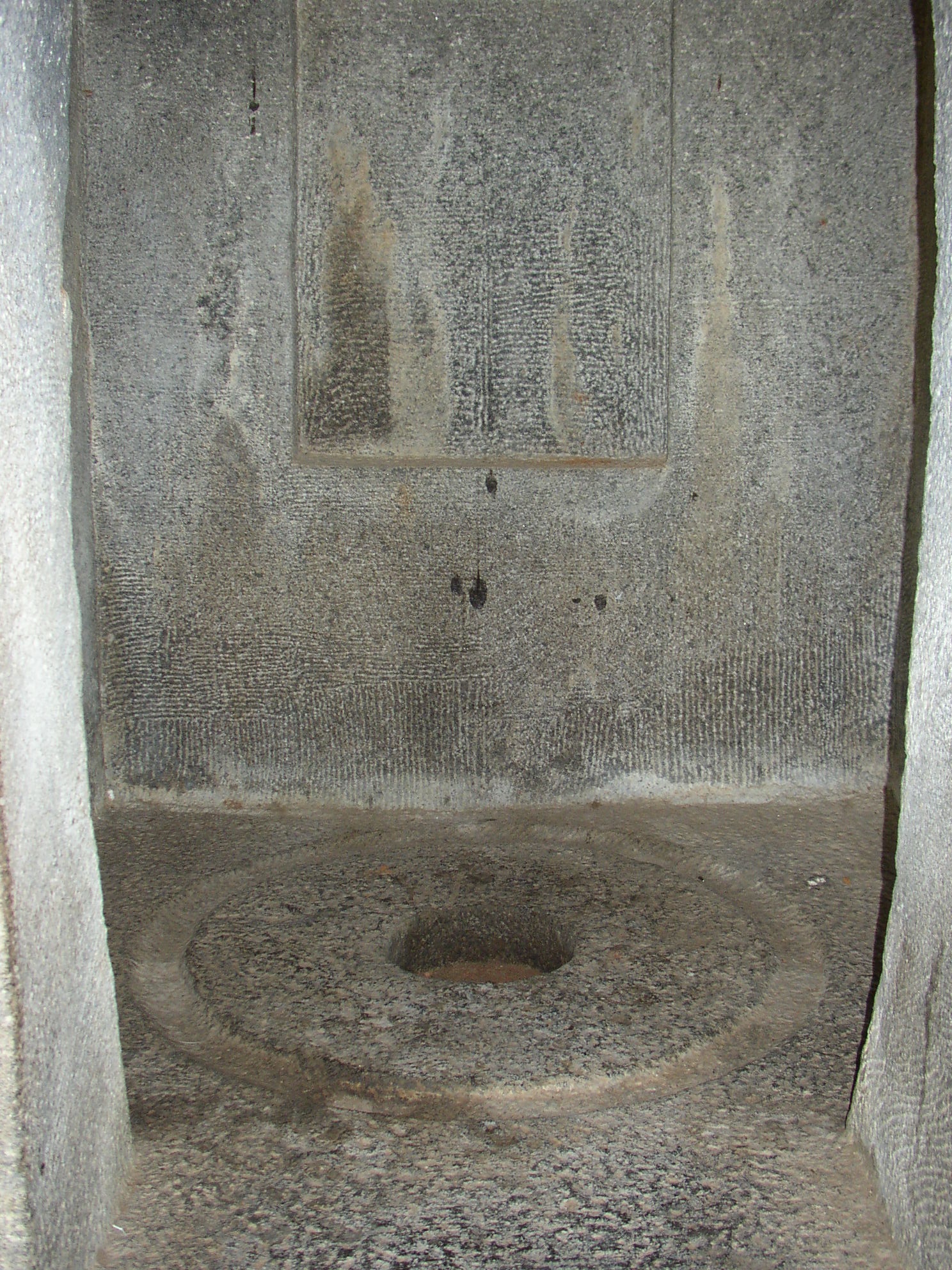
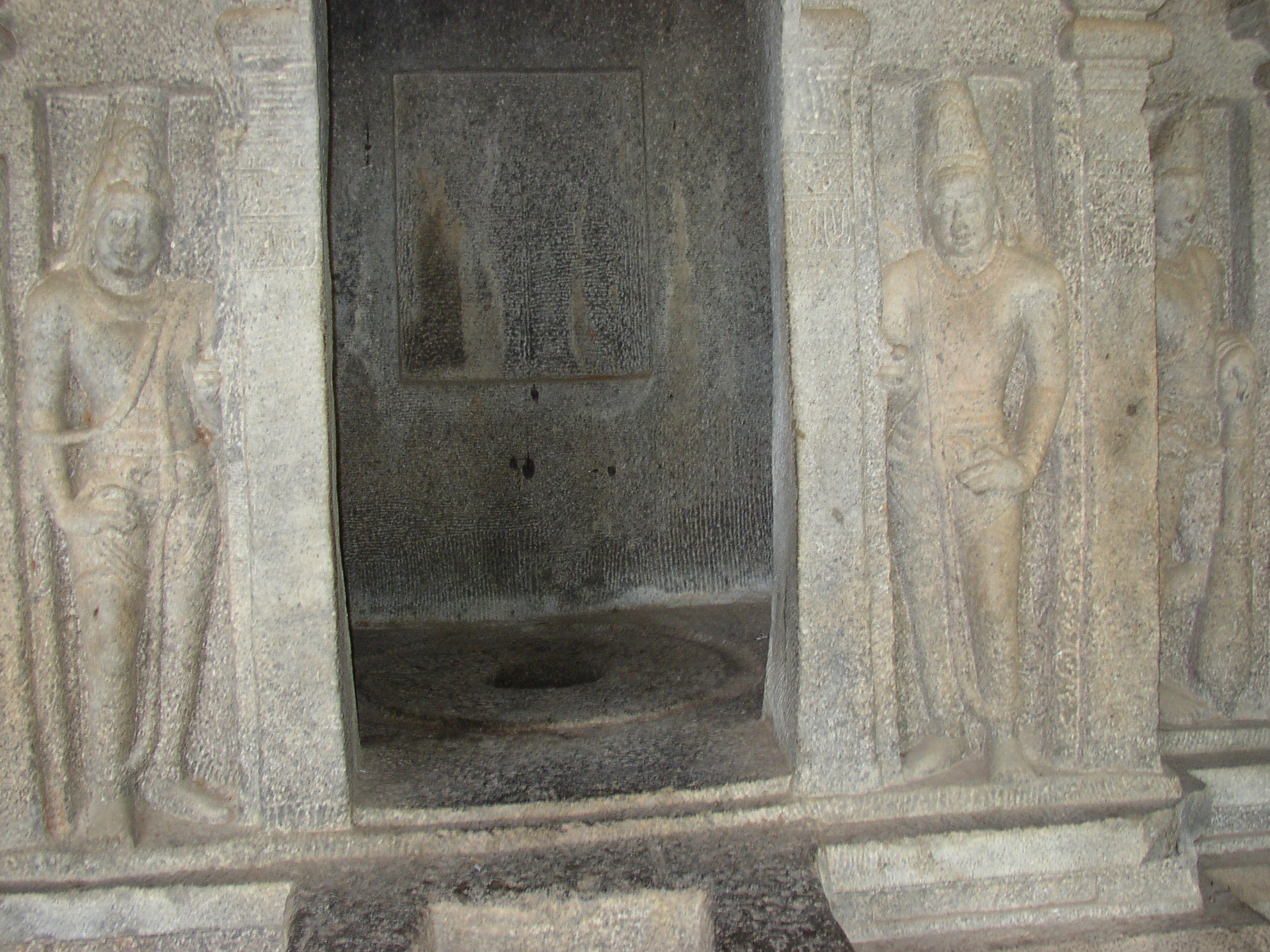
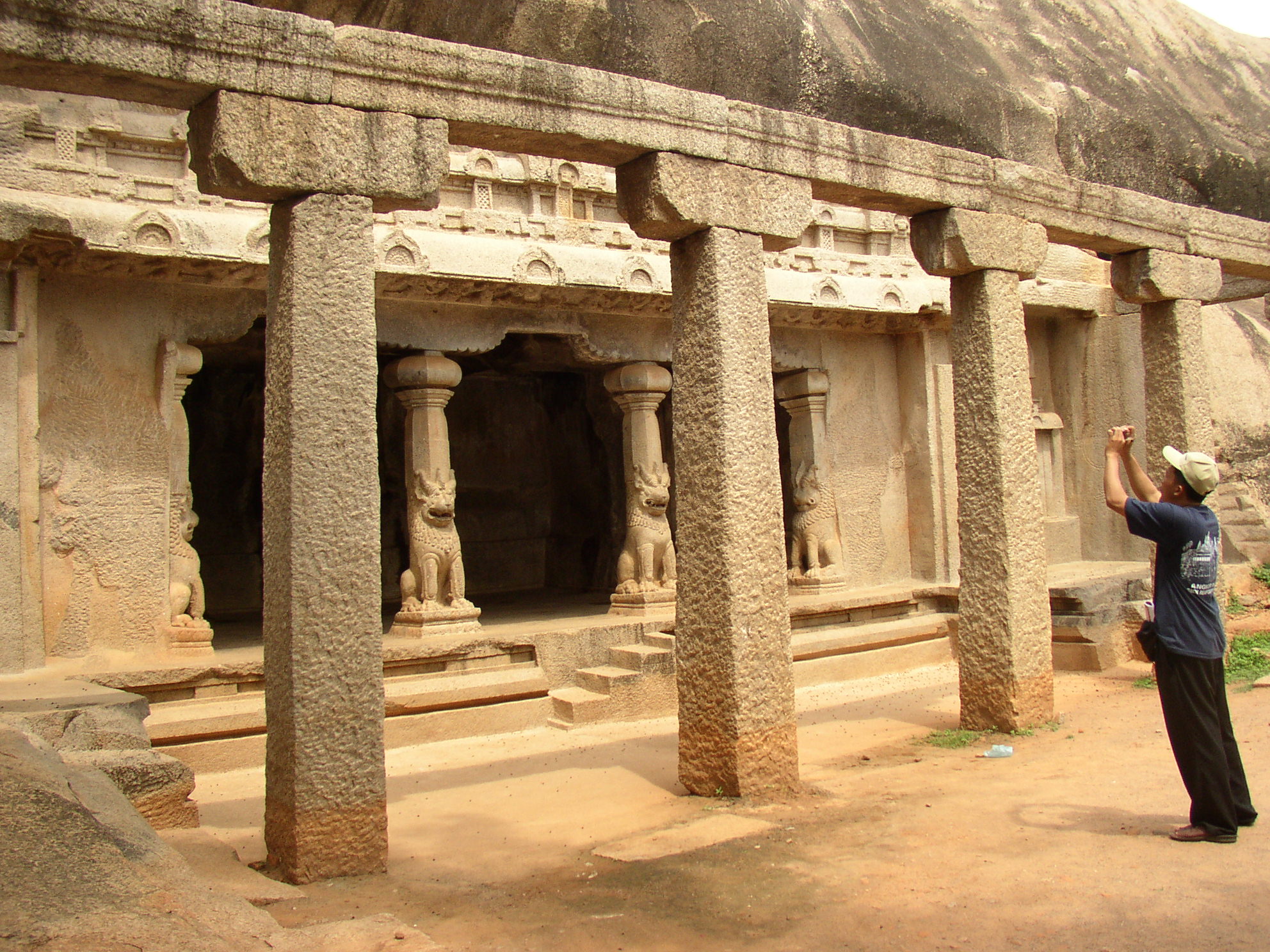
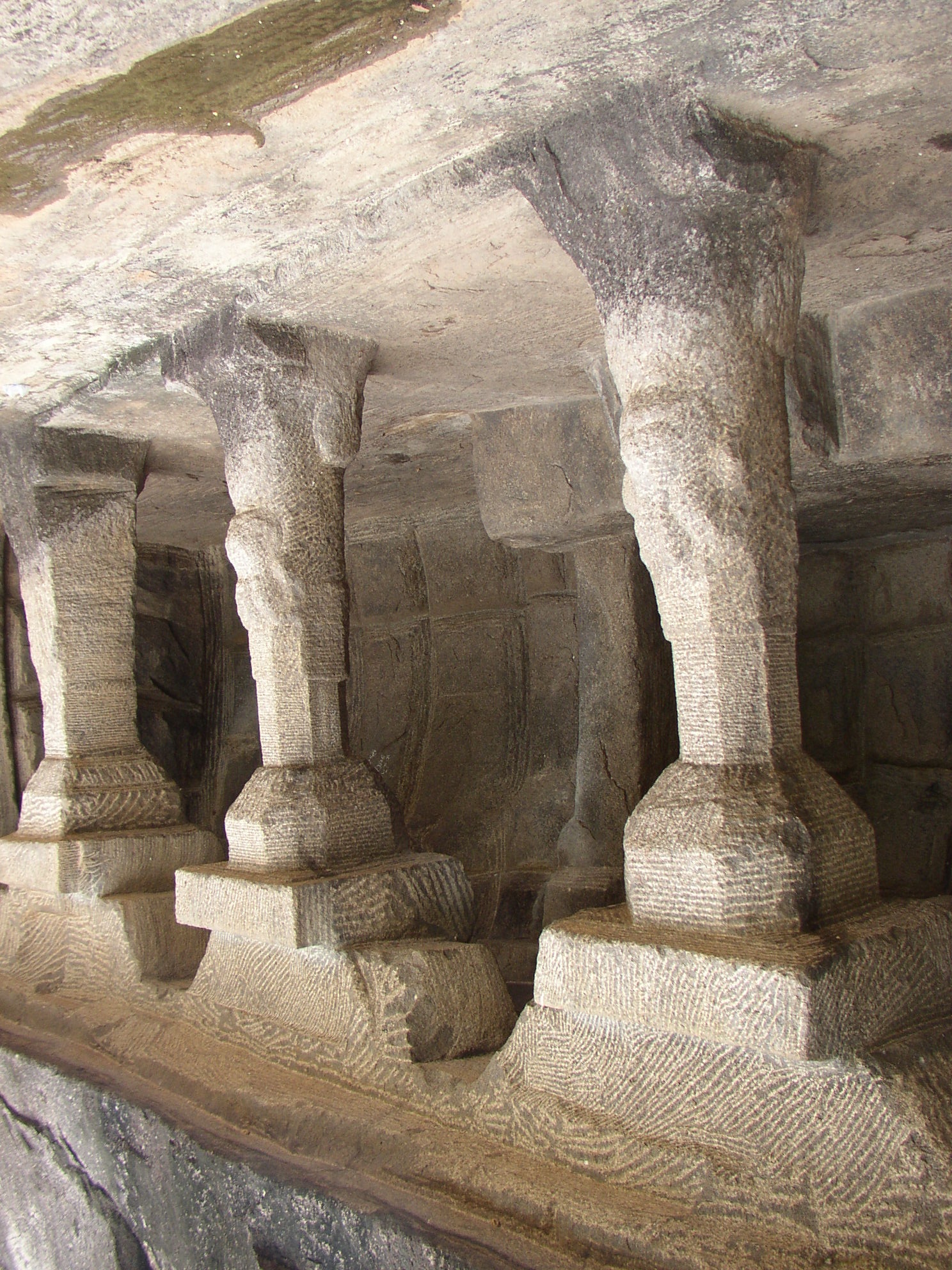
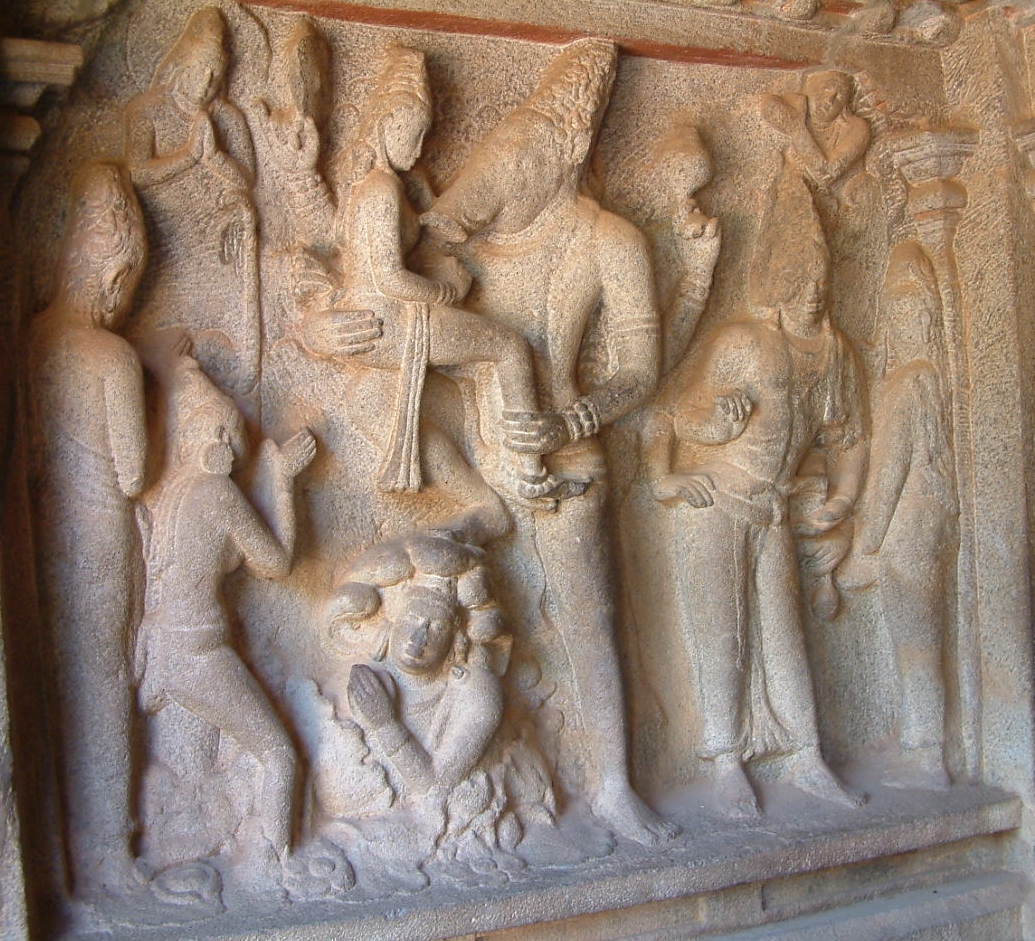
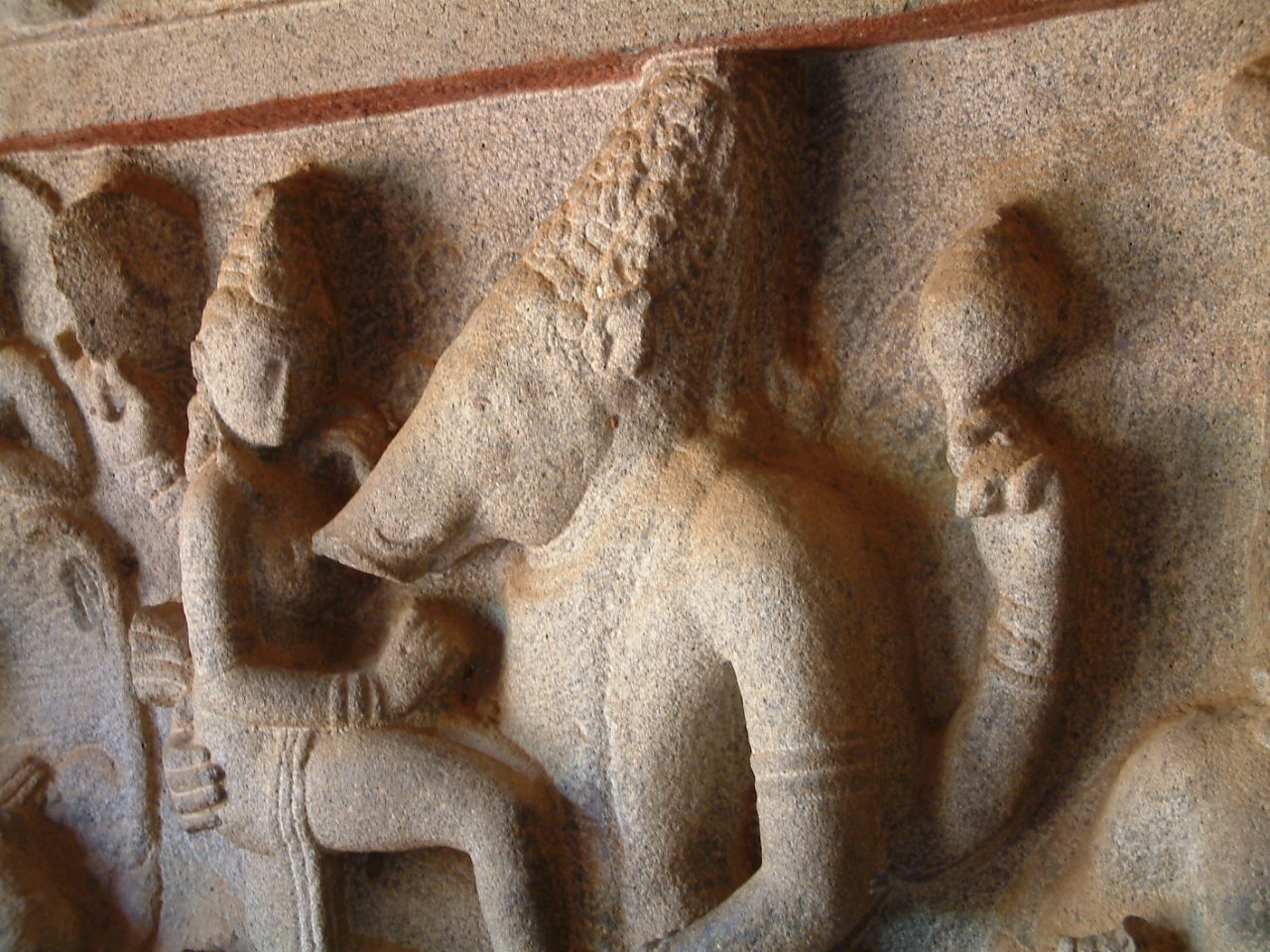
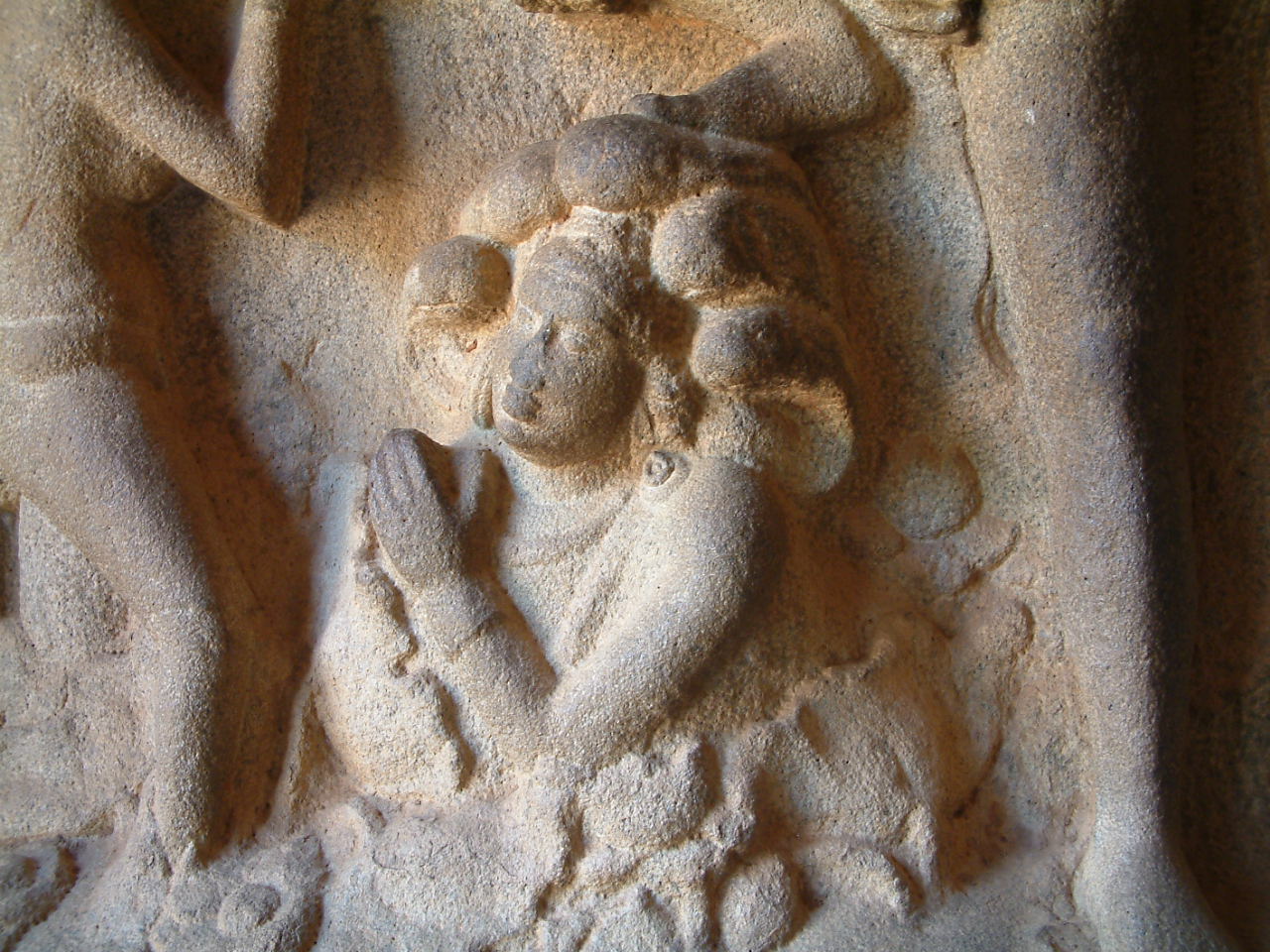
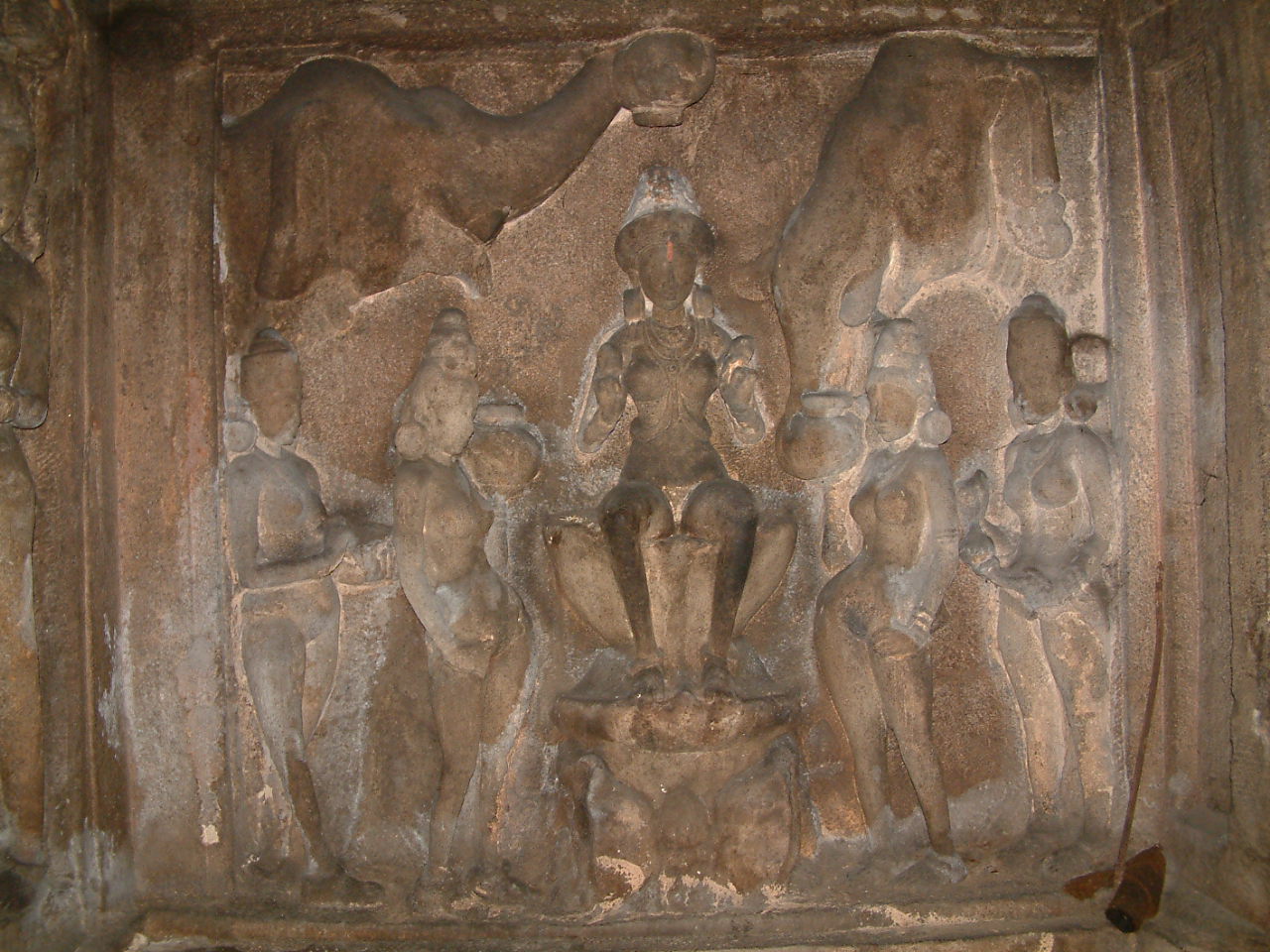
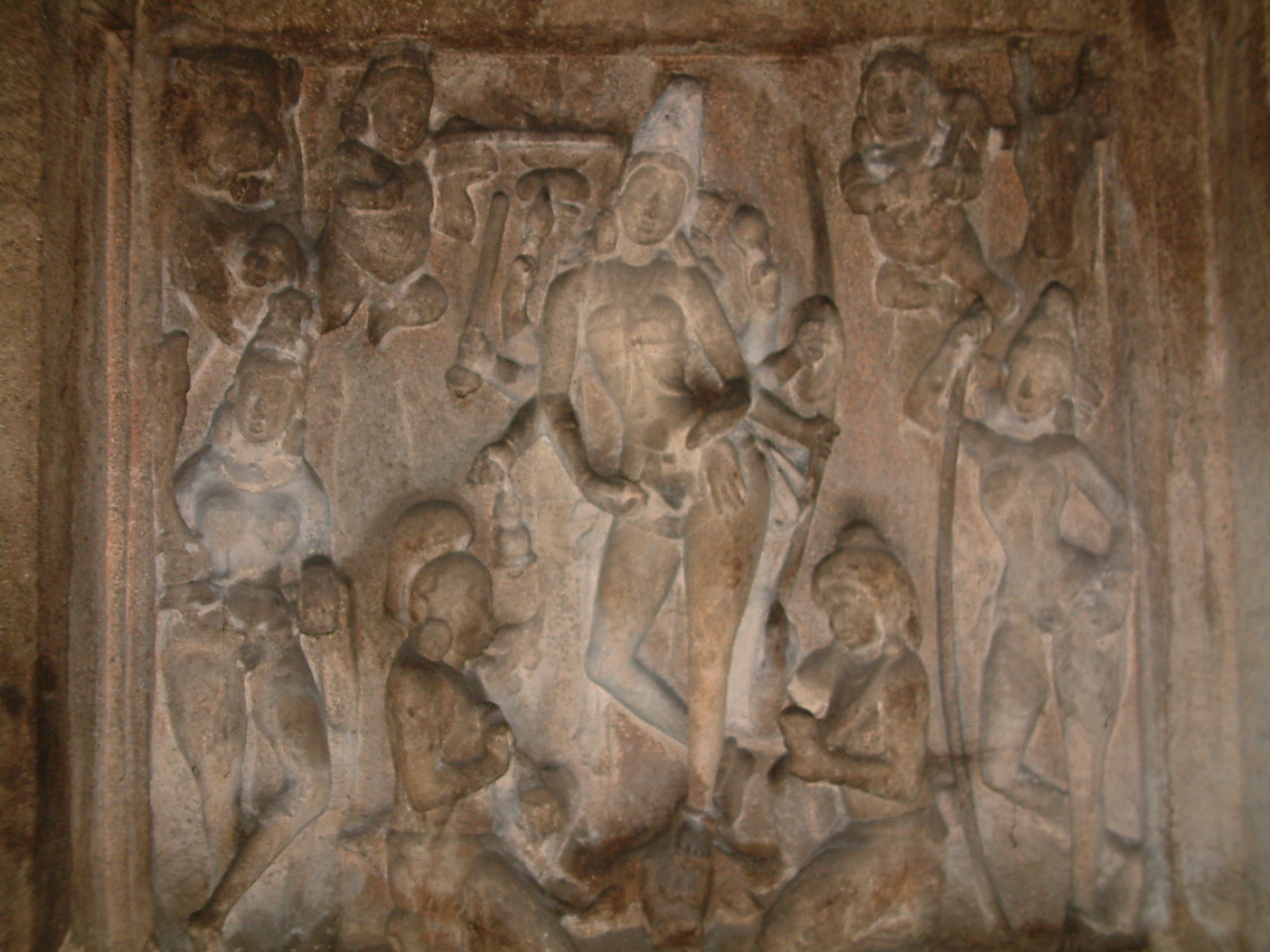
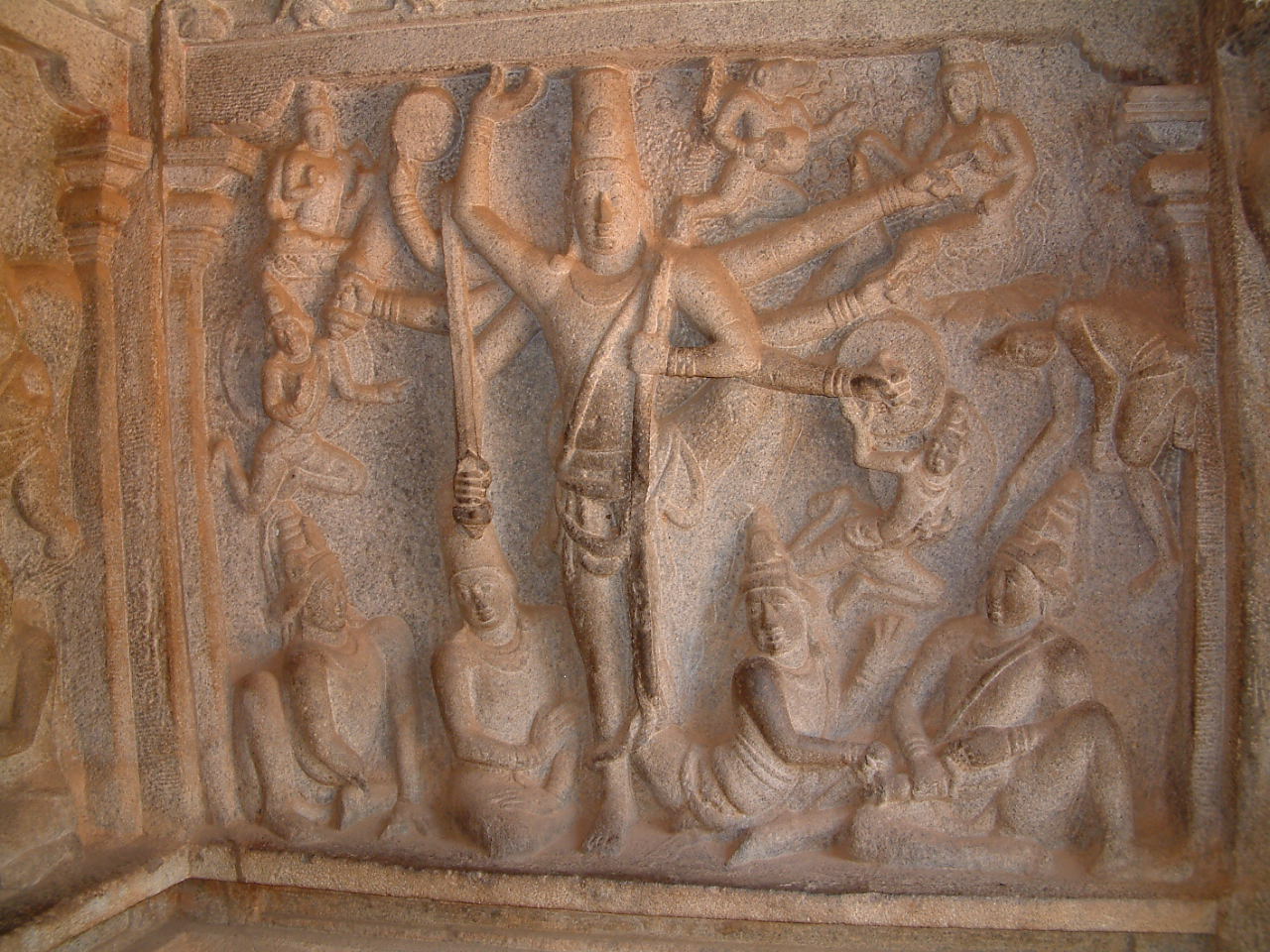
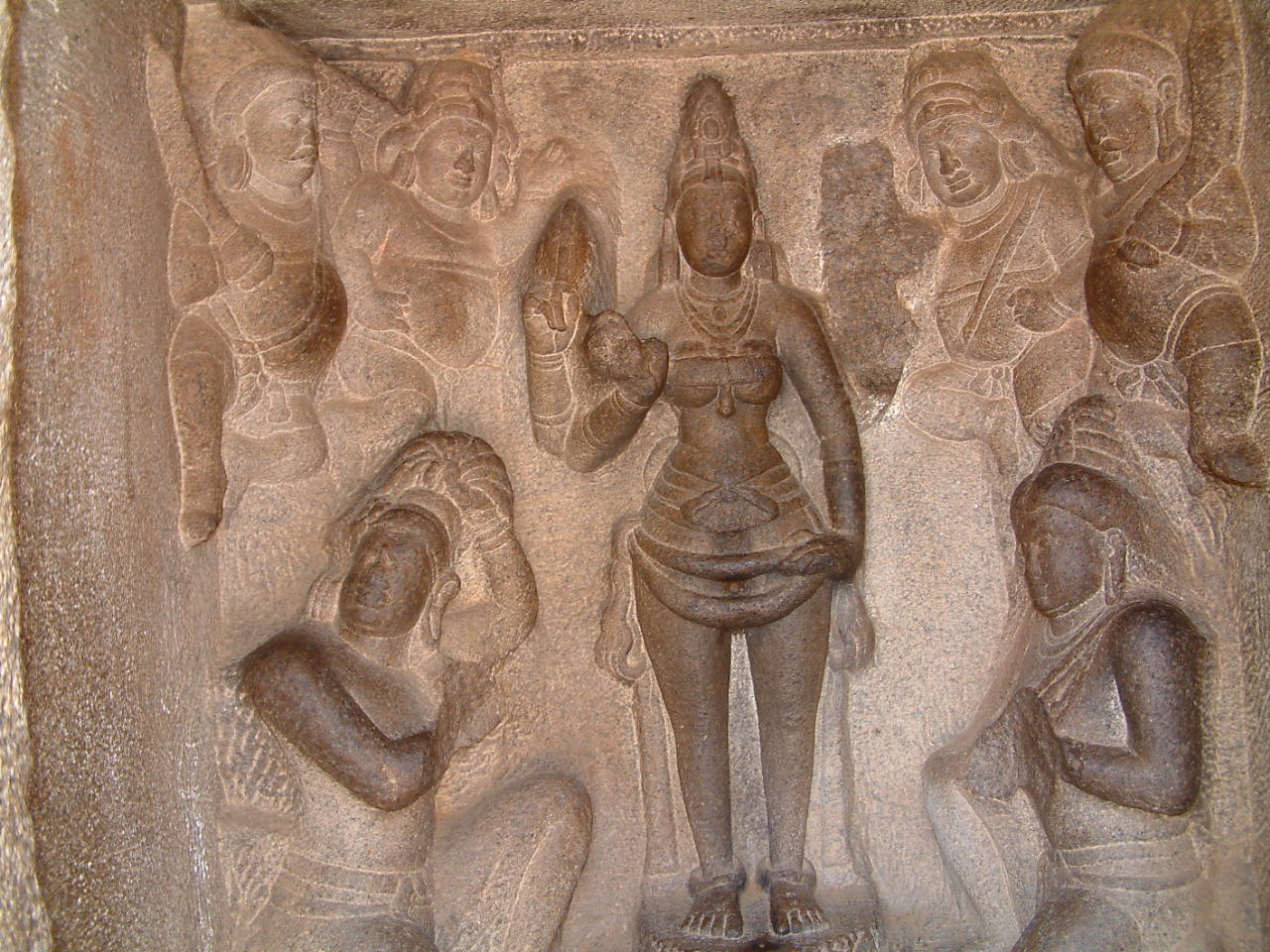
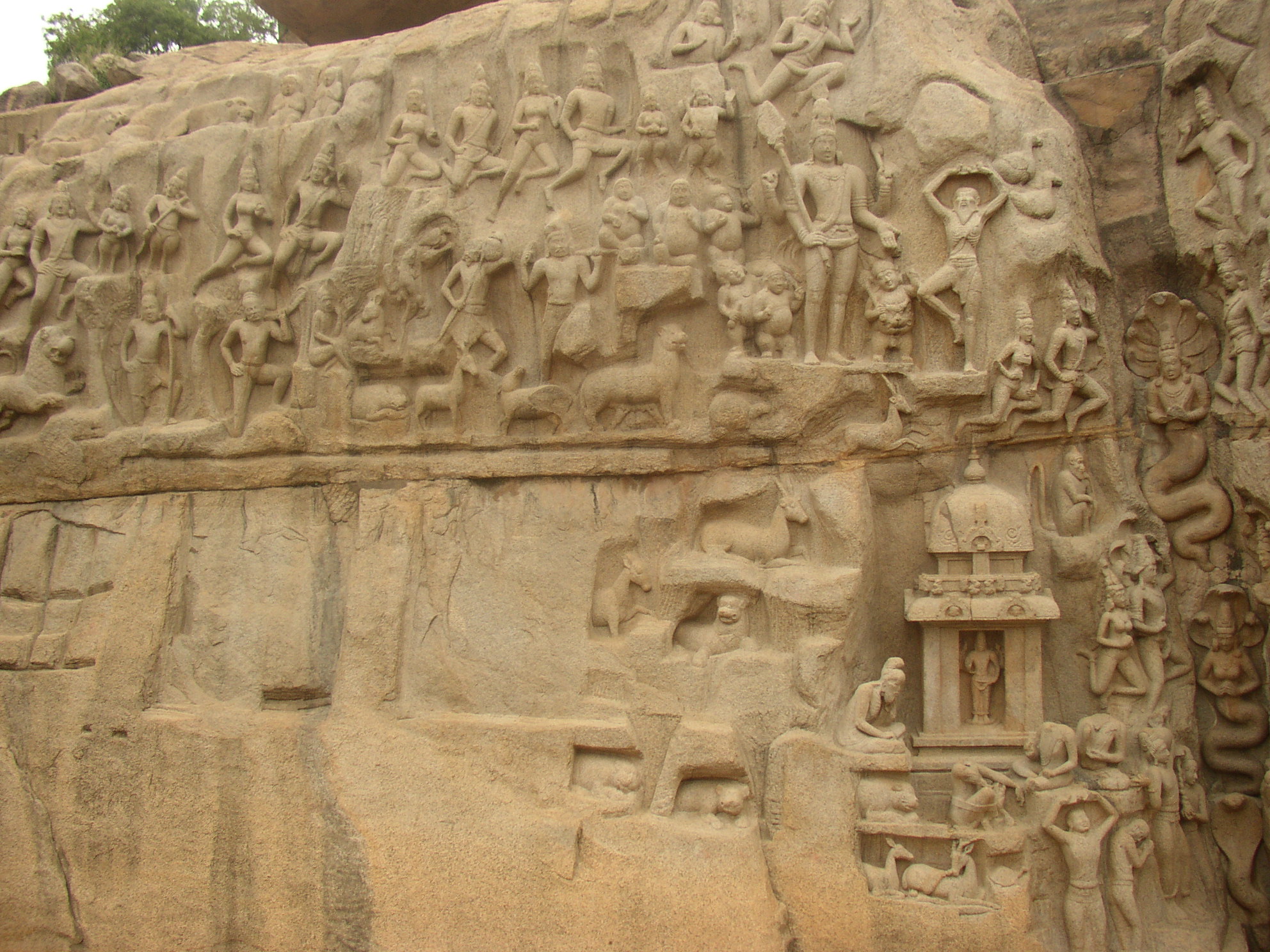
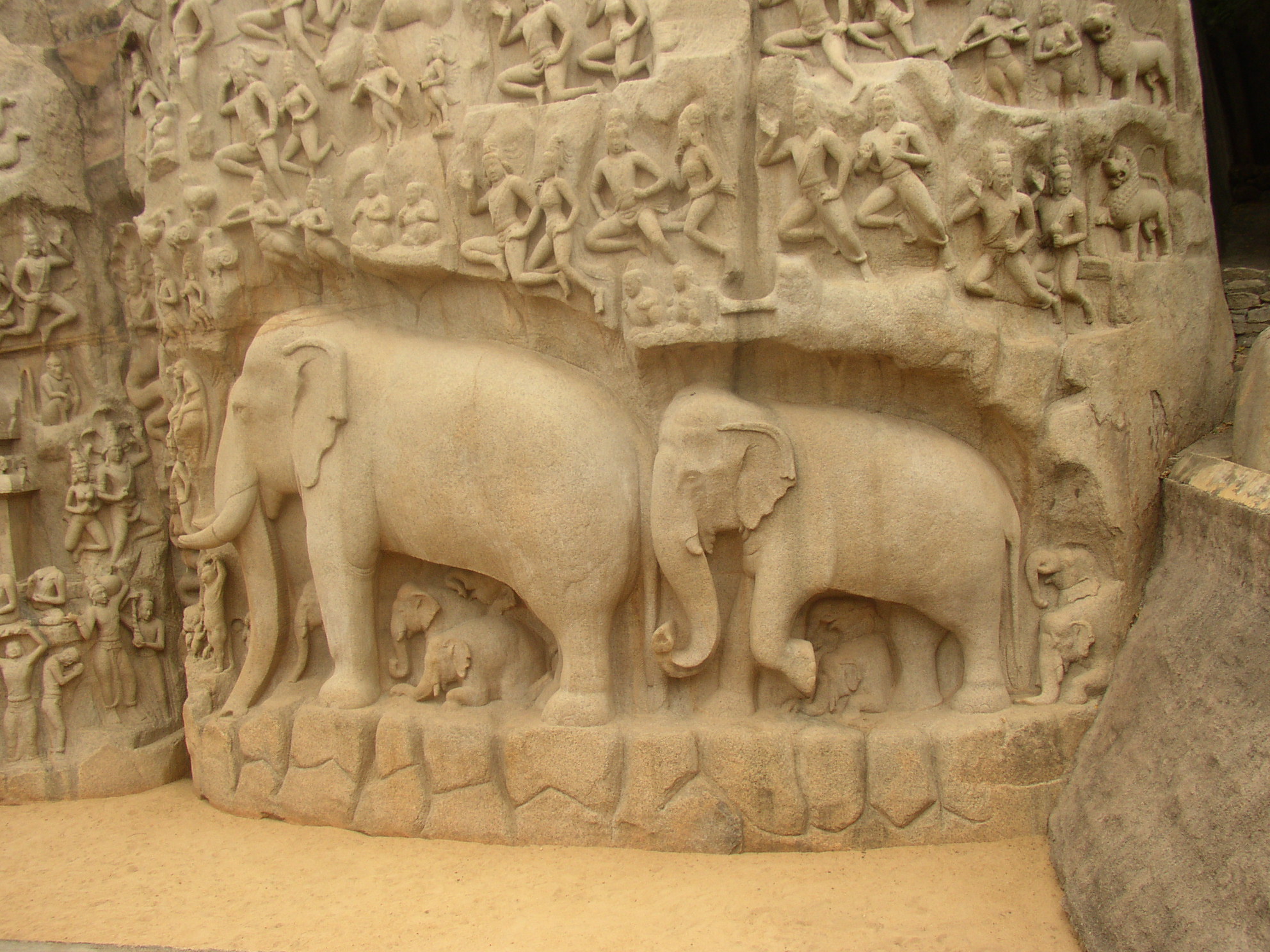
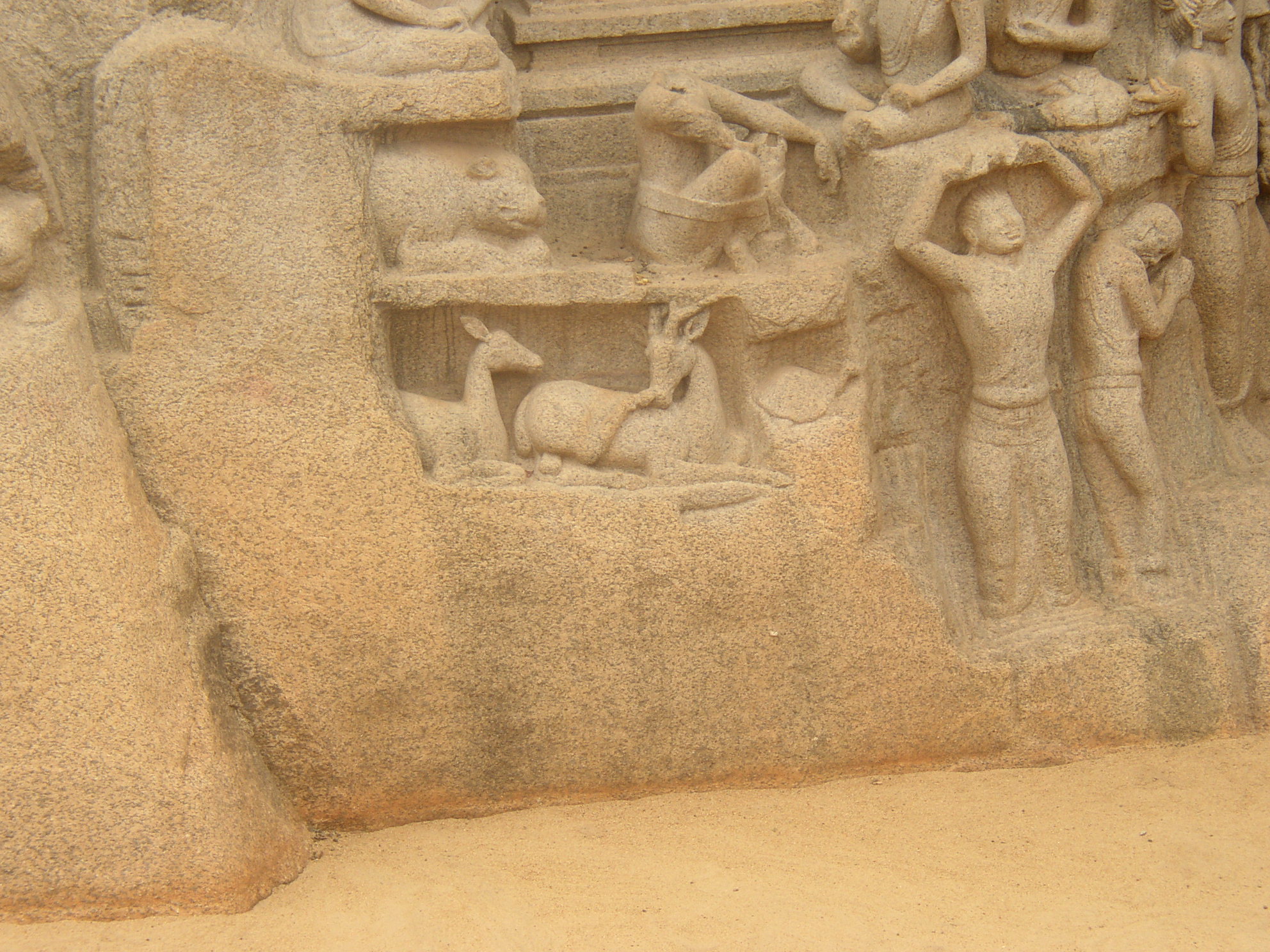
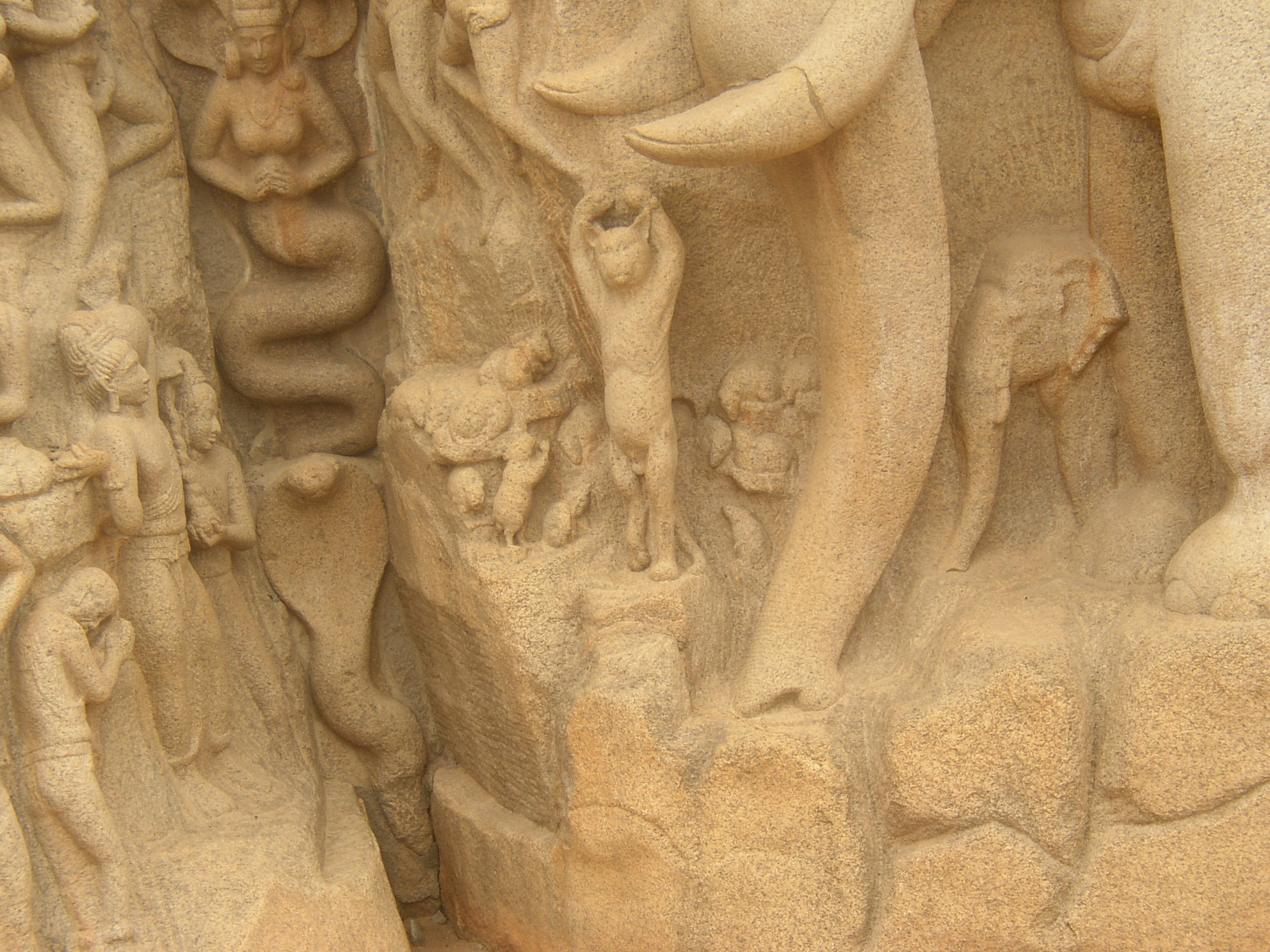
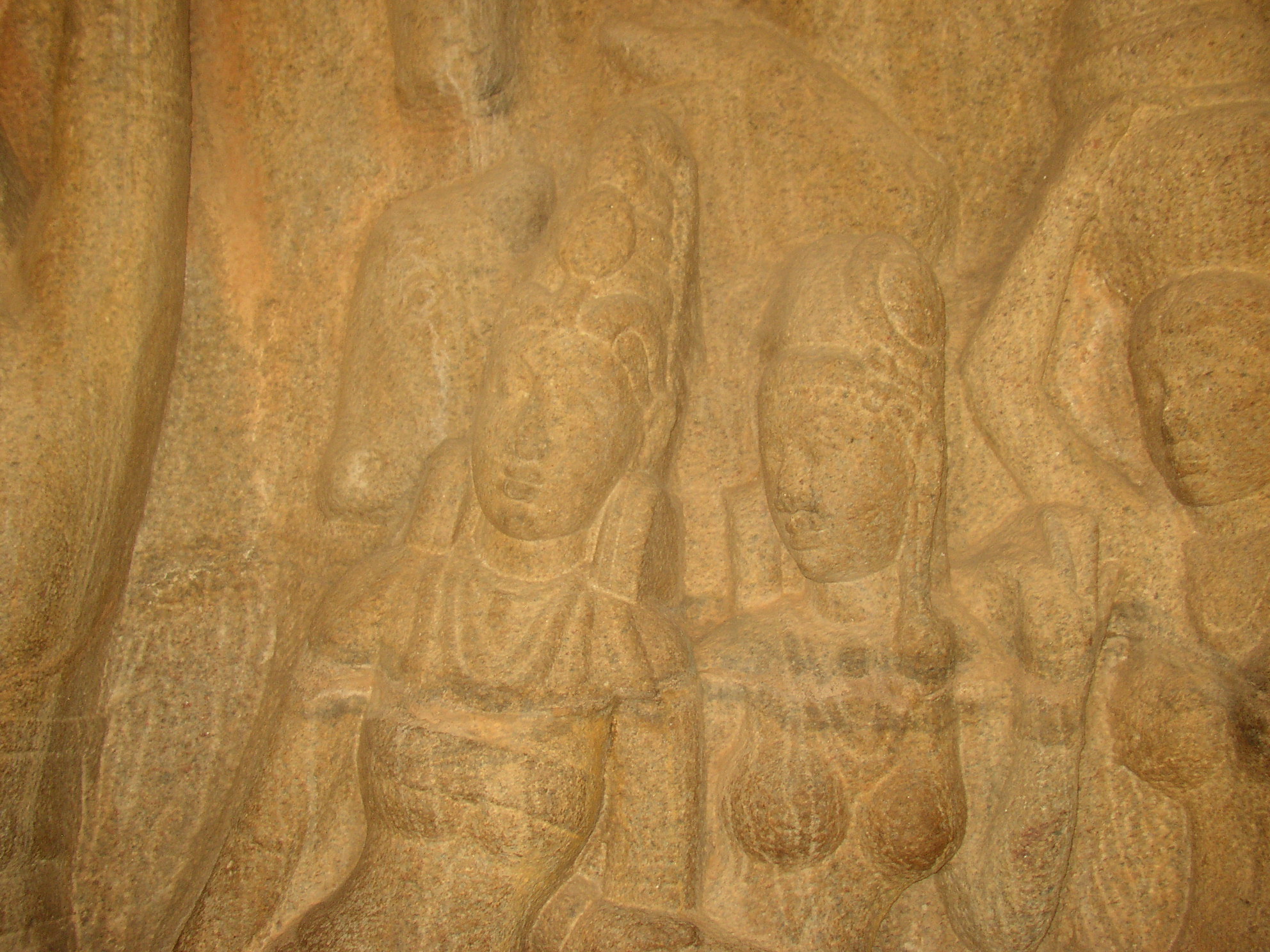
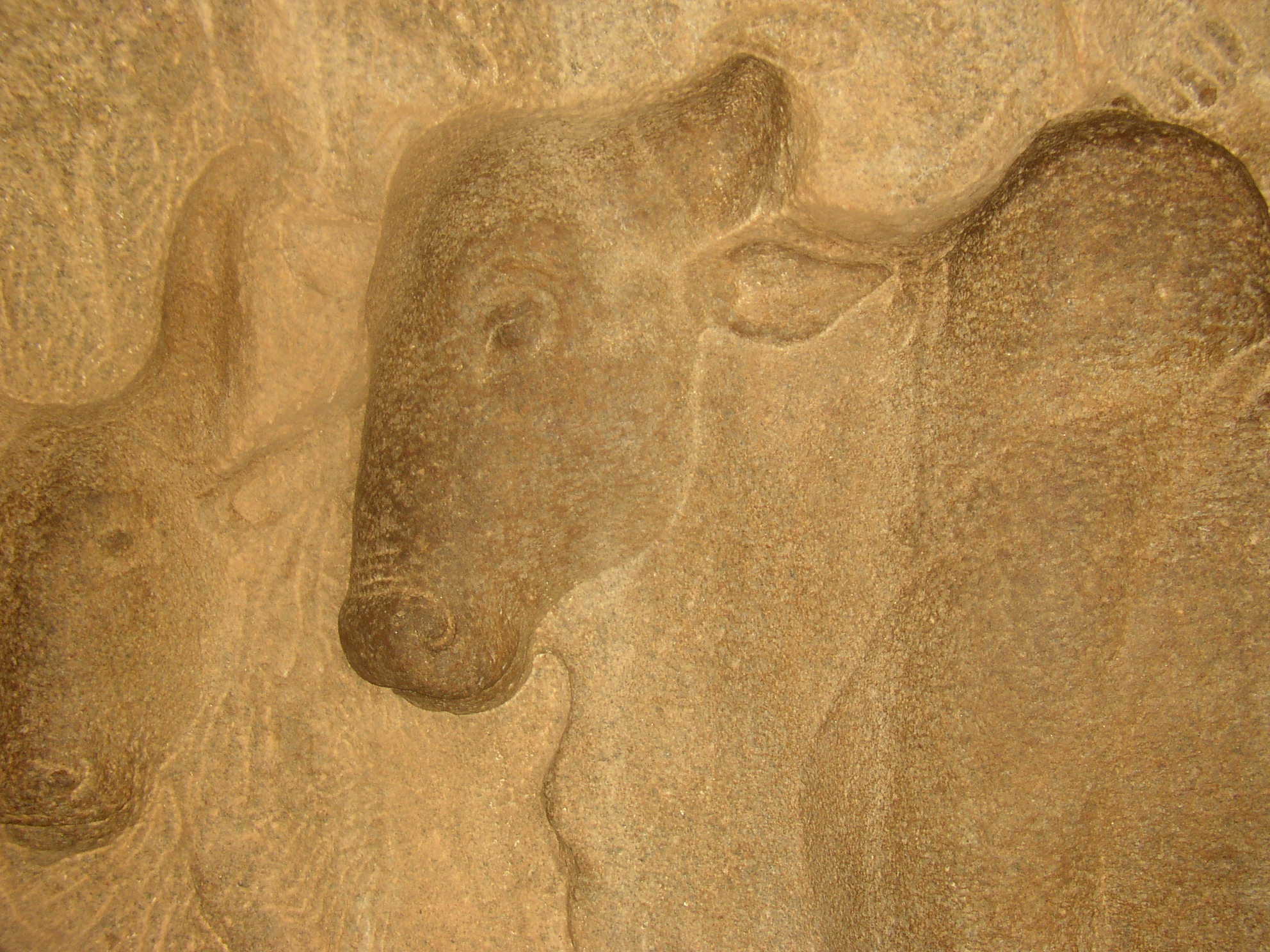
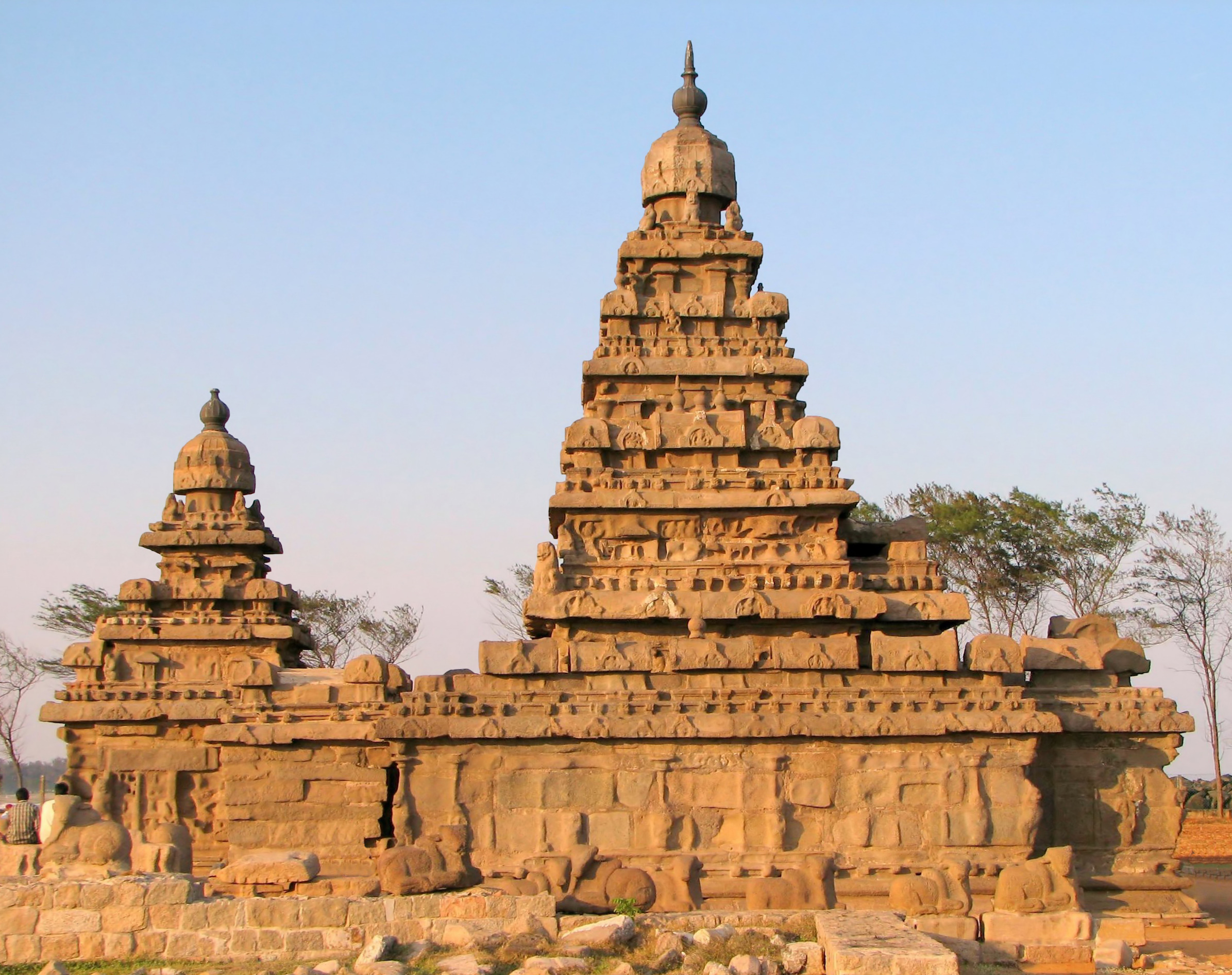
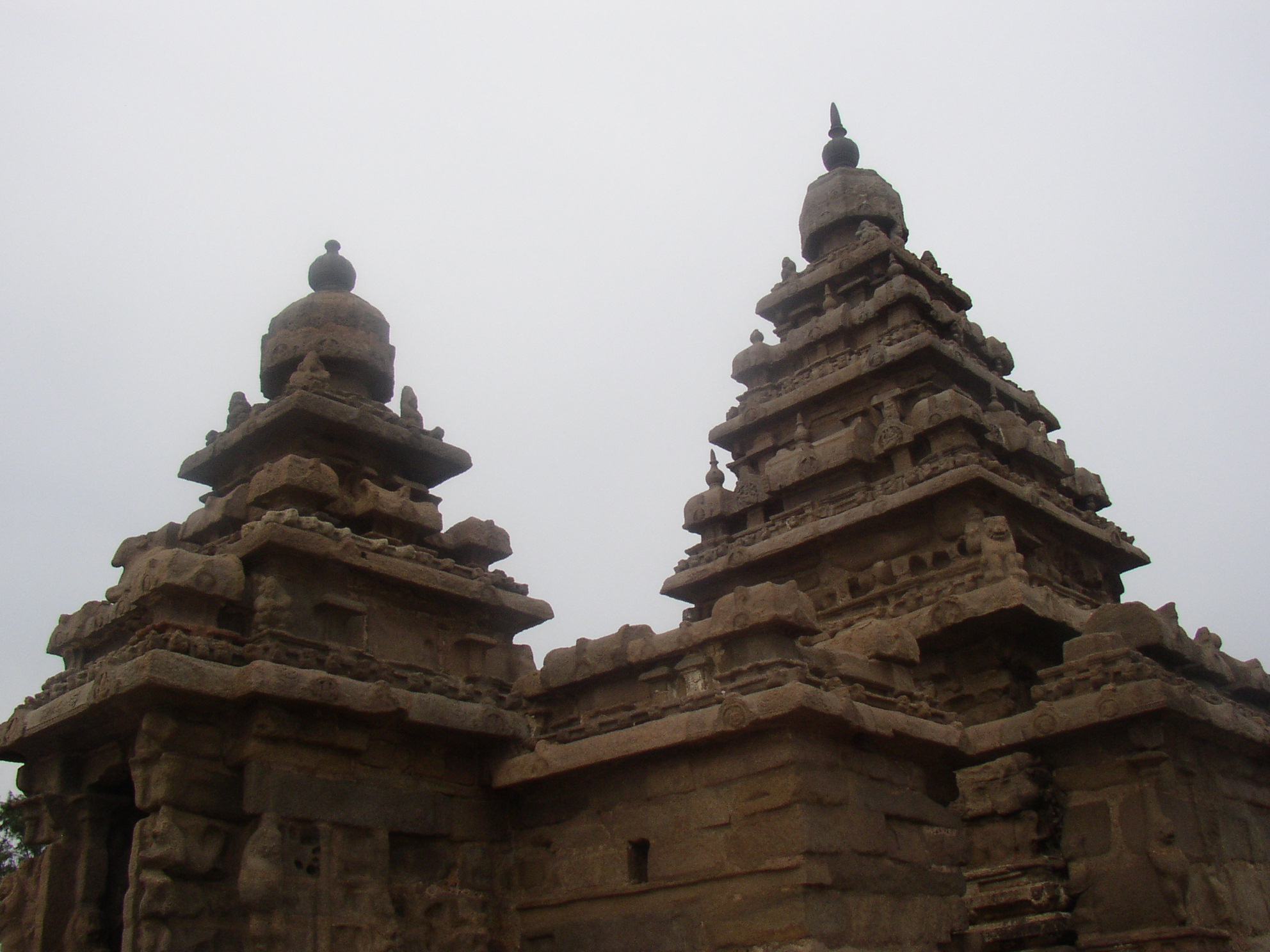
Acknowledgements: Photos and Plates by Mohan Nagaswamy and Vishnu Mohan.
New Light on Māmallapuram (1962 Paper)Paper read by Dr. R. Nagaswamy before the Archaeological Society of South India on 6 February 1962.Atyantakāma Pallaveśvara GṛhamIntroductionThe stately monuments of Māmallapuram, standing almost on the sea-shore, have been the great source of inspiration and joy for travellers, both from India and abroad.
With its unique monolithic temples called rathas, with the two little towers standing on the shore of the sea, set against the background of the vast ocean and the expansive open air sculptures of Arjuna’s penance, Māmallapuram is indeed the greatest centre of attraction in India, for artists, philosophers, poets, scientists and others alike. And hence it is very often visited, studied and illustrated by scholars from all parts of the world. Yet these monuments posed certain problems as to why such elegant monuments were left unfinished. An attempt will be made in this article to solve one such problem, though this was never a problem for any. Yet it poses itself as a problem to me and I believe if this is solved others are likely to vanish. And that is whether the great Māmalla, the son and successor of the great Mahendra and who inflicted crushing defeats on the great Satyāśraya Pulakeśin II and who probably established this town as a seaport after his own title Māmalla, and sent a naval fleet to Ceylon to help his friend Mānavarman, has anything to do with the monuments of Māmallapuram? My answer would be that he had little to do with the monuments.
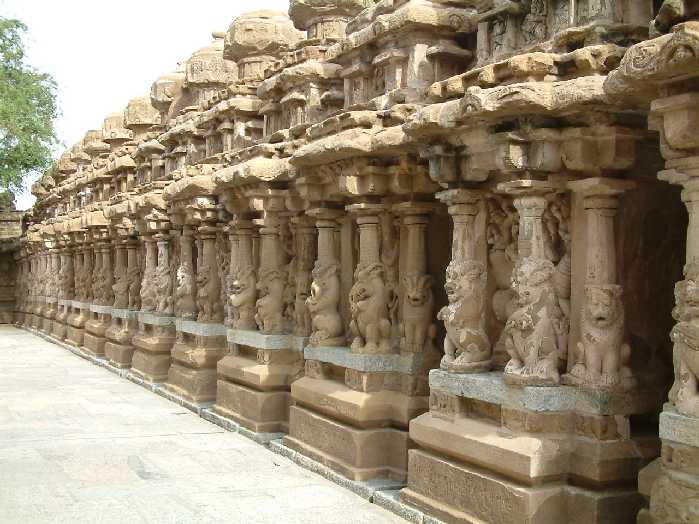
In saying so I am aware that I have to set myself against many problems and to a certain extent, severe criticism both from scholars and public and I am afraid that I have sufficient reasons to justify my statement.Views of ScholarsBefore proceeding further, it would be better if we could understand briefly the views held by scholars on the history of art and architecture of the Pallavas1. Both European and Indian scholars, basing their conclusions on the Maṇḍagapaṭṭu inscription of Vicitracitta2 (Mahendra), decided that Mahendra introduced the rock cut technique to South India for the first time and that before him, all the temples were built of brick, mortar and other perishable materials. His caves were characterised by simplicity in plan and in the treatment of pillars which were square at the top and bottom and octagonal at the middle. His son Narasiṃha also known as Māmalla continued the rock cut caves and for the first time conceived the idea of cutting the huge boulders into monolithic temples, familiarly known as rathas. He also introduced the sedent lion at the base of the pillars and bulbous capitals with palaka at the top.
Parameśvaravarman-I who succeeded Narasiṃha-I, continued the monoliths. He for the first time introduced the structural temples built of granite slabs and since he had to fight with the Cālukyan adversary, Vikramāditya-I, also known as Raṇarasika, the work at the monoliths abruptly ended. Rājasiṃha who succeeded Parameśvara-I was a great builder of structural shrines as evidenced from the Kailāsanātha temple of Kāñci and the Sea-shore temple of Māmallapuram. Except the stray example of Śāluvaṅkuppam cave, excavated by Rājasiṃha, there are no other caves, which could be ascribed to him. Rājasiṃha for the first time introduced the rampant lions at the base of the pillars. After Rājasiṃha, the rock cut technique ceased and only structural temples predominated as evidenced by the Vaikuṇṭhaperumāḷ temple of Kāñci, built by Nandivarman **. The above is the conclusion generally accepted by scholars now. The scholars also believed, that the rathas exhibit architectural details like the pavilions, etc. which were the copies of Buddhist Vihāras3.The conclusions mentioned above are far from satisfactory. Let us examine the Buddhist influence of architecture.
Did the sculptors of Māmalla’s reign copy the Buddhist structures already in existence in South India or did the inspiration come from Northern India? If it is from South, then is there any structure which could be cited as an example, which was the source of inspiration? If it is from North then which is the structural example for such an inspiration? Further why did not these rows of pavilions etc. found on the stories of rathas, and which are stated to have become reduced architectural motifs in the structural temples, like the shore temple, show the design of a Buddhist stūpa which was much more prevalent in northern India and particularly so in the Kṛṣṇa valley, from where the pallava art is said to have received its inspiration. So the theory that these pavilions etc. were after some Buddhist structures, is absolutely unsatisfactory.And again when we examine the main point, namely Māmalla started cutting the monoliths and his grandson Parameśvara continued it for sometime and abruptly stopped it afterwards, we are unable to appreciate the abrupt end of the work4.Since Parameśvara boasts5 himself of having invaded the very capital of Vikramāditya, he was certainly powerful enough in his own kingdom. It does not explain why he suddenly stopped the work.
There is no record from where we can gather that Parameśvara-I introduced structural temples of granite slabs. There is one copper plate grant from Kūram6, issued by the same king Parameśvara, recording the gift of a land for erecting a temple, at the request of a chieftain called Vidyāvinīta Pallava. It was this chieftain who built the temple and named it after his own name and also after the name of his ruler as Vidyāvinīta Pallava Parameśvaragṛham. Further the inscription states a portion of land was meant of burning tiles, which are to be used in building the temple (தளி எடுப்பதற்கு ஓடு சுடக்கொண்ட இடம் (taḷi eḍuppadarku ōḍu suḍakkoṇḍa iḍam)). The temple was perhaps built of brick and mortar and covered with tiled roof. There is nothing in the inscription to suggest that it was first introduced into this part of the country.Tiger Cave at Śāluvaṅkuppam
All the lithic records and copper plate grants of the pallavas, referring to Rājasiṃha, fortunately we have a good number of them, tell us that he was a great temple-builder and was a great devotee of Śiva. It is substantiated by atleast three of his monumental structures, viz. the Kailāsanātha temple, the Sea-shore temple and the Paṉamalai temple, where he was shown his capacity to erect, equally great monuments like the monoliths.It is not clear why such a prolific temple builder like Rājasiṃha did not continue the monoliths and complete the same and why he should have favoured only the structural temples. Further we are sure that he was equally interested in excavating rocks and that rock cut technique continued during his reign, as proved by the Śāluvaṅkuppam caves which are his creations. The explanation is again far from satisfactory.If it is suggested that Māmalla started and Parameśvara and Rājasiṃha both continued it and that after them it ceased, again the explanation falls short of reasons. We know that Narasiṃha-I ruled for about thirty years and Parameśvara-I twenty five years. We also know that Rājasiṃha had comparatively a peaceful rule for a long period of about forty years.
This will lead us to another problem, namely that since the beginning of the monoliths, the work continued on them for over hundred years and still the work could not be completed!Is name of the town the only clue?Thus we find ourselves in very unsteady grounds, in our conclusions regarding the authorship and date of these monuments. Hence I raised a new problem namely whether the name of the town Māmallapuram gives us the only clue to identify the author of these monuments with Māmalla. The name of Māmalla and Māmallapuram are so intimately connected, that we hesitate to raise the question whether Māmalla was the author of these monuments. In my opinion all our problems lie in the mystic word Māmalla. There are certainly other clues which will help us in arriving at some solutions and hence before attempting to answer the connection between Māmalla and Māmallapuram we shall examine the other evidences which may be divided into (a) Literature; (b) Paleography; (c) Evolution of Architecture; and (d) Epigraphy.
From LiteratureNo light is thrown on the subject by literature, for there are very few references to Māmallapuram. Referring to Toṇḍaimāṉ Iḷantiraiyaṉ, in Perumpāṇāṟṟuppaḍai7Kaḍiyalūr Rudraṅkaṇṇaṉār gives a graphic description of a seaport of Toṇḍaināḍu which was mainly the land of the pallavas in later times. He also refers to a light house which helped as a beacon light for seamen. Late M. Raghava Iyangar in his book8 on Āḻvārgal Kālavaralāru (The Age of Āḻvārs) identifies the town mentioned, with Māmallapuram and in doing so he points out that the intention of the poet was to indicate that Kāñci was very near to this town. From a reference to Lord Viṣṇu of the Seashore temple, in Avantisundarīkathā9, by Daṇḍin. Late M. Raghava Iyengar concludes, that the Viṣṇu image was under worship long before Rājasiṃha. The reference of Kaḍalmallai temples of Śiva and Viṣṇu, by Tirumaṅgai Ālvar10, is not much helpful for our present study, (he was later than Rājasiṃha,) since he does not refer to the building of the temples or other monuments. Thus literature does not help us.
From PaleographyPaleography has been a very useful source, in determining the age of inscriptions and monuments. We know that the scripts employed by the Cōḻas were different from those employed by the Pallavas and that the Vijayanagar kings employed altogether different scripts. Even amongst the same dynasty of rulers, like the Cōḻas, one could perceive some evolution in the scripts. But with reference to our study of the date of the Māmallapuram monuments, paleography is absolutely of little value. We know that several different alphabets were employed in the Kailāsanātha inscriptions11 of Kāñcipuram which led scholars to think that these inscriptions belonged to successive rulers of Kāñci. The inscription found all around the basement of the main shrine, and which was written in archaic characters were believed to be coeval with the temple. The rest of the inscription of the temple run round the inside of the enclosure, and contain an enumeration of several hundred birudās of Rājasiṃha. They are arranged in four tiers. The first tier is made of hard granite and preserves the inscription intact, while the other tiers are of sand stone and have suffered considerable weathering.
It was also found that the inscriptions of the second and third tiers, were word for word identical with the first. In describing the date of the inscriptions, Hultsch remarked that “the third tier is written in the same archaic alphabet as the inscription round the Rājasiṃheśvara shrine and evidently belongs to the time of Rājasiṃha, the founder of the temple himself. The first and second tiers must be considered as later copies of the original inscription of the third tier and were executed by some descendants of Rājasiṃha. The inscriptions of the fourth tier is written in a peculiar ornamental alphabet, which is based on the alphabet of the same type, as that of the first tier. It follows that the engraver of the fourth tier copies from the third and not from the first tier, perhaps the first and fourth tiers were contemporaneous.”12
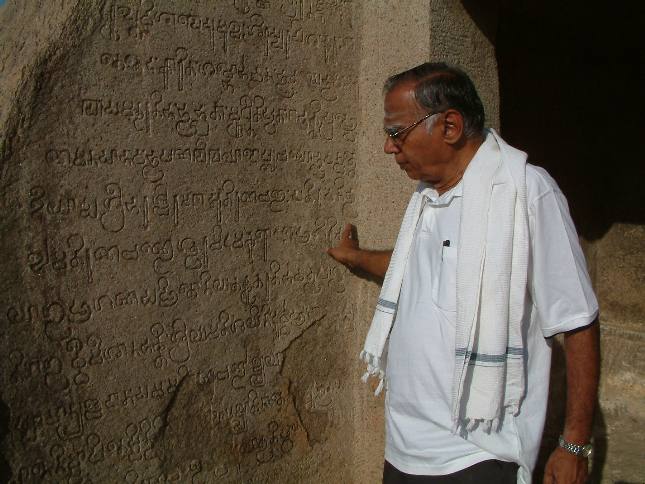
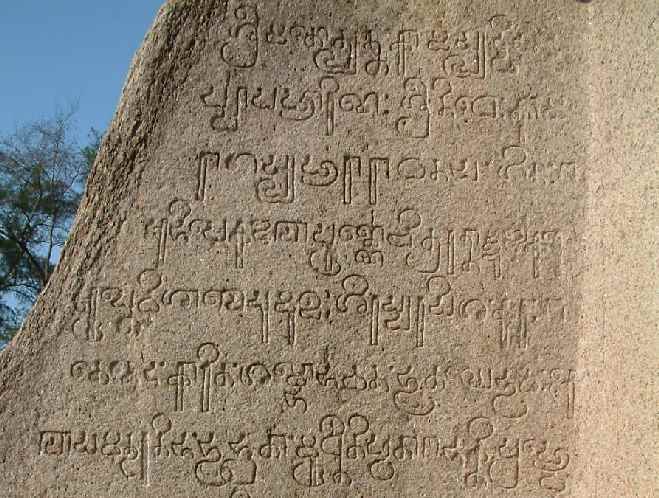
Śāluvaṅkuppam InscriptionsŚāluvaṅkuppam (pic Jul-2004)The rock cut cave at Śāluvaṅkuppam, called Atiraṇacaṇḍa Pallaveśvaragṛham, was excavated by Rājasiṃha himself. It contains some sanskrit verses13, inscribed on the northern and southern wall of the cave, extolling the greatness of Rājasiṃha.
The script employed in the northern wall is different from the south and hence it was suggested that the inscription of the southern wall was a later transcript of the north and the author of the inscription of the southern wall was a successor of Rājasiṃha., It was only in later times that the suggestion of successive engravers was discarded and rightly noted, that since the inscriptions on the south and north wall are identical verses, they were written by the same king Rājasiṃha. In the same vein it was concluded that the inscriptions in four different alphabets, found at the Kailāsanātha temple, which were the repetitions of the same titles of the corresponding tiers, were all inscribed by Rājasiṃha himself to exhibit varieties. Thus, since Rājasiṃha himself has left five different varieties of scripts which include the scripts employed by early Pallava kings, the study of paleography certainty fails in determining the age of the monuments of Māmallapuram.From ArchitectureThe scholars, being quite conscious of these defects, therefore turned their attention to the study of architecture, which, it was believed, shed welcome light on the subject.
We all owe a great deal to Prof. Joveau Dubreuil for his illuminating study of South Indian architecture14. It was he, who first made a thorough survey of Pallava monuments and brought out his valuable literature on Pallava antiquities. The evolution of pillars as shown by Dubreuil was perhaps the best study from which we were able to arrive at some tangible conclusions. Thus according Dubreuil, the Maṇḍagapaṭṭu cave was the first to be excavated by Mahendra, judging from the inscription, which states that this cave was caused to be made for Brahmā, Viṣṇu and Śiva, by Vicitracitta without the use of brick, mortar, wood and metal. Dubreuil suggested that the proud attainment of excavating rock, for the first time, made Mahendra to mention, that he caused it to be made without the use of brick etc. Further this suggests that all the monuments prior to Mahendra, were built of perishable materials like brick and owing to temperate climate nothing has survived. Further Dubreuil suggested that beginning from the Maṇḍagapaṭṭu cave, the pillars of Mahendra, are plain; Narasiṃha I introduced the sedent lion and Rājasiṃha introduced the rampant lion motif. But I am afraid that Dubreuil made the fundamental mistake and scholars subsequent to him, followed suit without pausing to question the suggestion.
In my opinion the evolution of architecture as suggested by Dubreuil is of little help for our study as we shall presently notice.Maṇḍagapaṭṭu inscriptionBefore proceeding further let us pause to think on the first suggestion of Dubreuil on Maṇḍagapaṭṭu inscription. I am sure that Dubreuil’s suggestion, though very fascinating, is not satisfactory. Aśoka Maurya started excavating caves for the Ājīvika ascetics in about 3rd century B.C. as evidenced from Barābar hills. Aśoka’s cave beds were highly polished and carry inscriptions is Brāhmī. Almost at the same time, if not earlier, we have in south, the natural caverns converted into beds, with the polish similar to that of Aśoka and with Brāhmī inscriptions. These inscriptions are ascribed to the middle of 3rd century, B.C., as almost contemporary with Aśoka. Thus we find that the travel of idea or the technique, from north to south is almost spontaneous. The rock cut technique in northern India, assumed greater importance, especially in the west coast, through the centuries, till the beginning of the 7th C.E.
There are remains of caves, which were excavated during the first and second centuries before Christ and also during the first, second, third, fourth and fifth centuries C.E. The technique of rock cutting became a highly developed art during this period. But in South India, the same art which travelled almost spontaneously during the Mauryan era, died out immediately and there was no rock cut caves! We wait patiently for almost about thousand long years from 250 B.C. to 600 C.E. for Mahendravikrama Pallava to introduce the rock cut technique! This almost coincides with the period in north, when the rock cut technique has almost died out to be revived by the Rāṣṭrakūṭas for a short period. This is very strange, since the contact between the north and the south during the succeeding centuries of the Christian era was much more easier and greater than the preceding era. We certainly know that Buddhism and Jainism did travel to a great extent during this period. If that be the case why should we wait for Mahendra alone to take up this work?Let us study the inscription itself. What does the inscription say? It says that this temple, dedicated to Brahmā, Viṣṇu and Śiva was caused to be made by Vicitracitta, without the use of brick, mortar, wood or metal.
It does not mention that this was being excavated for the first time in South India. Nor in any of his subsequent inscriptions Mahendra assumed a title, commemorating this great achievement of his life. He was certainly fond of titles and could have assumed a title like “the first excavator of cave” Ādyaguhayatanakari or some such thing. We do not come across any such titles in his inscription.None of the epigraphical records, both lithic and copper plates, which were issued after him, refer to Mahendra’s achievement in excavating caves for the first time.As I pointed out earlier, when the technique has reached a high perfection in the Andhra area and especially when Mahendra had great connections with that part of the country as evidenced from his titles, it is not convincing, when it is said that with Mahendra, only simpler forms of architecture were introduced like the pillars, which have plain cubical shape at the top and bottom with an octagonal fluting at the middle.
When we look at the Dvārapālakās,15 carved on either side of the very Maṇḍagapaṭṭu cave with an unsurpassing realism and elegance, and when we look at the Gaṅgādhara panel16 at Trichirappalli cave of Mahendra, it is futile to suggest that the granite carvers were still primitive in their conception and technique.Tirukkaḻukuṉṛam inscriptionIn order to justify the Mahendra style theory, the Tirukkaḻukuṉṛam inscription17 of Vātapikoṇḍa Narasiṃha pottarasar I, who confirmed a grant of Skandaśiṣya, who caused the mūlasthāna to be made, was explained in a very unsatisfactory manner. Tirukkaḻukuṉṛam inscription is certainly a pointer to the existence of either the cave or the other shrine, long before the time of Mahendra and that the theory none of them existed prior to him is absolutely untenable. After all a good number of prehistoric rock cut cave burials have come to light from Kerala and that the technique was already known to the south. I am therefore inclined to believe, that to arrive at a conclusion on the basis of the evolution of architecture, beginning with the plain pillars and sedent lion pillars and rampant lion pillars, does not contribute to the proper study of the age.
Study of Architecture falls short of expectationI shall now proceed to prove that the study of architecture, falls short of expectation in another direction. If it is proved that during the rule of one and the same king the architectural details exhibit great variety, then the evolutionary theory which is based on the conviction that with one king only one form of architecture prevailed and each king introduced a novel theme will certainly fall short of any satisfactory conclusion. One need not look anywhere for this. We may take the monumental structures of Rājasiṃha, who was left us more temples than any other monarch of South India. The Kailāsanātha temple of Kāñcipuram, the Tālagirīsvara temple of Paṉamalai, the shore temple of Māmallapuram, and the Atiraṇacaṇḍa temple of Śāluvaṅkuppam are undounbtedly the creations of Rājasiṃha, for he was virtually left his inscriptions there.
AtiraṇacaṇḍeśvararLet us study some of the features of the architecture of these temples. Śāluvaṅkuppam temple is a rock cave of rectangular plan, which is altogether different from the other three, which are structural examples. The ground plan of each of these temples is different from the other.(a) The sea shore temple has to square garbhagṛha one big and one small placed one behind the other and interspersed with the rectangular shrine in between, which is a peculiar combination not noticed any where. It has a large open court in the front and a balipīṭha. The Kailāsanātha has a square garbhagṛha with a large open court in front, carrying a pillar maṇḍapa. The Paṉamalai temple has also a small square garbhagṛha but has no open court in the front.
(b) The shore temple has two outer walls running parallel to each other with an intervening space of about ten feet, which forms itself as a prākara. The Kailāsanātha temple has no two outerwalls, but only one carrying number of small cells with elegant sculptures. There is no outer wall at Paṉamalai.(c) There is a narrow pradakshiṇāpada around the main sanctum, in the Kailāsanātha temple in between the garbhagrha wall and outer wall of the sanctorum whjch is a unique feature. At Paṉamalai there is no pradakshiṇāpada. At the sea shore temple the passage around the Śiva and Viṣṇu temple could be either described as a pradakshiṇāpada or as not.(d) There are no side cells around the wall of the sanctum at the shore temple. At the Kailāsanātha temple there are seven cells placed at equal distance in all the quarters. There are only three small cells at the Paṉamalai temple.(e) The outer walls of the sea shore temple are exquisitely carved, with sculptures. The outer walls of garbhagṛha at the Kailāsanātha temple are also carved. At the Paṉamalai temple, the outer walls are plain.
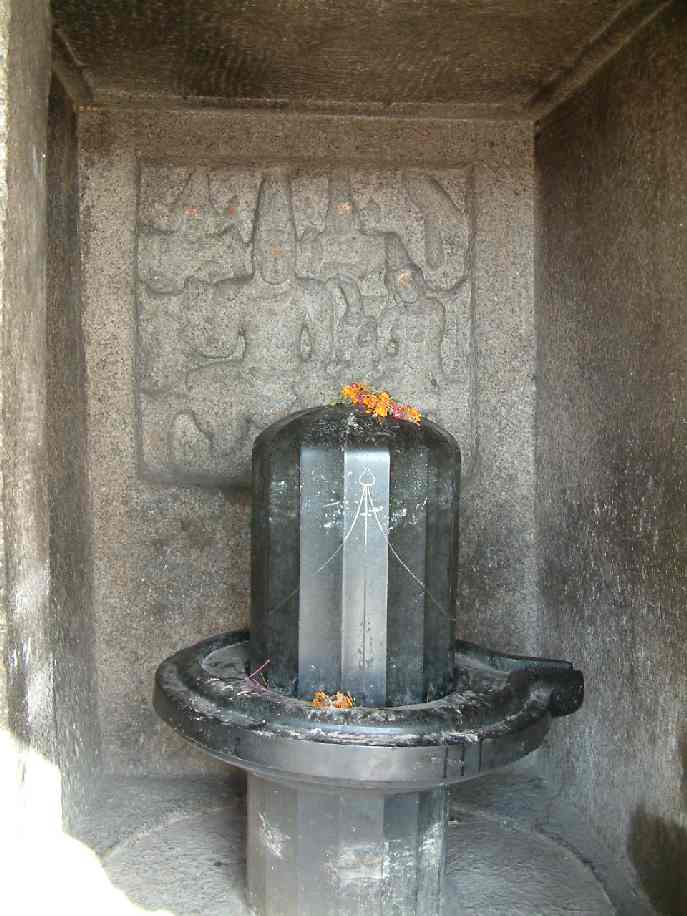
(f) At the Kailāsanātha temple the inner walls of the side cells contain colossal sculptures of Śiva but does not contain liṅga in the centre. At Paṉamalai the inner walls of the side cells are severely plain, and in the centre prismatic liṅgas are placed. In place of sculptures, Rājasiṃha covered the inner walls of the side cells with paintings of exquisite beauty, resembling exactly the sculptures of Kailāsanātha temple of Kāñci.(g) The superstructure of the Vimāna of the shore temple is swift and sharp in its up-ward movement and is slender in appearance. The Vimāna of the Kailāsanātha temples is slow and steady in its upward move and is solid and majestic in appearance. The Vimāna of the Paṉamalai temple shows a peculiar combination with its sharpely recessed corners, taken up to the stūpi. It blends in itself the horizontal and vertical lines of the structure and is stately in appearance.(h) The outer walls of the Kailāsanātha exhibit rampant lions with riders at regular intervals. The Paṉamalai temple show only rampant lions. The sea shore temple show a series of Nāgarājās in anjali pose.Thus these four temples exhibit bewildering variety in their architectural details in almost all respects.
Has Rājasiṃha not left his inscriptions in these temples, certainly these monuments would have been ascribed to various monarchs and would have been ascribed to various centuries. That it was the case we know with reference to the shore temple. Till the discovery of Rājasiṃha’s inscription18 in the plinth of the balipītha, scholars were divided as to the author of the Sea shore temple.Factor against the evolutionary theoryI shall cite another important factor against the evolutionary theory. The rock cut cave of Śāluvaṅkuppam excavated by Rājasiṃha has very simple and plain pillars very much like the Mahendra’s pillars. Therefore Śāluvaṅkuppam cave posed a great problem for scholars19 in placing it in the evolutionary cadre. It may be noted here that the inscription of Rājasiṃha is found outside the cave on the north and south wall. But let us take the case of Vāyalūr inscription20 of the same king. The inscription is engraved on a pillar itself, which is plain and is in the so called Mahendra style.
Kailāsanātha Temple KāñciThe huge Nandi Maṇḍapa in front of the Kailāsanātha temple of Kāñciuram has four pillars with sedent lions at the base. The small cells running along the outer walls of the same temple, also have pillars with sedent lions at the base. According to the prevalent view this is a motiff of Māmalla, but we know certainly that the Kailāsanātha temple is the magnificent creation of Rājasiṃha. The Konerimaṇḍapa at Mahābalipuram contains two rows of pillars. The outer row carries series of pillars with seated lions at the base end bulbous capital which may be termed as the Māmalla pillar. The inner row of pillars are slender and fluted without any motiff at the base and is termed the Parameśvara pillar.
It was therefore explained that the outer portion which was necessarily the first to be excavated was by Māmalla Narasiṃha - I, and the inner portion was excavated by Parameśvara. This explanation is quite convincing. But it fails with reference to the Ādivarāha cave where the outer pillars are plain, slender and fluted, while the inner row of pillars carry seated lion at the base and bulbous capital. The explanation will have to be reversed here and will totally ail since it will amount to saying that Narasiṃha - I succeeded his grandson Parameśvara. Thus the theory that with one king only from of architecture prevailed will not hold good. So also the theory that each king brought in a new innovation will fail. Thus it is quite evident, the evolution of architectural motiff fails with reference to our present study.Thus either literature or paleography or for that matter architecture help us in determining the age. We found ourselves in no better ground when we turn to the inscriptions. It may be mentioned that many kings are said to have assumed same names and titles and with Māmallapuram monuments, where we have only titles the difficulty is all the more greater.
When thus, all our tangible sources fail how are we to arrive at a conclusion? My answer will be that the clue to our problem lie in the very failure of all these sources. Paradoxical it may seem, when I say that all these evidences do ot ail us when we reverse our process of enquiry by first taking inscriptions, applying it to architecture and applying both to paleography. We arrive at a solution which is quite convincing.Inscriptions of RājasiṃhaLet us take the inscriptions of Rājasiṃha about whom we are absolutely on safe grounds. Rājasiṃha was a great monarch, an ambious king and was a prolific builder. In his celebrated Kailāsanātha21 temple he has left us about three hundred titles, ever assumed by any monarch of India. His titles are very valuable in understanding his personality. Of his birth, Rājasiṃha says that “He took birth from Parameśvara, the destroyer of the city of Raṇarasika just as Guha took birth from Parameśvara”. He was proud of his race and of his noble birth and hence assumed such titles as pallavādityaḥ, kulatilakaḥ, kuladhvajaḥ, jātigambīraḥ, adhbhutacaritaḥ, kshatracūlamaṇiḥ.
He was a prince of great beauty and elegance and was conscious of it when he assumed such title as ekasundaraḥ, nayanamanoharaḥ, parjjanyarūpaḥ, udayacandraḥ, vilāsaḥ, abhirāmaḥ, cāruvilāsaḥ, lalitāvilāsaḥ, sārvabhaumaḥ, etc. His great love for Vaidika mārga, viz. śruti, smṛti and purāṇa is reflected in his titles, as āgamapramāṇaḥ, āgamānusāri, śāstradṛṣṭiḥ, nayānusari, ācāraparaḥ, tattvavedī, etc. His devotion to Śiva and Śaivasiddhānta is unparalleled in the history of South India. All his inscriptions and the inscriptions of his successors, speak of him as a great Śiva-bhakta. He was Śivacūdāmaṇi and styled himself as īshvarabhaktaḥ, devadevabhaktaḥ, śaṅkarabhaktaḥ, īshānasharaṇaḥ, etc. We could only compare Raja Raja-I as an equal in his devotion to Śiva and who rightly assumed the title of Śivapādaśekhara. Rājasiṃha himself had the title of Raiaraja. He was the very abode of dharma. He was dharmasetuḥ, dharmakavacaḥ. He was afraid of only unrighteousness adharmabhīruḥ. He had unlimited desires atyantakāmaḥ and his ideals were lofty unnatecchaḥ. His ideals were mostly fulfiled, icchāpūraḥ, pūritecchaḥ, tṛṣṇāpūraḥ, etc. He had great love for all the fine arts, and was himself a great master of all arts, kalasamudraḥ, ātodhyatumburuḥ, vīṇanāradaḥ. In fact he was the very ocean of all fine arts kalasamudraḥ.
Such a king was never moved to anger and once roused he was terrible, tīvrakopaḥ, avandhyakopaḥ; but his angers were always reasonable kāraṇakopaḥ. He was severe in inflicting punishments and upholding justice, agradaṇḍaḥ, caṇḍadaṇḍḥ. He was a great statesman, and was the only Pallava monarch who could maintain friendly relations with his neighbours and give some peace to his subjects. dūradarśī, carucakṣuḥ, abhayarāśi, caṛvarti He was not at the same time weak. He was a great warrior raṇajayaḥ, aparājitaḥ, akutobhayaḥ, ugrapratāpaḥ, amitaprabhāvaḥ, etc. He was very fond of his subjects rakṣāmaṇiḥ, āśritavatsalaḥ. The very idea of poverty made him shiver, daridrānukampī, khinnānukampī and hence poured forth gifts and presents dānavarṣaḥ, aviratadāna. In short he is a true Hindu monarch, in whom we find all the qualities of warrior, statesman, poet and above all a lover of peace as described in our nitisastras.
Śāluvaṅkuppam InscriptionIt is no wonder that such a great monarch has left us his temples as monumental structures, unsurpassed in their variety and beauty. The same king Atiraṇacaṇḍa has excavated the Śāluvaṅkuppam cave and left his inscriptions. The verses are fascinating poetry. But strange indeed, the same verses are found in Dharmarājamaṇḍapa, Rāmānujamaṇḍapa and Gaṇeśa ratha! Verse for verse, word for word and syllable for syllable they are identical and yet we have been looking elsewhere for the author.Five verses found at Śāluvaṅkuppam, Gaṇeśa Ratha and Dharmarāja maṇḍapa:-अतयनतकामो नृपतिः निर्जितारातिमण्डलः ।ख्यातो रणजयः शूरः तेनेदं वेश्मकारितम् ॥भक्तिप्रह्वेण मनसा भवं भूषणलीलया ।
दोष्णा च यो भूवो भारं जीयात् स श्रीभरश्चिरम् ॥श्रीमतोत्यनतकामस्य द्विषद्दर्पापहारिणः ।श्रीनिधेः कामरागस्य हराराधानसंगिनः ॥अभिषेकजलापूर्णे चित्ररत्नाम्बुजाकरे ।आस्ते विशाले सुमुखः शिरः सरसि शङ्करः ॥तेनेदं कारितं शंभोर्भवनं भूतयेभुवः ।कैलासमन्दिरनिभं भृभृतां मूरद्ध्नि तिष्टता ॥atayanatakāmo nṛpatiḥ nirjitārātimaṇḍalaḥ ।khyāto raṇajayaḥ śūraḥ tenedaṁ veśmakāritam । ।bhaktiprahveṇa manasā bhavaṁ bhūṣaṇalīlayā ।doṣṇā ca yo bhūvo bhāraṁ jīyāt sa śrībharaściram । ।śrīmatotyanatakāmasya dviṣaddarpāpahāriṇaḥ ।śrīnidheḥ kāmarāgasya harārādhānasaṁginaḥ । ।abhiṣekajalāpūrṇe citraratnāmbujākare ।āste viśāle sumukhaḥ śiraḥ sarasi śaṅkaraḥ । ।tenedaṁ kāritaṁ śaṁbhorbhavanaṁ bhūtayebhuvaḥ ।kailāsamandiranibhaṁ bhṛbhṛtāṁ mūraddhni tiṣṭatā । ।ATYANTAKĀMA excavated Śāluvaṅkuppam cave. The same ATYANTAKĀMA excavated Gaṇeśa ratha, Rāmānuja maṇḍapa and Dharmarāja maṇḍapa. Yet we differentiate this ATYANTAKĀMA from the other.
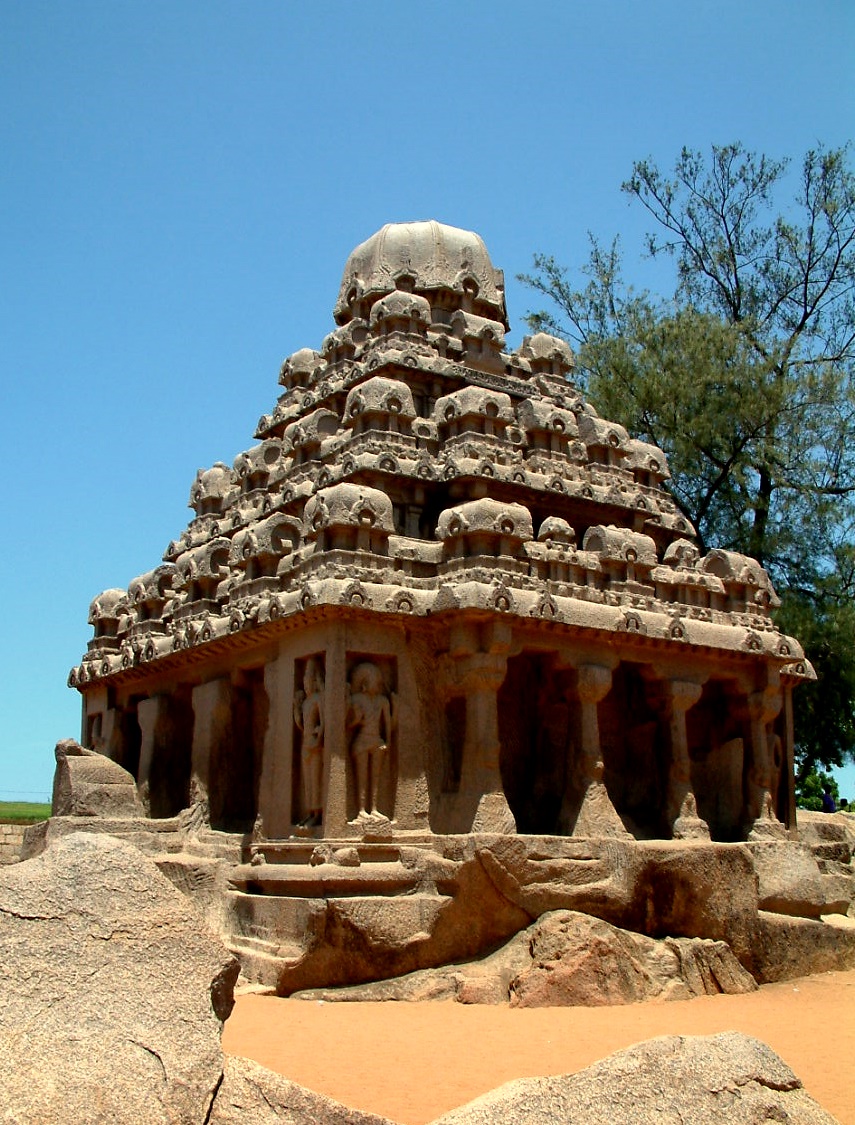
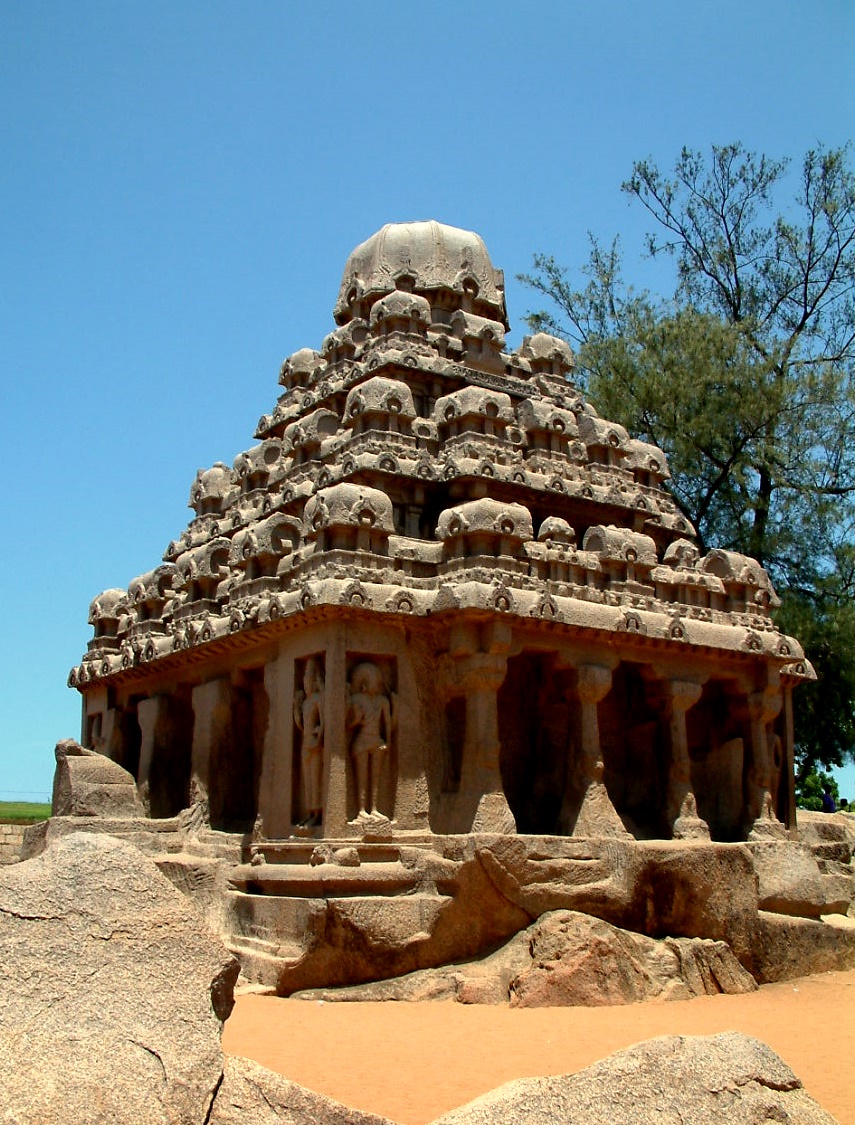
The Dharmarājaratha, bears the name of Atyantakāma Pallaveśvara gṛham. Of the thirty titles inscribed in Dharmarājaratha, over fifteen titles are found in Kāñci inscriptions of Rājasiṃha.Titles Common to both Kailāsanātha and Dharmarājaratha.Dharmarājaratha Kailāsanāthanarasiṃhaśrībharabhuvanabhājanaśrīmeghatrailokyavardhanaatyantakāmakāmalalitanayanamanoharasarvatobhadraśrīnidhiniruttaraparāvararaṇajayaparāparamahāmallaapratihataśāsanarājasiṃha
In all his inscriptions the Kāñci, the shore temple of Māmallapuram22, (22. A. R. E. 961 of 1913.) the Śāluvaṅkuppam23 (23. S. I. I. Vol. I. 21.) cave, the Vāyalūr inscription24 (24. E. I. XVIII. 145.) and the Tiruppōrūr25 (25. S. I. I. Vol. XII, 27, A. R. E. No. 76 of 1909.) inscription, Rājasiṃha calls himself Atyantakāma. Vainly we have been trying to give the same title to Narasiṃhavarman-I, Parameśvara-I, and even to Nandivarman Pallavamalla26. (26. S. I. I. Vol. I.)Table showing the titles of Rājasiṃha appearing in all the monuments. Note the significant titles of Raṇajayah, Atyantakāma, and Śrībhara.There is no evidence to show that Narasiṃha Varman I, the great Vātāpi-hero started these unique monuments. Strangely enough we have only two inscriptions of him, one at Vātāpi27 the capital of Cālukyas, far away from his own capital. The other is at Tirukkaḻukuṉṛam28. In none of his inscriptions, he records his unique achievement in temple building. Nor does he mention his title as Atyantakāma. The charters issued after him are equally silent on his unique achievement and his title.Let us study the Kūram plates29 of Parameśvara I, who was Rājasiṃha’s father.
From line 19 to line 39, where he gives his own attainment, there is no mention of the title Atyantakāma. Nor is there any mention of his attainment at these unique monuments or for that matter temple building. He only boasts of his victory over Vikramāditya - I, his Cālukyan adversary. Let us study all the copper plates issued after him. Vēlūrpāḷaiyam30, Kasakudi31, and Udayēndiram32, speak of him as a vanquisher of Vikramāditya and nothing else. His title as Atyantakāma is not mentioned in any.We know from the inscriptions of Narasiṃhavarman I, that the greatest event in his life was the victory over Pulakesi and the conquest of Vātāpi and Ceylon. It is recorded in all the Pallava charters issued after him also. But this event is not mentioned in any of the Māmallapuram inscriptions which unmistakably suggest, that Narasiṃha did not have anything to do with the monuments of Māmallapuram.
वातापि निर्ज्जय विलम्बित कुम्भ जन्मावीरस् ततोऽजनि जयि नरसिंह वर्मा ॥.......... कशाक्कुडि - स्. इ. इ. प्. ३४९.laṅkājaya adharita rāma parākramaśrīr udvaṛtta śatrukula saṁkṣaya dhūmaketuḥ ।vātāpi nirjjaya vilambita kumbha janmāvīras tato’jani jayi narasiṁha varmā । ।.......... Kaśākkuḍi - S. I. I. p. 349.तस्मात् अगस्त्य इव विमथित वातापिःपरियल मणिमंगल शूरमार प्रभृतिषु जेताबहुशः वल्लभ राजस्य नरसिंह वर्मा ॥...... उदयेन्दिरम् प्लतेस् - स्. इ. इ, प्. ३६६.tasmāt agastya iva vimathita vātāpiḥpariyala maṇimaṁgala śūramāra prabhṛtiṣu jetābahuśaḥ vallabha rājasya narasiṁha varmā । ।...... Udayēndiram plates - S. I. I, p. 366.तदान्मजात् आविरभूत् महेन्द्राद् उपेन्द्रकीर्तिः नरसिंहवर्मावातापि मध्ये विजितारिवर्गः स्थितं जयस्तम्बम् अलम्बयत् यः..................... वेलूर्पाऌऐयम् प्लतेस् - स्. इ. इ, प्. ५०८.
tadānmajāt āvirabhūt mahendrād upendrakīrtiḥ narasiṁhavarmāvātāpi madhye vijitārivargaḥ sthitaṁ jayastambam alambayat yaḥ..................... Vēlūrpāḷaiyam plates - S. I. I, p. 508.नरसिंह वर्मा.... वायलूर् इन्स्च्रिप्तिओन् - ए. इ. xविइइ, प्. १५०.narasiṁha varmā.... Vāyalūr inscription - E. I. XVIII, p. 150.We also know from the Kūram grant of Parameśvara I and the inscriptions issued after him, that the greatest event in the life of Parameśvara I, was the Victory over Vikramāditya I, also known as Raṇarasika, his Cālukyan enemy. This important event is also not noticed in Māmallapuram, though a major portion of these monuments are ascribed to him. The Dharmarājaratha which is said to have been continued by him does not even bear his name Parameśvara-I. It is thus evident that Parameśvara also had little to do with the monuments of Māmallapuram.
icchādheya sakalāvaniypālalokaḥpaścādbabhūva parameśvarapotavarmmā ।bhūtiparāṁ vahata bhūtapatiḥ khaḍhvāṁgaketuḥacalasthitiradhbhuto yaḥ । ।.............. Kaśākkuḍi - S. I. I - II, 349.ततः पेरुवलनल्लुर्युध्दे विजितःवल्लभलः परमेश्वरवर्म्मा..... उदयेन्दिरम् - स्. इ. इ-इइ, ३६६.tataḥ peruvalanalluryudhde vijitaḥvallabhalaḥ parameśvaravarmmā..... Udayēndiram - S. I. I-II, 366.ततः परम् अतद्वंसी बभूव परमेश्वरःचालुक्य क्शितिभृत् सौन्य ध्वान्त ध्वंस दिवाकरः............... वेलूर्पाऌऐयम् - स्. इ. इ-इइ, ५०८.tataḥ param atadvaṁsī babhūva parameśvaraḥcālukya kśitibhṛt saunya dhvānta dhvaṁsa divākaraḥ............... Vēlūrpāḷaiyam - S. I. I-II, 508.तेषां वंशे प्रसूतात् रणरसिक पुरोन् मर्ध्दनात् अग्रदण्डात्.........कैलासनाथ – स्. इ. इ–इ.teṣāṁ vaṁśe prasūtāt raṇarasika puron mardhdanāt agradaṇḍāt.........Kailāsanātha – S. I. I–I.
लोकादित्यात् प्रसूतः रणरसिक चमू पङ्क शोषि प्रतापात्—पनमलै.lokādityāt prasūtaḥ raṇarasika camū paṅka śoṣi pratāpāt—Paṉamalai.It is quiet clear, that the title of Atyantakāma is not noticed either for Narasiṃha-I, or Parameśvara-I, in all the known inscriptions. Nor is there any mention of this unique achievement of temple building, by either of them. Further the significant events in both their life, (the defeat of their Cālukyan rivals) which are mentioned in all inscriptions, are not at all noticed in any of the Māmallapuram inscriptions. It is therefore quite clear that neither of them had anything to do with Māmallapuram monuments.On the contrary, Rājasiṃha calls himself Atyantakāma in all his inscription. All the charters issued after him speak of him as a great temple builder. He did nothing but building temples and donating money.देव ब्राम्हण सात्कृतात्म विभवः यः क्षत्र चूलामणिःचातुर्वैध्यम् अवीविशत् स्ववशगां भूदेवत भक्तितः ।संप्राप्तो नरसिंहतां स्ववपुषा नाम्ना च दिग् व्यापिनाजात श्री परमेश्वरस्य सकलस्य अङ्गावतारस् ततः ॥............. कशाक्कुडि - स्. इ. इ-इइ, ३४९.
deva brāmhaṇa sātkṛtātma vibhavaḥ yaḥ kṣatra cūlāmaṇiḥcāturvaidhyam avīviśat svavaśagāṁ bhūdevata bhaktitaḥ ।saṁprāpto narasiṁhatāṁ svavapuṣā nāmnā ca dig vyāpinājāta śrī parameśvarasya sakalasya aṅgāvatāras tataḥ । ।............. Kaśākkuḍi - S. I. I-II, 349.तस्मात् प्रम माहेश्वर परम ब्रम्हण्यः नरसिंह वर्म्मा..................... उदयेन्दिरम् - स्. इ. इ-इइ, ३६६.tasmāt prama māheśvara parama bramhaṇyaḥ narasiṁha varmmā..................... Udayēndiram - S. I. I-II, 366.तत्पुत्र सूनुः नरसिंह वर्मापुनर्व्यधात् यो घटिकं द्विजानां ।शिलामयं वेश्म शाशाङ्क मौलेःकैलास कल्प्ञ्च महेन्द्र कल्पः ॥.... वेलूर्पाऌऐयम् - स्. इ. इ-इइ, ५०८.tatputra sūnuḥ narasiṁha varmāpunarvyadhāt yo ghaṭikaṁ dvijānāṁ ।śilāmayaṁ veśma śāśāṅka mauleḥkailāsa kalpñca mahendra kalpaḥ । ।.... Vēlūrpāḷaiyam - S. I. I-II, 508.
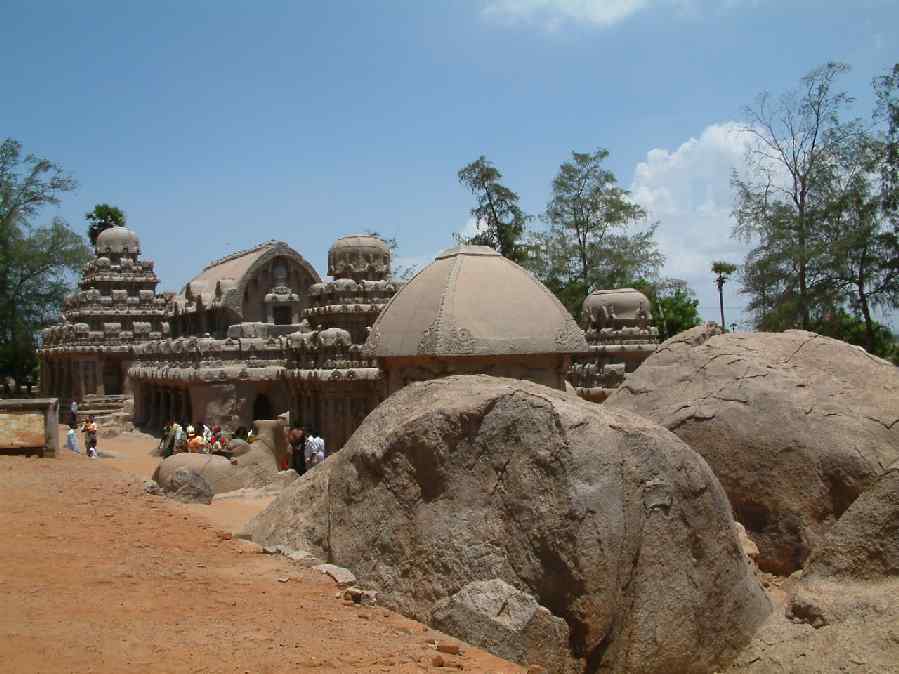
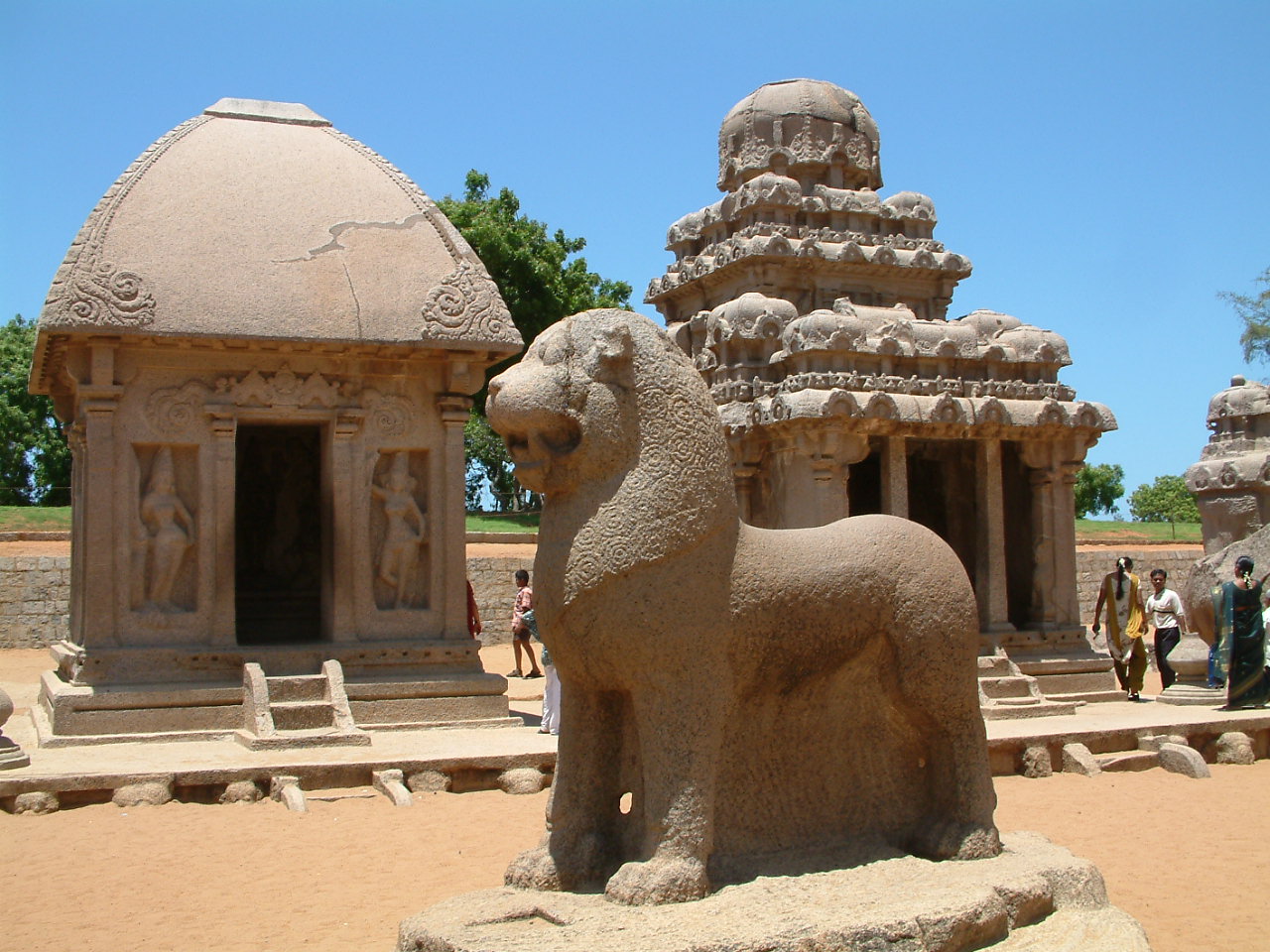
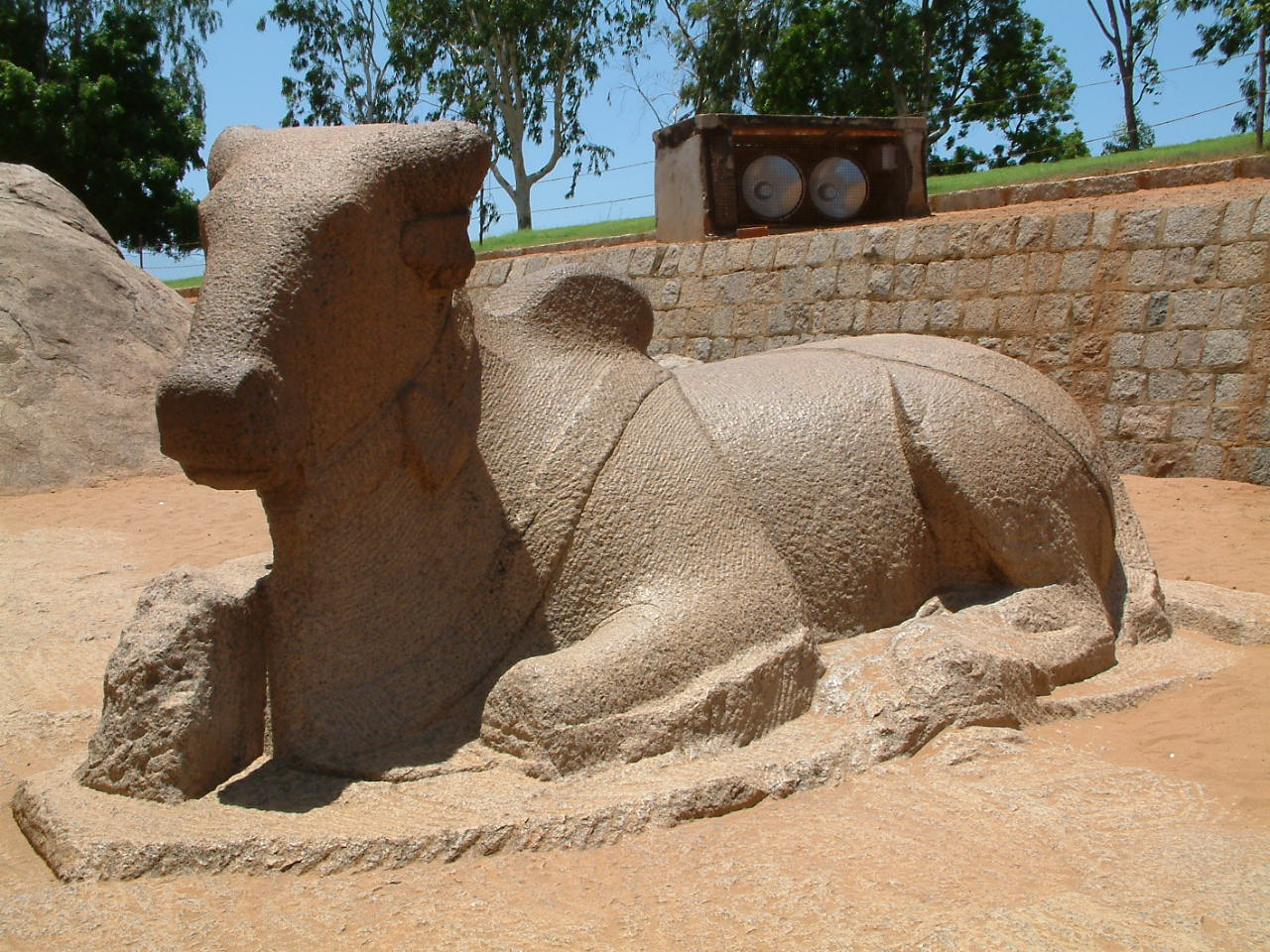
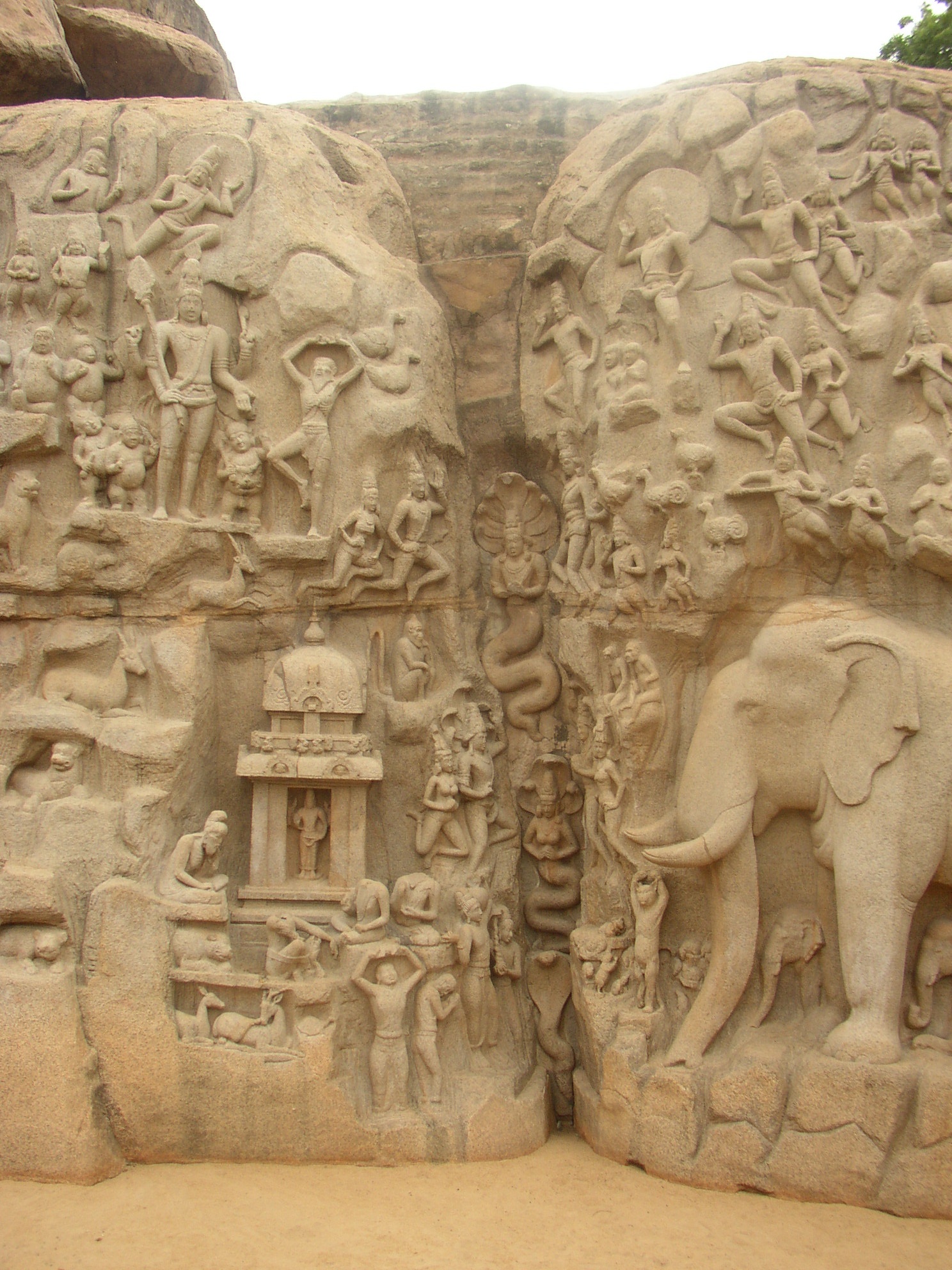
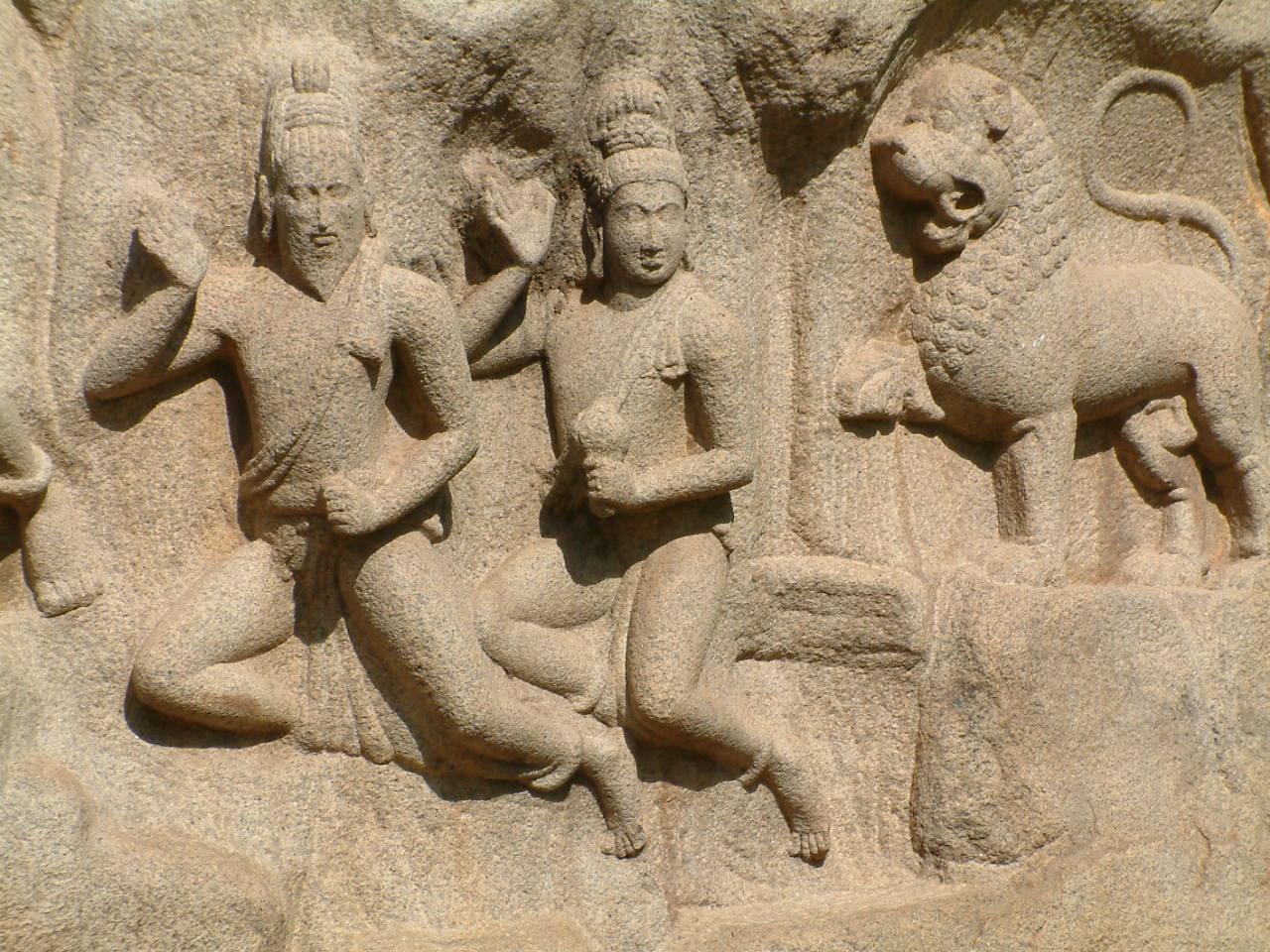
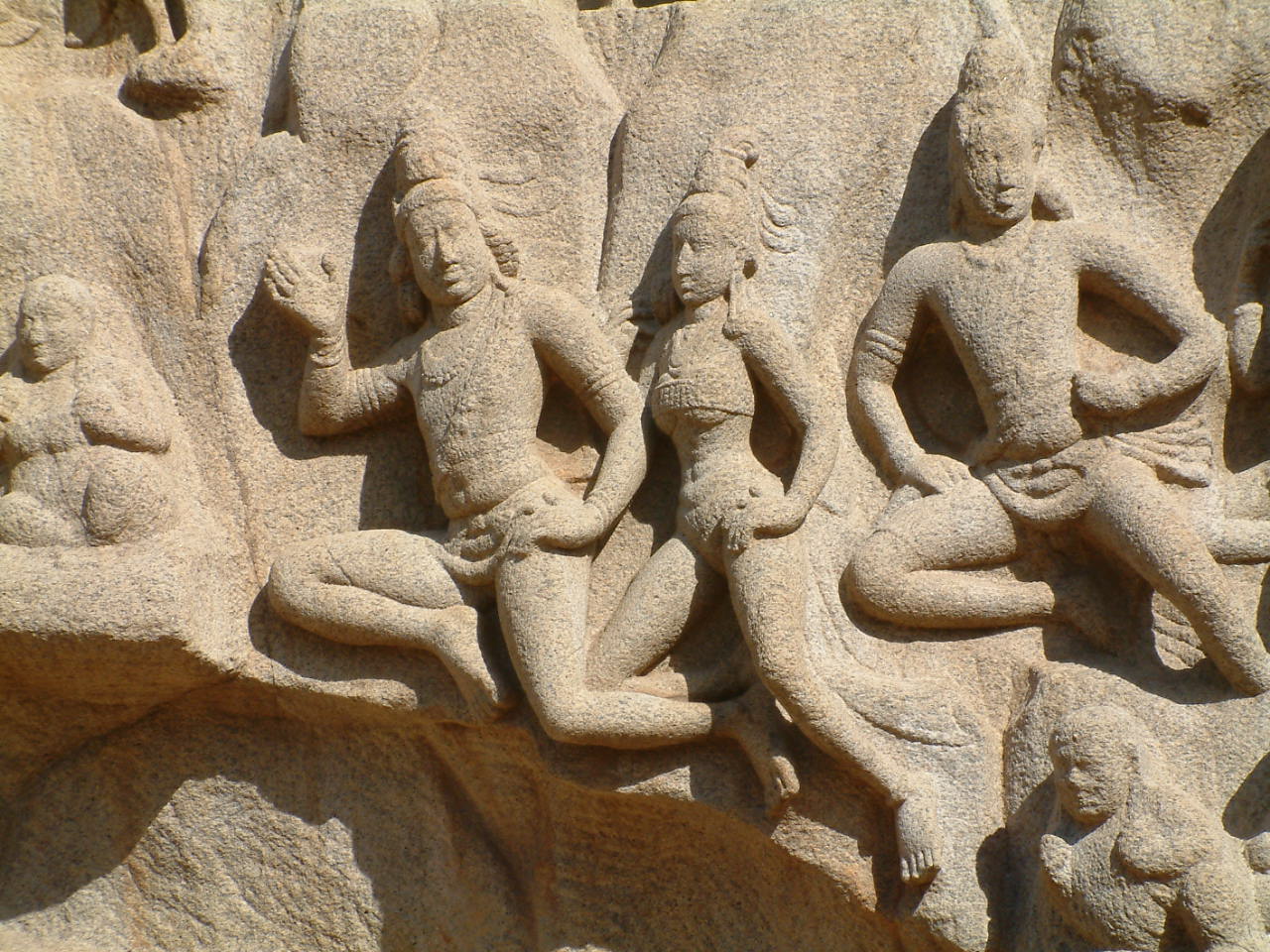
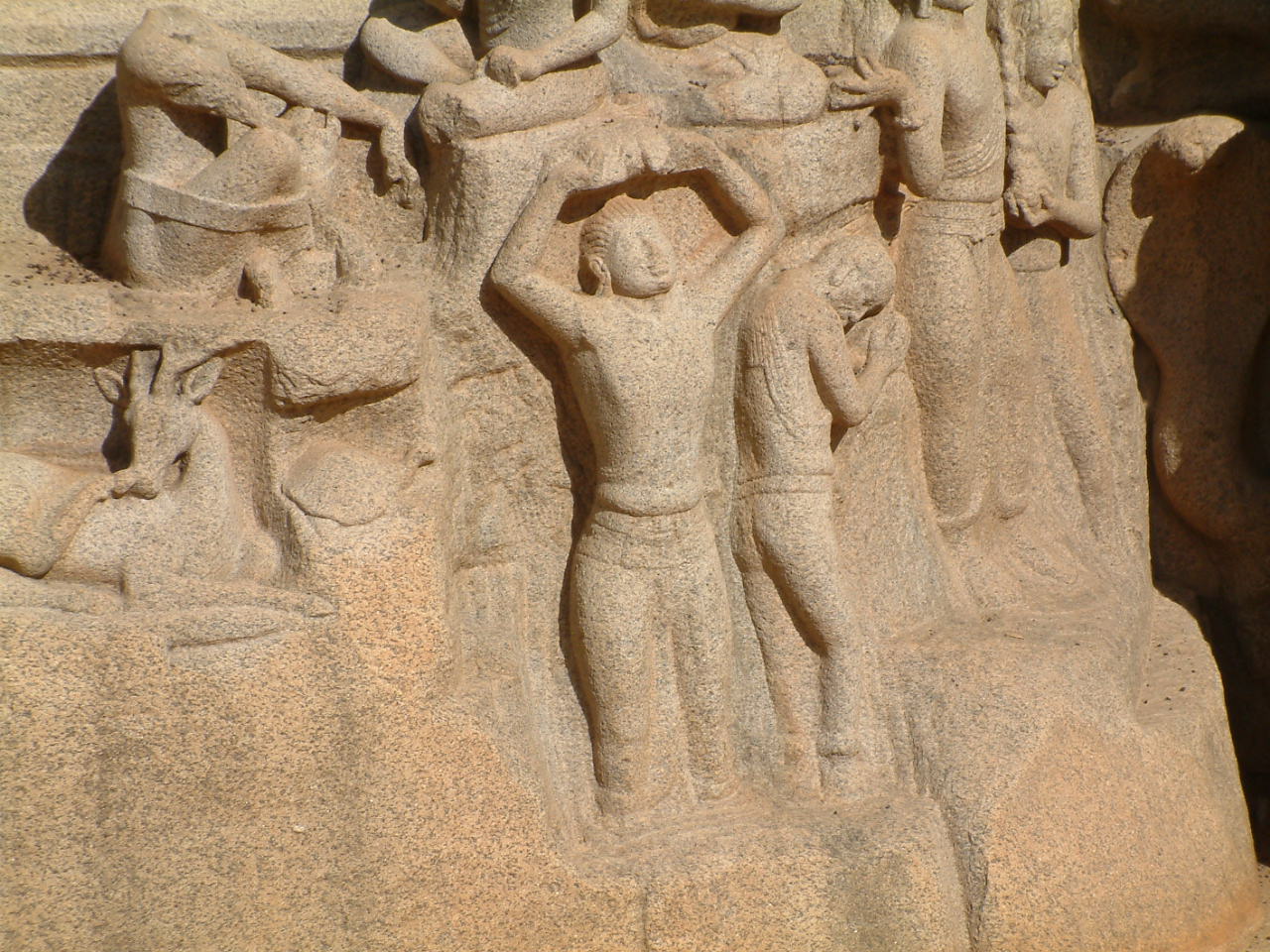
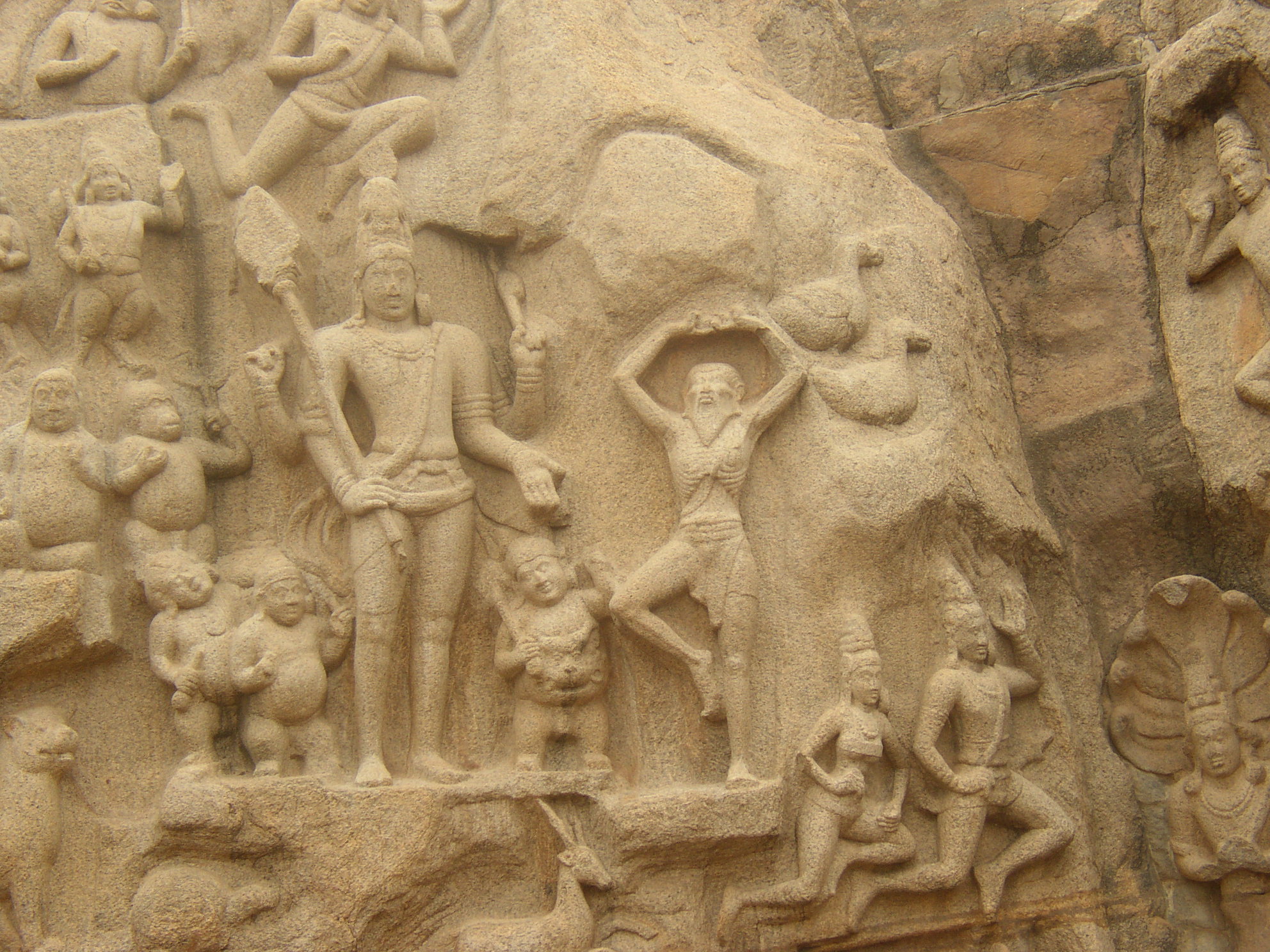
Ocean of Art and LiteratureLet us fancy for a moment as Rājasiṃha standing on the sea shore of Māmallapuram. He looks at the vast ocean in front of him. He whispers, that he also is an ocean. Ocean of art and literature. Kalāsamudrah. Wave after wave bring him new ideas, desires and fancies. He styles himself as Atyantakāma, a king of unlimited fancies. He turns and transforms these lofty ideals, into tangible and visual forms by way of art and architecture. He styles himself Icchapūrah, one whose desires a fulfilled. He is ever active Nityotsāha, Utsāhanitya; stands before the boulder; each idea transforms itself. One is a three storied square Dharmarājaratha. The other becomes a rectangular Bhīmaratha. The third becomes two storied Arjunaratha. The fourth becomes a hut shaped Draupadīratha; the fifth a horse-shoe Sahadevaratha. A lion, a bull an elephant. Wherever he turns he conceives new forms and transforms them. Power and force exhibit themselves in Mahiṣāsuramardinī panel. Absolute peace and composure, transform themselves into Viṣṇu as Anantasāyin. A huge vertical slab of 90’, with a fissure in the centre, transforms itself as an open air sculpture of unsurpassing beauty and variety.
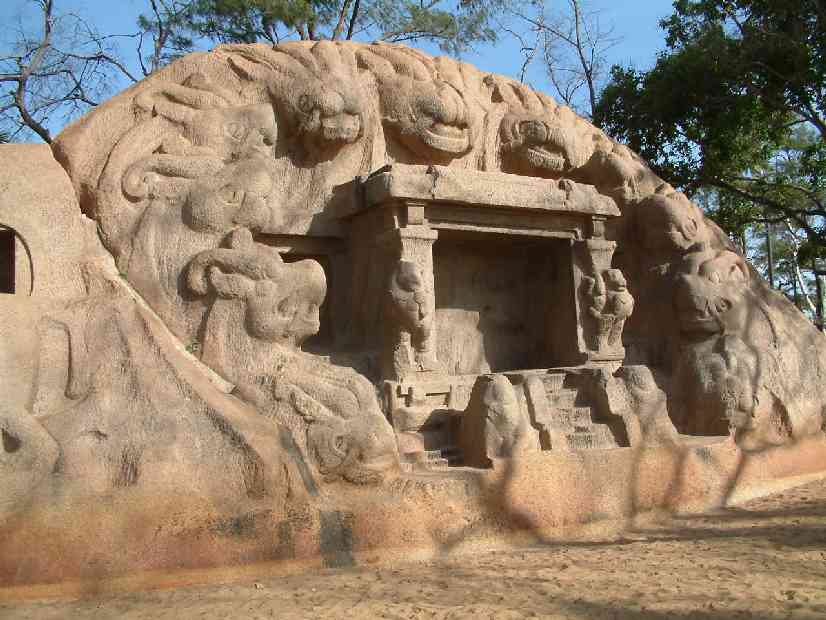
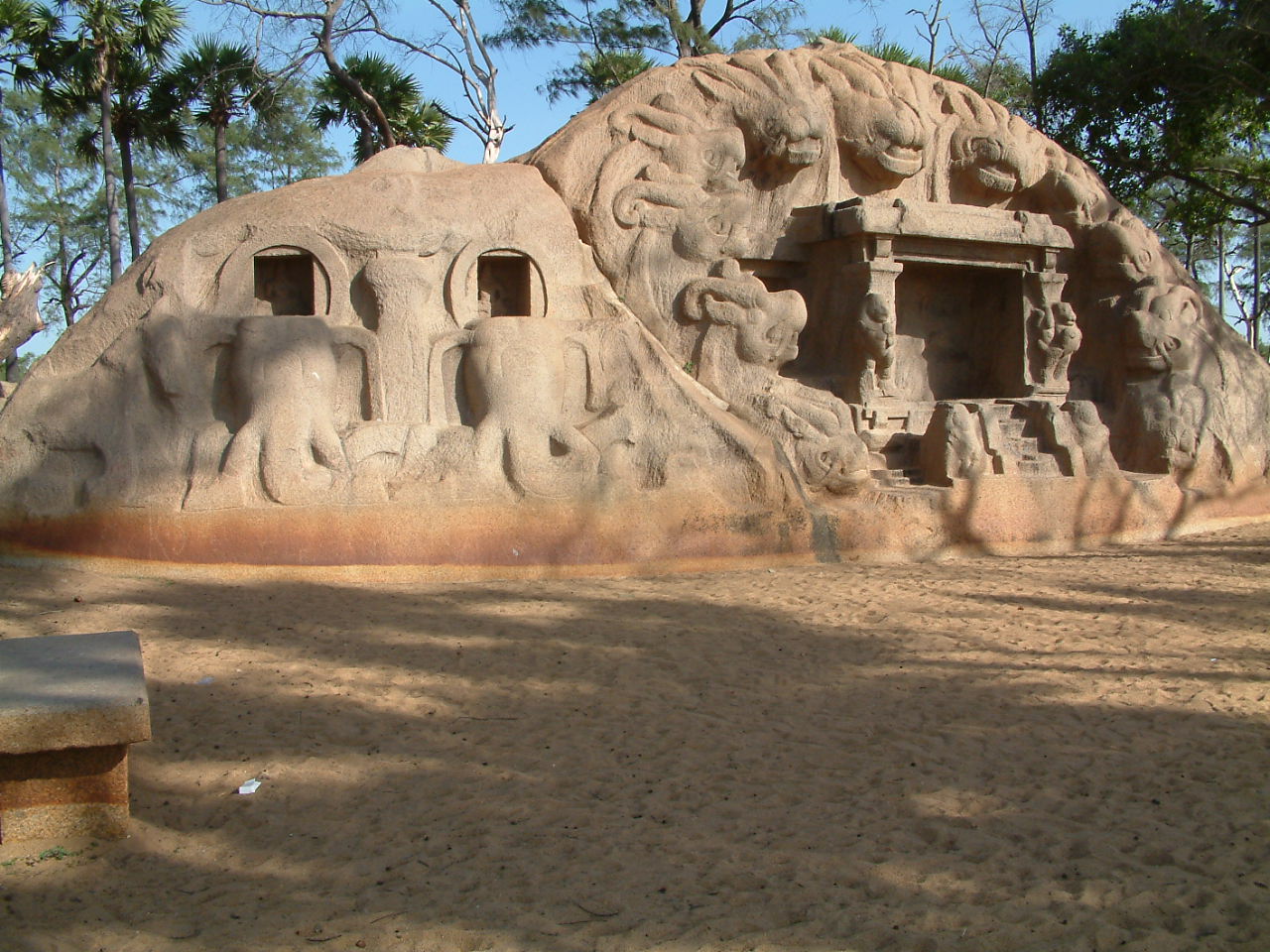
The elephants, the monkeys, the lion, the cat all are his fancies. A whole boulder is transformed into the heads of yālis and a cave cut into it becomes the tiger cave. He erects a temple on the sea shore, another in the plains of Kāñci and yet another on the top of a hill at Paṉamalai. He leaves painting at one place - Paṉamalai, and sculptures at another place Kāñci. He leaves complete list of geneology at one place - Vāyalur; gives titles at Kāñci and leaves poetry at Māmallapuram. He shows variety in scripts. He introduces prismatic liṅga; compares himself with Subrahmaṇya the son of Lord Parameśvara. It is a Kumara-sambhava. This becomes the Somāskanda motif at the back wall of the sanctum. What has he not fancied, what has he not thought of? He is indeed a great Atyantakāma and no one else.Struggle for powerNow the story is complete. Rājasiṃha, the greatest lover of art on earth dies; his son Parameśvara-II comes to the throne. Immediately he has to fight and his rule was short. Nandivarman, it is stated usurps the throne of Kāñci. He himself is driven out of Kāñci by Vikramāditya-II and runs for his life. Vikramāditya inspects the Kailāsanātha temple of Kāñcipuram.
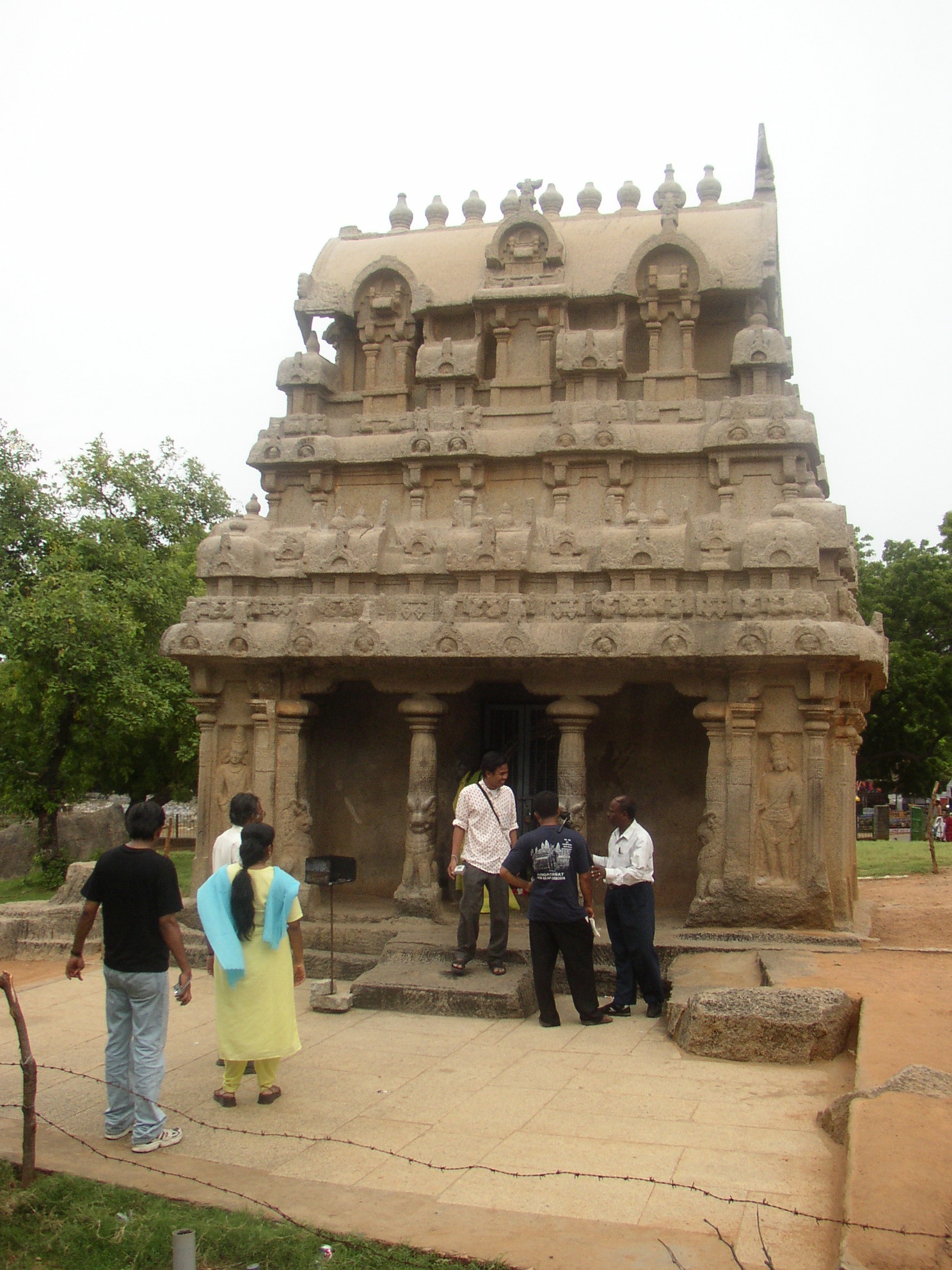
He is wonder stuck with the beauty of the temple and loftiness of the king. He pays tribute to Rājasiṃha by himself donoting gifts to the temple, without destroying it. Catches hold of the great artists, like Sarvasiddhi ācārya33 and removes them to his capital and there at Pattadakkal comes up a temple on the same model of Kailāsanātha temple. Nandivarman struggles throughout his life for the power. Thus with the patronage gone, with the best of artists gone, Māmallapuram stands as it is never to be completed.Great ImaginationA study of the Māmallapuram monuments will reveal that the author, whosoever he may be, had great imagination and delighted in getting monuments carved, according to his desire. The five rathas which are most fascinating, exhibit variety. Every ratha is different from the other and each sculpture (namely an elephant, a lion and a bull) is equally different from the other. All scholars, writing on the rathas have stated that it was the desire of the king to show five different varieties of structures, that were in vogue at the period. The other monoliths namely Gaṇeśa ratha, Valayaṅkuṭṭai ratha and Piḍāri ratha are also different from each other.
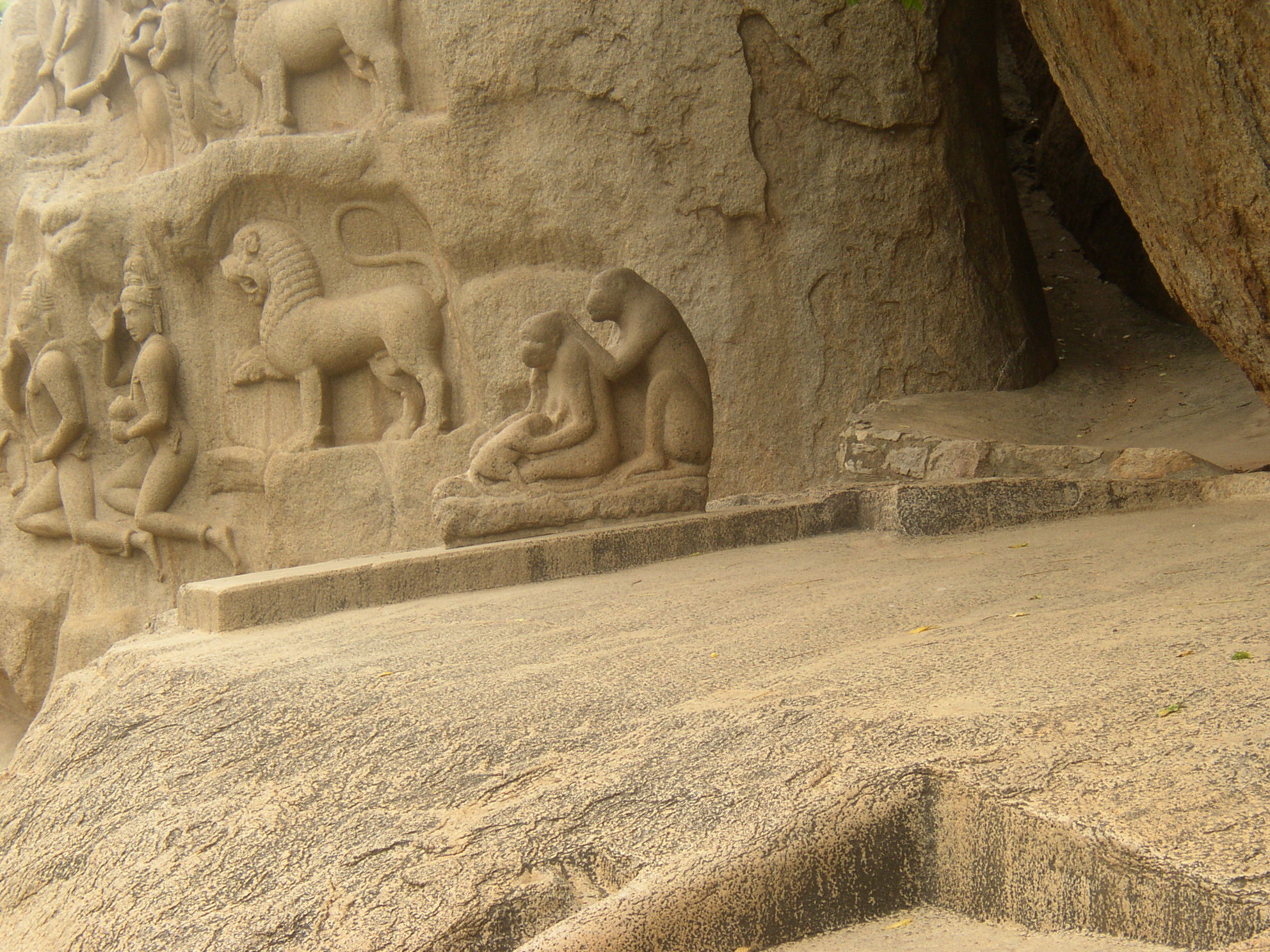
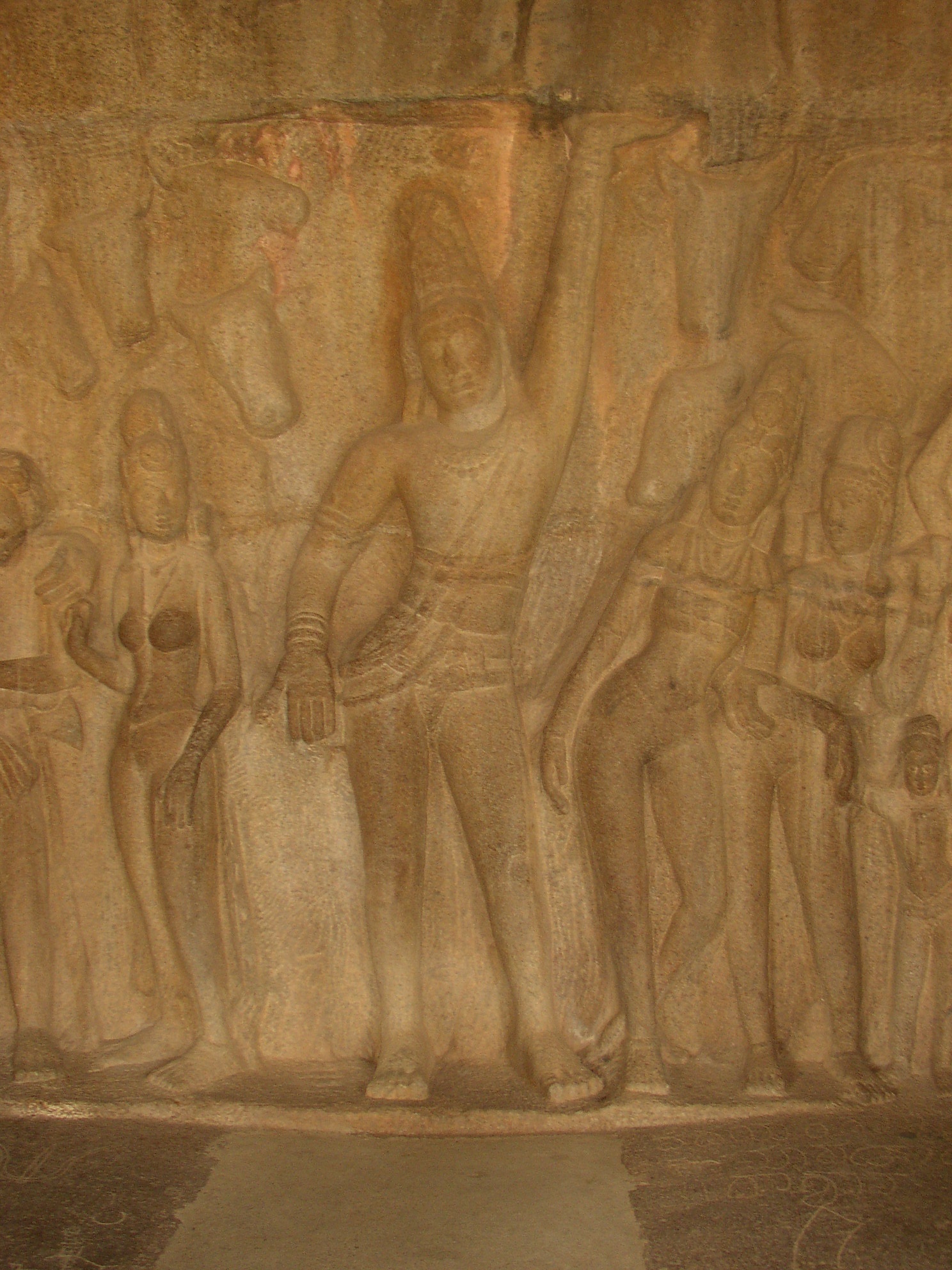
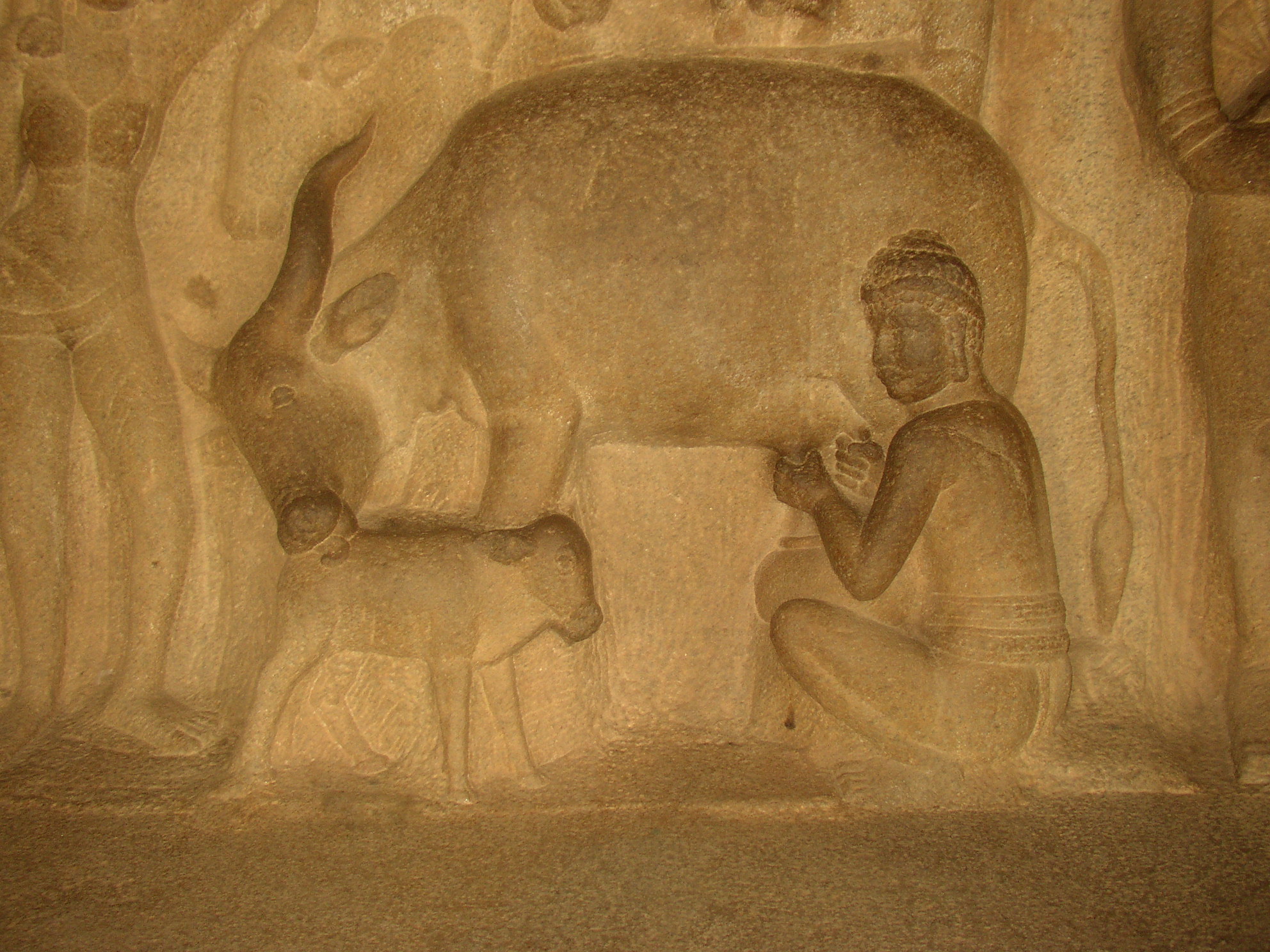
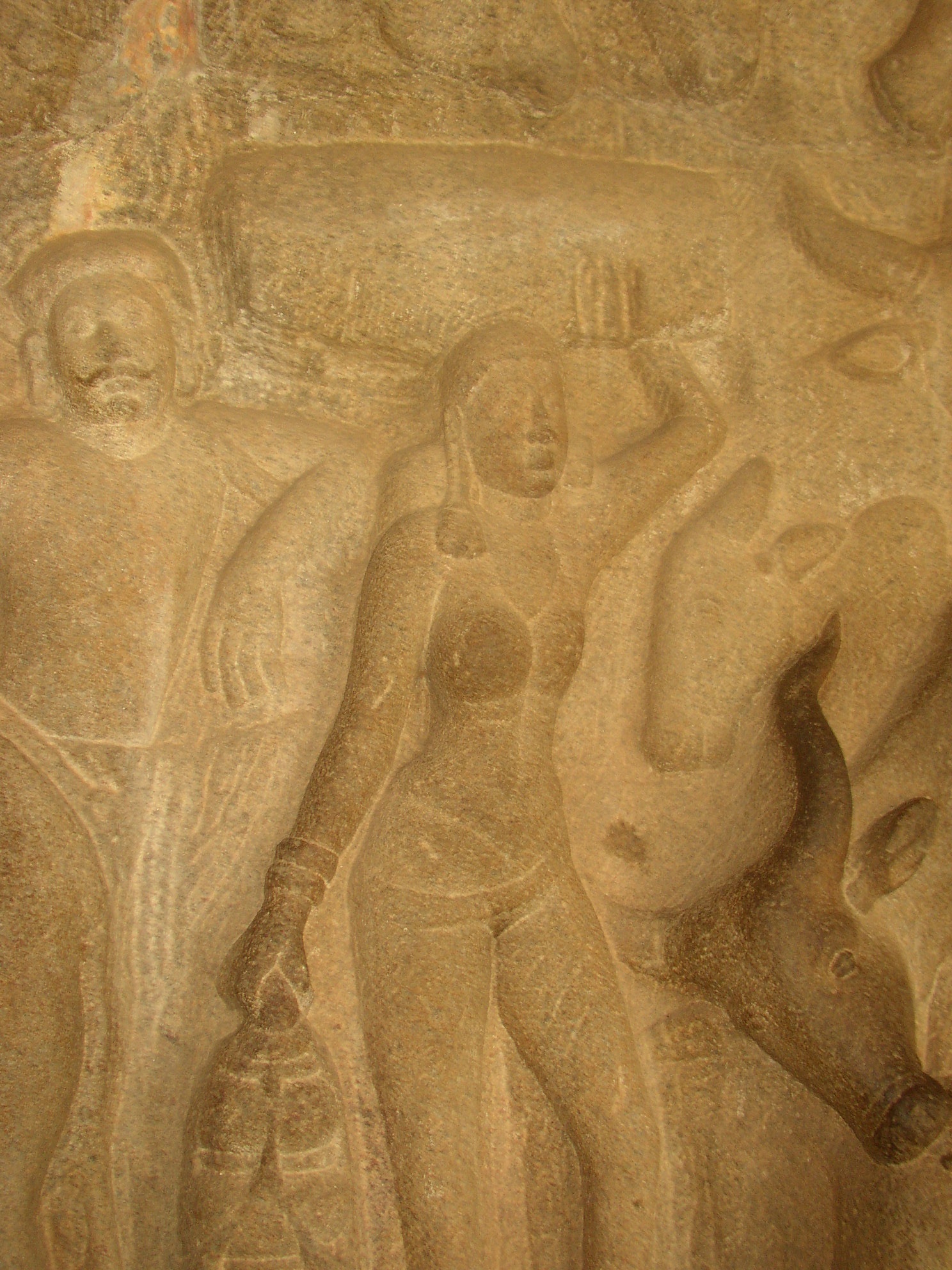
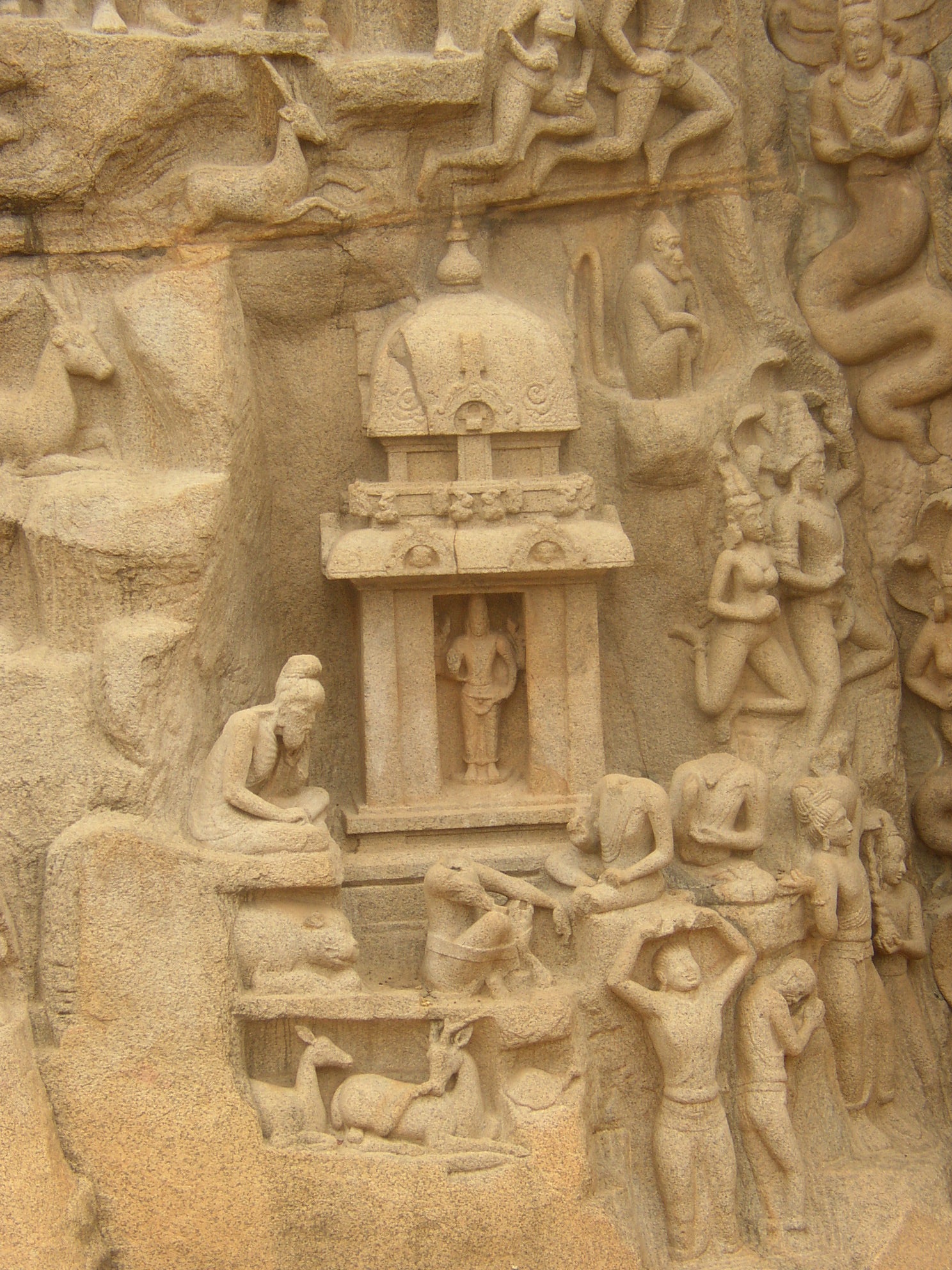
The same may be said of the caves of Māmallapuram.Each cave is different from the other in plan, as could be noticed from the Trimūrti cave, the Mahiṣāsuramardinī cave, the varāha cave, the Rāmānujamaṇḍapa, the Dharmarāja maṇḍapa, and the Pañcapāṇḍavamaṇḍapa, the mention only the well known ones. The open air sculptures which are again the unique contributions of Māmallapuram exhibit variety. There are two Arjuna’s penance carved, each being different from the other. By the side is Kṛṣṇa as Govardhanadhārī. The monkey group is yet another interesting creation and also the elephant-peacock monkey group near the Trimūrti cave. A little to the North of the Sea-shore temple is a Durgā cave, which has a colossal Mahiṣa carved on the northern side. In the south of the Shore temple, are again free monolithic sculptures, which are but small replicas of the Tiger cave of Śāluvaṅkuppam. The seated lion, with a little Durgā cut inside its stomach, within the outer walls of the shore temple, is again another interesting specimen. The cave with a series of Yalis, familiarly known as the Tiger cave at Śāluvaṅkuppam, is a unique monument of grandeur. Apart from these, there are also the rock cut tanks like Gopī’s churn.
Urge to Express Multitudious FormsUnderlying all these monuments, of rock cut caves, monoliths, open air sculptures and miscellaneous cuttings, on could clearly perceive that there was a great desire on the author, to be possessed of unlimited imaginations and to translate them into the living rocks. Each rock presenting a novel idea or theme got itself transformed, in the hands of the king. In fact, what we have at Māmallapuram is only a fraction of the king’s fancies for many of his desires, as could be noticed from attempts to cut every rock, never attained even the state of outlines. This urge to express multitudious forms, is the underlying current of Māmallapuram monuments. This aspect of variety in the expression of art, in all the rocks and at the same place, gives Māmallapuam a unique place, unparalleled by any in the world. It will not be an exageration, when it is said that Māmallapuram will ever be supreme in the art history of the world. As I have proved earlier this king who was the author of these monuments and who very appropriately assumed the title of Atyantakāma, a king of unlimited fancies, is none other than, the celebrated builder of the Kailāsanātha temple of Kāñcipuram, and the Sea shore temple of Māmallapuram.
General AgreementThere is a general agreement that the Śāluvaṅkuppam cave was undoubtedly the creation of Rājasiṃha. It is also accepted that the inscriptions at Śāluvaṅkuppam are that of Rājasiṃha, who also bore the title of Atyantakāma, Raṇajaya etc. I have stated earlier, that five verses found at, Śāluvaṅkuppam are found verbatin at the Gaṇeśaratha and the Dharmarāja maṇḍapa of Māmallapuram. But the same verses which are ascribed of Rājasiṃha at Śāluvaṅkuppam are ascribed to Parameśvara-I at Māmallapuram without much justification. After all not only the verses are repeated verbatin, but also the titles of the king are repeated. Prof. Joveau Dubreuil contends, that the verses at the Dharmarājamaṇḍapa, and the Gaṇeśaratha refer to a king called Parameśvara.Inscriptions of Gaṇeśaratha and the Dharmarāja maṇḍapaIt is therefore necessary to consider the inscriptions of the Gaṇeśaratha and the Dharmarāja maṇḍapa in some detail. The first three verses are imprecatary verses, refering to Śiva.
The general tenor of these verses is to state the great qualities of Lord, as having apparent contradiction, by a clever use of Sabdalankara. Thus Amāya - Chitramāya; Aguṇa - Guṇabhājana; Anīsa - Parameśvara - (One Without as Lord - The Lord of all the universe.) In the second verse, there are two words Anīsa and Parameśvara, which are enunciated as the essential natures of Śiva. The primary connotation of the word, Parameśvara, is to refer to lord Śiva. It does not refer to a king called Parameśvara as hitherto contended. In a subsequent verse, the name of the king is specifically mentioned as King Atyantakāma.अतयनतकामो नृपतिः निर्जिताराति मण्डलः ।ख्यातो रणजयः शूरः तेनेदं वेश्मकारितम् ॥atayanatakāmo nṛpatiḥ nirjitārāti maṇḍalaḥ ।khyāto raṇajayaḥ śūraḥ tenedaṁ veśmakāritam । ।“The king Atyantakāma, who was conquered all his foes and also known as Raṇajaya, has caused this temple to be made.” It is significant to mention that Rājasiṃha in his Kailāsanātha inscription of Kāñci states that he was Atyantakāma, the son of Agradaṇḍa.
तेषामं वंशे प्रसूतात् रणरसिकपुरोन् मर्दनाद् अग्रदण्डात् ।सुब्रह्मण्यः कुमारो गुहैव परमाद् ईश्वरादत्त् अमजन्मा ॥शक्तिः क्षुन्नारि वर्गः विदित बहुनयः शैवसिद्धान्त मार्गे ।श्रीमान् अत्यन्तकामः क्षतसकलमलः धूरधरः पल्लवानाम् ॥teṣāmaṁ vaṁśe prasūtāt raṇarasikapuron mardanād agradaṇḍāt ।subrahmaṇyaḥ kumāro guhaiva paramād īśvarādatt amajanmā । ।śaktiḥ kṣunnāri vargaḥ vidita bahunayaḥ śaivasiddhānta mārge ।śrīmān atyantakāmaḥ kṣatasakalamalaḥ dhūradharaḥ pallavānām । ।His title as Rājasiṃha appears only at a subsequent verse. In the same way, Rājasiṃha delights in calling himself as king Atyantakāma, in all his inscriptions.However the imprecatory verse in the Gaṇeśaratha, also seem to imply a reference to the king. Thus the first verse which reads asसम्भव स्थिति संहार कारणं वीतकारणः ।भूयात् अत्यन्तकामाय जगतां काममर्दनः ॥sambhava sthiti saṁhāra kāraṇaṁ vītakāraṇaḥ ।bhūyāt atyantakāmāya jagatāṁ kāmamardanaḥ । ।means - “May the destroyer of life, who is the cause of creation, sustenance and destruction, (but is himself) without cause fulfill the boundless desires of men.”
Here the word Atyantakāma is primarily employed to denote boundless desires, but also implies a reference to the King Atyantakāma (whose prosperity Śiva may fulfil). It is in the same context the word Parameśvara in the second verse must be taken to refer to Śiva primarily. It also implies a reference to a title of the King as Parameśvara. The title Parameśvara was borne by Rājasiṃha also is seen from his Kāñci inscriptions as ĪḶĀ PARAMEŚVARA. In Rangapatāka inscription he is refered to as PARAMEŚVARA.भर्तुः पुरोन्मथनदृष्टधनुर्बलस्य शैलाधिराजतनयेव वृषध्वजस्य ।यः कालकाल इति विश्रुत पुण्यकीर्तेः कान्ता नितान्तदयिता परामेश्वरस्य ॥bhartuḥ puronmathanadṛṣṭadhanurbalasya śailādhirājatanayeva vṛṣadhvajasya ।yaḥ kālakāla iti viśruta puṇyakīrteḥ kāntā nitāntadayitā parāmeśvarasya । ।That the Rangapatāka inscriptions is the one of Rājasiṃha, is beyond doubt and the title PARAMEŚVARA is also noticed there. Thus the secondary reference to the title of Parameśvara in the second verse of the Gaṇeśaratha and the Dharmarāja maṇḍapa is only a reference to Rājasiṃha. I have already stated that five verses found here are identical with the inscriptions of Rājasiṃha at Śāluvaṅkuppam.
Further out of the nine verses inscribed at the Gaṇeśaratha and the Dharmarājamaṇḍapa, the word Atyantakāma is repeated three times. The inscription specifically mentions that the temple was caused to be made by the king Atyantakāma. I have proved that the title Atyantakāma is the exclusive title of Rājasiṃha. It is therefore evident that the monolith called Gaṇeśaratha and the Dharmarāja maṇḍapa are the creations of Rājasiṃha.The last verse noticed at the Gaṇeśaratha and the Dharmarājamaṇḍapaधिक्तेषां धिक्तेषां पुनरपि धिक् धिक् धिगस्तु धिक्तेषां ।येषां वसति हृदये कुपथगतिविमोक्षको रुद्रः ॥dhikteṣāṁ dhikteṣāṁ punarapi dhik dhik dhigastu dhikteṣāṁ ।yeṣāṁ vasati hṛdaye kupathagativimokṣako rudraḥ । ।is found repeated at the Rāmānuja maṇḍapa and the Ādivarāha cave. The alphabet employed is also the same as that of the other monuments. It is also accepted by all, that the author of the Rāmānuja maṇḍapa and the Ādivarāha cave, is the same who created the Gaṇeśaratha and the Dharmarāja maṇḍapa. It follows that the Rāmānuja maṇḍapa and the Ādivarāha cave are also Rājasiṃha’s creations.
Authorship of the group of Five MonolithsFive RathasAs we now turn to the consideration of the authorship of the group of five monoliths, familiarly known as Pañcapāṇḍavaratha (The Dharmarāja ratha, the Bhīma ratha, the Arjuna ratha, the Draupadī ratha and the Sahadeva ratha) the answer is all the more clear. Of the five monoliths, only one, namely the Dharmarājaratha bears inscription. But it is accepted that the author of all these five monoliths, is the same king who evidently wanted to show five different kinds of architecture, that were prevalent at the time.
It is also held that they were started by Māmalla Narasiṃha-I and continued by Parameśvara-I. Regarding the authorship Prof. Dubreuil states “we shall therefore conclude by saying that the tenor of the inscriptions, the form of letters and the style of the sculptures are fully in accord to show that the caves and rathas of Mahābalipuram were cut in the rock, during the reign of Narasiṃha-I and that they were finished and consecrated during the reign of Parameśvara I.” The view that the monuments were consecrated by Parameśvara-I is untenable since most of the monuments at Māmallapuram are unfinished and were never consecrated.We shall examine the inscription of the Dharmarājaratha in detail. There are no verses but only titles of a King, inscribed in this ratha. But there are two label inscriptions which give the name of the Dharmarājaratha as ATYANTAKĀMAPALLAVEŚVARA GṚHAM. Both the lables are in the third story, one on the eastern side and the other on the western side. Basing the conclusion on the inscription of the Gaṇeśaratha, it was hitherto considered that Parameśvara-I is identical with Atyantakāma and that the Dharmarājaratha was consecrated by him. There are titles which mention Narasiṃha.
It was therefore contended that Māmalla Narasiṃha-I started these monoliths and that Parameśvara-I, continued and consecrated them. But the name Narasiṃha occurs twice in the Dharmarāja-ratha, once at the first story and secondly at the second story. Since the mode of cutting a monolith is from the top, the third story will be the first to be excavated and the work continued downwards to the second story and the first story will be the last to be excavated. Thus when the title Narasiṃha is found in the second and bottom story it is evident that Narasiṃha has carved the monolith to the present stage. Under the circumsstances it will be difficult to state the contribution of Parameśvara-I, to this monument and it may be mentioned that the Dharmarājaratha is still unfinished. It may also be mentioned that the name Parameśvara never occurs on the Dharmarājaratha. It must therefore be sstated that Parameśvara’s contribution was nothing and that he caused only the name Atyantakāma Pallavesara gṛham engraved. This explanation is not satisfactory.But as I have stated earlier, the title Atyantakāma is the exclusive title of Rājasiṃha and the name of the temple as Atyantakāma Pallaveśvara Gṛham is after the well known title of Rājasiṃha. This is fully supported by other inscriptions as well.
It is well known that Rājasiṃha is also known as Narasiṃha-II. In fact Narasiṃha seems to be the surname of Rājasiṃha, as gleaned from the copper plate charters issued after him. Hence the name NARASIṂHA appearing twice at the Dharmarājaratha is in fact the name of Rājasiṃha. (c) There are altogether thirty two titles mentioned in the Dharmarājaratha of which sixteen of them are noticed in the Kailāsanātha inscription of Rājasiṃha, which can not be taken as a mere coincidence (refer page 15). Of them, some are very significant titles mentioned by Rājasiṃha in all his inscriptions (Raṇajayah, Śrībhara, etc.) (d) There is a title, recently discovered by Sri K. R. Srinivasan, in the eastern face of the third story, on the parapet wall of the steps which reads as MAHĀMALLA. This title was held by Narasiṃha-I as seen from his Vātāpi inscription. However the same title was assumed by Rājasiṃha also, as noticed in his Kailāsanātha inscription. That this seems to have been a very significant title of Rājasiṃha is known from the Vāyalūr inscription, where he specifically states that he was well known to his subjects as MAHĀMALLA.शंभोः पादरविन्दद्वयपरिचरणे नित्यमत्यन्तकामःश्रीमेघो विप्रसस्याकरविभवकरो व्योमरत्नौघचण्डः ।
रज्यान्तारावागाहो विदित महामल्लशब्दः प्रजानाम्रक्षादीक्षाधिकारं वहतु रणजयः श्रीनिधिः द्वीपलक्षम् ॥ ॥śaṁbhoḥ pādaravindadvayaparicaraṇe nityamatyantakāmaḥśrīmegho viprasasyākaravibhavakaro vyomaratnaughacaṇḍaḥ ।rajyāntārāvāgāho vidita mahāmallaśabdaḥ prajānāmrakṣādīkṣādhikāraṁ vahatu raṇajayaḥ śrīnidhiḥ dvīpalakṣam । । । ।Thus it is evident that the Dharmarājaratha is the creation of Rājasiṃha; so also the other monoliths. It is also evident that Rājasiṃha is the author of the whole group of five rathas. It is also generally accepted that all the monuments, the Arjuna’s penance, the Goverdhanadhāri the Ādivarāha cave, the Mahiṣāsuramardinī cave, the varāha cave, the Trimūrti cave etc. were the creations of the same king, who created the five rathas.From the epigraphical records, and the Mahāvamsa, it is learned, that Narasiṃha-I, invaded Ceylon, twice during his victorious reign and his second assault was successful and that he esstablished his friend Mānavarman on the throne. Therefore it is possible that he established the present Māmallapuram as a seaport, from where he sent naval fleets and the village was renamed Māmallapuram after his title.
It is also possible that the present Māmallapuram was already a seaport of the Toṇḍaināḍu before Narasiṃha-I. This is likely, since we have reference to a seaport of Toṇḍaināḍu in Saṅgam literature which certainly ante-dates Narasiṃha-I. But because of the constant presence of Rājasiṃha at this village, commanding and supervising his creations, the village received the name MĀMALLAPURAM, after the well known title of Rājasiṃha. The word MĀMALLA appear as a title of Narasiṃha I, only once, in a fragmentary record at Vātāpi. But it appears as a title of Rājasiṃha thrice and that Rājasiṃha specifically mentions that he was well known to his subjects as MAHĀMALLA. Be that as it may, the mere name, Māmallapuram can not be taken as a conclusive evidence, to ascribe the monuments to Narasiṃha-I.As I have stated earlier from the well known monuments and inscriptions of Rājasiṃha, we understand, that he is a king who is fond of variety and new innovations. Thus he has shown five different alphabets at the Kailāsanātha temple itself. He has shown novel ideas at every monument. The monuments at Kāñci, Seashore, Paṉamalai, Tiger cave and Śāluvaṅkuppam well prove that there is great variety in his architecture. The inscriptions at Vāyalūr, Tiruppōrūr, Kāñci, Seashore, Śāluvaṅkuppam etc.
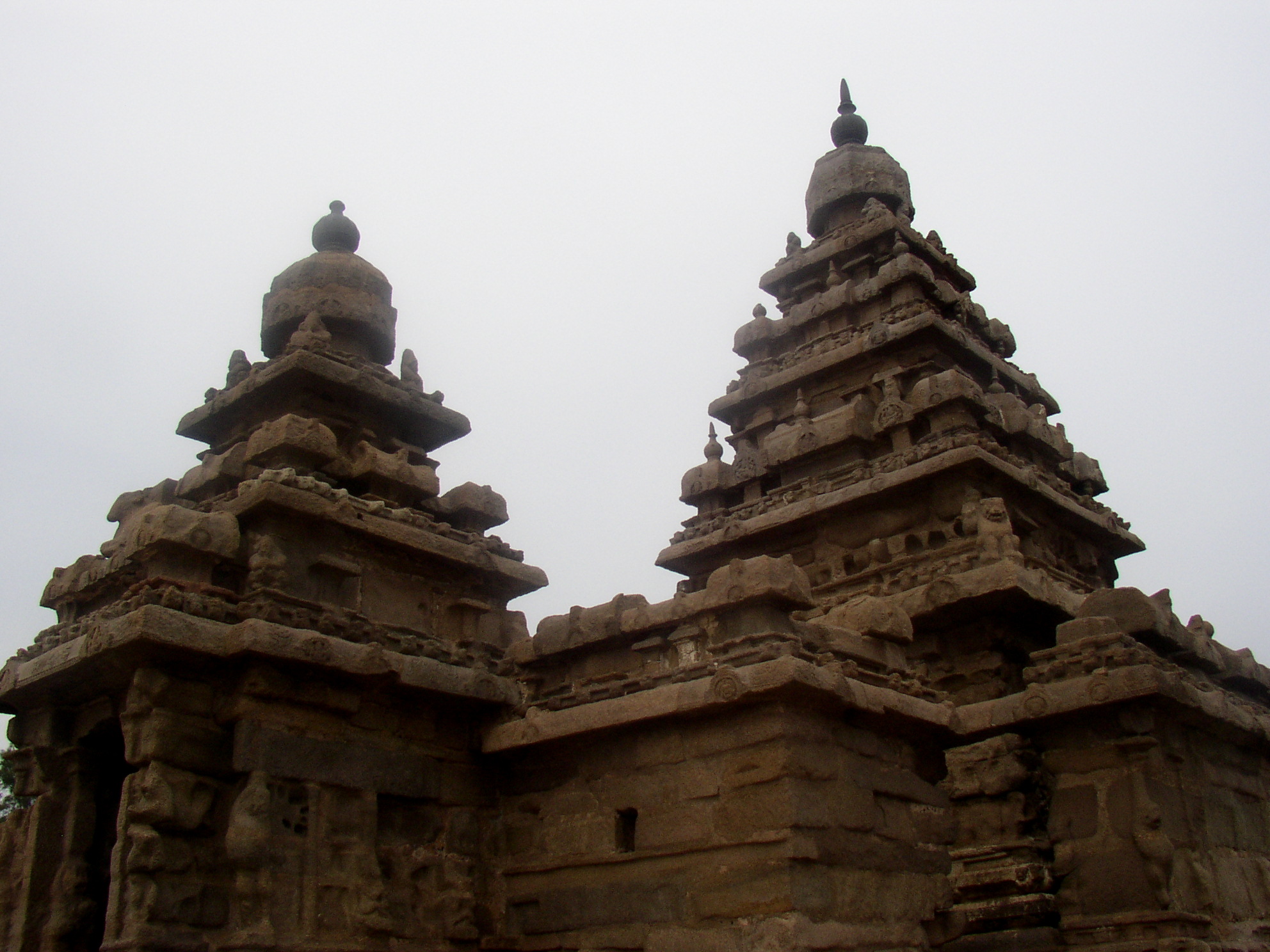
give new form of expression at every place, which is different from the other. At Tiruppōrūr Rājasiṃha gives his titles. At Vāyalūr he gives a list of geneology of the Pallavas, which is a unique record in the history of India and which proves beyond doubts, the historic leanings of Rājasiṃha. At Seashore he exhorts all kings to obey him. At Paṉamalai, he speaks of the Aśvamedha sacrifices performed by his ancestors. At Śāluvaṅkuppam he speaks of his Prowess as Atiraṇacaṇḍa and his attainment in music. At Kailāsanātha, he gives his great parentage and speaks of his magnificent creation. At Gaṇeśaratha he gives his Vedantic leaning. In all these monuments he shows his devotion to Śiva. He gives new names to his monuments. Thus Kailāsanātha temple is known as Rājasiṃha Pallaveśvaragṛham. Of the two towers of the seashore temple one is called Kṣatriyasiṃha Pallaveśvaragṛham and the other is called Rājasiṃha Pallaveśvaragṛham. The third is called Talāśayana Perumāl Temple. The Śāluvaṅkuppam bears the title of Adiraṇacaṇḍa Pallaveśvaragṛham. Thus every aspect, the palaeography the architecture, and the inscription point to the fact that these monuments could be ascribed to only one king and that is ATYANTAKĀMA RĀJASIṂHA and no one else.
This also explains why these monuments were left unfinished. If it is stated that Narasiṃha-I started and Parameśvara-I continued and consecrated, it does not explain why all these monuments are left unfinished. The question also arises, why Rājasiṃha who had a long and peaceful life and who was a lover of art, did not complete the magnificent creation of his ancestors? But when it is taken that Rājasiṃha is the author of them it is evident that due to the set back in the regular line of the Pallavas after him and since Kāñci was captured thrice by Cālukya Vikramāditya-II and since the best of the artists were transported to Paṭṭadakkal to erect the Virūpākṣa temple, the work at Māmallapuram ended abruptly.It is accepted by common consent that all the other monuments are the creations of the same king, who created the monoliths. THUS IT IS PROVED BEYOND ALL REASONABLE DOUBTS THAT MĀMALLAPURAM MONUMENTS ARE THE CREATIONS OF KING ATYANTAKĀMA RĀJASIṂHA. It is also wrong to suggest that Rājasiṃha misappropriated the monuments of his ancestors and caused his titles to be inscribed. A study of his character will prove the calumny of the suggestion. Further there is no evidence to show that these were started by other kings.
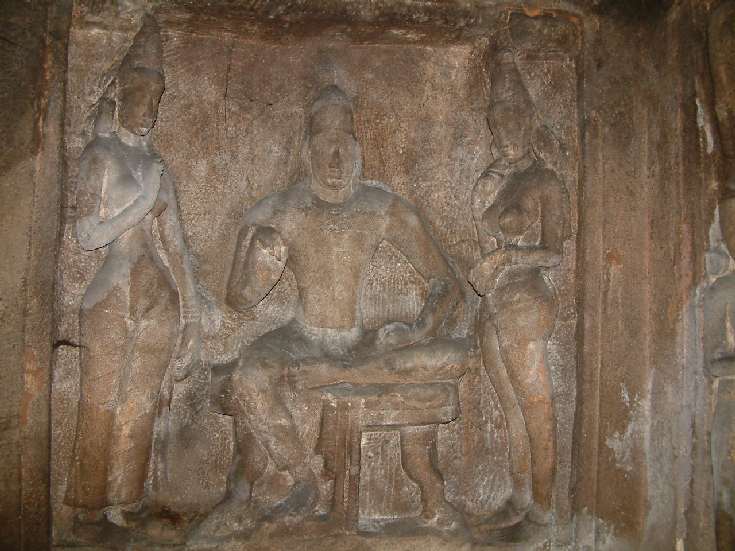
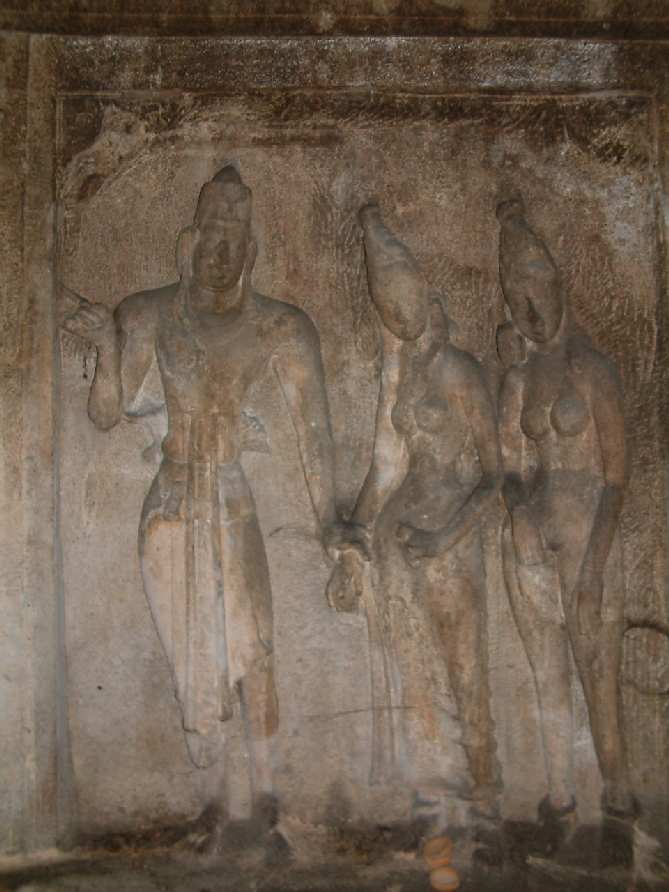
Ādivarāha CaveSiṃhaviṣṇu-PotrādhirājarYet there is one more point which needs clarification. The Ādivarāha cave at Māmallapuram, bears the title of Parameśvara Mahāvarāha Viṣṇu gṛha according to Cōḻa inscription. This cave is therefore ascribed to Parameśvaravarman-I. It contains with other sculptures two portraits of kings, one standing and the other seated with label inscriptions. The label on the top of the seated king with his consort, mentions Siṃhaviṣṇu-potrādhirājar and the one over the standing king mentions Mahendra Potrādhirājar.
Since all these monuments are ascribed to Narasiṃhavarman-I. earlier scholars identified the standing king with Mahendravarman-I, the father of Narasiṃha-I. Since Narasiṃha-I, also had the title of Narasiṃhaviṣṇu in his Vātāpi inscription, the seated figure was identified with Narasiṃha-I. But it is almost impossible to believe that the great Pallavas could depict the father standing and the son seated, which is against tradition and culture. Therefore some scholars identified the seated Siṃhaviṣṇu with that of Siṃhaviṣṇu, the father of Mahendra and the celebrated founder of the Pallava dynasty at Kāñci. But from the inscription we learn that the cave was named Parameśvara Mahavarāha Viṣṇugṛha. On this basis some scholars ascribe the excavation of the cave to Parameśvaravarman-I and identify the portraits as that of Narasiṃha-I and his son Mahendra-II. Since Mahendra-II was the father of Parameśvara-I this explanation was logica. But according to the present study, a better explanation becomes possible. One of the favourite verse of Rājasiṃha found at Gaṇeśa ratha, Dharmarāja maṇḍapa and Rāmānuja maṇḍapa, is also found here inscribed in which he exhorts the praise of Śiva.
Though Rājasiṃha was a great Śivabhakta, he was no bigot of Viṣṇu as is proved by the Varāha cave, the Mahiṣāsuramardinī cave, the Govardhandhari sculpture and the shore temple. In Reyuru Copper plate grant of the same king, we find that Rājasiṃha calls himself Paramamāheśvara, Paramabrahamaṇya, and Paramabhāgavata. Since one of his inscription mentioned above is repeated here also, the Ādivarāha cave must also be ascribed to him. The very fact that the praise of Śiva is inscribed in the Viṣṇu cave clearly indicates, that it was excavated by Rājasiṃha. Therefore the seated Siṃhaviṣṇu is none other than Rājasiṃha himself. His title as Narasiṃha-Viṣṇu is well known in the Rangapatāka inscription.देवे जगद्वलयरक्षणबद्धदीक्षे निर्भिन्नशत्रुहृदये नरसिंहविष्णौ ।वाल्लभ्यमूर्ज्जितमवाप्य विराजिते या निर्जित्य गर्वमिव पुष्करादेवतायाः ॥deve jagadvalayarakṣaṇabaddhadīkṣe nirbhinnaśatruhṛdaye narasiṁhaviṣṇau ।vāllabhyamūrjjitamavāpya virājite yā nirjitya garvamiva puṣkarādevatāyāḥ । ।
Mahendra PotrādhirājarThe other standing figure is therefore the portrait of Mahendravarman-III, the son of Rājasiṃha. It is well known that Rājasiṃha had a son Mahendra who erected the Mahendra varmeśvaragṛham at Kāñci at the entrance of the Kailāsanātha temple. Judging from the inscription engraved in Mahendravarmeśvaragṛha it is understopod that Rājasiṃha was still ruling when the temple was erected. The plan, the entrance and the rows of small shrines in line with the entrance suggest, Mahendra’s shrine was an integral part of the master plan of the Kailāsanātha temple of Rājasiṃha. It is therefore evident that Rājasiṃha associated his son Mahendra in this temple building activity. The portrait of the seated king at the back of the Mahendra’s shrine has been identified as Mahendra III the builder of the temple.
But a careful study of the inscription will reveal that Rājasiṃha gives his own attainment and simply mentions Mahendra as his son and that the temple was erected by Mahendra. It is therefore certain that the portrait at the back wall, is that of Rājasiṃha, shown as facing his favourite diety Rājasiṃheśvara.Therefore the standing portrait at Ādivarāha cave is Mahendra III, the son of Rājasiṃha. As I have pointed out earlier Rājasiṃha himself had the title of Parameśvara and hence there is no difficulty with reference to the name of the temple as Parameśvara Mahāvaradha Viṣṇugṛha.On the basis of the above conclusion and on the basis of a re-examination of the historic inscription of Vaikuṇṭhaperumāḷ temple of Kāñci, which seems to be a doubtful one, I am inclined to believe that even the Vaikuṇṭhaperumāḷ temple was the creation of Rājasiṃha. Rājasiṃha has built a shore temple for Anantaśāyī and also Varāha, and Ādivarāha caves, dedicating to Viṣṇu. This ambitious king would have naturally thought of a Viṣṇu temple in his own capital Kāñci, on the lines of Kailāsanātha temple and such a shrine could naturally be only VAIKUṆTHANĀTHA and that we have in Kāñcipuram.
Conclusions
That structural temples of stone existed prior to Mahendra in Tamilnād.
Though rock cut cave was known to the Tamils, Mahendra had a great fancy for it and was responsible for popularising it.
Māmallapuram was probably established as a seaport by Narasiṃhavarman-I, but the monuments did not come into existence during his reign.
The monuments of Māmallapuram were the creations of Rājasiṃha a king of unlimited fancies.
The view that these monuments were started by Narasiṃha-I and were continued by Mahendra-II and by Parameśvara-I when the work stopped because of the emphasis on structural temple, is therefore untenable.
a) The greatest event in the life of Narasiṃha-I is the conquest of Vātāpi which is not mentioned in any of the Māmallapuram inscriptions.
b) The greatest event in the life of Parameśvara-I is the conquest of Raṇarasika Vikramāditya which is also not mentioned in any of the Māmallapuram monuments.
c) The inscriptions found at Gaṇeśaratha, Rāmānuja maṇḍapa and Dharmarāja maṇḍapa are in fact repetitioins of Rājasiṃha’s inscriptions o Śāluvaṅkuppam.
d) Therefore there is no inscription of either Narasiṃhavarman - I or Mahendra - II or Parameśvara -I at Māmallapuram
The title Atyantakāma appearing on many of the monuments of Māmallapuram is the exclusive title of Rājasiṃha as is proved from his other inscriptions.
Out of 32 titles inscribed at Dharmarāja ratha, 16 of them are repetitions of Rājasiṃha’s titles found at Kāñcipuram.
A study of Rājasiṃha’s character proves that he was a peace loving king and lover of Art and literature. He was a king of unlimited imagination. That is perhaps the reason why a number of monuments carved here, do not correspond to any Āgamic discriptions.
That Rājasiṃha was a lover of great variety is proved from his
a) Employment of five varieties of scripts,
b) Varieties of inscriptions;
c) Varieties of Architecture; and
d) Varieties of sculptures.
While all the other kings were torn between wars, Rājasiṃha alone was free from war and had a peaceful reign.
Soon after him the Pallava rule received a set back and Nandivarman is said to have usurped the throne. Nandi was also driven out of Kāñci by Vikramāditya-II. Vikramāditya probably removed the best artists to Paṭṭadakkal for building the Virūpākṣa temple. After the death of Parameśvara II, the Pallava Kingdom, witnessed general confusion and war, through out the reign of Nandivarman. This explains why most of the monuments were left unfinished.
The Ādivarāha cave was also excavated by Rājasiṃha and that the portraits there are of Rājasiṃha and his son Mahendra-III;
Vaikuṇṭhaperumāḷ temple of Kāñci was also probably built by Rājasiṃha, since the inscription in the temple is a doubtful one.
APPENDIX I.The title of Atyantakāma being found in monuments that are definitely attributed to Rājasiṃha by all scholars.For others:- NilVātāpi and Tirukkaḻukuṉram inscriptions which are the only inscriptions of Māmalla Narasiṃha-I, do not mention this title of him.
Kūram plate of Parameśvara-I does not mention this title of the king.There is no record by which this title of Atyantakāma could be attributed to either Narasiṃha-I or Parameśvara-I.APPENDIX 2.EXPRESSION OF VARIETY BY RĀJASIṂHAVariety in script:- 5 varieties at Kāñci and2 varieties at Śāluvaṅkuppam.Variety in structures:- Śāluvaṅkuppam caves.Sea shore temple.Kailāsanātha temple in the plain.Paṉamalai temple in the hills.Mukundanāyaṉār temple.Variety in inscription:- Vāyalūr, Kāñci, Paṉamalai, Tiruppōrūr and Māmallapuram.Compare varities in Māmallapuram:- (a) Rock cut caves. (b) Monoliths. (c) Open air sculptures. (d) Structural temples. (e) Misc. cuttings.
APPENDIX 3SOME SIGNIFICANT TITLES OF RĀJASIṂHA:- Compare with this his title AtyantakāmaAPPENDIX 4.MONUMENTS OF MĀMALLAPURAM:- Each is different from the other.(Compare with this his titles. Atyantakāma, Anekopāyaḥ and Upayanipuṇah)From the foregoing conclusions, it is evident that Atyantakāma Rājasiṃha, the author of all the Māmallapuram monuments and inscriptions, is the noblest king that the Tamil country has ever produced. He is indeed one of the greatest sons of Mother India, who delighted in art, music, literature, valour and above all in peace and dprosperity of his people. Rājasiṃha’s attainment in the field of art is unparalleled in the history of India. It is indeed a pity that this noble Hindu monarch, has not been given an honoured place in the history of India. Let us do him justice by giving him, an exalted place in the history of the nation. (* The above forms part of a monograph on this greatest Pallava prince, to be published shortly by the author.)
Inscription on the Southern Wall of the Atiraṇacaṇḍeśvara Temple Śāluvaṅkuppam.श्रीमातो त्यनत कामस्य द्विषद्दर् पापहारिणः ।श्रीनिधेः काम रागस्य हराराधन संगिनः ॥ १अभिषेक जलापूर्णे चित्र रत्नाम्बुजाकरे ।आस्ते विशाले सुमुखः शिरः सरसि शङ्करः ॥ २तेनेदं कारितं शंभोर् भवनं भूतये भुवः ।कैलास मन्दरनिभं भृभृतां मूर्ध्नि तिष्टता ॥ ३भक्ति प्रह्वेण मनसा भवं भूषण लीलया ।दोष्णा च यो भुवन्धत्ते जीयात्स श्रीभरश्चिरम् ॥ ४अतिरणचण्डः पतिरवानिभुजाम् अतिरणचण्डेश्वरम् इदम् अकरोत् ।इह गिरितनयागुहगणसहितो नियतकृतरतिर्भवतु पशुपतिः ॥ ५गुर्व्वाम् ईशान भक्तिं श्रियमति शयिनीं दुर्व्वहं भारमुर्व्व्यानिस्सामान्यञ्च दानं सममति र णचण्डाख्यया यो बिभार्ति ।स्थाने निर्म्मापितेस्मिन्विदि तरण जयख्यातिना तेन भ र्त्ताभूतानाम् अष्टमूर्त्तिश् चिरम् अतिरणचण्डेश्चरे यातु निष्टाम् ॥ ६अ नुग्र शीलः ॥यदि न विधाता भरतो यदि न हरिर्न् नारदो न वा स्कन्दः ।बोद्धुं क इवसमर्त्थस् संगीतं कालकालस्य ॥ ७ओम् ॥ समरधनञ्जयः संग्रमधीरः ॥ ओम्
(Verses 1 and 2) Just as in a large lake filled with water which is fit for bathing, and covered with various lotus flowers, handsome Śaṅkara (Śiva) abides on the large head-sprinkled with the water of coronation and covered with bright jewels—of the illustrious Atyantakāma, who deprives his enemies of their pride, who is a receptacle of wealth, who possesses the charm of Cupid and who assiduously worships Hara (Śiva).3. For the welfare of the earth, he who stands at the head of the lords of the earth, caused to be made this house of Śambhu (Śiva), which resembles Kailāsa and Mandara.4. May Śrībhara be victorious for a long time, who bears Bhava (Śiva) in his mind which is filled with devotion, and bears the earth on his arm like a coquettish embellishment!5.Atiraṇacaṇḍa, the lord of the rulers of the earth, made this (temple called) Atiraṇacaṇḍeśvara. May Paśupati (Śiva), attended by the mountain-daughter (Pārvatī) and troop of Guhas, always take delight (in residing here!
6. May the eight-formed lord of beings (Śiva) for a long time take up his abode in this temple called Atiraṇacaṇḍeśvara which was caused to be built by him, who together with the name of Atiraṇacaṇḍa bears deep devotion to Īśāna (Śiva), abundant prosperity, the heavy burden of the earth and unequalled liberality, and who is famed by the name of Raṇajaya!Anugraśīla (the gentle-minded)7. Who will be able to understand the music of Kālakāla, if it were not Vidhātṛ (Brahman) Bharata, Hari, Nārada or Skanda?Samaradhanañjaya (the conqueror of wealth in battle) Saṅgrāmadhīra (the firm in war.)Inscription on the Northern Wall of the Atiraṇacaṇḍeśvara Temple, Śāluvaṅkuppam.श्रीमातोत्यनतकामस्यद्विषद्दर्प्पाफारिणः । श्रीनि-धेः कामरागस्य हराराधनसंगि-नः ॥ १अभिषेकजलापूर्णे चित्ररत्नां-बुजाकरे । आस्तेविशाले सुमुखः शिरस्सर-सि शङ्करः ॥ २तेनेदं कारितं शंभोर्भव-
bhaktiprahveṇa manasā bhavaṁ bhūṣaṇalīlayā ।doṣaṇa ca yo bhūvo bhāraṁ jīyātasaśrībharaściram । ।atyantakāmo nṛpatirnnirjitārātimaṇaḍalaḥ ।khyāto raṇajayaḥ śambhostenedaṁ veśma kāritam । ।ñjaḥ sthāṇurnniṣkalaḥ somaḥ pāvakātmā viyadvapuḥ ।bhīmaḥ śivo vijayatāṁ śaṅkaraḥ kāmasūdanaḥ । ।rājarājo na virasaścakrabhṛnna janārddanaḥ ।tārakādhipatiḥ svastho jayatāttaruṇāṅkuraḥ । ।śrīmatotyantakāmasya dviṣaddarppāpahāriṇaḥ ।śrīnidheḥ kāmarāgāsya harārādhanasaṅginaḥ । ।abhiṣeka jalāpūrṇṇe citraratnāmbujākare ।āste viśāle sumukhaḥ śirassarasi śaṅkaraḥ । ।tenedaṁkāritantuṅgandhūrjjaṭermmandira gṛha ।prajānām iṣṭa siddhayartthe śaṅkarīṁ bhūtimicchatā । ।। । oṁ । ।। । atyanatakāmapallaveśvaragṛham । ।dhikteṣāndhikteṣāmpunarapi dhigdhigdhigastu dhikteṣām ।yeṣānnavasati hṛdaye kupathagativimokṣako rudraḥ । ।TRANSLATION(Verse 1) May (Śiva) the destroyer of Love, who is the cause of production, existence and destruction (but is himself) without cause, fulfil the boundless desires of men!
2. May he (Śiva) be victorious, who is without illusion and possessed of manifold illusion, who is without qualities and endowed with qualities, who is existing by himself and is without superior, who is without lord and the highest lord!3. Śrīnidhi bears on his head the unborn (Śiva), by the weight of whose great toe Kailāsa together with the ten faced (Rāvaṇa) sank down into Pātāla.4. May Śrībhara be victorious for a long time, who bears Bhava (Śiva) in his mind which is filled with devotion, and bears the earth on his arm like a coquettish embellishment!5. King Atyantakāma, who has subdued the territories of his foes, is famed (by the name of) Raṇajaya:—he caused to be made this house of Śambhu (Śiva)6. May he be victorious, who is both sentient and motionless (Sthāṇu), who is both undivided and the moon, who is both fire and air, who is both terrible (Bhīma) and kind (Śiva), who is both the cause of prosperity (Śaṅkara and the destroyer of Love!
7. May Taruṇāṅkura be victorious, who is a king of kings, but is not ugly (like Kubera) who is an emperor, but does not distress people (while Viṣṇu as both Cakrabhṛt and Janārdana) who is the lord of protectors, but healthy (while the moon is the lord of stars, but is subject to eclipses)!(8 and 9) Just as in a large lake filled with water which is fit for bathing, and covered with various lotus-flowers, handsome Śaṅkara (Śiva) abides on the large head sprinkled with the water of coronation and covered with bright jewels—of the illustrious Atyantakāma who deprives his enemies of their pride, who is a receptacle of wealth, who possesses the charm of Cupid, and who assiduously worships Hara (Śiva.)10. He, desiring to attain the glory of Śaṅkara (Śiva), caused to be made this lofty dwelling of Dhūrjaṭi (Śiva) in order to procure the fulfilment of their desires to his subjects.11. Six times cursed be those, in whose hearts does not dwell Rudra (Śiva), the deliverer from the walking on the evil path! The temple of Atyantakāma Pallaveśvara.Inscription of the Gaṇeśa Temple, Māmallapuram.
सम्भवस्थितिसंहारकारणं वीतकारणः ।भूयाद् अत्यन्तकामाय जगतां काममर्दनः ॥ १ ॥अमायश्चित्रमायोसावगुणो गुणभाजनः ।स्वस्थो निरुत्तरो जीयादनीशः परमेश्वरः ॥ २ ॥यस्याङ्गुष्ठभराक्रानतः कैलासः सदशाननः ।पातालम् अगमद् भूर्ध्ना श्रीनिधिस्तम्भिभर्त्यजम् ॥ ३ ॥भक्तिप्रह्वेण मनसा भवं भूषणलीलया ।दोषण च यो भूवो भारंजीयातस श्रीभरश्चिरम् ॥ ४ ॥अत्यन्तकामोन् ऋपतिर्न्निर्जितारातिमणडलः ।ख्यातो रणजयः शम्भोस्तेनेदं वेश्म कारितम् ॥ ५ ॥ञ्जः स्थाणुर्न्निष्कलः सोमः पावकात्मा वियद्वपुः ।भीमः शिवो विजयतां शङ्करः कामसूदनः ॥ ६ ॥राजराजो न विरसश्चक्रभृन्न जनार्द्दनः ।तारकाधिपतिः स्वस्थो जयतात्तरुणाङ्कुरः ॥ ७ ॥श्रीमतोत्यन्तकामस्य द्विषद्दर्प्पापहारिणः ।श्रीनिधेः कामरागास्य हराराधनसङ्गिनः ॥ ८ ॥अभिषेक जलापूर्ण्णे चित्ररत्नाम्बुजाकरे ।आस्ते विशाले सुमुखः शिरस्सरसि शङ्करः ॥ ९ ॥तेनेदङ्कारितन्तुङ्गन्धूर्ज्जटेर्म्मन्दिरगृहम् ।प्रजानामिष्टसिद्धयर्त्थे शङ्करींभूतिमिच्छता ॥ १० ॥धिक्तेषान्धिक्तेषाम्पुनरपि धिग्धिग्धिगस्तु धिक्तेषाम् ।येषान्न वसति हृदयेकुपथगतिविमोक्षकोरुद्रः ॥ ११॥ अत्यनतकामपल्लवेश्वरगृहम् ॥
Fragment of an inscription at the Rāmānuja maṇḍapa, Māmallapuram.धिक्तेषान्धिक्तेषाम्पुनरपि धिग्धिग्धिगस्तु धिक्तेषाम् ।येषान्न वसति हृदयेकुपथगतिविमोक्षकोरुद्रः ॥dhikteṣāndhikteṣāmpunarapi dhigdhigdhigastu dhikteṣām ।yeṣānna vasati hṛdayekupathagativimokṣakorudraḥ । ।Inscription at the Ādivarāha cave at Māmallapuram.धिक्तेषान्धिक्तेषाम्पुनरपि धिग्धिग्धिगस्तु धिक्तेषाम् ।येषान्न वसति हृदयेकुपथगतिविमोक्षकोरुद्रः ॥dhikteṣāndhikteṣāmpunarapi dhigdhigdhigastu dhikteṣām ।yeṣānna vasati hṛdayekupathagativimokṣakorudraḥ । ।1. Percy Brown, Indian Architecture (Buddhist and Hindu), 3rd ed. (Bombay, 1956). 2. O. C. Gangoly, J. Goswamy and N. Ramakrishna The Art of the Pallavas (Calcutta, 1957). 3. G. Jouveau-Dubreuil, The Pallavas (Madras 1907). 4. G. Jouveau-Dubreuil, Dravidian Architecture (Madras, 1917). 5. G. Jouveau-Dubreuil, Pallava Antiquities, 2 vols. (Pondicherry, 1916 and 1918). 6. G. Jouveau-Dubreuil, Archéologie du sud de I’lnde (Paris, 1924). 7. St Kramrisch, The Hindu Temple, 2 vols. (Calcutta, 1946).
8. H Kṛṣṇa Sastri, The Statues of Pallava Kings and five Inscriptions in a rock temple at Mahābalipuram, Mem. Arch. Surv. Ind., No. 26 (Calcutta, 1926). 9. A. H. Longhurst, Pallava Architecture, 3 pts., Men. Arch. Surv. Ind., Nos. 17, 33 and 40 (Simla, 1924, Calcutta, 1928 and 1930). 10. C. Minakshi, The Historical Sculptures of the Vaikuṇṭhaperumāḷ Temple, Kāñci. Mem. Arch. Surv. Ind., No. 63 Delhi, 1941). 11. T. N. Ramachandran, ‘The royal artist Mahendravarman I’, Jour. Oriental Research, Madras, VII (1933), pp. 219–46. 12. A. Rea, Pallava Architecture Arch. Surv. Ind., New Imperial Series, XXXIV (Madras, 1909). 13. H. Zimmer, The Art of Indian Asia, 2 vols. (New York 1955). 14. Fergusson History of Indian and Eastern Architecture. 15. Hultsch, South Indian Inscription. Vol. I. 16. K. R. Srinivasan, Ancient India No. 14. 17. C. Śivarāmamūrti, Mahābalipuram.2. Epigraphia India, Vol. XVII. Page 17.3. Fergusson, Op. cit.4. Dubreuil, Pallava Antiquities. Vol. I. Page. 76.5. S.I.I. Vol. I. No. 24.6. S.I.I. Vol. 1.7. Perumbānaṛṛuppadai. Line. 319.)8. Pandit Raghava Ayangar, Āḻvārgal Kālavaralaru.
9. Avantisundarīkathā.10. Tirumaṅgai Āḻvār, Divya Prabandham. (1088-1107, 1995, 1551, 2050, 2060.)11. S. I. I. Vol. I.12. Ibid.13. Ibid No. 2114. Dubreuil. Op. cit.15. Ibid. plate. XXVIII.16. K. R. Srinivasan. Ancient India, No. 14. pl. XLIX.17. Annual Report on Epigraphy. 65 of 1907 pt. II para 5.18. A. R. E. 961 of 1913.19. C. Śivarāmamūrti. Mahābalipuram.20. Epigraphia Indica, Vol. XVIII - 145.21. S. I. I. Vol. I. 24.22. A. R. E. 961 of 1913.23. S. I. I. Vol. I. 21.24. E. I. XVIII. 145.25. S. I. I. Vol. XII, 27, A. R. E. No. 76 of 1909.26. S. I. I. Vol. I.27. Indian Antiquary. Vol. IX. P. 100.28. E. I. Vol. III. Pp. 277 - 280.
29. S. I. I. Vol. I. No. 151.30. S. I. I. Vol. II. NO. 98.31. Ibid. No. 73.32. Ibid. No. 74.33. F. H. Gravely and T. N. Ramachandra The three main styles of Indian temple Architecture. Page 18 - 19.** A. H. Longhurst in his Pallava Architecture divides the Māmallapuram monuments into four periods as (1) Mahendra style (610-640 C.E.), (2) Māmalla style (640-670 C.E.), (3) Rājasiṃha style (674-800 C.E.) and (4) Nandivarman style (800-900 C.E.) But Sri K.R. Srinivasan in his recent studies divides the periods into three as (1) Mahendra style; (2) Māmalla style; and (3) Parameśvara-I’s style.
Series Editor’s PrefaceThere are 911 sites on the World Heritage List, as on July 2010, ‘inscribed’ as properties by the World Heritage Committee of United Nations Educational, Scientific and Cultural Organization (UNESCO). The list includes: 704 cultural, 180 natural, and 27 mixed sites in 151 States Parties. These are ‘considered to be of outstanding value to humanity’, and belong to all mankind. The preservation of this shared heritage concerns all of us. India is an active member-state on the World Heritage Forum since 1977, and is one of the countries on the list, with 28 World Heritage Sites. Of these, 23 are recorded as cultural sites, while the rest are natural sites.I am delighted that the Oxford University Press is publishing brief books on each of the 23 cultural sites, under its series titled Monumental Legacy. So far, the following cultural sites of India have been listed as World Heritage Sites:
Ajanta Caves (1983), Ellora Caves (1983), Agra Fort (1983), Taj Mahal (1983), Sun Temple, Konark (1984), Group of Monuments at Mahābalipuram (1985), Churches and Convents of Goa (1986), Group of Monuments at Khajuraho (1986), Group of Monuments at Hampi (1986), Fatehpur Sikri (1986), Group of Monuments at Paṭṭadakkal (1987), Elephanta Caves (1987), Bṛhadīśvara Temple, Thanjavur (1987), extended to include under ‘Great Living Cōḻa Temples’, Gaṅgaikoṇḍacōḻapuram and Dārāsuram (2004), Buddhist Monuments at Sanchi (1989), Humayun’s Tomb (1993), Qutb Minar and its Monuments (1993), the Darjeeling Himalayan Railway (1999) extended to include under ‘Mountain Railways of India’, the Nilgiri Mountain Railway (2005) and Kalka Shimla Railway (2008), Bodh Gaya (2002), Rock Shelters of Bhimbetka (2003), Champaner-Pavagadh Complex (2004), Chhatrapati Shivaji Terminus, formerly Victoria Terminus (2004), Red Fort Complex (2007), and Jantar Mantar, Jaipur (2010).There is scope, indeed, for recognition of many more Indian sites in future on the World Heritage list. I am sure that as, and when, these are declared as World Heritage Sites, they will be included under the Monumental Legacy series of the Oxford University Press.
The Oxford University Press, in consultation with me, has invited the experts in the field to contribute small books, addressed to general readers, on each of these 23 cultural sites in India. These books obviously differ from cheap tourist books and glossy guide books and, at the same time, also from specialized monographs. Their importance lies in the fact that they are written by authorities on the subject to enable visitors to see the monuments in proper perspective.I record my sincere thanks to all the authors of the series and to the editorial staff at the Oxford University Press. Their constant support and enthusiasm is much appreciated.September 2010 — Devangana Desai
Preface and AcknowledgementsMāmallapuram situated on the seashore is essentially an ocean of artistic aspiration of a Pallava king, Rājasiṃha (700 CE) who called himself an ‘Ocean of Arts’, kalā samudraḥ. He was no doubt steeped in Indian religious ethos, myths and legends, music and dance and all the finer things in life. To express them he assumed different titles that are found engraved at Māmallapuram and Kāñcīpuram. But it was his creative genius in the field of poetry—both visual and verbal (dṛśya kāvya and śravya kāvya) that exemplified in his sculptural art. I have had the good fortune of studying this magnificent group of monuments for the past fifty years and more in the company of most outstanding scholars like A.L. Basham, C. Śivarāmamūrti, K.R. Srinivasan and others and also a galaxy of renowned dignitaries from all parts of the world both in my official and private capacity. I was always stunned by the spontaneous response from viewers of these creations. They invariably said, ‘No doubt these are world class art creations’. As a student of classical Sanskrit, the inscriptions on the monuments also fascinated me by their beauty and suggestions that speak of Rājasiṃha’s love of poetry, arts, music, and dance.
I was overjoyed when the Oxford University Press invited me to write a book on this World Heritage Site as a part of Monumental Legacy series. I express my profound thanks to the editors at the Press for the successful fruition of this venture. It was Devangana Desai who first suggested that I should write on this site and encouraged me to undertake this work and also made valuable editorial suggestions that I cherish very much and am beholden to her for this opportunity. All the photographs used in this work barring two were specially taken by my son Mohan Nagaswamy and grandson Vishnu Mohan with understanding and devotion they deserve appreciation. The Director General of Archaeological Survey of India and Director General of the American Institute of Indian Studies have very kindly accorded permission to reproduce some of the drawings and plans in this work for which I am grateful to them.The book I am sure would be read with keen interest by students and professors as well as visitors to the site.
About This EditionBuilt in 700 CE, Mahābalipuram (Māmallapuram) is a unique monument that combines art form with religion and legends, and showcases the best of Tamil art and architecture. Part of the prestigious Monumental Legacy series, this book presents a graphic account of the site and its monuments—maṇḍapas (cave temples), rathas (chariots), open air bas-reliefs, and structural temples. Arjuna’s penance to obtain Pāśupata astra, Goddess Durgā’s victory over Mahiṣāsura, Viṣṇu’s incarnation as Varāha, Kṛṣṇa lifting the Govardhana Hill—all familiar legends come alive in Mahābalipuram. The author also surveys other related sculptures, panels, inscriptions, as well as the shore temple.Well illustrated with layout plans, maps, and photographs, this book will be indispensable for general readers and informed tourists visiting the site. Students and scholars of history, cultural studies, and arts and architecture will find the work interesting.R. Nagaswamy was Vice Chancellor, Kāñcīpuram University and retired as Director, State Department of Archaeology, Tamil Nāḍu.
“Nagaswamy’s work is … a labor of love. His painstakingly detailed account of Mahābalipuram and its monuments takes the reader on a visually evocative tour and, at the same time, enables an appreciation of the grandeur and beauty involved.” — H-AsiaCover photograph: Dharmarāja ratha, Mahābalipuram. Courtesy Mohan Nagaswamy and Vishnu Mohan. Oxford India Paperbacks • Oxford University Press • ISBN 0-19-807127-2
1. Māmallapuram (Mahābalipuram)Shore Temple and coastal skyline at Māmallapuram (Mahābalipuram)The ancient name*1 of the coastal town Māmallapuram was “Mallai”. The word Mallal in Tamil stands for “Prosperity”. The town situated on the coast, had backwaters, entering deep into the township at its western end that made possible heavy boats and small ships laden with goods to enter and anchor on its shores providing a natural port environment. Early Tamil literature alludes to the prosperity of the town with ships that enter and leave the port with commodities. It is evident that from the very beginning of its history Mallai was a prosperous commercial port, especially with its overseas trade.
There are large salt pans manufacturing salt from sea water, both on the north and south of Māmallapuram. Some of these salt pans, bore the names of the then ruling Cōḻa monarchs in mediaeval times. Salt production was a royal prerogative in ancient times. In mediaeval times production of salt seems to have been carried out even in Māmallapuram as seen from an inscription which refers to an ‘Alam’ in the Village.The port town was mainly connected to Kāñcīpuram, the capital of the Pallavas. Kāñcīpuram was the most important city in the northern part of Tamil Nāḍu for over two thousand years, before the 17th cent, when Madraspattanam (modern Madras) began assuming importance with the advent of the British East India Company. Māmallapuram was connected to Kāñcīpuram by two routes - one the inland route, via Tirumukkūḍal and Thirukkalukkundram and the second was by a waterway. The river Palaru (Milky River) which skirting Kāñcī reaches the Bay of Bengal at a place called Vāyalūr (entreport) about ten km. south of Māmallapuram. Reaching Vāyalūr from Kāñcī through the river way, one can reach Māmallapuram covering the short distance by the coastal way.
Pallava monuments, especially of Rājasiṃha, the creator of the monuments, are found on both the routes from Kāñcī, at Thiru-kaluk-kundram where there is a lofty hill of Vultures with a Śiva temple and a structural temple built on top of the hill (Also nearby is a place Vallam, where two excavated cave temples of Mahendra Varman I, circa 600 C.E are found). At Vāyalūr on the coast, there is an old Śiva temple, which has a Pallava Pillar built into the entrance gateway, that lists 54 generations of Pallava rulers, beginning from mythical Brahmā, down upto the reign of Rājasiṃha, the builder of Māmallapuram. It has been suggested that this pillar was intended to perpetuate the coronation of Rājasiṃha. Māmallapuram’s trade connection with the Pallava capital ought to have enhanced its prosperity.About twenty km to the north of Māmallapuram, on the coast way, is another ancient settlement called Tiruvidaṇṭai - a Vaiṣṇava kṣetra (Celebrated as one of the 108 Pilgrim Centres of Vaiṣṇava Faith). The visitor will see the temple on his way to Māmallapuram from Madras.Around the 5th- 6th cent, one of the Vaiṣṇavite saint, Bhūtattāḻvār was born at Māmallapuram. He was listed as one among the three early Vaiṣṇava saints (Mudal-Āḻvār-Muvar).
The character of the town, which remained essentially as a commercial town since its foundation now changed into a sacred religious center of pilgrimage. This saint, Bhūtattāḻvār, has sung about different Vaiṣṇava settlements in the South and sings Māmallapuram as well).Around the middle of the 7th century (650 C.E.) the then Pallava ruler Narasiṃhavarman I, sent a successful naval expedition to Śrī Laṅkā, in order to help his friend Mānavarman, to regain his lost Śrī Laṅkā throne. Narasiṃha Pallava, who had the title “Māmalla” it is surmised sent his naval fleet from this port town, which he renamed as Māmallapuram. Though it became a pilgrim centre, it continued to remain a commercial town as denoted by the term “Puram”. Though Māmalla’s name is associated with this town no artistic activity of either Māmalla, or his illustrious father Mahendra I is noticed in the town nor the record of his successors till we come to the reign - of Narasiṃha II around 690 C.E. are noticed. From about 690, for nearly forty years, the town changed its garb and was teaming with artists, and the visit of the king, his queens and retinue, who swarmed the place to see the magnificent creations. It was art and art and nothing else.
The purāṇic legends that filled the heart of the people so long through hearing, suddenly were springing into visual forms to the delight of the onlookers. The charming legend of Kṛṣṇa lifting the hill Govardhana, to provide shelter to the cowherds, to save them from the torrential rain let lose by Indra, the legend of Arjuna, the hero of Mahābhārata, doing severe penance on the slope of the Himalayas by the side of the great river Gaṅgā, to obtain a weapon - Pāśupatāstra - from Lord Śiva, the legend of the great victory gained by the goddess, Durgā over the arrogant buffalo headed demon, Viṣṇu assuming the form of a wild boar and plunging into the ocean to bring the submerged goddess, Mother Earth, Viṣṇu taking three strides to subdue the demon king Mahābali and that charming-goddess Śrīlakṣmī, personification of beauty, and symbol of feminine tenderness - all these legends about which people had heard of, were springing up before the eyes, casting a spell of wonder and admiration. The sound of the chisels, the movement of the fluttering horses, the majesty of the king’s retinue, the chattering of the dumb founded people no doubt ought to have made Māmallapuram a wonderland.
The joy that permeated the town for nearly forty years came to a sudden end, on receipt of the news of the king’s demise. The sound of the chisels ceased. The kings retinue hurriedly rushed to Kāñcīpuram, never to return. The work on so many monuments, initiated simultaneously, was left unfinished. Human personality is steeped in individual taste. It dies with him, difficult to be continued or replaced. The dream of the king and his aesthetic subjects remained a dream, not to be transformed into reality. One should be satisfied with what remains though all that was started remained unfinished. The glorious Pallava dynasty started tottering. A young boy of 12 years of age was chosen as king, but he had to run for his life from the onslaught of his enemies. He came back to be driven out again, even to be imprisoned. It was a struggle for a long rule, indeed the longest of 65 years known to Pallava history, but of frequent clashes - disturbances. Art springs in serene environment. Māmallapuram had lost it once and for ever. CE 730 was the terminal date of artistic collapse at Māmallapuram.1. It was only in the 16th cent that the name of the town changed into Mahābalipuram, after the name of the Demon king Mahābali who in the myth of Vāmana (dwarf incarnation of Viṣṇu) gifted three steps of lands to Viṣṇu in his cosmic form,
2. Artists and Their MaterialsPallava rock-cut excavation technique showing chisel grooves and blocked-out graniteFor the creation of such exquisite monumental art, the world is beholden to the artists under the Pallavas who were working at Māmallapuram. The question that naturally arises is whether the name of any of the artist who worked at this site is known. There is a belief that the names of Indian artists are generally not known and there is even a suggestion that there was a taboo in mentioning their names. In other words the artists did not receive due recognition in the hands of patrons. This view is not based on available records but is more a preconceived notion, for the names of some of the leading artists who worked at Māmallapuram are still preserved in inscriptions.
On the western outskirts of Māmallapuram, a little less than a kilometer away, on the high road is a hamlet of Māmallapuram now called Punceri. There are rock boulders here, among which is a low rock with a cavity that is called “Horse cistern of lame Virappan”. On the periphery of this rock, are seven labels written in old Tamil and grantha script: Catamukhyan, Kalyani, Kevaḍa–Peruntaccaṉ, Kollaṉ Seman, Kuṇa-mallaṉ, Payyam Ilippan, Namaḥ - Thiruvorriyur Abhajan.All these are personal names, but they undoubtedly indicate that they were artists. The name - Kevaḍa Parumtaccan, for example is the name of a great artist. The name in Tamil, consists of three parts. Kevaḍa is personal name, Perum i.e - great in Tamil, and Taccaṉ means - sculptor. Taccaṉ is a Prākṛt form of the Sanskrit word Takshaka, standing for a sculptor - one who chisels. The sculptors were themselves painters in remote past. Master sculptor/artists were themselves architects who were called in many inscriptions as Peruntaccaṉ. There are pointed references to great architects/sculptors as Peruntaccaṉ in 6th - 8th century epigraphical records. Many such examples could be cited that speak of the respected position given to the sculptor/artist in Tamilnāḍu, who were mostly called Perum-taccaṉ (Master artist).
It would be interesting to give a brief account of these artists before we proceed to further examine these names of Māmallapuram artists. Several royal charters of the Pallava and Pandya Kings have survived, a study of which show the artist / sculptors were held in great esteem. They were very close to the king and wrote down even highly secret orders and messages of the king. They were trusted secret scribes (Rahasyādhikṛt) in the service of the king. The kings charters show that the scribes were conferred royal titles and are mentioned as the writers of the charters. The legal treatise (Dharma-Śāstras) prescribes that the name of the scribe should be written down at the end of the document. When the kings made any gift of villages to learned brāhmaṇas, one share of the village was allotted to this sculptor /artist.It is interesting to note that Kāñcīpuram was a great centre for artists. Many records of the Pallava age mention that the artists hailed from Kāñcīpuram. They seem to have had an effective guild, to which they referred to learn about their obligations.Thus the name Peruntaccaṉ, appearing in a part of Māmallapuram, shows they were working on these monuments.
These artist sculptors belonged to five groups, often calling themselves as “the five-artisan group” - that indicate though they all were adept in sculpting work, they occasionally divided themselves after the material with which they were working such, as stone, wood, iron, gold, and ivory. Early epigraphs of the Pallava mention all these sculptor/artists worked under the king as scribes. Obviously the division was not so well marked. So we have among the names of Māmallapuram artists one Kollaṉ-Seman - a metal worker (Kollaṉ - metal worker) Another name Gunamalla seems to be a royal title confered on the artist. Payyam seems to be a skill in scooping out. Thiru-vorriyur is a famous temple centre near Chennai. The epigraphist has rightly pointed out these names, occurring at the suburb of Māmallapuram, denote that they were artisans. As these records are assignable to C.700, that they represent the Māmallapuram artists, is certain. What needs to be borne in mind is the media through which they were expressing themselves.The artists were aware of the technique of carving stone, from the pre current era. A large number of rock shelters, dating from 2nd cent before CE. are found in the Tamil Country with neatly chiselled stone beds, bearing Tamil Brāhmī inscriptions.
Many hero stones portrayring the images of heroes with their names inscribed have also come to light that date from 2-3rd cent CE. These are carved on granite slabs, in low bas relief, often in animated poses, pointing to the art of carving prevalent even at the village level. And yet it was brick and mortar, and perhaps wood that was preferred generally for construction. Most of the temples were built of brick and mortar. The image in the sanctum was made of stucco, though some Śivaliṅgas made of stone were also installed. One of the earliest Śivaliṅga in stone assignable 2nd-1st cent BCE, is found at Gudimallam in the northern borders of Tamil Nāḍu. But the preference for stucco or painting continued. A point of technique that deserves attention was the art of carving brick walls with sculptures, covering them with lime plaster and painting them. Such sculptures were chiselled on brick walls in situ, after erecting the brick walls. It is this technique of brick carving, which was transferred to stone carving from the middle of 6th cent. With the introduction of a large number of cave temples, in which rock was scooped to provide wall surface, chiselling sculptures in situ came to dominate the scene. Simultaneously soft stone was used in place of brick to erect the wall structure and carve sculpture in situ.
Be it in granite stone, sand stone or brick on which the sculpture was carved, all were plastered and painted at the end. One would find no difference between a stone temple or brick temple in the end. Artists main technique remained carving large scale sculptures in situ.The enormous labour involved in quarrying stones and transporting them to distant places was not prevalent. The rock cut caves and structural stone temples built of sand stone, found in Māmallapuram and Kāñcī stand witness to this trend. When Mahendravarman I, carved his first cave temple at Maṇḍagapaṭṭu, he exclaimed about his novel technique of carving stone in situ, stating that he dispensed with the use of brick, wood, metal and stucco. It is also known that temples built of a single material like stone was called a pure temples (“śuddha” type) while using more than one material is called mixed temple “misra” variety. The excavation of rock cut temples and sculptures could have consumed less time than structural temples of granite. The medium of their creation, being already present permanently, the artists of Māmallapuram were freer to express themselves.
3. AuthorshipSiṃhaviṣṇu panel, Ādivarāha Cave Temple, MāmallapuramMahendravarman panel, Ādivarāha Cave Temple, MāmallapuramMost of the enthusiastic visitors to the fascinating monuments at Māmallapuram and their sculpture are curious to know who the author of these creations was.
This question has dominated the visitors for the past three hundred years, and in a sense continues even now. The enquiry may be divided mainly into two periods namely prior to the discovery of the inscriptions around 1800 and post epigraphical phase. The first phase was mainly based on individual conjectures, depending upon their acquaintance with art in other places.As Māmallapuram has attracted connoisseurs for the past five hundred years, especially travellers and mariners, their acquaintance with art of other countries, made them suggest that (a) these were created by Chinese artists or (b) these were the works of Siamese (Thailand) artists or (c) they were the works of Buddhists. The Chinese source arose from the Tiger cave - which depicted the yāḻi heads that resembled the dragons. Travellers, who had seen Buddhist stūpas, almost asserted that they are the creations of Buddhist faith.However these suggestions gradually faded into oblivion when the inscriptions began to point to a local dynasty - Pallavas. As, more royal records emerged into lime light, they gave rise to a fairly recognizable frame work within which these creations could be accommodated.
Names of some powerful Pallava rulers were known among whom Mahendravarman, Māmalla Narasiṃhavarman, Parameśvara Varman and Rājasiṃha, spanning about one hundred years in the 7th and beginning of 8th cent CE.are important. A point of great interest was that Mahendra I (590-630 CE.) left a few cave temples, at other places, leaving his titles inscribed on them. And what is important is that he mentioned specifically his love for art of sculpture and painting and also creating such novel temples. Rājasiṃha 690 – 728, expressed his fascination for art by calling himself “Ocean of art” (Kalā Samudraḥ) and did leave monumental arts in a number of places. And some of these names are found at Māmallapuram monuments and thus the date of these monuments was narrowed down to the 7th and early 8th cent.Inscriptions apart, a large number of articles and guides appear from 18th to 20th centuries in which, art historians tried to distinguish stylistic differences between these monuments. The volume of literature on style swelled. Writers were weighed down by stylistic considerations and assigned a chronological development within these monuments. This tendency went at times to an extreme level, alleging that some of the inscriptions were misappropriatied.
Mahendravarman, I (590-630) was an eminent poet and a lover of arts. Among his titles the following are well known. “Citrakārapuli”-i.e.Tiger among artists, “Chettakari” i.e- builder of temples, “Vichitra–Chitta” i.e, one fascinated by rare and special arts, particularly sculpture in the round, bas-relief and paintings. “Saṅkīrṇajāti” i.e. One who could blend different classical forms. Mahendra has left two great Sanskrit farce plays that stand to this day as unique creations, ridiculing the contemporary society, particularly the religious faiths that deserved condemnation. In one of the cave temples, he inscribed that he caused the temple to be made without the use of brick, mortar, metal and wood. This exclamation made scholars to say that this was his first creation. The great art historian, Ānanda Coomaraswamy pointed out that Mahendra might have been inspired by the trend found in the Kṛṣṇa Valley of Andhradesa. This suggestion is more probable as it is seen that Mahendra assumed more Telugu titles than Sanskrit. There is a cave temple excavated by him at Pallavaram, in Madras, which carries nearly seventy titles of Mahendra, out of which 47 titles are in Telugu language. Similarly the rock cut cave on top of the Tiruccirāppaḷḷi hill, carries nearly one hundred titles of Mahendra, out of which seventy are in Telugu language.
Mahendra’s association with Telugu country is more pronounced than his successors. The Telugu region had a long tradition of sculptural art, known from Amaravati and Nāgārjunakoṇḍa Buddhist stūpas. There were also some excavated cave temples in the region. Obviously Mahendra was inspired by this tradition which he brought to the Tamil country.Mahendra’s cave temples were simple excavations, with only the dvārapālas (guardians of doors), carved on either side, that are examples of his sculptural art. One remarkable cave of Mahendra is found at Tiruccirāppaḷḷi, which has a monumental sculpture of Śiva as Gaṅgādhara. Mahendra himself has eulogised this Gaṅgādhara in a beautiful Sanskrit inscription. His simplicity of carving with the pillar being square at the bottom and top with an octagonal fluting in the middle was considered his style. The sanctum of his temples do not house any deity now, but originally had either a stucco or painted image. Though Mahendra left many cave excavations around Kāñcī, Chennai and Trichy, there is no monument of Mahendra at Māmallapuram, as no inscription of him is found there.Narasiṃhavarman I, his son and successor (630-668) was a great fighter and so assumed the little “Mahā-malla”-great fighter.
From his record, and subsequent Pallava epigraphs, it is seen that he chased the Cālukya ruler Pulakeśin, from the outskirts of Kāñcī to Vātāpi, the Cālukya capital, engaged him in a battle, killed him, and won a signal victory. He assumed the title, “the conqueror of Vātāpi” (Vātāpi Konda) and he occupied it for nearly 13 years. His defeat of Cālukya Pulakeśin, and conquest of Vātāpi are invariably mentioned in his inscriptions and in all the subsequent Pallava records, whenever they refer to him.Some of the monuments at Māmallapuram are assigned to Māmalla Narasiṃha I, by some writers on stylistic grounds. But as none of the inscriptions found at Māmallapuram refer to his conquest of Vātāpi and victory over Pulakeśin no monument of Māmallapuram could be assigned to Narasiṃha I.The third Pallava King, who, ruled in the 7th Cent with some authority was Parameśvaravarman I, father of Rājasiṃha (670-690). This Pallava king also had to keep fighting with the Cālukyas. He gives a graphic description of his battle with the Cālukyas, and the defeat he inflicted on the ruler, in his own royal charter. This significant event is mentioned in his own charter and all other records issued by his successors. He assumed the title “Raṇarasika Puramarddana” i.e.
he who destroyed the capital of Raṇarasika Vikramāditya-Cālukya. As this outstanding achievement of Parameśvara is not mentioned in any inscription at Māmallapuram, it is clear that none of the monuments could be ascribed to him.
That brings us to the King Rājasiṃha who by all accounts is the author of all the monuments at Māmallapuram. In his inscriptions he is said to have spent all his wealth on temples (Deva-Brāhmaṇa-satkṛta - atma vibhavaḥ). In all his known inscriptions one of the most significant titles – “Atyantakāma” i.e. one of endless desires or fascination is mentioned. Many of the monuments at Māmallapuram not only bear this title but also are named as “Atyantakāma–Pallaveśvara-gṛham” i.e. the Īśvara Temple of Atyantakāma. Such monuments include two cave temples and two monoliths. Further, these monuments carry inscriptions that are specifically foundation inscriptions, declaring they were his creations (tena idam karitam). Another significant title found for him in records is “Kalā-samudraḥ” i.e. Ocean of Arts. Another point of interest is his love for variety, seen in the construction of different types of temples, employment of different scripts, and different style of expressing himself. It would therefore be interesting to know the personality of the patron behind the monument which is sketched in the next chapter.
4. Rājasiṃha, the BuilderAtyantakāma Pallaveśvara Gṛham (Dharmarāja Ratha), MāmallapuramKailāsanātha Temple at Kāñcīpuram built by RājasiṃhaMāmallapuram was probably established as a port by Narasiṃha I, after his title Māmalla. There is no specific evidence to connect this association.
But all the monuments were created by Rājasiṃha who was more popular among his subject as “Māmalla” (“vidita Mahāmalla śabdaḥ prajanam”) in his inscription at Vāyalūr. Rājasiṃha’s monuments are found at Kāñcīpuram, Paṉamalai, Vāyalūr, Tiruppōrūr, Thirukkalukkundram, Daḷavānūr and Māmallapuram, all in Pallava Country and at Thiruppattur near Tiruccirāppaḷḷi. He has left excavated cave temples, cut out monoliths, open air bas reliefs, and structural temples. He employed variations in scripts, like simple Pallavagrantha, ornate Pallava grantha, Grantha in which calligraphic letters resemble birds, animals and reptiles, and finally simple and ornate Nāgarī script. Also at different places he chose different modes of expression. For example at Kāñcī he arranged over 300 of his titles in alphabetical order, and had each title written in four different scripts. At Vāyalūr, he has tabulated a list of fifty four Pallava kings, beginning from the first known king, arranged in the order of succession, till his own times. Interestingly this record begins at the bottom of a pillar, and is written spirally going up. At Śāluvaṅkuppam, we have his authorship inscription both in Grantha and Nāgarī characters. Each and every one of his known monuments is laid out differently, in plan, elevation, or distribution of sculptures.
His choice of the sites to build his monumental temples, on the top of a hill at Paṉamalai, among the plain fields at Kāñcīpuram and on the seashore at Māmallapuram, depict his fascination for natural environment.He was born to Pallava Parameśvara the conqueror of the Cālukya, Raṇarasika - Vikramāditya I and resembled Guha-Subrahmaṇya born from Parameśvara (Śiva). He calls Pallavas as pious princes, who destroyed the pride of the evil dark age (Kālī), who always spoke truth, who were profoundly learned, who knew how to practice the Trivarga, who assiduously honoured aged people, who subdued lust and other internal foes, who excelled in the knowledge of weapons and who were mighty and endowed with polity and modesty. This illusterious king Atyantakāma was well known for his great statemanship. Like Kama, he charmed refined women in secret, protected the followers of Vedic learning like Indra, he protected like lord Viṣṇu, sages from the onslaught of enemies, and like Kubera, the lord of wealth, he gifted all his wealth to good people.He probably had his first name Narasiṃha after his great grandfather and when coronated assumed the title Rājasiṃha.
He was proud of his race and was called the “Sun among the Pallavas”, an ornament to his family, and virtually the fluttering flag of his family (Vṛṣa-dhvaja) were his titles. He seems to have possesd a beautiful personality (Eka-sundara - unequalled in beauty), and had a very pleasant appearance. Rājasiṃha’s prowess is evidenced from his titles. Invincible, (Aparājita) conqueror of battles (Raṇa-jayaḥ) and an Emperor, with a vision (Cakravartī) and (Dura-darshi). He always preferred righteous path, and followed the science of rule as enjoined in ancient traditional treatises. He was a great scholar of various branches of knowledge which he followed in his rule. (Śāstra-dṛṣṭi). endowed with active habits constantly (Nityotsaha). Expert (Upāya-nipuṇa). He was an accomplished musician especially stringed instruments, the vīṇā and was likened to the great sage Nārada in playing vīṇā.He was an outstanding personality among men, who always strove for righteous conduct which he considered as his armour (Dharma-kavacaḥ)- A lion among men. He called himself the crest jewel of the city of Kāñcī (Kāñcī-mahāmaṇiḥ).He begins the string of his titles with Rājasiṃha (his coronation name), Atyantakāma (of boundless desires) and Raṇajaya-conqueror in battle.
Thus he has given himself importance to the title “Atyantakāma”, both in the verse referring to his birth and also at the beginning of the list of his over 300 titles. There are several titles that speak about his passion for arts. One of his significant title was “Ocean of Arts”. (Kalā-samudraḥ) Obviously he was inspired by his illustrious predecessor, Mahendravarma who styled himself as Tiger among artists. This he explicitly indicated by assuming a title (Mahendra-Parākramaḥ) equaled Mahendra in his achievements. His love of arts extended beyond sculptural art to music and dance, which he showed by such titles as Vadya-vidyā-dhara (Celestial musicians in playing instruments), Vīṇā Nārada and Atodya tumburu, sage Tumburu in playing musical instruments. He had a great fascination for the epics - Rāmāyaṇa and Mahābhārata (Itihāsa-priyaḥ) which also suggest that he was fond of creating history. Rājasiṃha seems to have concentrated on increasing the greatness of his country (Deśa-vardhanaḥ).In his religious leannings particularly building temples and instituting worship he strictly followed the ritual treatises called Āgamas. Atyantakāma was a great devotee of Śiva, which he mentions in every one of his record. The titles like Īśāna-śaraṇaḥ, Devadeva-bhaktaḥ, Īśvara-bhaktaḥ etc.
illustrate his Śiva bhakti. One of the oft respected titles denoting his Śaiva devotion is Śiva-chudamani, one who bears as his crest jewel. The inscription at Vāyalūr states that he was Atyantakāma - one with boundless desires in adoring the sacred feet of lord Shambu for ever (Shambhor pādāravinda dvaya paricarane nityam atyantakāma) True to this expression, most of creations at Māmallapuram and elsewhere is dedicated to Śiva. But this devotion was not against the worship of Viṣṇu or other gods, for the extreme sectarian form of worship was unknown then. Rājasiṃha himself assumed titles Narasiṃha, Siṃha Viṣṇu etc. By his time in 700 CE, the Āgamic literature seem to have been well codified, for he declares that he took Āgamas as authoritative and guiding principles (Āgama Pramāṇaḥ) and a follower of Āgamas (Āgamānusārī). He was the first ruler to declare that he followed the various teachings of “Śaiva-siddhānta marga ” and got all his impurities cleaned (Vidita bahunayaḥ shaiva siddhānta marge).
The study of Māmallapuram monuments, against these qualities of an extraordinary personality with a great passion for variety, a constant enthusiasm to sustain novel creations, with a great enthusiasm for epics (Itihāsa-priyaḥ) and aesthetic sensitivity steeped in devotion, and a longing for chaste conduct in life, made the ruler to transform all that came in his sight into a creation of beauty. There are several caves, several monoliths, several open air sculptures at Māmallapuram. A remarkable fact is that each one exhibits a creativity and innovation differing from the other. No two monuments at Māmallapuram are identical. The monuments reflect the personality of great art lover. The selection of different rocks and the selection of art forms suited to the natural formation of the rock stand out when one moves from one monument to another. The great desire to create so many things at the same time by employing the available artists on so many monuments cause of so many new forms at the same place that also resulted in the sudden stoppage of work on all monuments when that great personality was no more.This is the only place, where the concept of art forms takes the leading role, the religious and legendary themes playing a subsidiary role.
The cut out monoliths, cut in cave temples, or the open rocks, chosen for their natural formation like Arjuna’s penance on the banks of descending celestial river Gaṅgā, or hill, lifted up by Kṛṣṇa or the location of the Viṣṇu reclining right on the waves of the ocean, on which he sleeps, they all portray an artistic sensitivity and does not follow a rigid textual grammar, every turn, and position of the sculptures, vividly portraying the supremely elegant conception.The lines and volume - and space captivate of the onlooker. Every portrayal pulsates with the inner spirit of theme that is portrayed in the most appropriate manner, the monkey group - male, the female and the young one, the male searching for the lice on the female, which in turn feeds the young one - is a superb study. The great elephants, the male, female and their calf - wading through the woods to the river bank - an unforgettable portrayal - and so is the cow that tenderly caresses its calf as a cowherd is milking the cow reflects truly the simpler characters of each animal. In fact, the animal studies in Māmallapuram remain unparalleled in Indian art.
So are the monoliths - the rathas - where each temple is presented as a sculpture - the Mahiṣāsuramardinī cave where the sculpture makes you feel the rage with the adamant demonic power is annihilated by the goddess Mahiṣāsuramardinī, the feminine power par excellence. The depiction brings before the eye vividly the legend re-enacted in stone.Behind all these tremendous portrayals is the king - patron - who was propelled by a desire to exhibit variety, (Atyantakāma) with an extraordinary sense of aesthetic perception (Kalā - samudra) and ocean of Arts.His successor Nandivarman had to struggle throughout his long rule to hold on to his seat, so that no great monumental creation came into existence subsequently. He created a Viṣṇu temple at Kāñcī, when some peace returned, but that was only a flicker of disappearing art. By the beginning of 800, the medium of building had changed from soft sand stone to hard granite with the result that sculptural art reached a low ebb.There are two prominent theories at present about the authorship of Māmallapuram monuments One holds that on the basis of stylistic variation, three periods could be distinguished as Mahendra style, Māmalla style and Rājasiṃha style.
This theory holds that the work at Māmallapuram was started by Narasiṃha I - Māmalla and continued by successive rulers till the end of Rājasiṃha’s reign, which means that all the rulers from Māmalla’s time took interest in these excavations, continued the work simultaneously on all the monuments, and with the death of Rājasiṃha all the monuments were left unfinished. The stylistic evolution is sought to be shown through designs of pillars, deep or shallow carving of the figures and some peculiar features.As has been mentioned earlier the most significant achievements of Māmalla, or Parameśvara are not mentioned in any of the inscriptions here. Nor is their interest in excavating monuments hinted. As most of the monuments are unfinished any attempt to distinguish style within a period of about fifty years is fraught with difficulty.The other theory is that all the monuments were the creations of one king namely Rājasiṃha. This theory is based on the unimpeachable evidence of inscriptions, which are foundation records, claiming that they were caused to be made by the king Rājasiṃha (690 - 728). Many records found in different monuments are repetitions of the records of the same king.
The theory is also based on the study of an extraordinary personality, a lover of great art and literature. Māmallapuram creations are first and foremost artistic expressions and religious fervour played a subordinate role. One of the questions frequently asked is, whether it would be possible for one king to create so many monuments in his own time. As has been pointed out earlier, quarrying, transporting and dressing and chiseling would have been more time consuming than carving in situ as found here. Illustrious monarchs, like Rajaja Cōḻa and Kṛṣṇa deva, built more number of monuments in much shorter time. It is not impossible. But what is of utmost importance, is the occurrence of foundation inscriptions referring to their creation. If these foundations records are set aside, one will have no way of dating any monument. And lastly to say that the earlier monuments had been misappropriated by the later king who inscribed his record on them would amount to imputing dishonesty to a great artist, nor can one justify by any means such a blasphemous claim. That all these monuments are the creations of a single king with an extraordinary aesthetic perception is a fact.
5. List of Monuments at MāmallapuramCave temples total 14
Ādivarāha cave
Atiraṇacaṇḍa cave
Dharmarāja maṇḍapa
Koṇeri maṇḍapa
Koṭikkāl maṇḍapa
Mahiṣa cave
Mahiṣāsuramardinī cave
Pañca Pāṇḍava maṇḍapa
Pulippuḍār maṇḍapa
Rāmānuja maṇḍapa
Tiger cave
Trimūrti cave
Unfinished maṇḍapa
Varāha cave
Rathas (Monoliths, total 10)
1. Five rathas 5
2. Gaṇeśa ratha 1
3. Valayaṅkuṭṭai ratha 1
4. Piḍāri rathas 2
5. Unfinished ratha in front of Mahiṣāsuramardinī cave 1
Open Air Sculptures, total 8
Arjuna’s penance
Elephant peacock monkey jump
Horse
Kṛṣṇa Govardhanadhārī
Lion with Durgā
Miniature Yāḻimaṇḍapa
Unfinished Arjuna’s penance
Varāha
Structural Temple, total 4
Mukunda Nāyaṉār temple
Olakkaṇṇeśvara
Sea shore temple
Central Viṣṇu temple
Others
A rock cut lion seat
Kālī in the round in the Saptamātā group
Subrahmaṇya temple
6. Cave TemplesĀdivarāha CaveOne of the best preserved but least visited cave temple in Māmallapuram is the Ādivarāha cave temple, situated in the west of the village near the Mahiṣāsuramardinī cave. The cave temple is under continuous worship from almost 700 CE and is generally kept locked except in the morning and evening during worship and the rest of the day the key remains with the priest, who can be approached by the visitors at the living temple in the centre of the village with the request to open the temple. Also the cave is not visited, as an unimpressive stone pavilion, built in the 16th century obscures the view of the cave temple. The temple is dedicated to Lord Viṣṇu in his third incarnation as Varāha, lifting goddess Earth, from the depth of the ocean. The form of Varāha emerging from the oceanic waters with goddess Earth is called Adi-Varāha, the Primordial boar, and hence the name Ādivarāha cave.The cave temple scooped out in the rock, faces west. The innermost sanctum carries a stucco image of Varāha with the goddess Earth.
He has four arms, holding his weapons - the conch and the discus with his rear arms and the Earth goddess with his main arms. The Pallava features of the image are not discernible as the whole image is plastered and painted in the 16th century. Unlike the other Varāha sculpture in the Varāha cave, this image in the sanctum has no accompanying figures.The sanctum has a small projection generally called ardha-maṇḍapa (half pavilion) the facade of which is adorned with sculptures, a pair of door guardians. (Dvārapālas) flanking the entrance in delightful profiles. Beyond them on either side are standing figures one on the south representing the composite form of Śiva and Viṣṇu, as Harihara, and the other Ādiśeṣa Nāgarāja, standing beneath a five hooded cobra..The front maṇḍapa pavilion, also rock cut is in two bays the front end supported by two rock cut pillars that are now enmeshed by a wall. The other interior pillars are supported by seated lions. In line with the sanctum are lateral bays one on either side, housing extraordinary graceful sculptures of Durgā in the south and Lakṣmī in the north, carved on the rock face. These two lovely sculptures were not so far well known as they were covered with plasters.
Like the Mahishmardini sculpture these two may be mentioned as acme of Māmallai art. The flowing lines, the volume, the flexions of the body and the profiles of these images are at once arresting.Durgā on the left wall, stands on the head of a buffalo with eight arms, holding conch and discus, bow and arrow, sword and shield in the three rear arms while the front arm are relaxed. On either side of the goddess are guardian women standing,one wielding a bow and arrow and the other sword and shield. Two seated devotees are also seen by the side. At the upper level are a prancing lion and an antelope on either side. There are several sculptures of Durgā portrayed in Pallava monuments but there is none equal in its aesthetic appeal to this supremely elegant portrayal.Gajalakṣmī seen on the northern lateral wall is seated on a prominent lotus seat, holding a lotus in her two arms. Lakṣmī is a picture of perfect beauty with a captivating face. She is flanked by two maidens on either side. At the top of the panel are two royal elephants, one pouring water over the goddess, and the other ready to follow. The composition of the panel, with distribution of space and volume single out the Pallava sculptors as master sculptors.
The side walls of the front maṇḍapa carry a standing figure of Śiva as Gaṅgādhara in the north, and Brahmā, the Creator in the south. Āgamic texts like Marīci, Atri or Bhrigu saṃhitās invariably include the consecration of Śiva and Brahmā images in Viṣṇu temples. The layout and distribution of the deities in this temple, conform to the Vaiṣṇava Āgamic text, Marīci Saṃhitā, which says, Durgā, Lakṣmī, Brahmā and Gaṅgādhara should be placed to the right and left of the sanctum of Viṣṇu.The cave temple has two almost life size portraits of Pallava rulers which present remarkable studies in human portraits. On the south wall of the inner bay is a standing king, pointing to the sanctum. He is accompanied by two of his queens who are draped in diaphanous lower garments. With smooth shoulders and elongated hands, they look like creepers. Above the panel is a label inscribed in Pallava grantha reading “Mahendra Potrādhirājaṉ” which is the name of the king. On the northern wall, opposite to the above panel, is another group of portrait, depicting a king, centrally seated majestically on a high seat. He is flanked by two women, one on each side, evidently his queens, all portrayed in life size. Above the seated king, is a label, reading “Siṃhaviṣṇu – potrādhirājaṉ”.
As the name ‘Potrādhirājaṉ’ is used in many inscriptions of the 7th-8th cent, for the kings of the Pallava dynasty there is no doubt they were the Pallava rulers responsible for the excavation of this cave temple. There are differences of opinion among scholars about the identity of the kings portrayed. The latest view based on the study of inscriptions at Māmallapuram and Kāñcīpuram, is that the seated king is Rājasiṃha Pallava – (690 - 728 CE)., who had the title, “Nara-siṃha-Viṣṇu”. The other standing king is his son Mahendra III. Rājasiṃha and his son were jointly involved in building temples at Kāñcī at the Kailāsanātha temple. The cave temple was orginally decorated with a row of miniature towers on the façade to indicate that it is complete with śikharas.Besides this unique portrayal of Pallava portraits and label inscriptions, there are three inscriptions in the temple that throw valuable light on three aspects of temple and culture.
The lintel in front of the sanctum, above the Harihara image is a Pallava inscription in Sanskrit, listing the name’s of the ten incarnations of Viṣṇu in order as 1) Matsya, (fish) 2), Kūrma (turtle) 3), Varāha (Boar) 4), Narasiṃha (Man-lion), 5) Vāmana (Dwarf), Rāma (Paraśurāma), Rāma (Raghurāma), Rāma (Balarāma), Buddha and Kalki. This is an inscription ascribable to c. 700 CE, by which time Buddha is accepted as the ninth incarnation of Viṣṇu in the South.The second is a long inscription in big Pallava grantha script inscribed on the floor in front of the sanctum, extolling the greatness of Rudra and the need to adore him. This inscription recording the greatness of Rudra-Śiva, in a Viṣṇu temple has been misunderstood by many scholars. The deep divide between Vaiṣṇava and Śaiva cults was unknown in early timesThe third epigraphical record of this temple which is in Tamil language is on the rocky wall outside the temple, recorded in the time of the Cōḻa Rājendra II in the mid 11th cent CE. It refers to provisions made to this temple. The record gives the name of this temple as “Parameśvara-Mahāvarāha-Viṣṇugṛham” i.e. Mahāvarāha-Viṣṇu temple of king Parameśvara.. This is evidently the name of the temple given by the original Pallava patron.
Another inscription of the same king in the same place also records gifts made to this templeA 16th cent inscription on the wall of the later maṇḍapa of the temple tells us that the temeple was conducting annual festivals, and that the bronze image of the god was taken out in procession. The endowment was made to enable the villagers to take the deity in procession to a nearby hamlet - Punceri on that occasion.The front maṇḍapa simple and functional supported by pillars, was constructed in the 16th cent, when in all likelihood the front maṇḍapa of Govardhanadhārī Kṛṣṇa in the centre of the village was also built.
Atiraṇacaṇḍa CaveAtiraṇacaṇḍa Cave Temple, Śāluvaṅkuppam: Liṅga in the sanctumAtiraṇacaṇḍa Cave Temple: Somāskanda / Jyotisvarūpa panel
Atiraṇacaṇḍa Cave Temple: monolithic liṅga in the courtyardŚāluvaṅkuppam is a small village, at the outskrits of Māmallapuram, about three km to the north. It was a hamlet of Māmallapuram in early period, under the name of Thiru Eluccil i.e. sacred centre for bringing deities in procession. Now it is more famous by the name - “Tiger cave” on account of a fanciful cave temple - with a row of yāḻi heads carved in a semi circular fashion like a prabhā-mandala that attracts visitors. There are two cave temples at this site, one the above mentioned cave temple with yāḻi heads and another a simple excavated rock cut temple, a furlong to the north of it. The latter is important on account of its inscriptions.
Further, about three hundred yards north east, nearer to the shore, is a rock abutting which a brick temple was erected even in Pallava times that has inscriptions calling it a Subrahmaṇya temple. The inscriptions were known from the beginning of last century, but recently some remains of the brick temple have been uncovered at this site.The cave temple is called in the inscription mentioned already, as Atiraṇa-caṇḍa-īśvara gṛha. It is a rectangular cave with simple type of pillars, having a central sanctum excavated at the hind wall. The back wall of this sanctum contains a panel depicting Somāskanda, Śiva and Pārvatī seated, with the child Skanda seated on the lap of his mother. At the back is shown Brahmā to the right of Śiva and Viṣṇu. In the centre of the sanctum is found a fluted liṅga with sixteen faceets. A Liṅga-pīṭha made of a single stone is seen slid from the top and is positioned about half the height of the liṅga. The lower part that should have been circular is missing.. The liṅga and the liṅga pīṭha are made of black granite and given a very high polish that makes them look like basalt. The upper part of the liṅga - called the pūjā-bhāga - has lines incised which culminate in a flame like form.
That indicates that these images were visualized as jyotir liṅga - “Symbol of flame” - and do not suggest phallus. The presence of Somāskanda at the back with Brahmā and Viṣṇu adoring Śiva in his liṅga form recalls the Siddhāntic view of the main deity.Flanking the sanctum are carved Dvārapālas. The central part of the side lateral walls is also carved with Somāskanda images which appear semi finished. There are indications to add a structural pavilion in the front. In the central beam of the facade are two label inscriptions in Pallava grantha script of about 700 CE, giving the name of the cave temple as “Atiraṇa-caṇḍa -Pallaveśvara gṛham” after Atiraṇacaṇḍa Pallava, a title found of Rājasiṃha, C 700 CE found in Kāñcīpuram, Paṉamalai, Tiruppōrūr, Vāyalūr, Māmallapuram and shore temples.There are two inscriptions on the side walls of the cave. one on the south wall is in Pallava grantha script, while the one on the north is in Northern Nāgarī script. Interestingly both the inscriptions are identical and record that the temple was caused to be made by Rājasiṃha. The inscriptions, give the title Atyantakāma, Raṇajaya, Śrībhara, Citra-karmukha, and Atiraṇa caṇḍa. As mentioned by K.R. Sreenivasan this temple was excavated by Rājasiṃha.
The above records state that the cave temple was excavated by Atiraṇa-caṇḍa, as the abode of Śiva with Uma and Skanda with the Gaṇas. They run into sixteen lines. While the principal verses are common to both, there is an additional seventh verse in the Pallava grantha version, eulogizing the musical talents of the patron, Kālakāla, a surname of Rājasiṃha himself. Of these the first and second verses are identical with the eighth and ninth verses of Atyantakāma in the Dharmarāja maṇḍapam and Gaṇeśa ratha.The other surnames of the king, Śrīnidhi, Kamaraja, Śrībhara, Dhananjaya, Sangrama-dhira are also found besides Atiraṇacaṇḍa. Since most of the names including Atiraṇacaṇḍa are also applied to Rājasiṃha in his Kāñcīpuram inscriptions, this inscription must also be attributed to him says K.R.Srinivasan. A point of interest is the earliest epigraphical reference to Bharata, the author Nāṭya-śāstra is noticed in this inscription.It is thus clear that this cave temple was a creation of Rājasiṃha and the verses found inscribed are also undoubtedly of Rājasiṃha. As some of the same verses and titles are found in Gaṇeśa ratha, Dharmarāja maṇḍapa etc., and they speak about the creation of those monuments there can be no doubt that all those monuments were also creations of Rājasiṃha.
Dharmarāja MaṇḍapaAs one approaches the Mahiṣāsuramardinī cave from Arjuna’s penance, this simple cave temple may be seen. It is facing east, carved in two bays, with two pillars in the front and two at the back, both square at the top and bottom and octagonal in the middle. A sanctum is carved in the centre at the back wall but no sculpture is found inside. Flanking the entrance of the sanctum are carved two Dvārapālas one on either side. But both these sculptures were chiselled away during the Vaiṣṇava resurgence..Besides the central shrine two more shrines were carved one on either side of the central sanctum but the three are somewhat recessed at the back wall.. All the three are provided with steps and show that three cells were dedicated to probably Brahmā, Śiva and Viṣṇu, The central one is dedicted to Śiva. The dedicatory inscription found in this cave is a word to word repetition of what is found on the Gaṇeśa ratha and at the end occurs a verse extolling Rudra, that is found also in Ādivarāha cave, Rāmānuja maṇḍapa and Gaṇeśa ratha. The name of the temple is given as “Atyantakāma-pallaveśvara-gṛham” i.e the Śiva temple of Atyantakāma Pallava. Evidently this cave temple is a creation of Rājasiṃha.
The central shrine has neither a socket for Somāskanda nor a soket to house a liṅga. This cave temple has been ascribed by some to Parameśvara varman I. As it has the foundation inscription of Rājasiṃha its authorship cannot be doubted.Koṇeri MaṇḍapaKoṇeri Maṇḍapa facade, Māmallapuram
Koṇeri Maṇḍapa interior pillared hallKoṇeri Maṇḍapa sanctumThis cave temple of simple rectangular design with two bays is found on the middle of the western face of the rock. It contains seated lion pillars outside and simple slim, facetted pillars on inner side. There are five sanctums scooped in the wall but no sculpture has been carved.
But in all the sanctums, a pedestal is carved on the back wall suggesting that the deities were probably made of stucco and painted. That it was intended for five Śaiva deities deserves to be noted. All the sangtum have sockets on the floor to house the Liṅgas. There are five pairs of Dvārapālas each pair flanking a shrine. some are unfortunately chipped off. It seems all the five cells were dedicated to Śiva in his five forms known as Tatpurusha, Aghora, Sadyojāta, Vamadeva, and Īśāna. As this is a west facing temple it is not unlikely that the main temple was dedicated to the Sadyojāta form of Śiva.Koṭikkāl MaṇḍapaAt the northern end of the main hilllock, is a rock cut cave temple facing west with a sanctum scooped at the back. The sanctum has no figures, but its facade has two female guardians, one holding a bow and the other a sword and shield. The presence of these two female door keepers indicates that the cave was dedicated to goddess Durgā.
Mahiṣāsuramardinī CaveMahiṣāsuramardinī panel, Mahiṣāsuramardinī Cave TempleThis cave temple is famous for its breath-taking Mahiṣāsura-mardinī Sculpture. The cave is near the present light house and faces east; the outer façade presents a simple cave like appearance, with fluted pillars. A central sanctum, enshrining a Somāskanda Śiva, is carved at the back wall, which is preceded by a maṇḍapa, Flanking the central sanctum, are two unfinished shrines, one on either side,The two side wings of the front hall, carry two masterpieces of Pallava art.
The north wall portrays the fight of Mahiṣāsuramardinī with the buffalo headed demon and on the other side, on the south, is Lord Viṣṇu lying in his cosmic sleep Yoganidrā, on his serpent couch. Both the sculptures occupy the full wall space, from the ground level to the ceiling. A perfect frame of wall is left out to picturise these great compositions.Mahiṣāsuramardinī panel, after whom the cave is named is a supremely elegant creation. Many great historians have spontanesouly described the beauty of this panel. It almost looks as though the artist has conceived this side wall as a tightly held canvas perfectly framed to picturise the episode with central line drawn vertically to distribute the charaters. Left of the panel is the march of the Goddess Durgā. accompanied by a host of retinue holding weapons like sword, bow and arrow etc.The retinue of the goddess are all women and dwarfish gaṇas, some with big belleys. It appearsas that women and the little dwarfish gaṇas are sufficient to wipe out brute force. Leading the striking power of virtue over vice is goddess Durgā having a powerful lion as her mount that charges towards the demon Asura. She wields a sword, bow, arrow, discus and the like. The long sharp sword is the weapon in her right hand with which she finally severed the head of the demon.
On the right, are shown the demon Mahiṣāsura and his soldiers all in retreating poses. The Mahiṣāsura who is already falling down, his left leg trembling to support his body. His big mace, gada looks heavy and a burden in his hand. The only thing that holds him up is his adamant nature and his arrogant unwillingness to yield. One of his attendants in front has fallen dead. Another cut into two pieces is falling head down, a poor third one is pathetically looking up hiding himself behind the person in front and hoping to escape. The Asura’s trusted commander has retreated in great disorder and another has turned his back to the battlefield and looks back with melonchally eyes to see whether he could escape as fast as he could. The scene is a brilliant exposition of evil routed by divine power. No where did Indian artists rose to such heights of perfection as in this panel. If Pallavas are praised as greatest sculptors this sculpture is the best example to justify that claimViṣṇu, two armed lies in a relaxed pose, head to the east and the legs extended to the west and his face turned upwards. He wears a cylindrcial crown; his eyes reflect his deep sleep. All the time the watchful five hooded serpent Ananta, serves as an umbrella over his head.
The two demons, Madhu and Kaitabha, approach the foot of the Lord to attack him with clubs in their hand, the snake, hisses sending out waves of flames, driving away the demons. The frightened demons turn their back to flee from the sight, but the heat of the flames burn their back. There are two figures in the upper part of the panel, one a dwarfish manly figure, and the other female, both flying joyfully, to crush the demons. The dwarfish figure is the personification Viṣṇu’s weapon, the conch Pāñcajanya. Viṣṇu’s other weapon, the gada (mace) named Kaumodaki, is praised as a female which flies to strike the demon.Beneath the reclining Viṣṇu are three figures, one the personified Cakra (discus), with the cakra shown as a crown on its head. It also seems to suggest Viṣṇu’s mount, the eagle (Vainateya garuda). By the leg side, and bent with folded hands in adoration is Bhūdevī, (the goddess earth), while Behind her is the sage Markandeya seated praising Viṣṇu for imparting immortal knowledge.Inside the central sanctum is a majestic figure of Śiva imposing in stature, seated on a throne accompanied by his consort Pārvatī, also seated while the child Skanda seated on her lap is in a playful poise.
Beneath the seat, reclines Śiva’s mount, the bull fairly powerful and robust. The panel depicts Viṣṇu and Brahmā adoring Śiva, at the top of the panel..Mahiṣa CaveThe Tiger cave, “Yāḻi maṇḍapa” should be studied in association with another cave, found immediately to the north of the shore temple. It consists of a cave temple, cut into a rock that is right on the shore, with the sea waves constantly dashing against it. On the northern face of the rock, is portrayed a huge monstrous Mahiṣāsura, weilding a club, running for his life. But he could not escape as a terrifying lion is pouncing on his head, mauling him down. It is a powerful awe inspiring portrayal of two animals, in combat, and the instinctive nature of the wild lion pouncing from behind on its pray, and bringing it down to its fall. This sculpture though not finished, is a masterly artistic visualisation of the animal combat, the like of which is not to be seen elsewhere.The Māmallapuram artists were masters of portraying the instinctive quality of each animal they portrayal, be it a cow, bull, monkey, elephant, deer, cat or rat, one finds its true nature captured.
The portrayal of lion pouncing on its pray in the Mahiṣa cave is the stroke of master artist.Pañca Pāṇḍava Cave TempleAdjacent to the great bas relief of Arjuna’s penance, on the southern side is the biggest cave temple attempted at Māmallapuram. It has been designed as a single celled temple with pillared passage to go around, by tunnelling the back part of the sanctum. The cave has been cut too deep inside, to a depth of about 32 feet, while on the north south lateral axis it is around 36’. Probably it was to be a square of 36 feet. In the front there are laterally two rows of pillars dividing the front part into two bays. The sanctum cell has been provided at the beginning of the third bay. The sanctum had an entrance of about three feet width. The work on the inner side of the sanctum has just begun when the work was abandoned. Also on top of the facade, a row of miniature rectangular square towers have been cut simulating temple towers;. No Inscription or sculpture is found in the cave.From this cave to the Kṛṣṇa Maṇḍapa, the rock shows attempt to cut some form.
The name Pañca Pāṇḍava cave temple applied to this cave has no connection to the Pañca-pāṇḍava heroes. The story of Mahābhārata was so popular at the village level that anything five or more grouped would be called after the five brothers..Pulippuḍār MaṇḍapaOn the western side of the village there are three cave temples in different stages of completion. These are not of aesthetic interest, but a visit to them will be useful to know the totality of Māmallapuram monuments and the ambition of the creator to have as many caves excavated as possible. Interestingly each one of these is laid out on a different plan, elevation, and also number of shrines. There are no inscriptions on any of them and the work is rudimentary.
Rāmānuja MaṇḍapaRāmānuja Maṇḍapa exterior facade, MāmallapuramRāmānuja Maṇḍapa central shrineBehind the light house passing through rugged boulders, one comes to another cave temple, now called “Rāmānuja maṇḍapa”.
This excavated cave, had originally delightful sculptures, The outline of the chiselled sculptures, show the cave was dedicated to Śiva and the central sanctum contained a Somāskanda sculpture. This cave has suffered maximum destruction. There seems to have been a revival of vibrant vaiṣṇavism in the 16th cent in this village, which witnessed new constructions of maṇḍapas, as in the case of Kṛṣṇa maṇḍapa - (etc). During that revival, the Vaiṣṇava religious mark of naman, and śaṅkha, cahkra were incised on the pillars of some monuments. Probably it was converted into a plain maṇḍapa, for the processional deity of Rāmānuja, the Vaiṣṇavite seer, that was brought here for audience during festivals. It must be remembered that Māmallapuram was a sacred centre for the Vaiṣṇavas.This cave temple originally had three shrine cells scooped at the rear with a front maṇḍapa like bay. The three shrines were almost of equal size, square in form separated by walls. The central one had a fine image of Somāskanda carved on the back wall but unfortunately has been completely chiselled off. All the three cell shrines have been completely chiseled avay and the dividing walls have also been removed.
No trace of sculpture is seen on the two side cell walls.The Central shrine shows traces of paintings indicating the sculpture was originally painted. It has been surmised that the two side shrines contained Brahmā and Viṣṇu thus the three shrines should have been dedicated to the Trinity.On the side walls of the cave immediately in front are carved the huge Śaṅkha and Cakra symbols. The symbols are stylistically attributable to the 16th cent. Secondly there has been some structural activity in front of the cave to enlarge and extend the cave by the addition of a structural maṇḍapa for which the pillars and beams have been erected. But this work also remains incomplete.It may be necessary at this stage to note the religious fervour that manifested in the later half of the 16th cent.It was the time when the Ādivarāha temple was also enlarged with the addition of a big maṇḍapa. It was also the same time when a later maṇḍapa was added in front of the Kṛṣṇa Govardhanadhārī bas relief. It was also the time when the Dvarapala and other sculptures were chiseled off in the Dharmarāja maṇḍapa. In all these places same form of Vaiṣṇava emblems were carved on the side entrance walls.
The inscription of the Vijayanagara period found in the Ādivarāha temple, refers to the festival instituted for God Viṣṇu (perumal) taken out in procession. The temple Sthala-sayana perumal in the centre of the village also witnessed large building activities in the 16th cent. The gopura, Dolotsava maṇḍapa etc were built during this period. Thus Vijayanagara period witnessed the resurgence of Vaiṣṇavism under the patronage of the Rajagurus of the Vijayanagara emperors. It is interesting to note that all the Vaiṣṇava centres in Tamil nadu received a great attention during this time. Festivals instituted to Kṛṣṇa and the Vaiṣṇava teacher Rāmānuja were symbols of this movement at Māmallapuram.There is one inscription in the Rāmānuja maṇḍapa found between two lion pillars in front, extolling the greatness of Rudra. The same verse is found in Ādivarāha cave, Gaṇeśa ratha and Dharmarāja maṇḍapa.
Tiger CaveTiger Cave (Yāḻi Maṇḍapa) at ŚāluvaṅkuppamTiger Cave (Yāḻi Maṇḍapa) side view, ŚāluvaṅkuppamThe cave temple at Śāluvaṅkuppam, now called Tiger cave, is a creation of fantasy.
It consists of about 30 feet high rock, facing the sea (east) cut with a row of mythical lion head (vyālas) arranged in semi circle, resembling an aureole (prabhā mandala). An attempt has been made to scoop a sanctum in the middle but the work remains unfinished. The attempt here is to express something new-something novel, propelled purely by artistic instinct. A very small scale model also found cut in a rock south of shore temple, with other sculputre seems to suggest that the cave was intended for goddess Durgā. It looks as though that it was a unique audience hall of the goddess of victory Durgā which infuses an awe and wonder. Though the art of Māmallapuram is rooted in religious ethos and fervour, it evidently was essentially artistic expression and urge to create aesthetically appealing forms. Secondly there is undoubtedly an emphasis on creativity, that is revealed in so many monuments, nearly forty in number, each one is different from the other in plan, elevation, or choice of the portrayal or mode of depiction. There are nearly two hundred sculptures carved in stone, each varying from the other. The artistic instinct is no where better expressed so vividly as in this Tiger cave. It is almost a clue to the understanding of the mind and propulsion of the author. Māmallapuram is truly an artist’s paradise.
This is further conformed by a sculpture carved in the same rock on the northern side where a huge seated lion is carved with a square socket on its front torso. The work is left unfinished. But almost a similar one, exists on a smaller scale but fully finished in the sea-shore complex. The majestic seated lion there has an image of multi armed Durgā, seated inside the square socket. This would indicate that a single seated lion-like hall was another abode of Durgā.While the single seated lion itself served as the temple, abode of the goddess in one instance, the multi headed Yāḻi Maṇḍapa (Tiger cave) was another hall, thus the king visualized his goddess, giving audience to him in different halls at different times.To the right of (south) the Tiger cave, two elephants, facing the front are figured carrying circular howda, on their back. Inside the howda are seated figures, probably portraying the celestial attendents of the goddess and further south on the same rock is seen a horse. There is a custom wide spread in Tamil Nāḍu, of portraying standing elephant and horses of terracotta or stucco in temples of Village gods. The portrayal of elephants and horses by the side of the cave temple of the Goddess recall to mind this tradition.
Tirumūrti CaveSubrahmaṇya / Tirumūrti Cave Temple, MāmallapuramSubrahmaṇya Cave Temple detail, ŚāluvaṅkuppamAt the northern end of the main rock (hilllock), facing west is the excavated cave temple called Tirumūrti cave.
Tirumūrti means three deities but in general parlance refers to the Hindu Trinity, Brahmā, Viṣṇu and Śiva. But this temple carries three sanctums scooped out, and contains Subrahmaṇya, Śiva and Viṣṇu. Brahmā of the Trinity is substituted by Subrahmaṇya. Some scholars have identified the first image as Brahmā but it represent only Subrahmaṇya for two reasons 1. In hundreds of illustrations this sculptural form represents Subrahmaṇya is seen from inscription and temples 2. This sculpture wears a cross chain across his body which is a symbol of a warrior god (Subrahmaṇya is a warrior god as Devasenāpati, the commander of the celestials) and never for Brahmā, who is only a Vedic scholar.The central sanctum, that has steps culminating in a moon slab, houses a Śivaliṅga in the centre, and a standing image of Śiva on the rear wall. The standing Śiva on the back wall, is four armed holding abhaya and hand on thigh with the main arms, and axe (paraśu) and rosary of beads (akṣamālā) in the rear arms.To the right (north) of the central sanctum, is the shrine of Subrahmaṇya standing erect in samabhaṅga sporting with four arms holding akṣamālā and lotus in the rear arms while is in abhaya and kati-hasta with the front arms.
Subrahmaṇya wears a conical crown, adorned by a garland of flowers at its base. This garland, a symbol of victory in battles, is repeatedly praised in early Tamil literature. Besides, the god wears, prominent armour called channavīra across the body made of Kadamba flowers. His inclusion as one of the three gods is significant. The Pallavas, claimed themselves as great devotees of Śiva, Viṣṇu and Subrahmaṇya, (Parama-maheśvara, Parama-bhagavata, and Parama-brahmaṇya) in their copper plate charters.To the left (south) of the central sanctum of Śiva is a shrine with the image of Viṣṇu, standing erect with four arms, carved on the back wall. Viṣṇu is in his usual attire with four arms, with abhaya and kati-hasta on the thigh with the main arms and holding the conch and discus with rear arms.Besides these three images with separate sanctums, is a standing image of Durgā, whose figure is carved on the south face (without a shrine). Durgā stands with eight arms wielding śaṅkha, cakra, sword, and shield, bell and abhaya gesture and hand on thigh (kati hasta). She wears a channa vīra and breast band and stands erect on the head of a buffalo.
Above her niche is shown a beautiful makara toraṇa.Steps are provided to indicate that it represents an independent shrine for the Goddess. It is necessary to note that Durgā is a protector of the gates of temples, forts etc The makara toraṇa is a symbol of entrance. Durgā is a powerful Goddess bestowing knowledge or victory her manifestation is varied. In this portrayal she appears with eight arms and standing on the head of the Mahiṣa appears here as ‘Goddess of victory’. Her importance may be further noted from th fact that she appears with eight arms wielding weapons like sword, shield, etc while all the three male gods in the adjusant shrines are endowed with only four arms. Her sculpture seems to have been originally plastered and painted, green, yellow, and red colours are seen on the top corner of the niche and in different parts of her body. Though she has no separate sanctum, all the four deities Subrahmaṇya, Śiva, Viṣṇu, and Durgā, stand in a row almost on the same level. The row of śikharas above the deities, indicate they were considered as shrines. However a closer look reveals that the main deity of the group is Śiva, whose shrine is provided with prominent steps, and the miniature śikharas above are centred around the śikhara of Śiva’s shrine.
The Pallava temples in general house Śiva-liṅga in the centre of the sanctum and an image of Somāskanda at the back wall. In this instance a standing Śiva is noticed on the back wall with a Śiva-liṅga in the centre of the shrine. This cave is interesting as it is different from the other cave temples in form and content, and provides a refreshing insight on Pallava cult traditions.A big stone trough is carved is front of the Tirumūrti cave, probably to store water for purposes of worship.Unfinished MaṇḍapaUnfinished rock-cut cave temple, MāmallapuramNear this Koṇeri maṇḍapa is another rock cut cave of almost equal diamension with two bays, which however remains in half finished stage.
Nothing can be made out about its dedication. There is an attempt to cut a single shrine cell in the back wall, the whole projecting somewhat into the Maṇḍapa. The walls were intended to locate painted stucco images. Four pillars with seated lion motifs are noticed in various stages of completion.Varāha MaṇḍapaVarāha (Bhūvarāha) panel, Varāha Maṇḍapa
Trivikrama panel, Varāha MaṇḍapaThis cave temple is situated behind the great bas relief – Arjuna’s Penance. One has to cross the nearly finished monolith called Gaṇeśa ratha. The cave faces west and has seated lion pillars to support the roof. It is a rectangular cave with a sanctum cell scooped out in cente of the hind wall. The sanctum is projected forward is now empty but the entrance is flanked by Dvārapālas one on each side. Besides these Door guardians, there are four paneled sculptures of exquisite workmanship. The north wall has a lovely group of sculptures with the Boar incarnation of Viṣṇu as the central theme. Facing this panel is Trivikrama panel on the southern wall. The hind walls on either side of the sanctum carry Gajalakṣmī on the north and Durgā on the south. These four panels are great aesthetic creations that draw admiration of the visitors.
As the Varāha ia the most impressive of all the sculptures the cave is called Varāha cave.The Central Sanctum is empty but as the other sculptures are associated with Vaiṣṇava manifestations the cave was obviously dedicated to Viṣṇu which probably was made of stucco or a painted image.In the centre of the Varāha panel stands Viṣṇu occupying the whole space from bottom to top in human form with his head as a boar. The Varāha has his left leg planted forcefully on the ground and his right leg lifted is placed on the head of the snake King, Ādiśeṣa. The Goddess of Earth, Bhūmidevī is seated on the right thigh of Varāha who holds her legs with the left hand. The Goddes is seated facing the god with intense love and affection, holding a flower with her left hand.Varāha in turn is fondling her breast with his spout. Two rear arms hold cakra and śaṅkha, while with the other right hand he is embracing the goddess. The Serpent king Ādiśeṣa with his five hoods adores the lord with folded hands. By his side stands the wife of Ādiśeṣa. The scene is enacted in the deep waters is suggested by waters shown as waves.and lotus flowers. Brahmā with three heads and four hands stands to the left of Varāha. The upper left of Brahmā holds a vessel while the lower one handles a sacrificial ladle. The right head is damaged.
Behind Brahmā stands a bearded sage holding a musical instrument, the Vīṇā which might represent Nārada, the great devotee of Viṣṇu. Correspondingly on the right extreme of the panel is a sage with jata-makuṭa, two armed, standing in anjali pose. A stringed musical instrument is vertically in front of him. The Purāṇic accounts speak of a sage Sunandana singing Sama-gana when Viṣṇu emanated as Varāha lifting the Earth. Sūrya and Candra are shown above one on either side. This beautiful sculpture has given the name Varāha to the this cave.The image of Viṣṇu as Trivikrama in the opposite wall is shown with his right leg planted on the ground and the left lifted high above his forehead. He has four hands, three hold cakra, mace and sword while the fourth is held upwards as if drawing the arrows from his quiver. The left hands hold bow, shield, and conch with the fourth raised and stretched parallel to the lifted foot. Brahmā is shown seated on a lotus in the heavenly sphere offering worship to the left lifted foot of Trivikrama. In between Brahmā and the lord is seen a bear headed Jambavan beating a drum; correspondingly on a lotus adoring Viṣṇu is Śiva seated on a lotus adoring Viṣṇu’s exploit. Beneath Brahmā and Śiva are seen the Sun and the moon flying and in the pose of adoring Trivikrama.
On the extreme left of Trivikrama is shown a crowned figure in human form with a sword in hand falling from the sky pathetically. It represents one of the attendant of the Demon king Mahābali who was tossed about by the force of Viṣṇu’s foot when it was thrown up to measure the heaven. The seated figure immediately to the right of Trivikrama is likely to be his mount Garuḍa, the eagle.The other close to the leg of Trivikrama is Viṣṇu’s devotee Sunandana. On the extreme left is seated a royal figure who is the Demon king Mahābali holding a long necked water vessel pouring water as a mark of gift. Seated before him in an extremely agitated posture is his royal priest Śukrācārya.According to the legend as Mahābali was an arrogant Demon king who boasted of gifting anything from the world.To quell his pride Viṣṇu came in the form a dwarfish Brahmin boy and begged Mahābali to gift a small land that could be measured by three steps. Mahābali ridiculed this as a small request and agreed. But his Guru Shukracharya warned his disciple not to be fooled by the boyish looking Viṣṇu who has come to destroy him. Mahābali would not listen and insisted that whatever he had promissed he would fulfill. He made the gift saying take any space you like that could be measured by your feet.
The moment he made the gift the little dwarfish Brahmin boy assumed a cosmic form encompassing the whole heaven and earth and measured the whole earth with one of his feet and with the second he covered the whole heaven and intermediate space. There was no space for the third step. So demanded where the third space is. Poor Mahābali had no other space and offered his own head and requested Trivikrama to place his third step on his head. Placing his third step Trivikrama – Viṣṇu pushed Mahābali to the nether world.The panel has played another interesting role. The name of the Demon king was Mahābali. As this story was known among the people and that this cave is in the centre of the village the name Mahābali was substituted for Mahāmalla. The name of the village is changed into Mahābalipuram instead of Māmallapuram from the 16th cent. Even a local legend was invented telling that this village Mahābalipuram was founded by this Demon king Mahābali Cakravarti. 17th -18th century foreign travellors were told that this village was the creation Mahābali Cakravartī.By the side of the Varāha panel is carved on the side wall a lovely image of Gajalakṣmī. The two armed Goddess holding a lotus in each hand is seated on a high lotus seat that emerges from waters.
The Goddess is seated with her legs rested on leaf of lotus in a relaxed pose. Flanking her are two attendant girls on either side,. The two girls closer to her carry water in golden pots while those behind them carry garments for the Godess to wear. The scene represents a celestial bathing of the Goddess. According to legends the four directional elephants including Airāvata the royal Elephant of Indra are said to bathe the Goddess when she emerged from the Milky ocean. The elephant to the right of the Godess in this scene would represent the Airāvata the Elephant of Indra, the king of the Gods.Durgā is seen on the corresponding niche on the south standing erect, with four arms- the upper pair holding cakra and śaṅkha (broken) while the lower one is in abhaya and placed on the thigh.The Goddess wears a breast band and a long conical headgear.Above the head of the Goddess is shown a royal umbrella as a symbol of lordship. Durgā is the giver of victory in battles and is the supreme goddess. Above are shown a prancing lion on the right and a tender deer on the left. Both are her mounts. The Goddess combines in her the tenderness of a deer and robust strength of a lion. A little below are shown two gaṇas (dwarfs) on each side. At the ground level there are two human devotees, one on either side.
It is necessary to note that in the Vaiṣṇava temples the Āgamic ritual treatise was followed in TamilNadu which prescribe Sri Lakṣmī should be worshipped to the north of the main deity and Harini Durgā to the south. The position of Gaja-lakṣmī and Goddess Durgā are seen in the same position in two cave temsples at Māmallapuram namely Ādivarāha cave and also Varāha cave. This would indicate that the Māmallapuram artists have followed ritual treatises in the distribution of icons. This assumes significance when we notice the King Rājasiṃha assumed titles Āgama-pramāṇa (one who held Āgamas valid ) and Āgamānusārī (a follower of Āgamas).
7. The RathasThe Five Rathas (Pañca Pāṇḍava Rathas), MāmallapuramThere are all together ten monolith temples (Rathas) cut out of single rocks in different parts of Māmallapuram. The famous and most beautiful monolithic temples are found as a group in the southern end of the village and these go by the term - “The Five Rathas” or more popularly “Pañca Pāṇḍava Rathas”. There are three at the western end of the village. One is behind the great bas relief – Arjuna’s Penance, and the last, which is in rudimentary stage of cutting in front of the Mahiṣāsuramardinī cave, near the modern light house.
The temples that are the abodes of gods, are generally called Vimāna – i.e celestial vehicles. The tradition of connecting the temple structure with the shape of celestial chariots is popular, The calling of the Vimānas or the temples of Māmallapuram chariots-rathas by the people is in tune with this public perception.The group of five temples at the southern end of the village is called “Five Rathas”. Pañca Pāṇḍavas are the five Pāṇḍava brothers - named Dharmarāja, Bhīma, Arjuna, Nakula and Sahadeva. They were virtually the heroes of the great epic Mahābhārata, the most popular epic. Every village, till very recent times, had regular meetings where the Mahabarata episode will be told or read to the public, that moulded their personality. As such anything grouped into five used to be named after the Pañca Pāṇḍava brothers. The group of five rathas were named Pañca Pāṇḍava Rathas in this manner, otherwise they are all temples and had nothing to do with the five brothers. In an ideal way these five monoliths suited this name. First of all they are five in numbers Among the five rathas, one on the extreme south is the tallest, with three stories and presents a dignified look and so was called by the people Dharmarāja-ratha, after the eldest brother.
The second is a rectangular, wagon roofed ratha, which presents a bulky body and look which, came to be called Bhīma ratha. The third from the south is slightly shorter than the earlier two, but has a charm of its own. It was therefore named after the third brother Arjuna and is called Arjuna-ratha. The fourth one at the northern end, resembling a simple thatched hut, houses an image of the goddess Durgā, in its sanctum and is called Draupadī-ratha. These four rathas are in one line running north to south. The other one, that stands to the west of this group,is an apsidal temple called after the last of the five brothers, as Sahadeva-ratha. The temple of the goddess is called after the name of the wife of the five brothers Draupadī. The five monoliths named Pañca Pandva rathas has a poetie charm rooted in Indian ethos.
Draupadī RathaKoṟṟavai (Durgā) in Draupadī RathaMonolithic lion beside Draupadī RathaAmong the five rathas, the first that one encounters is the Draupadī ratha, in the form of thatched hut, with a square slopping roof, beautified at its corners with lovely creeper design.
The temple is on a rock cut platform, which is common to its adjacent temple known as Arjuna ratha. This platform is supported by figures of lions and elephants.Inside the garbha gṛha (sanctum) stands Durgā on a lotus pedestal with four hands, the upper arms holding cakra and śaṅkha, and front arms held in abhaya and placed on thigh. The devī wears a breast band.There are two gaṇas on either side of the goddess both with pot bellies but with a grim look. At the ground level we have two heroes one on either side seated, the hero on the right is in the pose of offering his own head, by severing it with a sword, while the other offers a flower. It seems the goddess is here portrayed as an embodiment of knowledge, in which aspect she would stand erect as a motionless flame in space. The Tamil literature assigned to 3rd - 4th cent eulogise Durgā as the Supreme Goddess, adored by Brahmā, Viṣṇu and Śiva, in their heart that are the lotus seat of the goddess. Durgā is adored as a primordial goddess in Tamilnāḍu, even from the beginning of the current era.The temple faces west. The outer walls of this temple carry one niche in each direction.
namely north, east and south containing an image of Durgā standing on the head of buffalo (Mahiṣa) in some. On the platform of this temple is seen a big lotus bud like carving which represent the finial - called stupi, that would go on top of the tower. Obviously this was made separately and fitted into a socket.In front of this temple, stands a lion nearly six feet high on a rocky seat. The whole figure is carved in situ, on a rock that stood there. It is thus a monolithic figure. Lion is the mount of Durgā and in most Durgā temples, the lion mount is placed in front of the sanctum of the goddess. The artist has cleverly visualized a standing rock in front to carve this lovely standing lion.
Arjuna RathaArjuna Ratha and monolithic NandiNext to Draupadī ratha in the same line is Arjuna ratha that stands on the same platform as Draupadī ratha. The same decoration seen in the Draupadī ratha is noticed in the sub-base of the Arjuna ratha as well. The temple also facing west is a two storied structure topped by an octagonal śikhara. Such śikharas are called “Drāviḍa śikharas” The temple has a square sanctum, proceeded by a small projecting maṇḍapa. The sanctum is now empty, but the images on the external walls indicate it was dedicated to Śiva.The northern wall has sculptures that are cut only roughly. The central riche houses Śiva standing by the side of his attendant.
The central riche at the ground level of the rear wall shows Subrahmaṇya seated on an elephant with a prominent garland of flowers over his bead. There are generally two deities seen in this quarter, both shown seated on an elephant, one is Indra, seated on his elephant Airāvata and the second is Subrahmaṇya/Muruga seated on his elephant. To the left of Subrahmaṇya are shown a bearded priest and his attendant. On to his right are two superb Apsaras. Particularly the one closer to the God is an unparalleled depiction of perfect feminine beauty standing in a delightful three bends, stimulating a flowing creeper. Her face is absolutely charming. Especially when seen in the sun light falling at an angle in the morning her face is brightened up and the eyebrows and eyelids still fresh after nearly 1300 years, are seen delineated beautifully. This sculpture of Apsara is an unparalleled creation in the Māmallapuram art. On the south wall in the central niche stands Śiva, leaning on his mount Bull (Vrishbha) in his manifestation called Vṛṣabhāntika-mūrti. Flanking him on either side are portrayed, two couples one on either side which are again creations of a good artist. The stance of both the man and the woman are excellent depiction and are well proportioned. There is an inviting charm in both the pairs, that may represent Gandharvas.
At the corners are shown attendants on all the sides. Dr. Minakshi, who wrote on Pallavas, considered one of the couple as portraying Rājasiṃha Pallava and his queen.On the walls of the first floor may be seen eight couples of beautiful forms two on each direction, and in probability they represent the directional deities. The large sized lotus bud that goes into a socket on top of the śikhara is seen placed on the platform as in the case of Draupadī ratha.At the back of this ratha is seen a huge reclining bull carved in situ. Though final finish is yet to be given this bull has a charm of its own and is a great attraction for children to play.Bhīma RathaAdjacent to Arjuna ratha, is the huge oblong, monolithic ratha - known as Bhīma ratha, that derives the name Bhīma Ratha on account of its size as mentioned earlier. An oblong sanctum was planned, with a passage to go around in circumambulation. It was planned to leave corner walls and provide pillars supported by squatting lions, at the ground floor. The work at that level remains unfinished.
But the upper story with sloping roofs and other architectural embellishments are in advance stages of finish. The side gable ends are very interesting. They show imitation of wood works particularly the rafter ends. In the centre is seen a niche topped by a tower like ornamentation. It looks like a small vimāna, square from base to the neck and above shown as a circular śikhara. Already the five rathas show five different varieties of Vimāna towers. This miniature tower, square upto the neck and circular on top is the sixth variety. Also at the front facade of the Sahadeva Ratha, a miniature tower is shown, which is octagonal from base to the top, which is another variety. While describing four other monolith, it will be seen that each is different. Thus there are ten monoliths in which 12 different varieties of temple towers are shown, which show that there was a deliberate attempt to show a variety, which is the hallmark of Māmallapuram.The Bhīma ratha remains an unfinished monument. No sculpture is found that is worth the mention. There is also no inscription but it clearly suggest a western oritented shrine. From rectangular formation it has been suggested that it might have been intended for the reclining form of Viṣṇu, familiarly known as Ananta-shayi Viṣṇu, with other secondary deities portrayed.
Dharmarāja RathaThe tallest monolith majesties in its appearance and stands at the extreme south of the group is the three storied monolith called Dharmarāja ratha. This temple has three floors, the ground floor, first loor and the second floor. It faces west like the other three in line. From inscription it is known as a Śiva temple of Atyantakāma-pallava (Atyanta kama Pallaveśvara-gṛham). This name is found on the entrance to a central cell, in the top floor on the western side and again on the eastern side-entrance lintel of the same floor. Evidently it is the creation of the king who had the title Atyantakāma. In all the three floors various manifestations of Śiva are portrayed. Besides some forms of other gods are also seen. The three floors represent the three spaces earth, outer space and heaven (Bhur-Bhuvaḥ- Suvaḥ).At the Ground floor the following manifestations are seen from the north eastern corner.ArdhanariSubrahmaṇyaŚiva TrimukhaViṣṇuCandraśekharaBhairava
BrahmāHariharaThe following forms of Śiva are figured in this monolith that would interest students of Hindu Iconography. Besides there are other forms also Dvārapālas, Brahmā, Viṣṇu, Sūrya, Soma, Nandikeśvara and Caṇḍikeśvara in the the three floors of the monolith.Kaṅkālamūrti, Vīṇādhara–Ardhanari, Tandava–Śiva, teaching dance to sage Tandu, Caṇḍeśānugraha, Gaṅgādhara, Kalari, Harihara, Vrshabhantika, Bhiksatana, Andhakāsuravadha, Vīṇādhara Dakṣiṇāmūrti,, Nandīśānugraha, Somāskanda, Kevala-candrasekhara, Viṣāpaharaṇa, Bhairava and Kshetrapala.The Dharmarāja ratha is a three storied square, pyramidal tower, the ground floor being taller, the first floor a little shorter and the second floor further shorter that gave architectural stability. The base of the ground floor is somewhat higher than the other rathas in the series. Originally, it was planned to provide lateral steps on all the four cardinal directions for the visitors to climb up. The available rock on the northern side is cut to provide steps. Where there was no rock, it suggests a plan and to provide structural steps as seen in the east.
At the ground floor, end walls were provided at the corners, with a central opening supported by seated lion bases. Two such lions and two pilasters were provided on each direction. It seems it was intended to provide a sanctum in each floor but such a sanctum were not fully scooped at the ground floor and first floor whereas, a sanctum has been nearly completed on the second floor.Each corner wall of the ground floor was provided with a niche which houses a standing, almost life size image of Śiva. Above the sculptures, various titles of King Rājasiṃha were engraved in Sanskrit language in Pallava-grantha script. These labels are quite deeply and legibly inscribed but they are not related to the sculptures, below. Iconographically these sculptures breath freshness and mostly do not confirm to later conventional portrayals. On account of their interest, they are listed above. All these images exhibit tall and linear appearance, qualitatively they are very good examples of Pallava art.The temple is a Sarvato-bhadra variety with a square plan with opening on all the four sides. When completed, the ratha ought to have had provision by way of wooden ladders to chimb to the first floor.
The ceiling ends of the ground floor are decorated with a row of miniature square and rectangular towers, that go all around as a garland and act as parapets. The wall of the first floor is recessed, leaving about 1½ to 2 feet space for circumambulation. At the western end a half finished central shrine with a small projecting maṇḍapa is seen. Of the four sculptures on the western side the pair immediately flanking the sanctum, are images of Dvarapala. The one on the extreme south end, houses a lady carrying some offering in a pot. The other on the north is certainly Śiva’s attendant Nandikeśvara who holds a long sword across his body.The walls on the side, have niches each housing an image, mostly that of Śiva. They provide most interesting information about iconographical theme and in their distribution some early and rare forms are found. All of them are in standing posture and are about 3 feet in height. As pieces of art they are very great aesthetic creations and are to be ranked among the most outstanding creations. Their proportions, flexions of the body and above all, the facial bhavas are superb. Due to narrow space adequate attempt has not been made to illustrate them suitably.
The top floor has a number of sculptures of superb quality. A glimpse of these sculptures could be had from the south end side. There is a central shrine, cubical in shape that carrices a delightful sculpture of Somāskanda in the centre. Brahmā is shown on the right of Śiva and Viṣṇu on the left and in the centre of the sanctum is a square socket for installing a liṅga.It may be seen that all the central niches in the top floor carry significant sculptures. The west has Somāskanda. The north is the direction of Soma (Moon), where he is positioned; Similarly the east is the direction of Sūrya(Sun). Judging from this distribution it is seen that Śiva’s manifestations as Sun, Moon, Agni, and Supreme like Somāskanda occupy their position in the top floor. The sculpture in the south would therefore represent Kalā, the death - also identified with Kālāgnirudra - Bhariava. Thus the whole personality of the temple is revealed by this distribution.It has also been mentioned earlier than this temple has a label inscription, which reads Atyantakāma Pallaveśvara gṛham. As there are titles of Rājasiṃha inscribed above the sculptures on the ground floor, so also the titles of the king are written above some of sculptures in both the first and the top floors.
All these titles are found for Rājasiṃha Pallava at Kāñcī, Paṉamalai and other places, indicating that this monolithi is a creation of Rājasiṃha.The temple has an octagonal śikhara and is considered an illustration of Drāviḍa Śikhara. The big lotus bud like carving, that goes on top of the śikhara is also found on the ground, in the eastern side of the ratha.Sahadeva RathaIt has been noted that these four rathas are in a line. In front of the Arjuna ratha is a lovely monolith, facing south almost nearing completion, but in a horse shoe plan. Such a plan is technically called in Indian architectural treatises as Gajaprishta i.e. back of the elephant. As if to suggest this, a standing elephant is carved by its side. From the back of the elephant it may be seen that the tower of the Sahadeva ratha also looks like a back of an elephant.
Mention has been made earlier that these five rathas, were mainly intended to portray five different varieties of architecture, and with two miniature temple towers approaching as ornamental motif, one in the gable end of Bhīma ratha and the other on the facade of Sahadevaratha, the author of these monuments, have created seven different kinds of architecture at this place itself.Gaṇeśa RathaGaṇeśa Ratha, MāmallapuramBehind the great relief of Arjuna’s penance, is situated what is now called Gaṇeśa ratha. A nearly perfect example of almost fully finished monolith, it presents a beautiful picture and any onlooker would refuse to believe that it is cut out of a single rock.
Its proportion and articulation are so fine, it shows the perfection of planning, cutting monolith and the skill achieved in converting a rock into a delightful imagery. It is a rectangular temple, facing west. As it houses an image of Gaṇeśa in the sanctum it goes by the name Gaṇeśa ratha. The Gaṇeśa sculpture was installed about 125 years ago, but said to have had a liṅga earlier, with a Nandi facing it outside.There are no such sculptures of merit in this temple but of great significance is a long inscription, in Pallava grantha script, written in Sanskrit. The record is a repetition of the same verses found in the cave temple, named Dharmarāja ratha, and the cave at Saluwankuppam named Atiraṇacaṇḍa cave. This inscription says that this temple was called Atyantakāma Pallaveśvara gṛham (Śiva temple of Atyantakāma Pallava) and that he caused this to be made. One of the verses that extoles the greatness of Rudra found in the Rāmānuja maṇḍapa, Ādivarāha cave and Dharmarāja maṇḍapa is also found here. Thus it is clear that it was a foundation of Atyantakāma alias Rājasiṃha Pallava.
Valayaṅkuṭṭai and Piḍāri RathasThere are three rathas at the western end of the village, one is near a pond named Valaiyan-kuttai (fisherman pond) and the other two are near the temple of village goddess called Piḍāri temple. All the three are unfinished. The work on them have even started at the top level and reached upto the ground floor when the work has been abandoned. Two of them face east and the third face south. Further two of them have square śikharas from the neck, but the third has an octagonal śikhara. The square śikharas are seen only here. There are no sculptures or inscriptions but the work and their shape again show the desire on the part of the patron to create new forms. They are certainly different forms of temple architecture.Unfinished RathaIn front of the Mahiṣāsura-mardinī cave (near the modern light house) may be seen an attempt to cut another monolith. The cutting has started from the top, that shows the technique of carving rock cut temples, started from the top. That shows another attempt to carve a different monolith.
8. Bas-ReliefsArjuna’s PenanceArjuna’s Penance (Descent of the Gaṅgā) bas-relief, MāmallapuramNorthern half of Arjuna’s Penance bas-relief
Śiva bestowing Pāśupatāstra on Arjuna, Arjuna’s PenanceMonolithic monkey family sculpture, MāmallapuramAmong the most dramatic presentation of scultptural art are two bas reliefs in Māmallapuram considered the foremost.in conception and execution. The first is what is popularly called Arjuna’s penance and the other is Kṛṣṇa Govardhanadhārī.
The Arjuna’s penance is found behind the central temple of the village and covers a huge rocky surface which is approximately 100 feet in length and 50 feet in height. This has an impressive fissure in the centre that seems to play a crucial role in delineation of the episode depicted. A large number of divine and celestials, terrestrial men and animals are portrayed. More than 90 sculptures are to be seen in the whole panel. All those figures are moving to the centre from the sides towards the fissure, presenting a picture of a great river coming down from heavenly heights, passing through the earth and entering the nether world. The rock is vertically divided into almost two halves as north and south. At the top most part of them are seen two flying divinities holding their hands in adoration one on either side. They are adorned with circular halo behind their head and represent Sūrya (sun) and Chandra (moon). That sphere represents the heavenly region.Down below on either side are shown Gandharvas, and Vidyādharas, who are among the 18 group of gaṇas moving through the intermediate space. They are known for their beauty and accomplishments in art, music and dance.
There are also Ṛṣis, Siddhas and Cāraṇas with matted locks of hairs and beards who are men of wisdom assoiated with slopes of hills and flower gardens. There are dwarfs some shown with their heads covered with cloth and with long ears. They are called Kim-purushas. Another group called Kinnara pairs, shown as half human beings above the waist and birds below, the males shown with stringed instruments and the females with cymbals in their hands. The Sanskrit tradition ascribes the origin of music to birds. The panel a;so portrays hunters in the forest and villagers settled on the banks of rivers. The hunters are portrayed as well built men, sturdy, bearded, fierce looking and holding long bow and arrow, seen moving through woods. Around them are portrayed wild animals like lions, tigers, boars, monkeys ant-eaters etc. Down below is seen a temple of Viṣṇu on the banks of the river, surrounded by men, seen some taking bath, some offering their daily prayers and yet others seated in Yogic postures.Two lovely elephants are seen one a male and the other female moving majestically towards the waters., A numner of calves are shown playing beneath the legs of the elephants. The representation of these elephants invariably attract all the visitors for their realism and movement.
A pretentious cat doing false penance surrounded by rats is a contrast to the eal penance shown above. Other animals portrayed include lions, tigers, boars, wild goats, monkeys, rabbits, turtles, deers, rats and cats etc. In the middle are seen a row of swans flying in formation. Further beyond are shown water ducks. From the middle of the fissure emerge Nāgarāja, Nāginīs and snakes representing the nether world.The central theme of the episode is on the southern wing. Śiva majestically standing surrounded by his dwarfs and is presenting a weapon. By his side is shown an ematiated person with long beards, with both his hands raised and joined above the head and standing on one leg performing a severe penance.There are differences of opinion about the identification of this scene. The earliest accounts call this Arjuna’s penance. The central cleft fascinated some other writers who found in it the descend of the great river Gaṅgā (Gaṅgā-avataraṇa). According to the story the celestial river Gaṅgā came down to the earth with tremendous force and at the request of Bhagīratha, Śiva agreed to receive the force of the falling Gaṅgā. This episode has been a favourite theme of the artist from early times.
According to the legend the ancestors of king Bhagīratha were burnt to ashes and they could attain salvation only on being washed with the waters of sacred Gaṅgā. Bhagīratha undertook severe penance on the slopes of the Himalayas, Gaṅgā agreed to descend to earth but as she would fall with a tremendous force. The earth would not be able to bear her fall. Bhagīratha did penance and requested Śiva who received the falling Gaṅgā on his forehead. The waters of the Gaṅgā after circumambulating the jatas of Śiva fell to the ground from Śiva’s head. This episode which is described in the great epic Mahābhārata fascinated great poets and thinkers.There is another story also narrated in the Mahābhārata in which Arjuna the hero of Mahābhārata, undertook severe penance at the suggestion of Indra on the slopes of the Himalayas to obtain the Pāśupata weapon from Śiva. Pleased with his devotion and at the same time to test Arjuna Śiva appeared as a hunter. Both Arjuna and Śiva as a hunter killed at the same time a wild boar. A fight ensued between Śiva and Arjuna. Finally Śiva blessed Arjuna with the weapon.Both the episodes as given in the Mahābhārata took place on the slopes of the Himalayas.
The description of the slopes is identical in both the instances except that the case of Bhagīratha’s penance is somewhat more detailed.The story of Arjuna receiving the weapon called Pāśupata has fascinated an early great poet Bhāravi. An elder contemporary of Mahendra Pallava, he wrote a beautiful poem on the story named Kirātārjunīyaṁ. Sri T.N Ramachandran who examined the scene in detail suggested that the work of Bhāravi has directly influenced the Pallava artists of Māmallapuram to portray this scene which is not unlikely. Other scholars like Ānanda Coomaraswamy have argued for the descent of the river Gaṅgā episode.There is no doubt that the fissure in the centre of the Māmallapuram bas relief is overwhelming and shows a great descent of a river from the outer space. However the theme of the descent of the Gaṅgā river should be that the river should fall on the jatas of Śiva and should descend to earth from his jatas. This is the most crucial part of the story of Gaṅgāvataraṇa. But in the panel depicted the river does not fall on the head of Śiva nor does it fall from his jata. Śiva stands on one side of the river with no connection with it whatsoever.
In the case of Arjuna’s penance the central point of the episode is Śiva presenting the weapon on the slopes of the Himalayas. That is what is portrayed in the panel in which Śiva’s gift is the central theme. The most acceptable interpretation of the theme is Arjuna’s Penance.Kṛṣṇa MaṇḍapaKṛṣṇa lifting Mount Govardhana, Kṛṣṇa Maṇḍapa
Gopīs and cowherds, Kṛṣṇa MaṇḍapaSeated bull detail, Kṛṣṇa MaṇḍapaA few yards south of “Arjuna’s penance” is the famous Kṛṣṇa Maṇḍapa now a pillared pavilion with remarkable sculptures carved on the rock at the back. It is behind the living temple in the centre of the village. As it contains the sculpture of Kṛṣṇa, the Vaiṣṇavas built the maṇḍapa in front in the 16th cent for celebrating festivals for Kṛṣṇa.
Originally there was no maṇḍapa and the carved reliefs remained visible as a bas relief in the open air like Arjuna’s penance. In its original condition it should have been another fascinating group.The sculptures portrayed represent a long row of men and women, shepherds and cowherds with Kṛṣṇa lifting the hill Govardhana with one hand. All the scultptures are life size and are carved with exceptional care. Kṛṣṇa stands majestically as the leader of the group surrounded by Gopis and cowherds, some carry children on their shoulders, and others lead them by hand.Near Kṛṣṇa stands another royal figure who is identified with Balarāma, the brother of Kṛṣṇa. By his side stands a Gopī in delightful pose The cowherds are shown in different postures, one playing on his flute with a good number of cows, standing around him listening to his music. Beneath is shown a cow with its calf standing close to it and fondling it with its tongue affectionately even as the cowherd is milking it. It is a remarkable scene where the filial affection of the mother cow is brought out in a memorable way. This scene is a great attraction among all the visitors as a picture of tender affection. Cow is venerated in India as the embodiment of motherhood.
Nowhere Indian artist has achieved this height in depicting the motherly affection as in this animal. In front of it is another scene as a contrast showing a majestic bull moving very pompously with a little calf preceding it self-importantly. There is a milkmaid carrying milk in pots as is seen even to this day in country side. She also carries a rolled mat on her head. By her side is a bearded cowherd carrying cutting axe with a long handle. In front of the bull is a cowherd couple with their hands clasped and perhaps in an ebullient mood. The whole face of the rock portrays only pastoral scene with cows and cowherds with Kṛṣṇa their protector. On the side face of the rock are shown lions one of which is shown with human head and lion’s body recalling the epithet of the Pallava Nara-siṃha (Man-lion). It is surprising that this portrayal has deliberately contrasts with the figure sculptures of Arjuna’s penance where celestials, forest hunters, asnd villagers but not a cowherd or cow is portrayed whereas in the Kṛṣṇa scene no other clan except Cowherds is displayed showing thereby that there has been conscientious selection of portrayals in both together.
The second point that needs attention is that in Arjuna’s penance the downward force of the river is taken as the central theme, while in the Kṛṣṇa Govardhanadhārī scene it is the upward force of lifting the mountain that is the central point of attraction.According to the legend Indra the king of gods sent devastating rains and storm to punish the cowherds as they stopped the customary offerings they were rendering him annually at the instance of Kṛṣṇa,. But Kṛṣṇa came to their succour and lifted the hill with one of his hands which served as an umbrella and all the cowherds joyfully played and moved around beneath it. Indra was brought to his senses. This episode is shown in a very natural manner with the whole hill at the back shown as the Govardhana hill that Kṛṣṇa lifted.The last but not the least important aspect is that there was no preceding maṇḍapa originally. The artist has taken the whole hill behind Kṛṣṇa and portrayed it as the Govardhana hill. Without the front maṇḍapa the visitor would have seen Kṛṣṇa standing and lifting the hill behind him a fantastic integration of the natural formation with the theme of the portrayal.
It would have presented one of the most beautifully figured Govardhana episodes in bas relief a sight which unfortunately the visitor has been robbed now. When visualized the greatness of the Māmallapuram artists would be ever remembered.Unfinished Arjuna’s PenanceA few steps further south is seen another rocky surface where another attempt has been made to carve Arjuna’s Penance. This is unfortunately in the rudimentary stage of cutting. Though the outline of large number of figures are carved the work has not advanced and the whole presents a crude stage. But there s no doubt it would have been another great work.
9. Structural TemplesShore Temple complex overlooking the Bay of BengalTwin vimāna towers of the Shore Temple, Māmallapuram
Viṣṇu temple near the shore / riverbank, MāmallapuramSea Shore TempleOne of the most famous group of temples of Māmallapuram is the Sea Shore temple complex, that has attracted especially mariners, those who moved along skirting the shore from Pondichery to Madras and further to the north. The complex consists of three structural temples and a few rock cut sculptures. At present two towers are seen from a distance, the tallest one, a sharp pyramidal tower with a pointed stupi on the east facing the sea coast. The other is a smaller one, looking like a younger brother of the former faces west. Both these temples are dedicated to Śiva, and were built by Rājasiṃha Pallava. Sandwitched between them is a Viṣṇu temple dedicated to the reclining form as Anantaśāyī.
This image and architecture of the temple structure, covering it were originally carved out of rock in situ and the rest of the structure was built up with dressed sand stone. While the two Śiva temples were built on square plan, the Anantaśāyī temple was on a rectangular plan. The Viṣṇu temple also had a rectangular tower, which has crumbled, the portion upto the row of first tier now survives.The big Śiva temple has a very close enclosure wall, which probably had some sculptures. The east facing sanctum of this temple has a tall sixteen facetted Śiva liṅga, highly polished, planted in the centre. At the back wall of the sanctum, a Somāskanda image is seen.The liṅga seems to have been displaced and is now planted not in proper orientation.The sanctum is preceded by a small ardha-maṇḍapa. The inner wall of the ardha-maṇḍapa on the south carries an image of Brahmā (facing north) and the northern wall have a sculpture of viṣṇu, facing south.The northern wall of the sanctum on the outerside is fairly well preserved and houses sculptures of Tripurāntaka Śiva and Durgā.The rock cut image of Viṣṇu as Anantaśāyī has four hands; one of the left above the wrist is damaged and restored in cement now.
The side walls of this Viṣṇu temple has sculptures of Kṛṣṇa līlā. Kṛṣṇa felling the demon Kesi in horse form, Kṛṣṇa dancing on the serpent Kāliya in Kāliya-mardana form (both are in the northern side); a Viṣṇu on Garuḍa, rescuing Gajendra (elephant) from the mouth of a crocodile are found on the walls of the Viṣṇu temple.The smaller Śiva temple facing west houses a Somāskanda on the backwall of the sanctum. It also had a liṅga in the sanctum now missing. This small temple had a small maṇḍapa in the west, which was preceeded by a large maṇḍapa. The bases of these two maṇḍapas have survived, but their superstructures are gone.These two maṇḍapas and the temple seemed to have had two concentric enclosures. The inner enclosure has a central entrance/gopura on the west. There are two sculptures of great significance at this entrance. Both are seen on the entrance jamb. The one on the south portrays an Ekapādamūrti Śiva with three heads, one body and one leg depicting the unity of Trimūrti Śiva, Viṣṇu and Brahmā. The other one facing south but found on the northern jamb portrays Nāgarāja standing beneath the five hoods of a cobra.Beyond this entrance on the west there are three fairly large balipīṭhas, as temple altars, two for the Śiva temples and one for the Anantaśāyī temple.
The enclosure walls have survived only partially from the bottom but originally had a row of Nandis on top of them. All of them have fallen, but the restorers of late 19th and early 20th century have rearranged them. The inner walls of the inner enclosure had a serles of panels, portraying the history of the Pallavas. Some of the surviving panels may still be seen. It is pertinent to note that the Vaikuṇṭha perumal temple at Kāñcī, built about fifty years later than the Sea Shore temple, also by the Pallava king, portrays the history of the Pallavas from its mythical beginning to the building of that temple. There are label inscriptions, that mention the episodes connected with each sculptural depiction. The tradition of portraying the history of the dynasty in a sculptural sequence is first seen in Sea Shore temple in the time of Rājasiṃha.
There are a number of inscriptions, relating to this temple complex, found here. A label inscription found on the lintel of Anartasayi Viṣṇu Temple, calls it Narapatisiṃha Pallava Viṣṇu graha. Narapatisiṃha is a title of Rājasiṃha. The Balipīṭha of this temple carry inscriptions in Sanskrit, written in Pallava grantha extolling the greatness of Rājasiṃha. All his well known titles including the one Atyantakāma are mentioned in them. It is evident that these three temples were built by Rājasiṃha.Two inscriptions of Rājarāja Cōḻa I dated in his 25th year 1010 CE are found in slabs now inserted into the base of the smaller Śiva temple. They mention the names of all the three temples which are “Kshatriya siṃha Pallaveśvara Graha”, Rājasiṃha Pallaveśvara grham and “Pallikondaruliya devar” (Anantaśāyī).The whole temple complex is called Jalasayana. That would also indicate that rock cut Anantaśāyī temple was the first to be erected, followed by the other two Śiva temples. The two inscriptions of Rājarāja show that there were flower gardens on both sides of the complex and that all the three temples were under worship even in the beginning 11th cent CE
The Sea shore temple has given rise to many speculative theories. One was there were five more temples with towers that have got submerged under waters. There were persistent claims that the metal top of the kalaśas were seen by many village elders. These speculations have no basis and all that is known is during some high tides many carved sculptures have been sucked into the sea by the waves. The Archaeological Survey of India formed an underwater exploration wing; an enterprising official added to the speculation galore. However during the recent study, it has come to light that a long rock cut wall, like that of a prākāra, is seen jetting into the sea. Probably the sea was a little far away and there was an eastern extension of the prākāra. But nothing more has come to light.An important new find turned up on the floor of the Shore temple adjacent to the enclosure wall. A small tank like structure was uncovered with stone revetments. In the centre there was a well, lined with stones. It was the temple well, used for drawing abhiṣeka water. By the side was found a partly rock cut and partly structural, miniature temple, circular in plan and elevation, with a small socket in the centre, housing an image of Śiva as Tripurāntaka.
The base of this miniature temple is in the form of square, at the bottom, with an octagonal and circular plans one over the other, resembling a yantra.The Diving VarāhaBut the most striking find was a rock cut Boar, unfortunately damaged. It represents Lord Viṣṇu in his Boar/Varāha incarnation. The boar pressing its hind legs with great force and bending forward, with its head down as if powerfully charging, is ready to plunge into the ocean to lift the mother earth. According to legend the earth remained submerged under the deep waters of the ocean. The Varāha dived into the waters and lifted the earth above the waters. There are many Varāha sculptures in India, in most cases the boar will be shown with its head slightly lifted up to suggest, it has lifted the earth. But this is the only illustration where its head is lowered in the act of plunging into the waters. It should be understood in the situation in which it is located. The artist has located the Varāha right on the coast, on the shore, where the waves dash against thus integrating its location and environment, which suggest it is actually diving into the oceanic waters.
It is an extraordinary location, thoughtfully chosen to represent the real ethos of the event. I would consider this as the finest portrayal of not only the Varāha, but also the aesthetic approach of the artist of Māmallapuram.It is noticed in every choice of the monuments such as Arjuna’s penance, Kṛṣṇa Govardhana-dhari etc. Māmallapuram artists were great masters of integrating nature and environment into their artistic production that makes them the most fascinating pieces of art. The Varāha is carved on a rocky pedestal which bears the various names of Rājasiṃha-Pallava grantha characters - Rājasiṃha, Raṇajaya, Śrībharaḥ, and Citra karmukha. The inscription has abundantly proved the artistic sensibility of the Pallava king Rājasiṃha - an “ocean of art” and the patronage behind all the creations at Māmallapuram. This sculpture has been brought to light recently. It has one more interesting appeal. During rainy season, or when there is high tide the tank will be filled with water. At that time the boar will remain submerged under waters - a fasinating spectacle of the event that deseves to be seen.
The Lion TempleWithin the enclosure of the shore temple, to the south of the triple temple, is a majestic seated lion, partly carved on a rock and partly sculpted separately and placed in position. In the torso of it, almost representing its heart is a square socket, serving as a miniature cave - sanctum in which is carved an image of Mahiṣāsuramardinī. It looks that the lion itself is the temple of the goddess and she is seated in her sanctum. The Upaniṣadic passages often liken the heart to a Guha/cave and the Supreme is said to reside in it. This sculpture suggests that concept admirably. By the side of the lion is shown a pretty beautiful deer in a reclining pose unfortunately its head is damaged and lost. Deer is the mount of Durgā. In between the lion and deer stands a dwarfish gana, the head of which is also lost.To the south of the temple a few hundred yards away are a few low rocky out crops. These out crops have also been converted into art pieces. They are miniature replicas of what has been seen at Tigercave. They represent a miniature tiger cave, the horse and elephants with houdas and a seated lion. etc. These further illustrate the artistic instinct of the patron and his artists.
Olakkaṇṇeśvara TempleRight above the Mahiṣāsuramardinī cave, serving as its crown is a structural temple, built at the same time. The temple, approached by built up steps partly and partly through sloping rock, is at the highest point in the village.Dressed slabs have been used to build this temple, which originally had a tower, śikhara, probably resembling the tower of the sea-shore temple.It is also known that in spite of being in ruins, the temple was under worship even in the 19th century. The temple now remains from the base to the ceiling with the outer face of the walls exhibiting sculptures (check up). The wall on the south carries a delightful image of Dakṣiṇāmūrti Śiva. The temple is approached through narrow steps which seem to be the original one provided during the pallava times.
Mukunda Nāyaṉār TempleŚāluvaṅkuppam / Mukunda Nāyaṉār structural temple remainsBrick and stone structural temple remains at Śāluvaṅkuppam
Pallava inscription at Śāluvaṅkuppam structural templeAt the northern outskirts of Māmallapuram village, on the way to Śāluvaṅkuppam, a small structural temple, plain with an octagonal śikhara is found as if buried in sand. The surrounding sandy area has risen covering the temple which now remains exposed. Called Mukunda Nāyaṉār temple it is a Pallava structural temple of the age of Rājasiṃha.The Central Temple of ViṣṇuIn the midst of these great monumental and artistic productions stands the Talāśayana Perumāḷ temple dedicated to reclining form of Viṣṇu as Anantaśāyī. This is perhaps the oldest temple that has survived in the township of Māmallapuram.
Bhūtattāḻvār the 5th – 6th cent Vaiṣṇava saint, born here has sung the greatness of Viṣṇu of this town, as also another Saint Tirumaṅgai who lived in the 8th century. Ever since it has been in continuous occupation as one of the 108 Vaiṣṇavite kṣetra (Divya desa). The 16th -17th century references to large gathering of pilgrims at Māmallapuram is mainly due to this sanctity. However the present structure is of the age of mediaeval period. The side walls of the entrance of this gopura in front of the temple carry scenes from Rāmāyaṇa, Hanumān, and Kṛṣṇalīlā in addition to Narasiṃhāvatāra etc. which are worth the visit to have a feeling of the 16th century. A tall four pillared maṇḍapa was built further east on the way to the Seashore for dolotsava Swing festival. A temple tank lined with granite steps, with central maṇḍapa was also built during this period for the sacred bathing and floating festival.
The temple is called Talāśayana temple (Sthalaśayana_Skt.) in a number of inscriptions found on the walls of the temple The records refer to the temple as Sthalasayana and the Lord Viṣṇu as Ulaguyya ninra-perumal i.e Lord who stood for the emancipation the world.“It is interesting the Presiding deity of this World heritage site is called that the Lord who stood for the emancipation of the entire World. Inscriptions recording grants to the temple are found from the time of Śambuvarāya chieftainin of the 14th cent. Late 16th cent records of Vijayanagara kings are also seen A point of great historic interest is that the wellknown religious saint Kṛṣṇacaitanya Mahāprabhu paid a visit to this Māmallapuram between 1510 and 1512, and worshipped the Lord Viṣṇu and also Śiva here.KālīIn the midst of the village behind the shopping street, a raised platform houses a group of seven Mothers - Sapta matrikas,. While most of the Matrikas are of mediaval period the image of Kālī is a lovely Pallava sculpture in the round. The Goddess is majestic, seated and belongs to Rājasiṃha’s period. The location of the sculptures with reference to the Central Viṣṇu temple of the village is in the Īśāna i.e.
north east. According to the traditional architectural treatises the Viṣṇu temple should be located in the centre of the village while the temple of Saptamātās should be in Īśāna direction. As the Saptamātā temple is located in the prescribed location it is evident the centre of ancient Māmallapuram village was at the area of the Viṣṇu temple. This point remained the centre of village till recent times. It is a fine example of a Pallava village following the textual prescription in its lay out.Lion SeatOn the topmost part of the main rock, almost serving as the centre of the whole group of monuments, is a rock cut, rectangular seat with a reclining lion at one end serving as a rest. It served as seat (Siṃhāsana) for the patron Pallava king to sit and discuss with the artists the progress of work The romantic appeal of the site and the different shapes of the rocks and the waves of the ocean not far away, ought to have fascinated this king of great fancies.
10. Māmallapuram Through the CenturiesEarly Tamil literature, named Perumpāṇ-āṟṟuppaḍai, extolling a local chieftain, Toṇḍaimāṉ ilamtiraiyan, assigabble to first cent CE as the ruler of Toṇḍaimaṇḍalam - northern Tamilnāḍu, with Kāñcīpuram as his capital. The text also gives a description of a sea port under him, and a light house serving as a beacon light for seamen. As Māmallapuram is praised from 5th cent as a flounshing sea port, it is not unlikely that this port is the one mentioned in the early Tamil text.The Vaiṣṇava saint Bhūtattāḻvār of 5th-6th century born here praises, the place “Māmallai” indicating that it was a great port – (ma i.e.great; mallai i.e. prosperous port). Ever since his times, the port was venerated as a sacred Viṣṇu kṣetra. The Viṣṇu temple, centrally located in the village, and in worship is the one that predates the Pallavas, though the present structure has been rebuilt, in the 15th century. The village probably received a new name after the title of the great Pallava ruler - Māmalla Narasiṃha I in the mid 7th century, called Māmallapuram. Puram (Māmallai became Māmallapuram).
In the beginning of the 8th century Rājasiṃha frequently visited this port and commissioned the carvings of the caves, monoliths, open air sculptures and structural temples. His inscriptions are found on a number of monuments in this town, mentioning that he caused them to be made.Ever since their creations, the Māmallapuram Monuments, have inspired writers and poets, artists and tourists. The earliest writer incidentally was a great poet, who was in the very court of the Pallava King who was the creator of these monuments.. Daṇḍin, the poet who wrote the purely imaginative novel called “Avantī-Sundarī Katha” (The story of a beautiful girl of Avantī) writes at the beginning of this novel: a certain artist, Lalitalaya by name who surpassed in artistic skill, even the Yavanas (Greeks) arrived at the court of the king of Kāñcī, and invited the king to visit Māmallapuram, and see for himself how he has mended the forearm of Viṣṇu from the wrist.
The king whose name is not mentioned but was probably Rājasiṃha, in whose court the poet Daṇḍin is assigned to and the poet Daṇḍin, the author of the novel set out for Māmallapuram and reaching the port town, they saw the sculpture of reclining Viṣṇu with its broken arm so carefully repairedthat they could not even notice the joints (this is perhaps the earliest record of a scientific conservation in India).Even as they were admiring the artistic capabilities of the sculptor Lalitalaya, a miracle occurred in front of their very eyes. The sea waves brought a huge lotus flower, which was left on the sacred feet of reclining Viṣṇu. It immediately turned into a Gandharva who rose high in the air. On asking what this miracle was, the Gandharva began narrating the story and that was the origin of the story of “Avantī-sundarī-katha. The story is in Sanskrit and was found in a manuscript of Kerala that is several centuries old.Māmallapuram monuments have thus inspired poets, artists and art connoisseurs since its inception.The next account on Māmallapuram is seen in the work of another poet, but this time the poetry was religious. It was saint Tirumaṅgai Āḻvār who wrote nearly fifty years later than the creations of the monument.
This saint is assigned to mid 8th cent. CE He sings the Viṣṇu of the Temple of Sthala-sayana (the temple now is in the centre of the village). Even this religious saint could not escape the appeal of the natural environment of the town on the shore and its prosperity due to foreign trade. He sings that the prosperous “Kaḍal-mallai” was flourishing because of the ships that frequent the shore ladden with commoditiesAn inscription of Nandi potavarman (Pallava Nandi II) dated in his 65th year (795 CE) found in the Ādivarāha temple records a gift of land made by one merchant Kandan of Māmallapuram.In the 10th cent we find, that the great Cōḻa emperor Rājarāja visited this town, renamed it after one of his title as “Jananātha-puram” alias Māmallapuram, and provided two flower gardens one on either side of the Shore temple, with an endowment to supply flowers daily for temple services. His inscriptions are found at the Sea Shore temple. He gives the names of the two Sea Shore towers as Rājasiṃha-Pallaveśvara-Gṛham, and Kshatriya-siṃha Pallaveśvara - gṛham.Rājarāja also provided for the worship of the excavated cave temple at Śāluvaṅkuppam. Māmallapuram received great impetus under Rājarāja Cōḻa, the great (985-1015).
A few years after Rājarāja, an endowment is recorded in the Ādivarāha cave, in the reign of his grandson Rājendra’s II calling the temple Parameśvara-Mahāvarāha-Viṣṇu gṛham - the great Varāha temple of Parameśvara.In the 15th century under Vijayanagara rulers, Māmallapuram witnessed further prosperity. The main Viṣṇu temple with its front maṇḍapas and enclosure wall were rebuilt. The Ādivarāha cave received a maṇḍapa in front and endowments were made for festival when thr processional deity was taken to Puncheri. a nearby village. The front maṇḍapa of the Kṛṣṇa govardhanadhari was added, and also the Rāmānuja maṇḍapa received repairs. It seems by the 16th century, the Sea-shore temple has already fallen into ruins but, the pathway from the main Viṣṇu temple, to the sea shore, was laid with some maṇḍapas built at intervals to be used when the deity was taken to the sea shore for the immersion ceremony. The 16th century may be considered the era, when the Vaiṣṇavite character of the village reached a high sanctity.An atlas named, Catalan Atlas dated 1325, ascribed to Ahraham Cresquas a Catalonia in Spain, locates a place ‘Setemeter’ which is identified with Māmallapuram. But it is not unlikely that the name refers Sadraspatnam (now called Sadras).
However, the reference to Māmallapuram monuments, occur in 1582, in the work of a Venetian traveller who sighted “eight pleasant hillocks not very high”. He was Venetian Gaspero Babli, a jeweller who came for trade in the east. He wrote about this site on his way from Nāgapaṭṭinam to Santhome. This work has been translated by Purchas into English which reads. “About three O clock in the morning we came to a place called “Seven Pagodas” upon which are eight pleasant hill locks, not very high, which are seven league from Santhome where we arrived at noon”.Manucci who lived in Madras in the 17th cent, wrote in his ‘Storia do Mogor” that on the coast of Cōḻamaṇḍalam was the sea, there is also, a rock called Mavelivaro, distant four ciagnes from a place called Sadrsta Patao where there are many sculptural fragments resembling Chinese.’Captain Hamilton in his “New account of the East Indies”, published in 1727, says that “Near Conny-mere are the seven Pagodas, one of which whose name now I forget is celebrated among the Pagans for sanctity and is famous for the yearly pilgrimages made there. The god was very obscene.”
A Frenchman Sonnerat, says that - “The temple called the seven Pagodas which one sees between Sadras and Pondicherry should be one of the oldest on the Coromandal coast, because having been built on the sea coast, the waves come upto the first stage rowIn 1727, one Charles Boddam, captain of the ship Charlton, brought to India a copper diving Engine, together with a diver, in order to investigate the wreck of the Dartmouth, cast away at Mahābalipuram Six years previously (1721). The diver examined the wreck, but reported that the diving apparatus could not be used in the heavy surf.William Chambers who visited Māmallapuram in 1772 and 1776, was the first writer to give a systematic general description of the place and monuments, first published in 1788, in ‘Asiatic Researches’ - Vol.I, Calcutta, under the title. “Some Account of the sculptures and ruins of Mavalipuram a place, a few miles north of Sadras, and known to seaman by the name of the Seven Pagodas. Evidently, the name Seven Pagodas was known among seamen initially. Chambers believed that the Māmallapuram inscriptions to be Siamese.
In his list of the monuments we find, the Gaṇeśa ratha, Arjuna’s penance, Kṛṣṇa maṇḍapa, the structure on the hill on the Mahiṣa Mardini Maṇḍapa, the Pāṇḍava rathas and the Shore temple. Probably the rest were covered with sand then. According to him the “natives of the place, declared to him that the more aged people remembered to have seen the top of several pagodas which being covered with copper particularly visible at the sunrise, as their shining surface used then to reflect in sun) rays”Fra Paolino Da - San Bartholomeo who visited Māmallapuram wrote in 1800.“But how shall I describe this master piece of ancient Indian Architecture. Never in my life did I behold a work of the like kind. When I visited this place I was attended by five Brahmins who all spoke Portuguese and gave me an explanation of everything I saw”.In 1798, James Goldenham, an officer under Madras Government gave more details about Māmallapuram, in Asiatik Researcher. Most of the Monuments are discussed in this paper. He learnt that the great bas relief represented ‘Arjuna’s penance’.
Just as the Sanskrit poet Daṇḍin was inspired by Māmallapuram in the 8th Cent to write a fiction, so was an English poet, of the western world inspired by Mamllapuram one thousand years later to write an imaginative epic poetry even without visiting this site. It was Robert Southey who wrote his epic “The curse of Kehama”, which is centred around Māmallapuram. Some of the scenes of the epic are located at Māmallapuram.The first published drawing of Māmallapuram was by M.J. Haffner prepared in 1780, and published in a German book in 1806. His book “Journey to the Coromandal coast” was translated into French in 1811, and in English. Subsequently Haffner wrote that “whatever one might say about Hindu, one will be convinced on coming to Maweliwarom that this people had possessed in ancient times a great degree of culture and the sciences and that arts have flourished in this country”.‘Idle and Philosophical observer’ was the title given to herself by a lady, Mrs. Martha Gṛham, who visited Māmallapuram in 1811 and her writings are full of Philosophy and poetry about Māmallapuram. Her writings on Māmallapuram are found in “Letters on India” Published in 1814.
From the 17th century a gradual shift is noticed in the character of the village. Some of the appreciative writings on the monumental rock art, sculptures, and temples, started attracting art lovers when the inscription on the walls of the cave were deciphered in the 19th cent and the Pallavas revealed as the authors of Māmallapuram monuments. The long forgotten authors of the monuments, emerged from obscurity, and received greatest admiration from the visitorsThe first serious effort to study the inscriptions of Māmallapuram was made by Dr. Benjamin Guy Babington in 1828 who thought it was necessary to connect inscriptions with the monuments for a proper understanding. He read a paper on this in the Royal Asiatic Society in London on July 12, 1828.James Fergusson suggested first that the Māmallapuram Monuments belonged to the period 650-700 in his “History of Indian and Eastern Architecture”, published in 1880, but his revised edition in 1910 gives still shorter period from 670-700. Māmallapuram enters the age of photography around 1870. Alexander Hunter, the founder of Madras School of Arts arranged for photographs of monuments taken in 1871. The photographs taken by him are now in the Madras School of Arts.
The most important work to be published towards the end of 19th cent. was by E.Hultsch, the Government Epigraphist for Madras, who published all the inscriptions of Māmallapuram, with English translation in South Indian Inscription, Vol.1, in the year 1892., Hultsch gave a brilliant analysis of the records, which helped in clearing many wrong notions about the monuments. Being the first attempt, when epigraphic records were marshalled, there were some errors too in identifying the kings and also on paleography. For example Hultsch held that the two inscriptions in the Atiraṇacaṇḍa cave temple one in Nāgarī, and the other in Pallava grantha, belonged to two different periods, in spite of the fact that both are identical. This view has now been given up.Similarly the great art historian, Ānanda Coomaraswamy’s work “History of Indian and Indonesian Art”, (1926) needs a thorough revision in the light of subsequent studies. The first half of 20th cent made steady but slow progress, in interpretative efforts, but most scholars repeated what has been said earlier so far as the dating was concerned. K.R.
Srinivasan’s work “The Cave Temples of the Pallavas”, published by the Archeological Survey of India, provides a detailed survey of the descriptions of the cave temples at Māmallapuram, furnishing measured drawings of each cave and with full illustration. This remains a major work. K.R. Srinivasan followed it up with another work on Dharmarāja ratha (1975). However he followed the 19th Cent. views of the authorship, for the monuments, though be does say that there is no monument of Mahendravarman I at Māmallapuram. Following him, other writers held successive rulers continued the work on the Māmallapuram monuments.The other important work that has made a significant impact, is by me published in 1962, under the title, “New light on Māmallapuram” in which the inscriptions are analyzed from their content and all monuments are ascribed to one king Rājasiṃha, based on the foundation inscriptions.Two great world authorities on the subject, one Dr. Stella Kramrisch, an authority on art styles, and the other Dr. D.C.Sircar, formerly Chief Epigraphist for Inda, concurred with the above findings. Stella Kramrisch wrote “From the point of view of style, there is nothing to contradict this findings.
Also, as a matter of fact, we are at a loss to see stylistic difference in the work at Mahābalipuram which also handicap compairing with the sculpture of the Kailāsanātha temple on account their being overlaid with plaster.” Dr. Sircar wrote that “It seems to be better to regard the Atyantakāma-Śrīnidhi-Śrībhara-Raṇajaya as a single king rather than as two or three different kings as in Epigraphia Indica, Vol X, p.4 and elsewhere.”Further studies have appeared from altogether different angles. William Willetts published his valuable work “An Illustrated Annotated Annual Bibliography of Mahābalipuram”. He studied all writings from 1582 to 1962, and published the Bibliogaphy which throws abundant light on Māmallapuram studies. He concludes his bibliography with an analysis of the article – “New Light on Māmallapuram” in which he says that “this is a published version of the paper read before the Society (Archaeological Society of South India), on Feb 6, 1962, and might have been called ‘Mahābalipuram unwield’, since it draws together all the scattered strands of evidence that has been accumulating over the last century, into a stout draw cord with which to pull the shroud from the image of the makers, who stands revealed as Rājasiṃha.
It is the most important contribution to the literature of Mahābalipuram, since the site was first attributed to the Pallavas”.In 1985 Mahābalipuram was placed on the World’s tourist map and invites thousands of tourists, who delight in the marvel of sculptural beauty.
11. State and StatisticsFrom a small port town trading with foreign countries 2000 years ago, Mallai grew into a pilgrim centre in 6th cent and in another 300 years it changed into an “Artists paradise”. The town received a great uplift around 1000 CE when Rājarāja Cōḻa undertook a complete reorganization of the territories under him, renamed the port town as Jananāthapuram after one of his titles, raising to the status of a Town Council, giving importance to trade. The religious fervour overtook the town again in 16th cent. By the turn of the 18th cent it rose into a tourist site attracting a large number of foreigners for its sculptures. The 20th cent has placed Māmallapuram on the World heritage map.Māmallapuram has an agreeable climate with temperature ranging from 20 to 28 degrees C from Jan to April. From May to August it is hot reaching from 28 to 38 degree C. From the end of Oct to Dec, it is rainy season and sometimes the rains are very heavy.Māmallapuram is situated near the famous city of Madras (now renamed Chennai) which is connected to all parts of the world by air, sea, rail and also road.
Most foreigners prefer to stay in Chennai and pay a visit to Māmallapuram by road. There are two roads connecting Māmallapuram to Chennai; one an East Coast road which is short and recently laid according to international standards and the other, an old route via Tiruppōrūr, called Old Mahābalipuram Road.Most tourists visit the other great city Kāñcīpuram which can be reached in about 1 ½ hours by road from Māmallapuram. Kāñcīpuram was the most flourishing city of north Tamilnāḍu for over 2000 years from 3 cent BCE to 17th cent. It was the capital of the Pallavas from the end of 3rd cent to 9th cent and later the northern capital of the Cōḻas till the 13th cent and continued to be the flourishing city till 17th cent. It is one of the most famous pilgrim centres to this day and according to an ancient saying “the most beautiful city among all the cities of India (Bharat)”. It has the most beautiful Pallava temple, the Kailāsanātha temple built by Rājasiṃha in 700 CE and other temples among which Vaikuṇṭha perumal temple (Viṣṇu) with its Pallava historical sculptures, the great Śiva temple of Ekāmranātha, and the Viṣṇu temple of Varadaraja known for its lovely carved pillared pavilions. Kāñcīpuram is very famous for it pure silks and its silk weaving industry.
Tourists with limited hours at their disposal combine the visit to both Māmallapuram and Kāñcīpuram on the same day.Māmallapuram is connected to Pondicherry by the Southern East Coast High way and can be reached in about one and half hours.According to 1951 census the village was occupied by only 1500 people. It rose to 2200 in the year 1961, 3250 in 1971, and rose to 5250 in 1981 but reached 10,000 in 1991. Its present day growth is enormous.Māmallapuram covers an area of 225 hectares of land of which 70 hectares are occupied for residential purposes and 85 hectares for trade and petty shops. Out of 10,00,000 visitors annually about 5,00,000 are domestic tourists and 60,000 foreign tourists who visit the town,. They do not stay overnight here. In addition another 5,00,000 people of domestic region visit this town and stay overnight. The foreign tourists who stay overnight remain the same as 60,000.Among the residents of this village about 25% are agriculturists, half of them being cultivators and the rest agri-labourers. More than 30% are engaged in petty trades. Modern facilities like roads, street lighting have improved.
Just one hundred years ago people had to come to Māmallapuram by boat through the Buckingham canal or through Jutaks drawn by horses from the nearby town of Chinglepet. There is even a report that one group came by fishing boats on the sea from Madras. It took one whole night to reach Māmallapuram from Madras by boat then. Now there are excellent roads and one can reach by car just in 45 minutes.The Administration of the village is under the control of elected representatives of the Town Council called Panchayat. In 1974 it was made a Village Panchayat and in 1994 it was classified as a Town Panchayat. All the monuments are under the protection of the Archaeological Survey of India but the control of the surrounding area is under the Town council. The Government has built a modern shopping complex as close as possible to the five rathas and hope to move all the petty vendors into the complex. The Government constituted also committees to prepare development plans twice in the past twenty five years.All facilities are available at Māmallapuram. There are Telephone facilities in the town. STD code is 04113. There are many tourist attractions around Māmallapuram like:
Golden beach,
MGM Amusement Park,
Dakṣiṇa Citra, an interesting complex that exhibits traditional houses of Tamilnāḍu, Kerala, Karnataka, and Andhra Pradesh and their arts and craft. one can also see traditional craftsmen practicing there.
Muttukkadu a back water boating yard,
A Crocodile Farm etc
There are comfortable hotels by
India Tourism (ITDC) Ashok Beach Resort
Tamil Nāḍu Tourism Dept (TTDC) Beach Resort Complex..
Heritage Hotel
Fisherman Cove owned by the Taj Group
Ideal Beach Resort
Golden Sun
It is suggested the site be seen in the morning. An early visit helps in seeing the monuments rather quietly. From around 10 in the morning tourist rush begins that will go on upto 6 pm.The monuments are open to the Public from 7 am to 6 pm.There are special illuminations of the monuments and during the month of January special dance festivals are arranged.The site is located in the Sea Shore, but the water is rough and swimming is dangerous.A good view of the site can be obtained from the light house on the top of the hill from 2 to 4 pm.
12. Further Readings & References
Banerjee J.N., The Development of Hindu Iconography, University of Calcutta, Calcutta 1956.
Chambers, W., Some Account of the Sculptures and ruins of Mavalipuram, the Seven Pagodas. Asiatic Researches, Vol.I, Calcutta, 1788.
Coomaraswamy, A.K., History of Indian and Indonesian Art, New York, 1927.
Fergusson J., History of Indian and Eastern Architecture, 2 vol. London, 1910.
Hultsch, E, The Pallava Inscriptions of the Seven Pagodas, in Epigraphia India Vol.X., 1909, Calcutta 1910.
Joveau Dubreuil G. Pallava Antiquities, Vol.1, London, 1916.
Kramrisch Stella, The Art of India. The Phaidon Press, London, 1954.
Kramrisch, Stella, The Hindu Temple, 2 volumes, Reprint, Motilal Banarsi das, 1976.
Kṛṣṇa Sastri, Two Statues of Pallava Kings, and Five Pallava Inscriptions in a Rock temple at Mahābalipuram, Memoirs of the Archaeological Survey of India, No.26, Calcutta, 1926.
Longhurst. A.H., Pallava Architecture in 3 pts., Memoirs of the Archaeological Survey of India, Nos.17, 33, and 40, Simla, 1924; Calcutta, 1928, 1930.
Minakshi C., Administration and Social life under the Pallavas, University of Madras 1928.
Nagaswamy R., “New light on Māmallapuram”, in Transactions of the Archaeological Society of South India, Madras 1963.
Ramachandran,T.N., Kirātārjunīyaṁ or Arjuna’s penance in Indian Art, Vol.XVIII, Calcutta, 1950-51.
Ramaswamy, N.S., 2000 years of Māmallapuram, Vol.I, Navrang, New Delhi, 1989.
Ramaswamy, N.S., Indian Monuments, Abhirami Publications, New Delhi, 1979.
Rao T.A. Gopīnātha, Elements of Hindu Iconography in two volumes, 1915, Reprint, New Delhi.1971, 7.
Srinivasan K.R., The Cave Temples of the Pallavas, Archaeological Survey of India, New Delhi, 1961.
Srinivasan, K.R. The Dharmarāja Ratha and its Sculptures, Abhinav Publications, New Delhi, 1975.
Śivarāmamūrti C., Mahābalipuram, a guide, ASI. 3rd edition, 1972
Susan L. Huntington, The Art of Ancient India - Buddhist, Hindu, Jain, Weather Hill, Tokyo, 1983, Reprint, 1993.
Venkata Subbha Ayyer V., The Pallavas, South Indian Inscriptions XII, Madras, 1943.
Venkayya V., Inscriptions XII, Madras, 1943. The Pallavas, ARE. of ASI., Calcutta, 1909.
Venkoba G. Rao, Madras Epigraphist Report, Annual Report on S.I. Epigraphy, for the year ending March, 1923, Madras.
William Y. Willetts, An Illustrated Annotated Annual Bibliography of Mahābalipuram, University of Malaysia, Kualalumpur, 1966.
Zimmer Heinrich, “The Art of Indian Asia”, in two volumes, Bollingen series, XXX1, New York, 1955.
13. Glossary
abhaya: gesture of protection
Ādivarāha: Boar Incarnation of Viṣṇu
Āgama Pramāṇaḥ: One who accepts the authority of Temple texts
Āgamānusārī: follower of temple text
Āgamas: temple ritual texts
Aghora: south face of Śiva,
Agniṣṭoma: a Vedic sacrifice
Airāvata: Elephant of Indra
akṣamālā: rosary of beads
Alaya,: temple
Āḻvār:Vaiṣṇava saint of Tamilnāḍu
Amaravati: Capital city of Indra
Anantaśāyī:Viṣṇu reclining on serpent
Apsaras: celestial dancing girls
ardha-maṇḍapa: hall preceding the sanctum
Aśvamedha: a Vedic sacrifice
makuṭa: crown
Atyantakāma: One of endless desires
bhagavata: Devotee of Viṣṇu
bhakta: devotee
Bhūdevī: Goddess of Earth
Bhur: Earth
Bhuvaḥ: Intermediate space, sky
brahmaṇya: spiritual virtue attained through Vedic sacrifices
Cakra: discus
Cakravartī: Emperor
Cāraṇas: one of the 18 groups of celestials
Citrakārapuli: Tiger among artists,, a title of Mahendravarman
Deva-rāja: king of the celestials
Devasenāpati: Lord Subrahmaṇya; the Commander of the Gods
Dharmarāja: the eldest of the five Pāṇḍava brothers
Divya Prabandham: Poems of Vaiṣṇava saints of Tamilnāḍu
divyadeśa: one of the 108 celebrated Vaiṣṇava temples
Dolotsava: spring festival
Draupadī: wife of the five Pāṇḍava brothers
Durgā: Goddess who killed the buffalo headed demon, Goddess of Victory
Dvārapālas: Door guardians
Ekapādamūrti:Śiva with three heads, one body and one leg
gada: mace
Gajalakṣmī: goddess of Fortune
Gajaprishta: apsidal form
Gandharvas: celestial musicians
Gaṇeśa: Elephant headed God
Gaṅgādhara:Śiva bearing the river Gaṅgā on his head
Garuḍa: The eagle mount of Viṣṇu
Govardhana: name of a mountain lifted by Kṛṣṇa
Govardhanadhārī:Kṛṣṇa
Grantha: a script employed in Tamilnāḍu to write Sanskrit language
Guha:Subrahmaṇya the younger son of Śiva
Guru: preceptor
Harini:Durgā
Īśāna: The fifth face of Śiva; north east
Īśāna-śaraṇaḥ: devotee of Śiva
Īśvaragṛha:Śiva temple
Itihāsa: history, The two epics
Itihāsa-Priyaḥ: A lover of Epics, a title of Rājasiṃha
Jala syaana Viṣṇu lying on ocean
jyotir liṅga:liṅga representing cosmic flame
Kaḍal-mallai: ancient name of Māmallapuram
Kalā: arts
Kalā-samudraḥ: Ocean of Arts; a title of Pallava Rājasiṃha
Kālī: Goddess who destroyed the demons Chanda and Munda
Kāliya: Name of the poisonous snake subdued by Kṛṣṇa
Kāliya-mardana:Kṛṣṇa dancing on the serpent Kāliya
Kalki: horse headed incarnation of Viṣṇu
Kamaṇḍalu: spouted vase
karanda makuṭa: a form of crown
kati-hasta: gesture of the hand on thigh
Kaumodaki: name of Viṣṇu’s mace
Kesi: name of one o the demons
Kinnara: A pair of mythical birds in half humna aand half bird form considered as musicians
kirita: crown
Kūrma: tortoise incarnation of Viṣṇu
Lakṣmī: Goddess of prosperity
Mahābali: a Demon king
Mahābhārata: The great epic describing the batttle between Pāṇḍava and Kaurava brothers
Mahā-malla: the title of Pallava Narasiṃha I and also Rājasiṃha, the later was popular by that title Mahāmalla among people.
maheśvara: devotee of Śiva
Mahiṣāsuramardinī: The Goddess who killed the buffaloe headed demon
Mahiṣāsura: Buffaloe demon
Mallai: ancient name of Māmallapuram,, a prospering port
Mallal: Prosperity
mandala: circle
maṇḍapa: pavilion or hall
Marīci Saṃhitā: a Vaiṣṇava ritual treatise
Markandeya: a sage adored by Vaiṣṇavas and Shaivas
Matsya: Fish incarnation of Viṣṇu
Maya: author of architectural treatise
misra, mixed
Muruga:Tamil name of Lord Subrahmaṇya
Nāgarī: A script employed in Northern India to write Sanskrit language
Nakula: name of the fourth brother of the Pāṇḍavas
Namaḥ; saluatations
Nandikeśvara: Principal attendant of Śiva
Nārada: Famous celestial sage
Narasiṃha: man-lion incarnation of Viṣṇu
nava-kanda: severing one own head as offering
Pagoda: a word to denote a temple
Pallikondaruliya devar: reclining Viṣṇu
Pañca Pāṇḍava: the five brothers of Mahābhārata
Pāñcajanya: the conch of Viṣṇu
Parama: supreme
Parameśvara: Supreme Śiva, also the name of father of Rājasiṃha
paraśu: axe
Pāśupata: Follower of Śiva Paśupati
Pāśupatāstra: the supreme weapon presented by Śiva to Arjuna
Perum: great
Perumāḷ: Great person, Viṣṇu
pīṭha: pedestal
potavarman: a dynastic name of Pallava
potrādhirājaṉ: Title of Pallava
prabhā: halo
prākāra: enclosure
Prakṛti: nature; Earth
Prāsāda: sanctum tower
pūjā-bhāga: the cylindrical part of the Liṅga that is visible
Rājarāja chola: The Cōḻa emperor builder of the Great temple at Tanjore
Rāmānuja: The Vaiṣṇava Teacher
Raṇarasika: title of Cālukya Vikramāditya
Rathas: Monolithic temples, chariots
Ṛṣis: sages
Rudra:Śiva
Sadyojāta:Śiva, west face of Śiva
Śaiva-siddhānta: the Śaiva religious system
samabhaṅga: standing erect
Shambu:Śiva who is auspicious
Śaṅkha: conch
Saṅkīrṇajāti: one who could blend different classical forms, a title of Mahendra
Saptamātās: Seven goddesses who are called Seven Mothers
Sarnga:Viṣṇu’s bow
Satacandra: name of the shield held by Viṣṇu
siddhāntic: religious tenets
śikhara: tower or peak
siru-para: , little drum
Śiva-bhakti: devotion to Śiva
Skanda:Subrahmaṇya
Soma: Moon
Somāskanda:Śiva seated with Pārvatī and his child Skanda
stūpas: spherical burials generally Buddhist
Subrahmaṇya: second son of Śiva
Sudarśana: name of Viṣṇu’s cakra
Śuddha: pure
Śukra: preceptor of the demons
Sūrya: sun
Suvaḥ: heaven
svarna vaikakṣa: golden armour
Taccaṉ: architect, sculptor. carpenter
Talāśayana:Viṣṇu in his reclining form,
Tatpurusha:Śiva, the eastern face of Śiva
Trimūrti: the Three principal gods of the Hindus, viz Brahmā, Viṣṇu and Śiva
Tripurāntaka:Śiva as the destroyer of three cities,
Tripurāsuras: the Demon kings of the three cities
Trivikrama:Viṣṇu taking three strides
Vaikhānasa: One of the Vaiṣṇava school
Vaikuṇṭha: abode of Viṣṇu
Vainateya: name of the eagle of Viṣṇu
Vājapeya: a Vedic Sacrifice
Vamadeva:Śiva, north face of Śiva
Vāmana: Dwarf incarnation of Viṣṇu
Varāha: Boar incarnation of Viṣṇu
Vidyādhara: name of Viṣṇu’s sword
Vijayanagara: the Dynasty that ruled Southern India from 14th to 17th century