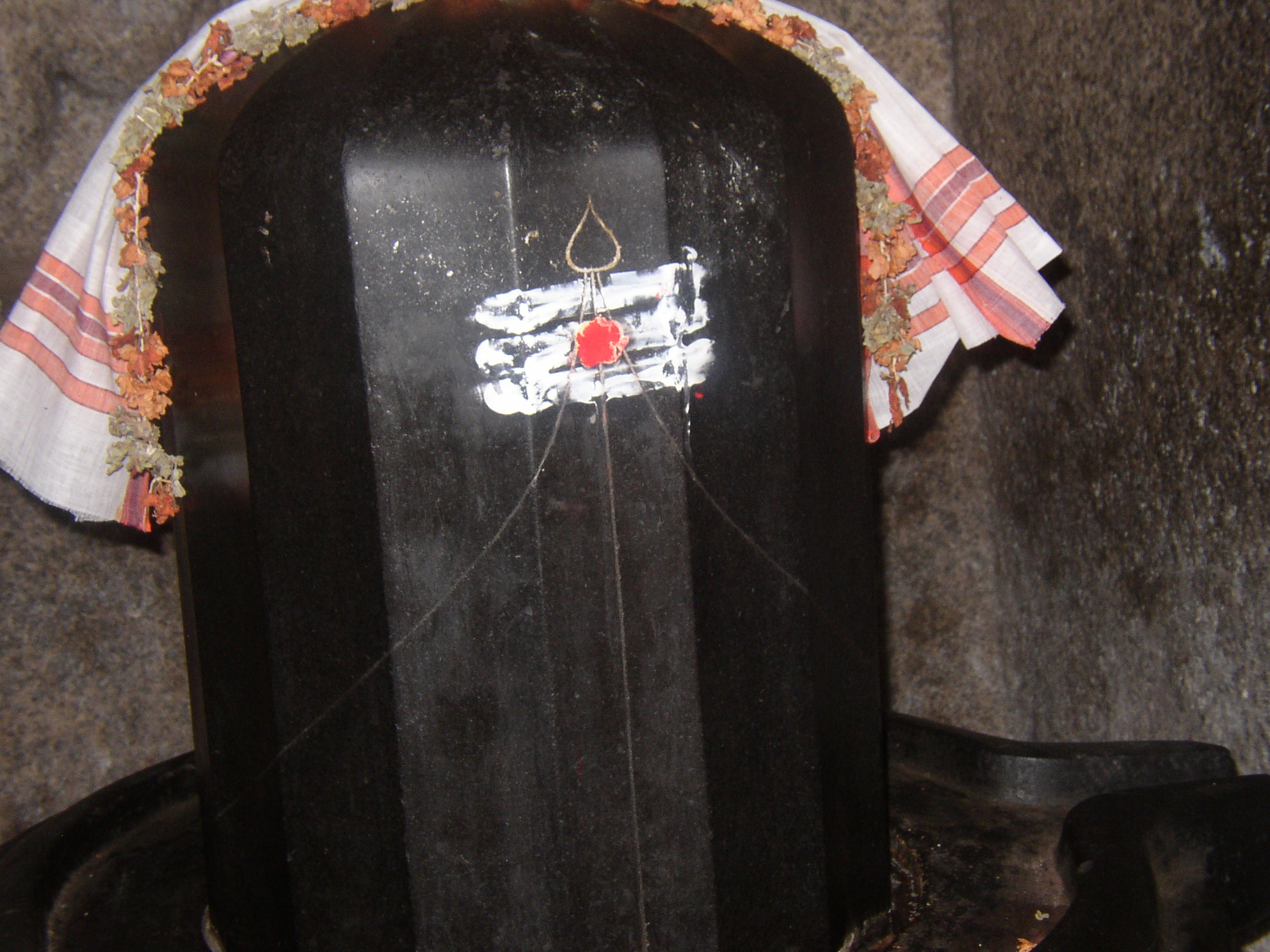
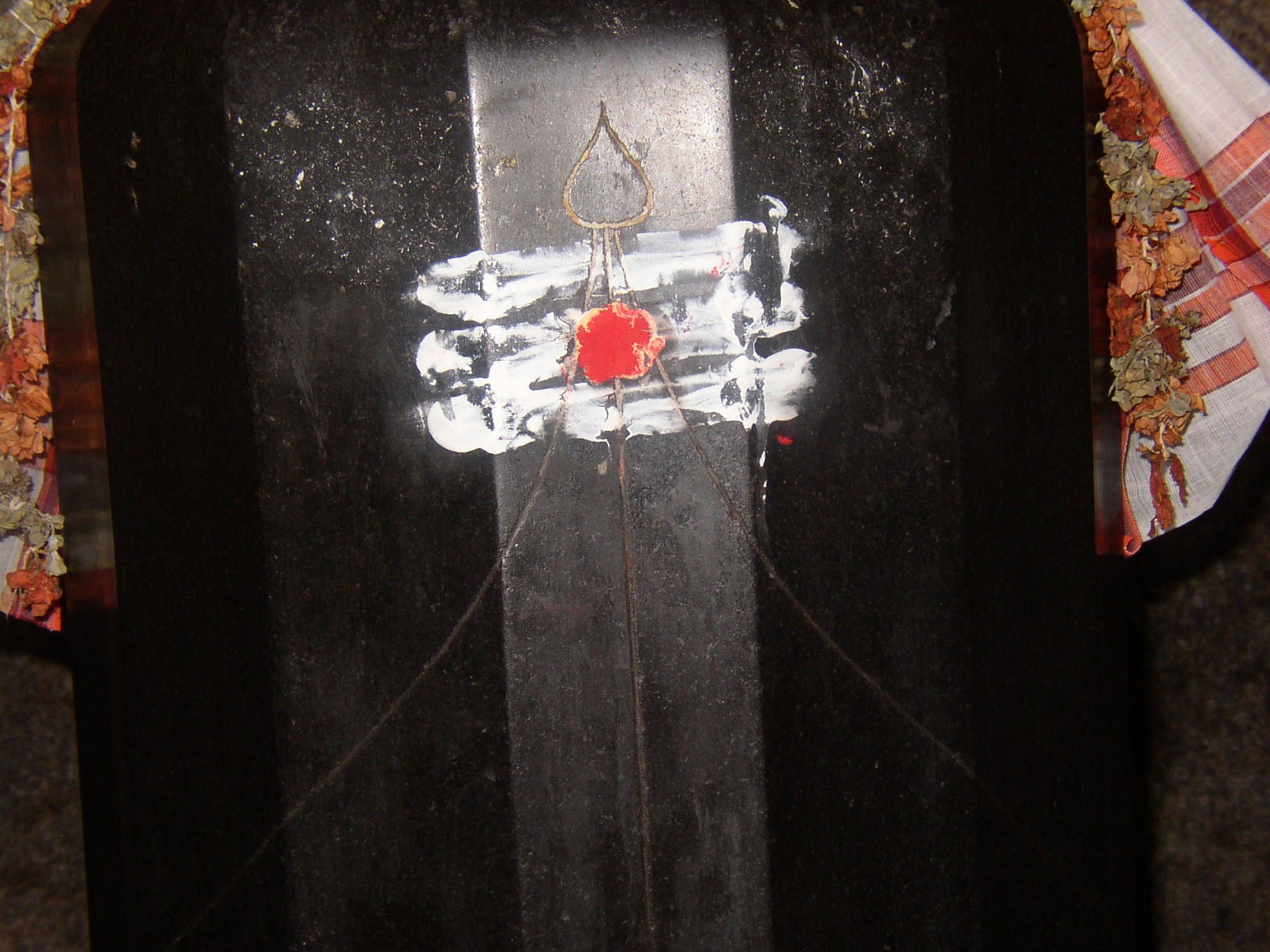
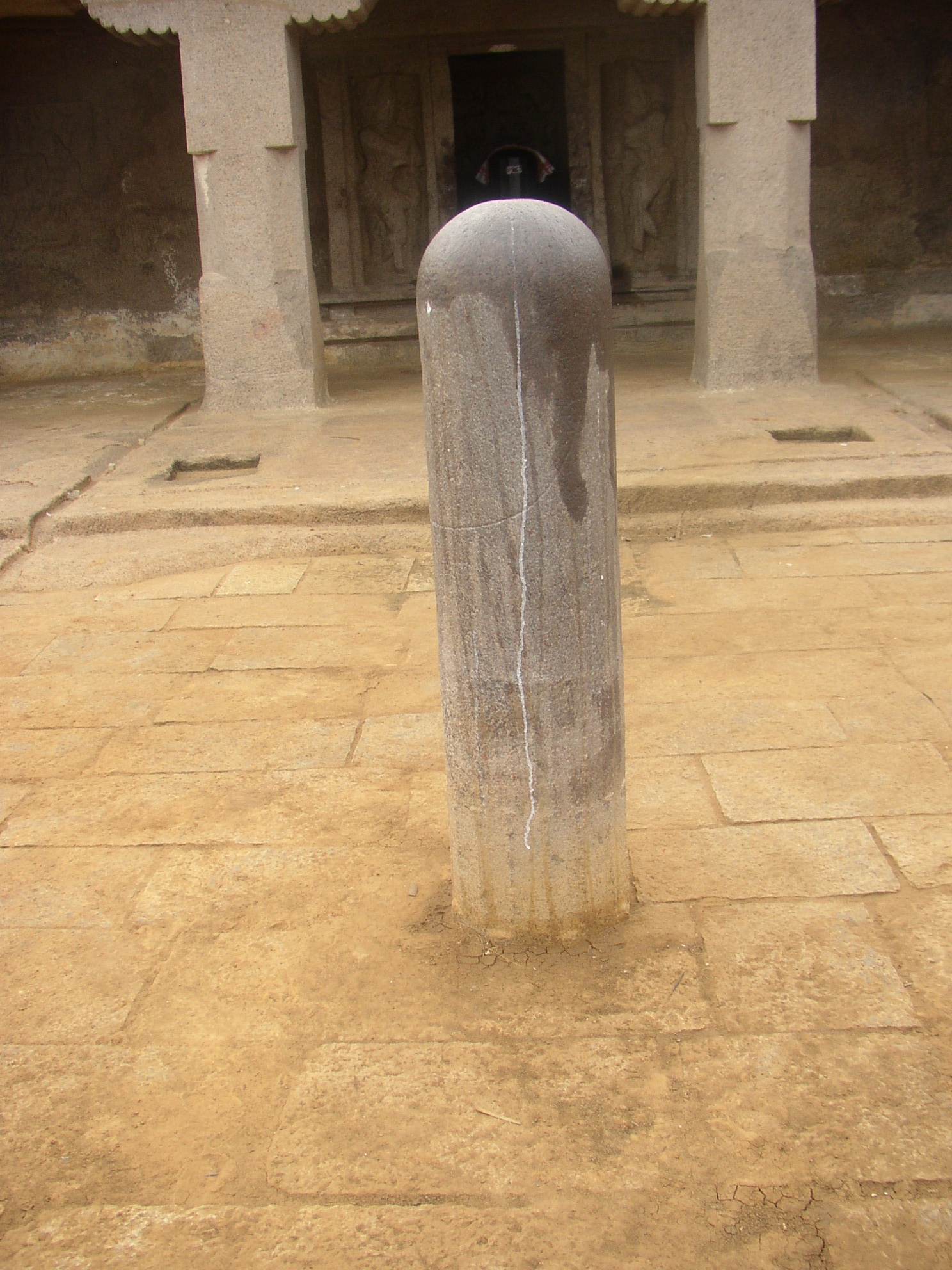
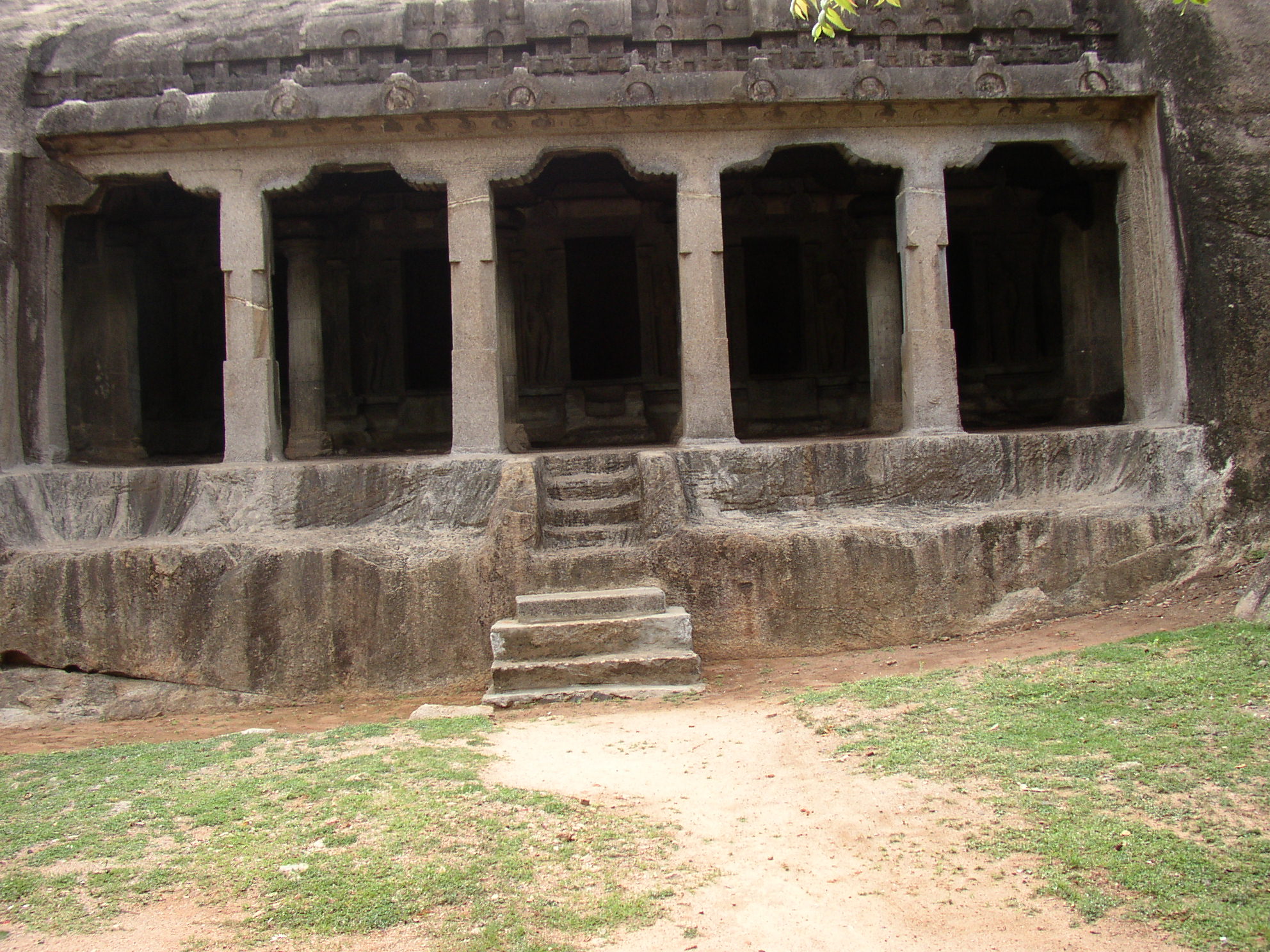
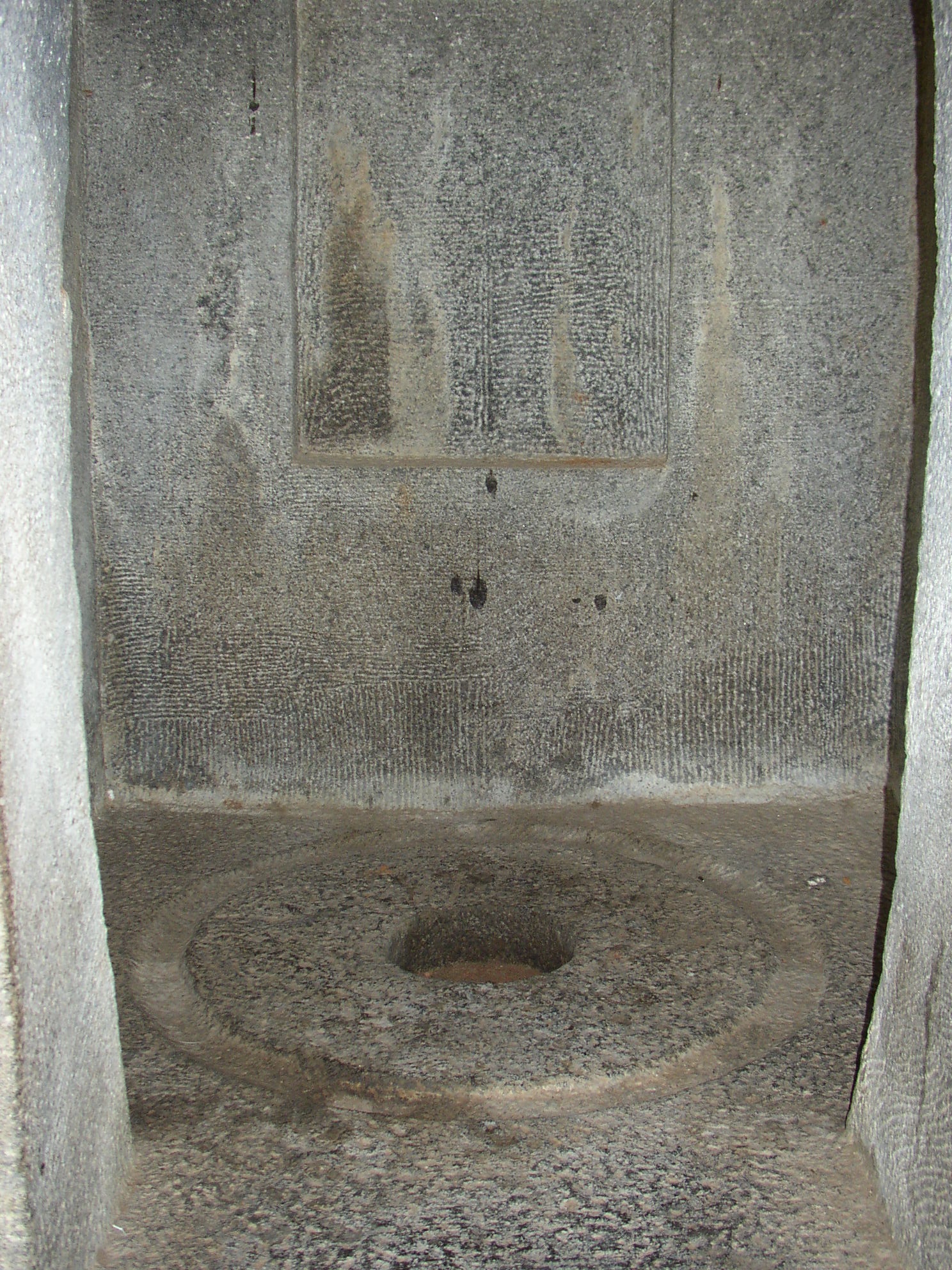
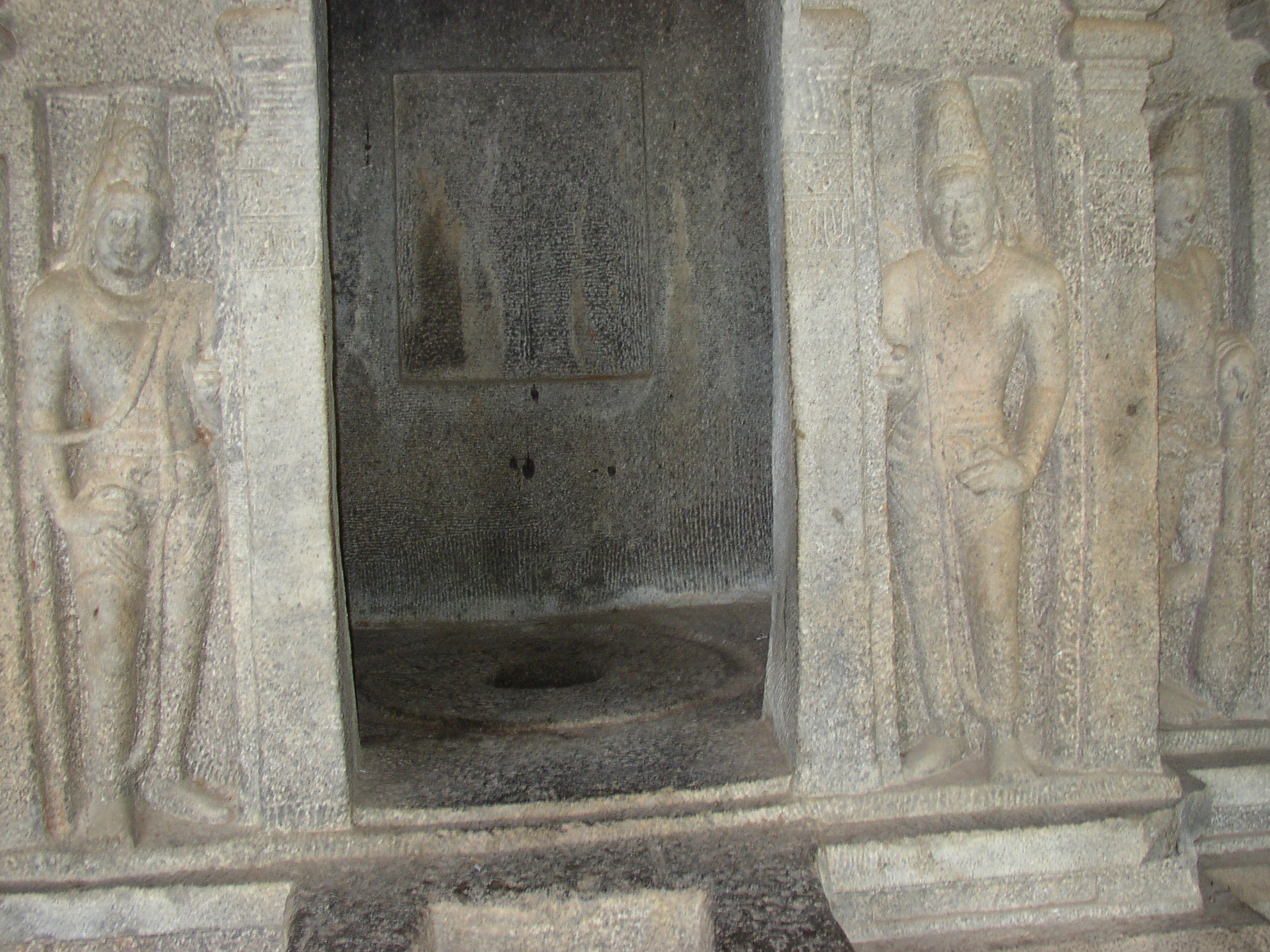
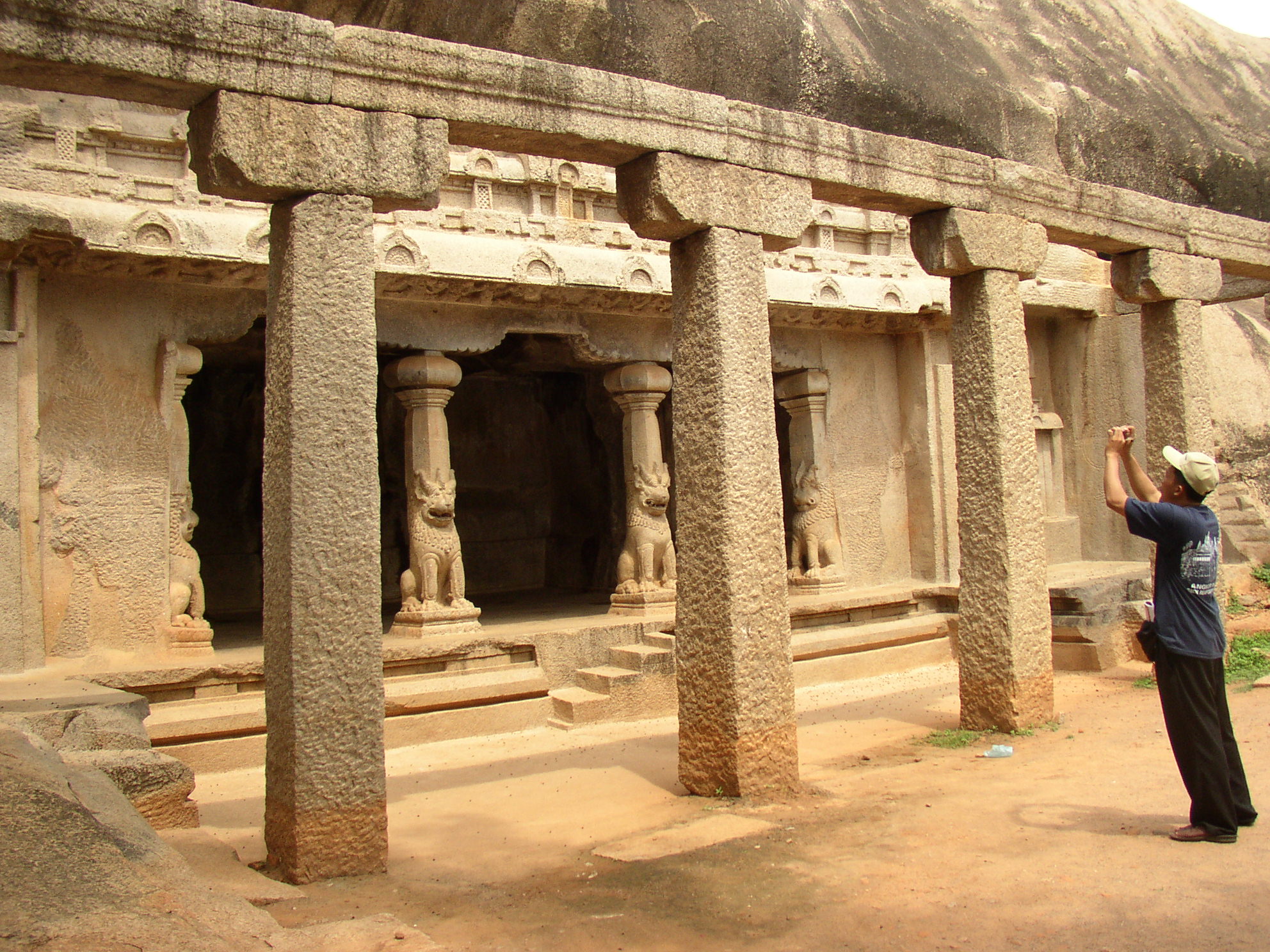
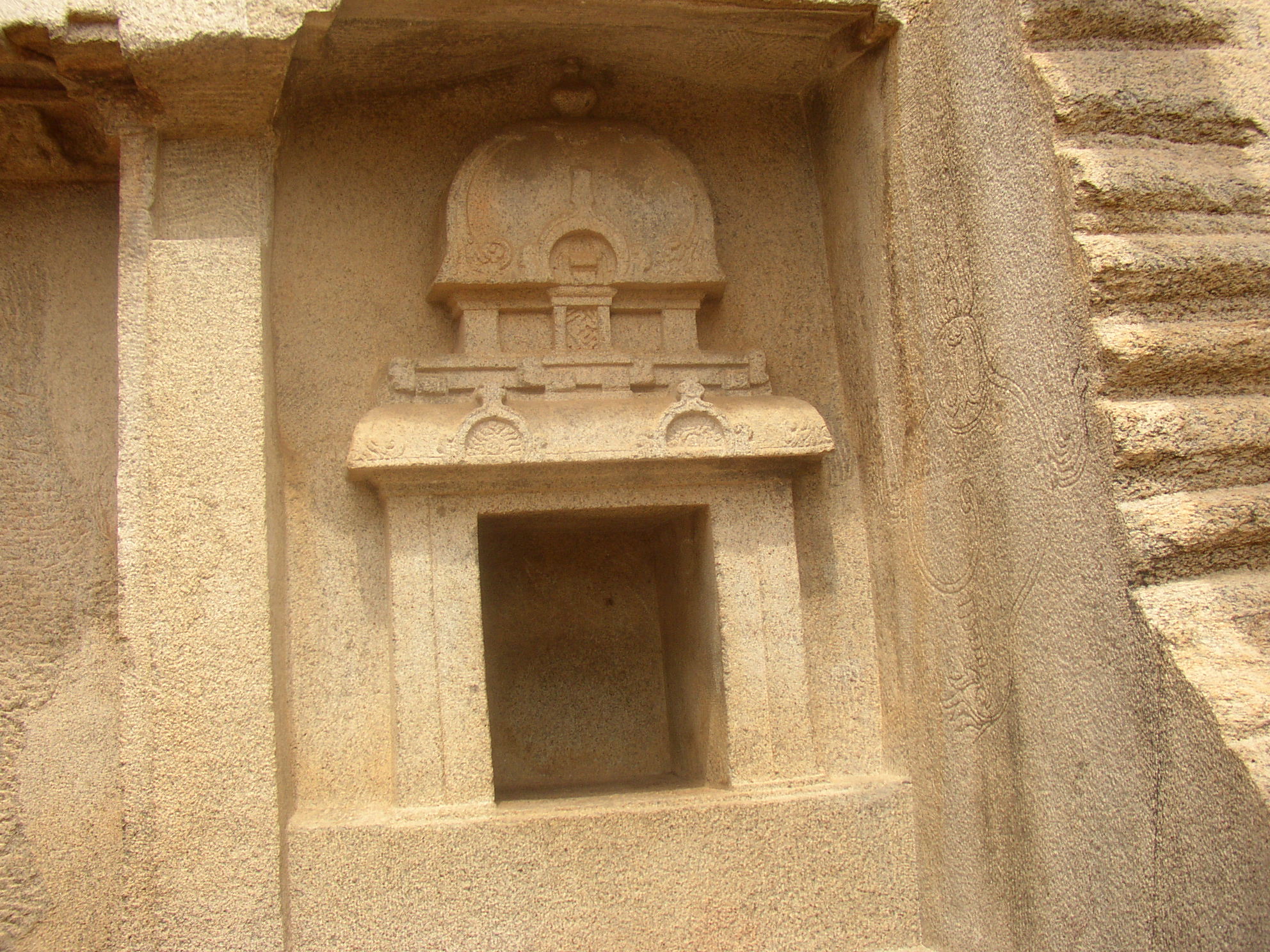
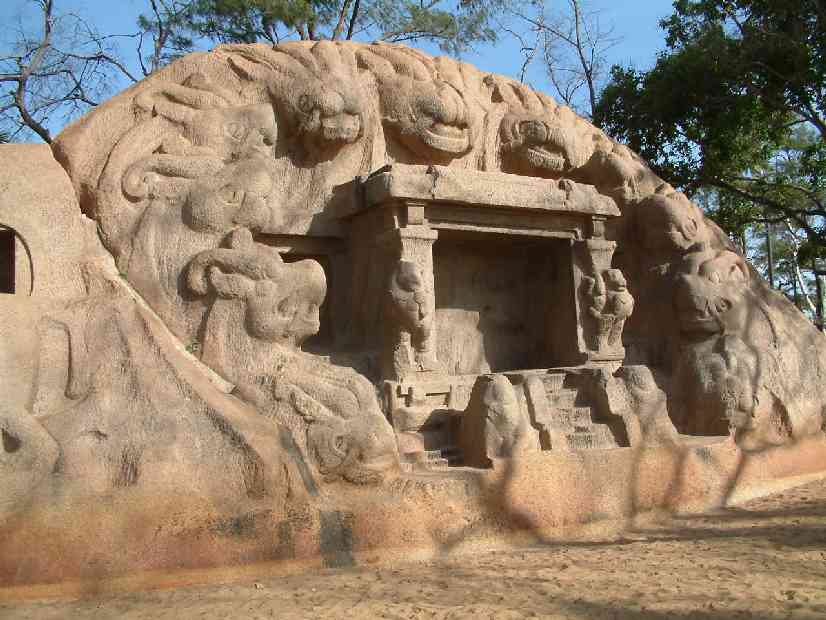
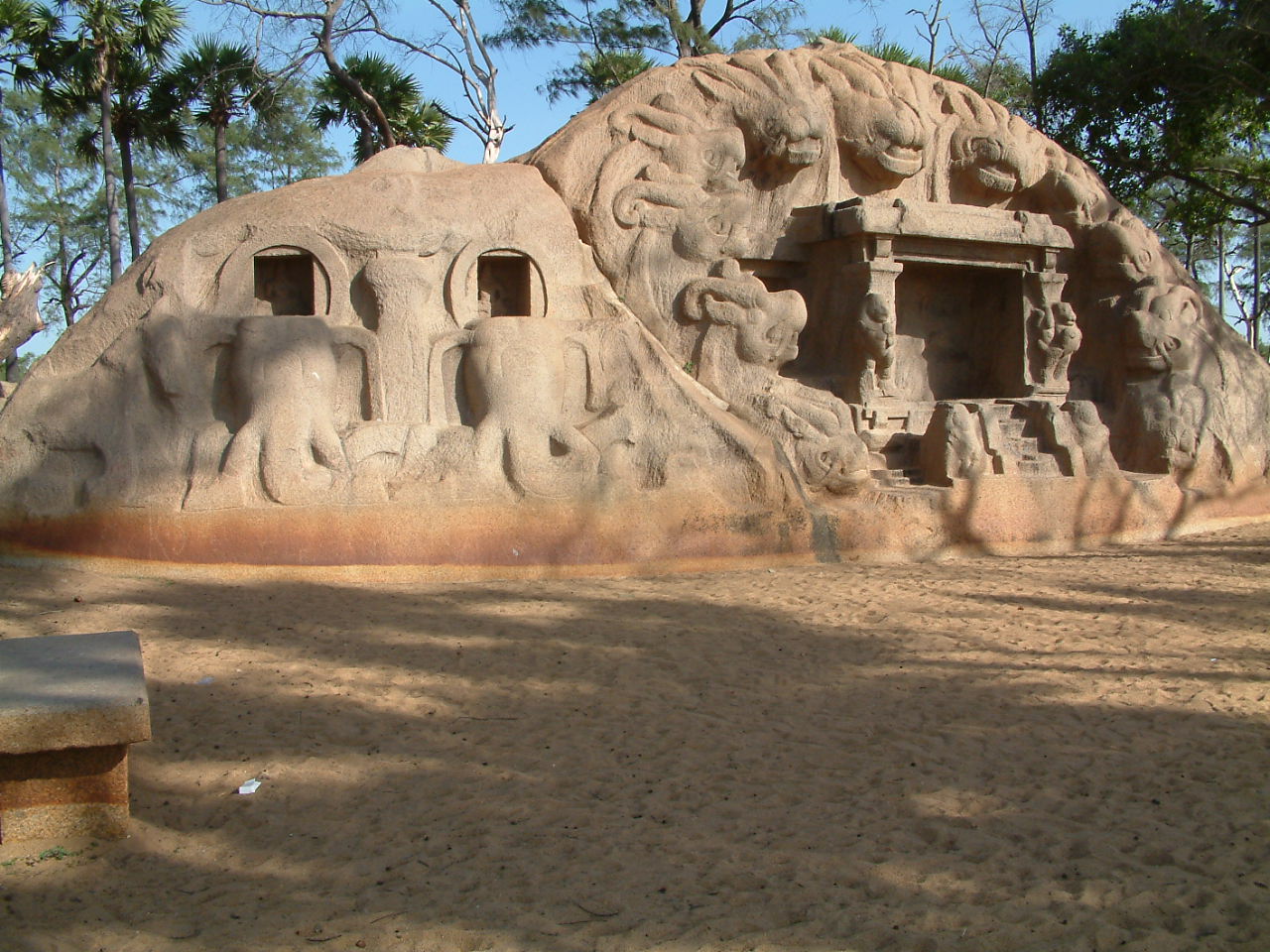
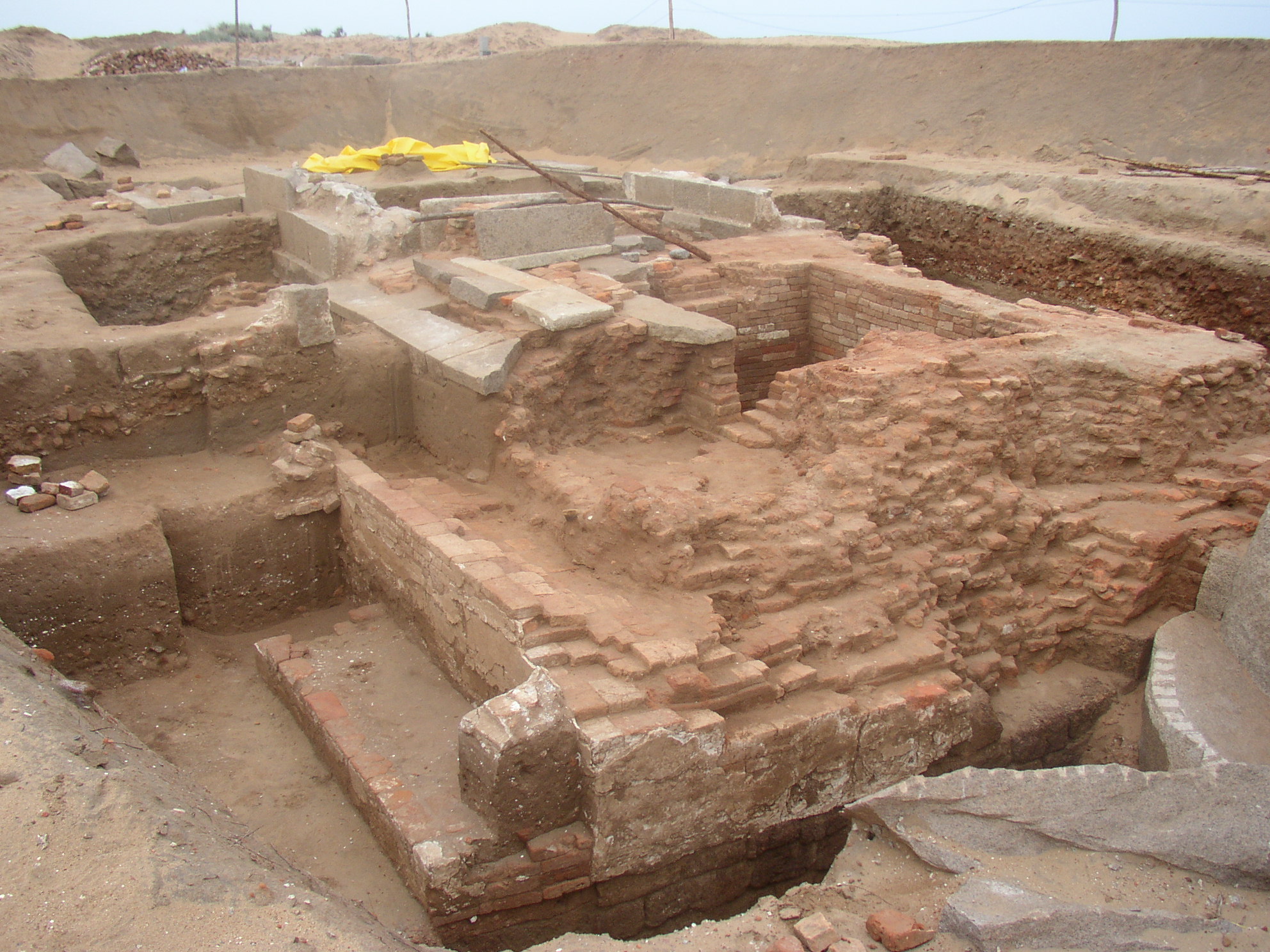
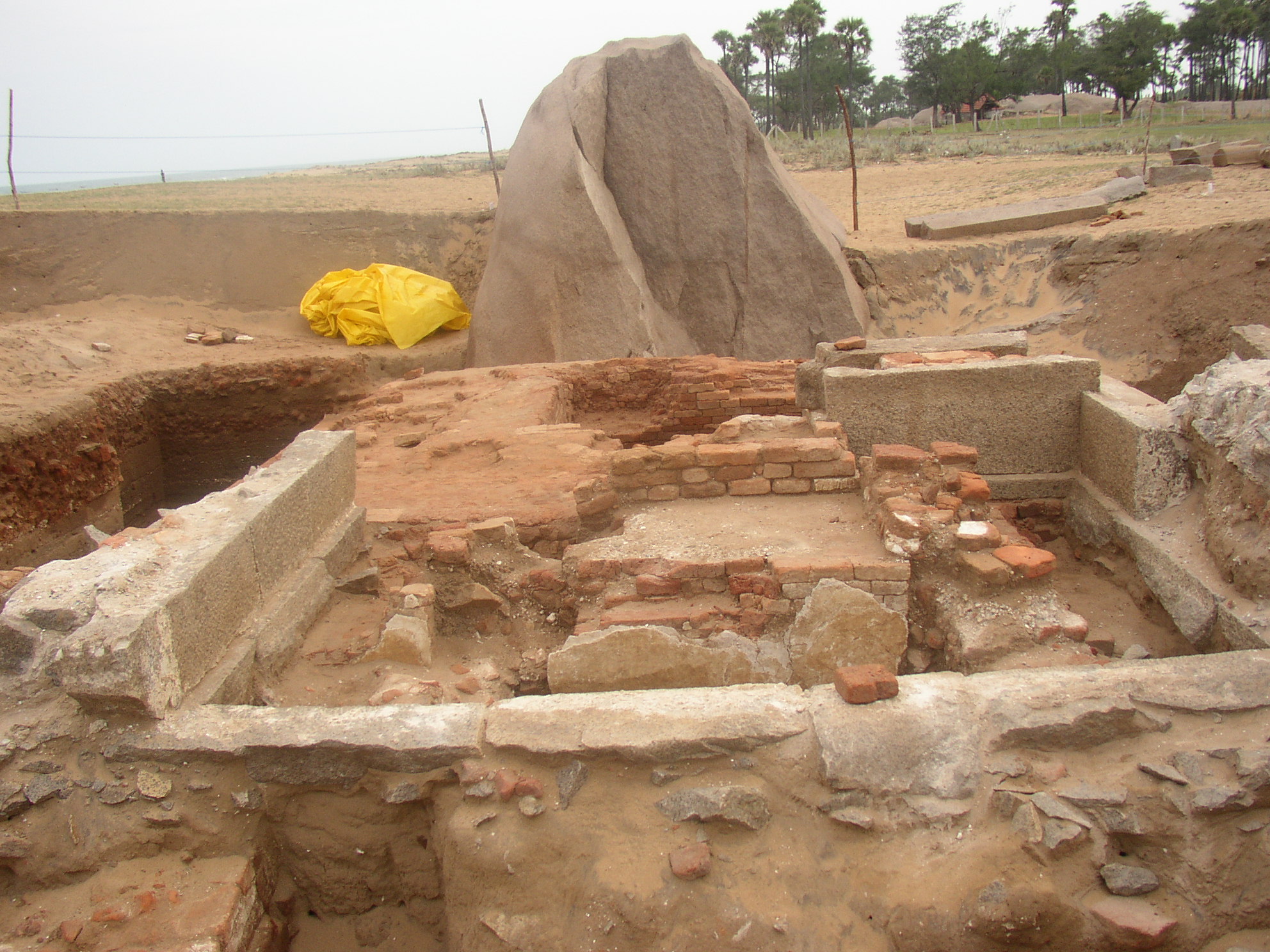
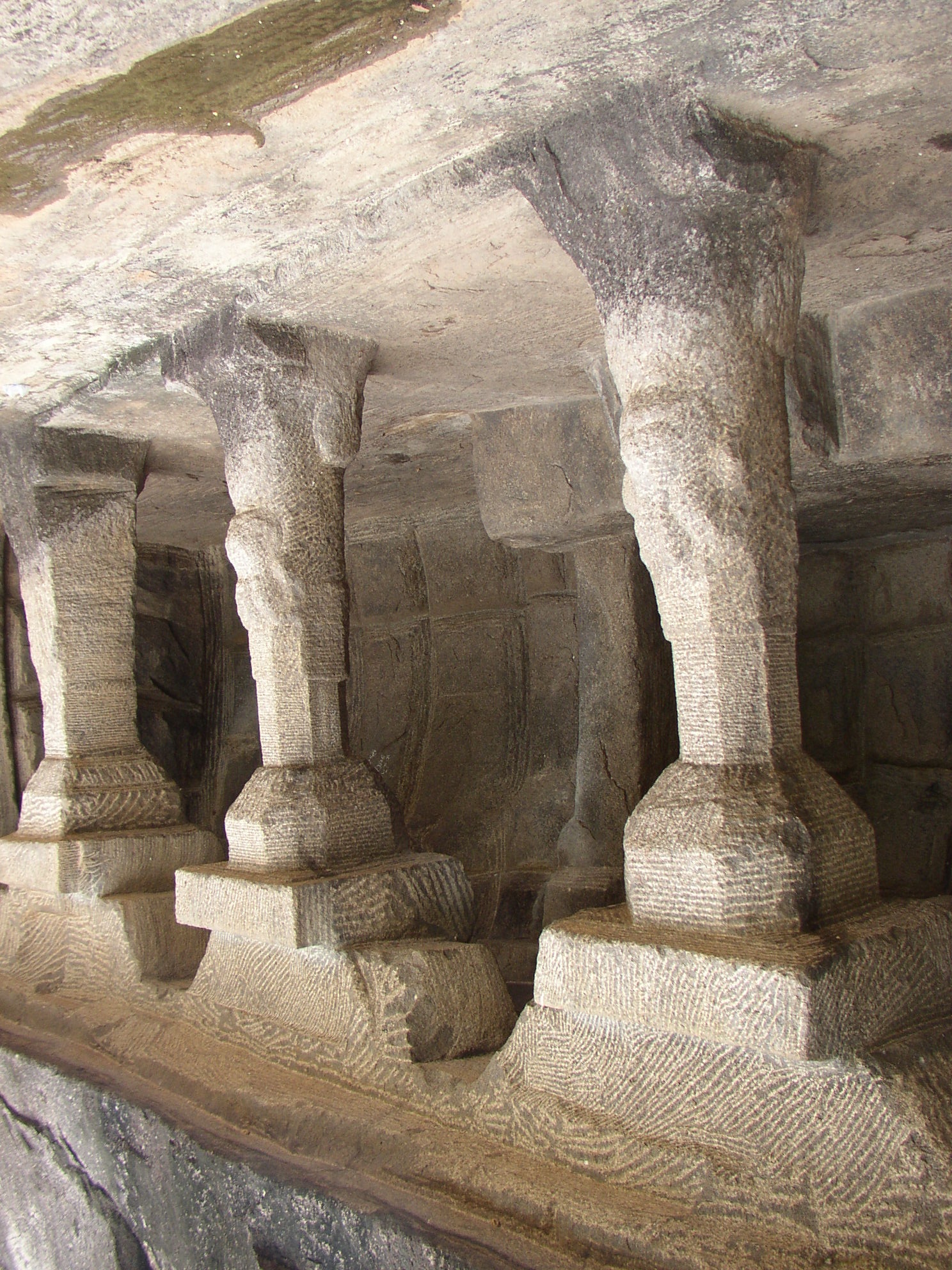
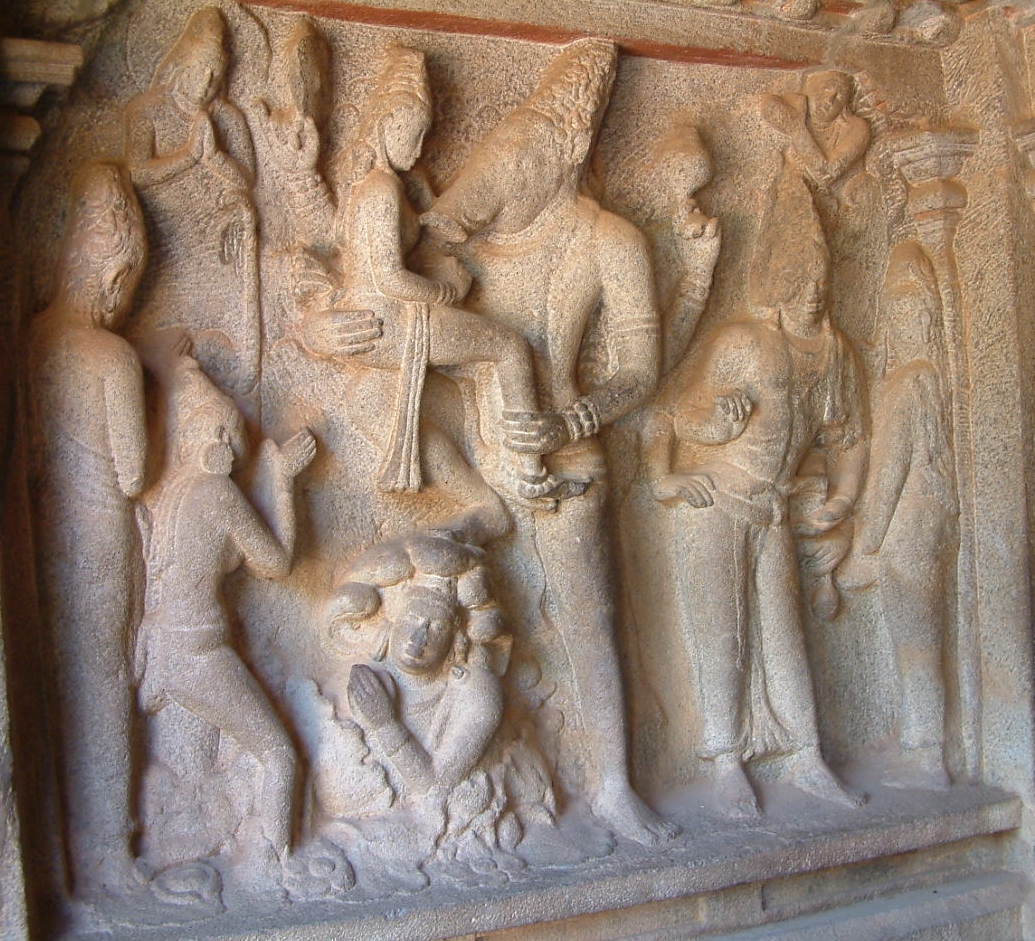
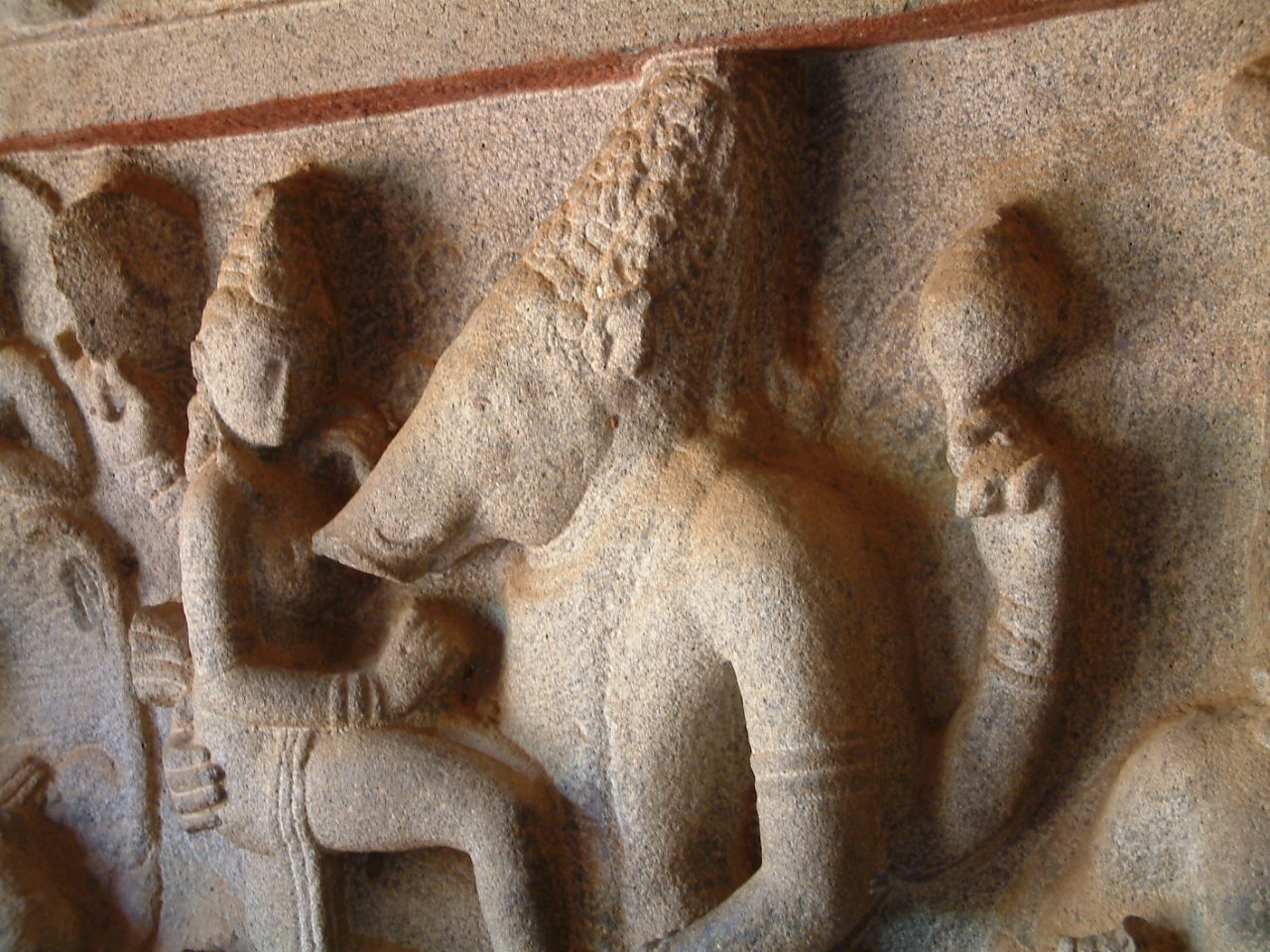
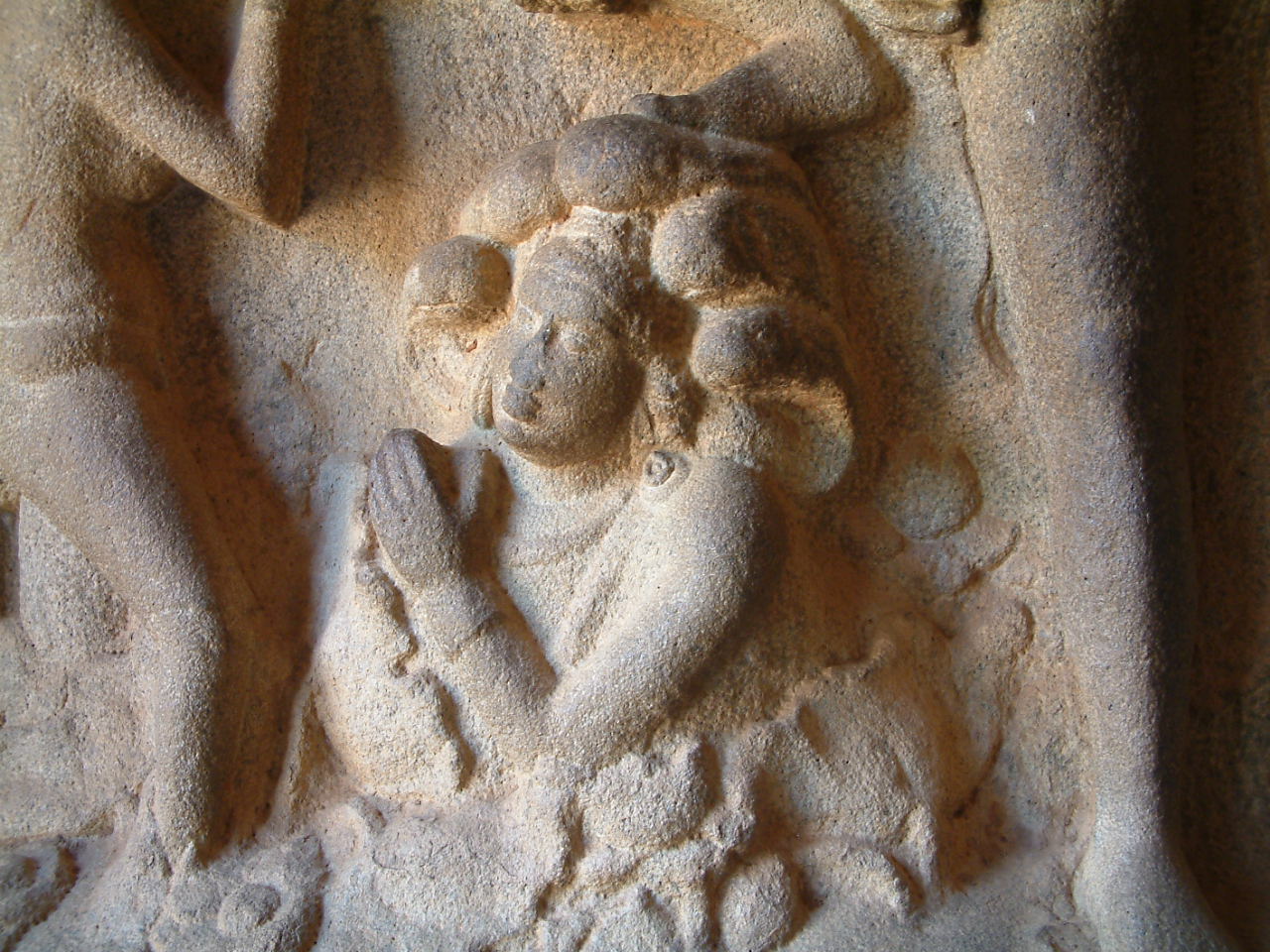
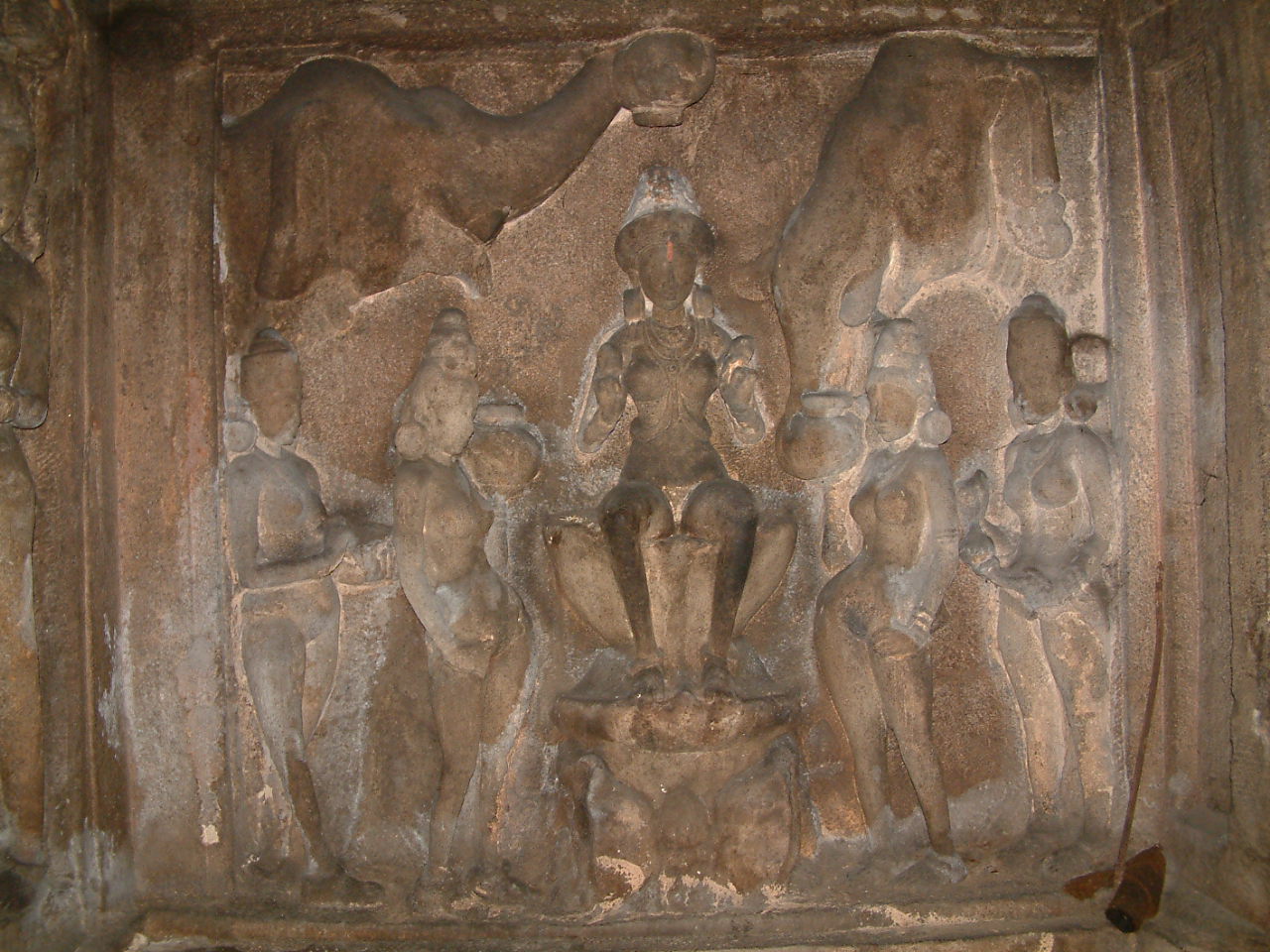
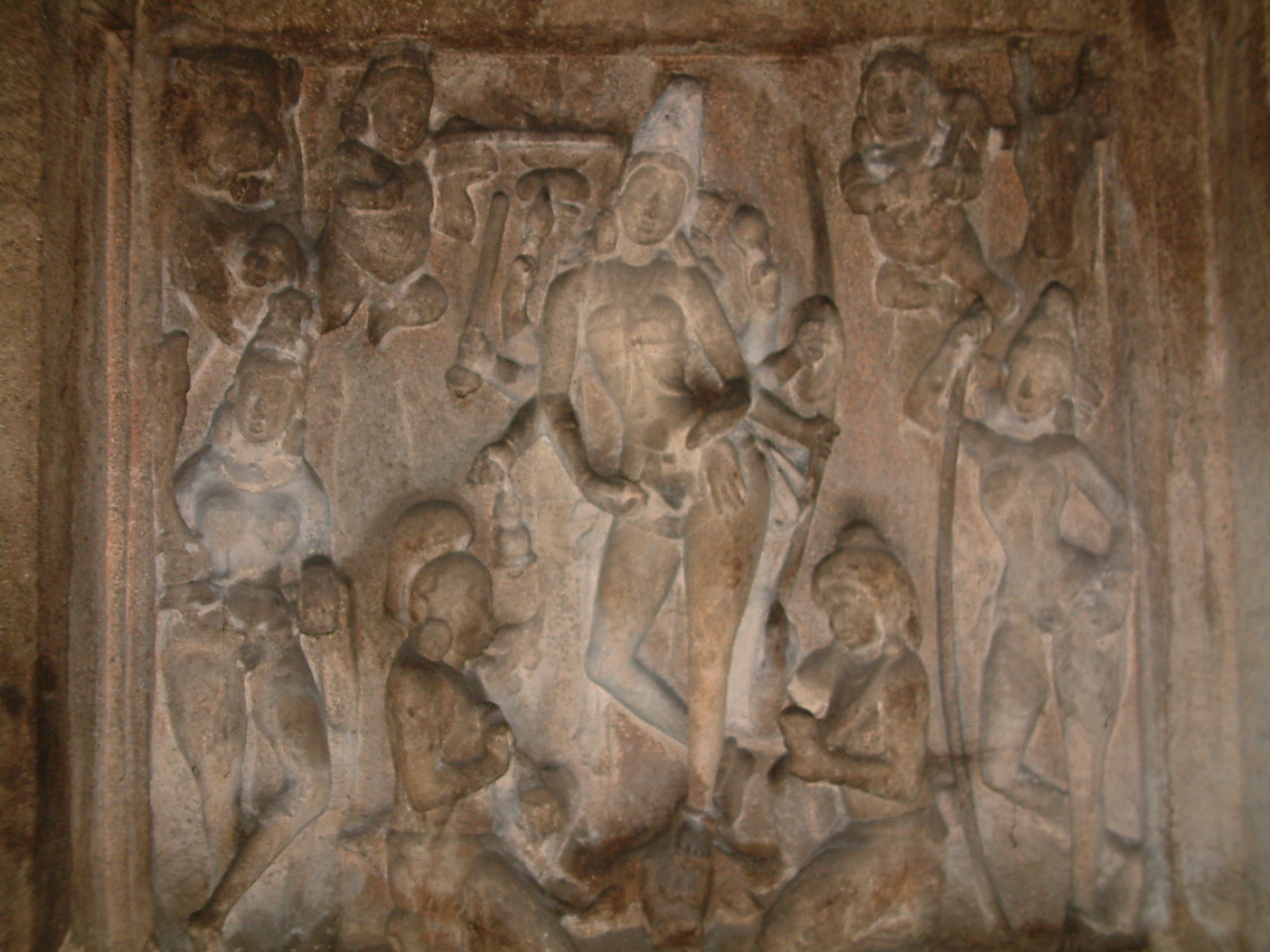
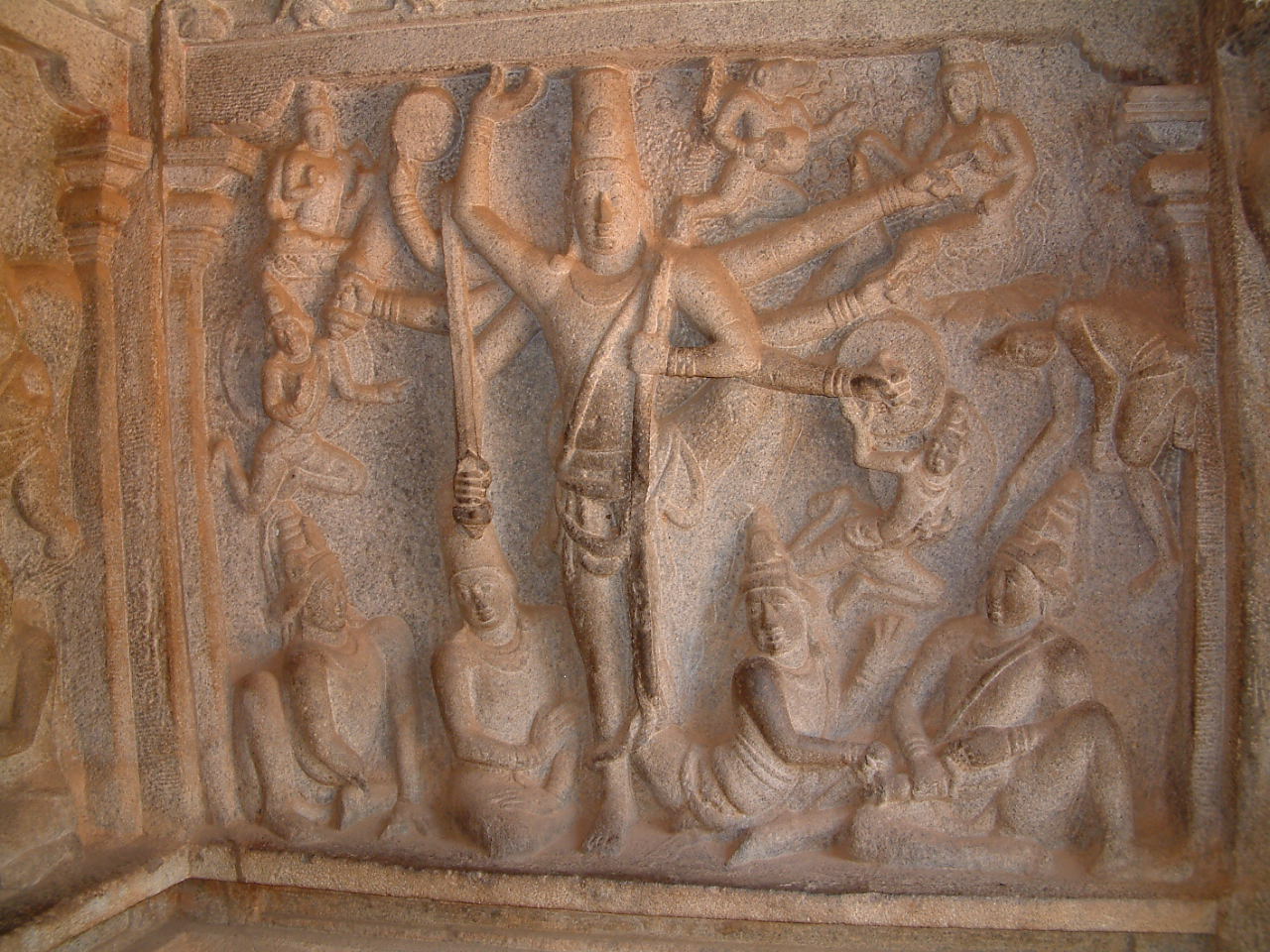
6. Cave TemplesĀdivarāha CaveOne of the best preserved but least visited cave temple in Māmallapuram is the Ādivarāha cave temple, situated in the west of the village near the Mahiṣāsuramardinī cave. The cave temple is under continuous worship from almost 700 CE and is generally kept locked except in the morning and evening during worship and the rest of the day the key remains with the priest, who can be approached by the visitors at the living temple in the centre of the village with the request to open the temple. Also the cave is not visited, as an unimpressive stone pavilion, built in the 16th century obscures the view of the cave temple. The temple is dedicated to Lord Viṣṇu in his third incarnation as Varāha, lifting goddess Earth, from the depth of the ocean. The form of Varāha emerging from the oceanic waters with goddess Earth is called Adi-Varāha, the Primordial boar, and hence the name Ādivarāha cave.The cave temple scooped out in the rock, faces west. The innermost sanctum carries a stucco image of Varāha with the goddess Earth. He has four arms, holding his weapons - the conch and the discus with his rear arms and the Earth goddess with his main arms. The Pallava features of the image are not discernible as the whole image is plastered and painted in the 16th century. Unlike the other Varāha sculpture in the Varāha cave, this image in the sanctum has no accompanying figures.The sanctum has a small projection generally called ardha-maṇḍapa (half pavilion) the facade of which is adorned with sculptures, a pair of door guardians. (Dvārapālas) flanking the entrance in delightful profiles. Beyond them on either side are standing figures one on the south representing the composite form of Śiva and Viṣṇu, as Harihara, and the other Ādiśeṣa Nāgarāja, standing beneath a five hooded cobra..The front maṇḍapa pavilion, also rock cut is in two bays the front end supported by two rock cut pillars that are now enmeshed by a wall. The other interior pillars are supported by seated lions. In line with the sanctum are lateral bays one on either side, housing extraordinary graceful sculptures of Durgā in the south and Lakṣmī in the north, carved on the rock face. These two lovely sculptures were not so far well known as they were covered with plasters. Like the Mahishmardini sculpture these two may be mentioned as acme of Māmallai art. The flowing lines, the volume, the flexions of the body and the profiles of these images are at once arresting.Durgā on the left wall, stands on the head of a buffalo with eight arms, holding conch and discus, bow and arrow, sword and shield in the three rear arms while the front arm are relaxed. On either side of the goddess are guardian women standing,one wielding a bow and arrow and the other sword and shield. Two seated devotees are also seen by the side. At the upper level are a prancing lion and an antelope on either side. There are several sculptures of Durgā portrayed in Pallava monuments but there is none equal in its aesthetic appeal to this supremely elegant portrayal.Gajalakṣmī seen on the northern lateral wall is seated on a prominent lotus seat, holding a lotus in her two arms. Lakṣmī is a picture of perfect beauty with a captivating face. She is flanked by two maidens on either side. At the top of the panel are two royal elephants, one pouring water over the goddess, and the other ready to follow. The composition of the panel, with distribution of space and volume single out the Pallava sculptors as master sculptors.The side walls of the front maṇḍapa carry a standing figure of Śiva as Gaṅgādhara in the north, and Brahmā, the Creator in the south. Āgamic texts like Marīci, Atri or Bhrigu saṃhitās invariably include the consecration of Śiva and Brahmā images in Viṣṇu temples. The layout and distribution of the deities in this temple, conform to the Vaiṣṇava Āgamic text, Marīci Saṃhitā, which says, Durgā, Lakṣmī, Brahmā and Gaṅgādhara should be placed to the right and left of the sanctum of Viṣṇu.The cave temple has two almost life size portraits of Pallava rulers which present remarkable studies in human portraits. On the south wall of the inner bay is a standing king, pointing to the sanctum. He is accompanied by two of his queens who are draped in diaphanous lower garments. With smooth shoulders and elongated hands, they look like creepers. Above the panel is a label inscribed in Pallava grantha reading “Mahendra Potrādhirājaṉ” which is the name of the king. On the northern wall, opposite to the above panel, is another group of portrait, depicting a king, centrally seated majestically on a high seat. He is flanked by two women, one on each side, evidently his queens, all portrayed in life size. Above the seated king, is a label, reading “Siṃhaviṣṇu – potrādhirājaṉ”. As the name ‘Potrādhirājaṉ’ is used in many inscriptions of the 7th-8th cent, for the kings of the Pallava dynasty there is no doubt they were the Pallava rulers responsible for the excavation of this cave temple. There are differences of opinion among scholars about the identity of the kings portrayed. The latest view based on the study of inscriptions at Māmallapuram and Kāñcīpuram, is that the seated king is Rājasiṃha Pallava – (690 - 728 CE)., who had the title, “Nara-siṃha-Viṣṇu”. The other standing king is his son Mahendra III. Rājasiṃha and his son were jointly involved in building temples at Kāñcī at the Kailāsanātha temple. The cave temple was orginally decorated with a row of miniature towers on the façade to indicate that it is complete with śikharas.Besides this unique portrayal of Pallava portraits and label inscriptions, there are three inscriptions in the temple that throw valuable light on three aspects of temple and culture.The lintel in front of the sanctum, above the Harihara image is a Pallava inscription in Sanskrit, listing the name’s of the ten incarnations of Viṣṇu in order as 1) Matsya, (fish) 2), Kūrma (turtle) 3), Varāha (Boar) 4), Narasiṃha (Man-lion), 5) Vāmana (Dwarf), Rāma (Paraśurāma), Rāma (Raghurāma), Rāma (Balarāma), Buddha and Kalki. This is an inscription ascribable to c. 700 CE, by which time Buddha is accepted as the ninth incarnation of Viṣṇu in the South.The second is a long inscription in big Pallava grantha script inscribed on the floor in front of the sanctum, extolling the greatness of Rudra and the need to adore him. This inscription recording the greatness of Rudra-Śiva, in a Viṣṇu temple has been misunderstood by many scholars. The deep divide between Vaiṣṇava and Śaiva cults was unknown in early timesThe third epigraphical record of this temple which is in Tamil language is on the rocky wall outside the temple, recorded in the time of the Cōḻa Rājendra II in the mid 11th cent CE. It refers to provisions made to this temple. The record gives the name of this temple as “Parameśvara-Mahāvarāha-Viṣṇugṛham” i.e. Mahāvarāha-Viṣṇu temple of king Parameśvara.. This is evidently the name of the temple given by the original Pallava patron. Another inscription of the same king in the same place also records gifts made to this templeA 16th cent inscription on the wall of the later maṇḍapa of the temple tells us that the temeple was conducting annual festivals, and that the bronze image of the god was taken out in procession. The endowment was made to enable the villagers to take the deity in procession to a nearby hamlet - Punceri on that occasion.The front maṇḍapa simple and functional supported by pillars, was constructed in the 16th cent, when in all likelihood the front maṇḍapa of Govardhanadhārī Kṛṣṇa in the centre of the village was also built.Atiraṇacaṇḍa CaveAtiraṇacaṇḍa Cave Temple, Śāluvaṅkuppam: Liṅga in the sanctumAtiraṇacaṇḍa Cave Temple: Somāskanda / Jyotisvarūpa panelAtiraṇacaṇḍa Cave Temple: monolithic liṅga in the courtyardŚāluvaṅkuppam is a small village, at the outskrits of Māmallapuram, about three km to the north. It was a hamlet of Māmallapuram in early period, under the name of Thiru Eluccil i.e. sacred centre for bringing deities in procession. Now it is more famous by the name - “Tiger cave” on account of a fanciful cave temple - with a row of yāḻi heads carved in a semi circular fashion like a prabhā-mandala that attracts visitors. There are two cave temples at this site, one the above mentioned cave temple with yāḻi heads and another a simple excavated rock cut temple, a furlong to the north of it. The latter is important on account of its inscriptions. Further, about three hundred yards north east, nearer to the shore, is a rock abutting which a brick temple was erected even in Pallava times that has inscriptions calling it a Subrahmaṇya temple. The inscriptions were known from the beginning of last century, but recently some remains of the brick temple have been uncovered at this site.The cave temple is called in the inscription mentioned already, as Atiraṇa-caṇḍa-īśvara gṛha. It is a rectangular cave with simple type of pillars, having a central sanctum excavated at the hind wall. The back wall of this sanctum contains a panel depicting Somāskanda, Śiva and Pārvatī seated, with the child Skanda seated on the lap of his mother. At the back is shown Brahmā to the right of Śiva and Viṣṇu. In the centre of the sanctum is found a fluted liṅga with sixteen faceets. A Liṅga-pīṭha made of a single stone is seen slid from the top and is positioned about half the height of the liṅga. The lower part that should have been circular is missing.. The liṅga and the liṅga pīṭha are made of black granite and given a very high polish that makes them look like basalt. The upper part of the liṅga - called the pūjā-bhāga - has lines incised which culminate in a flame like form. That indicates that these images were visualized as jyotir liṅga - “Symbol of flame” - and do not suggest phallus. The presence of Somāskanda at the back with Brahmā and Viṣṇu adoring Śiva in his liṅga form recalls the Siddhāntic view of the main deity.Flanking the sanctum are carved Dvārapālas. The central part of the side lateral walls is also carved with Somāskanda images which appear semi finished. There are indications to add a structural pavilion in the front. In the central beam of the facade are two label inscriptions in Pallava grantha script of about 700 CE, giving the name of the cave temple as “Atiraṇa-caṇḍa -Pallaveśvara gṛham” after Atiraṇacaṇḍa Pallava, a title found of Rājasiṃha, C 700 CE found in Kāñcīpuram, Paṉamalai, Tiruppōrūr, Vāyalūr, Māmallapuram and shore temples.There are two inscriptions on the side walls of the cave. one on the south wall is in Pallava grantha script, while the one on the north is in Northern Nāgarī script. Interestingly both the inscriptions are identical and record that the temple was caused to be made by Rājasiṃha. The inscriptions, give the title Atyantakāma, Raṇajaya, Śrībhara, Citra-karmukha, and Atiraṇa caṇḍa. As mentioned by K.R. Sreenivasan this temple was excavated by Rājasiṃha.The above records state that the cave temple was excavated by Atiraṇa-caṇḍa, as the abode of Śiva with Uma and Skanda with the Gaṇas. They run into sixteen lines. While the principal verses are common to both, there is an additional seventh verse in the Pallava grantha version, eulogizing the musical talents of the patron, Kālakāla, a surname of Rājasiṃha himself. Of these the first and second verses are identical with the eighth and ninth verses of Atyantakāma in the Dharmarāja maṇḍapam and Gaṇeśa ratha.The other surnames of the king, Śrīnidhi, Kamaraja, Śrībhara, Dhananjaya, Sangrama-dhira are also found besides Atiraṇacaṇḍa. Since most of the names including Atiraṇacaṇḍa are also applied to Rājasiṃha in his Kāñcīpuram inscriptions, this inscription must also be attributed to him says K.R.Srinivasan. A point of interest is the earliest epigraphical reference to Bharata, the author Nāṭya-śāstra is noticed in this inscription.It is thus clear that this cave temple was a creation of Rājasiṃha and the verses found inscribed are also undoubtedly of Rājasiṃha. As some of the same verses and titles are found in Gaṇeśa ratha, Dharmarāja maṇḍapa etc., and they speak about the creation of those monuments there can be no doubt that all those monuments were also creations of Rājasiṃha.Dharmarāja MaṇḍapaAs one approaches the Mahiṣāsuramardinī cave from Arjuna’s penance, this simple cave temple may be seen. It is facing east, carved in two bays, with two pillars in the front and two at the back, both square at the top and bottom and octagonal in the middle. A sanctum is carved in the centre at the back wall but no sculpture is found inside. Flanking the entrance of the sanctum are carved two Dvārapālas one on either side. But both these sculptures were chiselled away during the Vaiṣṇava resurgence..Besides the central shrine two more shrines were carved one on either side of the central sanctum but the three are somewhat recessed at the back wall.. All the three are provided with steps and show that three cells were dedicated to probably Brahmā, Śiva and Viṣṇu, The central one is dedicted to Śiva. The dedicatory inscription found in this cave is a word to word repetition of what is found on the Gaṇeśa ratha and at the end occurs a verse extolling Rudra, that is found also in Ādivarāha cave, Rāmānuja maṇḍapa and Gaṇeśa ratha. The name of the temple is given as “Atyantakāma-pallaveśvara-gṛham” i.e the Śiva temple of Atyantakāma Pallava. Evidently this cave temple is a creation of Rājasiṃha.The central shrine has neither a socket for Somāskanda nor a soket to house a liṅga. This cave temple has been ascribed by some to Parameśvara varman I. As it has the foundation inscription of Rājasiṃha its authorship cannot be doubted.Koṇeri MaṇḍapaKoṇeri Maṇḍapa facade, MāmallapuramKoṇeri Maṇḍapa interior pillared hallKoṇeri Maṇḍapa sanctumThis cave temple of simple rectangular design with two bays is found on the middle of the western face of the rock. It contains seated lion pillars outside and simple slim, facetted pillars on inner side. There are five sanctums scooped in the wall but no sculpture has been carved. But in all the sanctums, a pedestal is carved on the back wall suggesting that the deities were probably made of stucco and painted. That it was intended for five Śaiva deities deserves to be noted. All the sangtum have sockets on the floor to house the Liṅgas. There are five pairs of Dvārapālas each pair flanking a shrine. some are unfortunately chipped off. It seems all the five cells were dedicated to Śiva in his five forms known as Tatpurusha, Aghora, Sadyojāta, Vamadeva, and Īśāna. As this is a west facing temple it is not unlikely that the main temple was dedicated to the Sadyojāta form of Śiva.Koṭikkāl MaṇḍapaAt the northern end of the main hilllock, is a rock cut cave temple facing west with a sanctum scooped at the back. The sanctum has no figures, but its facade has two female guardians, one holding a bow and the other a sword and shield. The presence of these two female door keepers indicates that the cave was dedicated to goddess Durgā.Mahiṣāsuramardinī CaveMahiṣāsuramardinī panel, Mahiṣāsuramardinī Cave TempleThis cave temple is famous for its breath-taking Mahiṣāsura-mardinī Sculpture. The cave is near the present light house and faces east; the outer façade presents a simple cave like appearance, with fluted pillars. A central sanctum, enshrining a Somāskanda Śiva, is carved at the back wall, which is preceded by a maṇḍapa, Flanking the central sanctum, are two unfinished shrines, one on either side,The two side wings of the front hall, carry two masterpieces of Pallava art. The north wall portrays the fight of Mahiṣāsuramardinī with the buffalo headed demon and on the other side, on the south, is Lord Viṣṇu lying in his cosmic sleep Yoganidrā, on his serpent couch. Both the sculptures occupy the full wall space, from the ground level to the ceiling. A perfect frame of wall is left out to picturise these great compositions.Mahiṣāsuramardinī panel, after whom the cave is named is a supremely elegant creation. Many great historians have spontanesouly described the beauty of this panel. It almost looks as though the artist has conceived this side wall as a tightly held canvas perfectly framed to picturise the episode with central line drawn vertically to distribute the charaters. Left of the panel is the march of the Goddess Durgā. accompanied by a host of retinue holding weapons like sword, bow and arrow etc.The retinue of the goddess are all women and dwarfish gaṇas, some with big belleys. It appearsas that women and the little dwarfish gaṇas are sufficient to wipe out brute force. Leading the striking power of virtue over vice is goddess Durgā having a powerful lion as her mount that charges towards the demon Asura. She wields a sword, bow, arrow, discus and the like. The long sharp sword is the weapon in her right hand with which she finally severed the head of the demon.On the right, are shown the demon Mahiṣāsura and his soldiers all in retreating poses. The Mahiṣāsura who is already falling down, his left leg trembling to support his body. His big mace, gada looks heavy and a burden in his hand. The only thing that holds him up is his adamant nature and his arrogant unwillingness to yield. One of his attendants in front has fallen dead. Another cut into two pieces is falling head down, a poor third one is pathetically looking up hiding himself behind the person in front and hoping to escape. The Asura’s trusted commander has retreated in great disorder and another has turned his back to the battlefield and looks back with melonchally eyes to see whether he could escape as fast as he could. The scene is a brilliant exposition of evil routed by divine power. No where did Indian artists rose to such heights of perfection as in this panel. If Pallavas are praised as greatest sculptors this sculpture is the best example to justify that claimViṣṇu, two armed lies in a relaxed pose, head to the east and the legs extended to the west and his face turned upwards. He wears a cylindrcial crown; his eyes reflect his deep sleep. All the time the watchful five hooded serpent Ananta, serves as an umbrella over his head. The two demons, Madhu and Kaitabha, approach the foot of the Lord to attack him with clubs in their hand, the snake, hisses sending out waves of flames, driving away the demons. The frightened demons turn their back to flee from the sight, but the heat of the flames burn their back. There are two figures in the upper part of the panel, one a dwarfish manly figure, and the other female, both flying joyfully, to crush the demons. The dwarfish figure is the personification Viṣṇu’s weapon, the conch Pāñcajanya. Viṣṇu’s other weapon, the gada (mace) named Kaumodaki, is praised as a female which flies to strike the demon.Beneath the reclining Viṣṇu are three figures, one the personified Cakra (discus), with the cakra shown as a crown on its head. It also seems to suggest Viṣṇu’s mount, the eagle (Vainateya garuda). By the leg side, and bent with folded hands in adoration is Bhūdevī, (the goddess earth), while Behind her is the sage Markandeya seated praising Viṣṇu for imparting immortal knowledge.Inside the central sanctum is a majestic figure of Śiva imposing in stature, seated on a throne accompanied by his consort Pārvatī, also seated while the child Skanda seated on her lap is in a playful poise.Beneath the seat, reclines Śiva’s mount, the bull fairly powerful and robust. The panel depicts Viṣṇu and Brahmā adoring Śiva, at the top of the panel..Mahiṣa CaveThe Tiger cave, “Yāḻi maṇḍapa” should be studied in association with another cave, found immediately to the north of the shore temple. It consists of a cave temple, cut into a rock that is right on the shore, with the sea waves constantly dashing against it. On the northern face of the rock, is portrayed a huge monstrous Mahiṣāsura, weilding a club, running for his life. But he could not escape as a terrifying lion is pouncing on his head, mauling him down. It is a powerful awe inspiring portrayal of two animals, in combat, and the instinctive nature of the wild lion pouncing from behind on its pray, and bringing it down to its fall. This sculpture though not finished, is a masterly artistic visualisation of the animal combat, the like of which is not to be seen elsewhere.The Māmallapuram artists were masters of portraying the instinctive quality of each animal they portrayal, be it a cow, bull, monkey, elephant, deer, cat or rat, one finds its true nature captured. The portrayal of lion pouncing on its pray in the Mahiṣa cave is the stroke of master artist.Pañca Pāṇḍava Cave TempleAdjacent to the great bas relief of Arjuna’s penance, on the southern side is the biggest cave temple attempted at Māmallapuram. It has been designed as a single celled temple with pillared passage to go around, by tunnelling the back part of the sanctum. The cave has been cut too deep inside, to a depth of about 32 feet, while on the north south lateral axis it is around 36’. Probably it was to be a square of 36 feet. In the front there are laterally two rows of pillars dividing the front part into two bays. The sanctum cell has been provided at the beginning of the third bay. The sanctum had an entrance of about three feet width. The work on the inner side of the sanctum has just begun when the work was abandoned. Also on top of the facade, a row of miniature rectangular square towers have been cut simulating temple towers;. No Inscription or sculpture is found in the cave.From this cave to the Kṛṣṇa Maṇḍapa, the rock shows attempt to cut some form. The name Pañca Pāṇḍava cave temple applied to this cave has no connection to the Pañca-pāṇḍava heroes. The story of Mahābhārata was so popular at the village level that anything five or more grouped would be called after the five brothers..Pulippuḍār MaṇḍapaOn the western side of the village there are three cave temples in different stages of completion. These are not of aesthetic interest, but a visit to them will be useful to know the totality of Māmallapuram monuments and the ambition of the creator to have as many caves excavated as possible. Interestingly each one of these is laid out on a different plan, elevation, and also number of shrines. There are no inscriptions on any of them and the work is rudimentary.Rāmānuja MaṇḍapaRāmānuja Maṇḍapa exterior facade, MāmallapuramRāmānuja Maṇḍapa central shrineBehind the light house passing through rugged boulders, one comes to another cave temple, now called “Rāmānuja maṇḍapa”. This excavated cave, had originally delightful sculptures, The outline of the chiselled sculptures, show the cave was dedicated to Śiva and the central sanctum contained a Somāskanda sculpture. This cave has suffered maximum destruction. There seems to have been a revival of vibrant vaiṣṇavism in the 16th cent in this village, which witnessed new constructions of maṇḍapas, as in the case of Kṛṣṇa maṇḍapa - (etc). During that revival, the Vaiṣṇava religious mark of naman, and śaṅkha, cahkra were incised on the pillars of some monuments. Probably it was converted into a plain maṇḍapa, for the processional deity of Rāmānuja, the Vaiṣṇavite seer, that was brought here for audience during festivals. It must be remembered that Māmallapuram was a sacred centre for the Vaiṣṇavas.This cave temple originally had three shrine cells scooped at the rear with a front maṇḍapa like bay. The three shrines were almost of equal size, square in form separated by walls. The central one had a fine image of Somāskanda carved on the back wall but unfortunately has been completely chiselled off. All the three cell shrines have been completely chiseled avay and the dividing walls have also been removed. No trace of sculpture is seen on the two side cell walls.The Central shrine shows traces of paintings indicating the sculpture was originally painted. It has been surmised that the two side shrines contained Brahmā and Viṣṇu thus the three shrines should have been dedicated to the Trinity.On the side walls of the cave immediately in front are carved the huge Śaṅkha and Cakra symbols. The symbols are stylistically attributable to the 16th cent. Secondly there has been some structural activity in front of the cave to enlarge and extend the cave by the addition of a structural maṇḍapa for which the pillars and beams have been erected. But this work also remains incomplete.It may be necessary at this stage to note the religious fervour that manifested in the later half of the 16th cent.It was the time when the Ādivarāha temple was also enlarged with the addition of a big maṇḍapa. It was also the same time when a later maṇḍapa was added in front of the Kṛṣṇa Govardhanadhārī bas relief. It was also the time when the Dvarapala and other sculptures were chiseled off in the Dharmarāja maṇḍapa. In all these places same form of Vaiṣṇava emblems were carved on the side entrance walls. The inscription of the Vijayanagara period found in the Ādivarāha temple, refers to the festival instituted for God Viṣṇu (perumal) taken out in procession. The temple Sthala-sayana perumal in the centre of the village also witnessed large building activities in the 16th cent. The gopura, Dolotsava maṇḍapa etc were built during this period. Thus Vijayanagara period witnessed the resurgence of Vaiṣṇavism under the patronage of the Rajagurus of the Vijayanagara emperors. It is interesting to note that all the Vaiṣṇava centres in Tamil nadu received a great attention during this time. Festivals instituted to Kṛṣṇa and the Vaiṣṇava teacher Rāmānuja were symbols of this movement at Māmallapuram.There is one inscription in the Rāmānuja maṇḍapa found between two lion pillars in front, extolling the greatness of Rudra. The same verse is found in Ādivarāha cave, Gaṇeśa ratha and Dharmarāja maṇḍapa.Tiger CaveTiger Cave (Yāḻi Maṇḍapa) at ŚāluvaṅkuppamTiger Cave (Yāḻi Maṇḍapa) side view, ŚāluvaṅkuppamThe cave temple at Śāluvaṅkuppam, now called Tiger cave, is a creation of fantasy. It consists of about 30 feet high rock, facing the sea (east) cut with a row of mythical lion head (vyālas) arranged in semi circle, resembling an aureole (prabhā mandala). An attempt has been made to scoop a sanctum in the middle but the work remains unfinished. The attempt here is to express something new-something novel, propelled purely by artistic instinct. A very small scale model also found cut in a rock south of shore temple, with other sculputre seems to suggest that the cave was intended for goddess Durgā. It looks as though that it was a unique audience hall of the goddess of victory Durgā which infuses an awe and wonder. Though the art of Māmallapuram is rooted in religious ethos and fervour, it evidently was essentially artistic expression and urge to create aesthetically appealing forms. Secondly there is undoubtedly an emphasis on creativity, that is revealed in so many monuments, nearly forty in number, each one is different from the other in plan, elevation, or choice of the portrayal or mode of depiction. There are nearly two hundred sculptures carved in stone, each varying from the other. The artistic instinct is no where better expressed so vividly as in this Tiger cave. It is almost a clue to the understanding of the mind and propulsion of the author. Māmallapuram is truly an artist’s paradise.This is further conformed by a sculpture carved in the same rock on the northern side where a huge seated lion is carved with a square socket on its front torso. The work is left unfinished. But almost a similar one, exists on a smaller scale but fully finished in the sea-shore complex. The majestic seated lion there has an image of multi armed Durgā, seated inside the square socket. This would indicate that a single seated lion-like hall was another abode of Durgā.While the single seated lion itself served as the temple, abode of the goddess in one instance, the multi headed Yāḻi Maṇḍapa (Tiger cave) was another hall, thus the king visualized his goddess, giving audience to him in different halls at different times.To the right of (south) the Tiger cave, two elephants, facing the front are figured carrying circular howda, on their back. Inside the howda are seated figures, probably portraying the celestial attendents of the goddess and further south on the same rock is seen a horse. There is a custom wide spread in Tamil Nāḍu, of portraying standing elephant and horses of terracotta or stucco in temples of Village gods. The portrayal of elephants and horses by the side of the cave temple of the Goddess recall to mind this tradition.Tirumūrti CaveSubrahmaṇya / Tirumūrti Cave Temple, MāmallapuramSubrahmaṇya Cave Temple detail, ŚāluvaṅkuppamAt the northern end of the main rock (hilllock), facing west is the excavated cave temple called Tirumūrti cave. Tirumūrti means three deities but in general parlance refers to the Hindu Trinity, Brahmā, Viṣṇu and Śiva. But this temple carries three sanctums scooped out, and contains Subrahmaṇya, Śiva and Viṣṇu. Brahmā of the Trinity is substituted by Subrahmaṇya. Some scholars have identified the first image as Brahmā but it represent only Subrahmaṇya for two reasons 1. In hundreds of illustrations this sculptural form represents Subrahmaṇya is seen from inscription and temples 2. This sculpture wears a cross chain across his body which is a symbol of a warrior god (Subrahmaṇya is a warrior god as Devasenāpati, the commander of the celestials) and never for Brahmā, who is only a Vedic scholar.The central sanctum, that has steps culminating in a moon slab, houses a Śivaliṅga in the centre, and a standing image of Śiva on the rear wall. The standing Śiva on the back wall, is four armed holding abhaya and hand on thigh with the main arms, and axe (paraśu) and rosary of beads (akṣamālā) in the rear arms.To the right (north) of the central sanctum, is the shrine of Subrahmaṇya standing erect in samabhaṅga sporting with four arms holding akṣamālā and lotus in the rear arms while is in abhaya and kati-hasta with the front arms. Subrahmaṇya wears a conical crown, adorned by a garland of flowers at its base. This garland, a symbol of victory in battles, is repeatedly praised in early Tamil literature. Besides, the god wears, prominent armour called channavīra across the body made of Kadamba flowers. His inclusion as one of the three gods is significant. The Pallavas, claimed themselves as great devotees of Śiva, Viṣṇu and Subrahmaṇya, (Parama-maheśvara, Parama-bhagavata, and Parama-brahmaṇya) in their copper plate charters.To the left (south) of the central sanctum of Śiva is a shrine with the image of Viṣṇu, standing erect with four arms, carved on the back wall. Viṣṇu is in his usual attire with four arms, with abhaya and kati-hasta on the thigh with the main arms and holding the conch and discus with rear arms.Besides these three images with separate sanctums, is a standing image of Durgā, whose figure is carved on the south face (without a shrine). Durgā stands with eight arms wielding śaṅkha, cakra, sword, and shield, bell and abhaya gesture and hand on thigh (kati hasta). She wears a channa vīra and breast band and stands erect on the head of a buffalo. Above her niche is shown a beautiful makara toraṇa.Steps are provided to indicate that it represents an independent shrine for the Goddess. It is necessary to note that Durgā is a protector of the gates of temples, forts etc The makara toraṇa is a symbol of entrance. Durgā is a powerful Goddess bestowing knowledge or victory her manifestation is varied. In this portrayal she appears with eight arms and standing on the head of the Mahiṣa appears here as ‘Goddess of victory’. Her importance may be further noted from th fact that she appears with eight arms wielding weapons like sword, shield, etc while all the three male gods in the adjusant shrines are endowed with only four arms. Her sculpture seems to have been originally plastered and painted, green, yellow, and red colours are seen on the top corner of the niche and in different parts of her body. Though she has no separate sanctum, all the four deities Subrahmaṇya, Śiva, Viṣṇu, and Durgā, stand in a row almost on the same level. The row of śikharas above the deities, indicate they were considered as shrines. However a closer look reveals that the main deity of the group is Śiva, whose shrine is provided with prominent steps, and the miniature śikharas above are centred around the śikhara of Śiva’s shrine. The Pallava temples in general house Śiva-liṅga in the centre of the sanctum and an image of Somāskanda at the back wall. In this instance a standing Śiva is noticed on the back wall with a Śiva-liṅga in the centre of the shrine. This cave is interesting as it is different from the other cave temples in form and content, and provides a refreshing insight on Pallava cult traditions.A big stone trough is carved is front of the Tirumūrti cave, probably to store water for purposes of worship.Unfinished MaṇḍapaUnfinished rock-cut cave temple, MāmallapuramNear this Koṇeri maṇḍapa is another rock cut cave of almost equal diamension with two bays, which however remains in half finished stage. Nothing can be made out about its dedication. There is an attempt to cut a single shrine cell in the back wall, the whole projecting somewhat into the Maṇḍapa. The walls were intended to locate painted stucco images. Four pillars with seated lion motifs are noticed in various stages of completion.Varāha MaṇḍapaVarāha (Bhūvarāha) panel, Varāha MaṇḍapaBhūvarāha closeup, Varāha MaṇḍapaĀdiśeṣa supporting Varāha’s foot, Varāha MaṇḍapaGajalakṣmī panel, Varāha MaṇḍapaDurgā panel, Varāha MaṇḍapaTrivikrama panel, Varāha MaṇḍapaThis cave temple is situated behind the great bas relief – Arjuna’s Penance. One has to cross the nearly finished monolith called Gaṇeśa ratha. The cave faces west and has seated lion pillars to support the roof. It is a rectangular cave with a sanctum cell scooped out in cente of the hind wall. The sanctum is projected forward is now empty but the entrance is flanked by Dvārapālas one on each side. Besides these Door guardians, there are four paneled sculptures of exquisite workmanship. The north wall has a lovely group of sculptures with the Boar incarnation of Viṣṇu as the central theme. Facing this panel is Trivikrama panel on the southern wall. The hind walls on either side of the sanctum carry Gajalakṣmī on the north and Durgā on the south. These four panels are great aesthetic creations that draw admiration of the visitors. As the Varāha ia the most impressive of all the sculptures the cave is called Varāha cave.The Central Sanctum is empty but as the other sculptures are associated with Vaiṣṇava manifestations the cave was obviously dedicated to Viṣṇu which probably was made of stucco or a painted image.In the centre of the Varāha panel stands Viṣṇu occupying the whole space from bottom to top in human form with his head as a boar. The Varāha has his left leg planted forcefully on the ground and his right leg lifted is placed on the head of the snake King, Ādiśeṣa. The Goddess of Earth, Bhūmidevī is seated on the right thigh of Varāha who holds her legs with the left hand. The Goddes is seated facing the god with intense love and affection, holding a flower with her left hand.Varāha in turn is fondling her breast with his spout. Two rear arms hold cakra and śaṅkha, while with the other right hand he is embracing the goddess. The Serpent king Ādiśeṣa with his five hoods adores the lord with folded hands. By his side stands the wife of Ādiśeṣa. The scene is enacted in the deep waters is suggested by waters shown as waves.and lotus flowers. Brahmā with three heads and four hands stands to the left of Varāha. The upper left of Brahmā holds a vessel while the lower one handles a sacrificial ladle. The right head is damaged. Behind Brahmā stands a bearded sage holding a musical instrument, the Vīṇā which might represent Nārada, the great devotee of Viṣṇu. Correspondingly on the right extreme of the panel is a sage with jata-makuṭa, two armed, standing in anjali pose. A stringed musical instrument is vertically in front of him. The Purāṇic accounts speak of a sage Sunandana singing Sama-gana when Viṣṇu emanated as Varāha lifting the Earth. Sūrya and Candra are shown above one on either side. This beautiful sculpture has given the name Varāha to the this cave.The image of Viṣṇu as Trivikrama in the opposite wall is shown with his right leg planted on the ground and the left lifted high above his forehead. He has four hands, three hold cakra, mace and sword while the fourth is held upwards as if drawing the arrows from his quiver. The left hands hold bow, shield, and conch with the fourth raised and stretched parallel to the lifted foot. Brahmā is shown seated on a lotus in the heavenly sphere offering worship to the left lifted foot of Trivikrama. In between Brahmā and the lord is seen a bear headed Jambavan beating a drum; correspondingly on a lotus adoring Viṣṇu is Śiva seated on a lotus adoring Viṣṇu’s exploit. Beneath Brahmā and Śiva are seen the Sun and the moon flying and in the pose of adoring Trivikrama. On the extreme left of Trivikrama is shown a crowned figure in human form with a sword in hand falling from the sky pathetically. It represents one of the attendant of the Demon king Mahābali who was tossed about by the force of Viṣṇu’s foot when it was thrown up to measure the heaven. The seated figure immediately to the right of Trivikrama is likely to be his mount Garuḍa, the eagle.The other close to the leg of Trivikrama is Viṣṇu’s devotee Sunandana. On the extreme left is seated a royal figure who is the Demon king Mahābali holding a long necked water vessel pouring water as a mark of gift. Seated before him in an extremely agitated posture is his royal priest Śukrācārya.According to the legend as Mahābali was an arrogant Demon king who boasted of gifting anything from the world.To quell his pride Viṣṇu came in the form a dwarfish Brahmin boy and begged Mahābali to gift a small land that could be measured by three steps. Mahābali ridiculed this as a small request and agreed. But his Guru Shukracharya warned his disciple not to be fooled by the boyish looking Viṣṇu who has come to destroy him. Mahābali would not listen and insisted that whatever he had promissed he would fulfill. He made the gift saying take any space you like that could be measured by your feet. The moment he made the gift the little dwarfish Brahmin boy assumed a cosmic form encompassing the whole heaven and earth and measured the whole earth with one of his feet and with the second he covered the whole heaven and intermediate space. There was no space for the third step. So demanded where the third space is. Poor Mahābali had no other space and offered his own head and requested Trivikrama to place his third step on his head. Placing his third step Trivikrama – Viṣṇu pushed Mahābali to the nether world.The panel has played another interesting role. The name of the Demon king was Mahābali. As this story was known among the people and that this cave is in the centre of the village the name Mahābali was substituted for Mahāmalla. The name of the village is changed into Mahābalipuram instead of Māmallapuram from the 16th cent. Even a local legend was invented telling that this village Mahābalipuram was founded by this Demon king Mahābali Cakravarti. 17th -18th century foreign travellors were told that this village was the creation Mahābali Cakravartī.By the side of the Varāha panel is carved on the side wall a lovely image of Gajalakṣmī. The two armed Goddess holding a lotus in each hand is seated on a high lotus seat that emerges from waters. The Goddess is seated with her legs rested on leaf of lotus in a relaxed pose. Flanking her are two attendant girls on either side,. The two girls closer to her carry water in golden pots while those behind them carry garments for the Godess to wear. The scene represents a celestial bathing of the Goddess. According to legends the four directional elephants including Airāvata the royal Elephant of Indra are said to bathe the Goddess when she emerged from the Milky ocean. The elephant to the right of the Godess in this scene would represent the Airāvata the Elephant of Indra, the king of the Gods.Durgā is seen on the corresponding niche on the south standing erect, with four arms- the upper pair holding cakra and śaṅkha (broken) while the lower one is in abhaya and placed on the thigh.The Goddess wears a breast band and a long conical headgear.Above the head of the Goddess is shown a royal umbrella as a symbol of lordship. Durgā is the giver of victory in battles and is the supreme goddess. Above are shown a prancing lion on the right and a tender deer on the left. Both are her mounts. The Goddess combines in her the tenderness of a deer and robust strength of a lion. A little below are shown two gaṇas (dwarfs) on each side. At the ground level there are two human devotees, one on either side.It is necessary to note that in the Vaiṣṇava temples the Āgamic ritual treatise was followed in TamilNadu which prescribe Sri Lakṣmī should be worshipped to the north of the main deity and Harini Durgā to the south. The position of Gaja-lakṣmī and Goddess Durgā are seen in the same position in two cave temsples at Māmallapuram namely Ādivarāha cave and also Varāha cave. This would indicate that the Māmallapuram artists have followed ritual treatises in the distribution of icons. This assumes significance when we notice the King Rājasiṃha assumed titles Āgama-pramāṇa (one who held Āgamas valid ) and Āgamānusārī (a follower of Āgamas).