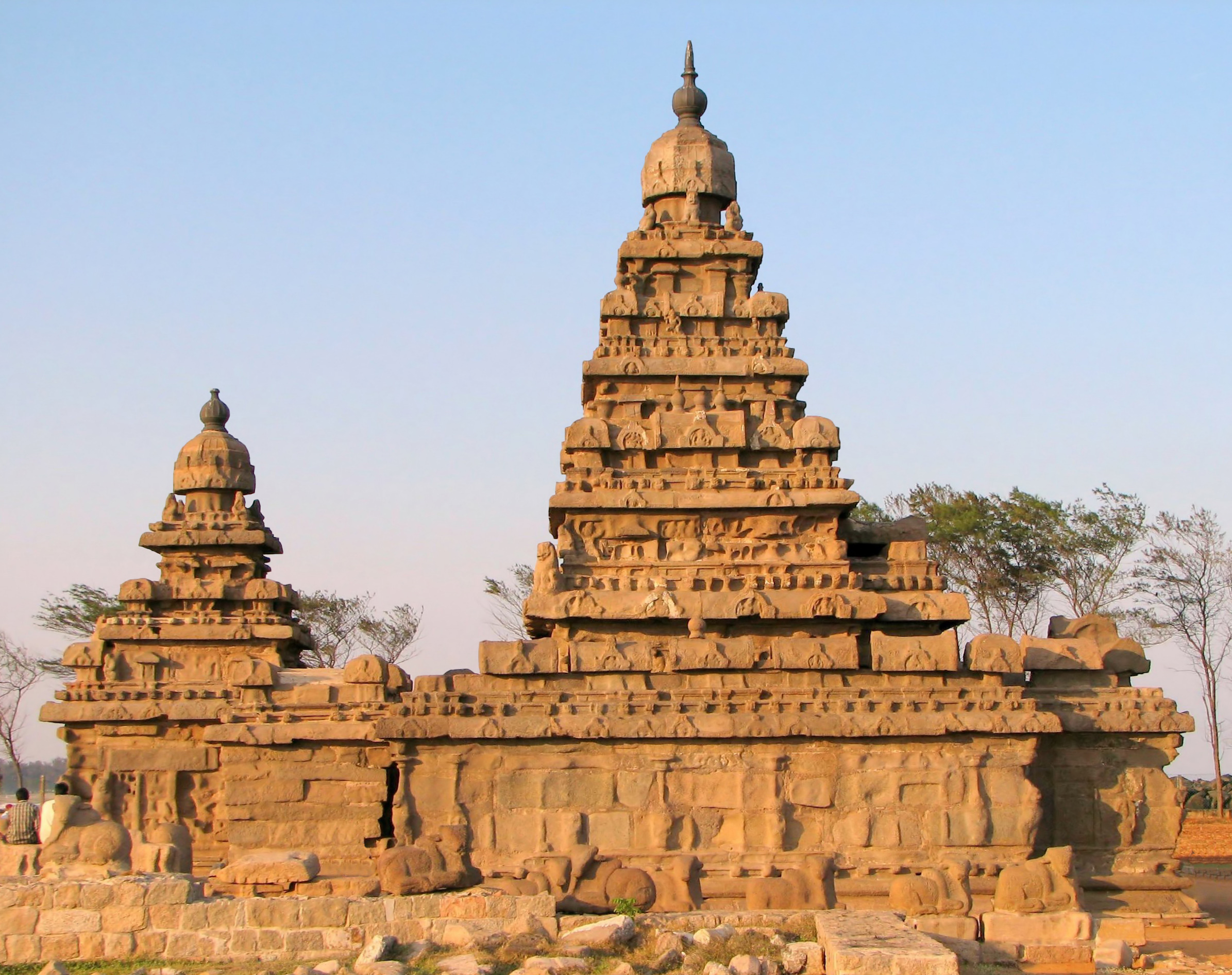
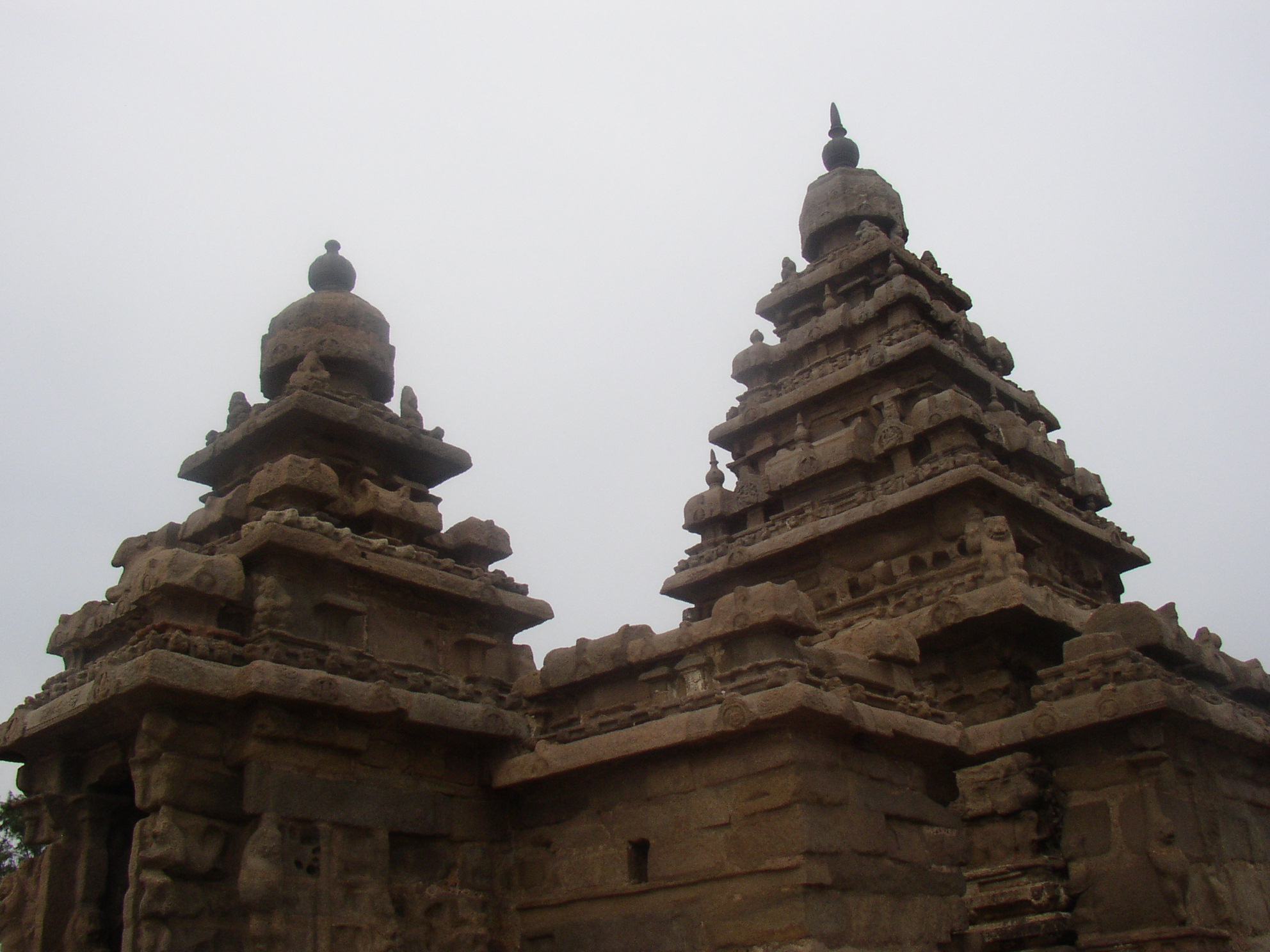
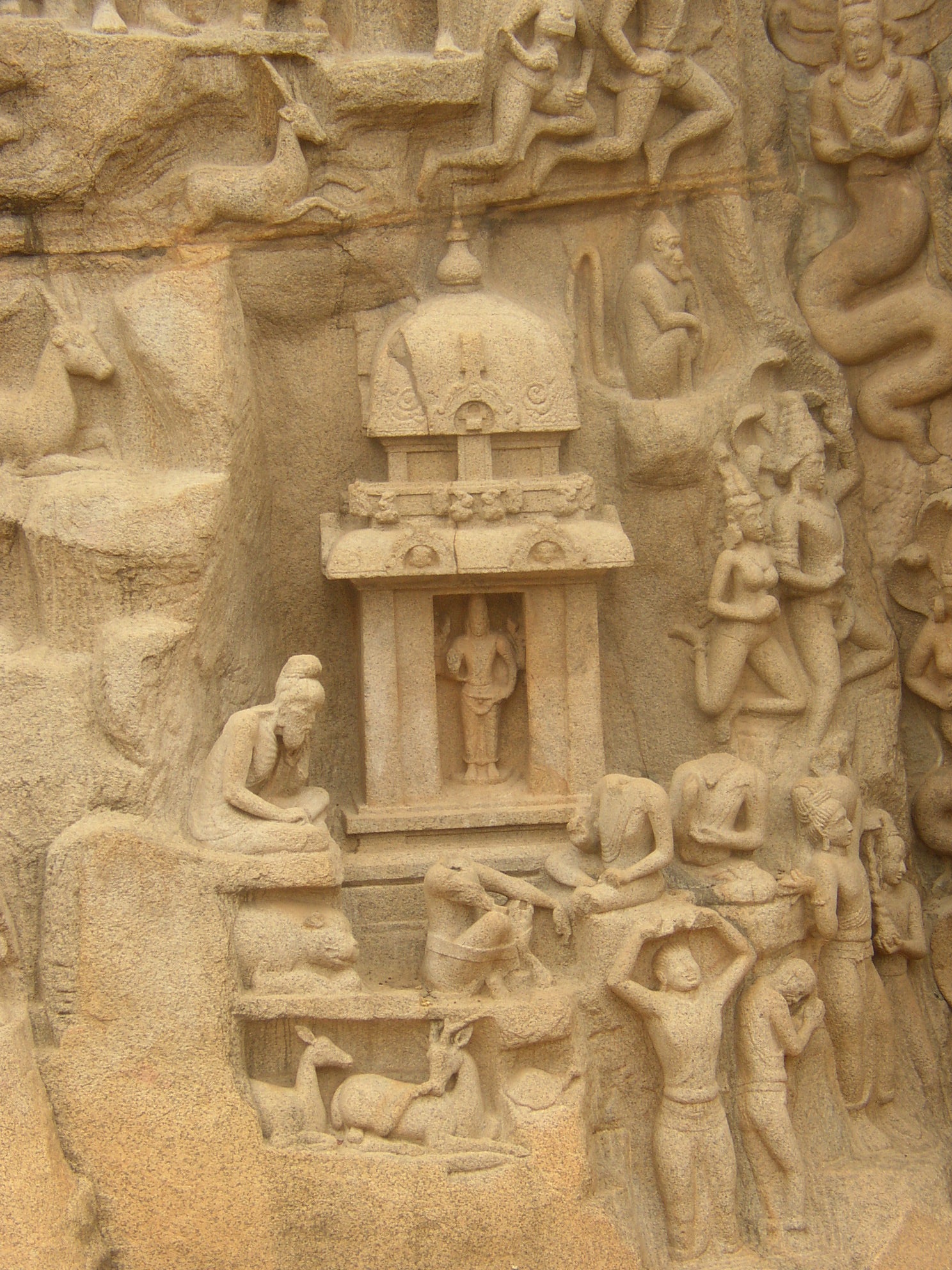
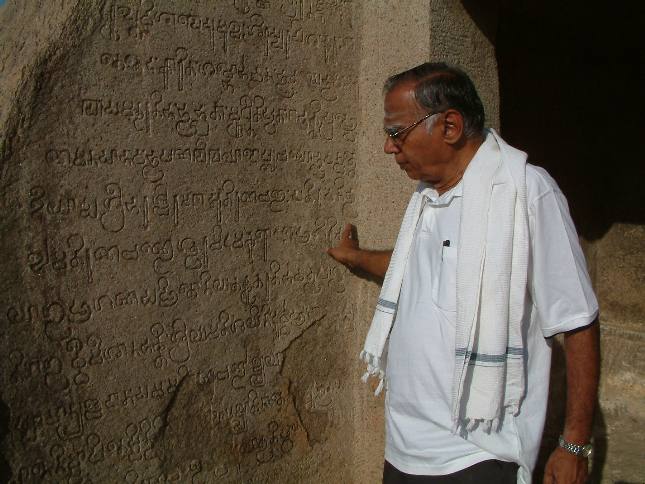
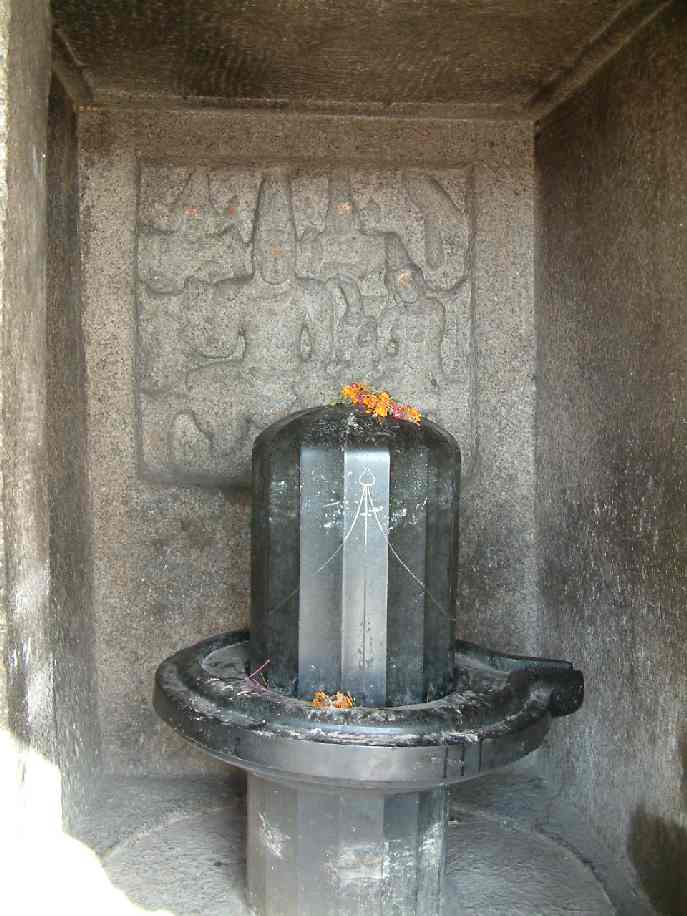
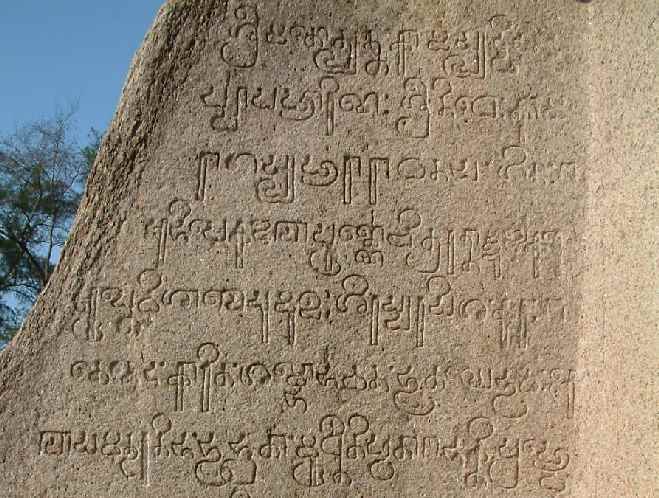
9. Structural TemplesShore Temple complex overlooking the Bay of BengalTwin vimāna towers of the Shore Temple, MāmallapuramViṣṇu temple near the shore / riverbank, MāmallapuramSea Shore TempleOne of the most famous group of temples of Māmallapuram is the Sea Shore temple complex, that has attracted especially mariners, those who moved along skirting the shore from Pondichery to Madras and further to the north. The complex consists of three structural temples and a few rock cut sculptures. At present two towers are seen from a distance, the tallest one, a sharp pyramidal tower with a pointed stupi on the east facing the sea coast. The other is a smaller one, looking like a younger brother of the former faces west. Both these temples are dedicated to Śiva, and were built by Rājasiṃha Pallava. Sandwitched between them is a Viṣṇu temple dedicated to the reclining form as Anantaśāyī. This image and architecture of the temple structure, covering it were originally carved out of rock in situ and the rest of the structure was built up with dressed sand stone. While the two Śiva temples were built on square plan, the Anantaśāyī temple was on a rectangular plan. The Viṣṇu temple also had a rectangular tower, which has crumbled, the portion upto the row of first tier now survives.The big Śiva temple has a very close enclosure wall, which probably had some sculptures. The east facing sanctum of this temple has a tall sixteen facetted Śiva liṅga, highly polished, planted in the centre. At the back wall of the sanctum, a Somāskanda image is seen.The liṅga seems to have been displaced and is now planted not in proper orientation.The sanctum is preceded by a small ardha-maṇḍapa. The inner wall of the ardha-maṇḍapa on the south carries an image of Brahmā (facing north) and the northern wall have a sculpture of viṣṇu, facing south.The northern wall of the sanctum on the outerside is fairly well preserved and houses sculptures of Tripurāntaka Śiva and Durgā.The rock cut image of Viṣṇu as Anantaśāyī has four hands; one of the left above the wrist is damaged and restored in cement now. The side walls of this Viṣṇu temple has sculptures of Kṛṣṇa līlā. Kṛṣṇa felling the demon Kesi in horse form, Kṛṣṇa dancing on the serpent Kāliya in Kāliya-mardana form (both are in the northern side); a Viṣṇu on Garuḍa, rescuing Gajendra (elephant) from the mouth of a crocodile are found on the walls of the Viṣṇu temple.The smaller Śiva temple facing west houses a Somāskanda on the backwall of the sanctum. It also had a liṅga in the sanctum now missing. This small temple had a small maṇḍapa in the west, which was preceeded by a large maṇḍapa. The bases of these two maṇḍapas have survived, but their superstructures are gone.These two maṇḍapas and the temple seemed to have had two concentric enclosures. The inner enclosure has a central entrance/gopura on the west. There are two sculptures of great significance at this entrance. Both are seen on the entrance jamb. The one on the south portrays an Ekapādamūrti Śiva with three heads, one body and one leg depicting the unity of Trimūrti Śiva, Viṣṇu and Brahmā. The other one facing south but found on the northern jamb portrays Nāgarāja standing beneath the five hoods of a cobra.Beyond this entrance on the west there are three fairly large balipīṭhas, as temple altars, two for the Śiva temples and one for the Anantaśāyī temple.The enclosure walls have survived only partially from the bottom but originally had a row of Nandis on top of them. All of them have fallen, but the restorers of late 19th and early 20th century have rearranged them. The inner walls of the inner enclosure had a serles of panels, portraying the history of the Pallavas. Some of the surviving panels may still be seen. It is pertinent to note that the Vaikuṇṭha perumal temple at Kāñcī, built about fifty years later than the Sea Shore temple, also by the Pallava king, portrays the history of the Pallavas from its mythical beginning to the building of that temple. There are label inscriptions, that mention the episodes connected with each sculptural depiction. The tradition of portraying the history of the dynasty in a sculptural sequence is first seen in Sea Shore temple in the time of Rājasiṃha.There are a number of inscriptions, relating to this temple complex, found here. A label inscription found on the lintel of Anartasayi Viṣṇu Temple, calls it Narapatisiṃha Pallava Viṣṇu graha. Narapatisiṃha is a title of Rājasiṃha. The Balipīṭha of this temple carry inscriptions in Sanskrit, written in Pallava grantha extolling the greatness of Rājasiṃha. All his well known titles including the one Atyantakāma are mentioned in them. It is evident that these three temples were built by Rājasiṃha.Two inscriptions of Rājarāja Cōḻa I dated in his 25th year 1010 CE are found in slabs now inserted into the base of the smaller Śiva temple. They mention the names of all the three temples which are “Kshatriya siṃha Pallaveśvara Graha”, Rājasiṃha Pallaveśvara grham and “Pallikondaruliya devar” (Anantaśāyī).The whole temple complex is called Jalasayana. That would also indicate that rock cut Anantaśāyī temple was the first to be erected, followed by the other two Śiva temples. The two inscriptions of Rājarāja show that there were flower gardens on both sides of the complex and that all the three temples were under worship even in the beginning 11th cent CEThe Sea shore temple has given rise to many speculative theories. One was there were five more temples with towers that have got submerged under waters. There were persistent claims that the metal top of the kalaśas were seen by many village elders. These speculations have no basis and all that is known is during some high tides many carved sculptures have been sucked into the sea by the waves. The Archaeological Survey of India formed an underwater exploration wing; an enterprising official added to the speculation galore. However during the recent study, it has come to light that a long rock cut wall, like that of a prākāra, is seen jetting into the sea. Probably the sea was a little far away and there was an eastern extension of the prākāra. But nothing more has come to light.An important new find turned up on the floor of the Shore temple adjacent to the enclosure wall. A small tank like structure was uncovered with stone revetments. In the centre there was a well, lined with stones. It was the temple well, used for drawing abhiṣeka water. By the side was found a partly rock cut and partly structural, miniature temple, circular in plan and elevation, with a small socket in the centre, housing an image of Śiva as Tripurāntaka. The base of this miniature temple is in the form of square, at the bottom, with an octagonal and circular plans one over the other, resembling a yantra.The Diving VarāhaBut the most striking find was a rock cut Boar, unfortunately damaged. It represents Lord Viṣṇu in his Boar/Varāha incarnation. The boar pressing its hind legs with great force and bending forward, with its head down as if powerfully charging, is ready to plunge into the ocean to lift the mother earth. According to legend the earth remained submerged under the deep waters of the ocean. The Varāha dived into the waters and lifted the earth above the waters. There are many Varāha sculptures in India, in most cases the boar will be shown with its head slightly lifted up to suggest, it has lifted the earth. But this is the only illustration where its head is lowered in the act of plunging into the waters. It should be understood in the situation in which it is located. The artist has located the Varāha right on the coast, on the shore, where the waves dash against thus integrating its location and environment, which suggest it is actually diving into the oceanic waters. It is an extraordinary location, thoughtfully chosen to represent the real ethos of the event. I would consider this as the finest portrayal of not only the Varāha, but also the aesthetic approach of the artist of Māmallapuram.It is noticed in every choice of the monuments such as Arjuna’s penance, Kṛṣṇa Govardhana-dhari etc. Māmallapuram artists were great masters of integrating nature and environment into their artistic production that makes them the most fascinating pieces of art. The Varāha is carved on a rocky pedestal which bears the various names of Rājasiṃha-Pallava grantha characters - Rājasiṃha, Raṇajaya, Śrībharaḥ, and Citra karmukha. The inscription has abundantly proved the artistic sensibility of the Pallava king Rājasiṃha - an “ocean of art” and the patronage behind all the creations at Māmallapuram. This sculpture has been brought to light recently. It has one more interesting appeal. During rainy season, or when there is high tide the tank will be filled with water. At that time the boar will remain submerged under waters - a fasinating spectacle of the event that deseves to be seen.The Lion TempleWithin the enclosure of the shore temple, to the south of the triple temple, is a majestic seated lion, partly carved on a rock and partly sculpted separately and placed in position. In the torso of it, almost representing its heart is a square socket, serving as a miniature cave - sanctum in which is carved an image of Mahiṣāsuramardinī. It looks that the lion itself is the temple of the goddess and she is seated in her sanctum. The Upaniṣadic passages often liken the heart to a Guha/cave and the Supreme is said to reside in it. This sculpture suggests that concept admirably. By the side of the lion is shown a pretty beautiful deer in a reclining pose unfortunately its head is damaged and lost. Deer is the mount of Durgā. In between the lion and deer stands a dwarfish gana, the head of which is also lost.To the south of the temple a few hundred yards away are a few low rocky out crops. These out crops have also been converted into art pieces. They are miniature replicas of what has been seen at Tigercave. They represent a miniature tiger cave, the horse and elephants with houdas and a seated lion. etc. These further illustrate the artistic instinct of the patron and his artists.Olakkaṇṇeśvara TempleRight above the Mahiṣāsuramardinī cave, serving as its crown is a structural temple, built at the same time. The temple, approached by built up steps partly and partly through sloping rock, is at the highest point in the village.Dressed slabs have been used to build this temple, which originally had a tower, śikhara, probably resembling the tower of the sea-shore temple.It is also known that in spite of being in ruins, the temple was under worship even in the 19th century. The temple now remains from the base to the ceiling with the outer face of the walls exhibiting sculptures (check up). The wall on the south carries a delightful image of Dakṣiṇāmūrti Śiva. The temple is approached through narrow steps which seem to be the original one provided during the pallava times.Mukunda Nāyaṉār TempleŚāluvaṅkuppam / Mukunda Nāyaṉār structural temple remainsBrick and stone structural temple remains at ŚāluvaṅkuppamPallava inscription at Śāluvaṅkuppam structural templeAt the northern outskirts of Māmallapuram village, on the way to Śāluvaṅkuppam, a small structural temple, plain with an octagonal śikhara is found as if buried in sand. The surrounding sandy area has risen covering the temple which now remains exposed. Called Mukunda Nāyaṉār temple it is a Pallava structural temple of the age of Rājasiṃha.The Central Temple of ViṣṇuIn the midst of these great monumental and artistic productions stands the Talāśayana Perumāḷ temple dedicated to reclining form of Viṣṇu as Anantaśāyī. This is perhaps the oldest temple that has survived in the township of Māmallapuram. Bhūtattāḻvār the 5th – 6th cent Vaiṣṇava saint, born here has sung the greatness of Viṣṇu of this town, as also another Saint Tirumaṅgai who lived in the 8th century. Ever since it has been in continuous occupation as one of the 108 Vaiṣṇavite kṣetra (Divya desa). The 16th -17th century references to large gathering of pilgrims at Māmallapuram is mainly due to this sanctity. However the present structure is of the age of mediaeval period. The side walls of the entrance of this gopura in front of the temple carry scenes from Rāmāyaṇa, Hanumān, and Kṛṣṇalīlā in addition to Narasiṃhāvatāra etc. which are worth the visit to have a feeling of the 16th century. A tall four pillared maṇḍapa was built further east on the way to the Seashore for dolotsava Swing festival. A temple tank lined with granite steps, with central maṇḍapa was also built during this period for the sacred bathing and floating festival.The temple is called Talāśayana temple (Sthalaśayana_Skt.) in a number of inscriptions found on the walls of the temple The records refer to the temple as Sthalasayana and the Lord Viṣṇu as Ulaguyya ninra-perumal i.e Lord who stood for the emancipation the world.“It is interesting the Presiding deity of this World heritage site is called that the Lord who stood for the emancipation of the entire World. Inscriptions recording grants to the temple are found from the time of Śambuvarāya chieftainin of the 14th cent. Late 16th cent records of Vijayanagara kings are also seen A point of great historic interest is that the wellknown religious saint Kṛṣṇacaitanya Mahāprabhu paid a visit to this Māmallapuram between 1510 and 1512, and worshipped the Lord Viṣṇu and also Śiva here.KālīIn the midst of the village behind the shopping street, a raised platform houses a group of seven Mothers - Sapta matrikas,. While most of the Matrikas are of mediaval period the image of Kālī is a lovely Pallava sculpture in the round. The Goddess is majestic, seated and belongs to Rājasiṃha’s period. The location of the sculptures with reference to the Central Viṣṇu temple of the village is in the Īśāna i.e. north east. According to the traditional architectural treatises the Viṣṇu temple should be located in the centre of the village while the temple of Saptamātās should be in Īśāna direction. As the Saptamātā temple is located in the prescribed location it is evident the centre of ancient Māmallapuram village was at the area of the Viṣṇu temple. This point remained the centre of village till recent times. It is a fine example of a Pallava village following the textual prescription in its lay out.Lion SeatOn the topmost part of the main rock, almost serving as the centre of the whole group of monuments, is a rock cut, rectangular seat with a reclining lion at one end serving as a rest. It served as seat (Siṃhāsana) for the patron Pallava king to sit and discuss with the artists the progress of work The romantic appeal of the site and the different shapes of the rocks and the waves of the ocean not far away, ought to have fascinated this king of great fancies.