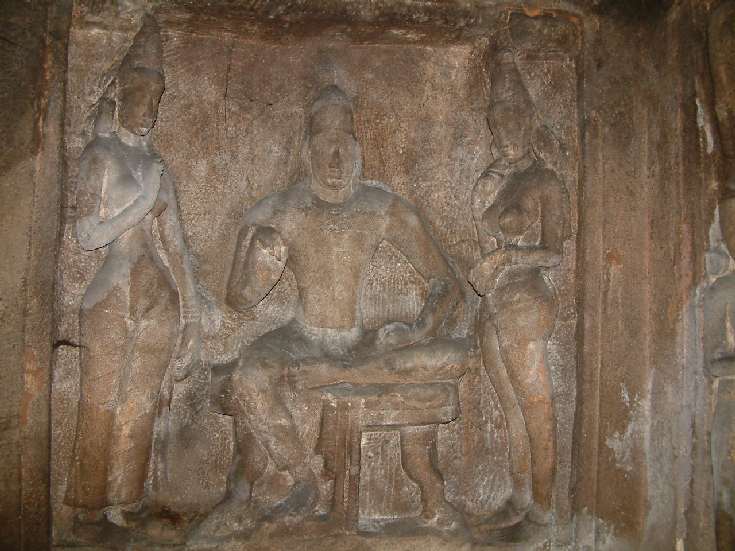
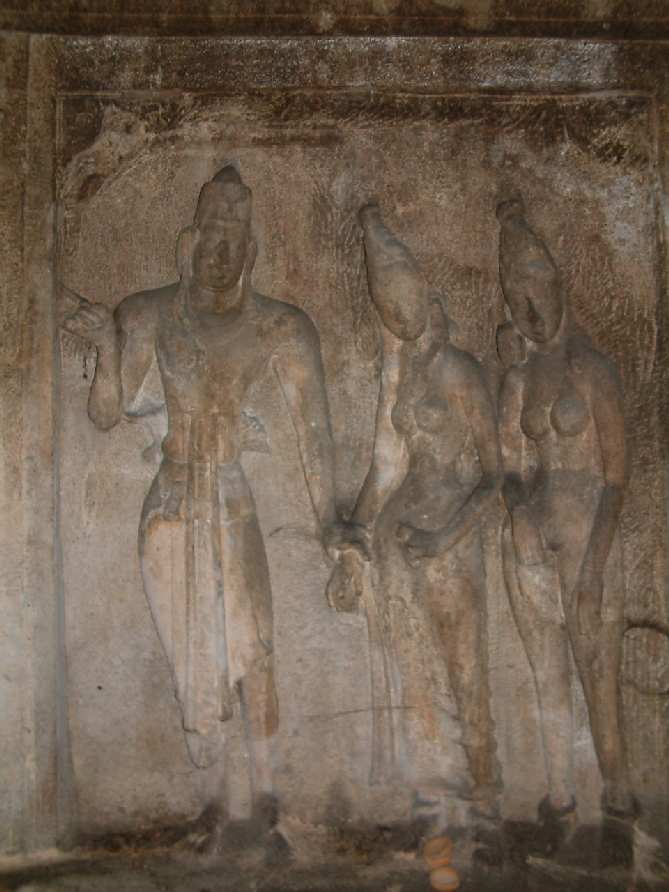
3. AuthorshipSiṃhaviṣṇu panel, Ādivarāha Cave Temple, MāmallapuramMahendravarman panel, Ādivarāha Cave Temple, MāmallapuramMost of the enthusiastic visitors to the fascinating monuments at Māmallapuram and their sculpture are curious to know who the author of these creations was. This question has dominated the visitors for the past three hundred years, and in a sense continues even now. The enquiry may be divided mainly into two periods namely prior to the discovery of the inscriptions around 1800 and post epigraphical phase. The first phase was mainly based on individual conjectures, depending upon their acquaintance with art in other places.As Māmallapuram has attracted connoisseurs for the past five hundred years, especially travellers and mariners, their acquaintance with art of other countries, made them suggest that (a) these were created by Chinese artists or (b) these were the works of Siamese (Thailand) artists or (c) they were the works of Buddhists. The Chinese source arose from the Tiger cave - which depicted the yāḻi heads that resembled the dragons. Travellers, who had seen Buddhist stūpas, almost asserted that they are the creations of Buddhist faith.However these suggestions gradually faded into oblivion when the inscriptions began to point to a local dynasty - Pallavas. As, more royal records emerged into lime light, they gave rise to a fairly recognizable frame work within which these creations could be accommodated. Names of some powerful Pallava rulers were known among whom Mahendravarman, Māmalla Narasiṃhavarman, Parameśvara Varman and Rājasiṃha, spanning about one hundred years in the 7th and beginning of 8th cent CE.are important. A point of great interest was that Mahendra I (590-630 CE.) left a few cave temples, at other places, leaving his titles inscribed on them. And what is important is that he mentioned specifically his love for art of sculpture and painting and also creating such novel temples. Rājasiṃha 690 – 728, expressed his fascination for art by calling himself “Ocean of art” (Kalā Samudraḥ) and did leave monumental arts in a number of places. And some of these names are found at Māmallapuram monuments and thus the date of these monuments was narrowed down to the 7th and early 8th cent.Inscriptions apart, a large number of articles and guides appear from 18th to 20th centuries in which, art historians tried to distinguish stylistic differences between these monuments. The volume of literature on style swelled. Writers were weighed down by stylistic considerations and assigned a chronological development within these monuments. This tendency went at times to an extreme level, alleging that some of the inscriptions were misappropriatied.Mahendravarman, I (590-630) was an eminent poet and a lover of arts. Among his titles the following are well known. “Citrakārapuli”-i.e.Tiger among artists, “Chettakari” i.e- builder of temples, “Vichitra–Chitta” i.e, one fascinated by rare and special arts, particularly sculpture in the round, bas-relief and paintings. “Saṅkīrṇajāti” i.e. One who could blend different classical forms. Mahendra has left two great Sanskrit farce plays that stand to this day as unique creations, ridiculing the contemporary society, particularly the religious faiths that deserved condemnation. In one of the cave temples, he inscribed that he caused the temple to be made without the use of brick, mortar, metal and wood. This exclamation made scholars to say that this was his first creation. The great art historian, Ānanda Coomaraswamy pointed out that Mahendra might have been inspired by the trend found in the Kṛṣṇa Valley of Andhradesa. This suggestion is more probable as it is seen that Mahendra assumed more Telugu titles than Sanskrit. There is a cave temple excavated by him at Pallavaram, in Madras, which carries nearly seventy titles of Mahendra, out of which 47 titles are in Telugu language. Similarly the rock cut cave on top of the Tiruccirāppaḷḷi hill, carries nearly one hundred titles of Mahendra, out of which seventy are in Telugu language. Mahendra’s association with Telugu country is more pronounced than his successors. The Telugu region had a long tradition of sculptural art, known from Amaravati and Nāgārjunakoṇḍa Buddhist stūpas. There were also some excavated cave temples in the region. Obviously Mahendra was inspired by this tradition which he brought to the Tamil country.Mahendra’s cave temples were simple excavations, with only the dvārapālas (guardians of doors), carved on either side, that are examples of his sculptural art. One remarkable cave of Mahendra is found at Tiruccirāppaḷḷi, which has a monumental sculpture of Śiva as Gaṅgādhara. Mahendra himself has eulogised this Gaṅgādhara in a beautiful Sanskrit inscription. His simplicity of carving with the pillar being square at the bottom and top with an octagonal fluting in the middle was considered his style. The sanctum of his temples do not house any deity now, but originally had either a stucco or painted image. Though Mahendra left many cave excavations around Kāñcī, Chennai and Trichy, there is no monument of Mahendra at Māmallapuram, as no inscription of him is found there.Narasiṃhavarman I, his son and successor (630-668) was a great fighter and so assumed the little “Mahā-malla”-great fighter. From his record, and subsequent Pallava epigraphs, it is seen that he chased the Cālukya ruler Pulakeśin, from the outskirts of Kāñcī to Vātāpi, the Cālukya capital, engaged him in a battle, killed him, and won a signal victory. He assumed the title, “the conqueror of Vātāpi” (Vātāpi Konda) and he occupied it for nearly 13 years. His defeat of Cālukya Pulakeśin, and conquest of Vātāpi are invariably mentioned in his inscriptions and in all the subsequent Pallava records, whenever they refer to him.Some of the monuments at Māmallapuram are assigned to Māmalla Narasiṃha I, by some writers on stylistic grounds. But as none of the inscriptions found at Māmallapuram refer to his conquest of Vātāpi and victory over Pulakeśin no monument of Māmallapuram could be assigned to Narasiṃha I.The third Pallava King, who, ruled in the 7th Cent with some authority was Parameśvaravarman I, father of Rājasiṃha (670-690). This Pallava king also had to keep fighting with the Cālukyas. He gives a graphic description of his battle with the Cālukyas, and the defeat he inflicted on the ruler, in his own royal charter. This significant event is mentioned in his own charter and all other records issued by his successors. He assumed the title “Raṇarasika Puramarddana” i.e. he who destroyed the capital of Raṇarasika Vikramāditya-Cālukya. As this outstanding achievement of Parameśvara is not mentioned in any inscription at Māmallapuram, it is clear that none of the monuments could be ascribed to him.That brings us to the King Rājasiṃha who by all accounts is the author of all the monuments at Māmallapuram. In his inscriptions he is said to have spent all his wealth on temples (Deva-Brāhmaṇa-satkṛta - atma vibhavaḥ). In all his known inscriptions one of the most significant titles – “Atyantakāma” i.e. one of endless desires or fascination is mentioned. Many of the monuments at Māmallapuram not only bear this title but also are named as “Atyantakāma–Pallaveśvara-gṛham” i.e. the Īśvara Temple of Atyantakāma. Such monuments include two cave temples and two monoliths. Further, these monuments carry inscriptions that are specifically foundation inscriptions, declaring they were his creations (tena idam karitam). Another significant title found for him in records is “Kalā-samudraḥ” i.e. Ocean of Arts. Another point of interest is his love for variety, seen in the construction of different types of temples, employment of different scripts, and different style of expressing himself. It would therefore be interesting to know the personality of the patron behind the monument which is sketched in the next chapter.