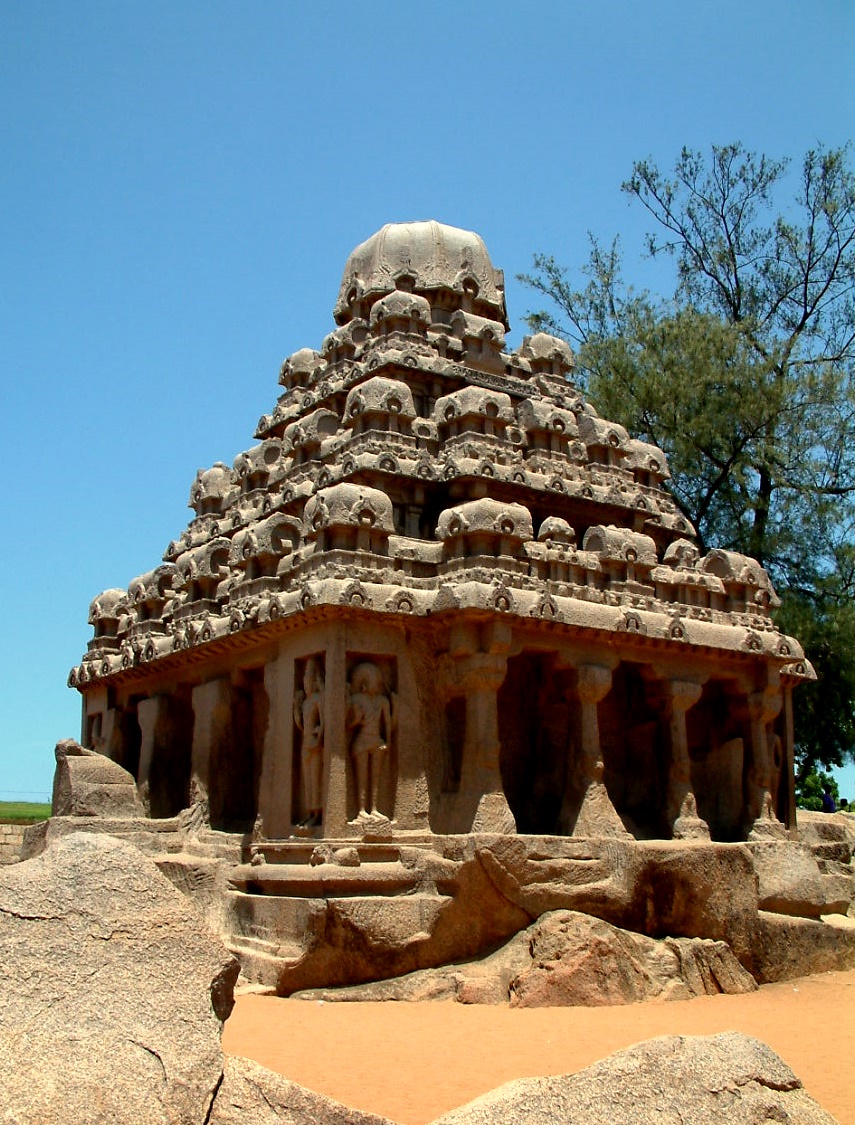
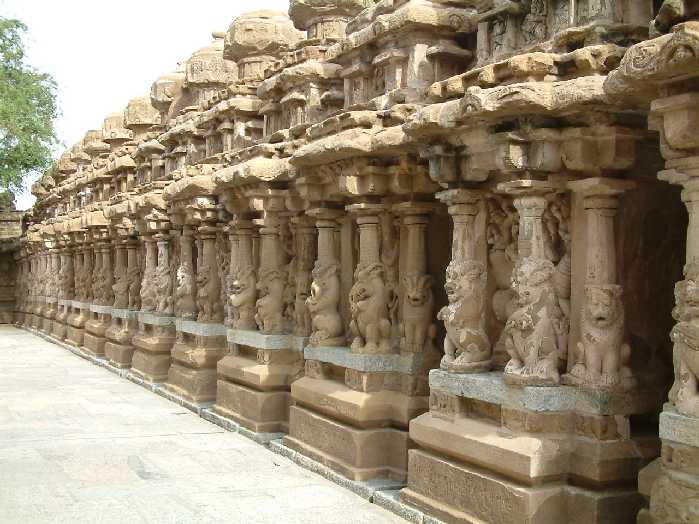
4. Rājasiṃha, the BuilderAtyantakāma Pallaveśvara Gṛham (Dharmarāja Ratha), MāmallapuramKailāsanātha Temple at Kāñcīpuram built by RājasiṃhaMāmallapuram was probably established as a port by Narasiṃha I, after his title Māmalla. There is no specific evidence to connect this association. But all the monuments were created by Rājasiṃha who was more popular among his subject as “Māmalla” (“vidita Mahāmalla śabdaḥ prajanam”) in his inscription at Vāyalūr. Rājasiṃha’s monuments are found at Kāñcīpuram, Paṉamalai, Vāyalūr, Tiruppōrūr, Thirukkalukkundram, Daḷavānūr and Māmallapuram, all in Pallava Country and at Thiruppattur near Tiruccirāppaḷḷi. He has left excavated cave temples, cut out monoliths, open air bas reliefs, and structural temples. He employed variations in scripts, like simple Pallavagrantha, ornate Pallava grantha, Grantha in which calligraphic letters resemble birds, animals and reptiles, and finally simple and ornate Nāgarī script. Also at different places he chose different modes of expression. For example at Kāñcī he arranged over 300 of his titles in alphabetical order, and had each title written in four different scripts. At Vāyalūr, he has tabulated a list of fifty four Pallava kings, beginning from the first known king, arranged in the order of succession, till his own times. Interestingly this record begins at the bottom of a pillar, and is written spirally going up. At Śāluvaṅkuppam, we have his authorship inscription both in Grantha and Nāgarī characters. Each and every one of his known monuments is laid out differently, in plan, elevation, or distribution of sculptures. His choice of the sites to build his monumental temples, on the top of a hill at Paṉamalai, among the plain fields at Kāñcīpuram and on the seashore at Māmallapuram, depict his fascination for natural environment.He was born to Pallava Parameśvara the conqueror of the Cālukya, Raṇarasika - Vikramāditya I and resembled Guha-Subrahmaṇya born from Parameśvara (Śiva). He calls Pallavas as pious princes, who destroyed the pride of the evil dark age (Kālī), who always spoke truth, who were profoundly learned, who knew how to practice the Trivarga, who assiduously honoured aged people, who subdued lust and other internal foes, who excelled in the knowledge of weapons and who were mighty and endowed with polity and modesty. This illusterious king Atyantakāma was well known for his great statemanship. Like Kama, he charmed refined women in secret, protected the followers of Vedic learning like Indra, he protected like lord Viṣṇu, sages from the onslaught of enemies, and like Kubera, the lord of wealth, he gifted all his wealth to good people.He probably had his first name Narasiṃha after his great grandfather and when coronated assumed the title Rājasiṃha. He was proud of his race and was called the “Sun among the Pallavas”, an ornament to his family, and virtually the fluttering flag of his family (Vṛṣa-dhvaja) were his titles. He seems to have possesd a beautiful personality (Eka-sundara - unequalled in beauty), and had a very pleasant appearance. Rājasiṃha’s prowess is evidenced from his titles. Invincible, (Aparājita) conqueror of battles (Raṇa-jayaḥ) and an Emperor, with a vision (Cakravartī) and (Dura-darshi). He always preferred righteous path, and followed the science of rule as enjoined in ancient traditional treatises. He was a great scholar of various branches of knowledge which he followed in his rule. (Śāstra-dṛṣṭi). endowed with active habits constantly (Nityotsaha). Expert (Upāya-nipuṇa). He was an accomplished musician especially stringed instruments, the vīṇā and was likened to the great sage Nārada in playing vīṇā.He was an outstanding personality among men, who always strove for righteous conduct which he considered as his armour (Dharma-kavacaḥ)- A lion among men. He called himself the crest jewel of the city of Kāñcī (Kāñcī-mahāmaṇiḥ).He begins the string of his titles with Rājasiṃha (his coronation name), Atyantakāma (of boundless desires) and Raṇajaya-conqueror in battle. Thus he has given himself importance to the title “Atyantakāma”, both in the verse referring to his birth and also at the beginning of the list of his over 300 titles. There are several titles that speak about his passion for arts. One of his significant title was “Ocean of Arts”. (Kalā-samudraḥ) Obviously he was inspired by his illustrious predecessor, Mahendravarma who styled himself as Tiger among artists. This he explicitly indicated by assuming a title (Mahendra-Parākramaḥ) equaled Mahendra in his achievements. His love of arts extended beyond sculptural art to music and dance, which he showed by such titles as Vadya-vidyā-dhara (Celestial musicians in playing instruments), Vīṇā Nārada and Atodya tumburu, sage Tumburu in playing musical instruments. He had a great fascination for the epics - Rāmāyaṇa and Mahābhārata (Itihāsa-priyaḥ) which also suggest that he was fond of creating history. Rājasiṃha seems to have concentrated on increasing the greatness of his country (Deśa-vardhanaḥ).In his religious leannings particularly building temples and instituting worship he strictly followed the ritual treatises called Āgamas. Atyantakāma was a great devotee of Śiva, which he mentions in every one of his record. The titles like Īśāna-śaraṇaḥ, Devadeva-bhaktaḥ, Īśvara-bhaktaḥ etc. illustrate his Śiva bhakti. One of the oft respected titles denoting his Śaiva devotion is Śiva-chudamani, one who bears as his crest jewel. The inscription at Vāyalūr states that he was Atyantakāma - one with boundless desires in adoring the sacred feet of lord Shambu for ever (Shambhor pādāravinda dvaya paricarane nityam atyantakāma) True to this expression, most of creations at Māmallapuram and elsewhere is dedicated to Śiva. But this devotion was not against the worship of Viṣṇu or other gods, for the extreme sectarian form of worship was unknown then. Rājasiṃha himself assumed titles Narasiṃha, Siṃha Viṣṇu etc. By his time in 700 CE, the Āgamic literature seem to have been well codified, for he declares that he took Āgamas as authoritative and guiding principles (Āgama Pramāṇaḥ) and a follower of Āgamas (Āgamānusārī). He was the first ruler to declare that he followed the various teachings of “Śaiva-siddhānta marga ” and got all his impurities cleaned (Vidita bahunayaḥ shaiva siddhānta marge).The study of Māmallapuram monuments, against these qualities of an extraordinary personality with a great passion for variety, a constant enthusiasm to sustain novel creations, with a great enthusiasm for epics (Itihāsa-priyaḥ) and aesthetic sensitivity steeped in devotion, and a longing for chaste conduct in life, made the ruler to transform all that came in his sight into a creation of beauty. There are several caves, several monoliths, several open air sculptures at Māmallapuram. A remarkable fact is that each one exhibits a creativity and innovation differing from the other. No two monuments at Māmallapuram are identical. The monuments reflect the personality of great art lover. The selection of different rocks and the selection of art forms suited to the natural formation of the rock stand out when one moves from one monument to another. The great desire to create so many things at the same time by employing the available artists on so many monuments cause of so many new forms at the same place that also resulted in the sudden stoppage of work on all monuments when that great personality was no more.This is the only place, where the concept of art forms takes the leading role, the religious and legendary themes playing a subsidiary role. The cut out monoliths, cut in cave temples, or the open rocks, chosen for their natural formation like Arjuna’s penance on the banks of descending celestial river Gaṅgā, or hill, lifted up by Kṛṣṇa or the location of the Viṣṇu reclining right on the waves of the ocean, on which he sleeps, they all portray an artistic sensitivity and does not follow a rigid textual grammar, every turn, and position of the sculptures, vividly portraying the supremely elegant conception.The lines and volume - and space captivate of the onlooker. Every portrayal pulsates with the inner spirit of theme that is portrayed in the most appropriate manner, the monkey group - male, the female and the young one, the male searching for the lice on the female, which in turn feeds the young one - is a superb study. The great elephants, the male, female and their calf - wading through the woods to the river bank - an unforgettable portrayal - and so is the cow that tenderly caresses its calf as a cowherd is milking the cow reflects truly the simpler characters of each animal. In fact, the animal studies in Māmallapuram remain unparalleled in Indian art. So are the monoliths - the rathas - where each temple is presented as a sculpture - the Mahiṣāsuramardinī cave where the sculpture makes you feel the rage with the adamant demonic power is annihilated by the goddess Mahiṣāsuramardinī, the feminine power par excellence. The depiction brings before the eye vividly the legend re-enacted in stone.Behind all these tremendous portrayals is the king - patron - who was propelled by a desire to exhibit variety, (Atyantakāma) with an extraordinary sense of aesthetic perception (Kalā - samudra) and ocean of Arts.His successor Nandivarman had to struggle throughout his long rule to hold on to his seat, so that no great monumental creation came into existence subsequently. He created a Viṣṇu temple at Kāñcī, when some peace returned, but that was only a flicker of disappearing art. By the beginning of 800, the medium of building had changed from soft sand stone to hard granite with the result that sculptural art reached a low ebb.There are two prominent theories at present about the authorship of Māmallapuram monuments One holds that on the basis of stylistic variation, three periods could be distinguished as Mahendra style, Māmalla style and Rājasiṃha style. This theory holds that the work at Māmallapuram was started by Narasiṃha I - Māmalla and continued by successive rulers till the end of Rājasiṃha’s reign, which means that all the rulers from Māmalla’s time took interest in these excavations, continued the work simultaneously on all the monuments, and with the death of Rājasiṃha all the monuments were left unfinished. The stylistic evolution is sought to be shown through designs of pillars, deep or shallow carving of the figures and some peculiar features.As has been mentioned earlier the most significant achievements of Māmalla, or Parameśvara are not mentioned in any of the inscriptions here. Nor is their interest in excavating monuments hinted. As most of the monuments are unfinished any attempt to distinguish style within a period of about fifty years is fraught with difficulty.The other theory is that all the monuments were the creations of one king namely Rājasiṃha. This theory is based on the unimpeachable evidence of inscriptions, which are foundation records, claiming that they were caused to be made by the king Rājasiṃha (690 - 728). Many records found in different monuments are repetitions of the records of the same king. The theory is also based on the study of an extraordinary personality, a lover of great art and literature. Māmallapuram creations are first and foremost artistic expressions and religious fervour played a subordinate role. One of the questions frequently asked is, whether it would be possible for one king to create so many monuments in his own time. As has been pointed out earlier, quarrying, transporting and dressing and chiseling would have been more time consuming than carving in situ as found here. Illustrious monarchs, like Rajaja Cōḻa and Kṛṣṇa deva, built more number of monuments in much shorter time. It is not impossible. But what is of utmost importance, is the occurrence of foundation inscriptions referring to their creation. If these foundations records are set aside, one will have no way of dating any monument. And lastly to say that the earlier monuments had been misappropriated by the later king who inscribed his record on them would amount to imputing dishonesty to a great artist, nor can one justify by any means such a blasphemous claim. That all these monuments are the creations of a single king with an extraordinary aesthetic perception is a fact.