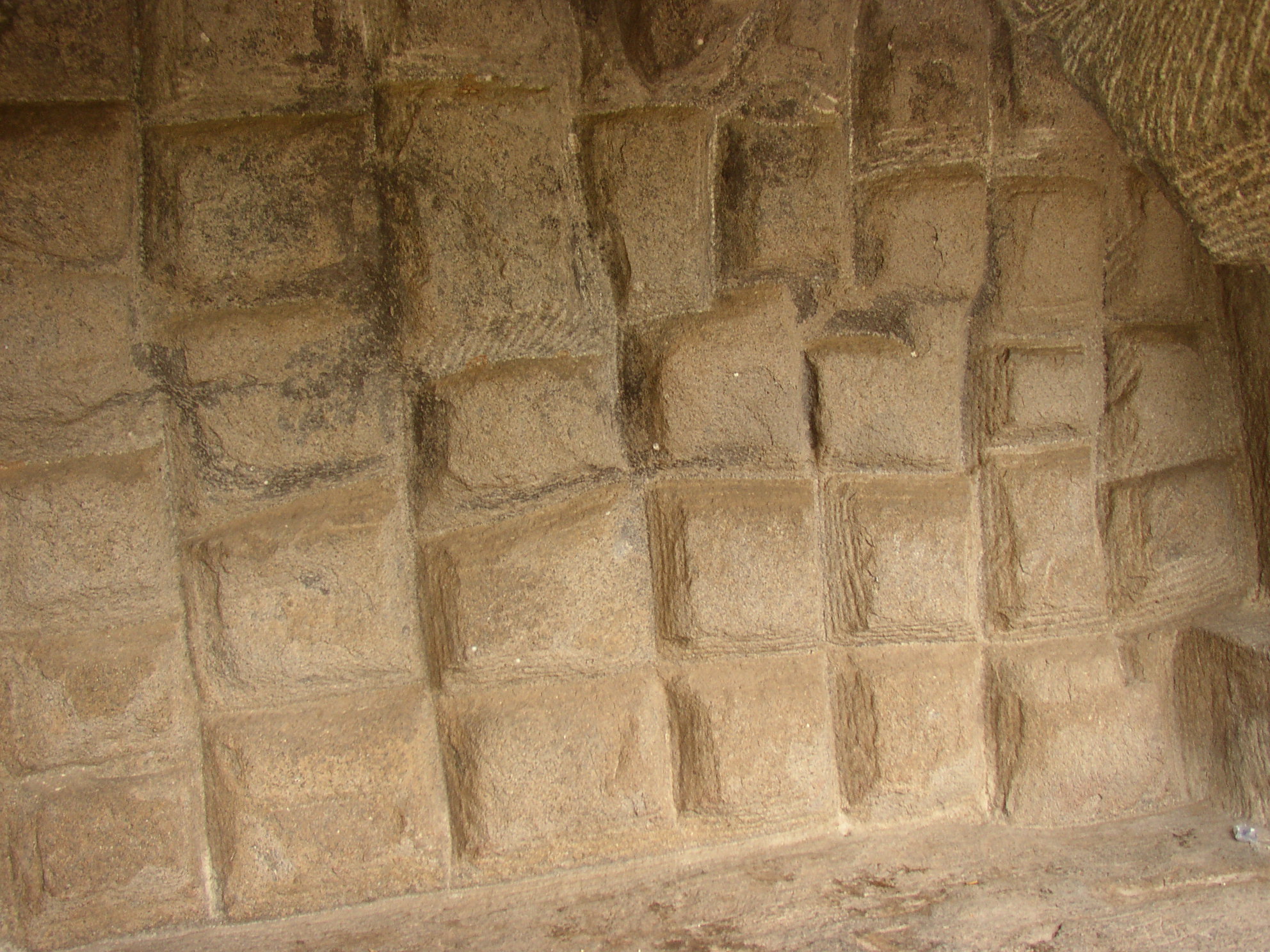
2. Artists and Their MaterialsPallava rock-cut excavation technique showing chisel grooves and blocked-out graniteFor the creation of such exquisite monumental art, the world is beholden to the artists under the Pallavas who were working at Māmallapuram. The question that naturally arises is whether the name of any of the artist who worked at this site is known. There is a belief that the names of Indian artists are generally not known and there is even a suggestion that there was a taboo in mentioning their names. In other words the artists did not receive due recognition in the hands of patrons. This view is not based on available records but is more a preconceived notion, for the names of some of the leading artists who worked at Māmallapuram are still preserved in inscriptions.On the western outskirts of Māmallapuram, a little less than a kilometer away, on the high road is a hamlet of Māmallapuram now called Punceri. There are rock boulders here, among which is a low rock with a cavity that is called “Horse cistern of lame Virappan”. On the periphery of this rock, are seven labels written in old Tamil and grantha script: Catamukhyan, Kalyani, Kevaḍa–Peruntaccaṉ, Kollaṉ Seman, Kuṇa-mallaṉ, Payyam Ilippan, Namaḥ - Thiruvorriyur Abhajan.All these are personal names, but they undoubtedly indicate that they were artists. The name - Kevaḍa Parumtaccan, for example is the name of a great artist. The name in Tamil, consists of three parts. Kevaḍa is personal name, Perum i.e - great in Tamil, and Taccaṉ means - sculptor. Taccaṉ is a Prākṛt form of the Sanskrit word Takshaka, standing for a sculptor - one who chisels. The sculptors were themselves painters in remote past. Master sculptor/artists were themselves architects who were called in many inscriptions as Peruntaccaṉ. There are pointed references to great architects/sculptors as Peruntaccaṉ in 6th - 8th century epigraphical records. Many such examples could be cited that speak of the respected position given to the sculptor/artist in Tamilnāḍu, who were mostly called Perum-taccaṉ (Master artist).It would be interesting to give a brief account of these artists before we proceed to further examine these names of Māmallapuram artists. Several royal charters of the Pallava and Pandya Kings have survived, a study of which show the artist / sculptors were held in great esteem. They were very close to the king and wrote down even highly secret orders and messages of the king. They were trusted secret scribes (Rahasyādhikṛt) in the service of the king. The kings charters show that the scribes were conferred royal titles and are mentioned as the writers of the charters. The legal treatise (Dharma-Śāstras) prescribes that the name of the scribe should be written down at the end of the document. When the kings made any gift of villages to learned brāhmaṇas, one share of the village was allotted to this sculptor /artist.It is interesting to note that Kāñcīpuram was a great centre for artists. Many records of the Pallava age mention that the artists hailed from Kāñcīpuram. They seem to have had an effective guild, to which they referred to learn about their obligations.Thus the name Peruntaccaṉ, appearing in a part of Māmallapuram, shows they were working on these monuments. These artist sculptors belonged to five groups, often calling themselves as “the five-artisan group” - that indicate though they all were adept in sculpting work, they occasionally divided themselves after the material with which they were working such, as stone, wood, iron, gold, and ivory. Early epigraphs of the Pallava mention all these sculptor/artists worked under the king as scribes. Obviously the division was not so well marked. So we have among the names of Māmallapuram artists one Kollaṉ-Seman - a metal worker (Kollaṉ - metal worker) Another name Gunamalla seems to be a royal title confered on the artist. Payyam seems to be a skill in scooping out. Thiru-vorriyur is a famous temple centre near Chennai. The epigraphist has rightly pointed out these names, occurring at the suburb of Māmallapuram, denote that they were artisans. As these records are assignable to C.700, that they represent the Māmallapuram artists, is certain. What needs to be borne in mind is the media through which they were expressing themselves.The artists were aware of the technique of carving stone, from the pre current era. A large number of rock shelters, dating from 2nd cent before CE. are found in the Tamil Country with neatly chiselled stone beds, bearing Tamil Brāhmī inscriptions. Many hero stones portrayring the images of heroes with their names inscribed have also come to light that date from 2-3rd cent CE. These are carved on granite slabs, in low bas relief, often in animated poses, pointing to the art of carving prevalent even at the village level. And yet it was brick and mortar, and perhaps wood that was preferred generally for construction. Most of the temples were built of brick and mortar. The image in the sanctum was made of stucco, though some Śivaliṅgas made of stone were also installed. One of the earliest Śivaliṅga in stone assignable 2nd-1st cent BCE, is found at Gudimallam in the northern borders of Tamil Nāḍu. But the preference for stucco or painting continued. A point of technique that deserves attention was the art of carving brick walls with sculptures, covering them with lime plaster and painting them. Such sculptures were chiselled on brick walls in situ, after erecting the brick walls. It is this technique of brick carving, which was transferred to stone carving from the middle of 6th cent. With the introduction of a large number of cave temples, in which rock was scooped to provide wall surface, chiselling sculptures in situ came to dominate the scene. Simultaneously soft stone was used in place of brick to erect the wall structure and carve sculpture in situ. Be it in granite stone, sand stone or brick on which the sculpture was carved, all were plastered and painted at the end. One would find no difference between a stone temple or brick temple in the end. Artists main technique remained carving large scale sculptures in situ.The enormous labour involved in quarrying stones and transporting them to distant places was not prevalent. The rock cut caves and structural stone temples built of sand stone, found in Māmallapuram and Kāñcī stand witness to this trend. When Mahendravarman I, carved his first cave temple at Maṇḍagapaṭṭu, he exclaimed about his novel technique of carving stone in situ, stating that he dispensed with the use of brick, wood, metal and stucco. It is also known that temples built of a single material like stone was called a pure temples (“śuddha” type) while using more than one material is called mixed temple “misra” variety. The excavation of rock cut temples and sculptures could have consumed less time than structural temples of granite. The medium of their creation, being already present permanently, the artists of Māmallapuram were freer to express themselves.