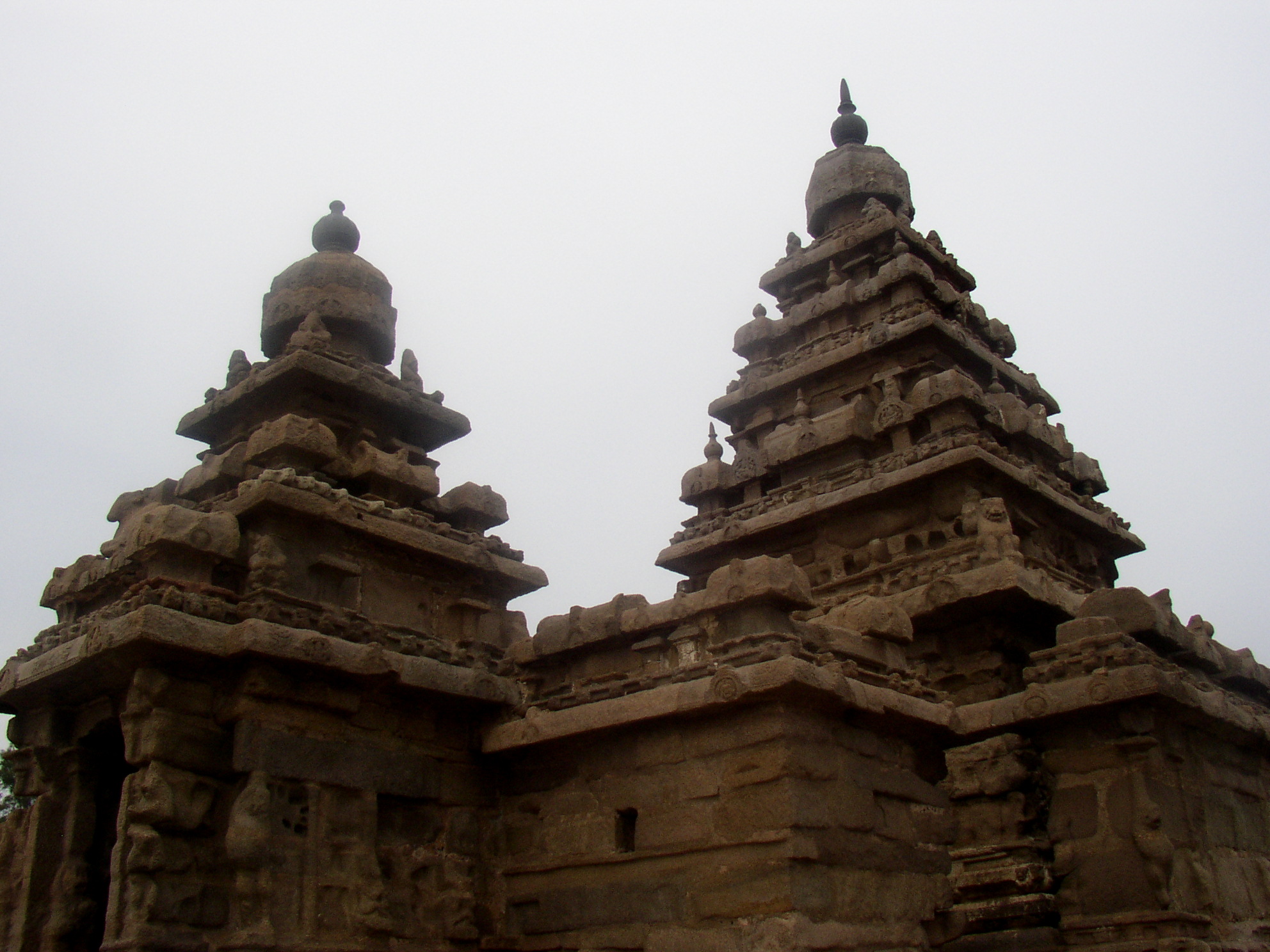
1. Māmallapuram (Mahābalipuram)Shore Temple and coastal skyline at Māmallapuram (Mahābalipuram)The ancient name*1 of the coastal town Māmallapuram was “Mallai”. The word Mallal in Tamil stands for “Prosperity”. The town situated on the coast, had backwaters, entering deep into the township at its western end that made possible heavy boats and small ships laden with goods to enter and anchor on its shores providing a natural port environment. Early Tamil literature alludes to the prosperity of the town with ships that enter and leave the port with commodities. It is evident that from the very beginning of its history Mallai was a prosperous commercial port, especially with its overseas trade.There are large salt pans manufacturing salt from sea water, both on the north and south of Māmallapuram. Some of these salt pans, bore the names of the then ruling Cōḻa monarchs in mediaeval times. Salt production was a royal prerogative in ancient times. In mediaeval times production of salt seems to have been carried out even in Māmallapuram as seen from an inscription which refers to an ‘Alam’ in the Village.The port town was mainly connected to Kāñcīpuram, the capital of the Pallavas. Kāñcīpuram was the most important city in the northern part of Tamil Nāḍu for over two thousand years, before the 17th cent, when Madraspattanam (modern Madras) began assuming importance with the advent of the British East India Company. Māmallapuram was connected to Kāñcīpuram by two routes - one the inland route, via Tirumukkūḍal and Thirukkalukkundram and the second was by a waterway. The river Palaru (Milky River) which skirting Kāñcī reaches the Bay of Bengal at a place called Vāyalūr (entreport) about ten km. south of Māmallapuram. Reaching Vāyalūr from Kāñcī through the river way, one can reach Māmallapuram covering the short distance by the coastal way. Pallava monuments, especially of Rājasiṃha, the creator of the monuments, are found on both the routes from Kāñcī, at Thiru-kaluk-kundram where there is a lofty hill of Vultures with a Śiva temple and a structural temple built on top of the hill (Also nearby is a place Vallam, where two excavated cave temples of Mahendra Varman I, circa 600 C.E are found). At Vāyalūr on the coast, there is an old Śiva temple, which has a Pallava Pillar built into the entrance gateway, that lists 54 generations of Pallava rulers, beginning from mythical Brahmā, down upto the reign of Rājasiṃha, the builder of Māmallapuram. It has been suggested that this pillar was intended to perpetuate the coronation of Rājasiṃha. Māmallapuram’s trade connection with the Pallava capital ought to have enhanced its prosperity.About twenty km to the north of Māmallapuram, on the coast way, is another ancient settlement called Tiruvidaṇṭai - a Vaiṣṇava kṣetra (Celebrated as one of the 108 Pilgrim Centres of Vaiṣṇava Faith). The visitor will see the temple on his way to Māmallapuram from Madras.Around the 5th- 6th cent, one of the Vaiṣṇavite saint, Bhūtattāḻvār was born at Māmallapuram. He was listed as one among the three early Vaiṣṇava saints (Mudal-Āḻvār-Muvar). The character of the town, which remained essentially as a commercial town since its foundation now changed into a sacred religious center of pilgrimage. This saint, Bhūtattāḻvār, has sung about different Vaiṣṇava settlements in the South and sings Māmallapuram as well).Around the middle of the 7th century (650 C.E.) the then Pallava ruler Narasiṃhavarman I, sent a successful naval expedition to Śrī Laṅkā, in order to help his friend Mānavarman, to regain his lost Śrī Laṅkā throne. Narasiṃha Pallava, who had the title “Māmalla” it is surmised sent his naval fleet from this port town, which he renamed as Māmallapuram. Though it became a pilgrim centre, it continued to remain a commercial town as denoted by the term “Puram”. Though Māmalla’s name is associated with this town no artistic activity of either Māmalla, or his illustrious father Mahendra I is noticed in the town nor the record of his successors till we come to the reign - of Narasiṃha II around 690 C.E. are noticed. From about 690, for nearly forty years, the town changed its garb and was teaming with artists, and the visit of the king, his queens and retinue, who swarmed the place to see the magnificent creations. It was art and art and nothing else. The purāṇic legends that filled the heart of the people so long through hearing, suddenly were springing into visual forms to the delight of the onlookers. The charming legend of Kṛṣṇa lifting the hill Govardhana, to provide shelter to the cowherds, to save them from the torrential rain let lose by Indra, the legend of Arjuna, the hero of Mahābhārata, doing severe penance on the slope of the Himalayas by the side of the great river Gaṅgā, to obtain a weapon - Pāśupatāstra - from Lord Śiva, the legend of the great victory gained by the goddess, Durgā over the arrogant buffalo headed demon, Viṣṇu assuming the form of a wild boar and plunging into the ocean to bring the submerged goddess, Mother Earth, Viṣṇu taking three strides to subdue the demon king Mahābali and that charming-goddess Śrīlakṣmī, personification of beauty, and symbol of feminine tenderness - all these legends about which people had heard of, were springing up before the eyes, casting a spell of wonder and admiration. The sound of the chisels, the movement of the fluttering horses, the majesty of the king’s retinue, the chattering of the dumb founded people no doubt ought to have made Māmallapuram a wonderland.The joy that permeated the town for nearly forty years came to a sudden end, on receipt of the news of the king’s demise. The sound of the chisels ceased. The kings retinue hurriedly rushed to Kāñcīpuram, never to return. The work on so many monuments, initiated simultaneously, was left unfinished. Human personality is steeped in individual taste. It dies with him, difficult to be continued or replaced. The dream of the king and his aesthetic subjects remained a dream, not to be transformed into reality. One should be satisfied with what remains though all that was started remained unfinished. The glorious Pallava dynasty started tottering. A young boy of 12 years of age was chosen as king, but he had to run for his life from the onslaught of his enemies. He came back to be driven out again, even to be imprisoned. It was a struggle for a long rule, indeed the longest of 65 years known to Pallava history, but of frequent clashes - disturbances. Art springs in serene environment. Māmallapuram had lost it once and for ever. CE 730 was the terminal date of artistic collapse at Māmallapuram.1. It was only in the 16th cent that the name of the town changed into Mahābalipuram, after the name of the Demon king Mahābali who in the myth of Vāmana (dwarf incarnation of Viṣṇu) gifted three steps of lands to Viṣṇu in his cosmic form,