The original text Sarva-siddhānta-vivēka is not known to any other source apart from these citations in the commentary of Jñānāvaraṇa-dīpikā. It is a very lucid commentary mainly meant to be useful to an ardent student of Śaiva system.
The available text begins abruptly with “Mantravāda” also known as Mantravāmi, and deals with nine subsects of Vāma schools of the Śāktas. However, from the first subsect described, it is seen that the original should have contained several chapters preceding the present portion as it mentions, “as described earlier” (prāk-ukta-vartmanā) in the very first verse.
The lost portion should have contained the name of the author, and perhaps his date and other biographical details, and may be details about other schools. The name of the author of Sarva-siddhānta-vivēka is not known. It is also not known whether the author has dealt with other schools of philosophy such as the Vedānta, Mīmāmsa, Nyāya, Bauddha, etc., as has been done by Sāyana Mādhava, the author of “Sarva-darśanasaṅgraha”. The Śaiva Siddhānta school mentions traditionally the systems of other schools, and refutes them before detailing their own system. It is possible that Sarva-siddhānta-vivēka also had details about other schools that have been lost. The name of the text Sarva-siddhānta-vivēka, “understanding all philosophical schools”, warrants the assumption. What has survived is only the portion relating to Śaiva schools and a part of Śākta schools.
Sāyana does not seem to have known either the text or the author of this Sarva-siddhānta-vivēka, for there is no mention of this text in his work Sarva-darśana-saṅgraha assigned to the 14th century. Sāyana does not confine his study only to the Śaiva system, though he discussed three sub schools among Śaivas namely Śaiva, Pāsupata-Śaivam and Vīra-Śaivam. He mentions the names of other schools, such as the Bauddham, Ārhatam etc.
Date of Sarva-siddhānta-vivēka
As mentioned earlier, the available text is found only in a Tamil commentary by Veḷḷi-amabala-vāṇa-tambiran. As he went to Vāranasi and studied the Śaiva Systems, he should have had access there to the vast body of Sanskrit texts on Śaiva systems. The Sanskrit text Sarva-siddhānta-vivēka is evidently one such work he found at Vāranasi, which was available in the 17th century. Inquiries at Varanasi and other institutions of Sanskrit manuscripts yielded no result, as none of them are aware of such a text. It is either lost or still in some library yet to be discovered. It is also not mentioned in any of the other ably and critically edited Āgamas or commentaries published so far. For example, the Svacchanda-tantra, Kiraṇa-vṛitti, Aṣhṭaprakaraṇa, Mātaṅga-paramesvara with the commentary of Bhaṭṭa Rāmakaṇṭa etc., has no mention of the Sarva-siddhānta-vivēka. It does not figure also in the exhaustive bibliography I listed by Sanderson in his recent article.1
Regarding the date of the composition, an interesting light is available in the text. At one place, the author cites the author of “Ratna-traya” as his guru, and also cites two sutras from Ratna-traya2. Ratna-traya was composed by Śrī-Kaṇṭa-sūri, a disciple of the well-known Śaiva commentator Śrī-Rāma-kaṇṭa I, (who is considered different from Bhaṭṭa Rāma-kaṇṭa II, the son of Nārāyaṇa-kaṇṭa). Rāma-kaṇṭa I is assigned to the second half of the 10th century.3 Śrī-Kaṇṭa-sūri, ought to have lived then and written his work Ratna-traya sometime in the end of 10th or beginning of the 11th century. Thus, Sarva-siddhānta-vivēka should be assigned to a date closer to that period, probably to the beginning of the 11th century.
The Ratna-traya has a gloss by Aghora-Śivācarya who lived in the 12th century. We may therefore conclude that this Sarva-siddhanta-vivēka was written earlier than Aghora Śiva, in the 11th century. As Śrī-kaṇṭa-sūri was a disciple of Rāma-kaṇṭa, he may be held to be a Kashmiri scholar or who had gone to Kashmir for study. As the author of Sarva-siddhanta-vivēka also does not mention Kashmir Śaivam or any of the well known Kashmir authors, it is likely that he was a scholar from Central India, as seems to be indicated by his writings. The great Ācarya Abhinava-gupta holds Madhya Pradesh as the spring of Śaiva scholarship.
The Tamil commentator on Jñāna-āvaraṇa-dīpika, cites extensively from the other text named Jñāna-siddhi. Though some texts with this name are available, it is not known whether the cited text is identical with any of them. The author of Sarva-siddhānta-vivēka mentions this text at one place. Obviously, it must be identical with the text cited in this Tamil work.
It is pertinent to point out that the work Sarva-siddhānta-vivēka and Jñāna-siddhi are important for Art-historians to identify many unidentified sculptures of mediaeval India and also correct some of the identification already provided. For example, the Sarva-siddhānta-vivēka says that the Kālāmukhas should wear red sandal paste on their forehead and decorate themselves with sphaṭika kuṇḍalas (crystal ear pendants). The School holds Māhadēva as Rudra and not Bhairava. Everything emanates as an atom (aṇu) of Rudra who is the Primordial deity - Mūla-vigraha. Sadaśiva, the lord of the Universe, is eternal: Paśu are of three kinds while the Pāśa (bondage) are also of three kinds. Paśu adores Śiva for release from the bondage. The aspirant should observe austerities on days of Aṣṭami, Caturdasi, Śivarātri, and Somavāra. This system of observance is called Kālāmukha-vrata. Initiated by Śiva-dīkṣa and by attaining Śakti-pāta (descent of divine grace), there arise equality in action from which the soul attains freedom. Lord Śiva shines as the sun while the individual shines as a star. The unity of ātma-śiva-samyoga is called para-mokṣa. The commentator Veḷḷi-ambala-Vāṇar adds a footnote to this Sarva-siddhānta-vivēka portion saying Kālāmukha school is also known as Soma-siddhāntam.4
Thiruvoṟṟiyūr, a village near Madras and which is now a part of the city has an ancient Śiva temple that is celebrated by the Śaivite Tēvāram Saints. It houses an interesting sculpture of Śiva dated the11th century. The sculpture is seated in Yogāsana pose holding his front arms in chin-mudrā like the dharma cakra pravartana mudrā of Buddha images. The rear arms hold triśūla in the right and kapāla in the left. The upper part of the trident is broken showing only the lower part. This has led to incorrect identification of the sculpture as Lakulīśa which is rarely seen in Tamilnadu. There is a similar portrayal in the original Vimāna of the same temple, especially in the grīva, which shows similar attributes wherein the triśūla is clearly visible. I have shown that this is a form of Dakṣiṇāmūrti. Both from inscriptions and literature it is known that Soma-siddhānta was expounded in the temple of Thiruvoṟṟiyur in Cōḻa times. From this text it is now possible to confirm that the sculpture represents Dakṣināmūrti, the Supreme deity of the Kālāmukhās. Other such identifications are possible as well. The available text of Sarva-siddhānta-vivēka is summarised in the following pages.
This text Sarva-siddhānta-vivēka is important from another angle. It focuses on five sub-sects among the Śaivas named after the sages Kauśika, Kāsyapa, Gautama, Bharadvāja, and Agastya. Among different schools the Vaidika Pāśupata school receives long passages.
Introduction to Vāma school
Veḷḷi-ambala-vāṇar provides valuable information about the Śākta System, before dealing with the Śaiva sub sects enumerated in the Sarva-siddhānta-vivēka. The Śaiva school divides various schools of philosophies into two broad categories as "Inner school" and "Outer school". This division is also called in Sanskrit as “Subtle school” or “Inner school” (sūkṣmam or abhyantara) and "Gross Outer school" (sthūlam or bāhyam).
स्थूलं च सूक्ष्मं चैव समयं द्विविधं भवेत् |स्थूलं बह्यमिति प्रोक्तं सुक्ष्ममाभ्यन्तरं स्मृतं ||
In each school, six systems are grouped. The external school consists of the following six schools:
1. Lokāyata 2. Bauddha 3. Jaina (Ārhata) 4. Mīmāmsa 5. Mayavāda (Advaita) 6. Pāñcarātra (Vaiṣṇava)
The following six are broadly brought under internal systems:
1. Śaivam 2. Pāśupatam 3. Vāmam 4. Bhairavam 5. Mahāvratam 6. Kālāmukham
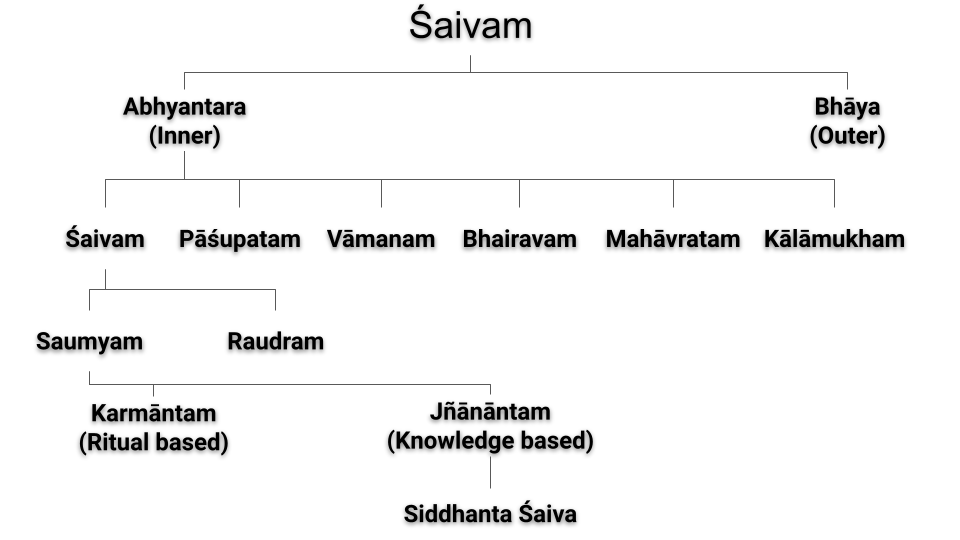
The Śaiva school mentioned at the beginning is called suddha-śaiva (pure Śaivam) and the remaining five beginning with Pāśupatam are considered as Asuddha Śaivam (impure Śaivam). The “suddha-śaiva” system also known as saumya-śaivam, (benign Śaivam) is further divided into two categories as “karmānta-śaivam” and “jñānānta-śaivam”, on analogy with the Mīmāmsa school called karma-mīmāmsa (pūrva-mīmāmsa) and jñāna-mīmāmsa (uttara-mīmāmsa)5. The Śaiva Siddhāntis are the followers of jñāna-mārga. It may be illustrated in the following chart.
Śaivam -> Ābhyantara-Inner -> Śaivam, Pāsupatam, Vāmanam, Bhairavam, Mahāvratam, Kālāmukham
Śaivam -> Śaivam -> Saumya, Raudra
Śaivam -> Śaivam -> Saumya -> Karmānta (Ritual based), Jñānāntam (knowledge based)
Śaivam -> Śaivam -> Saumya -> Jñānāntam (knowledge based) -> Siddhanta Śaiva
Śaivam -> Bāhya-Outer
All schools of Śaivas, except Siddhanta Śaivas, are called ābhyantara (ahac-camaya). The Karmānta Śaivam based on ritual is also clubbed with the other five schools that are counted as six systems and held Pūrva-pakṣa6 by the Siddhāntins. There is also an alternative definition. The Kāpālika school is considered a branch of Raudra school and a separate sect. Thus,it is counted with Pāśupata, Bhairava, Vāma, Mahāvrata and Kālāmukha schools, and designated as belonging to the Raudra school. The Śaivas (both Karmānta school and Jñānanta school) are counted together as Saumya schools, so the schools expounded by the Āgamas, beginning with Kāmika are considered “Siddhānta Śaiva”.
The āgamas are not uniform in their approach to classifications. For example, the āgama, “Acintya-viśva-sādākhya”7 divides Vāma (Śākta) school into three branches as “eastern school” (pūrva), “western school” (paścima) and “beginningless” (Anādi). The Acintya-viśva-sādākhya also divides Dakṣiṇa school into four sub schools.8
Mahāvratam
Kālāmukham
Kāpālam
Pāśupatam
Śaiva is also divided into four schools, but Siddhānta is divided into two sub schools.
The Suprabheda-āgama divides the Śaiva schools9 into four as:
Śaivam
Pāśupatam
Lākulam
Sōmam
However, the Jñānanta school which is considered a Saumya school, is called Parama Siddhānta.10
The Author of Sarva-siddhānta-vivēka cites a number of verses from Ratna-trayam and also from Śiva-yoga-ratnam,11 the latter authored by Maṟai-jñāna-desikar. The author of Sarva-siddhānta-vivēka also deals with the following Vāma Śākta schools:.
1. Mantra-vāmi 2. Yantra-vāmi 3. Auṣada-vāmi 4. Karma-siddhānta-vāmi 5. Advaita-vāmi 6. Dvaita-vāmi 7. Miśra-vāmi 8. Vāma-siddhānti and 9. Siddhānta-vāmi
Among the Śaiva schools, the following sub-sects are detailed in the Sarva-siddhānta-vivēka:
Kaulam
Driṣṭārtham
Gāruḍam
Vāmam
Dakṣiṇam
Bhūta tantram
Kālāmukham
Kāpālam
Mahāvratam
Pāśupatam
Guṇa-Sankrāntam
Pravāha-nityeśvaram
Vaidika-Pāśupatam
Yoga-Śaivam
Suddha-Śaiva-yogam
Siddhānta-Śaiva-yogam
Guṇa-Śaivam
Para-kaivalyam
Īśvara-Aikyam
Pashana-vadam
Bheda-Vadam
Sama-Vādam
Kauśikam
Bhāradvāja
Agastyam
Kāśyapam
Śiva-sankrāntam
Īśvara-avikāram
Pariṇāma-Vādam
Śaiva-Siddhāntam
There were some more sub-schools within the Śaivas mentioned by Veḷḷi-ambala-Vāṇar but they are not cited by the Sarva-siddhānta-vivēka. Either they are not mentioned in the original Sarva-siddhānta-vivēka text or Veḷḷi-ambala-vāṇar does not mention them. Instead, he cites extensively from Jñāna-siddhi and a little from Svacchanda-tantram, which also appears in the commentary. The understanding of all the schools of Śaiva system is possible only with all these citations. As Svacchanda-tantram is in print, I am dealing with this only in my introduction and not providing the text. But as Jñāna-siddhi is not available anywhere else, I am including that text also in this book.
Importance of Sarva-siddhānta-vivēka
The importance of Sarva-siddhānta-vivēka may be gauged against this background. It deals with not less than 30 sub schools among the Śaivas that include Kāpālika, Kālāmukha, Soma etc. As stated earlier the Sarva-darśana-saṅgraha of Sāyana Mādhava deals with only three schools, Nakulīśa Pāśupata, Śaiva, and Pratyabhijñā School. The Sarva-siddhānta-vivēka turns out to be a very valuable text that throws greater light on the Śaiva system that flowered in India by about 1200 CE.
The Vāma Śākta Schools
The Vāma and Dakṣiṇa divisions of the Vāma school are also called the Sāmbhava school. The Bhairava school is called Dakṣiṇa. There is a third category in this school called Miśra, which is known as Yāmalam that relates to the worship of Sapta-matas12. Some schools of the Śaiva system are called by the Siddhāntins as “Inner-outsiders” (ābhyantara-bāhya or ahap-puṟac-camayam), because they adopt a lifestyle such as eating fish, meat and drink liquor which is not acceptable to the Saumya Siddhānta Śaivas. The Śuddha Śaivas do not include them among their groups.
Common factors among Vāma school
It has been stated earlier that the following six systems are “Inner-outsiders”13.
Śaivam
Pāśupatam
Vāmam
Bhairavam
Mahāvratam
Kālāmukham
We have also noted that the Vāma school (Sāmbhava) and the Bhairava school (Dakṣiṇa) are categories of the Vāma school. The third in the Vāma school namely Miśram (Yāmalam) is generally counted with the Vāma-Bhairava school.
वामं हि शाम्भवं शास्त्रं दक्षिणं भैरवात्मकम्|मिश्रं यमलाभित्युक्त्तं सप्तमातृप्रधानकं ||
The Vāma school is explained mainly with Svacchandra-tantra and Ambā Sthuti.
Yantra vāmi: This school, considering magical diagrams (yantra), follows the general tenets of the Vāma tantras but holds, liberation is possible only through it. The main objective of this school is the acquisition of mystic powers (“yantra-sarva-siddhi”). It lists the following eight great Siddhis.
1. Aṇimā 2. Garimā 3. Īśitva 4. Prāpti 5. Mahimā 6. Laghimā 7. Vaśitva 8. Prākāmya
They are achieved by:
1. Karṣaṇa 2. Sthambhana 3. Vidvēṣaṇa 4. Mõhana 5. Māraṇam 6. Bhēdana
The followers of this school will acquire both bhakti and mukti. As Yantra is directly the manifestation of Śakti, Siddhi is obtained through it and not by other means, though mantra etc., can be used as auxiliaries.
Auṣada Vāma: By taking recourse to Auṣada (medicines) that protects the body disorders one obtains a shining body. This school even holds that movement through space is possible by administering medicines. The school speaks of what it calls Kāya Kalpa. On the whole, we may say this school is dealt with rather cursorily.
Karma-Siddhānta: It may even be called the school of fatalists. It holds no one can control birth, decay, comfort, suffering, old age and death. What is to happen will always happen. So, one should act rightly, and act wherever one’s mind goes. However, one should not be lethargic in comfort or suffering.
Siddhānta Vāmi: The Siddhānta vāmi school rejects the eight sub-schools mentioned, that are called external schools. In this text, reference is made to “Suddha Śaivas” who are the “Dakṣiṇa-vāma-siddhāntins”. But as this school also advocates eating meat, fish, drinking, sacrificing human flesh as offerings etc. The Siddhānta Śaivas do not accept this school of Dakṣiṇa-vāma-siddhānta. The Bhairava school is enumerated in Dakṣiṇāgama which emanated from the Bhairava Īśāna face14 (P. 21). According to Jñāna-siddhi, the Bhairava school has eight sub-divisions and six auxiliary divisions (upabhedas) 15.
Mantra Vāmi: The sub-sect Mantra-Vāma of the Śākta tradition holds that its followers will obtain liberation by reciting sacred hymns alone in preference to other modes. The mantras used differently by them are namaḥ, svāha, svadhā, vauṣaḍ, vaṣaḍ, humpaḍ. There are seven cores of such great hymns called mahā-mantras which are employed in all sacrifices. All of them are different manifestations of power (Śakti). It is called “mantra” because the word manana stands for all comprehending nature, and the word traṇa stands for bestowing grace on worldly men. When the functions of both manana, and traṇa are united it is called “mantra”. It is clear from this that when one practises mantra sādhana by obtaining the knowledge of mantra first, salvation is obtained in mantra-vāda.
Advaita-Vāmi: Advaita-vāmi holds that everything is a transformation of Śakti. Without such a transformation of Śakti, nothing exists either as karma, Māya, loka (world), jīva (soul), īśvara (god), śiva, paśu, pāśa etc. Man attains salvation through this knowledge, even if he is a murderer of Brahmins, drunkard or a debaucher. There is no question of salvation only through knowledge. The results of action (ritualistic action) do not disappear without having suffered. Not even crores of action can remove its effects. It is only an ignorant (ajñāni) who will say that liberation through knowledge is possible.
Dvaita-Vāmi: According to Dvaita-Vāmi school there are three entities Śakti, Paśu, and Pāśa. Śakti is not the only one. The individual soul has all knowledge like Śakti but this knowledge does not shine because of association with beginningless impurities (anādi-mala). One should receive initiation in Śākta-dīkṣa from a guru in order to obtain the knowledge and observe the tantra taught by him. He should worship through caryā (observances) or yoga, or image worship (of either various forms of Śaktis or Śakti alone). Such a person will certainly be liberated by knowledge but not by any rituals. Having been liberated by knowledge (Jñāna), he shines with Śakti . According to their Siddhānta, he enjoys freedom from impurities (su-nirmala) and gains all round knowledge and righteousness. It is clear that though this school prescribes image worship, right observances and yoga, it believes that liberation is possible only through Jñāna. In the ultimate state, the adherent attains all round knowledge sarvajñata and similarity with Śakti but he does not totally merge with Śakti. Hence the school goes by the name Dvaita-vāmi, dualistic Vāmi.
Miśra-Vāmi: The mixed school of Vāmi, holds that the categories remain mutually exclusive from each other but are pervaded by Śakti. The main tenets of this school is that everything is Śakti, Śiva, his body, the concealment of knowledge, the soul, its body, and the worlds, are all forms of Śakti. The adherent should practise the path of the Śakti-tantra, should gather liquor (madhu), meat (māmsa), fish (matsya) etc. He should perform image worship (pūja), fire sacrifice (homa), repetition of sacred names (japa) or meditation (dhyāna) and by worshipping Śakti, he attains liberation. The liberated person becomes the abode of Śakti, Śāktyātma, i.e., Śakti becomes his ātma. He is not separate from Sakti, but is dissolved in Śakti. He also does not believe in multiple lords (aneka-īśa-vādam) being equal to Śakti. He is pervaded by Śakti as his ātma, but is never equal to Śakti, the ultimate, and hence goes by the name Miśra-vāmi.
Vāma-Siddhānta: The adherent of the Vāma school accepts appropriate teachings of the eight Vāma āgamas (which are not listed). The instruments of cognition are as described earlier (this early part is not available). Their categories are namely Śakti, Paśu, and Pāśa. The unparalleled Śakti, remains pervading everything. The adherent, practising Vāma and other (eight) agamic prescriptions, obtains Śaktipāta (grace of Śakti) of either the intense or higher intense category, (Tīvra, or Tīvratara), and attains liberation by Sāmbhavi-dīkṣa (initiation). This is further aided by sad-upāya, which means the right course; defined as right path (san-marga), right knowledge (sad-jñāna) and right yoga (Sad-yoga). The root of this system, which is grace (anugraha), takes different forms. Śakti should be meditated as Sūrya, the Supreme Power. This school, though not explicit, also seems to advocate liquor, meat, fish etc., as it directs the adherents to follow Vāma texts.
Siddhānta-vāmi (Śakti-pariṇāma-siddhānta): Accepting appropriately the tenets of Śāktam commonly told, this school holds Śakti as the creator of the universe, who appears in a thousand forms. Beginning from parā-śakti and ending with kriya-śakti the mobile and immobile beings of the entire world are varied manifestations of that Śakti; crores of living beings, beginning from Mantreśvaras and others are all her transformation. The different sounds like “Vas” that separates the meaning and various forms of knowledge and the act of knowing which are all forms of Śakti. Whatever exists, including the world, are the forms of Śakti. Even the form of Śiva is Śakti. The followers of this school should adopt the path prescribed in the nine basic āgama texts with meaningful understanding. One who followed earlier either the external schools like Vaiṣṇavism or different internal Śaiva system like the Bhairava schools and receives the grace of Śakti (Śaktipāta) through good merits, and commonality of practices, become eligible to achieve liberation by initiation (dīkṣa) from a good guru in observances of Vāma-tantra and also by understanding the religious observances like caryā, kriyā etc. Thus, the Siddhānta-vāmi school does not reject the followers of other schools and states that there are certain common observances between them that give them the eligibility, but ultimately they have to accept the texts of Vāma-tantras and the need to be initiated by a Guru.
Dakṣiṇa Śaivas
The aspects of Dakṣiṇa system are demonstrated in texts like the Kāmikāgama, to exhibit achievements of mystic powers both visible and invisible, as there is a necessity to create confidence among people. It is for this purpose that four different texts namely, Gāruḍa-tantra, Dakṣiṇa-tantra, Vāma-tantra, and Bhūta-tantra, emanated from four faces of Śiva namely Puruṣa and other manifestations (Tatpuruṣa, Aghora, Sadyojata and Vāmadeva). These Śaiva schools are considered “downstream” (adhah-śrotas) schools, expounded by mūrtis such as Tatpuruṣa and others called vijñāna-kevala (manifestations of pure knowledge). These texts were expounded in conformity with āgamas like Kāmikāgama as dependent texts.
Gāruḍa-tantra: The Gāruḍa-tantra among the four mentioned above, advocates the worship of Tatpuruṣa Brahman, who is the lord of the universe, by which Siddhis mystic powers - are obtained.
Kālāmukha: Kālāmukha’s should wear crystal ear ornaments, smear their body with red sandal powder, putradīpa (there is a gap in the text at this point). Kālāmukha (the Aghora face) should be worshipped with these emblems. The instruments of cognition are mentioned earlier. Pati, Paśu and Pāśa are the three entities that need to be comprehended. Māhadeva who is none other than Rudra and not Bhairava, is the Pati (lord). As he does not manifest independently without Rudrāmśa this Rudra Māhadeva alone assumes forms like Dakṣināmūrti who is the main deity (mūlavigraha). He is Sadaśiva, eternal (nitya), auspicious (Śiva), and the universal lord (Jagat-pati). Depending upon his functions, he is called by different names.
Pāśas, Mala and Māya, as mentioned earlier are different. The world appears as a result of Māya. Śiva is worshipped for release from the bondage of Pāśa. The Kālāmukhas worship Śiva on aṣṭami day (8th day of the fortnight), caturdasi, (fourteenth day of the fortnight), on śivarātri day of each month, and somavāra (Mondays) regularly by fasting and other means. This kind of worship is called Kālāmukha-vrata. After initiation with Śiva-dīkṣa and depending upon the descent of grace (Śaktipāta), the individual becomes pure after which the individual soul shines like a star, while Śiva is like the sun. The coming together of the individual soul and Śiva is called Supreme liberation, para-mokṣa. This observance and path is called the Kālāmukha system.
Kāpāla School: The Kāpāla system follows the appropriate Kālāmula texts in which the adherent is guided by the Kāpāla-śaiva-tantra and considering himself as Maheśa at the end of final dissolution (Samhāra) , dances in the great cemetery. The follower of Kāpāla school goes abegging with human skull in one hand, singing Sāmagāna. One who practises this Kāpāla mode of observance is called Kāpāli.
Pañcārtha, Purākalpa, Śiva Guhya, Pramāṇa, Vyūha, Ādarśana, Padmā, Kāraka, Sailaka, Nṛtta, Suduṣprāpa and Siddhārtha, which are difficult to obtain, are the fourteen means for achieving mystic powers. The Lākula School is then detailed. The three principles of this school are Pati, Paśu, and Pāśa. Maheśvara who dances at the end of deluge in the great cemetery is Rudra, the lord of the universe. He is Sadaśiva, the omniscient and omnipotent lord. The ordinary souls are innumerable and are endowed with knowledge only. Śiva alone, has both knowledge and action not others. Karma and Māyā are the Pāśas. Ākaśa is called tattva (entity), time (kāla) is Māyā. There is no difference between time and Māyā. One who desires release from bondage initiated through Śivadīkṣa should perform daily rites as enshrined in Kāpāla Śāstra. He should acquire extreme determination, be indifferent to praise and ridicule follow the path mentioned earlier and eat food obtained through begging. Such a person attains liberation acquiring equality with Śiva. He does not shine like a star but like the Sun; the liberation gives him omniscience different from the earlier stage. So he attains knowledge like Śiva.
Mahāvrata Śaivas: Mahāvrata Śaivas accept appropriately the texts of the Kāpāla school. The Mahavrata has kuṇḍika, kuṇḍalam, uraga (snake), head ornament (sikhāmani), upavīta made of (human) hairs, which are called the five mudras, the signs of Mahāvrata. The three basic principles in this system are Pati, Paśu and Pāśa; the instruments of cognition in this system are as detailed earlier; among all pramāṇas (cognitive process), the Mahāvrata is considered the best. Being the omniscient and omnipotent, Sadāśiva is Pati, pure and blemishless, cause of all causes. Individual souls are many but they possess knowledge alone. The omnipotence is only with the Lord Pati, not with individual souls. Only karma and māyā are considered as bondages while āṇava (ego) is not which is accepted in other schools. One obtaining the grace of Śakti, (Śaktipāta), should get initiated into the Śiva-dīkṣā, as specified in the tāntra of this school. The individual observing caryā (personal ritual discipline) and acquisition of knowledge get liberation. He should wear liṅga (liṅga-dhāri) either on his head, neck, heart, or above the navel as prescribed in the śāstra. There is no use of pūja etc., but wearing liṅga alone is sufficient to bestow liberation. He should show devotion towards all human beings and his guru, similar to how he would adore Siva. Even among these, devotion towards human beings, (jaṅgamas), is considered the best. The Mahāvratin obtains salvation, within one birth by following the daily rites etc., as found in Mahāvrata Śastra.
Śiva-yoga-mata
In the Śivayoga school, the adherents attain equality with Śiva in form. There are some schools wherein their followers believe that they either reach the same world as Śiva (sāloka) or proximity to Śiva (sāmīpya), but the adherents of those schools do not attain their ultimate longings. In this school Śiva-yoga-mata which speaks of equality with Śiva in form, the follower attain “oneness with Śiva” (he becomes Śiva). Equality with Śiva means he assumes Śivas form, which is also called one-ness with Śiva (Śiva-sāyujyam). Śiva-sārūpya and Śiva-sāyujya are synonyms in this school. Accepting as many adherents as possible to achieve Śiva-hood does not lead to any contradiction or multiplicity of Śiva, as the soul attains equality by only the grace of Śiva. The liberated souls are also Śiva but achieve Śivahood by Śiva's grace. Whereas Śivahood is beginningless in Śiva, who is made of the body of pañca-mantras, the Śivayogi who achieves liberation through Śiva-sārūpya attains mystic powers like anima, mahima etc.
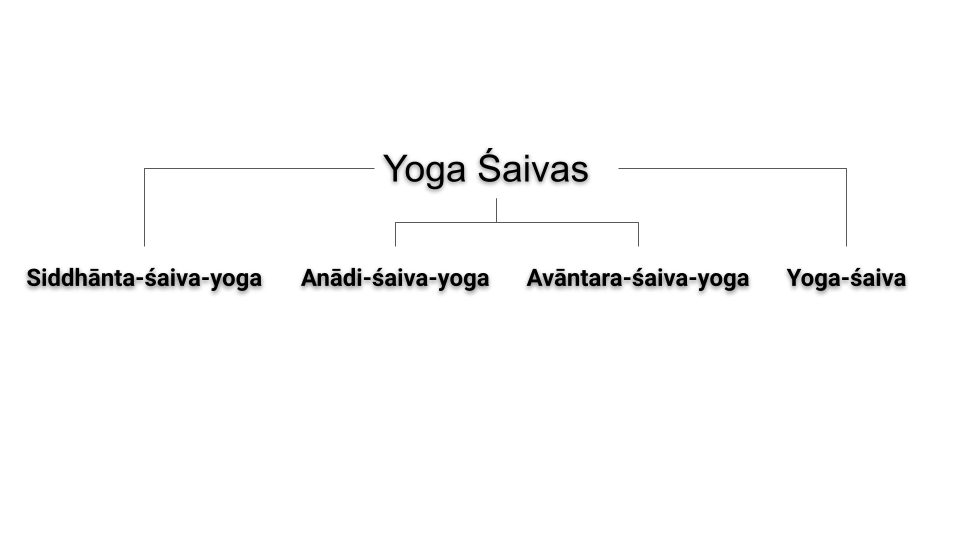
There are several schools of Yoga Śaivas. However four branches of this system, namely Siddhānta-śaiva-yoga, Anādi-śaiva-yoga, Avāntara-śaiva-yoga and Yoga-Śaiva are dealt with in this text.
Avāntara Śaiva yoga
This school accepts appropriate to this tenet what has been told by para-kaivalya school. According to this school, praṇava is considered inert as it is in the form of sound consisting of five syllables. It is the cause of knowledge for all living beings, inspired by Brahma and other divinities who stimulate their senses towards objects of experience. It constitutes the Supreme bondage. Composed of the syllables “a”, “u”, “ma”, “bindu” and “nāda”. Praṇava is realised through yoga. It is pervaded by five gods as souls..
The five syllables of praṇava are constituted this way. “a-kāra” is “egoism” (ahamakāra), “u-kāra” is analytical knowledge (buddhi) and ma-kāra is the sound (nāda). The self knowledge, obtained through these instruments of cognition, comes like waves of water. “a” has Brahma as its god, “u” has Viṣṇu, “ma” has Rudra, “bindu” has Īsvara and “nāda” has Sadaśiva as their gods. These are the five divinities. They have four-courses of action which pervade the three - life-breath (prāṇa), the accumulation of all these is bondage and release from bondage is salvation and nothing else, because actions like seeing can be prevented by getting rid of them. So, nāda is not the supreme Lord. Śiva, who is sentient and different from them. It is he who acts through the five acts in the form of “ma-kara” etc. As all of them are in essence Śiva, there is no difference among them. One should meditate these omniscient Gods in various forms. Brahmā, Viṣṇu, Rudra, Īśvara, and Sadaśiva are the five manifested gods. In whatever form the devotee worships him he takes that form and like Cintāmaṇi (wish fulfilling gem) bestows salvation. Brahmā who resides in mūlādhāra, pervades up to the nave through his own power. Viṣṇu, pervades from the navel to neck, Rudra pervades unto the forehead, Maheśa remains in forehead unto the Brahma-randhra. Sadaśiva remains engulfing in the midst of them. One should meditate on each at their appropriate seats.
Yoga-Śaivas
Yoga-Śaivas -> Siddhānta Śaiva Yogi, Anādi Śaiva Yogi, Avāntara Śaiva Yogi, yoga Śaiva
Suddha Śaiva Yoga
Among the putra-mārgas mentioned earlier this school accepts that which is appropriate. Paśu and Pāśa have already been defined earlier. According to this school, Pati, the Lord, is Sadaśiva. The other gods like Maheśvara execute his orders. Among the pañca-sādākhyas, (the five Brahmans) that which is to be worshipped with rituals is called Śiva. He is the Lord of 36 tattvas. One reaches proximity to Śiva by worshipping him through arccā rituals (sāmīруа); one achieves the very form of Śiva (sārūpya) by meditation which bestows equality with him and that is considered salvation which is the ultimate goal of this school. It is meant that one achieves equality with Śiva and the forms of Śiva (Śiva-samānatā and Śiva-vigraham) by sārūpyam. Among the puruṣārthas, (the ultimate achievement of human goals) sārūpya is considered the supreme for one to practise. That yoga should be practised according to the Āgamas like Mṛgendra.
Alternatively, learned men who would like to obtain self-realisation can practise the same, though it is a difficult path. This self-realisation is called Yogic state that is obtained by “one who has conquered perceptions” (jitākṣa). The state of jitākṣa is attained gradually by practising control of breath (prāṇāyāma). This consists of eight fold path - prā ṇāyāma, pratyāhāra, dhāraṇa, dhyāna, īkṣaṇa, japa, samādhi and yoga. The following are the definitions of these words.
Prāṇāyāma consists of two words: prāṇa - the vital breath and āyāma i.e., inhalation and exhalation. The word pratyāhāra means turning away the mind from all experiences of comforts and tastes. The mind is trained in this process to prevent the senses from attachments to external pleasures. Dhāraṇa stands for controlling to fix the mind on one’s chosen entity, to think about it constantly and fix it repeatedly on the same. Dhriṣṇa (jitākṣa) means to constantly think about the mantras hymns. Through these mantras, the five Brahmans - Tatpuruṣa, Aghōra, Sadyōjāta, Vāmadēva and Īśāna should be invoked in the east, the south, the west, the north and up above. The four faces are as prescribed in the chapter on arccanā (worship). However, the top one, that is Īśāna has no face but is made to manifest only through hymnal invocation. When a person is able to steady his mind in that particular state it is called samādhi. Japa is to recite its name, dhyāna is to meditate on that, which involves creating face to face relationship or visualization. This realisation of the Supreme state and cultivating the same is the ultimate, which is known as Suddha-śaiva-yoga. The same process is also acceptable to other yogis who can follow their own system.
Anādi Śaiva Yoga
Anādi Śaiva yogis accepts the tenets from that which is suited to their needs. They hold the suddha-vidya-tattvas as inert beings that do not have the nature of Śiva. On the other hand, nāda is considered īśāna-svarūpa, the knowledge form and he is held as Śiva. There is no knowledge of object without sound for human beings. Śivajñāna is obtained only through śabda (sound). This knowledge is obtained gradually from the subtle to the gross form. The mystic sound Omkāra, is created by nāda and bindu. Pure knowledge comes through a pure path. The seed of knowledge is Omkāra is composed of five kalās (parts) as a, u, m, bindu and nāda and its lord is Īśvara, that is Sadaśiva .
The nāda emanates from the great subtle entity (maha-sūkṣma) and bindu originates from the subtle form. Paśyantī creates na-kāra, u-kāra comes from madhyama, and a-kāra is produced by vaikārī. In the midst of it is Maheśa, Rudra, Viṣṇu and Brahma. From the five emanate the five great acts of creations, sustenance, dissolution, concealment, and grace, and for these five acts Brahmā and other Gods emanate. Kuṭilā-śakti comes into being from 36 tattvas. Kuṭilā encompasses kuṇḍalī-śakti. Kuṇḍal emanates from praṇava. Thus the creator of the whole world is Śiva who is nāda, which is considered his category. One is called pure brahman and the other śabda-brahman, the latter known as Sadaśiva. Sadaśiva is praṇava, the cause of everything. So, one should meditate on Omkāra as mentioned in the Vedas and the Śivāgamas. The yogins who desire salvation, always meditate on nāda, which is Śiva’s supreme form. When the śabda-tattva merges with the supreme, yogins attain supreme liberation. When he attains that state he is called “Laya-yogi”.
The Vedic scholars are hundred times more meritorious than Brahmins. Those who are initiated into the Śaiva-tantras, are thousand times better than Veda-vādins. The patron is superior to the initiates into Śaiva systems. One who wears sacred ash is superior to patrons. The one who performs worship to the Lord is thousand times better than the one wearing sacred ash, the one who knows mantras is far superior to all the pūjakas. The one who knows the spiritual path is superior to the one who knows mantras. One who knows prasāda (mantras) is superior to the knowers of the spiritual path. Laya-yogi is considered superior to the prasāda-jñāni. Among the laya-yogins, the prāṇa-liṅgin is great. Therefore this mode of practice should be known from the Guru. Those who follow this system are called Anādi-Śaiva-Yogi.
Siddhānta Śaiva yoga
The Siddhānta-Śiva-Yogins accept whatever is suited from the common yoga system. There are three principles - pati, paśu and pāśa. Pāśa is called an impure sphere that forms the wall of division. Human life is called paśu, other living beings without thinking faculty are categorised as insentient. Enjoyment of pleasures is not possible without human life. If, however, they are referred to as their souls at places, it is purely contextual, as the Śuddha Śaivas have defined this position clearly. The human self strengthened by pāśa (kāla), following the path shown by learning, enjoying through senses like buddhi and desire (rāga), partakes in all pleasures found in the tattvas, beginning from māyā up to the world.
Human being’s are fond of enjoying pleasures. It is Śiva-tattva that induces them to enjoy the worldly life so much so that it is known as preraka in texts.
The individual soul realises the worldly things not by their own powers but through Śiva's act. The five fold path of action of the Lord (pati) called Śiva-tattva, is based on the functions. Jñāna is nāda-svarūpa, while kriyā is through power. When jñāna and kriyā are equal the sādākhya-tattva emanates. The Maheśvara-tattva emanates where there is more of action than knowledge (jñāna). The Rudra-tattva emanates when there is more yoga and less action. Rudra is also called Śuddha-vidyā. Here the word yoga that stands for knowledge is called Śuddha-vidyā. The Śuddha-tattva is eternal and is totally independent. The above categories do not exist without actions.
Śiva is meditated in his multiple forms in this manner. He is Nirañjana, Śānta, Sarvajña, and Sarvaga. Īśvara should therefore be meditated in these different forms. So among the five categories (pañca-tattvas) the prominence of Śiva and Śakti are recognized. In the Śuddha Śaiva system, vidya is recognized either individually or collectively. Śuddha-vidyā is golden in colour while Maheśvara is white, Sadaśiva is crystal in colour, bindu is white, while nāda is red. While meditating separately they should be invoked in colours as above. Their collective form appears as a faded moon-light that shows everything. Śiva of this form has five faces and four arms, which should be meditated for liberation. The insentient beings that exist only help and so should be considered as Śiva's body. The Siddhānta-Śaiva-yoga is also called Adi Śaivam.
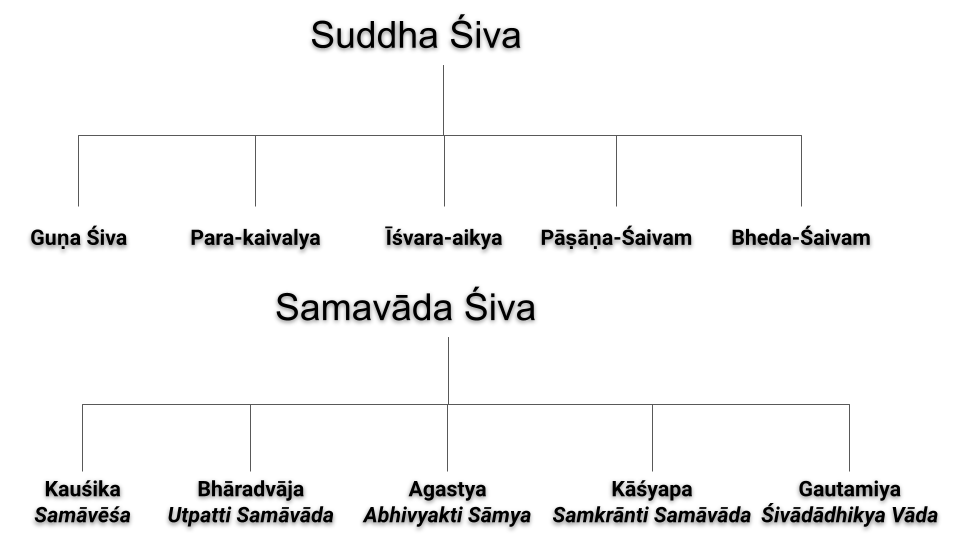
Suddha Saiva schools
Śuddha Śaiva -> Guṇa Śaiya, Para-kaivalya, Īśvara-aikya, Pāṣāna-Śaiva, Bheda Śaiviam
Samavāda Śaivas
Samavāda Śaivas -> Kauśika (Samāveśa); Bharadvāja (Uttpatti Samavāda; Agastya (Abhivyakti Sāmya); Kāśyapa (Samkrānti Samanvāda); Gautamīya (Śivādādhikya vāda)
Guṇa Śaiva schools
Guṇa Śaivas consider the whole world is permeated by guṇas - sattva, rajas and tamas. Salvation for the adherents of this system comes through the worship of Trimūrti. This school is considered a branch of Śuddha-Śaiva. In fact they are none other than Śuddha Śaivas. There is nothing in this world which has not got the guṇas, either alone or in combination with other guṇas. The text Mṛgendra Śāstra clearly states that the whole world is pervaded by guṇas. Pradhāna in this school is the cause of action. Pāśa is that which shrouds the intellect (tirodhāyi). Paśus are called sakalas. From Gods to trees and plants are considered of vijñāna-kāla - pralaya-kala. The creator of the universe is Brahmā, Viṣṇu and Rudra. The pradhāna is said to be 24 tattvas and are for the enjoyment and salvation of humans. God wills. From pradhāna, buddhi emanates and that is the cause of the world. From the agitation of buddhi comes egoism ahaṁkāra in three forms. The subtle tanmātras and senses are born out of egoism. From these subtle entities the five basic elements earth, water, air, fire and ākāśa are born. From these five elements the gross world comes into being; the unmanifest are 24 and Puruṣa constitutes the 25th tattva. Puruṣa performs only limited action, and has limited knowledge. Since he doesn’t act fully he also creates enjoyment. So, he is considered an independent entity, performs only limited functions and is atomic in state (aṇu). As he does not understand everything, he is considered ignorant. Salvation is attained only by the worship of Trimūrti. No other deities like Maheśvara etc., are recognised here. In this school of Guṇa Śaivas, Rudra alone functions due to the possession of guṇas; he dissolves the world, protects it and creates it. There is only one Supreme that is Rudra. This concept is postulated in Svayambhuva-āgama and Śiva-dharmottara. So, Rudra constitutes the 26th tattva. He is the ultimate cause of everything.
Rudra is born of pradhāna and then Viṣṇu and Brahma are born. As they are the functionaries of pure acts, they are called pure Maheśvaras. The Trinity equal among themselves are established as the gods for the sake of the world. By worshipping them, following the text of their schools, salvation is obtained. Even Vaidikas attain salvation through Śaiva path. The Gods like Indra and others are the executors of their (Trinity’s) orders. This system is described as Guṇa Śaivam in the text Jñāna-siddhi. The followers of the school wear jaṭācūḍa (malted locks), wear sacred ashes, smear themselves with ashes and adore Trimūrti.
Para-mukti mata
This school called Para-mukti believes by adoring a formless supreme. The Para-mukti is obtained in the Śuddha Śaiva School by Karma-āvaraṇa. They accept whatever is appropriate from among the common texts mentioned earlier and recognize the three categories as pati, paśu and pāśa. Pati is formless lord, who is absolutely pure. He is expressed through various words like Aprameya, Anirdesya, Analupamya, Anāmaya, Sūkṣma, Sarvagata, Nitya, Dhruva, Avyaya and Īśvara. The meanings of these words are defined. He removes the bondage of individual soul who is considered aṇu, the instrument through which he acts is Śakti which is sentient. His body is made up of “five mantras” (pañca-mantra) which performs the five acts (pañca-krityas - creation, sustenance, dissolution, concealment and bestowal of grace). These forms are Īśāna, Tatpuruṣa, Aghora, Vāmadeva and Sadyõjāta (Aja). Time has no form and yet performs many things. Similarly though Śiva is formless, he performs action out of his own will. He assumes forms for helping yogins, and for creating all tattvas for the world. So, it is said that he assumes form, it is not considered a blemish. The individual souls, called paśu are eternal and all pervasive. They are categorised into three as sa-kala, pralayā-kala, vijñāna-kala.
Innumerable souls who are sentient beings, are with forms and without forms. One who is covered by three impurities namely, māyā, karma, and mala is called sa-kala. Pralaya-kalas are those who have only two impurities namely mala and karma. Those who have only one mala are called vijñana-kalas. They enjoy all comforts and joy by being in the body. The paśas are said to be of five kinds in this school as defined earlier. So, if one achieves Śuddha-adhvā, pure state it is still considered bondage; when equality of action is attained, (karma-samya) and Śiva's grace descends, the individual qualifies himself for initiation (dīkṣa) from a Guru. Initiation is through the path of aṣṭāṅga-yoga and not through rituals (karma-māyā). By this process one devotes himself to adoration of formless Supreme and attains Supreme liberation (para-mukti). The yogi need not perform rituals but turn his attention from external acts and concentrate on his inner vision. The yogi should meditate on formless Supreme, which is like outer space, a great void mahā-sūnya. Otherwise he would become a worldly man like insects among the heaps of grain. If one abandons Śiva who resides in his own self and worships him externally it is a useless exercise similar to one who licks his elbow when having food in hand. Yogis see Śiva in their heart and not in idols, which are created for ignorant people. Yoga-jñāna-mata, Para-yoga-mata, Niṣkaḷa-yoga-mata, Para-mukti-mata, and Śaiva-sānkhya-siddhānta-mata are all synonyms.
Īśvara-Aikya-SiddhāntaĪśvara-aikya means identity of the soul with Īśvara in this school, which also accepts common sayings of early schools. According to this school, Īśvara is blemishless from the beginning, the individual soul is likewise blemishless; though he is also eternal like Śiva and pure he is without the power to create. Pāśa is considered four fold, but āṇava-mala is not accepted in this system.
Māyā is like kambuka, and kalās are like tuṣas. Māyā is the inborn impurity, sahaja-mala. So, the soul is covered with māyā-mohā and other impurities are considered, the qualities of māyā, moha, mada, naga, viṣada, sosluta, harṣaka, and vaicitriya are the seven inborn impurities (sahaja-malas). Individual is pure from the very beginning and yet by the will of Śiva he is bound by the pure and impure acts of māyā. The individual acquires merit and demerit (puṇya and pāpa). When there happens equality of karma, he attains Śaktipāta, and he is initiated into jñāna-dīkṣa (knowledge initiation) by a mumukṣu or naiṣṭikācārya and is liberated in this system. Identity of the individual soul with Śiva (Śiva-aikyam) is kaivalva-aikyam. That is achieved through practise of formless meditation. The adherent should think of Śiva as supremely auspicious, formless, pure, lord, eternally joyful in the form of an effulgent luminary. He must abandon the idea that he is a paśu (bound) and should consider “I am Śiva”. He is liberated without any suffering. When he is liberated in course of time his form is merged with Śiva inseperably in sayujyam. This inseperable union is like water dissolved in water. When he unites with Śiva, he performs his actions, enjoys his own nature untouched by māyā-mala.
Pāṣāṇa Śaiva Siddhānta
Accepting appropriately what has been laid down in Īśvara-aikya school, this system holds Lord (pati) as an ever liberated entity, but the individual soul (paśu) is impure (samalaḥ) bound by five bondages (pañca-pāśa) that are mala, karma, māyā, tirodhikā-śakti and bindu. When the soul is devoid of māyā, it is considered fettered with inborn impurities. Māyā is called Mohini different from āṇava-mala. Pati protects paśu and pāśa.
The soul that remains bound, approaches a knowledgeable guru when it attains equality in karma and receives jñāna-dīkṣa also called śastra-dīskṣa. Ritual initiation (karma-dīkṣa) is meant for those who are too strongly embedded in bondage but jñāna-dīkṣa is for souls with aspirations. By teaching śāstra-jñāna alone initiation is bestowed and not by other means. There is no sacrificial fire or fire offering rituals etc., in this process. jñāna-dīkṣa means understanding the tattvas through knowledge, whereas ritual initiation is through mind that should be avoided. Liberation is attained through knowledge, which is called kaivalyam. The worldly life (samsāra) comes as a result of ignorance (ajñāna) and men deeply embedded in worldly life are called ignorant men. A knowledgeable man escapes from samsāra (worldly bondage). One goes to heaven by simply reciting the Vedas, but returns after hundred manu years whereas one attains unity with Śiva-sayujya by Śiva-jñāna.
It is the dictum of Śaiva Siddhānta that jñāna is supreme. There is no yoga equal to jñāna and no vrata (ritual observance) equal to jñāna. There is no personal purity equal to jñāna and no ritual equal to jñāna; there is no sacred centre like jñāna and no penance equal to jñāna, there is no sacrifice equal to jñāna. Similarly, the soul achieves supreme liberation only through jñāna even in the Vedic tradition and not by even millions of rituals (karma). Therefore it is necessary that the guru should be a knowledgeable person and not otherwise. Such a guru is obtained by Śiva's grace. The Vedas could be taught for those who are initiated but for the uninitiated Śiva bhaktas, Śiva-jñāna should not be withheld but taught properly. When liberation is obtained, one remains like a stone. (Pāṣāṇa-vat). The incoming impurities of the soul are eradicated but the inborn impurities (sahaja mala) remain. All other pleasures and pains disappear except that of mala and that liberation means remaining like a stone which is the termination of mental suffering in this system.
Bheda Śaiva School
This school accepts the tenets of Pāṣāṇa Śaivas but selectively and holds pati, paśu, and pāśa are independent. Paśu - the individual soul is shrouded with āṇava-mala. By repetition of mantras and by receiving Śakti-nipāta liberation is obtained through initiation and not by jñāna, yoga or carya. One who is initiated belongs to Śaiva caste. There is only one caste that is Śaiva caste and no other. This school does not accept that liberation comes only through jñāna, but is attained by Śiva's Śaktipāta. Those who devote themselves to Śiva through devotion (bhakti), among all castes, are eligible to receive this dīkṣa. In the Bheda Śaivam, the devotee is equal to Śiva and Śiva is equal to the devotee, as liberation is assured for all living beings. Direct initiation is advocated for less knowledgeable human beings while for others liberation is immediate. So, two kinds of liberations are recognized namely immediate liberation through nirvāṇā-dīkṣa and the other liberation when the body dies. Extreme renunciation nirvāṇā-dīkṣa, itself is considered liberation for those who have adopted it.
Renunciation through vijñāna-yoga destroys sins which are committed knowingly.
Yoga etc., are observances or methods to achieve liberation, but are not mukti. Impurities can be destroyed only through initiation. Also, it cannot be removed through jñāna but only through dīkṣa. Dīkṣa can also be attained through sight - cakuṣ-dīkshā.
Sama-Vāda School
This school contends that liberation is not only through initiation (dīkṣa ) but also through jñāna etc. Śiva-pūja confers eligibility for it. The initiates are also expected to follow certain observances (caryā). They have to do daily rites of the Śaiva system. The liberation that would come at the death of a body can be obtained only by observing routine rituals. When it is said that only initiation (dīkṣa) confers liberation and not jñāna, yoga, or caryā, it is only to praise dīkṣa and not to dismiss jñāna, caryāand yoga.
When one is liberated he attains equality with Śiva with six kinds of qualities (guṇas) that are Sarvajñatā, trupti, anādi-bodhaḥ, svatantratā, aluptaśakti and anantaśakti. The liberated souls obtain these qualities equal to Sadāśiva. This liberation is called in this school para-mukti that admits only equality with Śiva (Śivasāmya) and not identity.
Kauśika Siddhānta
The Kauśika school also called Samāveśa school, has Mahipati as ṛṣi who was initiated by Tatpuruṣa face (eastern face of Sadāśiva). This school consisting of the Āgamas, beginning from Amsumadbhedāgama to Vīrāgama, was taught by the Tatpuruṣa face. A liberated soul is possessed of all auspicious qualities, becomes omniscient, omnipotent and equal to Śiva. By following the Yoga system that is detailed in Vāyavīya Samhitā he appears as if possessed by Śiva.
Bharadvāja School
Bharadvāja School, also called Utpatti-sama-vāda, is found in Sarvottara to Vātula-āgamas that emanated from the Sadyojāta face. Bharadvāja riṣi was initiated through sūtras. The liberation in this school consists of equality with Śiva, is created and not obtained through other means. The soul should abandon its old feelings and hold “I am Śiva” (Śivoham) considered samādhi. Feeling that he is Śiva, the soul will become Śiva and this process is also called Śivayoga. By this process, the soul obtains equality with Śiva which did not exist before. It obtains all comprehensive knowledge (sarvajñatā) and other important dharmas from Śiva and is liberated in this life itself as ‘jīvan muktaḥ’.
Agastya School
This school promulgated by saint Agastya goes by the name, Abhivyakti Samavāda. According to this school abhivyakti, which is a reflection is considered beginningless, and it emanated from Vāmadeva face. The Vāmadeva face initiated Agastya, who is a Brāhmaṇa Riṣi. The individual soul reflects the six qualities found in Śiva by offering ghee with the ladle in sacrificial fire. When the reflection takes place, he shines like Śiva, the Brahman, called Saccidānandarūpi, (existance, knowledge and bliss) sad-asad vyakti varjita (He is neither a manifest nor a non manifest) and sarvagaḥ, omnipresent. So far as soul is concerned, there is no dispute about its existence and knowledge, that also experiences bliss. The soul also gains bliss by action (karma) and knowledge (Jñāna). This school employs the words samṛddhiḥ, paripūrti, vāpti, akhaṇḍatā and tṛpti as synonyms of bliss. This is detailed in “Ratna-traya” and also in Vedantas. Ones inherent bliss is obtained by samādhi. So the soul is also considered sat-cid-ānanda-rūpi. The soul experiences its own bliss in the stage of Brahman realization, (atmānanda). By this the individual soul obtains equality with Śiva (Śiva-sāmya) in all round knowledge and the six qualities of Śiva.
Śiva Gautamya School
The Gautamiya school is called Śivād-ādhikya-vāda (Beyond Śiva). This school holds that even Śiva is paśu, because he is engaged in the five kinds of actions pañca-krityas - (creation, sustenance, dissolution, concealment and grace). He can perform these acts only by assuming a form and so bound by bondage as these are different actions. In the case of Sadaśiva there are two pāśas namely anugraha and tirobhāva (bestowing grace and concealment). Therefore Sadaśiva is considered the first paśu. The liberated individual soul cannot create like Śiva for he reaches a stage beyond action. So, this school considers that the soul goes beyond Śiva (Śivād-ādhikya-vāda) in the state of liberation.
Kāśyapīya
This school known as Kāśyapīya is also called Śiva-saṅkrānta-vāda. It is expounded by Mahaṛṣi Kāśyapa. The five faces of Sadaśiva initiated the five ṛṣis Kauśika, Kāśyapa, Bharadvāja, Gautama, and Agastya. Out of the Īśāna face emanated the Āgamas like Sahasrāgama. Kāśyapa is called Brahma riṣi, who was initiated by the top Īśāna face. The Raurava āgama calls Kāśyapa school as “Saṅkrānti Śaiva”. This school accepts appropriately the Sama-vāda school, but holds pati the lord alone as sentient, while other two paśu and pāśa are considered insentient jaḍas. Paśu is not a sentient being but is eternal without guṇas, without actions and without lordship, and doesn’t undergo change. However, it shines like a light by its own brightness inside the body. It gets yoga-siddhi in the body. When it receives Śaktipāta through practise of prāṇāyāma etc., through supreme yoga, and through the teachings of a good guru, he attains samādhi. Through that yoga he is able to see the supreme in his own body as a reflection of moon in water. He obtains good knowledge and never returns to the state of paśu, paśutva. In this stage though he is in the midst of objects and sound etc., and remains unaffected by them. When he attains complete liberation, he is dissolved totally in Śiva, like salt dissolved in water. He loses his individual identity and becomes equal to Śiva. As Śiva himself is both in sakala and niṣkala form, this liberation is also known as identity, sāyujyam.
Śiva-aikya-vāda
This school accepts appropriately what is said by Śiva saṅrāntavādis, but holds Śiva alone is the cause of the world. As the individual soul is also sentient, the pāśa alone is insentient in this system. The soul follows the pāśa-dharma, as it is totally bound by it. It enters the body by itself. In the presence of Śiva and with the help of āgama he acts by his own efforts and enjoys all pleasures through intellect, buddhi and other senses. When Śaktinipāta is obtained through knowledge, practice, and understanding of the tattvas (principles) he abandons residing in village houses. He acquires ṣaḍaṅga-yoga, discards paśu-bhāva and goes after Śiva in exclusion. He sees Śiva in his conscience attains the abode of Śiva and meditates on pañcākṣara. He reaches a stage, which is neither void nor non-void but peace - śānti. He retires to an isolated place, abandons all bondages and obtains liberation.
Śaiva Pakṣa
This school accepts the earlier system appropriately, namely that Pati, Paśu, and Pāśa are mutually related to each other. The soul is self-luminant and is of the nature of consciousness. He is shrouded by the beginningless impurities, enjoys pains and pleasures in his worldly life. When he attains Śaktipāta, Śiva himself assumes the role of guru and initiates him and also teaches him how to get rid of mala, māyā etc., Attaining knowledge through that he loses the state of knower, known and knowledge. At that stage the soul and the Supreme are united inseparably. There is no question of enjoyment as there is no existence of individuality. When the body dies, he becomes one with Śiva. He stands above all paths. He is not sakala with parts, performs all actions but has no beginningless impurities.
Pāśupata SystemGuṇa-Saṅkrānta-vādin
The Pāśupatas, have ash (bhasmam) (medhyam), shoulder scarf, book, rag of cloth and waist band. These five are called Pāśupata - signs. Great men adore and observe this system. Pratyakṣa and other instruments of cognition have been detailed earlier. Among them the Pāśupata-āgama is the best. The following sixteen texts enumerated in the Dīptāgama constitute the Pāśupata system.
Prājāpatya,
Prabuddha,
Kāśyapa,
Bhārgavõttara,
Vāsavam,
Vārunam,
Padmasamhita,
Pāramēśam,
Pāśupata,
Vaśiṣṭa,
Kalpa,
Praphullam,
Vāyavīyam,
Bārhaspatyam,
Varāha,
Sadagama
This System accepts the three entities Pati, Paśu, and Pāśa. The Paśus are considered omnipresent, but are bound by māyā and karma, by cause and effect, that are generated by their known action. At some stage and cause they develop self-denial Vairāgya. Then they take Śaiva initiation Śiva-dīkṣa as prescribed in the Pāśupata system from a learned Ācarya, and obtain liberation and becomes equal to Śiva, śiva sama. Originally they were endowed with limited knowledge, but when liberated, attained all knowing power. The One who obtained blemishless state and liberation attains equality with Śiva and kaivalya. All the qualities of Śiva, manifest in his soul, who is now considered a freed soul. Even if he does not act like Śiva he remains always in his own self. This system is called Guṇa-Saṅkrānta branch of the Pāśupatas.
Pravāha-Nityeśvaras
There is another school named Pravāha-nityeśvaras that differs from the Saṅkrānti School. They consider the relationship of soul with Śiva as postulated by Ekānmavāda. They follow what is said in the Pāśupata system for the rest. The soul becomes Śiva when liberated and he begins performing celestial actions. Śiva retires from his powers and does not act then. When the individual soul becomes pure all guṇas of Śiva manifest in him. So, he understands Śiva's actions like creating the universe etc., and performs them himself. Similar to a father seeing his son being intelligent and able to manage the family affairs, retiring from his supervisory power, and becoming a recluse, so also Śiva retires after entrusting his powers to the liberated soul. This school is called Pravāha-nityēśvara, Eternal Śivahood like a stream.
Śrauta Pāśupata
The Śrauta Pasupata system is also called Vaidika Pāśupata, which was taught by Śiva to Pārvatī in accordance with the Vedas. Propounded by Upamanyu, the Vaidika Pāśupata system is very extensive. The best exposition is found in Vāyavīya Samhita. Like all other Śaiva systems this also holds three entities as pati, paśu, and pāśa. Liberation is considered Utpatti-Samavāda in this school.
Āgamas are classified into two branches: 1. Śrauta (Vedic) and (2) Aśrauta (non Vedic). The Vedic branches are the very essence of the Vedas (Veda-śāra). The non Vedic branches are said to be independent (svatantra). The independent works are ten and eighteen (constituting a total of 28 in number) beginning from Kāmikāgama and so on, which are called the Siddhānta.
The Śrauta branch is a vast school with several hundred branches. The one that speaks of the supreme Pāśupata observance and knowledge is called śrautam (vaidikam) and this is detailed in atharva-śiras (upaniṣad) which holds that the supreme mode is in four parts as caryā, kriya, yoga and jñāna. Following this four fold path, the Pāśupata devotee will behold Śiva. Therefore the Pāśupata yoga system is considered the best observance. Śrīkaṇṭa Śiva taught this system to Pārvatī. Among all the paths prescribed in Śaiva system, the singularly best practice is said to be the śrauta-pāśupata system. Śiva who himself manifests in the cycle of yugas as Yogācārya, expounds this system. Four Supreme Riṣis, Ruru, Dadhīci, Agastya and Upamanyu of great fame and called Pāśupatas, abridged this system and propagated the practice. Out of these four came hundreds of thousands of gurus in their lineages.
The Vaidika Pāśupata system, accepts three entities (pati, paśu, pāśa), realised through pratyakṣa, and other instruments of cognition (pramāṇas) based on Vedanta-vākyas, which are interpreted through Viśiṣṭādvaita tenets. They also briefly accept the principles relating to pati, paśu, and pāśa, detailed in āgamas like Kāmika.
The instruments of cognition like pratyakṣa, anumāna, upamāna, āgama and artāpatti, are accepted as valid pramāṇas in Śrauta Pāśupata system like the Vaidika Śaivam. Paśu is considered intelligent (ajaḍa) but pāśa is non-intelligent while pati is the controller (niyanta). Eminent teachers of this system describe these as immortal, mortal and immortal-mortal. Paśu, the individual (soul) is immortal (akṣara), pāśa is mortal (kṣara) and pati is immortal-mortal (kṣara-akṣara). These are also identified with prakṛti (kṣara), puruṣa (akṣara) and Parameśvara is kṣara-akṣara. Prakṛti is māyā-puruṣa enveloped with māyā is related to māyā through mala (impurity and action (karma)). Māyā is also called the power of Maheśvara (Maheśvari-Śakti); the individual consciousness is enveloped by māyā, eradication of impurity is purification. Puruṣa is identified with the form of consciousness, (cidrūpa). Purity of consciousness is called Śivahood.
Though the individual soul is omni-present, it is enveloped by mala. Enjoyment of pleasures through action is the cause of this envelopment. When the mala is removed the soul returns to its original state. Five categories are recognised in this regard; they are kalā, kāla (time), vidyā (knowledge), rāga (passion), and niyati (?) these are attached to Puruṣa, meritorious and sinful acts result in happiness or sorrow; one takes recourse to jñāna to enjoy the beginningless results till it is ended: enjoyment is for the termination of karma; enjoyment is unmanifest, the body is the vehicle for experiencing enjoyment through organs of actions (karmendriyas) and organs of perceptions (jñānendriyas), the former being external and the latter being internal organs.
The impurities are wiped out by deep feelings (bhava) when grace dawns and with it the impurity of the soul is gone; he becomes one like Śiva (Śiva-sama). Vidyā fastens actions and sight together as a string; kalā, induces passions: kālā breaks, and niyati-induces. Unmanifest is the cause though it is overwhelmed by the three guṇas; those who are shrouded by pleasure or pain are divided into three catagries on the basis of three guṇas, sattva, rājas, and tāmas, which arise due to natural causes. Pleasures and their causes are called sāttvikas, the opposite namely pain and causes of pain are called tamasa guṇas. That which produces both is called rājasa. Sattva is called the ascending path; tamasa is called the descending path; while rājasa is called the middle path. Tanmātras are the five subtle elements, (sound, taste, sight, smell. touch); earth, water, fire, air and ether are five basic elements; organs of knowledge are five, skin, mouth, eye, ear, and nose, organs of action are five, hands, legs, anus, generative organ; mind (mana), buddhi critical faculty and egoism ahamkāra and three guṇas. By the combination of all these, that which is unmanifest is made manifest. When these tattvas are in causal state they are unmanifest but when in manifested stage, they are the effects. The soul is called antaryāmi, which pervades everything and is different from intellect, senses, and body. Even eyes cannot see it. It can be perceived only by an illumined mind. The soul is a man, a woman or an inert being. The soul, which has no body, resides in a body that is mobile. One becomes an enjoyer of pleasure or suffers pains, due to his own action. The soul sees the body but the body cannot not see the soul. All beings from Lord Brahmā to plants and vegetation are called paśus. One who is bound bypāśa (bondage) and enjoys pleasures or suffers pain is called a paśu. He has all instruments of actions like Īśvara, but because of ignorance he acts like an animal. By the inducement of God he can go to heaven.
Pati is different from paśu and pāśa. (The text goes to enumerate the nature of pati in a long passage extensively citing Vēdic and Upaniṣadic passages). Pati is an endless beauty and possessed of endless guṇas. He supports the whole manifest and unmanifest beings of this universe. There is nothing that needs to be known beyond him. He is different from the souls of even Mahātmas. One who is ever engaged in truth and penance beholds him; he is one Lord who controls all these by himself through his various powers (Śaktis). He is the one Rudra and there is no other. Having created this universe he protects this and dissolves it. He eyes everything (viśvatas cakṣuḥ). He has faces everywhere; similarly he has hands everywhere and legs everywhere (viśvato bāhuḥ viśvataḥ pādam ucyate). He creates heaven and earth; he is lord of all gods and creator of all gods. He creates first Hiraṇya-garbha among gods. So, Rudra is greater than all the universe and is called Mahaṛṣi. He is beyond darkness and is of the colour of the sun (adityavarṇan tamasaḥ parastād). He is subtler than the subtlest and greater than the greatest. He resides in the cave of the human soul. One should know māyā as the prakṛti, and māyin in is Maheśvara. Having known him. One attains Supreme peace (param śāntim). Having known this lord of the universe one is relieved of bondage of death. He resides in one’s heart and having known him, one attains immortality. There is Śiva alone who is the embodiment of most ancient knowledge. There is no image of him (na tasya pratimā asti). There is no name for him; he is immortal; he is unborn. Those who are afraid of birth and long for liberation adore the Southern face Rudra.
This viśvarūpa, abhava (unmanifest) becomes bhava prajāpati (manifest). He is Deva-deva, and lord of the universe. He remains in our consciousness and we worship him (sva-cittastham upasmahe). Those mahātmas (great men) who perceive him in their own self, they alone enjoy supreme happiness. This supreme lord created Brahma and taught him the Vedas. Those who know this through their bright knowledge take recourse to Śiva. So, the Mahaṛṣis through their penance and the grace of Lord reach the end of suffering (duḥkānta) that is the teaching of Vedānta.
The Supreme lord of all the above is one. Three classifications are attempted on the basis of place (sthāna), action (kārya) and delegated power (adhikāra). Up to the world tattvas (Jagat) is ruled by Sata Rudras; the antarikṣa is ruled by Indira and other devas up to the end of Mahāmāyās. The Śaktis like Vāmas and also Bhuvanadhīpas who rule these are the emanations in space.
There is nothing that needs to be done by the Supreme Śiva (kārya). He acts only for bestowing grace on the world. Various gods manifest to execute these graces on men through various forms. The various forms of gods are visualised for the sake of worship. (pūjartham mūrtyātmā parikalpanam). That which is offered to these different images reaches Śiva himself. Those who offer anything to liṅga or ācārya worship Śiva. It is for these reasons we worship different images. Śiva bestows grace through those manifestations. Sadaśiva and other forms manifest only to bestow grace on earth. Rāga and other blemishes are present even in manifested images and yet they remain with them but do not affect Śiva. As Śiva is pure and is the soul (ātmā) of the individual, the duality is not accepted. Therefore this school considers that Śiva's manifestation in the individual soul leads to inseparable unity (advaita) as taught by Vedānta-vākya. So, an individual is said to be equal to Śiva-(Śiva-sāmya).
Liberation is possible only for those who are practioners of this system, who have received Śaktinipāta due to the equalizing influence of the impurities of action, karma malas following caryā, kriyā and yoga. Only those who observe Śaiva-kriyā, caryā, and yoga and are purified by Śaktipāta become eligible for Nirvāṇa-dīkṣa (ultimate initiation) and obtain liberation. The disciple is qualified to receive initiation according to the Śaktipāta, for only such initiation purifies the candidate. So without Śivācāra and Śiva-jñāna there is no liberation. So, it is incumbent on the guru to examine the disciple for his knowledge and action. Guru's examination appropriately is essential for knowing the Śaktipāta for it is the instrument of bestowing knowledge of bliss. For ānanda (bliss) and yoga are the functions of inner consciousness. This attainment gives the practitioner a shiver in his body, limbs, horripulation, sound and eyes. The guru should examine the disciple for such changes in body before initiating him. The dīkṣa is so called because it gives (dīyate) special knowledge and eradicates the bondage (kṣīyate pāśa bandhanam).
There are three kinds of dīkṣa (initiations) mentioned in Āgamas namely Śāmbhava-dīkṣha, Sakti-dīkṣa and Mantra-dīkṣa. It should be understood that dīkṣa is taught by Śiva himself. By the guru's sight, touch or speech, the disciple gets awakening and such an instantaneous initiation is called Śāmbavi-dīkṣa. This is again divided into two categories as tīvra, and tīvratarā. The one that bestows immediate release is called tīvratarā while the other is continued up to the end of the practitioner's life. The Śakti initiation is one in which the guru enters the body of the disciple through yogic means and bestows knowledge. The Mantra-dīkṣa is the one in which a sacrificial altar is prepared, homa is offered and the initiation given lightly or more intensely suited to his capacity. A non-śaivite initiate should not practise Śaiva discipline, Śiva pūja or meditate on Śiva, as he will not obtain Śivahood. So, one has to transform ones body into a Śaivite body, abandon the feeling that he is bound by pāśa (fettered), consider that “I am Śiva” (Śivoham) and perform Śaiva-kriyās actions.
There are five yajñas ritual practices, namely karma-yajña (action as ritual), tapoyajña (penance as ritual), japa-yajña (repetition of Śiva's names as ritual), dhyana-yajña (meditation as ritual) and jñana-yajña (knowing as a ritual). There are practitioners of one or the other of these yajñas (rituals), but the ones mentioned in the above order are superior to the earlier ones. One who performs jñāna-yajña will obtain Śiva-sāyujya (unity with Śiva) very quickly out of this five yajñas, practising meditation (dhyāna-yajña) one attains jñāna-yajña and crosses the ocean of worldly life samsāra. One who leaving aside Śiva who resides in his own self, worships him in outside images is like one having a fruit in his hand tries to obtain it by licking his elbow. Śiva-jñāna is obtained by meditation and so one should practise meditation on Śiva. One should meditate either on the top of the head, forehead, between the eyebrows; tip of the nose, neck, heart, navel or on the permanent seat, worshipping Śiva and Pārvati devī. It is called aṣṭāṅga-yoga and by this, Śaiva awareness dawns and through it Śiva-jñāna. Śiva is pleased with such a practioner so that he is able to perceive Śiva. The liberated by this process becomes equal to Śiva. Whether in the ultimate stage, there is unity with Śiva or equality with Śiva is the question that is posed. If one attains unity with Śiva in the Viśiṣṭādvaita mode, he again returns to action as in the case of ekātmavāda and gets into samsāra. So this system does not accept the concept of unity, but holds Śiva-sāmyatā i.e. equality with Śiva as the ultimate end. This system does not accept ekātma-vāda or saṅkrānta-vāda and accepts only equality with Śiva for the soul.
Endnotes1. Alexis Sanderson History through textual criticism in His sources Et le Temps ed. Francais Grimal, Institute Francais de Pondichery, Pondichery, PP 1-47, 2001.
2. Jv. p. 322. Ratnatrayādau gurubhih eva hi; gurubhih api tathaiva pratīpādyate. p. 321, sūtras 47 and 87.
3. Goodall Ibid, Introduction.
4. Jv. p.184
5. Jv. p.3
6. Jv. p.2
7. Jv. p.3
8. Jv. p.3
9. Jv. p.3
10. Jv. p.3
11. Jv. p.321-323 Verses of Śivayoga ratna cited are 171 (32. - 782), 146 (32. - 808) 21 (25. para-kaivalyam - 600)
12. Jv.p8 vāmam hi sāmbhavam śāstram dakṣiṇam bhairavātmakam miśram yāmalam ityuktam sapta matṛ pradhānakam13. Jv.p.8 śaivam pāśupatam vāmam bhairavam tu mahāvratam kālāmukham iti khyātam antaḥ samaya ṣaḍkakam14. Jv. p.21
15. Jv. p.21