Introduction
Two Sanskrit texts, Sarva-siddhānta-vivēka and Jñāna-siddhi, both of great importance to the study of history of Indian Śivaism are included in this volume. This work also gives a brief history about where these texts are found, the texts in original, followed by brief summaries of the contents of both texts and a critical evaluation and their use to Śaiva art and religion.
The text is found in a Tamil commentary on Jñāna-āvaraṇa-viḷakkam1 by Veḷḷi-ambala-vāṇar Tambiran who was an extraordinary Śaiva exponent. According to traditions, he was a contemporary of the celebrated Kumara-guruparar who lived in the time of Tirumalai Nayak of Madurai who ruled in the middle of 17th century. Veḷḷi-ambala-vāṇar belonged to the 17th century. He is said to have gone to Vāranāsi to learn Śaiva systems, studied under Kumara-guruparar and has written an exhaustive commentary on the Tamil Jñānāvaraṇa2 text. The interesting part of the text is he cites many important Sanskrit texts in a Tamil work. Veḷḷai-ambala-vāṇar cites more than 180 texts.
Sanskrit and Tamil texts cited in Jñānāvaraṇa-viḷakkam by Veḷḷi-ambala-vāṇa Tambiraṉ:-
Acintya-viśva-sādākhya-dakṣināgama — 253
Āditya-purāṇam — 981
Ajitāgamam — 340
Ambā-sthavam — 10
Ānmārtha-pujā paddhati — 767
Arivānanda-siddhi T — 126
Bhaviṣya-purānam — 981
Bhīma-samhitā — 413
Bhoga-kārikā — 737
Bhuvan Tattvam — 30
Brahadāraṇyaka-bhāṣyam — 103
Brahad-kālōttara — 1055
Brahmāṇḍa purāṇam — 413
Candra-dīpam — 65
Chidambara-māhātmyam S — 1003
Chidambara-mānmyam — 247
Dakṣiṇa — 1132
Dakṣiṇāgamam — 252
Devi-kālōttaram — 348
Dīkṣā-vivēkam
Dīptam — 186
Dṛk-dṛśya-vivekam
Gauḍapādīya-vivaraṇa by Bhagavadpāda — 104
Gauda-pādīya-vivaraṇam — 104
Guru-sthuti — 115
Hālāsya-māhātmy — 787
Hiraṇya-garbha-vēdāntam — 71
Hitōpadesa
Jīvaka-cintāmaṇi — 411
Jñāna-dīkṣā-prakāsikā — 383
Jñāna-dīpikā — 72
Jñāna-dīpikā T — 837
Jñānānta-paribhāṣā — 661
Jñāna-ratnāvalī — 1134
Jñāna-sāram — 65
Jñānaśāstra-pañcakam
Jñāna-siddhi – 114
Jñāna-siddhi(Prāsāda-prakaraṇam) — 78
Jñāna-vāciṭṭam T — 165
Jñānāvaraṇa bhāṣyam — 331
Jñānāvaraṇam — 53
Kālidāsa — 672
Kālōttaram — 402
Kāmikam — 228
Kāñci-mānmyam — 5
Kanda-kālōttaram — 646
Kanda-purāṇam — 229
Kandha (S) — 646
Kanmāvaraṇam — 53
Kāraṇam — 1003
Kiraṇam — 806
Kriyā-krama-dyōtikā T — 1009
Kriyā-sāra — 727
Kumara-guruparar T
Kurum-tiraṭṭu — 164
Kūṭastha-dīpikā — 148
Mahimnam — 413
Mahimna-sthavam — 424
Makuṭam — 674
Makuṭottaram — 257
Mālinī-vijaya — 517
Matangam — 656
Mey-jñāna-viḷakkam T — 1168
Mṛgendra — 663
Mudumoḻimevaippu T
Mukti niścayam — 325
Nāda-kārikā — 622
Navalinga-līlai T — 181
Nirāmaya-devar-(work) — 131
Nirvāṇa-sāram — 65
Niśvāsa-kārikā — 26
Niśvāsōttaram — 596
Paripūrṇa-siddhi T — 107
Pañca-daśi — 349
Pañcā-praṇava-vivēkam — 52
Pañcanada-mānmyam — 349
Pañcāvaraṇa-sthava — 1054
Parākhya — 255
Paramokṣa-nirāśā-kārikai — 227
Parāsaram — 514
Pauṣkaram — 223
Ponvaṇṇattu-antāti T — 1003
Prakaṭārtha-vivaraṇam — 102
Prāśāda-vivaraṇam
Prāśāda-viḷakkam T
Pūjā-sthavam — 684
Pujā-sthava-vyākhyānam — 1054
Puṇḍarīkapura-mānmyam — 231
Ratna-trayam — 633
Raurava-vṛitti-vivēkam — 224
Raurava-āgamam — 217
Rauravōttaram — 579
Rupasvarūpa-ahaval T — 637
Sadāśiva-rūpam — 1054
Śaiva-nikanṭu T — 169
Śiva-purāṇam — 404
Śakti-nipāta-ahaval T — 361
Sālīkanātha — 430
Sambandar-tēvāram — 595
Chāndokya-upaniṣad
Samkṣepa-sārīrakam — 102
Saṅkalpa-nirākaraṇam — 298
Sarva-jñānottaram — 218
Sarva-mata-upanyāsam — 185
Sarva-siddhānta-rahasya — 1136
Sarva-siddhānta-saṅgraḥ — 1135
Sarva-Siddhānta-vivēkam
Shad-padārtha-dīpikā — 1054
Shad-sahasra-kālottara — 611
Siddhānta-bhodam — 402
Siddhānta-cintya-viśva-Sādākhya — 95
Siddhānta-dīpikā — 186
Siddhānta-rahasya S — 1130
Siddhānta-samuccayam — 187
Siddhānta-sārāvaḷi T — 1068
Siddha-tantra — 595
Siddha-tantra-āgama — 606
Siddha-tantram — 456
Śiva-dharmottaram T — 900
Śiva-dharmam — 229
Śiva-gītā — 784
Śiva-Jñāna-bodham — 390,415
Śivajñāna-bodha-saṅgraham — 228
Śiva-jñāna-siddhiyār T — 170
Śiva-prakāśam
Śiva-prakāśam T — 676
Śiva-pūjā-sthavam — 236
Śiva-purāṇam also called Brahmāṇḍa-purāṇam — 32
Śiva-tantra-rahasya — 665
Srī makuṭam — 249
Srīman mṛgendram — 255
Suddhākhya — 623
Suprabhēdham 341
Sureśvara-vārtika
Sūta-samhitā — 170
Svacchanda-Bhairavam — 26
Svacchanda — 10
Svāyambhuvam — 472
Svētāraṇya mānmiyam — 220
Tarkka-paribhāṣā — 459
Tattva-dīpam — 65
Tattvāmṛtam T — 106
Tattvaprākaśa-vritti of Aghōraśiva — 830
Tattva-prakāśam — 189
Tattva-saṅgraham — 745
Tattvasāram — 65
Tattva-siddhi — 65
Tattva-vivēkam — 102
Tevāram — 815
Thiru-mantra-mālai — 815
Thirup-puhaḻ T — 7
Thiruveṇkāṭṭu-mānmyam — 417
Tiruvācakam T — 960
Tolkāppiyam T — 715
Uttara-kāmikam — 507
Vaiśeṣika-mata — 611
Vākya-vṛitti — 106
Vāma-tantra — 1131
Varga-rahasa — 729
Vāsiṣṭa-laiṅgam — 19
Vātula-suddhākhyam — 254
Vātulōttaram — 341
Vāyaviya-pūjā-paddhati — 692
Vāyu-purāṇam — 220
Vedānta prakaraṇam — 111
Vīra-tantram — 245
Viśva-sārōttaram — 653
Vṛddhagiri–mānmyam — 345
Yōgajam — 413
Yōga-sāram S — 720
Yōga-siddhi — 65
Yoga-śāstram — 417
Bhatta Pakaha — 434
(The numbers after the titles denote the page number of the book Jñānāvaraṇa-viḷakkam. “T" denotes the works in Tamil. Unless otherwise stated numbers given in the brackets in this and two more chapters refer to the page number of the book Jñānāvarṇa-viḷakkam.
The Tamil Śaiva Siddhānta school was founded by Meykaṇṭa Dēvar in his Tamil work “Śiva-jñāna-bodham” written in the 13th century. Aruḷ Nandi in his “Śiva-jñāna-siddhiyār”3 elaborated this. These two works put together constitute the basis of Tamil Śaiva Siddhānta system. Another Śaiva Siddhānta text Jñāna-āvaraṇa-dīpika is said to have been written as a supplement to the Siddhānta text Śiva-Jñāna-siddhiyār by Guru Jñāna-sambanda-mūrtikaḷ (addressed as ādīna guru-mudalvar), the Founder Head of the Dharmapuram Ādhīnam Maṭha of Tamilnadu.
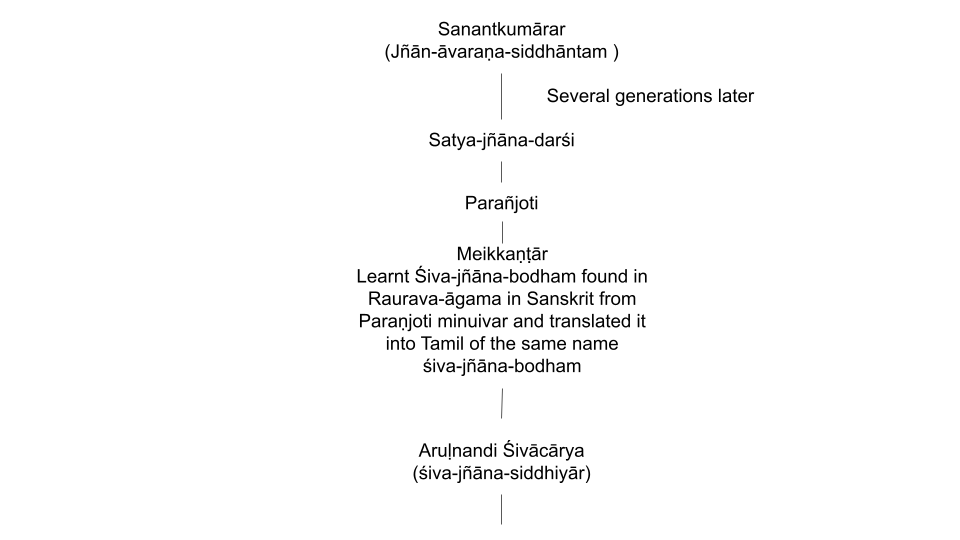
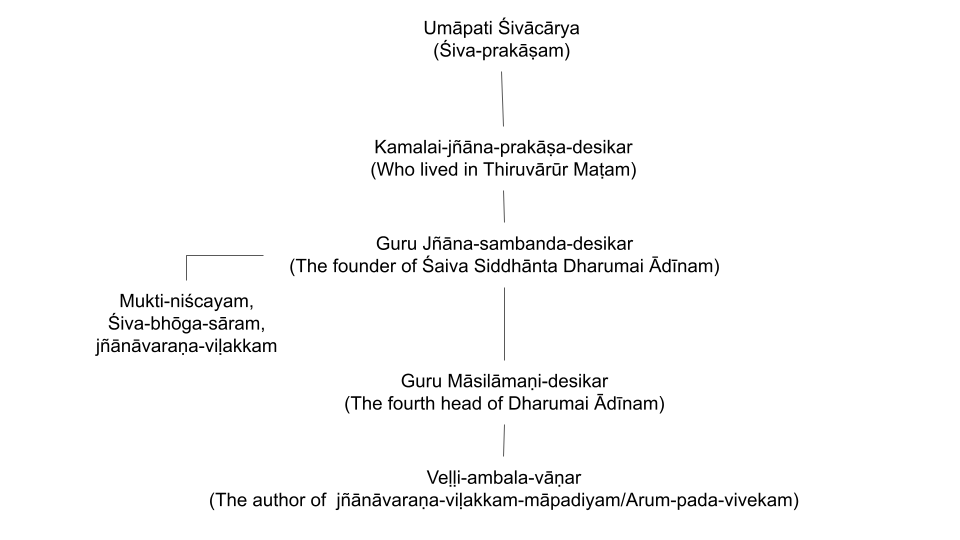
Veḷḷi-ambala-vāṇar who is mentioned as “Śiva-Jñāni” and also “Rajata-Sabhānātha-yogi” wrote this commentary on the Jñāna-āvaraṇa-dīpikā as vyākhyāna-viḷakkam. He belonged to the Sanat-kumāra-santāna which elucidated Jñāna-āvaraṇa-siddhānta4 (School). This was a tradition established by one Satya-Jñāna-darśi, followed by Parañjoti who initiated Meykkaṇṭār, the founder of Śaiva siddānta tradition through his Tamil work Śiva-jñāna-bodham. This was a translation into Tamil of the Sanskrit text Śiva-jñāna-bodham (of the same name). In this line of teachers came Kamalai-jñāna-prakāśa-desikar who initiated Guru Jñānasambanda who established the Dharmapuram Ādhīnam maṭha. Guru Jñānasambanda wrote a text called Jñānāvaraṇa-dīpikā. Veḷḷi-ambala-vāṇar the author of this commentary obtained śiva-dīkṣa and sanyāsa from Māsilāmaṇi Deśika, the fourth head and initiation (jñāna-dīkṣā) from Jñāna-sambanda-desikar, the fifth head of the Dharmapuram Maṭha .
Please check. [There was an Institution at Thiruvārūr in Tañjāvūr District, where one Kamalai-jñānap-prakāśa-deśika lived during the 16th century. Also at the maṭha of Dharmapuram was its head Jñāna-sambanda-deśika who initiated a certain Akalanka-muni (also called in Tamil as Māsilāmaṇi-deśika bhagavadpāda). Veḷḷi-ambala-vāṇa, who was called an “Ati-varnāśramī" received introduction and initiation under these great Ācāryas.]
From this it is evident that Veḷḷi-ambala-vāṇa Tambirāṉ had another but famous name Satya-jñānī and that he was an Ati-varṇāśrami, a recluse.
The Famous Śaiva Maṭha Dharmapuram Adheenam published the text Jñānāvaraṇa viḷakkam in two parts, the first part in 1957 and the second in 1959.
Sarva-Siddhānta-Viveka
The Sarva-siddhānta-viveka is a rare Sanskrit text dealing with various Śaiva and Śākta subsects that existed in mediaeval India. It deals with more than thirty subsects among the Śaiva and Śākta schools, their basic philosophy, the concept of Supreme in each school, their mode of worship, and the texts they followed, that are of great value to Indian religious history. This text helps in understanding monumental temples and sculptures throughout India that have come up in mediaeval times based on these schools. The name of the author is not available, but the date of composition can be fixed with an amount of certainty. The available texts consist of more than 840 verses in anuṣṭub metre with a few prose passages in between. As its name “Sarva-siddhānta-viveka” suggests, in its original form, this text dealt with other schools as well like Advaita, Mīmāmsa, Sāmkhya, Yoga, Dvaita, Bauddha, Jaina and others, such as the “Sarva-darśana-sangraha” of Sāyana Mādhava,5 which has been published in more than two editions. The later text Sarva-darśana-saṅgraha is well known and extensively cited by scholars, but Sarva-siddhānta-viveka is not known. The present text shows that there has been a tradition of compiling basic tenets of all schools for the better understanding of serious students of philosophy.
Jñāna-Siddhi
The other text Jñāna-siddhi6 is an important source for the study of Śaivism and is also found in the same commentary on Jñānāvaraṇa-dīpikā by Veḷḷi-ambala-vāṇa-swāmikaḷ. It is mentioned in the commentary that it is an Āgama included among 224 secondary Āgamas and follows the Āgamic structure in its arrangement. This text contained more details in its original form but the available parts have been used to supplement what is not found in the Sarva-siddhānta-viveka. Jñāna-siddhi is in the form of a dialogue between Śiva and Devī and is ascribed to divine origin that carries authority as the other Āgamas. It consists of nearly 500 verses in anuṣṭub metre in the Sanskrit language.
Both the texts available to us have neither the beginning nor the end but compiled from the bulky volumes of commentary as homogeneous texts and presented here as found in the citations in their incomplete forms. As the citations are selective, there are gaps and also loss of continuity. In some instances, the same verses are cited more than once. Such repetitions have been removed in this volume. The citations occur along with many other quotations thus seem to fail in their cohesiveness. Veḷḷi-ambala-vāṇar has taken extraordinary care to cite the name of the text and even the chapter from which he quotes that makes the collection easy and authentic. In one or two instances there still persist doubts as to the citations and its text. Despite such difficulties, the volume of text cited from both the works is so great that they stand out as monumental texts. Unfortunately it has not been possible to trace the manuscripts that were used for the 1957 edition as they seemed to have suffered damage and loss. What is available are the citations only from which these two texts are reconstructed. As these two texts are not cited in any study so far, including the recent exhaustive Śaiva studies by Sanderson7 or Goodal8, it is obvious that these texts are not known to any and deserve to be brought to the notice of the scholars in their present of state of availability with notes and comments.
The Jñānāvaraṇa had a bhāṣya in Sanskrit from which Veḷḷi-ambala-vāṇar draws citations. At the beginning of the text, he makes it clear that he was composing Pada-vivēka (a commentary with meaning for words) for the Tamil Jñānāvaraṇa-viḷakkam that was composed by Guru Jñāna-sambanda-deśika9, the founder of the Dharmapuram Śaiva Siddhānta maṭha. This Acārya wrote three great works - Śiva-bhōga-sāram, Mukti-niścayarm and Jñānāvaraṇa-viḷakkam. As the contribution of Śrī Guru Jñāna-sambanda, the founder of the Dharmapuram maṭha is a landmark in the history of Tamil society and deserves to be properly appreciated. It is dealt with in the sequence. It is not known how close Jñānāvaraṇa-viḷakkam in Tamil, is to the bhāṣya in Sanskrit. Obviously, it is evident that Guru Jñāna-sambanda-deśika was steeped in Jñānāvaraṇa tradition which is also called Jñānānta school (different from the Karmānta school). Jñānānta school is also called Siddhānta Śaivam. Veḷḷi-ambala-vāṇar was also an ardent follower of the same school and hence wrote this Pada-vivēka, now well known as Mahā-bhāṣya10. As Veḷḷi-ambala-vāṇar cites extensively from both Tamil and Sanskrit texts, there could be no doubt that his work is a Mahā-bhāṣya.
The benedictory verse of the Mahā-bhāṣya seems to suggests that “Jñānāvaraṇa-viḷakkam” of Guru Jñāna-sambanda-deśika was known as “Jñānāvaraṇa-dīpīkā in Sanskrit and that of Veḷḷi-ambala-vāṇar’s own work called arump-pada-vivēka or shortly pada-vivēka.
This work is an exposition of Śiva-jñāna-bodham and its great exposition Śiva-jñāna-siddhi by Aruḷnandi Śivācaryar. The later work Śiva-jñāna-siddhi is in two parts, as Parapakṣa and Supakṣa (parapakkam - the external schools and supakkam - the internal schools). This text begins with the Supakṣa of Aruḷnandi. As the external schools have already been dealt with elaborately in Aruḷnandi's Parapakṣa, Veḷḷi-ambala-vāṇar begins discussing supakkam or what we may call the internal schools and their refutation and finally establish their own school firmly.
So, both the Sanskrit and Tamil texts dealing with the external schools have not been elaborately discussed here. It is in a way a great loss to our knowledge, because those portions dealing with Lokāyatas, Ārhatas, Baudhdhas, Māyāvādins and others in such texts as Sarva-siddhātanta-viveka and Jñāna-siddhi are lost.
It is however a matter of satisfaction that the extensive citations especially of Sarva-siddhātanta-viveka and Jñāna-siddhi provided in this portion help us greatly in understanding the Śaiva Siddhānta in an all India perspective, the like of which is not furnished by any other source. This part establishes that by Siddhānta Śaiva, it means the Śaiva system that is based mainly on the tenets of Āgamas like Kāmikāgama which in essence is a combination of both Vedic and Āgamic paths. In this school there is no question of rejecting either the Vedas or the Āgamas. It also categorically states that the Vedas are considered the “general texts” and the Āgamas are “specific texts”. Secondly, it also holds that Siddhānta Śaivas were classified as “the benign school” (saumya) while all the others were considered (raudra) “the wild schools”. Thirdly, even among the saumya schools, there are two distinct sub schools; one “the Karmānta school” and Jñānānta school. Karmānta school is also considered external school and the branch that emphasizes “Jñānānta" is called Siddhānta Śaivam. This Siddhānta Śaivam thus holds the observance of caryā, kriyā, and yoga as enunciated in the Āgamas culminate in Jñāna-knowledge like Vedānta and that alone is the path of liberation. So, Siddhānta Śaiva is called Jñānānta Śaivam through out this text. The supremacy of Jñānānta is consistently maintained and all other Śaiva schools are held Pūrva-pakṣa i.e., the tenets of the schools are outlined and logically disproved. This means the followers of other schools will reach certain stages in the path of Śaiva liberation called pada-prāpti, while Siddhānta alone is considered the fruition of Supreme Śaiva liberation.
Date of Tamil Śiva-jñāna-bodham
In the history of Tamil Śaivam, the text Śiva-jñāna-bodham by Meykaṇṭa-devar is the foremost and is assigned to the 13th century.11 It is in 12 sūtras. Earlier the Tamil authors and poets considered this text as a translation of the Sanskrit text Śiva-jñāna-bodha of Rauravāgama.12 However, in recent times they are claiming that the Tamil Śiva-jñāna-bodham is not a translation but an original work. The 1956 publications of the Tamil Śaiva maṭha, published the Sanskrit text along with the Tamil text13.
Veḷḷi-ambala-vāṇar discusses in a lengthy passage that the Sanskrit Śiva-jñāna-bodham is the original text and that the Tamil Śiva-jñāna-bodham of Meykaṇṭār and the Tamil Śiva-jñāna-Siddhi follow the original Sanskrit text page (579). The original Sanskrit text is found in the chapter “pāśa-vimocana paṭala” of the Rauravāgama which is the “ādi sūtra” (p. 581). The original Śiva-jñāna-bodha (in Sanskrit) was taught by Śiva (583). Veḷḷi-ambala-vāṇar is following the Jñānā-varaṇa-bhāṣya in Sanskrit in his tradition which he cites. The Sanskrit bhāshya holds that Sanaka and others understood this Sūtra, expounded by “Śiva”.
śiva vākyena pratiāpaditatvāt, pañca rūpa upapannāt liṅgāt, paraiḥ sanakādibhiḥ jagataḥ sakartṛkāriam jñāyate p.583.
Again the same position is asserted that the original Śiva-jñāna-bodha was taught by Śiva.
atra śiva jñāna bodha harasya prabhutva ukteḥ jagat kartṛtva anādi nirmala cidrupakena sarvajñatvādi śaktimatvam api siddham p.585.
Veḷḷi-ambala-vāṇar says Śiva-jñāna-bodha constituted an upāgama bheda called as Rauravottara thus suggesting that itself is an Āgama (p.579).
Veḷḷi-ambala-vāṇar is categoric in stating that the Tamil Śiva-jñāna-bodham is a translation from the Sanskrit Śiva-Jñāna-bodha, found in the pāśa-vimocana-paṭala of Rauravottara-āgama14. Another great commentator on the Tamil Śiva-jñāna-bodham was Śiva-jñāna Yogi, whose work Śiva-jñāna-bhāṣyam and called also as Drāviḍa-mahābhāṣyam, lived in the 18th cent. At the very beginning of the first sūtra, he maintains that the Tamil work is a translation of the Sanskrit Śiva-jñāna-bodham15. (Śiva-Jñāna-bhāṣyam of Śiva-jñāna-yogi, Śaiva Siddhānta Mahāsamajam, Chennai, 1936, p.73) In his long introduction it is said that Nandikeśvara received this Śiva-jñāna-bodham in Sanskrit from Srikaṇṭa Parameśvara, (p.15). Nandi taught this to Saint Sanatkumāra, who transmitted this to Satya-jñāna-darśi from whom it came to Paramjyoti, the teacher of Meykaṇṭa-deva (p.16).17 Paramjyoti directed Meykaṇṭa-deva to translate this into Tamil which he did and from then the Tamil school took firm root. Aruḷnandi Śivācārya wrote the exhaustive commentary on this Tamil Śiva-jñāna-bodham in his Śiva-jñāna-siddhiyār. Śiva-jñāna-yogi in his bhāṣya mentions that this original Sanskrit text is found in Rauravāgama (and not Raurvaottara-āgama) (Also, see another publication of Tamil Śiva Jñāna Bodham with a commentary, Vedānta dīpika, published in 1922 at Kumbakōṇam which says in the title page Vedānta dīpika a commentary on Śiva-jñāna-bodham translated into Tamil by Meykaṇṭa Devar). From his time onwards the source of the original Śiva-jñāna-bodham was mentioned as Raurava-āgama. Whatever be the variations in the name it was believed until 20th century that the Tamil Śiva-jñāna-bodham is a translation from Sanskrit. Thiru V. Kalyanasundara Mudaliyar, the noted Tamil Scholar wrote in the 1936 Samājam edition that the Śiva-jñāna-upadēśa was received from his Gurunātha by Meykaṇṭa-devar and wrote the Tamil version (p.11). However, it was M. Balasubramanya Mudaliyar who wrote the biography of Śiva-jñāna-yogi, asserted in the same 1936 edition that the Tamil Śiva-jñāna-bodham not a translation but an original Tamil work (p.24). From then on, the now populist scholars started asserting that it is not a translation. But, any one who reads the available original texts and understands chronology will not be convinced by the present advocacy of independent work.
Sri N.R. Bhat, who has edited many Śaiva-āgamas for the French Institute of Indology, Pondicherry stated the Sanskrit Śiva-jñāna-bodham text is not found in any known Raurava-āgama manuscripts and so the Tamil text should be considered the original. The Sarva-siddhānta-vivēka text which is earlier than Aghōra-Śivācārya, quotes three sūtras verbatim from the Sanskrit Śiva-jñāna-bodham. So, the existing Sanskrit Śiva-jñāna-bodham is certainly earlier than 11th century. We must now agree with earlier Tamil poets and scholars and hold that the Tamil Śiva-jñāna-bodham is a Tamil translation from the original Sanskrit text. The controversy may now be set at rest.
The entire text of Sarva-siddhānta-viveka is based on this Śiva-jñāna-bodham and hence should be viewed as a Siddhānta Śaiva text par excellence. A careful study of this school and the texts cited indicate that both the Tamil Śaiva Siddhānta and Siddhānta Śaiva of the rest of India are identical. It also shows that Śaiva Siddhānta of the Tamil region produced an enormous body of Śaiva Śāstra literature in Tamil language, that spread Śaivism among a vast population not fluent with the Sanskrit language and never struck an independent or conflicting path.
The Tamil soil was most fertile for this movement by its great devotional popular upsurge created by the Śaiva Nāyaṉmārs, especially Tēvāram saints Appar, Sambandar, Sundarar and the Thiruvācakam of saint Māṇikkavācakar. The age of the Tēvāram saints showed that Śaivism went beyond caste and that trend remained throughout the centuries. In one and the same santāna paramparā - hierarchy of Ācāryas, we find both non-Brahmins and Brahmins as gurus. Eminent Ācāryas, of the agricultural caste were held as the most venerated Ācāryas by even the most eminent Brahmin Śaivācāryas as in the case of Meykaṇṭār and his disciple Aruḷnandi Śivācāryār. The one distinct contribution of the Tamil Śaivam, is the total integration of the Indian society under the banner of Śaivism, beyond caste and creed.
This also gives a negation to the populist movement that Sanskrit is a Brahminical language that was not available to the non Brahmin community. The shear volume of Tamil Śaiva Śāstric texts, considerable number being excellent translations from Sanskrit originals, by eminent Ācāryas belonging to Veḷḷāḷa caste (Śūdras) shows that there was no linguistic divide. This text Jñānāvaraṇa-dīpika by Guru Jñāna-sambanda-deśika and Veḷḷi-ambala-vāṇar is the best example of such a great system.
S.N.Dasgupta has done yeomen service to the history of Indian philosophical systems by publishing five volumes19. While he has dealt with all the major schools in detail, the history of Śaiva has not received adequate attention in his series. The learned professor had a desire to treat the Śaiva systems more exhaustively and was obviously collecting data but could not complete the task in his lifetime20.
Monumental temples dedicated to Śiva were built and sculptures portrayed in the whole of India and South East Asia. There have been overwhelming numbers of Śiva temples when compared to all other systems put together, but the history of the Śaiva system has not received the attention it deserves. The present text gives more information and picture about this system than hitherto known. It is thus a very valuable text.
The available text also gives the tenets of subsects among the Sākta Vāma schools which is another notable usefulness of this text. It gives nine subsects among them, throwing light on their diverse approaches. Interestingly, it includes the Śākta Vāma school as a sub school of the Śaiva system and is thus a valuable source for the history of Sākta traditions as well.
Different schools of Philosophies: Summarising Traditions
The tradition of summarising different systems of philosophy either for study or for purpose or refutation may be traced to the sūtra period. The Brahmā-sūtra for example refers to various systems and their refutations. The commentators like Śaṅkara have elaborated these various systems in the course of their refutation. This gives us an insight into these systems and helps us in understanding the history of various schools.
Āgamic tradition: Mṛgendra Āgama
Traditionally the Śaivāgamas list the external schools from early times. The Mṛgendra-āgama for example which is an early text (earlier than the 10th cent) refers to the following schools, the views of which are refuted from the Śaiva-siddhānta standpoint.
Vedānta-vādi
Kāpila’s Sāmkhya school
Kānāda School (Vaiśeshikas)
Hiranya garbha school
Pātanjala (Yoga) school
Anekāntika-vādi (Jains)
Saugatas (Buddhist school)
Sadasad-vādi
Pāñca-rātra school (Vaishnava school) and
Padārtika-darśana
The Great Kashmiri scholar Nārāyaṇkaṇṭa (10th cent) has an elaborate commentary on Mṛgendra in which he gives more details about all these schools.21 (Sri Mrigendra Tantra – Vidyāpāda and Yoga-pāda, with the commentary of Nārāyanakanṭa. Ed by Madhusudan Kaul Sastri, published by Meharchand Lakshman Dass, New Delhi, 1982.)
Svacchanda-tantra
Another important text that similarly gives a list of different schools is the Svacchanda-tantra. This text is held by some scholars as not the original Svacchanda-bhairava-tantra22 but should be considered a later work. However, as the present text has a detailed commentary on it by Kṣemarāja, a disciple of Abhinavagupta, there could be no doubt that it is earlier than the 10th century. The Svacchanda-tantra is called Mahāmaheśvara-darśana and also as Svacchanda-naya. Kṣemarāja himself was called Mahāmaheśvara-ācārya and his commentary called Udyota. While the text Svacchanda briefly gives the list of different schools, Kṣemarāja in his commentary provides more insight into the schools so listed. The following are the schools listed in the text.
Sāmkhya
Yoga
Pāñcarātrikas
Svabhāva-vādis
Karma-vādis
Samsaya-vādis
Nagna-kṣapaṇakas (jains)
Bhūta-vādis
Laukika-vādis
Ātma-cintakas
Tarka-pravādis (Naiyayikas)
Vaiśeṣikas (also called Shad-padārtha-parāyanas)
Nyāya-vādis
Hetu-driṣṭānta-vādis (Saugatas)
Eka-janma-vādis
Eka-vādis
Dhūrta-vādis (Mlecchādi sāśtra niṣṭakas)
Kṣemarāja gives the following details on these schools.
Sāmkhyas are those who hold that ignorance about the principles Prakṛti and Puruṣa leads on to worldly suffering and their correct knowledge leads them to liberation:
(prakṛti puruṣayor aviveka mātrāt samsāraḥ; vivekāt tu muktiḥ).
Yoga-śāstra-vādi are those who hold that realisation of the nature of one's own self, by a manifestation of union of soul with the mind by steadfast retention:
cittaikagryaātma-yoga āveśa samprāpya - driṣṭa svarūpāvasthiti muktiḥPāñca-rātrikas: The Pāñca-rātris accept 26 principles. They hold that Vāsudeva who is of the nature of great splendour and who is the soul of Para-prakṛti constitutes the world.
(ṣaḍvimśati tattva-rūpa mahāvibhūtyātmaka - vāsudevākhya – paraprakṛti pariṇāmātmaka-prakṛtyādi jagad-vādi)
Svabhāva-vādi contents that there is no such entity called God other than Nature that causes bodily-form, instruments of perceptions and worldly spheres:
(pṛthvyādayaḥ svabhāvena tanu-karaṇa-bhuvana-kāryam pravartante. na punaḥ īśvaraḥ asti iti evam vādi).
Karma-vādi This school contends that action alone is the cause of the Universe and nothing else. (It is not clear whether karma here refers to Vedic sacrifices (yajña-karma) or simple worldly action. For there are many āgamic texts list Mīmāmsa-karma Śāktas which emphasise karma and are known as karma-mīmāmsakas. But, there is another mention of mīmāmasakas in this list. In all probability, it is the mīmāmsakas who are referred to here.
(karmaiva viśvakāraṇam. na anyat iti ācakṣvānāḥ)
Samsaya-vādis are those who express doubts about all tenets.
Nagna-kṣapaṇakas Are the Jains who argue as “asti nāsti”.
Bhūta-vādis are the Cārvākas who hold that there are only four basic elements namely earth, water, air and fire that are seen visible and there is nothing else.
(pṛthvi appa, tejaḥ vāyu iti bhūta catuṣṭayam eva pratyakṣha driṣṭam asti iti kathayadbhiḥ cārvākair)
Ātma-cintakas: those who hold that all those that have come into existence and are likely to appear again are none other than the Supreme are the Vaidikas.
(puruṣa evedam sarvam yadbhūtam yad ca bhavyam ityādi cintayadbhir vaidikais)
Tarka-pravādis: Inferring causes for principles that are not known by other means is called ūhah-tarkaḥ a form of deduction. Those who insist on such deductions are the tarka-vādis.
(avijñāta tattve arthe kāraṇa utpatti tattvajñānārtham ūhaḥ-tarkaḥ)
Vaiśeṣikas also called Ṣaḍ-padārtha-parāyaṇas: this school hold that there are only six principles namely material, quality, action, commonality, special characteristics, and coherence.
(dravya, guṇa, karma, sāmānya,viśeṣa, samvāya padārthākhya ṣaḍkam eva tattvam iti abhidadabhiḥ kānāda siṣyaiḥ)
Nyāya-vādas: This school is different from the Tarka School. The Naiyāyikas believe that knowledge of evidence about the 16 principles provides a source of liberation.
(pramānādi padārtha ṣodaśa tattva jñānāt niśśreyaso bhavati iti bhruvānaiḥ naiyāyikaiḥ)
Hetu-drishṭānta-vādi: Buddhist (Saugatas)
Ekajanma-vādi: this school asserts that there is no other birth than this.
(vartamānam eva ekam idam janma na tu janmāntaram abhūt bhāvi vā iti uditavadbhiḥ)
Ekātma-vādi: This is the Advaita school which holds that the consciousness which is only one and that is what Śivādvaitin holds as non dualism of the self-luminous consciousness and independent - pārameśvara-śāstra.
(Pārameśvara-śāstra-pratipādita-svaprakāśa-svatantra-cid-advaya-vāda-vyatirekena sattādyadvaya vādibhiḥ)
Dhūrta-vāda lokaih: The texts expounded by dhūrtas like mlecchas.
(dhūrta-viracita-mlecchādi śāstra-niṣṭaiḥ)
The above schools mentioned in the Svacchanda tantra and the commentary by Kṣemarāja around 1000 CE would show that many sub-sects were active at that point of time.
(sanskrit)
(Sri Svacchanda Tantram - Pg.11 with the commentary of Kshemaraya, Pub. By Sampurnan and Skt. University. Varanasi, 1993, Patala 10, verses 676-681.)
Though the names of these schools are listed, there were more such schools which may number more than three hundred, says Svaccanda tantra.23
The Tarka school is always engaged in clearing doubts rather than realising the truth. This concentration is on arguments and all interested in winning over the others. Those who do not have devotion towards the preceptor, good and the Śāstras, and waste their time in arguments are dry logicians,24 (śuṣuka tarkavalambinaḥ (10/1149)). They abandon the true path and hence go to the nether world, as they pursue an ignorant path laid on an unrighteous path. The four principles regained progress are dharma, jñāna, vairāgya and aiśvarya, righteous conduct, knowledge, determined rejection of desires and command over self unrighteous conduct. Importance, attachment to desires and non-control over self arise out of tamoguṇa. Those who pursue tarka system are overtaken by tamoguṇa.
The Laukika knowledge is based only on right conduct dharmas (Vārtā). The Pañcarātrins have the righteous knowledge. They are (abhygamana, upadana, yajna and a conclusion that god himself becomes a worldly element).
The Vaidikas preach both rituals (karma anuṣṭāna) and knowledge, the Baudhas and Jainas are bound by rejection of desires. The Sāṁkhyas, emphasise, both prāṇa (knowledge and rejection of desires) (vairagyam). The Pātañjala yogin emphasise prāṇa-vairagyan and in addition self control. All these followers are born again after their demise.
The Parameśvara Śāstra crosses these boundaries and so is called ‘Atimārga’, those who go beyond birth and death are Atimārgins.
The Kapālavratins and Pāśupatas are not born again, as they remain steadfast in Īśvara. By the knowledge (dīkṣa) obtained through imitation and observing that Śaiva code of conduct, the Kapalavratins goes to his chosen path. Similarly, the Pāśupatas who smear his body with sacred ashes and repeat gods name constantly, reach the abode of lord Īśvara.25 (11-74) They attain liberation and are not reborn. The Laukikas die and are born again and again.
Para-mokṣa-nirāśā-kārikā
A text of another category in the Śaiva system that is of interest to this study is Para-mokṣa-nirāsā-kārikā of Sadyojyoti Śivācārya, an eminent Kashmiri scholar (10th cent). He begins his work with a citation from the Rauarava-āgama which he calls Raurava-sūtra, and refers to Sāmkhya, Yoga, Vedānta-jñāna , Pāñcarātra, Māheśvara yogis, Pramāna-āgneya-kartṛtva, and Viśikhāmala-kāraka schools. Obviously, these schools were the earliest that prevailed in the time of the early stage of the Raurava āgama. Bhaṭṭa-Rāmakaṇṭa who was a disciple of Abhinava-gupta, 2nd half of 10th century wrote a commentary on Sadyojyoti-Śiva’s work. As mentioned earlier Sadyojyoti in addition to listing a number of schools external to Śaiv-siddhānta, lists many internal Śaiva schools as well. Rāmakaṇṭa elaborates all these schools. The following are the schools thus listed in the work.
Sāmkhyas
Pramāna-kartritva (Yogis)
Āgneya-kartritvas (These hold that the their followers will attain equality with Sūrya and Agni (Āditya agniyādi samatā) by following their respective āgamas)
Pravāha-nityeśvaras
Pradīpa-nirvāna-vadi
Samāna-tāntrikas
Samutpatti-samkrānti-vāda
Utpatti-sama-vāda-pakṣha
Śikhā-samkrānti-vādi (Pāśupatas)
Abhivyakti-samatā
Samata-samkrānti-pakṣha
Āveśa-samatā-pakṣha
Gaṇendra-sama-pakṣha
Svarūpāvāpti-pakṣha
Śivād-ādikhya-pakṣha
Guṇa-samkrānti-vāda
Jñāna -samkrānti-vāda
Utpatti-samkrānti-pakṣha
Guna-samkrānti (Pāśupatas)
Parama-āveśa-pakṣha
Parināma-vāda
Siddhānta-vādi
(Paramokṣa-nirāśa-kārikā in Aṣṭa-prakaraṇa Ed. By Pandit Vraja vallabha Dwivedi, Sampurnanand Sanskrit University, Varanasi, 1988)
Makuṭāgama
The Makuṭāgama provides the following list of Śaivas in order and their divisions.
Urdhva Śaivam
Adi-Śaivam
Mahā Śaivam
Anu Śaivam
Avānatara Śaivam
Miśra Śaivam
Bheda Śaivam
Guṇa Śaivam
Ajñā Śaivam
The Makuṭāgama is called a Mahātantra which is said to deal with Ūrdhva Śaivas. It also mentions four divisions among the Śaiva system namely Śaivam, Pāsupatam, Sōmam, and Lākulam and holds Śaivam as the best among the four. This division is further categorised into two as Raudra and Saumya schools. It further says that the Saumya school is divided into Dakṣṇina (right) and Vāma (sub-school). The discipline enjoined in the Vedas is called Dakṣiṇācāra while the system advocated opposite to Dakṣiṇa is called the Vāma system. There are some schools in which there is a mixture of both the systems that go by the name Miśra. (Makuṭa Tantrāvatāra Paṭala.27 - (ver. 16-22) The Makuṭa is declared as the essence of the Vedas (and falls under Dakṣiṇa school.)
The Makuṭāgama defines tantra as that which weaves expanding knowledge found in rituals and mental imagery into a carpet and protects the follower (the word tantra is split who “tan" (weave) and “yra" (protect) on the basis of which the above meaning is derived).
Sarva-darśana-saṅgraha
In the Sanskrit tradition, the most outstanding work on different schools of Indian philosophy is no doubt the “Sarva-darśana-saṅgraha”, without entering into the polemics of refutation. This work of Sāyana, assigned to 14th century is an admirable history of Indian philosophy and scholars have drawn on it for an understanding of different systems28. Sāyana deals with the following systems in his work.
Cāruvākas
Bauddhas
Arhatas (Jainas)
Ramanujīya system
Pūrṇa Prajña system
Nakulīśa Pāśupata
Śaiva
Raseśvara
Pratyabhijñā
Vaiśeṣika or Aulūkya
Akṣapāda or Nyāya
Jaiminīya
Paninīya
Sāmkhya and
Patañjali yoga sūtra.
Sāyana mentions the sub-sects among the Bauddhas and their tenets briefly as:
Vaibhāṣhikas
Sautrāntika
Yogācāra and
Mādhyamika
Dealing with Jainas, Sāyana mentions the two main divisions amongst them namely Svetambaras and Digambaras and their life style. Sāyana also refers to Vaiṣṇava system as Rāmānuja-darśana, and mentions in the text Veṅkaṭanātha (Vedanta desika) and Yāmuna. The dvaita school of Vaiṣṇavism is called Pūrṇa-prajñā-darśanam, at the beginning of which Mādhvācārya is called Ānanda-tīrtha. Four different Śaiva schools namely Nakulīśa-pāśupata, Śaiva, Pratya-bhinjñā and Raseśvara systems are dealt with. In the Pāśupata school, the Gana-kārika, Haradattācārya, and Nakuleśa are cited as authorities, In the Śaiva system Siddha-guru, Bhojarāja, Sōmasambhu, Nārāyana-kaṇṭa, Saurabheya, Mṛgendra-āgama,Pauṣkara-āgama, Kāraṇa-āgama,Tattva-prakāśa, Tattva-saṇgraha, Kālottara, Kiraṇa-āgama, and Jñāna-ratnāvalī are cited as authorities. Somānandanātha, Utpalācārya, Udayākara’s son, Śiva sūtras and Kriyādhikāra appear as authorities in Pratybhijñā school. The Raseśvara-vādins are also considered Maheśvaras. Govinda-bhagavadpāda, Rasārṇava, Rasa-hṛdaya, Raseśvara-siddhānta and Sarvajña, and Sarvajña Rāmeśvara bhaṭṭāraka, Sākara siddhi appear as authorities. The other schools are cited mainly as respective Sūtrakāras. The most important point is that Sāyana does not import his conclusion on any of the schools, but reflects truly the respective schools. He cites in each school the views of opposing schools and answers them from their respective stand point.
On account of its objectivity, clarity and comprehensiveness, Sarva-darśana-saṅgraha remains a leading text as history of Indian philosophy.
Śivāgrayogi’s Śaiva pari-bhaṣa
Śivāgrayogi, who was almost a contemporary of Veḷḷi-ambala-vāṇar, the commentator, and lived in Tamilnadu, has composed a Sanskrit text called Śaiva-paribhāṣa29. (The Śaiva Paribhāṣa of Śivagra yogin. Text and Translation by S. Suryanarayana Sastri, Pub. University of Madras, 1982).
Following the tradition, he deals with the opposing schools and establishes his own school based on Śaiva-āgamas, mainly on Pauṣkara. He deals with the following schools.
Bauddhas
Prābhākaras
Bhāṭṭas
Naiyāyikas
Pāñcarātras
Kṣapanakas
Vamsikas
Sāmkhya
Cāruvakas
Mādhyamikas
Yogācārās
Śivasāmya vādins
Pāśupatas
Kāpālikas
Mahāvratis
Abhivyakti
Guṇa - Sattva
Utpatit Sāmya
Sankrāntavādi
Samāveśa
According to his school, experiencing the joy of Śiva through union with Śiva is liberation. śivākyabhāvena, śivananda anubhava eva mokṣa.
(sanskrit)
Bhaṭṭa in Sthavacintāmaṇi, verse 16.
(Sanskrit)
Sarasvata Stotra, cited by Kṣemarāja in Stavacintāmaṇi.
(Stavacintāmaṇi, of Bhaṭṭa Nārāyaṇa, with the commentary of Kṣemarāja, Ed Pandit Mukunda Rama Shastri, Published in Kashmir Series of Texts Srinagar, 1918)
Dasgupta, Smendranath, A History of Indian Philosophy, Vol. I Vol. V Motilal Banarsidass, Delhi, Reprint, 1975.
We have seen that Sarva-siddhānta-viveka, brings the Vāma systems under the Śaiva group. The Kulārṇava tantra has the following to say on the subject.30
“This world is constituted of both Śiva and Śakti, consciousness and power, and established in such a world is the Kula-dharma which is therefore the highest of all. It bases itself on the truth of both Śiva and Śakti and therefore it is the most true, most wholesome. The six darśanas are my limbs. He who differentiates among them cuts across “my body”. Therefore the Śāstra of the Kula is none other than the Śāstra of the Veda”.
“vedāntmakam śastram viddhi kaulātmakam”
There are seven religious systems recognized bestowing spiritual merits to the followers. The first is the path of Karma - the Vedic ritual, the second is Vaiṣṇavism that emphasises, bhakti, devotion towards Lord. The third is Śaivam which is a path of meditation (japa) and knowledge (jñāna); The fourth is the Dakṣiṇa system that harmonises karma, bhakti and jñāna. The fifth is the Vāma school where externalisation (pravṛtti is turned into nivṛtti (internal the dakṣiṇa and vāma school considered for a man of evolved nature. The Siddhānta is considered still for a highly evolved nature. The final is said to be the Kaula system which is claimed to be the essence of all, the very Śiva. It has been extracted from the ocean of the Vedas and Āgamas with the churning rod of jñāna by Śiva himself.31 p. 30-31.
Dealing with Daśa-kārya, the Jñāna-siddhi, shows that the text was in the form of questions by the Devī and the answers were provided by Īśvara,32 as seen in many Āgamic texts. (p. 144).
The Tamil tradition
The Tamil language has also a long-standing tradition of referring to different viewpoints of philosophical systems almost from the beginning of the common era. A verse in the Puranāṉūṟu anthology of the Saṅgam age refers to a Brahmāṇa of Puṉcāṟṟūr, whose family was Vedic Śaivas, who were reputed for their mastery of logic with which they refuted the other schools of thoughts and established the system of Śaivāgamas taught by Śiva33. There are references in other Saṅgam poems to such philosophical disputations.
Maṇimēkhalai
The most striking example of listing systematically other schools of thoughts is found in the Tamil epic, Maṇimēkhalai, the date of which is not certain, but probably ascribable to 3rd, 4th century CE.34 It is a Buddhist text in which the central character, Maṇimēkhalai, visits different philosophers, and listens to the exposition of their systems. Enumerating the schools she listened to, the text mentions first six systems and their authors, which are as follows:
Lokāyata - Bṛhaspati
Bauddha - Jina (Buddha)
Sāmkhya - Kapila
Naiyāyika - Akṣapāda
Vaiśeṣhika - Kānāda and
Mīmāmsā - Jaimini
The text then details briefly their tenets. Besides these six schools, (which are considered ṣanmatas later), the text also says she met Śaiva-vādi, Brahmā-vādi (of Hiraṇya garbha), Vaiṣṇava-vādi, Veda-vādi, Ājīvaka-vādi and Nighaṇṭa-vādi, who seem to have formed another group of six systems. As she was not convinced of their expositions, she finally embraced Buddhism and became a nun. Maṇimēkhalai says though they are not convincing systems, she is not refuting any, as it is not her mission. (Ch., 27)35 Thus this text summarises 12 schools without any debate, and would thus constitute an attempt to give history of philosophies, known to them then. But, what is surprising is that it deals in long passages, the Naiyāyikās, Ājīvikas, Jainas (Nighaṇṭa-vādis), Sāmkhyas and Vaiśeṣikas and Bhūta-vādis whereas the other schools like Śaiva, Vaiṣṇava, and Veda-vādis are only cursorily mentioned. There is no mention of subsects among various schools either.
Tēvāram hymns
The Tēvāram saints have given references to Buddhist and Jains, and their lifestyle in their devotional songs though in a negative way by ridiculing them. Three texts of the Śaiva canon, belonging to the mediaeval period, 12th to 14th century, deserve attention in this regard. They are Jñāna-mirtam by Vāgīśamuni, Śiva-jñāna-siddhiyār by Aruḷnandi-Śivācāryar 13th century, and Śivaprākasam by Umāpati-Śivam, of 14th century.
Jñānāmirtam
Vāgīśa-muni, the author of this Tamil-text, hailed from Kodampākkam, a part of Madras and later moved to Thiruvoṟṟiyūr, an outskirt of Madras, where he expounded Sōma-Siddhānta school of Śaivam.36 He wrote this work in his Jñānāmirtam, around 1175 CE which belongs to the saumya school of Śaivam. The author refers to Lokāyata, Mīmāmsa and Māyā-vāda, the last one was identified by one commentator as Śivādvaita school. The treatment of these three schools is not exhaustive in this text but gives only a bare outline.
Śiva-jñāna-siddhiyār
The second text, which is of great importance, is Śiva-jñāna-siddhiyār by Aruḷnandi Śivācārya. The Tamil Śaiva Siddhānta school, was founded by Meykaṇṭa-deva with his Śiva-jñāna-bodham in Tamil in the 13th century. Aruḷnandi Śivam was his disciple who wrote an exhaustive treatise, expanding the Śiva-jñāna-bodha. These two texts form the main plank of Tamil Śaiva Siddhānta. Aruḷnandi wrote his text in two parts as (a) External schools and (para-pakkam) (b) own Siddhānta (su-pakkam; sva-pakṣa). It is in part 1, the para-paksha, that he details various schools differing from the Śaiva Siddhānta system. The later is considered the Jñānānta-āvaraṇa, school, which emphasises, path of knowledge. Consisting of 300 Tamil verses, it deals with views of fourteen opposing systems and refutes them in detail.
The following are the systems that are detailed.
Lokāyata
Sautrāntika
Vaibhāṣika
Yogācāra
Mādyamikas
Nighanṭa vādi
Ājīvaka
Bhaṭṭācārya
Prābhākara
Sabda Brahmā vādi
Māyā vāda
Bhāskara
Niriśvara Sāmkhya
Pāñcarātri
Among them are the four branches of Buddhism: Sautrāntika, Vaibhāṣika, Yogācāra, and Mādhyamikas. The tenets of each system are first given in outline followed by point-by-point refutation. While most of the other schools are dealt with in detail Vaibhāṣika, Yogācāra, and Mādhyamika Schools are treated rather summarily in just two verses each. It may be seen that Naiyāyikas, and Vaiśeṣika and other schools of Śaiva system are not dealt with at all in this text. However, this may be considered as an exhaustive text that throws light on different systems that held the field in the 13th century.
Saṅkalpa-nirākaraṇam of Umāpati
The third text of importance is Saṇkalpa-nirākaraṇam by that great and prolific Tamil Śaiva Siddhānta exponent, Umāpati Śiva, who wrote this work in Saka 1235 (1313 CE). He mentions the date of this composition in the text. This whole work is meant to refute the opposing views like the Para-pakṣa of Aruḷnandi, but with this difference that he does not state or refute the well known opposing schools like Lokāyata, Bauddha, Jaina, Mīrnāmsa, (Vaiśeṣika and Sāmkhya) as these are considered external (purac-camayā). On the contrary, he concentrates on the subsects among the Śaiva system. The following Śaiva sub-sects are thus detailed in the text and rejected.
Māyā vāda
Aikya vāda
Pāṣhāna vāda
Bheda vāda
Śivasama vāda
Sankrānta vāda
Īśvara Avikāra vāda
Nimitta Kārana Parināmavāda, and
Śaiva vāda
Thus, it is evident that by about 1300 CE, several sub-sects among the Śaivas had cropped up, each emphasising their own system. If one takes the work of Śiva-jñāna-siddhiyār of Aruḷnandi and this Saṅkalpa-nirākaraṇam of Umāpati, we get a complete picture of history of philosophy, opposed to the Śaiva Siddhānta school. Even Saṅkalpa-nirārakaraṇam does not deal with Kāpālika, Mahāvrata and other such schools. The number of sub-schools among the Śaivas treated in the Sarva-siddhānta-viveka is far more than in any of the texts mentioned above.
Veḷḷi-Ambala-vāṇar on Āgamas
Some of the observances of Veḷḷi-ambala-vāṇar on Āgamas are interesting and of historic interest. The Siddha-tantra from which he quotes extensively is called an Āgama (606). Svacchanda tantra is called at places as Svacchanda-bhairava,Svacchanda-lalita, Svacchanda-lalita-bhairava-mahā-tantra at other places. That it is identical with the now available text is seen in a number of instances. For example, Tattva-vijñāna-paṭala from which he quotes is verbatim found in the available published text.39 (638, 867, 1051, 1106 etc) Virtually the entire Svacchanda text is cited all over this work that would enable one to take up a critical comparison and even edition of Svacchanda is possible. However, it is not attempted here as it is outside the scope of this school. The following paṭalas of Svacchanda is mentioned in this text.
Tantravatara paṭala (43)
Gangāvatāra paṭala (42)
Dikshā paṭala (38)
Prāsāda vidhi paṭala (38)
Śivaprāpti paṭala (38)
Tattva-vijñāna paṭala
(36) etc.
Tantravātara paṭala (43)
Gangāvatara paṭala (42)
Dikshā paṭala (38)
Prāsāda vidhi paṭala (38)
Śivaprāpti paṭala (38)
Tattva-vijñāna paṭala (3 Tantravātara patala (43)
Gangāvatara paṭala (42)
Dikshā paṭala (38)
Prāsāda vidhi paṭala (38)
Śivaprāpti paṭala (38)
Tattva-vijñāna paṭala (38)
The Svacchanda holds that Śiva-tattva is śūnya as it is the base of Laya-Śiva (laya śiva adhiṣṭāna). There are many common factors between Svacchanda and Siddhānta Śaivam. Śiva is called bhairava-sadāśiva, who is rudra-murti who remains in Sadāśiva form and not in other Rudra forms. Bhairava is also identified with Srikaṇṭanātha Rudramūrti. The Svacchanda also holds that one who meditates on Svacchanda Bhairava-deva will attain mokṣa quickly. There is also variation in the dikṣa among the followers of the Bhairava school. Bhairava also had five faces. All schools proclaim that their Supreme has five faces.The Bhairva school also holds that Pāśupatas, Rudras and others fall under pūrva pakṣins. The Āgama Jñāna-siddhi is a Vāma-dakṣina-tantra-bheda40.
Śrauta Pāśupatam was propagated by Upamanyu muni41. It was taught by Śiva to Śivā in accordance with Śruti. Nīlakaṇṭa Śivācārya is a Vaidika Pāśupata, which is divided into Vaidika pāsupatam and Tāntrika Pāśupadam. The Śiva-jñānottara is a Śuddha-śaiva-āgama. It is also called Yoga-sāmkhya-āgama.42 Some authorities hold Sōma-siddhānta as a subsect of Kālāmukha system. At places Veḷḷi-ambala-vāṇar refutes Aghōra Sivācārya’s views43. The teachings like bheda, mukti etc are not found in contemporary texts44.
Matsyendranātha Kaula
Regarding Matsyendranātha’s date, attention may be drawn to the view of Gopinath Kaviraj, in “Some aspects of the history and doctrines of the Nāthas”45 (notes an religion and philosophy of Gopinath Kaviraj, Ed. Gaurīnath Sastri, Sampuranand Sanskrit - university Varanasi, 1987 - P.56-62). Gopinath Kaviraj discusses the possible age of Matsyendranātha and seems to hold 12th century as a possible date46 (p.61) though he also refers to 6th or 7th century or even 1000 CE as held by others. In the light of the present text Sarva-siddhānta-viveka the 12th century date may have to be discarded. This text says that they belonged to the Kaula school of the Siddha’s path matsyendranātha siddha mataḥ kaulaka smṛtaḥ47 who followed eight texts listed as:
Mantrevara Śaiva, Yantra Śaiva, Divya Śaiva, Arṣa-gaṇa?, Arka Śaiva and Yogini Siddhata.
A gap in the text unfortunately, leaves a lacuna in the list but that it consisted of eight texts is made clear. The school is brought under Bhairava Śaivam. “bhairavasyāpi bhedosti”48. The adherents of this school reach the abode of Bhairava at the time of liberation.
Pañca-mūrta are different from Pañca-Brahmāns49 - the Pañca mūrtas are Śiva, Śakti, Nāda, Bindu and SadaŚiva, whereas pañca-brahmās are Tatpuruṣa, Aghōra, Sadyōjāta, Vāmadeva, and Īśāna.50 (p.67)
While elaborating on the pañca-bhutas, a kuraḷ is quoted and Thiruvaḷḷuvar is called Thiruvaḷḷuva-nāyanār.51 There are two schools that bring Vidyā-tattvas and Śiva tattvas expounded in Siddhānta, under Vedanta. Tattvarāya school brings these tattvas directly under Vedānta, while the school of Nirāmayadeva includes them in their detailed exposition. So both Tattvarāya and Nirāmaya deva were Vedānta Śaivas.52
The five sacred acts of Śiva pañca-krityas are divided into three as sthūla-pañca-krityam, sukṣma-pañca-krityas and anugraha-pañca-krityas.53 (page 99). Śiva performs sūkṣma-pañca-kritya during the stage of samhara.
The school of Nirāmaya-deva, who was an exponent of Vedāntic Śaivism, is considered as “nimitta karaṇa pariṇāma vādi"54 as his school. Though mostly akin to Siddhānta the Śiva-vedanta is held to be a pariṇāma vāda, of the ekānma-vāda. The work of Tattva-rāyar another school of Śiva-vedānta, in which one attains the vision of the guru - standing at the stage of Omkāra (praṇava), expounds 68 tattvas. The work of Niramaya-devar expounds 36 tattvas.
The text Jñāna-siddhi is an Āgama55 of Śakti-pariṇāma-vāda. Śiva himself is considered the guru-svarūpa.56 (p.114). Jñāna-siddhi expounds guru-pādukā at the end of detailing kalā-rūpas57 - p. 116.
Thiru-mantiram
The Tamil text Thiru-mantiram cited here gives the following lineage of Suddha Śaiva exponents. The system starts with Para Śiva, and down up to Nandikeśvara, falls under divine origin.
ParaŚiva -> Śakti -> Śadāśiva -> Maheśa -> Rudra -> Viṣṇu -> Brahmā -> Nandi
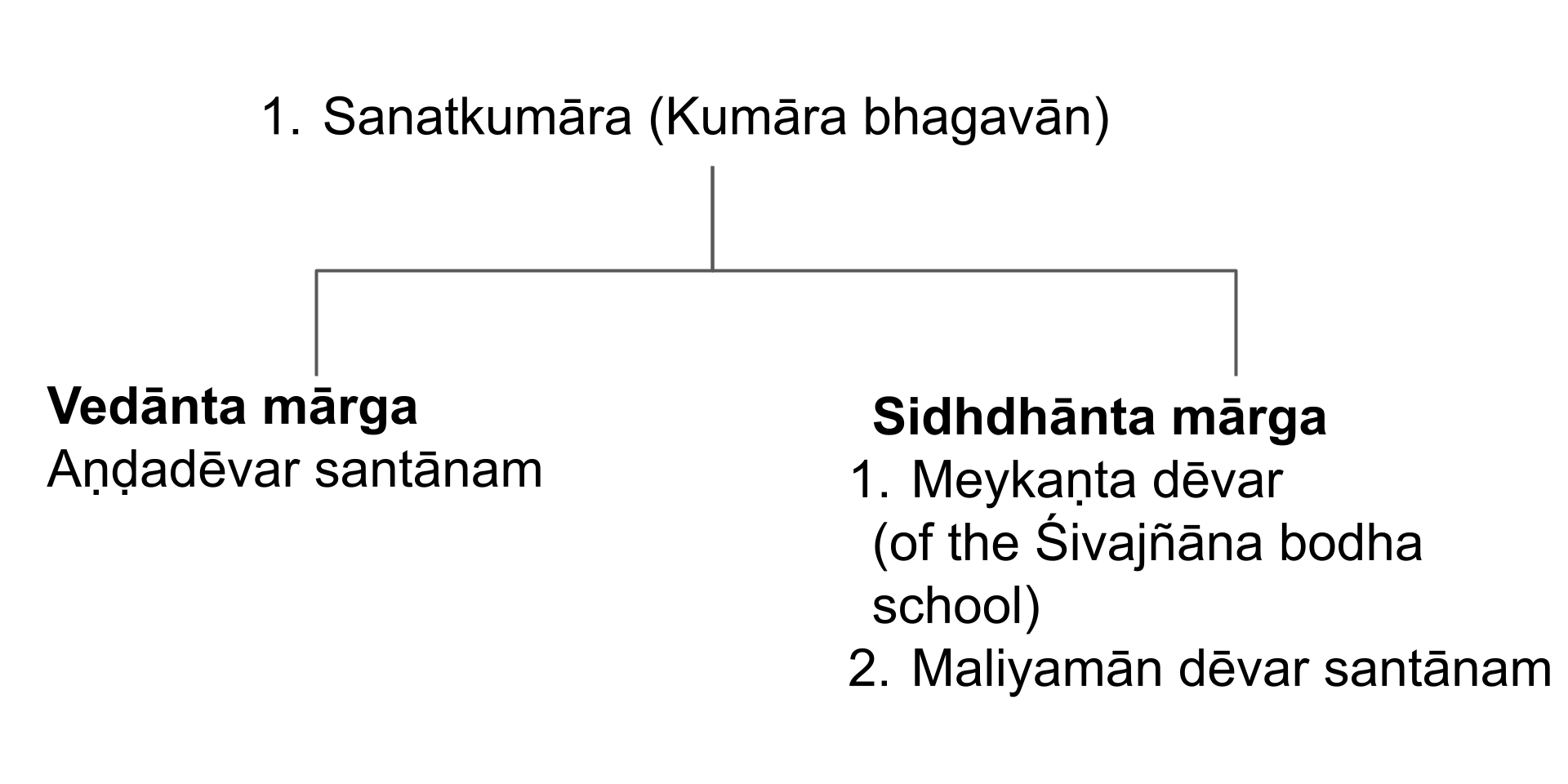
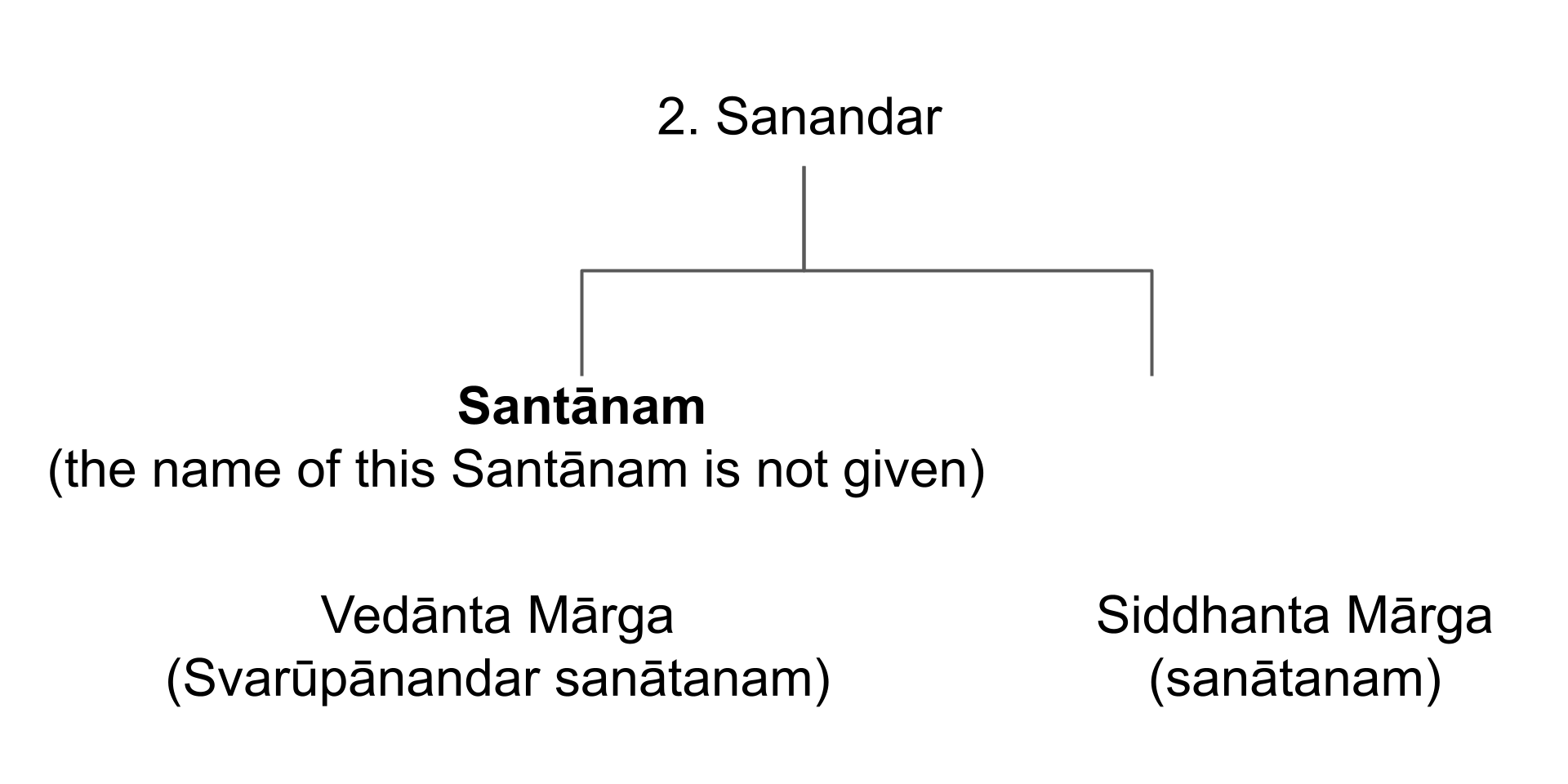
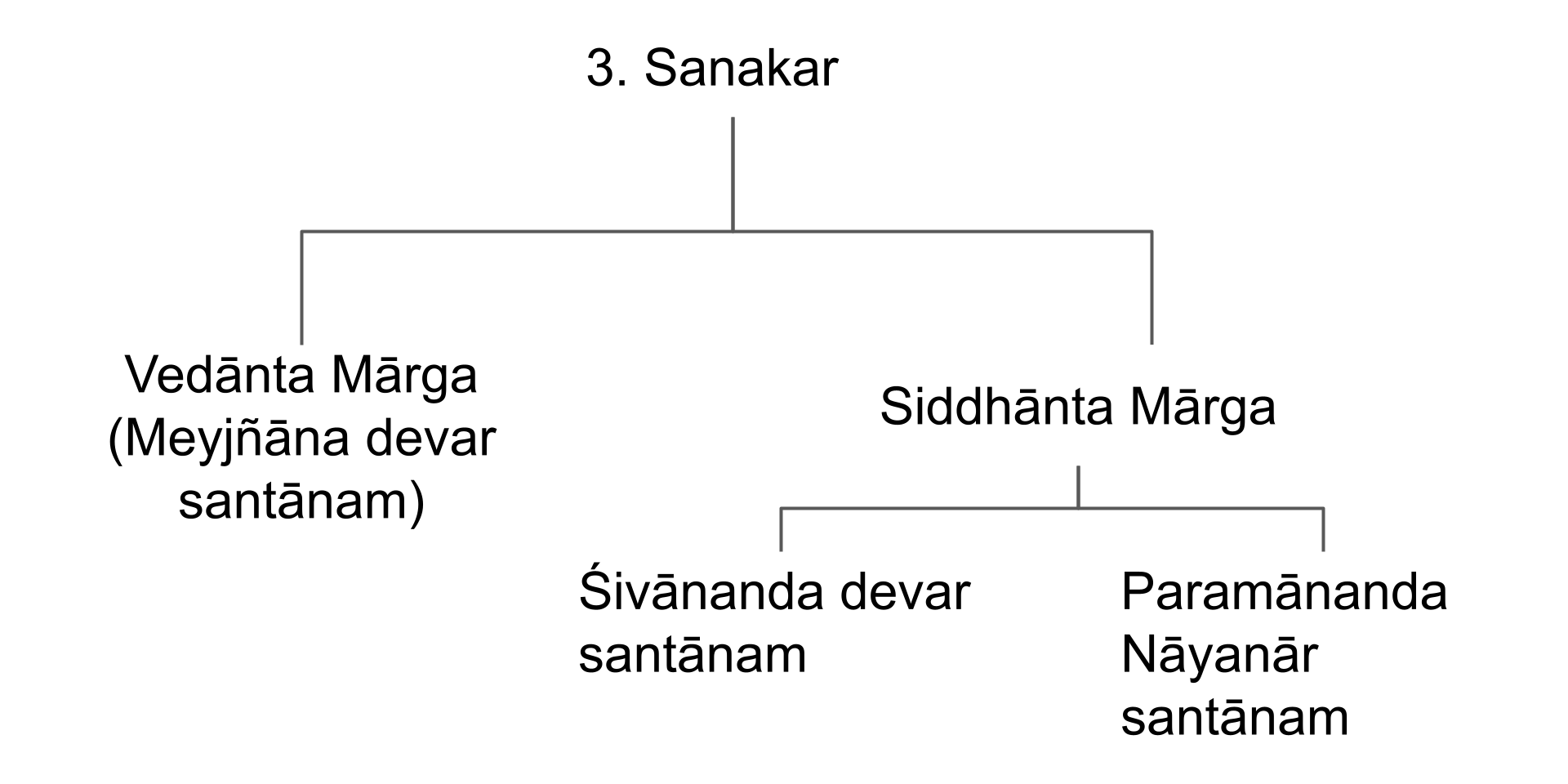
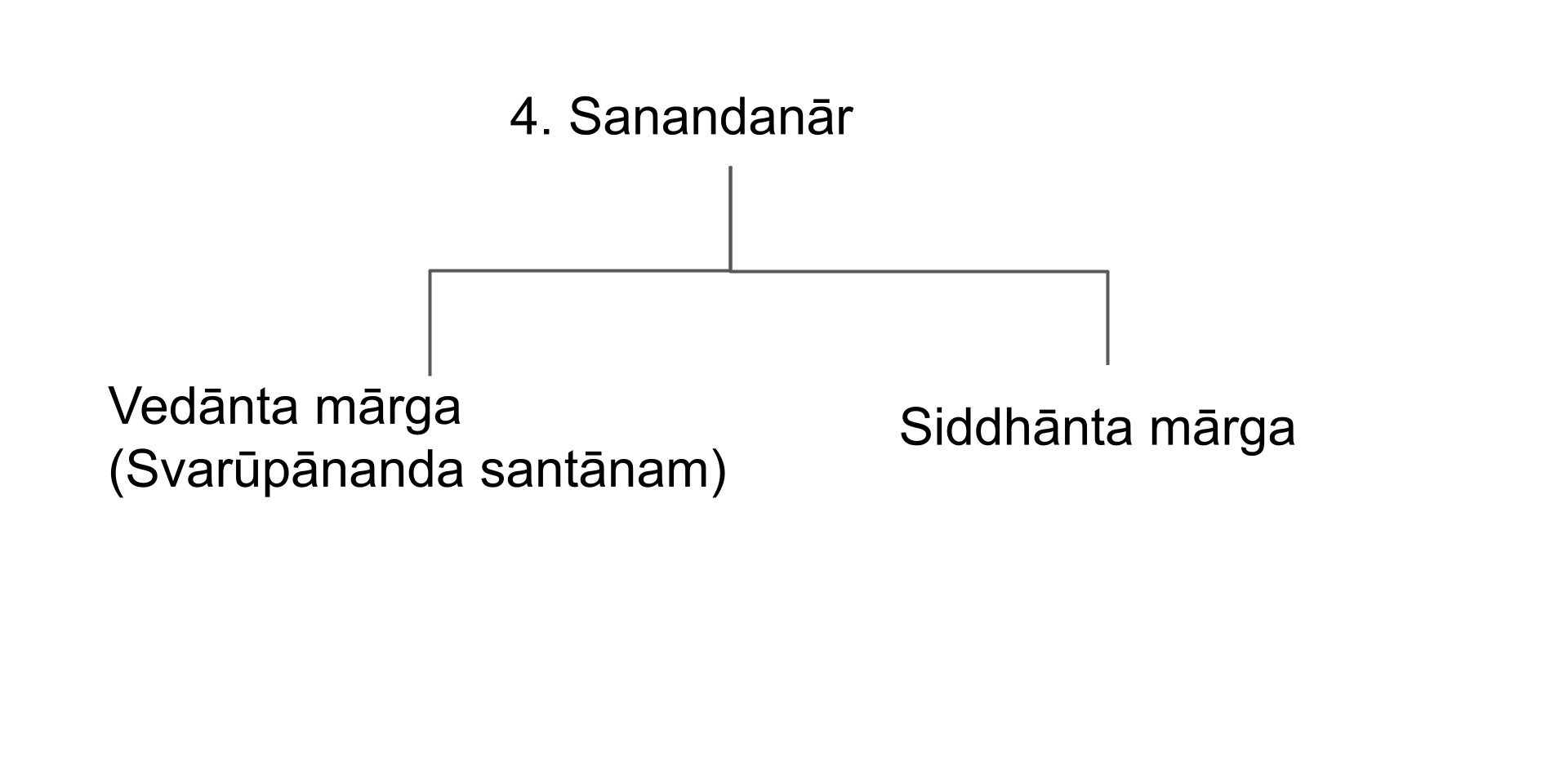
Nandi taught this Jñānamārga to four sages, who were also called Nandis, they were Sanatkumārar, Sanandar, Sanakar, Sanandanar.
This Jñāna school branched into two broad divisions - Vedānta Mārga and Siddhānta Mārga. Besides these four sages, four other sages also received this knowledge from Nandi. They were Patañjali, Vyāgrapādar, Śivayoga Māmuni and Thirumūlar. Vyāgrapādar was the giver of Jñānavarṇa school. (The other two were probably originators of Śuddha-śiva-yoga and Śuddha-śiva-jñāna schools). Thirumūlar had the following disciples: Mālāngan, Indran, Soman, Brahman, Rudran, Kanduru, Kālāngi and Kañca malaiyan.
Jñāna mārga
How the main school of Jñāna branched are detailed bellow:
Among those mentioned, Śiva-yoga-māmuni is probably identical with Upamanyu-mahāmuni who is mentioned as the teacher of the vaidika (Vedānta) pāśupata system in many texts. The Pāśupata system is known as Pāśupat-yoga. Thiru-mūlar in his own work Thirumantram, states (in verse 102 of Pāyiram) that eight maṭhas were established, including the one under his own name. The other seven were headed by 1) Kālangi (Kālāgni), 2) Aghora, 3) Thirumālikai devar, 4) Nādāntar, 5) Bhoga devar, 6) Paramānandar and 7) Nirāmaya devar. The works of Thirumālikai devar, Thiru-mūlar, and Nirāmaya devar have survived and are in Tamil language. It is not known whether the others wrote treatises in Tamil.
A total of eight belonging to Nandikeśvara school are thus known.
Besides Nandikeśvara, Vijñāna-devar also known as Rudra-devar was the originator of another branch that gave birth to the following branches.58
Thiru Mālikai Devar Santānam
Vālikanta Santānam
Vāmadevar Santānam
Uttamanathas Santānam
Karuvar devar Santānam
Idaikkāṭṭu devar Santānam
Thiruvaḷḷuva devar Santānam
Śivavākya devar Santānam
These eight and the eight of Nandikeśvarar santānam, making a total of 16 were called ancient Jñāna-santānams.
A few later sanātanams that came up are also listed. They are.
Thiruneri Santānam
Thirupperumturai Santānam
Thirumaḻapādi Santānam
Nirainta-devar Santānam
Singanath-devar Santānam
and so many others. These five were probably active during the 17th century.
It is seen that eight Santānam lineages are traced to Nandikeśvara. Of these, three Santānam that came through Sanatkumāra had at least two distinct branches as Vedānta school and Siddhānta school. Meykaṇṭa-dēvar belonged to the Siddhānta school. An interesting note says that Meykaṇṭa-dēvar of the Siddhānta school followed the Śiva-jñāna-bodha-mārga which suggests that there was a specific lineage before him that went by the name Śiva-jñāna-bodha-mārga. This is obviously identical with the Sanskrit Śiva-jñāna-bodham of Raurava-āgama and that explains why he translated it into Tamil.
From other sources it is learnt that Meykaṇṭar learnt Śiva-jñāna-bodham from Parañjoti munivar, who came in the lineage of Nandikeśvara through Satya-jñāna-darśi.
The other point of interest seen from this account of Veḷḷi-ambala-vāṇar is four out of the 16 Santānas that came out of Vijñāna-devar alias Bhoganātha - were well known to Tamils as great Siddhas. They are Karuvūr-devar, Iḍaik-kāḍar, Thiruvaḷḷuvar and Śiva-vākyar. From this we learn they were also Santāna ācāryas. It may be noted that Thiruvaḷḷuvar the great exponent of Thirukkuṟaḷ was recognized as a Saivite Nāyaṉār of the Santāna category.60 Among the other notables, Thirumālikai-devar sang a delightful Thiru-visaippā poem on Śiva included in an anthology of Śaiva canonical text. The other lineages mentioned are otherwise not so well known.
The Dakṣiṇa school is included as a branch of Vāma school. (vāma bhedam and dakṣiṇa matam)61 (P. 169). Veḷḷi-ambala-vāṇar cites an interesting passage from Cintyāgamam which divides Śuddha Śaiva school into three categories as (1) vāma-śaivam, (2) dakṣiṇa-śaivam and (3) siddhānta-śaivam. The school that follows the Mūlāvatāra tantras is called vāma-śaivam that which follows Svacchanda school is dakṣiṇa-śaivam and the one that follows Āgamas like Kāmika etc. is siddhānta-śaivam.
vāma dakṣiṇa siddhāntam tridhātaḥ śuddha śaivakammulavatāra tantram śāstram yad vāma śaivakamsvacchanādi śāstram dakṣiṇam śaivam ucyatekāmikādini tantrāni siddhāntam śaivam ucyate
Veḷḷi-ambala-vāṇar seems to suggest that there existed a Śaiva nigaṇḍu that was cited in Cintyāgama.62 The Āgama such as the Sarva-jñānottara were considered a branch of Śaiva Sāmkhya in the Jñāna-siddhi63 (P.171).
Veḷḷi-ambala-vāṇar has quoted the important part of Navaliṅga-līlai, a Tamil text of the Vīra-śaivas. The Kāmikāgama also refers to Gāruḍa Śaivam, Bhūta Tantra, Dakṣiṇa Śaivam, and Vāma Tantra64 (p.183). Veḷḷi-ambala-vāṇar says Kālāmukha school was also called by some as Sōma Śaivam65 (p.154).
The Vātulāgama according to Veḷḷi-ambala-vāṇar is called a Mahāvrata tantra66. Wearing a liṅga on the body is also mentioned in Kāmika that speaks of Śuddha Śaiva. The liṅga-dhārana is also prescribed to Mahāvratis and Pāśupatas. Even as the Śri-Parvata mountain (now in Andhra Pradesh) is important for Vīra-śaivas, Thiruvoṟṟiyur a part of Madras is very important to Mahāvratis.
The Tantrika Pāśupata system is divided into three branches as Candra-vāda, Sūrya-vāda, and Sama-vāda67 (P.189). The Vaidika Pāśupata system originally taught by Śiva to Devī, was propagated by saint Upamanyu (śrauta pāśupatam nāma śrutyanusārena śivāyai śivena proktaḥ upamanyu ādibhih pravartitah ity jñeyam).
Veḷḷi-ambala-vāṇar holds that Nīlakaṇṭa Sivācārya was a Vaidika Pāśupata. He also says that Candra-vādins are a branch of Pāśupata system, and Kāleśvara Vādins are a branch of Kāpāla-śaivas. He also says that Sōma-siddhānta is a branch of Kālāmukha-bheda. Veḷḷi-ambala-vāṇar says that these schools are no longer in practise.68 (p.219). Obviously, these schools of Pāśupatas and Kāpālikas went out of existence by 17th century.
Veḷḷi-ambala-vāṇar says Makuṭāgama is considered Dakṣiṇa-śaiva. The 25 Āgamas beginning from the Kāmika are divided into three as Dakṣiṇa, Vāma, and Miśra. Among them Makuṭa is brought under the Dakṣiṇa branch.
The Yoga-śaivam is called Saha-mārgam. The Yoga-jñāna-matam, Parayoga-matam, Niṣkala-yoga-matam, Paramukti-vāda-matam, and Śaiva Sāmkhya-Siddhānta-bhedam are all synonyms.
The Vaidika-vedānta has as its limb Jñāna sāṁkhya also known as Kapila sāṁkhyas, while the Yoga-sāṁkhya is known asPātañjala sāṁkhya. Similarly there are Śaiva-sāṁkhya a limb of Karmāvaraṇa-siddhānta and the jñāna-sāṁkhya and yoga-sāṁkhya as limbs of Jñānāvaraṇa-siddhānta.
Veḷḷi-ambala-vāṇar holds Śiva-Jñāna-bodha as a Jñānavaraṇa-siddhānta Āgama69(p.291) The Śiva-jñāna-bodha (obviously the Sanskrit one) is called Āgama and this fact points to its importance and its place in the Āgama literature.
Vira Śaivam
Veḷḷi-ambala-vāṇar, gives some important details about Dakṣiṇamata-siddhānta. He says that in modern times the Dakṣiṇa-śaiva school is now known as Vīra-śaivas.70 That the Vīra-śaivas are recognized as Dakṣiṇa-śaivas in the time of Veḷḷi-ambala-vāṇar in 17th century., who however does not cite any Sanskrit text, to outline the Vīra-śaiva school. On the other hand, he cites a Tamil work Nava-liṅga-līlai in which the Vīra-śaivas subsume the Dasāvasthā in their system (p.173). He cites as many as 92 Tamil verses from this text. An examination of the verses suggests the work is self contained and probably the text is complete. According to the editors of Jñānāvaraṇa-viḷakkam, this Tamil work is not found in other sources and is not available except in this form.
The first verse abruptly begins with the statement that “this text was originally taught by Śiva to Umādevī on Kailāsa, which was taught to Basaveśvara by Prabhudeva in Karnāta language which was translated in Tamil by me ”… name of the translator is not available.
The second verse says that this text was translated as expounded in the nava-liṅga-cakra, and is appropriately called nava-liṅga-līlai. The same Śiva manifests in nine forms by internal divisions for the removal of pāśa of the souls shrouded in ignorance. The text mentions the nava-tattvas (nine) as Para Śiva, Para Śakti, Nāda, Bindu, Sadāśiva with five faces, Maheśa, Rudra, Viṣṇu, and Brahmā.
The Ekamūrti (supreme) splits itself into three as guru, liṅgam and jaṅgama. Continuing to detail the tenets of the school, it mentions iṣṭha-liṅga, prāṅa-liṅga and bhava-liṅgas. These three branch into six as acāra-liṅga, guru-liṅga, śiva-liṅga, jaṅgama-liṅga, prāsāda-liṅga, and mahā-liṅga. These six further undergo division due to tattvas into 36 and further sub-divided into 21671. There are Śrotas; crossing these six Śrotas one attains Jñāna-samadhi which is called “reaching the cave of nirañjana” (nirañjānādi guhai ceṟdal).72
The Suddhākhya-tantra gives the following account of Vīra-śaivas. Vīra-śaivas is superior to all other Śaivam which is also called Vīra-maheśvaram. The worship of God including the process of worship is very easy and convenient.73Vīra-śaiva-tantra is divided into three categories as Samānya, Viśeṣa, and Nirāhāra.74 By touching the head with hand and wearing sacred ash, the adhrent’s body is considered Śiva-deha. He is absolved of all sins. He should wear the liṅga given by his guru either on his head, neck, hand forearm, heart, navel or in any one of these places. He should always be filled with devotion to Guru and liṅga and worship it once, twice or thrice a day. These are the common categories.
The Viśeṣa category consists of initiation by a guru, by invoking Śiva in a Kumbha and following the process of dīkṣa. In this process, consecration of prāṅa-liṅga is advocated.
The two categories of Nirāhāra consists of abandoning all worldly comforts and concentrating on Śiva in mind. He should wear a rag of cloth, a suffron cloth, jaṭā (matted locks of hair) or shaven head, and of trees, staff and Śaiva signs. He should eat food obtained through begging moderately and reject all comforts and this observance is called Nirāhāri. Such an adherent is himself considered Parama Śiva (Supreme Śiva). Vira Maheśvaras have some common code of conduct. They should devote themselves to the Śiva mudras, and devotees with mind and material. One should never commit sin towards them at any cost. He should not be indifferent to a sin if committed by another person but if he is a strong well built man, the wrong doer should be punished. If he is not strong enough, he should move away from that place. He should constantly unite his prāṇa with the liṅga from the moment he receives the liṅga from his guru. For him, every breath is liṅga.75 (p.243-245)
Ādi-śaivas follow the Aghōra-Śivācarya-paddhati76. Mahā-śaivas follow the Kāraṇāgama;77 In addition to performing ātmārtha and parārtha pūjās, Ūrdhva-śaivas perform and also perform Vedic sacrifices which are different from Ādi-śaivas and Mahā-śaivas. Among the habitations of Śivācāryas, Dakṣiṇāraṇya identical with Tillai-āraṇya is the abode of Ūrdhva-śaivas. The Makuṭāgama followed by Ūrdhva-śaivas, is a Dakṣiṇāgama78. They are Advaita-vādins.
The Śiva-jñāna-bodham is considered an Āgama of Jñānāvaraṇa siddhānta. The texts like Mokṣa-kārikā of Sadyojyoti, and Tattva-prakāśa of Bhojarājā are considered Advaita-vādam by teachers80. But Aghōra Śivāchārya treats them as dualistic systems. The Śiva-jñāna-bodham was taught through bhāvanā-dīkṣā which is mentioned in Rauravāgama. The Jñānānta-paribhāṣa cites Śiva-jñāna-bodha-sūtra.
śirasthāne padam āhṛtya praṇato daṇḍavat guruḥbhāvanā dīkṣayā cainam śuddham kṛtvā yathā vidhiśivajñāna bodha śāstram dadyāt patyādi antaramanugrāhyastu yaḥ śiṣyaḥ varimāna kāya karmabhiḥartha prāṇābhimānāni sadgurubhyo nivedayet81
Śiva-vākya and Paṭṭinattu-piḷḷai are naiṣṭikar. Maṟai-jñāna-paṇḍāram and Umāpati Śivācāryār had knowledge of Śaiva system but no experience of Śaiva knowledge Jñānānta-anubhavam82 (p.422). Thirumūla-devar is called Thirumūla-deva-śivācāryar and Meykaṇṭa-devar as Meykaṇṭa-deva-śivācāryār.83 - P. 423.
(Sanskrit) … P. 440
Tīvrabheda Śaktipāta was obtained in Saumya Śaiva, by Maheśvara, Devi, Vighneśvara, and Guha.84 - P. 351
The Āgamas Makuta, Devi-kālottara, Suprabheda, Sarva-jñānottara are dakṣiṇa-āgamas. The meaning expounded in them namely the advaita system does not contradict Vedānta.85 P. 351.
Bharadvāja, Mātāṅga and others who had mild Śakti-bheda were taught Mṛgendra and Mātaṅga which are Vāmāgamas. They teach dvaita system, that contradict what was taught in the Vedas and so they are considered pūrva-pakṣas.86 - p.351.
(sanskrit)
Veḷḷai-ambala-vāṇar discusses in a lengthy passage that the Sanskrit Śiva-jñana-bodham is the original text and that the Tamil Śiva-jñāna-bodham of Meykaṇṭār and the Tamil Śiva-jñāna-Siddhi follow the original Sanskrit text87. The original Sanskrit text is found in the chapter “śivajñāna-vimocana-paṭala” of Rauravāgama which is the Ādi sūtra88. The original Śiva-jñāna-bodha (in Sanskrit) was taught by Śiva.89 Veḷḷi-ambala-vāṇar is following the Jñānāvaraṇa-bhāṣya in Sanskrit as his tradition which he cites. The Sanskrit bhāṣya holds that Sanaka and others understood this Sūtra expounded by Śiva.
śiva vākhyena pratyāpāditatvāt pañca rūpa upapannāt liṅgāt, paraiḥ sanakādibhiḥ jagataḥ sakartṛkāryam jñāyate90
Again the same position is asserted that the original Śiva-jñāna-bodha was taught by Śiva.
atra śiva-jñāna-bodhe harasya prabhutva ukteḥ jagat kartṛtva anādi nirmala cidrūpakena sarvajñatvādi śaktimatvam api siddam91
Veḷḷi-ambala-vāṇar, says Śiva-jñāna-bodha continued an upāgama bheda called as Raudravottara suggesting that itself is an āgama.92
The Svaccandra Tantra text gives interesting data about Pāśupata (verse 70).93
It speaks of two schools of Pāśupata, Lākula and Mausala. In a commentary on this verse, Kṣemarājā says that one school was established by Lakulīśa, and the other established by Lakulīśa's disciple Musalendra. The difference between the two schools lies in the ultimate stage of salvation. Lakuleśa school hold the adherent of the school will reach the abode of Īśvara, Aiśvaram-padam in which the emphasis seems to have been on japa and dhyāna (repetition of god's name and meditation.)
But the Musala school seems to have emphasized rituals (kriyā pradhānā) and hold the follower will reach māyā-tattva considered the ultimate. The Svacchanta Tantra itself refers to this difference.
(sanskrit)
It evidently shows, very early in the Pāśupata school, may be in the time of Lakulīśa, or immediately after his passing away, there arose differences in Pāśupata system, headed by Musala. It is also seen that there were other schools that sprang up such as Kāruka, also mentioned in Svacchanda text. It seems that the Musala school held that the ultimate stage was Kṣemeśa, while Kāruka held it is brahmāśrami.
There were also other schools among Pāśupata such as Vaimala who follow the rituals. The text pañcārtha-pramāṇa-aṣṭaka hold that Dhruva is the ultimate stage. This school is identical with Kāpālavratins. Kāpālikas held that those who through knowledge obtained by initiation become pure, and observe Kāpālavrata till the end of their life, reach their salvation presented in their respective schools. Kṣemarājā says that Mausala and Kāruka emphasize only rituals, while Vaimalas emphasize Jñāna through dīkṣā. They wore kāpāla and bone ornaments as vrata and this seems to have been prescribed in kakutāmnāya. They also postulate tejesa as the ultimate while the Lakulīśa school - īśvara tattva pada prāpti; Mauśulaḥ - māyātattva pada prāpti and Vaimalas - īśvara tattva tejasa prāpti.94
Bhairavam also had two broad divisions namely (1) the Vāma Bhairava and (2) Dakṣina Suddha Bhairava. Veḷḷi-ambala-vāṇar cites extensively from Svacchanda Bhairava text. According to it, the Śiva-tattva is “śūnya” as it is the laya-śiva-adhiṣṭāna. Veḷḷi-ambala-vāṇar is of the opinion there are many common factors between Siddhānta Śaiva and also Svaccanda (Bhairava). There is a long discussion by Veḷḷi-ambala-vāṇar, on the tenets of Svacchanda, the prāsāda-vidhi-paṭala referring to it as Svacchanda-śiva-prapti. Svacchanda Bhairava is also called Sadāśiva Bhairava. The text holds, the follower of this school who mediates on Svacchanda Bhairava-deva, will attain liberation quickly. The follower will also attain both Siddhi and Mukti.95 (P.37). There are variations in this school in dīkṣas (dīkṣina-paṭala - initiation). The Bhairava Sadāśiva is identified with Rudramūrti, who remains in Sadāśiva form, and not other Rudra forms. Bhairava is also identified with Śruti-antanatha-rudramūrti. The texts cites verses giving the āvaraṇas of Bhairava.96 (P.44). There are eight Bhairavas in the second āvaraṇa whose names and places are also mentioned.
Kapālīśa - East
Sikhivāhanam - South east
Krodharājā - South
Vikarāla - South west
Manmatha - North West
Meghanādheśvara - West
Saumārājā - North
Vidyārājā - North East
Each of them has five faces, ten arms, kapāla-mālā, twinkling anklets etc. Bhairavi should be seated on the lap of Bhairava, and should have the same form as Bhairava with a slightly gasping mouth, and graceful smiling face.
भैरवं पूजयित्वा तु तस्योत्सङ्गे तु तां न्यसेत् ।यादृशं भैरवं रूपं भैरवीं तद्वदेव हि ॥ईषत्करालवदनां गम्भीरविपुलस्वराम् ।प्रसन्नास्यां सदा ध्यायेत् भैरवीं विस्मितेक्षणाम् ||
The text Jñāna-siddhi, published here speaks of the two broad divisions of the Bhairava system as Vāma and Dakṣiṇa Bhairava schools (p.46). This text also mentions Bhairava as having five faces. The Bhairava school holds the Pāsupata, and Rudra systems as Pūrva-pakṣa. An interesting point is that all schools hold that their supreme deity has five heads.
The work also deals with three kinds of dīkṣas in the Bhairava school. Different branches of the Bhairava-śaiva-siddhānta are:-
Lākulā
Vaidikī
Ādhyātmikī
Atimarga and
Mantra
All these schools were also considered as pūrva-pakṣa for in worship they advocate nara-māmsa etc. Rare texts named “Bhairava-siddhānta-siddhi” and “Siddhānta-rahasya”97 (p.49) are also mentioned. As the school concentrates on achievement of mystic powers (siddhis) its aim is not liberation. Vāma, Bhairava and the Kaula schools reach pisāca-pada. As in the case of Vāma and Bhairava systems, the Saumya Siddhānta is also a tantrānuṣṭāna-siddhi.
Śiva-jñāna-bodha is a sūtra text such as the (Brahmā) sūtras of Vyāsa. The Tamil works Śiva-jñāna-bodha and the Śiva-jñāna-siddhiyar follow the original Sanskrit text as the Source. (p.529) The authority attributed to the original source is equally applicable to its translation. Veḷḷi-ambala-vāṇar repeatedly mentions that the Sanskrit Śiva-jñāna-bodha is the original text.98 (pp.578, 579, 581, 583). He also holds Śiva-jñāna-siddhiyār also should be considered as uddesa sutra. He cites also from Jñānāvaraṇa-bhāṣya in Sanskrit. It important to trace this full text giving it the authority of the Sūtra literature.
Endnotes1. Jñānāvarṇa viḷakkam and Mahā Bhāṣyam. Veḷḷi-ambala-vāṇar, Dharmapuram Ādhīnam, Vol.I, 1957; and Vol.II, 1959.
2. The tenth year Sovenir of Śrila Śri Shanmukha Desika Paramacharya Svamikal, Dharmapuram, Ādhīnam, 1943, p.83.
3. Śiva-jñāna-siddhiyar in Śiva-Jñāna-bodham, Meykaṇṭa śastram, Dharmapuram Adhīnam, 1956.
4. Jñānāvaraṇa-vilakkamum Mābātiamum, of Veḷḷi-ambala-vāṇar, Dharmapuram, p.407, the following colophon is found.
dharmapura stihitē śrī jñānasambandha guru caraṇa nīṣaṇṇa sainskāra vilasad. akalamka muni bhagavadpāda hṛdaya sambaddha sadācāra upadeśa samprāpta. śivānanda rasānubhava jāta varṇāsramātita niṣṭa niṣṇāta satya jñāna iti prasiddha rajata-sabha-nātha yogi viracita. jñānā varaṇa dīpikā vyākhyāna asphaṣṭa-pada-bodhanīyē sanmārga vivēkaḥ5. Sarva-darśana-saṅgraha of Sayana Madhava Ed. Cowell E.B and Gough Parimal Publication, New Delhi, 1986. Also published by Asiatic Society of Bengal, Calcutta, 1986.
6. Jñāna-Siddhi cited in this text, Jñānāvaraṇa viḷakkam-mābāṭiyam.7. Alexis Sanderson, "History through Textual criticism" in the study of Śaivism, Pañcaratra and Buddhist yogini Tantras, Les Sourus des Temples, Ed. Francoise Grimmal, 1FP, Pondichery, 2001.
8. Kiraṇavṛt - Bhatta Ramakanta's commentary On Kirana Tantra, Ed. Dominic Goodall, IFP, Pondichery, 1998.
9. Arunachalan M, Guru Jñāsambandhar, Dharmapuram, 1981, pp.85-86.
10. lbid= p.86
11. Meykaṇṭa Śātram, Pub, Dharmapuram, Preface, P.V.
12. Jñānāvaraṇa viḷakkam - p.421. (This text will be referred to in its abridged form as jv.)
13. Meykaṇṭa Sāttiram, 1956
14. jv. p.581
இந்த சிவஞான போதம் முதல் நூல் வழியே தமிழ் சிவஞான போதமும் சிவஞான சித்தியாரும் நடத்தலின் அந்த வடமொழியான சிவஞான போதம் இரெளரவோத்தரம் என்னும் உபாகம பேதம் என்னும் பக்ஷத்தாலும் வியாச சூத்திரம் போல பிறிதொரு நூலாம் என்னும் பக்ஷத்தாலும் மூலசூத்ரம் வேண்டுதலின் மற்ற உத்தேச சூத்திரமும் தானே சித்தித்தலின் அம்முதல் நூல் போல வழிநூலுக்கும் உண்டாம் என்க. jv. p.579
15. Śiva-Jñāna-bhāṣyam of Śiva-jñāna-yogi, Śaiva Siddhānta mahasamajam, Chennai, 1936, p.73
l6. Meykaṇṭa Sattiram, 1956, p.15
17.Ibid, p.16
18. jv. p.297, p.333, and p.337
19. Surendranath Das Gupta, A History of Indian Philosophy, Five volumes, Motilal Banarsi dass, Delhi, 1975.
20. Ibid, vol.5, introp.XI
21. Śrī Mṛgendra Tantra-Vidyapada and Yoga-pada, with the commentary of Nārāyaṇakaṇṭa. Ed by Madhusudan Kaul Sastri, published by Meharchand Lakshman dass, New Delhi, 1982.
22. Svacchanda Tantra, with the commentory of Kṣemarājā, Five Volumes, Sampūrṇānand Sanskrit viśva vidyālaya, Vāraṇāsi, 1992.
23. Śrī Svacchanda Tantram - Pt.ll with the commentary of Kṣemarājā, Pub. by Sampūrṇānand Sanskrit University Vāranāsi, 1993, Paṭala 10, verses 676-681.
24. Suṣka tarkavalambinaḥ (10/1149);
25. Svacchanda Tantram, Paṭala ll, verse.74
26. Paramokṣa-nirāśā-kārikā in Aṣṭa-prakaṇa Ed. By Pandit Vraja vallabha Dwivedi, Sampurnanad Sanskrit University, Varanasi, 1988.
27. Makuṭāgama, Purva bhaga, Ed. S. Swaminatha Sivacharya, South Indian Arccakar Association, Chennai — 1977, Tantravatara Patala, Verses 16 - 22
28. Sarva-darśana-Saṅgraha, of Sayana Madhava ed Cowell E.B. and Gough A.E., New Delhi, 1986.
29. The Śaiva Paribhāṣa of Śivgra yogin. Text and Translation by S. Suryanaryana Sastri, Pub. University of Madras, 1982.
30. Kulārṇava Tantra, Ed. Sri John Woodroff, and M.P. Pandit, Motilal Banarsidass, Delhi, Reprint, 1984, p.35.
31. Ibid. pp.30-31; 32. jv p.144
33. Puranānūṟu, Ed. Svaminatha Iyer, U.V., Tyagaraja vilasam Publication, Chennai, 1962, Reprint, Verse-166.
34. Manimekhalai, Svaminatha Iyer, U.V., UVS Library, Chennai, 7th Reprint, 1998.
35. Manimekhalai, Murray S.Rajam Edition, Chennai, 1957, Chapter 27.
36. Jñānāmṛtam, of Vāgīsamuni with an ancient commentary (in Tamil), Ed. by Avvai S.Duraiswami Pillai, Annamalai University, Annamalainagar, 1987, 2nd Edition.
37. Śivajñāna siddhiyār in Meykaṇṭa Sāthram, Dharmapuram, 1956.
38. Saṅkalpa nirākaraṇam, of Umāpati Śivam, in Meykaṇṭa, Dharma Puram, 1956. p. 316
ஏழஞ்சு இருநூறு எடுத்த ஆயிரம்வாழுநற் சகளம் மருவா நிற்ப39. jv. p.638, 867, 1051, 1106 etc.,
40. Jñānasiddhi, cited in Jv. p. 46,
41. jv. p.193; 42. jv. p.329; 43. jv. p.219 44. jv. p.219
45. Notes on Religion and philosophy of Gopinath Kaviraj, Ed. Gaurinath Sastri, Sampūrṇanand Sanskrit University; Vāranāsi, 1987 - P.56-62).
46. Ibid p.61; 47. jv. p.48; 48. jv. p.48; 49. jv. p.67;
50. jv. p.67; 51. jv. p.75; 52. jv. p.76; 53. jv. p.99;
54. jv. p.101; 55. jv. p.114; 56. jv. p.114; 57. jv. p.116;
58. jv. p.167; 59. jv. p.167; 60. jv. p.169; 61. jv. p.169;
62. jv. p.171; 63. jv. p.173; 64. jv. p.183; 65. jv. p.184;
66. jv. p.189; 67. jv. p.189; 68. jv. p.219; 69. jv. p.329;
70. jv. p.173; 71. jv. p.181; 72. jv. p.181; 73. jv. p.189, p.244
74. jv. p.244 the text pertaining to this school is called Vīra maheśvara - Tantra.
75. jv. pp.243-245; 76. jv. p.247; 77. jv. p.247; 78. jv. p.245
79. jv. p.291; 80. jv. pp.311-329;
81. Raurava cited in jv. 421;
82. jv. p.422; 83. jv. p.423; 84. jv. p.351;
85. jv. p.351; 86. jv. p.351; 87. jv. pp.578-579
88. jv. p.581; 89. jv. p.583; 90. jv. p.583; 91. jv. p.585; 92. jv. p.579;
93. Svacchanda, vol. 5, Patala II, verse,.70
94. Ibid, paṭala X, 675-680 also, 1084 where in Kapālīśvara is called Bhūteśvara95. Svacchanda, cited in Jv. pp. 37-45
96. Ibid p.44; 97. Ibid p.49;
98. jv. pp.578, 579, 581, 583 etc., On page 583 he makes a specific mention that the Sanskrit Śivajñāna bodhan is the original text or root text as
முதல் நூலான சிவஞான போத சூத்திரம்
and gives the first Sanskrit sutra as
strīpum napumsakādivāt jagatah kārya darśanāt asti kartā sa hṛtvaiva sṛjatyasmān prabhur haraḥ