Preface
Karūr in Trichy district of Tamil Nadu has been yielding in recent times an astonishing number of antiquities especially coins and inscribed objects both in quantity and variety from the Amarāvatī river bed. The learned Tamil Scholar Francois Gros of the École Française d’Extrême-Orient, Pondicherry, suggested that I study all the recent Karūr finds and assess their archaeological significance and the role of Karūr in the history of Tamil civilization. This book is in response to that suggestion. I am thankful to Dr. Gros for his keen interest in the subject and also valuable suggestions when the work was under preparation.
As the work progressed, it was becoming increasingly clear that Roman presence in Tamil Nadu either directly or through their Egyptian-Greek subjects, had left a far deeper impact on the economy, defence, arts and architecture than hitherto visualised.
The Tamil literature makes it abundantly clear that the Tamils admired the work and products of the Romans for their quality and in a number of cases started imitating them.
The issue of portrait coins with the legend and head of the local rulers is a clear pointer in this direction. The portrayal of men and animals on the local coins suggests a Roman hand, as they are praised for their artistic skill. The second point that emerges from this study is that Karūr in Trichy district was undoubtedly the capital of the Cēras of the Saṅgam age. The third and perhaps the most crucial point that stands out is the date of Saṅgam classics. As some of the coins bear the names of the Cēra rulers mentioned in the Saṅgam classics, these classics can be placed only after the establishment of Roman trade on an impressive scale. It seems to me that the time has come to enlarge the field of enquiry into other areas and assess the impact of the Romans. One thing seems to be clear: beginning from the royalty and the rich merchants, the quality of life of the people seems to have been enriched by this contact.Karūr, Veḷḷalūr and Tirukkōyilūr finds of Roman gold coins and jewellery are of great significance to this study. I have categorised and illustrated a number of coins from Karūr and tried to indicate the changing technological trends in minting coins.
I have taken this opportunity to outline briefly the history of Karūr through the centuries from different sources.
Śrī Iravatham Mahadevan has been my close friend and a source of inspiration to me in the field of Tamiḻ-Brāhmī studies. When the outstanding gold signet ring from Karūr was found, Mahadevan gave the photograph to me and encouraged me to write on its significance, instead of himself writing on it. It always reminds me of the Saṅgam chieftain Atiyamāṉ who gifted the immortal fruit he obtained to the poetess Avvaiyār, instead of himself benefiting from it. I express my profound thanks to Śrī Mahadevan for readily agreeing to my request and giving the foreword which reflects the historic association we had with the subject.
It is a pleasure and privilege to be intimately associated with Thiru R. Krishnamurthi of Dinamalar, whose keen interest in the field of numismatics has brought to light several new finds. In fact his discoveries of the Cēra coins Mākkōtai and Kuṭṭuvaṉ Kōtai and Peruvaḻuti Pāṇḍya coin are landmarks in South Indian numismatics. I am beholden to him for kindly permitting me to study some of his coins and also use some of the illustrations in this book.
Poḷḷācci Vaḷḷal Dr. N. Mahalingam who has enriched Tamil literature, music and dance by his liberal patronage is a keen scholar in the field of ancient history and civilizations. I am ever thankful to him for his kind encouragement.
Dr. F. Grimal, the Director, École Française d’Extrême-Orient, Pondicherry, evinced deep interest in this study and it is my duty to thank him for the same.
My thanks are also due to Thiru V. K. Rajamani, Madras, Thiru Raman, I.A.S., and Alakkudi Seetharaman who have permitted me to use some of their photographs in this book.
Four happy coincidences bring Karūr studies closer to my heart. 1) I was the first to read the Satyaputra Atiyamāṉ Neḍumāṉ Añci inscription of Jambai which was first discovered by my student Thiru Selvaraj. 2) I had the privilege of undertaking the first archaeological excavation at Karūr as the then Director of Archaeology of Tamil Nadu State.
3) I brought to light for the first time the inscribed Cēra coin Kollippuṟai and 4) The first Roman coin (of Valentinian) was unearthed at Aḻagankuḷam in a stratified layer in the archaeological excavation conducted under my direction, which is of immense archaeological value for chronology. I present my studies as a participant in Karūr history.R. Nagaswamy
ForewordIravatham Mahadevan
When Dr. Nagaswamy asked me to write a foreword to his valuable study on the archaeology and history of Karūr, the ancient Cēra capital, I readily agreed as it gives me an opportunity to reminisce about our shared experiences in the discovery and interpretation of the inscriptions of the Saṅgam Age. The foreword is intentionally anecdotal, revealing the human side of archaeology not normally seen in the dry-as-dust academic papers.
IMy emotional involvement with Karūr began on the cool sunny afternoon of 1st February 1965, when I first climbed the Āṟnāṭṭār hill at Pukaḻūr, very near Karūr, to have a close look at the Tamiḻ-Brāhmī inscriptions discovered there much earlier, but left unread as they were said to be ‘mostly damaged’ and ‘as the rock was very much weather-beaten’.
In the mellow light of the setting sun, the long four-line inscription engraved on the southern rock-face stood out; and it was not too difficult to make out the bold characters even though they had worn paper-thin over the centuries.
As I began spelling out aloud the names Kō Ātaṉ Cellirumpoṟai, Kaḍuṅkō and (I)lango, I realised with utter astonishment that I was indeed looking at a Cēra inscription of the Saṅgam Age. When I published it shortly thereafter (The Hindu, 7 March 1965), I wrote, perhaps a trifle too lyrically: “The Tamil kings of the Saṅgam Age have at last come into the limelight of history and archaeology from the twilight of fables and ballads”. You will read in this volume Dr.Nagaswamy’s analysis of the implications of this discovery for the chronology of the Saṅgam Age in general, and the history of Karūr in particular.
II
Dr. Nagaswamy had a very similar experience years later when he was looking at the Jambai record of Atiyamāṉ Neḍumāṉ Añci, one of the most celebrated heroes of the Saṅgam Age, and a contemporary of the Irumpoṟai rulers of the Pukaḻūr inscriptions. I can even now recall vividly his excited voice over the telephone one early morning in October 1981 informing me about the telegram received from Selvaraj, his student, announcing the discovery of a Tamiḻ-Brāhmī inscription at Jambai near Tirukkōyilūr in South Arcot District. As Dr. Nagaswamy was rushing to the site I wished him godspeed and remarked jocularly that he might have stumbled on an Aśōkan Rock Edict. As it turned out I was not too far off the mark. Dr. Nagaswamy did discover the title Satiyaputō at Jambai known earlier from the second Rock Edict of Aśōka. This finding clinched once and for all the identification of Satiyaputa with the Adiyamāṉs of the Tamil Country.
There can hardly be any doubt that the Jambai record of Atiyamāṉ Neḍumāṉ Añci read by Dr. Nagaswamy is one of the most important epigraphical discoveries in Tamilnadu and ranks with those of the Cēra inscriptions at Pukaḻūr and Neḍuñceḻiyaṉ’s inscriptions at Māṅguḷam, all belonging to the Saṅgam Age. I was then working in the Indian Express. I invited Nagaswamy to contribute two articles explaining the significance of the discovery, one in English to be published in all the editions of the Indian Express (Indian Express, Sunday Magazine, 7 October 1981) and the other in Tamil (Dinamani 12 Oct, 1981). One would have thought that such a major discovery would have been hailed by epigraphists. That is not what happened.
A whispering campaign through footnotes citing footnotes was set afoot casting doubts on the ‘authenticity’ of the Jambai inscription. How could a Sanskrit expression like Satiyaputō occur in a Tamiḻ-Brāhmī record? And why is the dental n used instead of the correct alveolar n in the inscription?
Neither objection can stand scrutiny. Apart from the well-known occurrences of numerous Prakrit loan-words in the Tamiḻ-Brāhmī cave inscriptions discovered earlier (and published by me in the corpus of the Tamiḻ-Brāhmī Inscriptions in 1966 in a volume edited by Dr. Nagaswamy), we now have the Prakrit grammatical form Utayaṉa-sa occurring in the newly-discovered Mēṭṭuppaṭṭi inscription and a similar expression Peruvaḻuti-sa occurring in one of the bi-lingual coin legends on an early Pāṇḍyaṉ coin. As regards the second objection, Tamil epigraphists know only too well that the use of the dental for the alveolar n is one of the commonest errors in Tamil inscriptions. The examples are too numerous to need citation.
I became so concerned with these unfair criticisms that I decided to visit the site once again for more detailed investigations. With the co-operation of the District Collector of South Arcot, I convened a meeting at Jambai on 14th December 1991, attended by the Tahsildar, the village revenue officials and some prominent citizens. The Tamilnadu State Department of Archaeology was represented by Thiru Kulandaivelan. (Dr.M.D.Sampath of the ASI, Epigraphy Branch, was to have attended, but got held up in Delhi).
At this meeting, Appavu, the retired Talaiyāri of the village stated that he took Selvaraj to see the inscription in 1981. Appavu had known the inscription since his boyhood as he used to take rest in the cavern when grazing his cattle nearby. Two other villagers also corroborated the testimony and stated that they had also often visited the cavern with the inscription. All the three volunteered to make sworn affidavits duly attested by the Revenue Officials.
And then the clinching evidence turned up. A Senior PWD Engineer who was present on the occasion, made arrangements to remove the top-soil from the two caverns situated opposite to each other. The cavern opposite the one with the inscription was found to have two rock-beds, a large broad one near the entrance and a smaller one in the middle of the cavern. The existence of the rock beds proves Jaina association with the Jambai caverns. This discovery, I note, has given the final quietus to an avoidable controversy.
III
When I was serving as the Editor, Dinamani, Dr. Nagaswamy walked into my room one day in November 1987 with obvious excitement bringing with him the first known Cēra coin with an inscription. The coin-legend reads Kol-i-p-puṟai in characters similar to those found in the Cēra inscriptions at Pukaḻūr. I was very happy with the discovery as it confirmed my earlier readings of the Cēra names at Pukaḻūr. (where both the forms Poṟai and Puṟai are found). Dr. Nagaswamy’s article describing the coin was immediately published (Dinamani, 15th November 1987). More recently some more inscribed coins of the Cēras of the Saṅgam Age have been found at Karūr and published by R. Krishnamurthy and A. Seetharaman. These finds are described by Dr. Nagaswamy in detail in this volume with critical assessments of their paleography and chronology.
IV
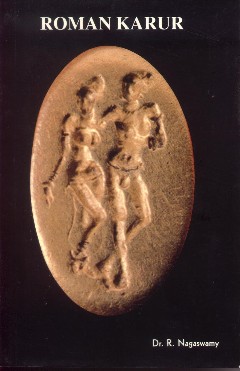
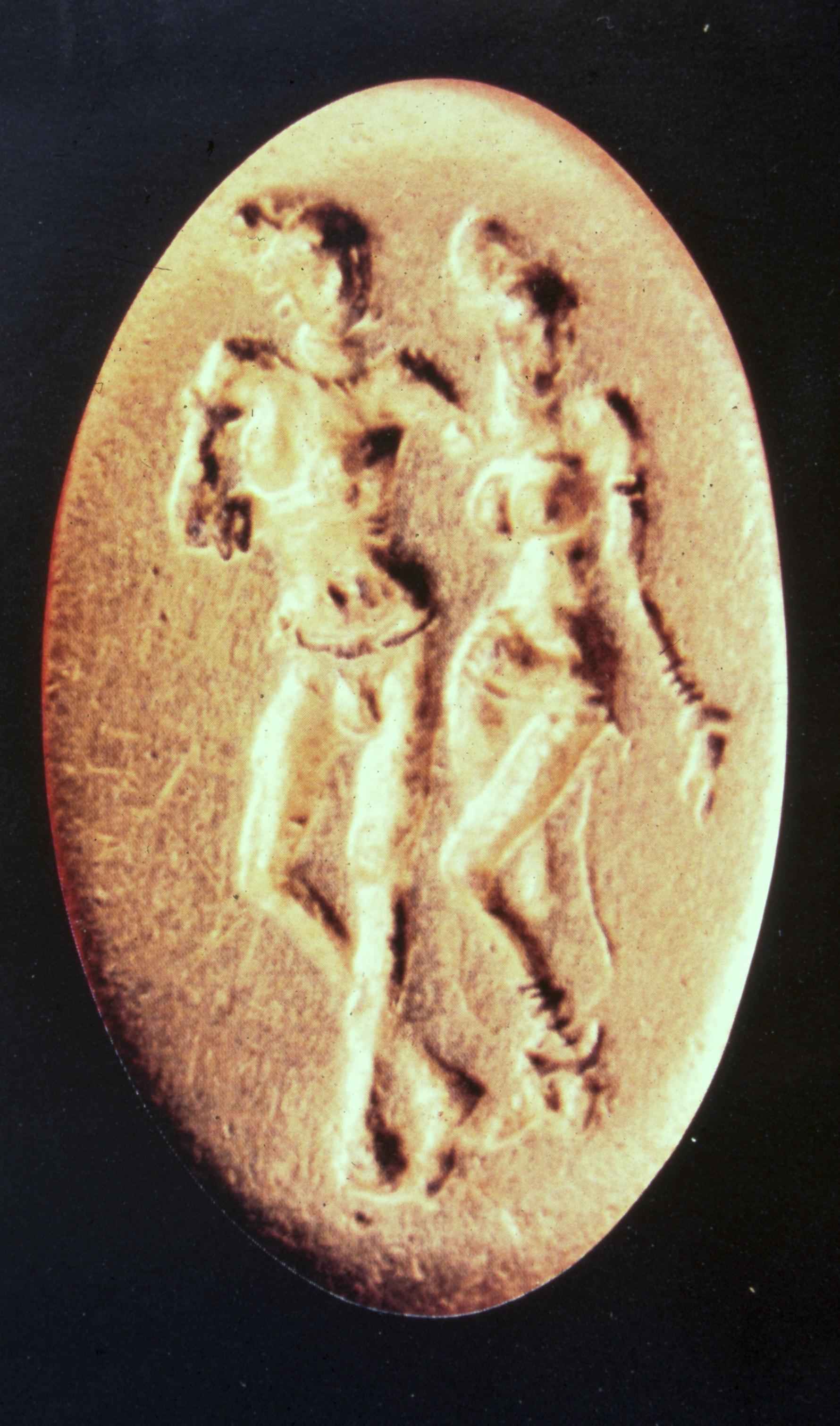
At the South Indian Numismatic Conference held at Tañjāvūr in January 1991, a coin-dealer from Karūr exhibited a unique golden signet ring featuring a mithuna couple of extraordinary grace and beauty. One could see in this truly remarkable work of art the influence of the Graeco-Roman lapidary on the portrayal which is still essentially South Indian in its ethos and idiom. As far as I know, this is the only known example of the ‘royal art’ of the Saṅgam Age (as distinguished from the ‘folk art’). I arranged to have the ring photographed and wax impressions taken and invited Dr. Nagaswamy to publish the find (Dinamani 16, March 1991; Indian Express 17, March 1991).
By this time it was becoming known in the scholarly circles in Tamilnadu that the market was getting ‘flooded’ with coins, seals and rings picked up from the ‘dry’ river bed of Amarāvatī at Karūr. I had seen many of them, and quite a few were published in the dailies. I decided to investigate the phenomenon and visited Karūr on 16 February 1991, accompanied by Dr. Chitra Viji, the well-known art historian.
We arrived there quite early in the morning; but even earlier Dinamani had hit the newsstands carrying the article by Dr. Nagaswamy illustrated by a magnificent enlarged colour reproduction of the Mithuna couple on the ring. The effect on the local bullion and coin dealers was sensational. The Mithuna ring which we had particularly wanted to see and, if possible, acquire, disappeared underground and the coin dealer was nowhere to be found. It is sad to contemplate that due to avarice a truly precious work of art of the Saṅgam Age has been lost to Tamilnadu. You can read in this volume Dr.Nagaswamy’s evocative description of this find.
The day at Karūr was not wholly wasted. As we strolled along the Jawahar Bazaar, the main marketing centre of Karūr, we could see in the glass cases of a few saraf shops, literally hundreds of coins of the Early period belonging to the Cēras, Cōḻas and Pāṇḍyas; many Roman coins in gold, silver and copper; and later coinage by the Pallavas etc. We were told all of them had been picked up from the river bed.
We then walked along the dry bed of the Amarāvatī river. We could see several small groups of tribals digging shallow pits and panning for coins and gold pieces. On an impulse I asked one of them to dig at a point chosen by me at random. A shallow circular pit was dug to a depth of about one metre where water level was reached. Out of this pit came in the next few minutes a square copper coin of the Cēras with the elephant and bow and arrow symbols, a copper Roman coin and a gold ring made of wire!
V
As Dr. Nagaswamy has pointed out in this volume, there is now overwhelming evidence from coins, inscriptions, seals, rings etc. that Karūr was without doubt the ancient capital of the Cēras during the Saṅgam Age. Dr. Nagaswamy has traced the history of Karūr from the earliest times to the modern period, utilising the data from his own archaeological excavations and on the basis of epigraphic, numismatic and literary evidence. The story told by him is all the more fascinating as the narrator himself has played a leading part in unravelling the lost glory of Karūr.
VI
I do not propose to deal with the contents of the volume in further detail as my purpose is to introduce the book. All the same I would permit myself one comment. I do not accept Dr. Nagaswamy’s contention that the Tamiḻ-Brāhmī inscriptions are not earlier than 1-2 centuries A.D. The paleography of the script, near-identical with that of Aśōkan edicts, and the recent stratigraphic evidence of the inscribed sherds especially from the recent excavations at Arikamēḍu and Koḍumaṇal indicate that Brāhmī reached the Tamil country in the Late Megalithic - Early Historical Period and was adapted to the Tamil language shortly thereafter, sometime towards the end of the third century B.C. or the commencement of the second century B.C. I am content to let the evidence speak for itself.
Dr. Nagaswamy is a rare combination of Sanskritist and Tamil scholar, archaeologist and historian, with an enviable skill for communicating his enthusiasm and knowledge to others. One more book from his pen is most welcome.
Iravatham Mahadevan, Madras, 20th December 1994
Introduction
Karūr now in Trichy district of Tamil Nadu, is a town of great significance for the history and culture of the Tamils. It has played an important role in the Tamil region for over two thousand years. For the past one hundred years it has been turning out important artifacts and historical relics that have invited the attention of scholars all over the world.
Karūr’s emergence as a centre of archaeological interest could be dated back to 1806, when several Roman coins were accidentally dug up as treasure trove. Considerable quantity of these coins disappeared immediately, but the ones that came to the Museum, pointed out that maritime trade of South India with Rome was considerable and deserved attention. This was followed by two more Roman hoards found at Karūr, and also a number of treasures of Roman coins and jewels found around Karūr. Immediately Karūr re-emerged on the international map after nearly two thousand years in an altogether new context.
This led modern researchers to enquire into one aspect of Tamil Civilization, namely the capital of the ancient Cēra Kingdom. The early Tamil literature refers to Karūr as the capital of the Cēra rulers. But they also refer to it as Vañci. The early mediaeval commentators mention Vañci as the other name of Karūr.
From around 7th century or even earlier, the Cēras are seen ruling from the West Coast, of what is now called Kerala (Travancore - Cochin region). Late mediaeval literature locates Vañci, in the west coast. Recent memory is thus strongly attached to the west coast - the modern Kerala.
The opinion among modern research scholars vacillated from Karūr in Trichy district to Tiruvañcikkaḷam on the west coast. Two scholars, namely Prof. Kṛṣṇaswāmi Iyengār and K.G. Śēṣa Iyer, almost vehemently argued in favour of Tiruvañcikkaḷam and throughout their work they argue from a committed notion. As against their view, Pandit R. Rāghava Iyengār, marshalled all available Tamil literary references, and presented in a disciplined, consistent, and cogent manner that Karūr was the capital of the Cēras of the Saṅgam age. R. Rāghava Iyengār’s work was a brilliant exposition.
Prof. K. A. Nīlakaṇṭha Śāstrī, the great historian accepted the view of Rāghava Iyengār and located the Saṅgam age Cēras at Karūr.
And yet most of the Tamil scholars and scholars of Kerala were emotionally in favour of locating Cēras only in the west coast.
Then came the brilliant reading of the Pukaḻūr inscription by Śrī Iravatam Mahadevan, who showed three generations of Saṅgam-age Cēras mentioned in the record near Karūr. In fact Mahadevan pointed out that the name Karūr mentioned in the record is within ten kilometers from Pukaḻūr and he held that the ancient Cēra capital was Karūr.
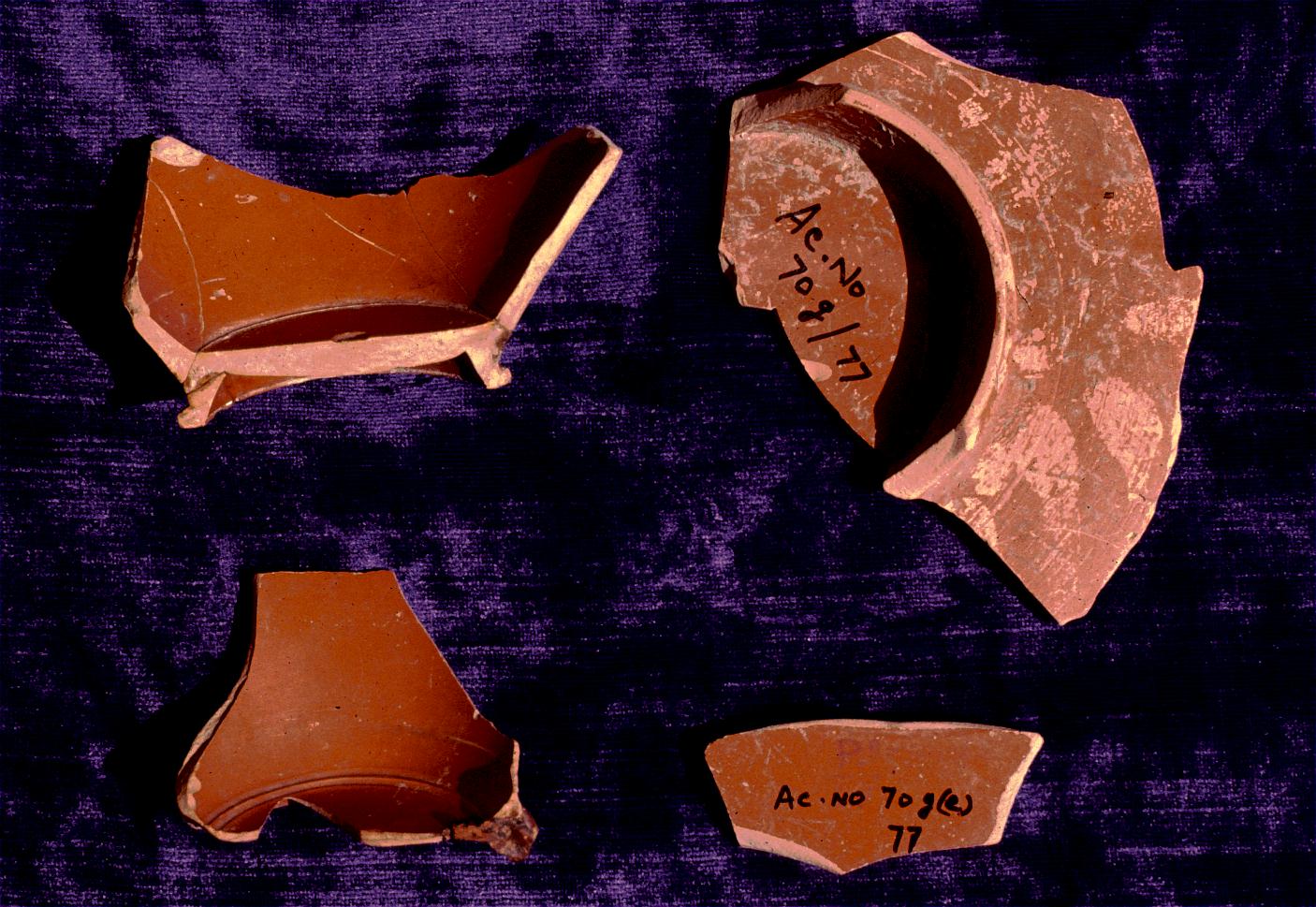
In the year 1974 I conducted an archaeological excavation at Karūr, which yielded Roman potsherds besides other important antiquities. I also wrote in 1974 on the identification of Karūr on the basis of archaeological, numismatic, epigraphical and literary sources.
The most historic find was the Cēra coin inscribed, Kollirumpuṟai, found at Karūr and identified and published by me for the first time. It is the most important turning point in the history of Karūr studies.
Subsequently, two more inscribed coins—one of Mākkōtai and the other of Kuṭṭuvaṉ Kōtai—have been reported by R.Krishnamurthi of Dinamalar.
But this was not the end. One of the most outstanding golden rings found at the Amarāvatī bed at Karūr, was brought to my notice by Śrī Iravatam Mahadevan, who was kind enough to request me to publish it. My publication of the ring has almost sensationalised Karūr studies.
Recently several other antiquities including late Roman coins have come to light from Karūr. This is sufficient enough to re-evaluate the importance of Karūr, the Cēra kingdom, the date of Saṅgam classics and ancient Tamil civilization, which is attempted in this work. These evidences have now clinched the issue of ancient Cēra civilization once and for all.
The Tamil literature and also Sanskrit works, written in Tamil Nadu refer to Yavaṉas, their life and work in Tamil land. They were overseas westerners who came in ships, bringing gold, wine, and horses and exchanged them for precious gems, crystals and pepper. They also settled in separate colonies called Yavaṉappāḍi, Yavaṉar irukkai, or Yavaṉaccēri in the capitals and port towns of the Tamil kings.
They had dreadful weapons and were fierce fighters and were employed as guards to protect the gates of the royal forts. They spoke in violent tongue and were often quarrelsome. Roman wine was in demand in Tamil Nadu and the Tamil kings were fond of drinking daily Roman wine poured by beautiful women. Roman lamps used in several places were also liked by the people. The Yavaṉas were great and skilful architects designing and constructing attractive structures like pavilions. Some of the royal palaces of the Tamil kings were designed and built by them. They were called Yavaṉat taccar i.e. Roman sculptor-architects. They constructed impressive chariots and decorated them with gold and precious gems. They worked in Tamil Nadu by the side of other skilful artisans who were known for their excellence and came from different well known centres of India. The sculptures modelled by the Yavaṉas were known for their beauty and workmanship. Above all, Roman jewel boxes made of gold and crystals were the treasured possessions of the Indian princesses and were used for storing jewels, gems, diamonds etc.
Thus in the field of architecture, sculpture, manufacture of vehicles, working in gems and gold, in weapons and warfare, and in wine, the Romans excelled the locals. The above points culled from literature need not be considered poetic conventions or exaggerations but reflected the very presence of the Romans, and their avocations in Tamil Nadu are astonishingly proved by archaeological finds.
Roman skill and thoughts influenced the Tamils who did not hesitate to benefit by these incoming ideas and techniques. The best illustration being the local coins modelled after Roman coins, incidentally pointing to the influence of Roman economic management of the Tamil country in the early centuries of the Christian era. Roman impact on Tamil life was far closer than hitherto appreciated.
The later history and the literary and religious development centered around Karūr are equally fascinating.
A vast body of literature and epigraphical sources are available, almost through the centuries, throwing light on Karūr.
It is seen that the Cēras were ruling with Karūr as their capital, the country extending up to the west coast through the Palghat gap and were originally ruling the northern part of present day Kerala, up to 7th century A.D. Their activities in the south in Travancore region are not seen perceptibly. By the turn of 7th century they seem to have established themselves in the south of Kerala as well, which reached as far as Travancore. This is evidenced by the Tamil work Pāṇḍikkōvai - an early 7th cent. work. The Cēra hold on Karūr was weakening.
The Divyaprabandham of the Vaiṣṇavite saint Tirumaṅgai Āḻvār, (in the 8th cent.), the hero stones found at Karūr (9th cent.), Āditya Cōḻa’s activities in the Koṅgu country in the 9th cent., Karuvūr Dēvar’s Tiruvisaippā in the 11th cent., Sēkkiḻār’s Periyapurāṇam in the 12th cent. and the royal grants of Kulōttuṅga Cōḻa III in the 13th cent. are the important sources that give us the history of Karūr in the heyday of Tamil rulers.
Subsequent history of Karūr, is seen from the Tiruppugaḻ of Aruṇagirināthar - 14th cent., Koṅgumaṇḍala Śatakam (16th- 17th cent.), and Karuvūr Purāṇam of the 17th century.
In the 18th cent. it played an important and strategic role in the Carnatic wars. Around 1800, after the fall of Tippu Sultan of Mysore, it was taken over by the British. Some information is forthcoming also from Pāḷaiyappaṭṭu Vaṃśāvaḷi, collected by Col. Mackenzie. In the latter half of the 19th cent. Karūr was in the Coimbatore district, the ancient Koṅgu country, but in the year 1910, the British added it to the Trichy district.This book is essentially the history of Karūr, with special reference to its early history when it was under the Cēras. It is studied in this volume under two parts. Part I details the recent numismatic, epigraphical and archaeological finds and evaluates Karūr’s place in history and Part II is the history of Karūr through the centuries. Karūr was never under the Romans. The title ‘Roman Karūr’ would at first sound misleading. Throughout its history it was associated with the Cēras. So it would be appropriate to call this book Cēra Vañci. I have given the title Roman Karūr to focus attention on the enormous amount of Roman antiquities - coins, potsherds, seals etc.
found in and around Karūr, and also the singular impact Roman contact left on the coinage, art and civilization of the Tamils, which have come to light by the recent discoveries. Perhaps no part of India has yielded such a large quantity of Roman artifacts. One would miss the importance of the recent finds to Tamil history, but for this title.
Two of my articles on Aḻagankuḷam and the Satyaputra record published elsewhere which have a close bearing on the subject have been incorporated as they might have been missed by scholars interested in this particular subject.
1. Numismatic finds, Inscribed Cēra Coins
The recent discovery of three inscribed coins and a flood of inscribed seals and antiquities from Karūr in Trichy district, Tamil Nadu, calls for a reappraisal of the antiquity of the town, Indo Roman trade, and also the antiquity of Saṅgam Tamil literature.
Three coins of historical interest, with the portrait of the respective kings and the names of the Cēras have been found on the Amarāvatī river bed at Karūr in Trichy district in recent years. The first such coin was brought to light by me in November 1987.(1) The coin has on its obverse a portrait of a king standing with the legend Kolippuṟai. The second such coin was found in November 1990 with the portrait head of a king resembling very much the portrait coins of the Roman emperors found in large numbers in South India particularly at Karūr. A legend reading Mākkōtai in Tamiḻ-Brāhmī characters is found above the portrait head.
The coin was noticed by Mr. Krishnamurthi of Dinamalar.(2) The third coin more or less similar to the first but with a slightly variant reading was noticed subsequently by a coin collector.(3) I have already published a detailed note on the first mentioned coin in the local dailies and followed it up with a research article in P.L. Gupta Felicitation volume.(4) Hence a brief account alone is given here. Recently another inscribed coin with the legend Kuṭṭuvaṉkōtai has also been noticed by Mr. Krishnamurthi(5).1. Kollippuṟai Coin
The coin was gifted by a vessel merchant of Karūr along with a number of other coins, to the Karūr Museum of the Tamil Nadu State Department of Archaeology, while I served as the Director of the Department. When received, the coin was totally encrusted beyond recognition. When it was cleaned in the Archaeological Laboratory, it was found to have Tamiḻ-Brāhmī legend reading Kollippuṟai. The description of the coin is as follows:
Obverse: Portrait of a king standing majestically beneath a tōraṇa with four turrets. In his extended right arm, the king wields a sword with its point planted on the ground. With his left he wields a shield also resting on the ground. To the left of the arch there is a tree issuing from a railing.. Around the periphery is the Tamiḻ-Brāhmī legend, beginning at 7 o’clock, which reads in clockwise direction Ko-l-i-p-pu-ṟai. But for the legend and the script, the portrait would have been mistaken for a Roman soldier.
Reverse: A bow and arrow are shown prominently. At a corner is seen a wavy line inside which are seen two fishes swimming. At the other corner is seen the Mēru mountain (the arched hill motif). Below the hill is seen a tank, in which may be seen turtles. In the solitary example I noticed, it looked like an animal, which I identified with hesitation as a tiger. But the subsequent finds of similar coins seem to suggest that it represents turtles within a square tank.
I have shown that the legend occurring on the obverse should be read as two words - Kolli and Puṟai and stands for Poṟaiyaṉ, the Cēra Lord of Kolli hills.
The coin is obviously a commemorative one, issued by the Cēra, to celebrate his conquest of Kolli hills. I have identified the Cēra with Kō-Peruñcēral Irumpoṟai the conqueror of Takaḍūr and Kolli hills. I have also assigned the coin to first cent A.D. This will be discussed further in the sequence.2. Kolli Irumpoṟaiyaṉ Coin
Subsequent to my discovery of Kollippoṟai coin in 1987, another similar coin was reported in 1989, from the river bed of Amarāvatī in Karūr. (By Alakkudi Arumukam Seetharaman reported in Dinamani 17-11-89). On the obverse the coin bears the portrait of the king in full, standing, holding a long spear in his right arm and a square shield on the left. To the left of the king, a tree is seen issuing from a railing.. The posture of the king with the spear and shield is clearly in imitation of Roman coins and the portrait looks like a Roman soldier. Along the periphery, beginning at 8 o’clock, is a Tamiḻ-Brāhmī legend reading - clockwise Ko-li-i-ru-m-pu-ṟai-ya-ṉ. The letters are clear enough. The word has to be split into two as Kolli+Irumpuṟaiyaṉ, i.e. the Irumpoṟaiyaṉ of the Kolli hills.
On the reverse of the coin there are multiple symbols (a) the first is the bow and arrow (b) the hills with six arches and (c) to the left of the bow are two fishes in a tank. Above them is a demarcating line in angles - probably showing the sea, wherein we find four fishes and three turtles swimming. This is certainly another variety - probably another issue either of the same ruler or one of his successors.
A word must be said about the orthography of the letters. Ko is normal as found in the inscription of the age. The li has an additional horizontal stroke at the tail end with a slight curve, to denote the vowel sign i which would read l + i = li.
In the coin published by me, the l appears without this horizontal stroke for the vowel sign i. There the word is Kol and then the long vowel sign i appears. The reading in that coin is Ko-l-i. But in the later coin the reading appears as Ko-li-i. The second part, is to be read as I-ru-m-pu-ṟai-ya-ṉ being the name of the Cēra occurring as Irumpuṟaiyaṉ, with the suffix ‘an’ at the end. Thus this coin makes it more explicit that the issue is that of the Cēra, Irumpoṟaiyaṉ, the Lord of Kolli hills.
Mr. Krishnamurthi of Dinamalar has also obtained a similar coin later, which shows Kollippuṟaiyaṉ coin was minted in large numbers.
Mākkōtai Coins
A few silver coins, with the portrait head of the King, and a legend in Tamiḻ-Brāhmī reading Mākkōtai, have come to light recently.
Obverse: The head of the King resembling Roman portraits is figured in the centre and a legend in Tamiḻ-Brāhmī reading Ma-k-kō-tai is seen above.
Reverse: Reverse is severely plain.
Mr. R. Krishnamurthi, who first discovered this coin, and published it in “Studies in South Indian Coins” Volume II,(6) has given very useful information on the coins, which may be noted here: (1) These are the first silver coins to be noticed so far, in Tamil Nadu, with the portrait head and legend. (2) They bear close similarities with the Roman portrait coins. (3) They have a diameter of 1.7 cm almost equal to that of Roman silver coin of Augustus (1.8 cm) and that they are half the weight of Roman Augustus coins, and (4) the reverse of the coin is plain.
There are other suggestions which Mr. Krishnamurthi has made, that need evaluation.
(1) “That the minting technology is indigenous and ancient”. I feel that the very moulding of the portrait and the distribution of the legend seem to suggest that it is a technology borrowed from the Romans. Even the metal seems to be the Roman one, reused. It is not unlikely that the Yavaṉa artisans were employed in fashioning and casting these coins. That the Yavaṉas were fashioning figures in Tamil Nadu is positively mentioned in Neḍunalvāḍai, a Saṅgam anthology(7).
(2) Mr. R. Krishnamurthi suggests that “the obverse and reverse were probably minted in two pieces and joined by molten lead paste”. We may wait for the finding of such a coin, to confirm this assumption.
(3) Drawing attention to the paleographical similarity to Māṅguḷam inscription, R. Krishnamurthi assigns the Mākkōtai Coin to 2nd-1st cent B.C. The date of Māṅguḷam inscription itself is not finally settled, and paleographical comparison with just four common letters, which do not show any distinguishing peculiarity, is not a convincing point to date this to pre-christian era.
Mr. Krishnamurthi himself points out, that these coins and the Roman coins bear close similarities, and that Roman coins begin to appear only from the first cent A.D. So any date earlier than first cent A.D. is ruled out. Also that the Mākkōtai issue is later than Kollippuṟai coin will be shown in the succeeding paras.(4) On the basis of slight differences in the portrayal of the heads, Krishnamurthi suggests five successive generations of rulers to have issued the coins. This is based on the assumption that (a) all the coins issued by one ruler are identical and (b) Each king issued only one series. On that account, to postulate 125 years span for these issues does not seem to be convincing. Each ruler might have issued different series, depending upon the situation and length of his rule. Secondly even successors could have issued the same type of coins as their predecessors. All that can be said is that they are different issues (Otherwise we have over fifty varieties of square copper coins coming from Karūr itself and if for each variety one generation is ascribed we may have to postulate 50 generations leading to more than one thousand years).
Regarding the identity of the King, Mākkōtai, Krishnamurthi has identified him with “Kōṭṭampalattu Tuñciya Mākkōtai”. There is a poem in Puṟanāṉūṟu collection,(8) sung by this Cēra, bemoaning the death of his queen who was consigned to the fire.
There are two other poems in Puram (48 and 49) sung by Poet Poykaiyār. The name of the Cēra appears as Kōtai, in both the poems, though the colophon gives him the title ‘Kōtaimārpaṉ’, after the beginning of the poem 48. This Kōtai is said to be the chieftain of Toṇḍi. It is not known whether this Kōtai is identical with Mākkōtai.
The poem 172 of Puram sung by Poet Vaḍama Vaṇṇakkaṉ Dāmōtaraṉār, is in praise of Piṭṭaṉ Koṟṟaṉ, a commander under the Cēra. The same poem also sings the greatness of King Mākkōtai who can be identified with the Cēra, Mākkōtai. The reference to Piṭṭaṉ Koṟṟaṉ, as a chief under the Cēra Mākkōtai, leads us to further study the Saṅgam literature and arrive at a possible chronology.
At least six poets of the Saṅgam anthologies are seen singing the greatness of Piṭṭaṉ-Koṟṟaṉ.
Karikkaṇṇaṉ of Kāvirippūmpaṭṭiṉam -Puṟam 171.
Maruttuvaṉ Dāmōtaraṉ of Uṟaiyūr - Puṟam - 170.
Vaḍama Vaṇṇakkaṉ Dāmōtaraṉār - Puṟam - 172.
Kaṭappiḷḷai Cāttaṉār of Karuvūr - Puṟam - 168.
Ālampēri Cāttaṉār - Aham 200.
Marutaṉ Iḷanākaṉār - Aham 77.
Piṭṭaṉ is praised as a great warrior, commander of the archers, a commander under Mākkōtai, and the chieftain of Kudiraimalai. He is also called Vāṉavaṉ and Maṟavaṉ, and as such was probably related to the Cēra. These six poets were contemporaries of other kings and chieftains prominent among whom were
The Pāṇḍya - Naṉ Māṟaṉ, who died at Ilavantikaippaḷḷi
The Pāṇḍya - Peruvaḻuti - who died at Kūḍakāram (the name Peruvaḻuti appears also as Māṟaṉ Vaḻuti in Aham - 77) and
Tirumāvaḷavaṉ who died at Kurāppaḷḷi.
It is seen that these rulers were near contemporaries of the following poets, as they have celebrated them in their poems.
Āvūr Mūlaṅkiḻār
Āḍutuṟai Mācāttaṉ
Ālattūr Kiḻār
Iḍaikkāḍar
Aiyūr Muḍavaṉār
Kōvūr Kiḻār
Māḍalaṉ Madurai Kumaraṉ, of Kōṉāṭṭu Ericcalūr
Tāyaṅkaṇṇaṉār
Nakkīrar
Nalliraiyaṉār
Nappacalai of Māṟōkkam
Nākaṉār of Veḷḷaikkuḍi
By collating the patrons sung by these poets, particularly Nakkīrar, we find that they were very close in point of time to the famous Cōḻa Karikāla(9) the Pāṇḍya Neḍuñceḻiyaṉ(10) the victor of Talaiyālaṅkāṉam, the chieftain Eḻiṉi(11) and the patron, Pāri(12).
Piṭṭaṉ Koṟṟaṉ, and Mākkōtai were later than the Cēra-Kollippuṟaiyaṉ. Thus Mākkōtai, the issuer of the coin (bearing the legend Mākkōtai) is later than Kollippuṟai-Peruñcēral Irumpoṟai(13).
It is interesting at this stage to mention that the names Piṭṭaṉ Koṟṟaṉ, occur in the Pukaḻūr inscription.
I. Mahadevan, who has commented on the inscription(14) holds that (1) Piṭṭaṉ and Koṟṟaṉ were father and son, Koṟṟaṉ being the son of Piṭṭaṉ, and (2) since Koṟṟaṉ and Eḻiṉi (son of Atiyaṉ) are both described as chieftains of Kudiraimalai (Puṟam 158–168), it is probable that the place was seized from Atikaimāṉ, and given to a Koṟṟaṉ after the sack of Takaḍūr by Peruñcēral Irumpoṟai.John Marr in his “The eight anthologies” states - “It is more likely, perhaps, that he or his forebears helped Peruñcēral to defeat Eḻiṉi, and were given Kudiraimalai in return for help” (p.218). It seems as mentioned by these two scholars that the Cēra Mākkōtai, the overlord of Piṭṭaṉ Koṟṟaṉ was posterior to Peruñcēral Irumpoṟai. We would therefore hold that the Mākkōtai coin was issued later than Kollippuṟai coin but not far removed in point of time. It is also not far removed from such great kings like Karikāla Cōḻa and the Pāṇḍya Neḍuñceḻiyaṉ the Victor of Talaiyālaṅkāṉam. We must also mention at this stage that the Epigraphical reference to Piṭṭaṉ occurs in Pukaḻūr, near Karūr in Tiruchi district. That the Pukaḻūr inscription also mentions Karūr is well known.
The Kollippuṟai and Mākkōtai coins are found in Karūr which has a vital bearing on the issue of the capital of the Cēras of the Saṅgam age.Kuṭṭuvaṉ Kōtai Coin
Recently another silver coin, bearing the portrait head of the Cēra ruler and a Tamiḻ-Brāhmī legend Kuṭṭuvaṉ Kōtai(14) has been reported by Śrī. R. Krishnamurthi. The coin is in the possession of Mr. Balusvami of Karūr. It is 1.9 cm in diameter and weighs 2.300 gms according to the report. On the obverse of the coin there is the head of the King, a slim, long necked figure with sharp nose and high forehead. The head seems to be cropped and shows no signs of crown. The treatment of the neck line is absolutely like the Portrait heads and there could be no doubt that it is in imitation of Roman Coins. Around the head, starting from about 9 o’clock is the Tamil legend Ku-t-tu-va-ṉ kō-tai. There are no other signs on the obverse. The reverse is severely plain. Śrī. Krishnamurthi, categorically assigns this coin to first cent. B.C. and draws our attention to the Poem 54 in the Puṟanāṉūṟu anthology referring to Kuṭṭuvaṉ Kōtai, the ruler of Kuṭṭanāḍ (?)
It is necessary to draw the attention of scholars to the paleography of the legend. There are seven letters on the coin. Though one has to be cautious in using paleography in dating the epigraphist will not fail to recognise, the clearly evolved forms of at least six of the letters in this legend. The middle horizontal stroke in the letter “Ku” shows curving, a later feature. The symbol for the vowel “u” is placed to the left of the vertical line instead of right which is a strange representation. It may be attributed to the moulder’s ignorance of the script. The vowel sign for ‘u’ in the letters ‘tu’ also shows a curving tendency, whereas the earlier forms had straight lines. The letters ‘va’ and ‘n’ show very highly evolved characters almost looking more like Vaṭṭeḻuttu than Tamiḻ-Brāhmī. This palaeography seems to suggest a date even later than the Araccalūr record 2nd-3rd cent. A.D. Similarly the sign for vowel in the ‘Ko’ is also clearly curved. The ‘Ta’ in ‘tai’ also is well curved. Thus six out of the seven letters clearly show curving signs, which appear as straight lines in early letters. To date this coin to first cent. B.C., on paleographical grounds is clearly untenable.
It could only be placed towards the end of 3rd cent. A.D. and a date in the beginning of the 4th cent. A.D. may not be considered wrong.
It has been mentioned that there is a reference to the Cēra ruler Kuṭṭuvaṉkōtai in the Puṟanāṉūṟu collection. The king is mentioned as Kōtai (not as Kuṭṭuvaṉ Kōtai) in the body of the poem, but the colophon gives the name “Kuṭṭuvaṉ Kōtai” in clear terms. The name consists of two parts. Kuṭṭuvaṉ and Kōtai and it stands for Kōtai the son of Kuṭṭuvaṉ. Both the terms Kuṭṭuvaṉ and Kōtai are general terms, used to denote the Cēras(15). There are several references to Kuṭṭuvaṉs and Kōtais. As the legend in the coin gives the name Kuṭṭuvaṉ Kōtai, the question arises whether he is not identical with the king mentioned in Puṟanāṉūṟu verse 54.
The poem in Puṟanāṉūṟu verse was sung by Madurai Kumaraṉ, a Māḍalaṉ (Maudgalya gotra) who hailed from Kōṉāṭṭu Ericcalūr. It extols Kōtai, also called Kuṭṭuvaṉ Kōtai. He is praised as a liberal patron of poets and a great fighter. Nothing further is known about this ruler. The native place of the poet who sang this ruler is called Kōṉāṭṭu Ericcalūr. Kōṉāṭṭu is the region adjoining Karuvūr.
There is a village here (not far away from Karūr) even now called Ericcil (Vaḷḷi Ericcil). This poem does not mention that Kōtai was ruling Kuṭṭanāḍu. The Cēra ruler Kōtai was ruling with Karuvūr situated on the banks of the river Āṉporunai. Karuvūr is said to be a very rich capital - Tiru māviyal nagar(16).From the available poems(17) it is seen that the following rulers and poets were contemporaries with Kuṭṭuvaṉ Kōtai - Piṭṭaṉkoṟṟaṉ, Pāṇḍyaṉ, Neḍuñceḻiyaṉ, the victor of Talaiyālaṅkāṉam, Perum Tirumāvaḷavaṉ and Nalaṅkiḷḷi. Among the poets Mūlaṅkiḻār of Avur, Kōvūr Kiḻār, Maruttuvaṉ Dāmōdaraṉ of Uṟaiyūr, Nakkīrar and Karikkaṇṇaṉ of Kāvērippūmpaṭṭiṉam. Kuṭṭuvaṉ Kōtai is posterior to the Cēra Peruñcēral Irumpoṟai, but not far removed in point of time. We have seen that Peruñcēral Irumpoṟai is to be placed in the first cent. A.D., Kuṭṭuvaṉ Kōtai of the Puṟanāṉūṟu poem, should also be placed towards the end of first cent. A.D. but preferably in the beginning of 2nd cent. A.D. The paleography of the legend in Mākkōtai, and Kuṭṭuvaṉ Kōtai are so different that it is impossible to hold both as contemporaries.
Kuṭṭuvaṉ Kōtai, the issuer of the silver coin, was in all probability a later king, who ruled around the end of 3rd cent. and is not identical with the ruler mentioned in Puṟam poem.
We have seen that the silver coins of Mākkōtai were designed and cast by Roman artisans. The Kuṭṭuvaṉ Kōtai, coin was also in all probability cast by Roman artists. That the Roman artists continued to be present in Karūr, in the end of 3rd cent. and perhaps even later, seems to be indicated by this coin. This is further confirmed by late Roman coins assignable to 4th-5th cent. A.D. being found in Karūr.
Inscribed Cēra coin?A square coin of the elephant type has been reported from Madurai(18) but its origin is traced to Karūr. The coin is about 2.3 cm square and weighs 10.70 grams. On the obverse there is an elephant facing left standing in front of a tree raising from a railing. A legend is said to read “puṟaiyada a”. I am unable to comment on this legend as the illustration is poor and I had no access to the coin. It is not unlikely that the coin came from Karūr as suggested by Śrī.
Krishnamurthi. If the legend is correct then we have another inscribed Cēra coin the significance of which needs further study. However we will reserve our comments on this coin for the future. Krishnamurthi considers that the coin may belong to Celvak Kaḍuṅkō Vāḻi Ātaṉ of the 7th decade of Patiṟṟuppattu. He also suggests that the technology of the coin might have been adopted from the Romans and so assigns a date from 1st cent B.C. to 1st cent. A.D.Notes
Nagaswamy R., Saṅgam age Cēra coin found, The Hindu, 5.11.1987.
Krishnamurthi R. (i) Mākkōtai coin, Paper presented at the First Oriental Numismatic conference, Oct. 1990. (ii) Mākkōtai coins,studies in South Indian Coins, Vol.ii, pp.89-93.
Alakkudi Seetharaman, Cēra coin discovered near Karūr, The Dinamani, 17th Nov. 1991.
Nagaswamy R., Kollippuṟai, an inscribed Cēra coin of first cent. A.D., P.L. Gupta felicitation volume, pp. 187-193.
Krishnamurthi R., Coin of Kuṭṭuvaṉ Kōtai discovered, The Hindu, Madras, 24.5.94.
Krishnamurthi R., Mākkōtai Coins, Studies in South Indian coins, Vol. ii, Madras, 1992, p.89-93.
Neḍunalvāḍai, in ‘Pattuppāṭṭu’ anthology, Ed. Dr. U.V. Swāminātha Iyer, Madras Ed., line 101.
Saṅga Ilakkiyam, Vaiyāpuri Piḷḷai, S. Madras, 1940, p.1469, p.1479.
Krishnamurthi R., Saṅgam period coins with Tamiḻ-Brāhmī legends, (copy circulated, date and place of publication not recorded) p.6 coin No.2.
Roman Coins
It is well known that Karūr has yielded several hoards of Roman coins, which have been commented upon by historians and Indologists. The earliest report on Roman coins found at Karūr may be seen in Thurston “Madras Museum Catalogue of Coins No. 1”, in 1874. It refers to the hoard of aurei, Augustus Claudius, dated 54 A.D.. A large hoard of Roman coins-denarii, Augustus Tiberius (dated 37 A.D..) was reported in 1883 - (Madras Government Museum catalogue of Coins No.2). The third hoard was reported in the same year, which consisted of 500 coins of Augustus Tiberius (dated 37 A.D..) in a pot (reported in Madras Museum Annual Report - 1893). The fourth hoard consisted of 5 aurei including one of Claudius (dated 54 A.D..) in 1884. The fifth hoard was found in 1904, which consisted of aureus of Marcus Aurelius (dated 180 A.D..).
Besides these five hoards, some more hoards were also reported from places near Karūr.
They are (a) from Kāṭṭāṅkaṇṇi, Dhārāpuram taluk, Coimbatore district, found in 1913, which consisted of 233 denarii of Augustus Tiberius (dated 37 A.D..); (b) Kuḷattuppāḷaiyam, Dhārāpuram Taluk, Coimbatore district, (1934) which yielded aureus of Theodosius (dated 395 A.D..); (c) Poḷḷācci, Coimbatore district - A hoard of denarii in a pot, of Augustus Tiberius (dated 37 A.D..).
Besides the above, other hoards in and around Coimbatore, as at Veḷḷalūr, are also reported. A detailed catalogue of such hoards is given by Sir Mortimer Wheeler in Ancient India(1), No. 2, pp.118-119. From the list it may be seen, that the earliest coin to have been found around Karūr is that of Augustus, date of issue - 14 A.D.. So far as Karūr is concerned, the earliest coin to be found as Treasure Trove is that of Tiberius (dated 37 A.D..).
The next Roman coin of interest is a silver coin found in the excavation under my direction. However as the coin is badly corroded, not much could be made out. In recent times, some stray finds of Roman coins, including a gold aureus of Claudius are being reported now and then.
List of Roman Coins
(Found in and around Karūr as per Wheeler)
1874 Karuvūr - Hoard of aurei, Augustus Claudius (d. A.D. 54).
1883 Karuvūr - Large hoard of over 500 denarii, Augustus, Tiberius (d. a.d 37).
1884 Karuvūr - 5 Aurei, including one of Claudius (d. A.D. 54).
1884 Karuvūr - Aureus of Marcus Aurelius (d. a.d 180).
1886 Kalaiyamputtūr - 63 gold coins in a pot, Augustus Nerva (d. a.d 98).
1913 Kāṭṭāṅkaṇṇi - 233 denarii, Augustus, Tiberius (d. a.d 37).
1934 Kuḷattuppāḷaiyam, Aureus of Theodosius (d. a.d 95).
1882 Madurai - Honorius and Arcadius (c. a.d 400).
1984 Madurai - Aureus of Domitian (d. a.d 96).
1888 Mahābalipuram - Coin of Theodosius (d. a.d 395).
1888 Pennar, Denarius of Augustus.
1807 Poḷḷācci - Hoard of denarii Augustus Tiberius in a pot (d. a.d 37)
1937 Tanjore - Silver washed coin of Diocletian (d. a.d 305).
1891 Veḷḷalūr - Silver denarii (547 silver).
1843 Veḷḷalūr - 522 denarii, Augustus, Claudius (d. A.D. 14).
1932 Veḷḷalūr - 121 denarii of Augustus (d. a.d 14).
David W. Macdowell, in his paper “The evidence of Roman coins found in India”, presented at the ‘Trade on the Maritime Silk Route’ seminar at Madras, 1990(2) has some remarks which are pertinent with reference to Karūr coins. “It has commonly been recognised that Roman coins found in India, were valued solely as bullion. In Indian finds, all the hoards of Julio-Claudian denarii which include denarii of Augustus (2 B.C.. - 14 A.D.) have terminus post quem of Tiberius (14-37 A.D..) or later. In these circumstances the single finds of denarii of Augustus cannot provide evidence of loss under Augustus. There is no clear evidence that any of the denarii of Augustus were lost or buried in India, in the time of Augustus - (p.3).
In other words, “With very few exceptions, finds of Roman gold aurei, consist solely of aurei struck in the first and second centuries A.D. None of the hoards recorded has a terminus post quem earlier than the principate of Tiberius (14 - 37 A.D..)”. Commenting on the date when the Roman coins reached India, Macdowell points out, that, “the occurrence of a Roman coin need not necessarily mean, that it was brought to India, during the reign of the ruler who issued it. “Roman coins remained in circulation within the empire long after the period when they were struck. For example, silver denarii of the Roman Republic struck in the second and first centuries B.C., remained in current hoards found inside the Roman Empire, until the time of Trajan two to three centuries later. It is self evident that the date at which a particular hoard was deposited or lost must be later than the date on which the latest coin in the hoard was struck. It is also important to remember that the date at which a hoard was deposited may have been some considerable time after the terminus post quem” - (p. 2 Macdowell).
The above citations prove that none of the Roman coins, ever reached Karūr region before the time of Tiberius (14 to 37 A.D..) and possibly reached much later.
Some Republican coins, are reported to have been found at Iyyal, Kerala(3). However they were found along with the coins of Augustus, Tiberius, Claudius, Nero and Trajan (98 - 117 A.D..). The last of the emperors to be represented in the hoard is Trajan (98 - 117 A.D..) and that would show that the hoard is to be dated to second cent A.D.
Recently a remarkable Republican coin(4) was reported from the beds of South Pennar river, in the Kṛṣṇagiri region of Dharmapuri district. The coin is a silver ‘serratus denarius’, with notched edge. According to Andrew Burnett of the British Museum, who examined the photographs, in a communication to the finder, “the coin is a Roman silver denarius of the moneyer C. Naevino Balbus, who minted coins in about 79 B.C.. It depicts the Goddess Venus on the obverse and the Goddess Victoria, on the reverse”. The coin was found by Mr. Ahmed Nishathudeen of Kṛṣṇagiri. No doubt that is a rare and important numismatic find, but this stray find does not indicate any contact with Tamil Nadu, in the pre-Christian era.
The Iyyal hoard from Kerala, though it has Republican coins, probably arrived in the south in 2nd cent. A.D. The Karūr coins could at best have arrived in the mid first cent. A.D. It is against this background, the portrait coins of the Cēra rulers, Kollippuṟai and Mākkōtai, which were issued in imitation of Roman coins, are studied here. The archaeological findings confirm this data.Tirukkōyilūr Roman Coins
A huge treasure of over 200 Roman gold coins was found in Sept 1992, at Sōraiyappaṭṭu Village near Tirukkōyilūr(5), in South Arcot district, Tamil Nadu. These were found accidentally while digging a land for laying pipelines. The casual labourers digging the land, divided the find amongst themselves and subsequently sold or pledged them through a school teacher, who swallowed the major gain. When the matter leaked out a month later, the government officials were able to recover 193 numbers of gold coins and four “Surai” and one diamond ring. The casket in which the coins were found could not be traced. The entire collection contained only Roman coins.
According to a preliminary report published, the hoard consisted of coins issued by at least three Emperors-Nero (54-65 A.D.), Domitian (92a.d) and Antonius Pius (138-161a.d).
I have examined this entire hoard except one coin which was in the court, I could examine each and every coin in the collection. It is one of the fabulous collections, in which twelve Roman Emperors are represented by their coins. The earliest Emperor to be represented is Tiberius (14-37 A.D..) and the latest is Caracalla (211-212 A.D..). The date of deposit could be placed in the 3rd century or later. The list of emperors, and the number of coins of each emperor as far as I could examine is as follows:
Roman Emperor
Reign / Period
No. of Coins
Tiberius
14 - 37 A.D..
3
Claudius
41 - 54 A.D..
5
Nero
54 - 68 A.D..
18
Vespasian
69 - 79 A.D..
20
Titus
79 - 81 A.D..
15
Domitian
81 - 96 A.D..
7
Trajan
98 - 117 A.D..
9
Hadrian
117 - 138 A.D..
42
Antonius Pius
138 - 161 A.D..
63
Marcus Aurelius
161 - 181 A.D..
4
Septimus Severius
193 - 211 A.D..
4
Caracalla
211 - 212 A.D..
2
In addition to the above gold coins, there is a fine diamond ring and four eyelets, originally rivetted and soldered to the coins to form a necklace. The following points deserve to be noted. The entire hoard consisted only of Roman antiquities and no indigenous object.
It is a remarkable collection in which, the coins issued by almost all the Roman Emperors are included. Coins issued from the time of Tiberius to Caracalla appear without a break. The collector, who collected them in the 3rd century must have been a numismatist. In a number of coins the eyelets riveted and soldered to a serrated ring are still in position. A few coins show holes, which were for fastening. One of the coins shows a cut on the head of the emperor as seen in some Roman coins found in South India. The hoard appears to have been originally used for jewellery and also as valuable precious metal. They seem to suggest that they were brought as jewellery or for making jewellery. These gold coins could have been exchanged either with the royalty or very rich merchants. That Tirukkōyilūr was the capital of the Malaiyamāṉ family from the very beginning of the history, adds meaning to the find. That the Roman trade continued to flow into this region.Among the different symbols found on the reverse of these gold coins, one deserves special mention. It shows a peacock. It is known that Romans imported peacocks from India. The coins are fresh as if from mint and do not show signs of wear.
They were not obviously in circulation as currency and were primarily hoarded for jewellery.
A good account of the find is published by Mr. R. Krishnamoorthy of Dinamalar in the daily on Oct 5, 1992.
This hoard again confirms more emphatically that the Roman trade with Tamil Nadu was very active in 2nd-3rd cent. A.D. It is also significant that the hoard has been found at Tirukkōyilūr, the ancient Capital of the Malaiyamāṉ chiefs, close allies of the Cēras. Tirukkōyilūr was captured initially by the Atiya chief Atiyamāṉ Neḍumāṉ Añci from the Malaiyamāṉ chief Tirumuḍikkāri, who later with the assistance of the Cēra, Peruñcēral Irumpoṟai, drove Atiyamāṉ out and besieged his fort at Takaḍūr (for a fuller discussion of this episode see Chapter on Satyaputra Inscription).
It is significant that this hoard of Roman Coins has been found at Tirukkōyilūr, a seat of Political power. Tirukkōyilūr has yielded earlier late Roman coins of the 4th & 5th cent. A.D. It seems that the Romans were acquainted with this place and frequented it in connection with trade.
Late Roman Coins
Over 5000 late Roman Coins in copper or bronze have been reported from Karūr. They mostly belong to 4th and 5th cent. A.D. Roman coins continued to arrive in the 3rd to 5th cent. A.D., in Karūr and its surroundings. For example, the coins of Marcus Aurelius, datable to 180 A.D.., probably arrived in Karūr in the beginning of 3rd cent A.D. The coins of Theodosius, dated 395 A.D.. found at Kuḷattuppāḷaiyam near Karūr, might have arrived in Karūr in the beginning of 5th cent. A.D. However the recent finds of over 5000 coins, simply overwhelm the numismatists by the huge number. Most of them are fairly worn out, an indication that they were in circulation for long. From the first arrival of the Roman coins at Karūr for their metal value, they assumed currency status over a hundred years or more. The large number of Roman coins, in copper, found not only at Karūr but in different regions seems to suggest that they were accepted as legal currencies and were in circulation among the common people(6).
Śrī R. Krishnamurthi who himself has over four thousand such coins, from Karūr, has published a good book(7) on Late Roman coins from Karūr and Madurai. The book is sumptuously illustrated with all the important issues. Besides giving the updated list of Roman coins found in South India, mostly on the lines of Paula Turner’s work, Mr. Krishnamurthi deals with the subject very competently and also quotes extensively from earlier authorities. As such late Roman coins are not discussed at length in this work.
Notes
Mortimer Wheeler, Sir, Ancient India, No. 3, pp. 118-119. The list given by Wheeler is given in the text. Subsequently Paula Turner has published a work on Roman coins in which she discusses in detail the Roman coins found in Tamil Nadu and corrects some of the earlier findings. See Paula Turner, Roman coins from India, London 1989.
Macdowell, The evidence of Roman coins found in India, Paper presented at the Silk Route seminar at Madras. The paper was circulated, but has not appeared in print.
Gupta P.L., The early coins from Kerala, Trivandrum, 1965, p.66.
Vide a report published in the Tamil daily Dinamalar, 1992
The Gold Treasure from Tirukkōyilūr, The Dinamalar, 5.10.92.; Śrī Krishnamurthi R., has identified the issues of Roman emperors and published a very good account of them, in the above report.
Nagaswamy R., Tirukkōyilūr coins, published in Dinamalar, August 1984.
Krishnamurthi R., Late Roman copper coins, Madras, 1994.
Punch Marked Coins From Karūr
Several punch-marked coins have been picked up in recent times from the Amarāvatī bed of Karūr and most of them are now in private collections. In the absence of systematic documentation, it would be difficult to arrive at any definite conclusion about them as to whether they were local issues or have found their way to Karūr in the course of trade. The present writer himself has seen a number of coins, quite a number of them worn out without any punch marks. Two in fairly good condition are now in a private collection. One is a rectangular issue and the other a circular one. The symbols on the circular ones are clear and are five in number. They are punched around in an order. The symbols are
Sun (symbol 1 of P.L. Gupta)(1)
Bull facing right - (No.43 of P.L.Gupta)
Two ovals, inside each of which is seen an arrow. Probably it contained the third as well which is cut off by the circle. It is nearer to the symbol No.10 of P.L. Gupta without the arrows as spokes.
A spade like figure with a cross bar beneath which are seen two turtles. The spade head has a mouth like that of a bird. P.L. Gupta lists a similar symbol from Kottayam hoard in which the head is like a triangle instead of spade. It has a semi-circle around the head, ending with the cross which is not represented in the Karūr coin.
The symbol is not very clear.
The symbols on the rectangular coins, though faintly visible, do not lend themselves for definition. One of the symbols, however is elephant.
Most of the symbols on this circular coin, are found in Punch marked coins found in Kottayam (Kerala) published by P.L. Gupta.
Regarding the Punch marked coins occurring in Tamil Nadu, P.L. Gupta has made some interesting observations in his special lecture at the 4th annual conference of the Tamil Nadu Numismatic Society, Madras, 14th April 1989 - under the title “South Indian Numismatics - problems and prospects”. He says that “the Punch Marked Coins were not the local coinage of the region. They undoubtedly have come by way of trade. It seems to me that the southerners hardly had any need or had no likings for North Indian products, whereas the Northern traders needed the Southern products. The only course for them was to bring their own coins and purchase the commodities” (P. 12).
While that the coins have come by way of trade is true, the statement that the Southerners had hardly any need or liking for the northern products is not correct. The Tamil Saṅgam classics, and later inscriptions speak specifically of North Indian products being traded in the Tamil country. Trade is rooted not only on need but also on novelty. Nor is there any evidence to show that the southerners had no liking for North Indian Products.
It has been shown that the early Tamil kings were performing vedic sacrifices and were gifting large sums of money as dakṣiṇā and the coins so gifted ought to have included the punch marked coins as well.
P.L. Gupta points out rightly, that the Punch marked coins were in use at least up to the first cent.A.D. He points out that the Mambalam hoard of Punch Marked coins, included a coin of Roman Emperor Augustus. In his studies on Kerala coins(2) P.L. Gupta has drawn our attention to the occurrence of Roman coins in two hoards of Punch Marked Coins, from Kottayam and Iyyal(3). The Kottayam hoard of Punch Marked coins included a coin of Nero. The Iyyal hoard had a number of Roman issues, the republican coins, Augustus, Tiberius, Claudius, Nero and Trajan (98 - 117 A.D..). Gupta points out that the hoard should have been deposited either during the period of Trajan or later, as, his is the latest of the series found in the hoard. He assigns C.100 A.D.. to the hoard. It is not unlikely as Gupta remarks(4) that the Punch Marked coins, were in use as late as the beginning of the second cent. A.D.
Gupta refers to the Bōḍināyakkaṉūr and Tirunelvēli (Tamil Nadu) hoards of silver Punch marked coins, and holds that they were local issues and issued by the Pāṇḍyas. It is held by some(5), that only the Pāṇḍyas issued the Punch marked coins. If the Pāṇḍyas could issue a local variety, there is no reason to believe why the other South Indian dynasties could not issue similar local issues of Punch marked coins. On the contrary, there was the compelling reason of trade and also payment of dakṣiṇā to brahmins in vedic sacrifices to issue similar coins. However, it is too early to say, whether the Karūr coins were definitely local issues. Some obviously were. It may however be said that they were in use side by side with the Roman coins in the first and the second cent A.D. The recent finds of inscribed Cēra coins Kollirumpoṟai, and Mākkōtai, which we are assigning to first cent A.D., would show that the Punch marked coins, were in circulation along with the local coins of the kings as well. This must also be viewed in the light of hundreds of square copper coins found in Karūr, some with multiple symbols obviously issued in imitation of Punch marked coins and some with elephant and bow and arrow, mentioned above.
One may visualise five different series of coins that were in circulation simultaneously in Karūr during the first - second cent ad.
(1) Punch marked coins of the northern issues and perhaps also the regional issues.
(2) Roman coins.
(3) Inscribed coins of the rulers like Kollippuṟai and Mākkōtai.
(4) Square copper coins with multiple symbols issued in imitation of Punch marked coins. The reverse of these coins, in some cases, is plain without any marks. Probably they were brought in bulk from a central mint and the local emblem - the bow and arrow, imprinted later at Karūr, and
(5) The square coin with the elephant on one side and the bow and arrow on the reverse.
The first two varieties - Punch marked coins and the Roman coins were probably of higher denominations as they are made of precious metals, gold and silver (copper Roman coins are considered later issues). Some local issues like that of Mākkōtai, are in silver but the rest - are all in copper and were obviously of a lower denomination.
Notes
Gupta P.L., The early coins from Kerala, Trivandrum, 1965
Ibid, p.13
Ibid, pp.64-65
Ibid, p. 64
Ibid
Roman Head on Punch Mark CoinsIn the year 1988, about 335 silver coins were found in a village Nāvalai, Harūr taluk, Dharmapuri district. These are punch marked coins of irregular shapes varying from square to circle. These coins are now in the collection of Tamil Nadu State Department of Archaeology. A point of great interest is that these coins are coated with copper and show impressions of Roman emperors, with legends. The cause for coating copper and imprinting Roman heads and legends is not known. Perhaps the Roman copper coins were circulating as popular currency and that some attempts were made to convert them into Roman copper coins.
The discovery of these coins shows that imitation Roman coins were in circulation and such coins were minted in Tamil Nadu. Scholars suggested that some imitation coins were made locally. The present find proves this suggestion. The Roman portrait and legends are yet to be deciphered. The hoard may be assigned to 4th–5th century A.D. It is possible that by the time of conversion to Roman coins, the punch mark coins were no more recognised as legal currency.Notes
Nagaswamy R., A report on the Nāvalai finds, Dinamani, 16.4.88.
Sātavāhana Coins
Karūr has yielded a few Sātavāhana coins, bearing the name of the Sātavāhana rulers in Brāhmī script. They show the commercial contact, the Cēra capital had with the Sātavāhana Kingdom. Since the dates of Sātavāhana rulers are known, and their issues documented, the occurrence of their coins at Karūr, helps us in assessing the age of flourishing Karūr trade.
Coin of Puḷumāvi: A circular coin with the name ‘Puḍumāvi’ inscribed in Brāhmī script on the obverse, and the Ujjain symbol on the reverse, has been found in Karūr. The legend is in a straight line but does not have any other symbol. The lower part of the coin is somewhat corroded. The Brāhmī letters are tending towards the nail-headed variety and may be assigned to 2nd cent. A.D.
The coin may be ascribed to Vāsiṣṭhīputra Puḷumāvi II, who ruled between 88 A.D.. and 116 A.D..(1). He came to the throne after Gautamīputra Śātakarṇi. Vāsiṣṭhīputra Puḷumāvi was a very powerful ruler who is said to have shifted his capital to Pratiṣṭhāna (Paithan).
His inscriptions have been found at Amarāvatī, Nasik, Karle and other places. Under his patronage, the art of Amarāvatī reached its Zenith. The Deccan witnessed all-round economic prosperity under his rule. He has issued several types of coins like the elephant, horse, lion and cakra types. He has also issued a bilingual portrait series of coins - bearing on the obverse, the legend in Prakrit, reading Rājñō Vāsiṣṭhīputasa Śrī Puḷumāvisa.(2) The reverse reads in Tamil: Aracaṉaku Vācitti makaṉaku Tiru Puḍumāvikku. The occurrence of his coin at Karūr, would suggest that Karūr continued to have a flourishing trade in the 2nd cent A.D.Notes
Sharma I.K., Coinage of the Sātavāhana Empire, Delhi, 1980, pp.98-101, and 135.
Nagaswamy R., (i) A bilingual coin of the Sātavāhana, Seminar on Inscriptions, Madras, 1967, p. Nagaswamy. R., A bilingual coin of Vāsiṣṭhīputra Śiva Śrī Puḷumāvi, Journal of Archaeology of Andhra Pradesh; vol 1, pp. 105-113.
Durgā Coins
Among the different varieties of coins found at Karūr, one series of coins is of great iconographic interest. They may be called Durgā Mahiṣāsuramardinī coins. I have examined three such coins which are in private collections. The obverse bears an image, of goddess Durgā.
Durgā is standing erect, with both her legs planted firmly on the back of a recumbent Mahiṣa. Two hands are clearly visible. A long handled spear or śūla appears by the side of her left hand. The right hand is raised in the pose of abhaya. By its side is a bow. Mahiṣa crushed by the feet of the goddess is lying beneath the feet facing left. A long bladed sword is seen above its neck.
Artistically, the figure no doubt belongs to 2nd - 3rd century A.D. Iconographically too, it is interesting. Which dynasty issued this coin series will remain doubtful for the present. The bow and arrow sign of the Cēras, imprinted on the reverse is not seen. The Goddess wields a long bow. Durgā images in later sculptures do carry a bow.
The ear ornaments of the Goddess are big as found in early sculptures. Stylistically, the sculpture bears resemblance to early Kuṣāṇa sculptures. The reverse of the coin bears a standing lion. On grounds of style, the coin could be placed in the 2nd century. There are no other evidences to date this series. Since all the three coins I have examined come from Karūr, it is likely that they were issued at Karūr. We are not sure who issued the coin. It might be that they were issued by the Cēras of Karūr, as they have issued the elephant and tiger coins.
The Cēras were great devotees of Durgā. The Durgā on the hill of Ayirai, was their family Goddess, as she is praised in a number of Saṅgam poems. Following the footsteps of their ancestors a number of rulers of this dynasty propitiated her (see the chapter on Cēra Karūr). We may tentatively identify the goddess with goddess Durgā of Ayirai Malai, in which case this will be the earliest representation of a god, portrayed on a coin though religious symbols like triśūla, cakra etc do appear. These Karūr finds give us material evidence for the study of religious faith in Tamil Nadu in general and Karūr in particular.
Lakṣmī Coins
An oblong Śrī Lakṣmī Coin has been found in Karūr recently(1). The description of the coin as given is:-
Metal - Copper; shape - oblong; weight 2.500 grams; length 3 cm, width 1.1 cm.
Obverse: Standing female figure with very narrow waist facing front completely nude. Feet turned half outward, arms are hanging down holding at each side, near the border a thin curved line which may be a flower stem, ending at shoulder level. The nude figure has prominent breasts and big hips. The reverse seems to have a tree issuing from a railing.
It has been suggested by Mr.R.Krishnamurthi(2) that the representation is that of Mother Goddess and that “these oblong coins with Mother Goddess symbol found in Mullaitivu, Anurādhapura and Tissa (in Śrī Lanka) might have gone from Karūr, the capital of the Saṅgam period Cēras to Śrī Lanka due to maritime trade”. Mr.R. Krishnamurthi draws our attention to the studies, of these coins by Parkar H.(3) Father Heras(4) and also that of Codrington(5).
I may draw attention to the excellent study by P.E. Pieris(6). Pieris reporting the discovery of such coins by Parkar in 1884 and Mr.Still in 1907, from Tissamahārāma and Thūpārāma at Anurādhapura, referred to the occurrence of this specimen from Kantarōḍai, and Vallipuram, in extraordinary variety. Comparing the finds of this specimen from the middle and North of Ceylon, Pieris, remarked “The figure is somewhat of inferior make, bold but not graceful, and the lines of the design on both the faces undoubtedly heavy. Those found in the North are singularly artistic and of good workmanship, while the metal though largely mixed with lead, is in no way brittle”. Giving an accurate description of the obverse and reverse of the coin (p.52-53), Pieris identified the figure quite correctly with Śrī Lakṣmī. “The representation, is of course, that of Lakṣmī or Śrī, the Goddess of Wealth, Chief consort of Viṣṇu, who sprang from the ocean, when it was churned to obtain the ambrosia of the Gods. She is usually represented with two elephants pouring water over her from two pots. This is a Brahminical Vaiṣṇava symbol”, (p.53) Citing Rapson (Indian coins - page 7 also plate 1 No.15) - Pieris suggested that these coins were imitated from Greek coins.
Pieris also reported two series - which he calls “Lakṣmī coins”. The first series displays a fair degree of merit, the figure not badly designed and the metal of substantial thickness. Of this, a dozen perfect specimens have been found at Kantarōḍai and three at Vallipuram. The second series is stamped on copper in some cases, as thin as paper of medium thickness, irregularly chiselled out of a large sheet with the figure clumsily executed. A few perfect specimens of this series, and a large quantity of fragments have been found at “Kantarōḍai” - (p.54).
A chemical analysis of this coin, was made by Mr.Rae (pages 54-55) which showed.
Constituent
Composition
Lead
59.93%
Copper
11.84%
Silica
0.62%
Iron
0.14%
Nickel
trace
The coin reported from Karūr may be rightly identified with “Lakṣmī Coins” and that they are akin to the second series of coins, of great artistic merit, reported by Pieris. It should be mentioned that while very large number of such coins have been reported from Śrī Lanka and that too mostly from Buddhist sites and whereas so far only one from Karūr it cannot be said that the Ceylon coins were exported from Karūr. The reverse may not be wrong.
The other point that deserves special mention, is the form of Lakṣmī. Scholars familiar with the artistic trend in Sāñcī and Amarāvatī sculptures(7), would at once assign the Lakṣmī figure to the mature Amarāvatī phase, 1st cent.A.D. and not early phase of archaic forms.
Notes
Krishnamurthi R., Oblong Copper Coin with Mother Goddess symbol from Karūr, Paper presented at the Conference of the Numismatic Society of India, Aurangabad, 1990.
Ibid.
Parkar H., Ancient Ceylon, P. 475, coin no. 4 and pp.497 and 499.
Heras Father, Royal Asiatic Society of Ceylon, Vol XXXIV, no 90, 1937, p.47-48.
Codrington, Ceylon Coins and Currency, p.28.
Pieris. P.E. Nāgadīpa Coins, Journal of the Asiatic Society (Ceylon) XXVIII, No.72, 1919, pp.52-55.
Śivarāmamūrti, C., Amarāvatī Sculptures in the Madras Govt Museum, Madras, 1977.
Square Cēra Coins
Thousands of copper coins, have been found in the Amarāvatī river-bed at Karūr. Most of them bear a bow and arrow and aṅkuśa on the reverse. A considerable number of coins bear a well executed elephant, facing either left or right. Above the elephant are seen the aṣṭamaṅgala, auspicious symbols. In front of the elephant is often seen a triśūla on a long stand on base. The paraśu (axe) is also seen on the staff of the Triśūla(1). In some a Cakra (disc) is in front on a long staff. In some coins, a creeper with leaves is seen meandering behind the back of the elephant. Some of the elephant figures are of exceptional artistic merit. The coins may be divided into three categories depending upon their sizes viz. (1) large, (2) medium and (3) small.
Large size - 2 to 1.5 cm in diameter
Medium size - 1 to 1.2 cm in diameter
(3) Small size - 0.7 to 0.9 cm in diameter
Again, these coins are not of uniform thickness, which varies considerably. However, for purposes of easy understanding, they may also be divided into three categories as: (1) Thick (2) Medium and (3) Thin, like paper.
Square Coins - Large Size
Large size square Cēra coins are found in great numbers from Karūr. Over two thousand coins are reported so far, which are now mostly in private collections. I have myself seen a couple of hundreds of these coins. None of the square coins found so far in Karūr, carry any legend and their dating would remain for the present only a surmise. However it is possible, to classify them typologically and also suggest a possible chronology. The large size square coins, can be classified into four major types.
Type A
“Punch-mark type” with five symbols. These coins are mostly thick in cross section. Four different types could be identified in this variety and in each a number of issues could also be distinguished.
Series 1: The obverse of these coins carry principally five symbols and are clearly in imitation of punch marked coins. It is well known that the punch marked coins carry five symbols punched on the obverse. In Type A square coins from Karūr, the five following symbols are found in order starting from the top, in an anti-clockwise direction. 1) a wavy line at the top representing a river or sea wave; a number of fishes are seen swimming on either side, 2) a bow and arrow, 3) the three arched hill, probably representing the Mēru mountain, 4) a standing elephant with its trunk hanging down and its tusks pointing to the front. The treatment of the elephant is exactly like the elephant found in punch marked coin; it is crude and like a drawing of a child, 5) a paraśu, the cutting spade, is broad and prominent. This order is maintained in most specimens though some minor variations are noticed.
Series 2: The five symbols are found in order in the peripheries as found in the punch marked coins. However in the specimen, which we may classify as Type A, series 2, the bow and arrow is found in the centre and the other four symbols are distributed at the four sides.
In both the series the obverse portraying the five symbols is cast in a mould. Technologically, it is a change from punching technique to casting by mould, but the symbols are in imitation of punch marks. Another point worthy of note is the size of the symbols. All the five symbols including the elephant are of equal dimensions.
The reverse of both the series, in most cases, carries a small bow and arrow punched or stamped. The reverse of some of the coins is plain without any marks.
Type BThe Type B issues are interesting. Though the coins are generally square and in some cases rectangular, the symbols are found within an oval or circle. Except the elephant and the Mēru, other symbols are different. There are no more five symbols. Instead we find four, but the elephant symbol is emerging as a dominant figure in the group. The following are the symbols found on top. Two or in some instances four fishes are found in a square tank; beneath it is seen the elephant moving forward.
It is no more an abstract childish elephant, but a realistic one with its trunk raised in front moving forward. Behind the elephant is the Caitya tree or plant. Above the lifted trunk of the elephant is the three arched hill. Thus the fishes in a tank, Caitya plant, the elephant and the Mēru hill are the four symbols found in order. The whole group is enclosed by two circular or oval lines, with a row of fishes in between.
The reverse of these coins carries a small bow and arrow in the centre, enclosed within two dotted circles with a circular line in between.
Type C
It is almost similar to type B and carries on the obverse the elephant, the Mēru hill, four fishes in a square tank, and the Caitya tree. The size of the elephant is bigger, which now occupies half the coin size. It moves forward with its raised trunk. The Caitya hill, shown above the trunk is very small. So is the square tank with four fishes, shown above the elephant. At the back of the elephant is the Caitya plant. The obverse is identical to Type B, except the size of the elephant.
The reverse of the coin, shows a bow and arrow in the centre. The arrow is shown fully drawn, the bow string in high tension. It is enclosed by two circular lines with a wavy line running around in between. Fishes are seen swimming in between the lines, which serves as a pattern. The obverse and reverse sides of both the types B & C are cast in moulds.
Type D Elephant Coin
There are several issues of this type. In all these issues, the whole of the obverse is occupied by the elephant which is the most dominant emblem. Hence, these may be called the Elephant Coins.
Series 1: The elephant is shown standing within a square. No other emblem is seen. The elephant is shown in deep relief. The reverse shows a bow and arrow and aṅkuśa horizontally. The bow and arrow and the aṅkuśa are stamped whereas the elephant on the obverse is cast in a mould.
Series 2: The issue is thick; showing the elephant in high relief on the obverse. Above the elephant, Śrīvatsa, sun, the Mēru mountain etc. which are the mangala symbols are shown.
At the back of the elephant the Caitya tree is shown. In front of the elephant are vertical staffs. The whole group of emblems, seems to have been shown within a square. The reverse has the bow and the aṅkuśa. Some dots are seen flanking the arrow. Both the obverse and reverse sides are cast in mould.
Series 3: Same as above in all respects, but the staff in front of the elephant has a triśūla on top and a paraśu (axe blade) on the staff beneath the triśūla blades. In some a parallel staff is seen with a flag.
Series 4: Same as above, except there is found a Cakra on top of the staff instead of the triśūla.
Series 5: This series may be called the paper thin variety for, the whole coin is cast as a sheet of paper. In all respects this series resembles series 3 & 4 but the Caitya tree now looks like a creeper, with small leaves bending at the back, coming as far as the middle of the elephant’s head. Either the Cakra standard or the triśūla standard is seen in this issue also. The elephants are well moulded and as a class are great pieces of art. The reverse has the bow and arrow and the aṅkuśa. Both the obverse and reverse of this series are also cast in moulds.
There are several varieties of elephants and the bow - arrow and the aṅkuśa indicating that several varieties of this issue were minted and put into circulation.
Series 6: In this series, the obverse is identical to issue 5, but the reverse shows the bow and arrow and the aṅkuśa within a circle.
General Observation
That all these are issues of the Cēras is abundantly clear from the bow and arrow emblem. The Cēra king is described as Villavaṉ, i.e. one whose royal insignia is bow. Vil in Tamil means bow. The Cēras are praised in the Saṅgam literature for imprinting the bow, their insignia on the Himālayas. Right through the centuries, the Cēras are associated with the Bow emblem.
The elephant is also associated with the Cēras, in somewhat greater measure than the other two dynasties - Pāṇḍyas and Cōḻas. Palyāṉai Celkeḻu Kuṭṭuvaṉ, i.e., the Kuṭṭuvaṉ of several elephants; Yāṉaikkaṭcēy i.e. the Cēra of elephant look etc., are some of the significant titles.
Though the elephant is a common symbol and is found in the issues of number of dynasties of India, and especially so the Sātavāhanas(2), the Cēras among the three dynasties of the Tamil country, were the ones to use the elephant as a prominent symbol right through the centuries.
In the absence of an authentic hoard of punch marked coins from Karūr region, it is difficult to say whether any regional punch marked coin, was issued by the Cēras from Karūr.
As mentioned earlier, the type A, which is in imitation of the punch marked coins, should have been the earliest indigenous coin issued by the Cēras.
However it has been noted earlier that the reverse of some punch-mark type coins is plain without any symbol and some stamped with a bow and arrow. It seems to suggest that the coins without any sign were cast in a lot by a central authority and then the Bow and arrow stamped by the local issuing authority. Even in the case of some Pāṇḍya and Cōḻa - square coins of the same age - we find the punch mark type symbols cast on the obverse and the fish or tiger symbol stamped on the reverse in a small scale(3). Thus typologically, these punch-mark type coins seem to be the earliest coins issued by the Cēras.
About the symbols appearing in these issues, it may be mentioned that the elephant, the Mēru, and the wavy water line with fishes are found in the punch marked coins. The bow and arrow and the paraśu are however not seen and seem to be local introductions.
Type B & C, are shown having the following symbols - 1) the elephant, 2) the Caitya plant in a Vēdī, 3) the Mēru, 4) two or four fishes within a square tank, which are also symbols adopted from the punch marked coins. Also the motif of fishes or turtles swimming around, on the obverse or reverse of these coins, is also found in punch marked varieties.
Typologically, type B seems to have been issued later than Type A series, as both the obverse and reverse are cast in moulds. Type B & C are almost identical except that the reverse of type C, is more elaborate and therefore may be considered a later issue. The time gap between ‘B’ & ‘C’, may not be very great. The ‘Type-D’ coins show the elephant as the most dominant symbol on the obverse. This type includes an ‘aṅkuśa’ by the side of the bow and arrow on the reverse. The series 1 of this issue has the symbols on the reverse stamped, while the other issues have both the obverse and reverse cast in moulds. So, as far as the elephant coins are concerned, the stamped variety seems to be typologically earlier than the other issues. The paper thin variety (Type-D issues 5 and 6) seems to be the latest to be issued.
The portrait coins of Kollippuṟai and Mākkōtai, issued after Roman contact are assigned by us to the first cent.A.D. and Kuṭṭuvaṉ Kōtai to the 3rd century A.D. Both the obverse and reverse of these coins are cast in mould.
It is also seen that the earliest Sātavāhana coin, bearing the name of the king was issued towards the end of 1st cent.B.C. by Śātakarṇi I(4).
The inscribed square Pāṇḍya coin with the legend Peruvaḻuti,(5) could also be ascribed to first cent.A.D. The horse with the legend in Brāhmī characters is cast in a mould but the reverse with the triangular fish like symbol is stamped. This may be an issue of first cent. A.D., imitating the Sātavāhana coins. Working backwards from the inscribed Cēra coins, and comparing them with the Sātavāhana coins, the following chronology is suggested for the square Cēra coins.
Punch mark type - Type-A series 1:
Elephant coin with the bow and arrow and aṅkuśa stamped. 1st cent. A.D.
Type B, C & D: middle and late first cent. A.D.
Type D-series 5 and 6:-the Paper thin variety -post 2nd cent. A.D.
It is not unlikely the square coins continued to be issued from the 3rd to 5th cent. A.D. as well, for we find the Pallavas of 6th cent.A.D. issuing square coins with the Cēra emblem bow and arrow.
Square Cēra Coins - Medium and Small Types
In the medium and smaller type coins, the following varieties occur.
Standing elephant.
Standing horse
Standing tiger
Standing bull
Multiple symbols and
Inscribed varieties.
It has been mentioned above that most coins bear the bow and arrow and aṅkuśa on the reverse. These symbols are impressed not in the centre of the coin, but irregularly. The size and shape of the bow and aṅkuśa also vary from simple to most beautiful forms. In some, the symbols are small, while in others, the symbols are bigger than the coin itself, showing that they were not designed for that particular coin, but were there with the authorities earlier. In some cases dots are seen within the bow while in others dots are outside. In some, a circle of dots are found around the bow and aṅkuśa. In many the bow and arrow and the aṅkuśa are encased in a well formed circle.
The coins with multiple symbols (the punch marked type) which are generally thick, show an elephant, bow and arrow, Paraśu, the arched hill, a river with fishes swimming, an axe and others. The reverse has the bow and arrow stamped on them.
There are some varieties, that do not show the bow and arrow on the obverse. They have the elephant, the tree from railing, two or more turtles moving inside a pond, the arched hill and fishes swimming. The reverse is plain without any stamping.
Descriptions of some of the varieties are given below:
Medium types
The medium type of coins, occurring in Karūr, may be classified into four categories:
(1) Elephant type: They show on the obverse an elephant, vigorously moving forward within a circle of dots encased by a circular line. The reverse has the bow and arrow, aṅkuśa within a dotted circle. Two dots are seen inside the bow as well.
(2) Standing Elephant type: On the obverse they bear a figure of an elephant standing and on the reverse, the bow and arrow and aṅkuśa.
(3) Horse type: It has on the obverse a standing horse and on the reverse bow and arrow and aṅkuśa.
(4) Multiple Symbols type: Like the larger types, this has on the obverse a number of symbols - bow and arrow, arched mountain, fishes within a pond, river line with fishes, paraśu and probably elephant. The reverse shows bow and arrow.
Smaller Coins
(1) Horse type: The tiny coins, in paper like sheets are found in great quantity. Mostly they bear horse on the obverse standing before an altar. Behind the horse is a meandering creeper, issuing from a railing.. The horses are of varying sizes and some of them are of remarkable artistic execution. In most cases the horse is shown standing on a horizontal line, but in one or two, it is shown on a curved line indicating that it was imprinted within a circle. On the reverse are seen the bow and arrow, sometimes encased in a circle.
(2) Tiger type: Some of the tiny coins bear on the obverse, a standing tiger, with the mouth opened and the tail uplifted. The front leg is lifted. The reverse carries the usual bow and arrow and the aṅkuśa.
(3) Elephant type: Tiny coins with elephant on the obverse with a Śrīvatsa above and the bow and arrow on the reverse are also found, but their number is not so great as the horse type.
(4) Bull type: Tiny coins, not of the copper variety, but somewhat leaded occur in small quantity with the bull standing on the obverse. The reverse carries the usual bow and arrow and aṅkuśa symbol.
(5) Multiple Symbol type: Tiny coins with multiple symbols on the obverse, as in the large size, also occur in smaller numbers. The reverse has the bow and arrow sign.
(6) Coin with a Grid: A special variety with a grid of squares (3x3 = 9 squares) is also seen. In the centre of the square, circles with dots are noticed.
(7) With other Symbols: There are a few other coins with varying symbols.
Notes
Nagaswamy R., New light on the religion of the Saṅgam age, Dinamalar.
Walter Elliot, coins of Southern India, 1886, Reprint, Delhi, 1975, p.23
Krishnamurthi R., A rare Saṅgam period Cōḻa coin. Studies in South Indian Coins, Vol.I, Madras 1991, p.32.
Sharma I.K., Coinage of the Sātavāhana Empire, Delhi, 1980, p.64.
Krishnamurthi R., Pāṇḍya Peruvaḻuti Coins (T) Madras, 1987.
Square Cōḻa Coins From Karūr
Square copper coins, with the Cōḻa emblem, tiger on one side are being found, in good numbers in the Amarāvatī bed of Karūr. These coins are not only interesting typologically but also seem to throw some light on minting coins. There are three distinct series of the tiger coin.
Series 1: The obverse of the coins carries multiple symbols like the Caitya tree, elephant, four fishes in a pond, the arched Mēru mountain, and what seems to be a temple. A row of fishes is shown swimming on the borders. The reverse, which is mostly plain has a figure of a tiny tiger punched. It is clear that the punches have been put later. The coin is approximately 2 cm square and weighs 7.100 grams. Mr. Krishnamurthi suggests that this may be a copy from the silver punch marked coin. In fact all the multiple symbol coins are copies of punch marked coins(1).
Series 2: It consists of square series with an elephant prominently shown, either alone or with a chariot drawn by horses. In some instances, a flag or an umbrella is seen above the elephant.
In some specimens, the elephant is shown standing before a Caitya tree. A parasol is seen above the elephant. The reverse has a standing tiger with its tail and front leg lifted.
These coins are approximately 2 cm square but weigh around 5 grams. Quite a number of such coins are illustrated by Mr. Krishnamurthi in his book (in Tamil) ‘Saṅgam age Cōḻa coins’(2) but the place from where they were obtained is not mentioned. But in his article ‘Coins of the Saṅgam Period Cōḻas’ - (a paper presented at the Numismatic Society of India - Conference-Dharmasthala-1991), he has published seven coins, coming from Karūr. He assigns them to first cent.B.C. He also suggests that coins were made in two pieces and soldered together.
Series 3: The third series of coins, are likely to pose some problems regarding identification. A standing tiger is noticed on one side but on the other side the bow and arrow are seen. These are medium or tiny coins found in good numbers in the Amarāvatī bed of Karūr. The bow and arrow would suggest the Cēra origin, whereas the tiger emblem would indicate a Cōḻa origin.
Circular Copper Coin
Besides these square coins, the Karūr town also yields a circular copper coin series. On the obverse it carries an elephant standing. Above the elephant is śrīvatsa topped by a parasol. In one, there seems to be a flag mast in front of the elephant. The reverse carries a standing tiger with its front leg raised, and the tail lifted. In front of the tiger is a staff with a triangular head and the flag shown fluttering. The tiger and the flag are encircled within the dotted line. The question arises whether these coins were issued by the Cōḻas.
So far as the dating of these tiger coins are concerned, they are generally assigned to the Saṅgam age. Such square coins with tiger emblem have been found in the excavations at Kāvērippūmpaṭṭiṉam(3) the ancient port of the Cōḻas by the Archaeological Survey of India. They are said to occur both as surface collection and in the excavations. As the stratigraphical positions and the relative chronology are yet to be published, the dating still remains a surmise. However, it is not wrong to hold that they are coins of the Cōḻas.
Beginning with Vijayālaya Cōḻa, in C. 850 A.D.., they represented their tiger seated(4) in their seals, coins and inscriptions. The standing and roaring tiger is certainly the emblem of the Cōḻas of the Pre-Vijayālayan age. So far no inscribed coin, with the Cōḻa name, has been found with the roaring tiger symbol. The dating is purely on typological and associated finds. We may not be wrong in accepting them as the coins of the Saṅgam age Cōḻas. The occurrence of the coins in Karūr, may primarily be attributed to trade. We may also point out that even in the Saṅgam age, Karūr was captured by the Cōḻas on more than one occasion as mentioned in Saṅgam classics. Puṟam 36 refers to the Cōḻa ruler Kiḷḷivaḷavaṉ who scattered the sands of Karūr on the banks of the Āṉporunai. Another verse, Puṟam 373, mentions that Karuvūr was captured by the Cōḻa Kiḷḷivaḷavaṉ who died at Kurāppaḷḷi. These Saṅgam poems clearly indicate the occupation of Karūr by the Cōḻas for some time in the Saṅgam age. Another poem in the Puṟanāṉūṟu collection (Puṟam-5), refers to Oḷ Vāṭ Kō Peruñcēral Irumpoṟai recapturing Karūr or crowning himself at Karūr (probably after some disturbance). At any rate, that the Cōḻa Kiḷḷivaḷavaṉ captured Karūr is made explicit.
Besides Kiḷḷivaḷavaṉ, the Cōḻa Nalaṅkiḷḷi also seems to have captured Karūr, and was prepared to confer even Vañci (Karūr) on the bards(5). The commentator, takes this as Vañci Karūr.
Besides these poems, mediaeval literature, especially that of Sēkkiḻār refers to Karūr as the ancestral city of the Cōḻas(6) (of the Saṅgam age). A certain Pukaḻ Cōḻa, who was raised to the status of a Nāyaṉār is said to have ruled from Karūr.
The coins bearing on one side the tiger emblem of the Cōḻa and the bow and arrow of the Cēra may be viewed in this context. Though the Cōḻa rule was imposed on Karūr by Kiḷḷivaḷavaṉ, the Cēra emblem of bow and arrow, had to be embossed on the coins, if it was to be accepted as a legal currency at least at the initial stages. We see Rājarāja Cōḻa, issuing coins in the 11th cent., with the emblems of the conquered territory in addition to his own(7). When the rule of the East India Company was imposed in Pondicherry, and Madras, we notice the already prevalent devices, being used in the coinage. The coins from Karūr with the tiger emblem on one side and the bow and arrow on the other may be considered the issues of the Cōḻas when they were in occupation of Karūr.
They might have been issued when the Cōḻa Kiḷḷivaḷavaṉ occupied Karūr. If this be so, then the tiger and the bow and arrow coins, the third series mentioned above may clearly be attributed to the Saṅgam age. We do find the early Pallavas, issuing coins some what later from Karūr with the bull on the obverse and the bow and arrow on the reverse.It seems to us that one of the coins of series I gives us the clue to the technology employed in issuing such coins in early times. It is likely that such coins were cast in a lot with multiple symbols on the obverse, by the central authority. Subsequently the reverse was heated up and the required design punched by different local authorities at different places. Some coins, with the reverse plain without any symbol - punched or struck, have also come to light, which indicate, that coins with the symbols struck on obverse were produced at a central place and sent to different centres where the reverse was stamped by the local authorities. It may also be mentioned that, in the elephant type coin, the elephant is seen within the boundaries of the square coin, the reverse symbol which is a simple sign is imprinted irregularly. Quite often they are not in the centre.
They vary in size and shape and frequently, the symbol punches were available before the coins were received. It is not out of place to mention, that in one hundred coins, the position and form of reverse symbols vary almost a hundred times.Notes
Krishnamurthi R., (i) Coins of the Saṅgam period Cōḻas, paper presented at the Numismatic Society of India, Dharmasthala, 1991. Mr. Krishnamurthi assigns this coin to 2nd cent.B.C. Sharma I.K., assigns this to 1st cent B.C.-1st cent A.D. in his South Indian Coinage; a review of recent discoveries, 1992, .247.
Krishnamurthi R., Cōḻa coins of the Saṅgam age (T) Madras. Krishnamurthi R. Coins of the Saṅgam Period Cōḻas, Numismatic Society of India, Dharmasthala, 1991.
Indian Archaeology, a review, 1963-64.
Elliot Walter, S, Coins of Southern India, Reprint, Delhi, 1975, Nos.151-174.
Puram, 11.
Periyapurāṇam by Sēkkiḻār, Published by the Śaiva Siddhānta Maha Samajam, Madras, 1950.
Nagaswamy R., Tamil coins - a study, Madras, 1981, pp.39-40.
Pallava Coins
Some coins approximately 1.5 cm square, bearing on the obverse a bull, fairly in bold relief are found at Karūr. The bulls are perfectly in Pallava form and seem to be reclining. No other symbol is seen on the obverse. In one specimen the bow and arrow and aṅkuśa are seen on the reverse but in the others the emblem is not visible. Two such coins were examined by me. Sir T. Dēśikācāri, has illustrated a few such bull type coins under the Pāṇḍya coinage(1). Commenting on these coins, Dēśikācāri states: “Those which appear to be the earliest issues do not bear the emblem of the fish but are square pieces, bearing well executed figures of the elephant and the bull”(2). The reverse of these coins bears the triangular diagram identified with stylised fish.
While the bull found on the Karūr coins bears close resemblance to the Pallava Nandi in Toṇḍaimaṇḍalam, the bull from the Pāṇḍya region with the triangular diagram on the reverse, has no such resemblance. This needs explanation.
Circular Coins
Circular coins, both inscribed and uninscribed of the Pallavas have also been found in considerable number in Karūr.
Uninscribed circular coin, probably leaded bronze is larger and of considerable thickness. It shows on the obverse the Pallava type of bull standing. There is no other symbol or legend on the obverse. The reverse has two circles.
Inscribed Coin: I have examined three coins with inscriptions from Karūr. It is the usual Pallava type, on thin sheets. On the obverse is seen a bull standing within a circle with a legend above reading Śrī-Bha-ra-ḥ. The legend is absolutely legible. On the reverse of the coin are two well executed fishes within a circle. The outer side of the circle has semi circular decoration all round. Though the coins are of the same size and metal, and bear the same legend, a careful examination of the bull form reveals that they are minted in two different dies. In one, dots are seen on the body of the bull.
Karūr under the PallavasThe Pallava Power was extended up to Trichy on the banks of the river Kāvēri under Siṃhaviṣṇu, the father of Mahēndra I. Siṃhaviṣṇu’s conquest of the region may be placed around 575 A.D..(3). Though there is no definite reference to the conquest of Karūr by any Pallava, it appears as a territory under Nandivarman Pallavamalla in the 8th cent(4). It seems therefore possible, that the conquest of Kāvēri region by Siṃhaviṣṇu, included Karūr for it is hardly 40 miles away from Trichy. It was obviously under the Pallavas from the 6th to 8th century. In the time of Pallava Nandi II (mid 8th cent.), we find bitter fights between the Pallavas and the Pāṇḍyas taking place in and around Karūr. That the Cēras, frequently called Kēraḷas, had by then settled themselves in the West is suggested by the Śīvaramaṅgalam plates(5). The Kēraḷas are said to have come from the western direction, whereas the Pallavas came from the east towards Pukaḻūr - Karūr, to help the Atiya, who was being driven by the Pāṇḍya. A certain Atiya(6) is seen at Nāmakkal excavating two cave temples(7) - one to Anantaśāyī Viṣṇu and the other to Narasiṃha.
The cave temple to Viṣṇu at Tāṉṟōṉṟimalai hill at the outskirts of Karūr is also ascribed to the Atiya by H. Sarkar(8). Atiya’s titles suggest that he was closely related to Rājasiṃha Pallava 725 A.D..(9). The fact that he embarked on excavating the two great cave temples indicates that he wielded considerable power in the region. So the Pāṇḍya Parāntaka chose to drive him out and inflicted a defeat on the banks of river Kāvēri at Ayiravēli Aiyilūr and Pukaḻiyūr. These places are very near Karūr. The Pukaḻiyūr referred to here is the Pukaḻūr where the Cēra inscriptions in Tamiḻ-Brāhmī legend are found(10). That, Karūr is hardly 12 miles from Pukaḻūr has been noted already.
Āḻvār Tirumaṅgai says that the Pallava defeated the Pāṇḍya at Karūr(11). The Daḷavāypuram copper plates state that the Pāṇḍya defeated the Pallava at Karūr(12). Evidently the battle of Karūr between the Pallava and Pāṇḍya was severe, both sides claiming victory over the other. This should be placed around c. 775 A.D.. For the next hundred years, Karūr should have changed hands between the Pallava and Pāṇḍya. By 875 A.D.., the place had passed on to the Imperial Cōḻas under whom it remained at least up to 1200 A.D..
We find Karūr was under the Pallavas from 575 A.D.. to 775 A.D.. for nearly 200 years. The Pallava coins found at Karūr should be viewed against this background.
Two types of Pallava coins are found at Karūr - the square coins and the circular coins. From the history of Pallava coinage so far known(13), it is seen that only circular coins were issued since the time of Mahēndravarman I (590-630). Coins of ‘Śrībhara’(14) the issues of Rājasiṃha Pallava have been found in Karūr-725 A.D.. The square coins with the Bull emblem of the Pallavas should therefore be considered pre 7th cent. (pre Mahēndra I) age. They may be assigned to the age of his predecessor Siṃhaviṣṇu. A point of interest in the square bull coins is the occurrence of the Cēra royal crest the bow and arrow, and aṅkuśa. Obviously to be accepted as a legal tender in the Cēra region, the Pallavas used the bow and arrow emblem on the reverse. These coins may therefore be called the Karūr issues of the Pallavas. Later in the 7th and 8th centuries circular Pallava coins issued from Kāñcī were also in circulation at Karūr.
The Karūr issues of the Pallavas also give a clue to the dates of the square coins found at Karūr(15). At present it is considered by all scholars, that all the square coins, the elephant or Caitya type were issued during the Saṅgam age. This view is not necessarily correct.
That square coins continued to be issued till the end of the 6th cent., is now proved by the square Pallava coins. It is not unlikely that many of the Karūr square coins were issued up to 6th cent. A.D. However it is difficult to assign any chronology to them, in the absence of any inscribed or stratigraphically known coin.
Notes
Ten Pāṇḍya Copper Plates, Daḷavāypuram Copper plates of Parāntaka, Viranarayana, Madras, 1967, pp.83-130.
Tamil Coins, a study, Nagaswamy, R. Madras, 1981, p.125.
Śrī R. Krishnamurti and Śrī. Alakkudi Seetharaman, have in their collection, some Pallava coins from Karūr. The latter has published recently a Pallava coin, circular in shape, with a standing bull and a Tamil legend reading Pakāpiḍuku, on the obverse, and a wheel on the reverse. Obviously it is a coin of Mahēndravarman I. The coin is said to come from Kāñcīpuram.
Śrī Krishnamurthi assigns all square coins to pre-Christian era.
Coin Moulds
Some terracotta coin moulds have been found in Kāñcīpuram excavations(1). They include moulds for casting punch marked type coin and Sātavāhana coins. It is seen from these moulds, local issues of Punch marked coins were common and that the technique had now changed. Instead of punching every coin, casting with similar symbols had become easy and was adopted. The article on Kāñcī coin moulds, does not mention, the number of symbols that were there on each face, but denotes two symbols - the sun and the bull.
The Sātavāhana coin moulds found at Kāñcīpuram, are said to be moulds for casting coins of Vāsiṣṭhīputra Puḷumāvi and Vāsiṣṭhīputra Śātakarṇi. That Sātavāhana coins were cast even at Kāñcī is thus proved by these moulds. It included the coin of Vāsiṣṭhīputra Puḷumāvi II. That Puḷumāvi’s coin has been found at Karūr has already been mentioned. The finds of these coin moulds indicate five distinct phases in the technology of minting coins.
Phase 1: is the punching phase. The earliest indigenous coins are the ones with a number of punches, generally five, punched on sheet metals cut to sizes.
Phase 2: Issuing same type of coins, but cast in moulds instead of being punched.
Phase 3: Same type of multiple symbol - coins were cast in moulds. The symbols were cast on one side and the reverse was left plain. But the regions which acquired them for circulation, either punched their symbols on the reverse or even stamped them. The large numbers of multiple symbol coins, found in Karūr, some with the regional symbols punched or stamped on the reverse, clearly demonstrate this phase.
Phase 4: Once these multiple symbol type of coins were accepted, the next stage was to choose one symbol - like elephant, horse or the caitya-vṛkṣa to be shown prominently on the obverse and the regional or royal symbol represented on the other side.
Phase 5: Coins with the portraits of the king or the royal emblems, with their names inscribed, were issued in Tamil Nadu imitating the Roman Coins.
While postulating the above sequence of each phase succeeding the other, it is not possible to suggest a long time gap between two phases except perhaps between the first and the second phases, that is the punching phase and the casting phase.
Once the casting technique was introduced, the other phases were witnessed in quick succession, specially in the context of Graeco-Roman contact. The inscribed coins begin to appear only from the first cent. A.D. The Karūr coins have thrown very valuable light on the technological advancement of minting coins in the early centuries of the Christian era.
K.G. Krishnan, in his article ‘Minting industry and process of coining in Tamilnadu’ Studies in South Indian Coins(2), gives interesting details on minting process from mediaeval inscriptions. But neither the source nor the date of the inscription is mentioned. However the details given in the inscription are very interesting. The relevant part of the record reads:
Poṉ cuṭṭu veṭṭi, cūḍu koḍuttu kācēṟṟi, kaiccelvatu, kaḻañciṟ pērtta tuḷaippoṉ, uraiyum tuḷaiyum vaḻuvātatuFrom this epigraphical passage, it seems, the gold ingots were (1) heated and cut to required sizes, (poṉ cuṭṭu veṭṭi), again these cut pieces were heated (cūḍu koḍuttu) and stamped as coins (Kācēṟṟi) and issued for circulation.
(Kaiccelvatu) and again Kaḻañciṟ pērtta i.e. converted (into coin) from Kaḻañju (lump of standard weight gold), tuḷaippoṉ i.e. stamped or punched, and Uraiyum tuḷaiyum vaḻuvātatu i.e. not faulty in standard of fineness and weight.
The inscription seems to suggest two techniques of casting coins the first by casting in dies or moulds from pieces of metal specially cut for the purpose and the second, punching in globules Kaḻañju which were already available in certain weight measure (as in the case of Dhavaḷēśvaram hoard)(3). In both the cases, before punching or casting, the metal was heated up or melted. The goldsmiths in their household furnace even now heat up the metal in coals with blowers and flatten it by beating or drawing into wires, all the while holding red hot metal with tongs. A similar technique should have been adopted for stamping coins. While stamping on one side, possibly the hot coal was put only on one side to soften that side and the stamps punched. The inscription suggests that both the techniques existed side by side. Though the above record refers to the techniques prevalent in mediaeval times, they would not have differed much in earlier times when the Karūr square coins were made.
Another inscription also of the mediaeval age, suggests, the coin moulds, used for manufacturing coins were stored in secure places called Karuvuk kaḷam(4). Karu is the Prakritised form of the Sanskrit word garbha i.e. the moulds (to hold the coins); Kalam is the place of work or storage. From this word Karuvuk kaḷam, the word Karuvūlam was derived and is generally now used for treasury or storage place. The inscription refers to minting coins in the Karuvūla kaḍamai irukkum aḷavil Karuvukkaḷattu aḍikkum paṇam(5). The inscription refers to an undertaking by the territorial assembly to pay their dues (Kadamai) by paying the coin (Paṇam) minted in the Karuvukkaḷam. Here in all probability the coin paṇam mentioned is a silver issue. It also shows the territorial assemblies were empowered to mint coins.
It has been suggested that Akkacālai, is a state mint, and that Karuvūlam(6) a territorial mint. The reference to Akkacālai Vari in many inscriptions meaning tax on Akkacālai, would negate the suggestion that Akkacālai were state mints. It could only suggest that simply they were mints and used as synonyms of Karuvūlam, the former solely devoted to minting whereas Karuvūlam, also stood for treasury.
These mediaeval records clearly demonstrate, that the big village assemblies, and the territorial assemblies were empowered to mint coins and were taxed for that work. The elected representatives of the assemblies-like the Poṉ-vāriyams(7) looked after the minting of coins. Since innumerable assemblies were issuing coins, it was necessary to test their standard of fineness and weights when they came in for circulation and these committees looked after these functions as well. The members of the gold committees were probably in charge of the dies or stamps and were authorised to stamp or use them. This system gives us a clue to the punch marking of the coins. The committee consisted of five members, each in charge of a particular symbol. The variation in symbols on punch marks may be attributed to such varying committees. We have seen that the hundreds of square coins found at Karūr, carry elephant and Bow symbols, but show bewildering variety in form and size. It is perhaps due to the presence of several authorities issuing coins that the form and size varied, though the devices were the same.It has also been suggested that the Tuḷaippoṉ meant a punch marked coin(8). The mark by punching is called Tulai.
Invariably it is a depression, and not a hole, never met in the collections. But Dr. Meenakshi(9) has drawn our attention already to this fact and says ‘Tuḷaippoṉ is identified by reason of a hole at the centre, which is believed to be a base mark certifying the genuineness and fineness of the gold used’. Viḍēlviḍugu tuḷaiyiṭṭa-cempoṉ was evidently a gold coin bearing the Viḍēlviḍugu mark. Meenakshi quotes from ARE 297 of 1902. It suggests that Tuḷaippoṉ meant also an inscribed coin.Notes
Raman K.V. and Shanmukham P., Coin moulds from Kāñcīpuram, Studies in South Indian Coins, Vol. 1, Madras, 1991, pp.23-24.
Krishnan K.G. (i) Minting industry and process of coining in Tamilnadu, Studies in South Indian coins, Vol. 1, Madras, 1991. p. 13. (ii) Studies in South Indian History and Epigraphy, Madras, 1981, pp.99-100.
Nīlakaṇṭha Śāstrī K.A., The Cōḻas, Madras, Reprint, 1984, p.614.
Krishnan K.G., Ibid., (1991) p.11.
Annual Report on Epigraphy, 1943, p.202.
Krishnan K.G., Ibid., (1991) p.11.
Nīlakaṇṭha Śāstrī K.A., the Cōḻas, Ibid.
Krishnan K.G., Ibid, p.13.
Meenakshi C, Administration and Social life under the Pallavas, Madras, 1938, p.92.
Karūr Archaeological Excavations
Karūr was excavated under my direction. Six trenches were laid in the following places of the town. The excavations were mainly exploratory in nature to assess the archaeological potential of the township(1).
Jaiprakash School (trenches KRR 1 and 2).
C.S.I. High School ground (trench KRR 3).
Taluk office (trench KRR 4).
Boy’s High School near the Paśupati temple (KRR. 5).
The Girls High School (trench KRR 6).
Among the important antiquities discovered during the excavation, the following deserve special mention; the Roman amphora, rouletted ware, russet coated ware, inscribed black and red ware with Tamiḻ-Brāhmī inscription and mat design pottery. A corroded Roman coin in silver, a square copper coin with an elephant on the obverse, and the bow emblem in the reverse, are other important finds. In all these excavations, the natural soil was reached.
At the Jayaprakash school and the girls high school ground which are located at a high level, an occupational deposit of about 5 metres was noticed - (4.52 m in the former and 5.25 m in the latter). It was found that the town had a continuous occupation without any break.
Amphora pieces of the imported varieties were also found in the above two sites. The following were the finds.
A rim of an amphora 1.10 m depth
A rim of an amphora 1.85 m
A double handle 1.75 m
A shoulder and a part of the handle 4.30 m
A sherd 4.30 m
A sherd 4.50 m
(Items 1 to 3 were found in the Jayaprakash school and the rest in the girls high school).
Imported Rouletted wares were found in KRR 4 (2.80 m) and KRR 6 (depth 2.40 m). Three fragments of imported arretine ware were found as surface collection but none in the regular excavation.
At KRR 6, the cultural deposit that yielded the Roman amphora, also yielded a local black and red ware sherd with a Tamiḻ-Brāhmī inscription Cā-ta-ṉ in character akin to the Pukaḻūr record. Two other inscribed sherds were also found at the upper levels of the same trench, the first one occurring at a depth of 1.85 m with two letters ‘Ka-ṭi’ and the other at 2.75 m with four letters i-r-ku-p. The fragmentary nature of the inscriptions does not yield meaningful interpretation. The second one, however, is in a somewhat evolved script. Beneath this was found nearly 1.5 m of cultural deposit, yielding only the black and red ware, and the red ware sherds, commonly found in megalithic tombs. At KRR 1, (the Jayaprakash school), a sherd, with inscription on a black and red ware, with just one letter la, showing somewhat an evolved form (with a tendency to curve) was found at a depth of 3.85 meters. Besides, some inscribed sherds with Tamiḻ-Brāhmī writings were found as surface collections. Two of them had just one letter each ‘a’ - ‘ya’ both with slightly evolved characters. But the third was a small drinking cup of the red slipped variety. The inscription in Tamiḻ-Brāhmī - reads ‘Ku-ṟa-ka-l’. Kuṟu akal i.e. the little cup.
The characters of ‘Ra’ and la suggest 2nd-3rd cent. A.D. characters. The cup has a diameter of 6.2 cm.
Among the coins found - two deserve special mention. One was a Roman coin - silver, badly corroded - found at CSI high school ground. It was found at a depth of 52 cm almost at the upper levels. Except that it was found in excavation, nothing much could be made out. The other significant find was the square copper coin, with an elephant on the obverse and the bow and arrow on the reverse. It was for the first time that such a coin was found.
The cultural sequence of the site may be divided into four broad periods. Period 1 represents - the pre-christian era deposits, of which so far as the limited scope of the excavations is concerned, did not yield Roman artifacts. Period two reveals Roman contact, with amphora, rouletted ware, and black and red ware and the mat design pottery. This represents the first two centuries of the Christian era. This level needs to be carefully noted. The cultural deposit shows, pot sherd with Tamiḻ-Brāhmī inscription, akin to the Pukaḻūr record, occurring side by side with rouletted ware and amphora.
This also to a certain extent confirms the date of Tamiḻ-Brāhmī inscription of the Pukaḻūr record. Though the available materials are inadequate for a very close comparison, they are sufficient enough to indicate the trend. Two types of Tamiḻ-Brāhmī sherds are seen - the simple straight line letters and the curving letter. It is the straight lined letters, that are seen in the sherd found in the early layers. So far as Karūr is concerned, the Tamiḻ-Brāhmī inscriptions occur from the age of Roman contact only.
Overlying the phase yielding amphora, rouletted and inscribed sherds, are seen, the russet coated ware assignable to period III of Karūr. The fourth period is characterised by coarse red ware.
Besides the antiquities mentioned, a brick pavement with a drain was noticed at KRR 1. The structure seemed to be a domestic house site of very moderate dimension.
Notes
Nagaswamy R. Roman sites in Tamil Nadu, Recent discoveries, Madhu, Delhi, 1986, p.337-8.
Karūr AntiquitiesGold Signet Ring from Karūr
A remarkable signet ring in gold, was found by chance, on the river bed of Amarāvatī, in Karūr in the year 1991(1). It is not only a revelation to the art connoisseurs of the south but also opens up new vistas in the history of Tamil art. The ring weighs 15.6 grams with an oval face measuring 25 mm length and 15 mm across. On the face of the ring is engraved an amorous couple-mithuna of extraordinary grace and beauty.
The amorous couple portrayed on the face of the ring is truly one of the finest expressions of Indian art. The figures are slim and elongated. The lady in her youth stands with her arm thrown around the shoulders of her lover. Her face turned to the right, tilted down a little, and her hairdo in the dhammilla fashion, are expressive of bashfulness, at the approach of her lover. Rounded and prominent breasts adorn her sinuous and graceful body.
Her legs, the left firm and steady and the right gently bent across the left—enhance the feminine stance. She is dressed with a thin and fine silken cloth suggested by a flowing thin line, but for which she would almost appear nude. With a few ornaments, there is a beauty in her simplicity, but she does wear bangles, one being pronouncedly big. The supple limbs, delightful poise, the gentle turn of legs, body, neck and face, portray this lady with perfect feminine modesty.
Her lover stands in a dignified pose, with his right arm hugging the shoulders of his love, while the other arm offers what seems to be a flower. He is obviously delighted at the charm of his love. His right leg is planted straight, while the other, slightly bent, is placed at the back. His physical stature portrays him as a man of classical taste and civility.
The absolutely perfect proportions of the figure, the concept of symmetry as delineated in the legs, face and body, the flowing limbs, the composition and use of space, the remarkably agreeable contours, mark this as one of the most outstanding pieces of Indian art.
Above all the emotional context-the intensity of feeling the lovers display, so vividly brought out by the artist, would place him, among the foremost creative geniuses of ‘Ancient India’.
Two other rings of great significance have been recovered from the same river bed in Karūr in recent times - one is a gold ring with a legend in Tamil - Brāhmī reading Upā(s)aṉ i.e. a lay devotee, and the second a silver ring also with a legend in Tamiḻ-Brāhmī characters reading Tittaṉ. The former suggests that it belonged to a merchant who was, judging from the contemporary records, a lay disciple of a Jain monk.
Two gems with figures inscribed on them have been found at Arikamēḍu(2), again collected as surface finds. One is reported to bear the head of Augustus. This intaglio was sent to the French Museum at Hanoi. The other intaglio bears the figure of Cupid and the eagle and is now in the Bibiliotheque(3), Pondichery. According to Sir Mortimer Wheeler, this gem, a quartz intaglio, is of Graeco-Roman workmanship. The untrimmed nature of the gem led Wheeler to suggest that it may have been made locally by a Mediterranean craftsman.
This would confirm that Graeco-Roman artists were on Tamil soil, a fact mentioned in early Tamil literature as well. That the artists of Arikamēḍu were in their leisure time executing such carvings is brought to light by two potsherds, both of them being imported rouletted variety. In one, a figure of a standing lady holding a metallic mirror is shown within an oval. The female figure resembles the Karūr figure in delineation and is obviously by a local artist. Another sherd carries two figures, one a lion shown within an oval standing in an animated pose and nearby an outline of a lady standing. The find of such potsherds proves at least two significant points - a) both Indian and Graeco-Roman artists were working side by side and b) the artists made use of potsherds to carve such intaglios either as models or to use them as moulds to cast their signet rings. The Arikamēḍu finds are assigned to the First Century, A.D.Another important find of gold jewellery and coins comes from a hoard found at Veḷḷalūr in Coimbatore district in 1932(4). The hoard yielded gold jewellery along with 121 denarii of Augustus, the Roman Emperor. Four gold rings found here are of great interest.
All the four of them were made by Graeco-Roman artists. The first one depicts a lion with lifted paw and the other a fish (makara). Among the other two, one represents a lady dressing her hair and the other a dragon, also revealing a head of a Graeco-Roman soldier with elaborate headgear. The latter are distinctly by Mediterranean artists. A carnelian stone intaglio with the figure of a horse has also been found. That this was also intended for a ring is quite evident. Among other jewels found in this hoard may be mentioned pendants in the form of inverted triratnas made of gold, showing indigenous workmanship. Thus the Veḷḷalūr hoard, like the Arikamēḍu finds, indicates that Graeco-Roman artists and Indian artists were working together in Tamil Nadu in the First Century A.D.Another gold jewel revealing, Roman contact comes from Karivalamvandanallūr in Tirunelvēli District of Tamil Nadu(5). It is a circular pendant with two discs welded together, carrying on one side the head of Ptolemy of Egypt and on the other a jar and a cornucopia with a legend on the periphery, badly mutilated. It was in a hoard with a coin of the Roman ruler Hadrian (118 A.D..).
It had reached Indian shores only in the Second Century A.D. According to the British Museum experts who have examined the find, the figures were carved by local craftsmen.
The find of this remarkable signet ring at Karūr should be viewed not only against the finds of Roman jewellery in other parts of Tamil Nadu but also against Roman contacts with Karūr itself, indicated by the large number of Roman coins found here and also the archaeological context. Among the sites that have yielded hoards of Roman coins in India, it is Karūr that has yielded the maximum number. The Roman emperors represented by their coins are Augustus, Tiberius, Claudius and Marcus Aurelius. Several thousand coins have thus been found in Karūr alone, among which the majority belong to Tiberius (37 A.D..). A statistical analysis of Roman coins found in South India reveals that most of the coins found in Tamil Nadu belong to the First century A.D., whereas most of the Roman coins found in Andhra were issues of the Second Century A.D. It seems that Roman trade with Karūr was at its peak in the First Century A.D.
Roman contact with the Cēra capital Karūr was at its height in the First Century A.D. The present ring also belongs to this period. The nearest comparison to the present figures in the ring are the Amarāvatī sculptures carved in lime-stone under the patronage of the Sātavāhana emperors(6). A majority of these sculptures are now housed in the Madras Museum and a few in the British Museum. In form, flexion and treatment, the Karūr intaglio has much in common with the middle phase of Amarāvatī sculptural art (First Century A.D.). The Amarāvatī sculptures are Buddhist in nature and they abound in the portrayal of human figures. The Karūr intaglio has a close similarity and yet has an individuality of its own, which may be termed its regional character. Judging from the highly sophisticated portrayal of the forms, it seems that the gold ring from Karūr is the work of royal artists working for the Cēra rulers. Do the figures in the ring thus represent the Cēra and his queen? It is anybody’s guess. But that it represents a unique early tradition in Tamil art is unmistakable.
Notes
Nagaswamy R., A ring of rare beauty, Indian Express, Madras, 17.3.1991.
Mortimer Wheeler, Ancient India, No. 2.
Cassal J.M., Fouilles de Vīrampaṭṭiṉam, Arikamēḍu, Paris, 1949.
Veḷḷalūr Hoards, 1841, 1891, 1931 & 1939; Paula Turner, Roman coins from India, London, 1989, pp.80-84.
Balakrishna Nair T., Ptolemic gold strater of Arsinoe II, Philadelphos from Tirunelvēli district, South Indian Studies, Vol.i, Ed. Nagaswamy R., Madras, 1978, pp. 105-108.
Śivarāmamūrti C., Amarāvatī Sculpture in the Madras Govt. Museum, Madras, Reprint 1977.
Aḻagankuḷam, An Indo Roman Trading Port
Aḻagankuḷam(1), a village about 20 km from Rāmanāthapuram, near Rāmēśvaram in Rāmanāthapuram District of Tamil Nadu, is situated on the banks of the river Vaigai. It is virtually at the mouth of the river about two kilometres inland from the sea. Originally the sea was skirting the village during ancient times but now has receded far. Now a tiny village Āṟṟaṅkarai is situated on the coast that overlooks the Śrī Lankan coast. It is claimed that the opposite side could be reached in about 25 minutes by country boats from this village.
The river Vaigai passes through the city of Madurai, the ancient capital of the Pāṇḍyas. It is dry for nearly half of the year and empties itself in a big tank near Rāmanāthapuram town, and beyond that, the river bed has now dried up totally, and only traces of the bed passing through Aḻagankuḷam and joining the sea are visible, to show that it ever reached the sea some centuries ago.
However, there are copious references in the Saṅgam Tamil literature to this river since it passed through the Pāṇḍyaṉ capital Madurai. The Pāṇḍyas were called the rulers of the Vaigai, Vaikai Kōmāṉ, just as the Cōḻas were called the rulers of the Kāvēri. The Saṅgam work Maduraikkāñci(2), calls it a perennial river (line 356). The commentator Nacciṉārkkiṉiyar also confirms it. The Tamil epic Cilappadikāram(3) also refers to its perennial nature. It further says that the river fed people of the earth with its various products and provided immense pleasure to those who courted her company. The poets showered praise on her. It is praised as the standard of the Pāṇḍyakula, Pāṇḍyakulak koḍi. Its greatness, particularly its floods which enabled the citizens of Madurai to indulge in all the pleasures of water sports comes in for repeated praise in the Paripāḍal(4); another verse(5) says that the river Vaigai joined the sea. The commentator, Parimēlaḻagar, devotes as many as eight full poems (6, 7, 10, 11, 12, 16, 20 and 22) to this river and the water sports. The Paripāḍal (No. 11), says that it starts in the Sahyādri mountain, and brings floods in the rainy seasons - Kārkālam, (August and September) - when the water used to be muddy.
In the Iḷavēṉil season (Cittirai and Vaikāsi months corresponding to April-May) the waters are clear. There was also water in the winter. From this it is abundantly clear, that the river had waters even at the height of summer.
By the 12th century A.D. (or even earlier) it had ceased to join the sea. Oṭṭakkūttaṉ, a poet in the court of the Cōḻa emperor Rājarāja II, mentions in his work Takkayāgapparaṇi(6) that Vaigai does not join the sea. The learned commentator says that Vaigai is not a Samudragāmiṉi i.e., it does not join the sea, but joins the river Pāmpāṟu which falls into the sea(7), and had dried up to a great extent.
ExcavationThe Tamil Nadu State Department of Archaeology had undertaken excavation at Aḻagankuḷam under my direction. The site is now called Kōṭṭaimēḍu i.e., ‘fort mound’ and extends over one kilometre in diameter. Situated on the northern banks of the dried up river, the outer periphery of the mound is said to contain a brick wall probably a fort wall which has given the name of the site.
In spite of the fact that only two trenches were laid, the excavation has yielded cultural data of far reaching importance to the study of Indo-Roman trade in the early centuries of the Christian era.
At Aḻagankuḷam I, the occupational deposits consisted of about 6 metres or so, whereas at Aḻagankuḷam II, on the slope, the total deposit is 4.75 m. The excavation revealed a continuous occupation without break. It has revealed three distinct groups of ceramics viz.,
a. The imported wares like Amphora, Rouletted Ware, etc.
b. The NBP Ware; and the
c. The local wares.
African wareAmong the imported wares are four distinct types of pottery, viz., (1) Rouletted Ware, (2) Amphora, (3) Late African red slipped ware and (4) Stamped pottery.
The Rouletted Ware occurs from the very beginning of occupation and is found up to a depth of 5.10m. The Amphora also occurs from almost the beginning and is found up to a depth of 4.80 m in Aḻagankuḷam I. The third type of pottery with a lustrous red surface manufactured from well-levigated clay, with generally a thin cross section, was mistaken by us at first to be the Arretine Ware, known to occur in Arikamēḍu. I am thankful to Dr. T.N. Potter, of the Department of Prehistoric and Romano-British antiquities of the British Museum, who identified the pottery as “late African red slipped ware”(8) its probable place of origin being Tunisia. This is the first time that this ceramic has been identified and is noticed in the Indian context and hence important. A few of them have been recognised from the Arikamēḍu collection in the Pondicherry Museum. Its occurrence in Arikamēḍu needs to be carefully studied with its bearing on Arikamēḍu chronology. Its occurrence at Aḻagankuḷam seems to be significant. Literally, thousands of sherds of this ware have been collected from a very small area of excavation. The fourth type of imported ware is the stamped pottery.
They were also found in Arikamēḍu and resemble type 10 of Wheeler’s report who describes them as a special form of cup or small bowl of grey, greyish pink or Black and Red Ware of fine fabric, usually with a black slip inside and pink outside. It has a flat base and tapering profile and it is ornamented on the interior of the sides with a row of stamped medallions between two rows of multiple incised grooves. The medallions represent fish and birds including peacock. This is one of the characteristic sherds of the site and is occasionally found throughout the occupation of both sectors(9). Many such sherds have been found at Aḻagankuḷam, the decorations being mostly birds and peacock. One sherd however, shows a horse rider.N.B.P. WareThe second group that deservess special mention is the decidedly N.B.P., the Northern Black Polished Ware. In stratigraphic context it occurs at Aḻagankuḷam I from the depth of 2.90 m to a depth of 6 m which shows its use from almost the third century B.C. to the second century A.D. A highly polished black ware was first found also at Koṟkai during the excavation(10).
It was examined by experts from the Survey like Krishnadeva, B.K. Thapar and H. Sarkar who were of the opinion that it is an N.B.P. sherd. A considerable number (more than ten) of sherds occurring at Aḻagankuḷam makes it now more than certain that N.B.P. Ware was in use in the extreme south of India. It is now reported, that N.B.P. Wares have been found in Śrī Lanka as well.
The indigenous pottery forming the third group, are the Black and Red Ware, with mat design, perforated pottery, etc. The Black and Red Ware and mat design pottery are found right from the beginning of occupation. In addition two potsherds with Tamiḻ-Brāhmī inscriptions have also been found.
Among other finds mention may be made of beads of fine workmanship, in precious and semi-precious stones. One bead, in the form of nellikāy (gooseberry) deserves special mention. Both from surface and excavations, conches used for making bangles were found in various stages of finish and indicate an extensive conch-shell industry. Grooved and perforated tiles were also found. At Aḻagankuḷam, a thick deposit of charred earth, conches, timber and potsherds found, indicate a possible burning of the site. The wood identified belongs to the palmyra tree.
Roman Coins
The most important finds from excavations for fixing the relative chronology of the site, however, are the two groups of coins: (1) the Roman coins and (2) indigenous coins. Many coins mostly copper, occur in surface also. They are mediaeval coins belonging to Rājarāja Cōḻa and the later Pāṇḍyas.
Three Roman copper coins have been found, one is in fairly good state of preservation, while the other two are worn out. One of the worn out coins shows the trace of Roman head. The well-preserved coin was found in Aḻagankuḷam I between 65 cm and 96 cm. It was encrusted, but after chemical cleaning it was found to be a Roman coin. Coin No. 1 was found at depth of 95 cm, weighing 2 gm but after cleaning its weight was 1.72 gm. It has a diameter of 1.9 cm. Both the coins bear the portrait head of a Roman emperor and a legend running around reading DNVALENTINIAUS-PF-AVGG. On the reverse is the figure of goddess Roma holding a globe in her right hand a long spear in her left. A legend reading CONCORDIA AVGG is found on the periphery.
Beneath the standing figure of the goddess is the legend ANTA, the last letter being worn out. On either of her sides are three symbols-Greek letters. I could recognise the coin as an issue of Valentinian and assigned it to A.D. 375. Subsequently I had the benefit of expert assessment of Dr. Andrew Burnett of the Department of coins and medals of the British Museum, to whom I am thankful for his opinion. The legend on the obverse DN VALENTINIAUS PF AVGG stands DOMINUS NOSTER VALENTINIANUS PIUS FELIX AUGUSTUS - i.e., ‘Our Lord Valentinian god blessed Emperor’. The legend on the reverse CONCORDIA AVGG means ‘Concord of Emperors’. The letters of ANTA, stands for the name of mint ANTIOCH in Syria, from where the coins were issued by the Emperor Valentinian. The other three symbols - Greek letters are the mint marks. Valentinian II minted coins at Antioch between A.D. 378 and 383(11).Local CoinsTwo square coins, one a copper and another silver were also found in the excavations. The copper coin was found at a depth of 2.75 m and the silver at 3.30 m. They are, however, very much corroded.
The silver coin shows punch marks and thus is a punch-marked coin. An encrusted square copper coin from surface, when cleaned revealed the well-executed elephant with the mangala symbols on the obverse and arrow type of symbol on the reverse. It is too early to come to any conclusion on the evidence of the square coins except to say that they have been found two metres below the Roman coins - of fourth century A.D. and were in circulation, a couple of centuries prior to that date. The Roman coins found at a depth of .95 m would indicate the 4th century A.D. level. A metre below the present surface level at Aḻagankuḷam I, which incidentally is the highest point of the mound, is perhaps the level of late Roman contact 400 A.D.. Beneath this level, there is a deposit of about 5 m of continuous occupation. If an average of one hundred to one hundred and fifty years are given to one metre of deposit as taken by Wheeler at Arikamēḍu(12), the occupation of the site goes back to c. 3rd century B.C. The site was obviously abandoned around 600 A.D.. which may be attributed to: (a) decline of foreign trade and (b) the drying up of the river Vaigai as mentioned earlier.
The occurrence of the Valentinian Roman coins of 380 A.D.. throws fresh light on the economic and commercial history of Tamil Nadu. For the first time they have been found here.Roman trade
The Roman coins so far reported from Tamil Nadu may be divided into two broad categories. The first is assignable to the first two centuries of the Christian era ending with Septimus Severus around 200 A.D.. after which is a break. The second category occurs between 300 A.D.. and 450 A.D.. from the reign of Diocletian (A.D. 295) to Theodosius II (402-450 A.D..). Not many coins issued between 200 A.D.. and 300 A.D.. have been found so far. At present it is difficult to explain, but contrary to earlier views the trade between Tamil Nadu and the Roman empire, did not cease but continued in the 4th and 5th century A.D. perhaps with greater vigour. Roman coins of the 4th century have been found in the following places.
1. Diocletian 305 A.D.. Tañjāvūr
2. Theodosius 395 A.D.. Māmallapuram
3. Theodosius 395 A.D.. Kuḷattuppāḷaiyam
Honorius & Arcadius 400 A.D.. Madurai
Theodosius II 450 A.D.. Pudankavur (Kerala).
To this may be added three more sites. The first is Aḻagankuḷam, which has yielded Valentinian coins. Three coins were noticed from Tirukkōyilūr of which one carries a Cross on the reverse(13). (About the remarkable recent find of Roman coins from Tirukkōyilūr see under Roman coins). Among the other two, one shows on the reverse a standing emperor and a goddess crowning him. The other shows three standing figures, the central one being shorter. A legend reads GLOR ROMA. The Christian religious symbol cross was first introduced by the Roman emperor Constantine, the Great around 330 A.D.. These coins seem to have been issued in 4th century. Mr. Iravatham Mahadevan, who had a collection of coins (which he presented to the National Museum, New Delhi), tells me that his collection included two coins, both copper, one of Theodosius and another of Constantine. Both are said to come from Pērūr near Coimbatore and the latter carries a cross at the back. In this connection, a few new finds in Andhra and Karnataka may also be noticed.
About 43 gold coins have been found in the village Akki Allur in Dharwar district of Karnataka. The coins include issues of Roman rulers beginning with Theodosius II (402-450 A.D..) and ending with Justinius (518-527 A.D..) and include rulers like Marcian, Leo I, Zeno and Anastinus. The coins reached India obviously around 525 A.D.. and the issues of earlier rulers were included and were used for making jewellery(14). A coin of Constantine (353 A.D..) and another of Anastinus (500 A.D..) were found in Kondavilli in Mehboobnagar district of Andhra Pradesh(15). Most of the Roman coins found in Śrī Lanka belong to the 4th and 5th century A.D. and hardly any before Nero, as listed by Wheeler(16). Only one hoard of coins of Nero and Vespasian had been found. All others are later coins. Coins of Valentinian II, have been found at Piḍārikuḷam in Śrī Lanka. Warmington suggests that ‘Greek merchants were generally content to find the products of Śrī Lanka in the marts of the West Coasts of India without visiting the island itself. Few coins have been found, certainly dating before Nero and even after him only about a dozen dating before the end of the second century(17).
This would show that coastal trade round the Cape Comorin, was active not in the first century A.D. but in the 4th-5th century A.D. Wheeler’s list of Roman coins would show that most of them were found as hoards and contained the issues of more than one ruler.The earliest Roman coin is that of Emperor Augustus 31 B.C.. to 14 A.D.. It is towards the end of the reign of Augustus, contact between the Tamils and the Roman empire, is recorded. Even then trade and contact remained along the West coast, keeping the land its vicinity and through middlemen. No Roman coin seems to have reached the Tamil land, before the Christian era. In all probability they reached the Tamil kingdoms in the reign of Tiberius, in whose time there was a great increase in trade. With the coins of Tiberius in gold, after the establishment of direct trade between the Roman world and the Tamil Kingdoms, as a result of the discovery of the monsoon by Hippalus, Roman artifacts are found in increasing number in the Tamil soil. Though Romans themselves never seemed to have reached the Tamil kingdom it is the Graeco-Romans from Egypt who represented them.
Hence for the identification of the imported pottery found in Roman context in Tamil Nadu, one has to look to Egypt. The identification of the red slipped ware as the African red ware thus confirms that they were brought by the Egyptian Graeco-Romans. Several of the African Red slipped ware show rouletting.Regarding the Rouletted Ware, Vimala Begley suggests:(19) (a) that the Rouletted Ware - trade was coastal and in southern regions of the Peninsula and (b) that Rouletted Ware evolved at Arikamēḍu which produced the ware on a large scale both for domestic use and trade. Citing the occurrence of Rouletted Ware at inland sites (Brahmagiri, Candravaḷḷi, Maski, Kondapur, and Amarāvatī in Andhra and also at Śiśupālgarh) Warmington suggests that ‘the Rouletted Wares found in India came from the West’(20). Wheeler and others also suggested the western origin of the Rouletted Ware, especially the finer varieties. Arikamēḍu has yielded them from the very beginning of the occupation. So any suggestion, that it evolved at Arikamēḍu, is not convincing. The discovery of other sites like Aḻagankuḷam, with Rouletted Ware occurring also from the very beginning would preclude Arikamēḍu as the source of manufacture.
There are however two varieties, one imported and the other local, of inferior workmanship. The excavation at Aḻagankuḷam has shown that Rouletted Ware continued to be used up to 4th century A.D. or so.Reconsidering the date of Arikamēḍu, Vimala Begley(21) starts with the assumption that the Brāhmī script was introduced into the Tamil country in the 3rd-2nd century B.C. She considers the Black-and-Red Ware sherd with a five letter inscription in early Brāhmī script at some length and holds this as the earliest inscription at Arikamēḍu and so dates phase A of Arikamēḍu to mid 300-200 B.C.. I have shown that the adoption of Brāhmī to Tamil language could have taken place around 1st century B.C. only and not in 3rd century B.C.(22) Apart from my views, the Brāhmī sherd from Arikamēḍu may be examined in the light of chronology suggested by I. Mahadevan. The inscribed sherd from Arikamēḍu, taken by Vimala Begley as the basis for her dating is clearly in Tamil language.
I. Mahadevan himself holds that the earliest Tamiḻ-Brāhmī inscription-his early period-dates only from 2nd century B.C. and not 3rd century B.C. Secondly in his early phase, the medial a sign is shown by a horizontal line on top of the letters which he holds as the most distinctive feature(23) In the illustration chosen by Vimala Begley the script does not show this early feature. It means, even according to I. Mahadevan’s chronology, the Arikamēḍu sherd, assignable to Phase A, can at best belong only to 1st century A.D. and not earlier. This would indicate that Wheeler’s dating of the site to the end of 1st century B.C. or the beginning of the Christian era, with a preference towards the latter seems to hold good. The other sherds that Vimala assigns to 1st century A.D. could as well belong to 2nd century A.D. as it shows evolved characters and are close to the 2nd century Amarāvatī letters. Since this inscription is in Prakrit, a close comparison is feasible.With the discovery of Aḻagankuḷam, indicating profuse Roman contacts in the later period, the centre of attraction now shifts to the Pāṇḍyaṉ Kingdom.
Situated on the river Vaigai, the river of the Pāṇḍyas, it is tempting to identify the site with Sāliyūr, mentioned in the accounts of the classical geographers. ‘The farfamed Sāliyūr (Selur, Salur, Delur in Ptolemy) opposite the north end of Ceylon, was a similar mart evercrowded with ships which had crossed the dangerous ocean and from which costly wares were landed(24).
Further excavations would reveal more evidence on Indo-Roman trade particularly in the 4th-5th centuries A.D. African red-slipped ware seems to have been found always with Arretine, amphora, and rouletted dishes(25).
Warmington suggested that the Roman gold and silver coins were imported into India, for creating a currency but later he revised his opinion(26). ‘Although there was no native currency of gold and hardly any of silver in all Peninsular India, the natural explanation of the hoards before they were banked or lost in some way, is not the desire to create a Roman currency, but provision of bullion to be weighed against articles of commerce to be exchanged, each hoard being probably a unit or set of units, each unit being the sum paid for a set of articles.
The slashing of the coins in six or more of the hoards must have had as its object cancellation by Indians to put the coins out of any sort of circulation”.
Roman coins have been found in large numbers in and near Coimbatore. They point (1) to active overland trade between the Malabar coast and the eastern coast at Arikamēḍu via Coimbatore (Palghat) gap thus avoiding the sea voyage round cape Comorin and (2) to a natural concentration of the trade of the three Tamil Kingdoms in Coimbatore District. Among the two inscribed sherds found at Aḻagankuḷam - one is a surface find and the other occurs from the excavations. Both belong to the imported Rouletted variety. The inscriptions are in Tamil language and in Tamiḻ-Brāhmī script. They are scratched after firing and betray an irregular hand.
The first one - a surface find is a red Rouletted sherd and has six letters. The first two are indistinct. It is possible, a few more letters at the beginning are missing. The last four letters are very clear and read - ‘Ti-ca-a-ṉ’. The last two letters represent the nominative masculine singular suffix. It probably gives the name of a person and may indicate the owner of the vessel - ‘Tīcaṉ’.
The use of the word ‘an’ also indicates an orthographical peculiarity. Such usages are found in early Tamiḻ-Brāhmī inscriptions in places like Mīṉākṣipuram (Māṅguḷam). Such usages are assigned to the early period of Tamiḻ-Brāhmī and dated to the 2nd–1st century B.C. by I. Mahadevan. The sherd thus may be assigned to 1st century B.C. The second sherd was found at the depth of 4.10 m. The inscription is on a black Rouletted sherd. Interestingly the letters are inscribed, keeping the rim upside down. There are five letters - reading PI-ṬI-U-ṞA-Y, which seems to be complete. It may be translated as ‘handle cover’. Probably the lid plate was used as a lid and is assignable to the beginning of the Christian era.
Tamiḻ-Brāhmī inscriptions have been found in the Pāṇḍyaṉ country from the beginning of first century B.C. The present find is a pointer to the importance of the site(27).
Notes
Nagaswamy, R., Aḻagankuḷam, an Indo-Roman Trading Port.
Maduraikkāñci in ‘Pattuppāṭṭu’, Dr. U.V. Swāminātha Iyer, (ed.) Madras, line 356.
I am thankful to Dr. Robert Knox of the Indian section, British Museum, for his very valuable help and keen interest in this subject.
Ancient India, 2, p.59.
Damilica, 1, Madras, 1970.
Carson, R.A.G. Hill, P.V. and Keni, J.P.C. ‘Late Roman Bronze Coinage’, The British Museum Catalogue, London, 1960, p.101.
Wheeler, Ancient India, No. 2, (1946).
Nagaswamy, R. ‘Tirukkōyilūr Coins’ Dinamalar. Tamil daily, Madras, Aug. 1984.
Nagaraja Rao, M.S. ‘Early Byzantine Solidi from Karnataka’ in ‘Kusumanjali’, Delhi, 1987, pp.441-445.
Journal of the Numismatic Society of India, XLII. pt. I and II, 1980, pp.11-17.
Wheeler, op. cit., p.121.
Warmington, E.H., The Commerce between the Roman Empire and India, Delhi, 1974, p.63.
Ibid., p.41.
Begley, Vimala ‘Rouletting and Chattering’ Expedition 28, No. 1, pp.47-54.
Warmington, op. cit., p. 394.
Begley, Vimala ‘Arikamēḍu reconsidered’, American Journal of Archaeology, 87, 1983, pp.461-481.
Nagaswamy, R., the origin of Brāhmī Script in Gupta S.P. and Ramachandran, K.S. (ed.) Delhi, 1979, p.83.
Mahadevan, I., Tamiḻ-Brāhmī inscriptions in ‘Seminar on Inscriptions’, Nagaswamy, R. (ed.) Madras, 1968, p.58.
Warmington, op. cit., p.62.
Ibid., p.394.
Ibid., p.394.
Aḻagankuḷam site was first noticed by the Tamil Nadu State Department of Archaeology in the year 1982. Thiru Sampath, Curator and Thiru. Karunanandan, Curator, explored the site and discovered Rouletted Ware, Black and Red Ware, the red ware, the African red slipped ware, beads, and conch shells used for making bangles.
Epigraphical EvidenceThe Saṅgam Age CērasKarūr Inscribed Sherds
The earliest epigraphs so far found at Karūr are the inscribed potsherds found in the excavation. Written in Tamiḻ-Brāhmī script, they are too fragmentary. It has been mentioned earlier that two phases of writings are noticed in the potsherds - the first and earliest is found in layers denoting Roman contact. The script carries straight lined letters, very much similar to the Pukaḻūr records. The second, found in the upper layers, shows the tendency to curve, denoting a century or more of evolution. They also show that Karūr had a continuous occupation.
Pukaḻūr Cēra recordsAt this stage it may be useful to study the Tamiḻ-Brāhmī inscription on the Āṟnāṭṭār hill at Pukaḻūr(1). Pukaḻūr is a village about 10 km from Karūr town. Situated on the banks of the river Kāvēri, it has a hillock called Āṟnāṭṭār Malai.
There is a Subrahmaṇya temple on top of the hill. The hamlet beneath the hill is now called Vēlāyudampāḷaiyam, after the name of the Subrahmaṇya temple. The hillock runs east-west. At the back of the hill there are natural caverns having rock-cut beds provided for ascetics. An inscription in Tamiḻ-Brāhmī script is found on the rock bed on the northern face reading: Nākaṉ makaṉ Peruṅkīraṉ i.e. Peruṅkīraṉ (the donor of the bed) son of Nākaṉ.
On the southern face, inscriptions in Tamiḻ-Brāhmī script are found both on the rock-beds and on the overhanging rock above. The following are the two inscriptions, found on the overhanging rocks.
mūta amaṇṇaṉ yāṟṟūr ceṅkāyapaṉ ... kō ātaṉ ...lirumpuṟai makaṉ peruṅkaṭuṅkōṉ makaṉ kaṭuṅkōṉ iḷaṅkōṉ iḷaṅkō āki aṟupita kal.mūta amaṇṇaṉ yāṟṟūr ceṅkāyapaṉ uṟai, kō ātaṉ cellirumpoṟai makaṉ peruṅkaṭuṅkōṉ makaṉ iḷaṅkaṭuṅkō iḷaṅkō āki aṟutta kal.It may be seen that both the inscriptions carry the same content and record that, ‘Iḷaṅkaṭuṅkō’, son of Peruṅkaṭuṅkō, who was the son of Kō Ātaṉ Cel Irumpoṟai, got these beds cut as the abode of an Amaṇa, the Elder Ceṅkāyapaṉ of Yāṟṟūr. The gift was made when Iḷaṅkaṭuṅkō was made Iḷaṅkō-’Crown Prince’.
The term ‘Ko’ suggests that this is a royal family. The names Ātaṉ Cel Irumpoṟai clearly show that the Kings mentioned in the record are the Cēras. Thus the record mentions three generations of the Cēra line: Kō Ātaṉ Cel Irumpoṟai his son - Peruṅkaṭuṅkō and his son - Kaṭuṅkō Iḷaṅkō.
There are a number of other inscriptions on the rock beds in the cavern, one repeats the same found on the overhanging rock. Though it is somewhat damaged it clearly repeats what is found in the other two inscriptions and records.
3. Yāṟṟūr Ceṅkāyapaṉ atiṭṭāṉam - i.e. This is the atiṭṭāṉam of Ceṅkāyapaṉ of Yāṟṟūr.
Some of the other inscriptions are damaged. Leaving out the badly damaged record other inscriptions are given below.
4. .... Vaṇikaṉ. i.e. The merchant.
5. .... Ātaṉ atiṭṭāṉam i.e. the abode of Ātaṉ.
6. Koṟṟantai Iḷaiyaṉ mūṉṟu i.e. The sacred abode of Koṟṟantai Iḷaiyaṉ.
7. Karuvūr poṉ vaṇikaṉ Natti atiṭṭāṉam i.e. The abode of gold merchant Natti of Karūr.
8. Nalliyūrap Piṭantai makaḷ Kīraṉ Koṟṟa i.e. Kīraṉ Koṟṟa the daughter of Piṭantai from Nalliyūr.
9. Nalliyūrap Piṭaṉ kuṟum makaḷ Kīraṉṉōri ceyipita paḷi. The monastic abode caused to be made by Kīraṉṉōri, the younger daughter of Pitam from Nalliyūr.
From the above records the following points may be noted.
a) That a gold merchant from Karuvūr is mentioned.
b) The following proper names are also mentioned: Piṭṭaṉ, Koṟṟaṉ, Kīraṉ, Ōri, Ātaṉ.
We have seen that the main abode was made by the Cēra crown prince. Iḷaṅkaṭuṅkō, that a gold merchant from Karūr is also mentioned and that Karūr is hardly 10 kilometers from here. That Karūr as the capital of the Cēras is mentioned through the centuries in other records is known. This record proves beyond doubt that Karūr which is nearby, was the capital of the Cēras Kō-Ātaṉ-Cel-Irumpoṟai, Peruṅkaṭuṅkō and Iḷaṅkaṭuṅkō.
From the excavated inscribed pottery, the Pukaḻūr record is to be assigned to the age of Roman contact that is first cent. A.D., and the three Cēra rulers mentioned in the record lived in the first cent. A.D. This correlation is of great interest which will be discussed in the sequence.
Notes
Mahadevan, I., ‘Corpus of Tamiḻ-Brāhmī Inscription’, in Seminars on Inscription, Ed. Nagaswamy, R., Madras, 1967.
Nagaswamy, R., Kalvettiyal, (T) Madras, 1973, pp.66-74.
Satyaputra Inscription
The reference of Kollippuṟai and Mākkōtai in the coins, and the three generations of Cēra rulers at Pukaḻūr, need to be studied in the light of ‘Satyaputra inscription, newly found(1).
The inscription is found on a rock inside a cavern, on the hillock of Jambai, a village in South Arcot district, Tamil Nadu. The village is 15 km away from Tirukkōyilūr town and can be reached by a motorable road. The epigraph is in Tamil (except for the title in Prakrit) and reads:
satiyaputō atiyaṉ neḍumāṉ añci ītta paḷi
The meaning of the epigraph may be rendered as ‘The abode (pali) given by (itta) Atiyaṉ Neḍumāṉ Añci (name), the Satyaputra (title)’. Though the record is a short one in a single line, it throws valuable light on various aspects of South Indian history. The title, the name of the chief and the spot, all contribute greatly to the early history of the Tamils(2).
The inscription is in Tamiḻ-Brāhmī script found in early Tamil epigraphs. It is now well established that the earliest known Tamil and Ceylonese scripts are derived from the Brāhmī script employed by the Mauryan Emperor Aśōka(3).
It is interesting to note that in the recently found record, both the northern Brāhmī letter sa and the Tamiḻ-Brāhmī letter Li have been used.
The inscription clears the doubt about the identity of the Satyaputras, a dynasty of rulers, mentioned in Aśōka’s inscriptions in the 3rd century B.C. This great Mauryan Emperor, in his rock edicts, mentions a number of contemporary rulers among whom figures ‘Satiyaputra’(4). In his Girnar rock edict II, Aśōka details the arrangements made by him within his empire and also beyond its borders:
‘Everywhere in the conquered dominions of king Priyadarśin, the beloved of the gods, and the dominions on the borders as those of the Cōḻa, the Pāṇḍya, the Satiyaputra, the Kēraḷaputra, Tāmraparṇī, the Yavaṉa King named Antiyoka and the other neighbouring kings of this Antiyoka, (Yē ca aṃtā aṭa Cōḍā, Paṃḍiyā, Satiyaputō, Kēlalaputō, Tambapaṇṇī, Aṃtiyōgō nāma Yōnalājā) two kinds of medical treatment were established by king Priyadarśin, the beloved of the gods viz. Medical treatment for human beings and medical treatment for cattle’.
The Satiyaputras are placed, it may be seen, among the Cēras, the Pāṇḍyas and the Kēraḷaputras. While the countries of the Cōḻas, the Pāṇḍyas and the Kēraḷaputras are well known, the identity of the Satyaputras was the subject of controversy among scholars. Some identified the Satyaputras with the Sātavāhanas, while others identified them with the Satputas of Mahārāṣṭra. Still other scholars located their country in northern Kerala. But judging from the way Aśōka mentions them alongside the Cōḻas, the Pāṇḍyas and also the Kēraḷaputras, and the fact that they were outside the domain of Aśōka’s rule, it was suggested by some scholars that they should be identified with one or other of the known rulers of the Tamil land.
In early Tamil literature, a clan of people named Kōsar(5), known for their honesty and trustworthiness (Satya), are referred to and they were considered the Satyaputras of the Aśōkan edict. But the Atiyamāṉs were also equated with the Satyaputras by K.G. Śēṣa Aiyer, Burrow and the great historian, K.A. Nīlakaṇṭha Śāstrī(6). In the Jambai epigraph, the title Satiyaputō is given to the Atiyamāṉ chief, thus setting at rest once and for all the controversy about the identity of the Satyaputra rulers of the Aśōkan edicts with the Atiyamāṉ chiefs, rulers of a part of the Tamil country.
The Jambai record is somewhat later than the Aśōkan period, which indicates that the line of Atiya chiefs held sway over a part of the Koṅgu country from the 3rd century B.C. to the 1st century A.D. and were powerful enough to be listed by Aśōka on par with the Cōḻas, the Cēras and the Pāṇḍyas of the Tamil land. On grounds of paleography and other contemporary records, the Jambai record has to be placed in the first century A.D.
In the early Tamil Saṅgam literature a number of rulers of Tamil land are mentioned and several historical episodes are recorded.
Among the rulers of the Saṅgam age, Atiyamāṉ Neḍumāṉ Añci is celebrated in the Tamil classics by eminent poets like Paraṇar(7) and Avvaiyār(8). Avvaiyār, the greatest Tamil poetess, was a very close friend of Atiyamāṉ Neḍumāṉ Añci, and has left several poems on him. He had his capital at Takaḍūr, the modern Dharmapuri, in northern Tamilnadu. Añci was the leader of the Maḻavars against whom no enemy could prevail. His ardour for battle and heroism in war form the themes of many poems.
Avvaiyār describes at some length Atiyaṉ’s arms(9) and power, swords, spears, elephants and infantry, and advised his foes to submit and pay tribute to him if they hoped to escape disaster. Once Avvaiyār went on an embassy to Tondaiman on behalf of Atiyaṉ; when Tondaiman showed her around his arsenal, the poetess confessed with subtle sarcasm, that the arsenal of her chief was full of rusty, broken and blood-stained weapons. She implied that while Atiyamāṉ made victorious use of his weapons on battle fields, Tondaiman merely exhibited them for show!(10)
Atiyaṉ belonged to a family whose ancestors were great performers of Vedic sacrifices and devout worshippers of gods(11).
An ancestor of Atiyaṉ is said to have introduced sugarcane cultivation from the celestial regions to earth. Atiyaṉ himself was a noted patron of poets whose palace gates usually remained open for wandering minstrels. Once he got a rare myrobalan fruit which made the individual who ate it an immortal(12). Instead of eating it himself, he presented the fruit to the poetess and the grateful bard celebrates this noble gesture of Atiyaṉ in a poem, expressing the wish that her patron, Atiyamāṉ Añci, should live forever, like Lord Śiva who swallowed the deadly poison himself and gave the deathless ambrosia to this world. This great act of Atiyamāṉ is praised in several Tamil verses of both the early and mediaeval periods, so much so that the very name Atiyaṉ came to mean liberality.
Among his conquests, two victories come in for special praise. Atiyaṉ single handedly met the confederacy of seven rulers and won a signal victory(13). Avvai states that there was no poet who was capable of giving a verbal description of this battle and the valour of Atiyaṉ. The second victory relates to the capture of Tirukkōyilūr by Atiyaṉ, a conquest praised by no less a poet than Paraṇar of the Saṅgam age(14). The poetess herself mentions that this conquest was sung by Paraṇar.
In the end, Atiyaṉ himself was besieged in his own fort at Takaḍūr by the Cēra king Peruñcēral Irumpoṟai, who ultimately captured it(15). This Peruñcēral Irumpoṟai, the victor of Takaḍūr, is probably identical with Ātaṉ Cēral Irumpoṟai, the first king mentioned in the Pukaḻūr record. The Jambai record is contemporaneous with the Pukaḻūr inscription. A long Tamil poem, Takaḍūr Yāttirai(16), surviving only in parts, celebrates the conquest of Takaḍūr by Peruñcēral Irumpoṟai. Atiyaṉ fell in a battle pierced by a spear of his opponent. Avvai gives an eyewitness account of the fall of Atiyaṉ(17). His body was consigned to flames and Avvai, visibly moved by the scene, has a poem on the cremation(18). Later a memorial stone (dolmenoid cist erected in honour of warriors who met with heroic death), was erected to this great ruler(19). Ever since, the name Atiyaṉ was always associated with the poetess Avvaiyār who is much venerated in Tamil Nadu.
The discovery of the inscription of Atiyamāṉ Neḍumāṉ Añci recording his own gift has proved his historicity and its location near Tirukkōyilūr, attests to his conquest of that town about 80 km from his capital, Takaḍūr.
The gift was made by Atiyaṉ obviously when this territory was under his control. The early Saṅgam poetry describes Atiyaṉ as a great Śaivite(20) but the fact that he has gifted an abode to a Jaina ascetic shows the religious tolerance of the age.The Satyaputra inscription should be studied in relation to the Kollippuṟai coin. The Satyaputra inscription mentions specifically the name of Atiyaṉ Neḍumāṉ Añci and it occurs near Tirukkōyilūr, the seat of Malaiyamāṉ Tirumuḍikkāri, another chief of the Saṅgam age(21). Tirumuḍikkāri was a great friend of the Cēra - Peruñcēral Irumpoṟai. The occurrence of Atiyaṉ Neḍumāṉ Añci’s inscription shows, Kari suffered a defeat initially at the hands of Atiya, a fact also mentioned by Avvaiyār in the Saṅgam poems. He seems to have obtained the help of the Cēra. At the same time, Vālvīl Ōri, a chieftain of Kolli hills antagonised the Cēra, by aligning himself with the other two kings-the Cōḻa and the Pāṇḍya; Atiya also joined this confederacy. The Cēra and Kari on one side and the other four on the opposing side, fought a severe battle at Nīḍūr(22).
The Cōḻa and the Pāṇḍya were utterly routed and escaped for their lives leaving their royal umbrellas and drums on the field, which were captured by the Cēra. Tirumuḍikkāri chased Vālvīl Ōri, engaged him in a battle, killed him, captured the Kolli hills and handed it over to the Cēra. Ever since, the Cēra, Peruñcēral Irumpoṟai came to be called, the Irumpoṟai of Kolli hills. He chased Atiya to his capital Takaḍūr where he was besieged and finally killed. The Satyaputra Atiya inscription of Jambai, is chronologically earlier than the Kollippoṟai coin. It should be considered co-eval with the Pukaḻūr record. However these two inscriptions, the Pukaḻūr and Jambai, and also the Kollippuṟai coin are separated hardly by five or ten years. What is here emphasized is only their chronological sequence.Karūr Hero StonesTwo hero stone inscriptions were noticed at Karūr by the Tamil Nadu State Archaeology Department, both assignable to 8th-9th cent. A.D.(23). One is in Tamil language written in Tamil script reading Kō Kaliyaṉ makaṉ Karuvūriḍai taṉ āṉirai koḷal vīḻndu paṭṭāṉ.
The stone (memorial) of the son of Kaliyan, who fell rescuing his cattle, (that were being carried away) at Karuvūr. The second one also in Tamil language but in Vaṭṭeḻuttu is somewhat damaged, but the first three lines which are seen clearly record Vañci Vēḷ aḍiyāṉ - the servant of Vañci Vel. These two hero stones show that Karūr, was known as both Vañci and Karūr in the 9th cent.Notes
Nagaswamy, R., Aśōka and the Tamil Country, A new link, Indian Express, 6-12-1981.
Ibid. This inscription was noticed first by my student Śrī Selvaraj who undertook Jambai village for his research project. The chief Epigraphist initially brushed aside this find as spurious. Subsequent excavations have brought to light rock beds as in other caverns, found beneath a thick deposit of earth. The Satyaputra inscription could no more be doubted.
Nagaswamy, R., Tamiḻ-Brāhmī in ‘The Origin of Brāhmī script’, Ed. Ramachandran, K.S. and S.P. Gupta, Delhi, 1979, pp. 79-82.
Radha Kumud Mukherjee, Candragupta Maurya and his times, Delhi, 4th edition, 1966, p. 75.
Mahadevan, I., Proceedings of the world Tamil Conference, 1968.
Nīlakaṇṭha Śāstrī, K.A., A history of South India, Madras, 1977.
Puṟam 99.
ibid., 101.
ibid., 93, 95.
ibid., 95.
ibid., 99.
ibid., 91.
ibid., 99.
ibid., 99.
Patiṟṟuppattu, patikam, 8.
Nīlakaṇṭha Śāstrī, K.A., A history of South India, Madras, 1977, p.125.
Puṟam 235.
ibid., 231.
ibid., 232.
ibid., 91.
ibid., 121-124, 126, 158.
Patiṟṟuppattu, patikam, 8.
Nagaswamy, R. Karūr in history, Kumbhābhiṣēka malar, Karūr, 1974, pp.54-68.
Literary EvidenceKarūr And/Or Vañci Capital Of The Saṅgam Age Cēras
This chapter deals with 1) The identity of Karūr as the capital of the Saṅgam age Cēras 2) The relative chronology of the Saṅgam age Cēras, 3) Indo-Roman contact as reflected in Tamil literature and 4) The date of the Saṅgam classics.
Karūr and VañciWhether Karūr in Trichy district was identical with Vañci, the capital of the Cēras of the Saṅgam age, was a matter of great debate among scholars like Kṛṣṇaswāmi Ayyaṅgār(1), Śēṣa Aiyer(2), K.A.N. Sastri(3) and others. So far as the literary evidences are concerned, the most remarkable analysis was published by Pandit R.Rāghava Aiyaṅgār in his book Vañci Mānagar (Madras) 1932(4).
This outstanding scholar, deeply rooted in traditional studies, had a brilliant command over historical methodology and has marshalled all references to Karūr and Vañci from Tamil literature both ancient and mediaeval and presented the view that all references overwhelmingly point to Karūr in Trichy district, as the capital of the Saṅgam age Cēras, and that it also had the name Vañci in ancient times. Rāghava Aiyaṅgār’s work is so systematic and convincing, the opposing views held by Kṛṣṇaswāmi Ayyaṅgār and K.G. Śēṣa Aiyer are no more valid.
In his work ‘Cēra kings of the Saṅgam age’ Śēṣa Aiyer has discussed the problem of the identity of Karūr with Vañci in detail. A careful study of his work would reveal that he was writing with a predetermined conclusion, as a result there are a number of self contradictory statements such as:-
Karūr is not a proper name at all (p.82)
Karūr and Vañci are two different places (p.82)
Karūr and Vañci are identical (p.90)
Though Vañci is Karūr, it is not the same town in Trichy district.
Karūr was established as the seat of viceroyalty but its capital was in Toṇḍi on the west coast. (p.83)
Karūr and Muciri are identical.
These are nothing but contradictions.
The salient points of Rāghava Aiyaṅgār’s work may be recounted here.
1. The river Āṉporunai is identical with the Amarāvatī river, on the banks of which Karūr is situated.
2. Koṅgu Nāḍu, the mountain Kolli, the river Āṉporunai, and Karūr are prominently and frequently referred to in association with the Cēras.
3. The Aham poem 93, mentions Karūr as the capital of the Cēra Kōdai. ‘Kaḍum pakaṭṭu yāṉai neḍum tēr Kōtai tiru māviyal nagar Karuvūr’.
The Aham 263, mentions Vañci as the capital of the Cēra Kōtai, ‘Oḷir vēl Kōtai ōmpik kākkum Vañci’, which makes it evident Vañci and Karūr are identical.
4. The commentators of Puṟappāṭṭu, and Arumpadavurai on Cilappadikāram specifically state that Karūr is Vañci. Since Karūr was the popular name, and Vañci more a literary word, wherever Vañci occurred, they stated that it referred to Karūr.
5. Ptolemy mentions Karūr as an inland capital.
6. Vañci is the name of a tree and also a creeper. It is mentioned as Vētasam or Vānīra in Sanskrit. Bhavabhūti refers to Vañjuḷa. The name Vañci, ascribed to the capital of the Cēras is after this creeper.
7. All the Nighaṇṭus equate the city of Vañci with Karūr.
8. The Cēras were controlling Kuḍa Nāḍu, Kuṭṭa Nāḍu, Malai Nāḍu, Pūḻi Nāḍu, and Koṅgu Nāḍu.
9. All the literature down through the centuries takes the name Vañci to refer to Karūr. (Pandit Aiyangar has cited extensively from early and mediaeval literature to substantiate these points).
10. One or two writers like Aḍiyārkku Nallār, according to Rāghava Aiyaṅgār, have confused the location of this city.
Rāghava Aiyaṅgār’s work can hardly be excelled.
The crucial references to identify Karūr with Vañci are Aham 93, Puṟam 36 and Cilappadikāram. The following points may be noted in this regard.
Aham 93 states that Karūr, the capital of the Cēra, was on the banks of Āṉporunai river. Puṟam 36, states that the capital of the Cēra was on the banks of Āṉporunai. The ancient colophon mentions this as Karuvūr.
Cilappadikāram also refers to the Cēra Ceṅkuṭṭuvaṉ as the ruler of Āṉporunai river(5).
There are several other references which need not be gone into here. It has been shown that two newly found hero stones from Karūr, assignable to 8th-9th cent A.D. also prove that Vañci and Karūr are identical. Mediaeval Cōḻa inscriptions near Karūr (at Nērūr) specifically state-Vañci Mānagar alias Karuvūr. We have shown that the Pukaḻūr inscriptions in early Tamiḻ-Brāhmī characters, refer to Karuvūr gold merchant, and three generations of Cēra rulers. It seems to us that literary references confirm what we know from other evidences, that the Modern Karūr in Trichy district was the capital of the Cēras of the Saṅgam age.
When the Cēras were pushed out of Karūr, after the establishment of the Pallava power in the region in the 6th cent A.D., they shifted their capital to the western coast and gave the names of their ancestral capital to new places. This took a couple of centuries to get recognition. So references to Vañci and Karūr as also being in the West Coast, begin to occur from 12th cent A.D.Chronology of the Cēra Kings
The chronology of the Saṅgam age Cēras as gleaned from Tamil literature has been discussed by earlier writers like Prof.Sastri(6). This aspect need not be discussed here in detail. It is known that, the Cēras were referred to as Kēraḷaputras in the Aśōkan record. We know very little about the Cēra rulers of that time. When we come to the Saṅgam poems, the collation of different patrons and poets suggest about six generations of rulers and that too in the context of the Yavaṉas, the Romans. We have shown that this could be placed only in the first two centuries of the Christian era.
The Cēra rulers have to be accommodated in a chronological frame work within these two centuries. We have also shown that Kollippuṟai, the issuer of the coin was by a few years anterior to Mākkōtai. The chronology of other rulers has been discussed by Prof. Sastri.
The Tamil literary evidence regarding Indo-Roman contact is studied in the chapter on Romans in Tamil Nadu.
Date of Saṅgam ClassicsThis study has also an important bearing on the dating of the Saṅgam Tamil Literature. Elaborate discussions are available on the Gajabāhu synchronism, considered to be the sheet anchor of dating Saṅgam classics. Even in his latest book on ‘Companion studies to Tamil Literature’ - Kamil Zvelebil deals very elaborately with this point. Without entering into all the points raised, we may say that the Gajabāhu synchronism is no longer pivotal; the Pukaḻūr inscription, mentioning the three Cēra rulers, rightly assumed the most important position in dating the Saṅgam literature.
The occurrence of names found in Saṅgam literature, mentioned in Tamiḻ-Brāhmī records enlivened the correlation and dating. And yet the dating of Tamiḻ-Brāhmī records was mainly dependent on paleographical evaluation and the chronology assigned was only an approximation, and had the inbuilt weakness of subjective approach. Though archaeological excavations at Arikamēḍu could have helped stratigraphically to give a relative chronology to the Tamiḻ-Brāhmī script, Wheeler’s report unfortunately did not give the required scientific data of stratigraphical sequence to the inscribed sherds. Under these circumstances, the dating of Tamiḻ-Brāhmī script, was far more valuable than the Gajabāhu synchronism.However, the present numismatic discoveries of Kollippuṟaiyaṉ and Mākkōtai, issued in imitation of Roman coins (which arrived in the Tamil country only in the first cent. A.D.) has adduced one clinching evidence, that the Saṅgam corpus belongs to the post-Christian era and none to the pre-Christian era. The numismatic evidence now is of utmost importance. Further it has been shown earlier that inscribed potsherds with Tamiḻ-Brāhmī legends have been found in the archaeological excavation at Karūr.
The script found on them shows close affinity to the Pukaḻūr record. Stratigraphically, the Karūr inscribed sherds were found in layers yielding Roman potsherds. They could therefore be assigned to the first century A.D. That also gives a far closer data to Pukaḻūr record as first cent A.D. All these new materials confirm that the Saṅgam corpus could only be placed in the first two centuries of the Christian era and not earlier.Notes
Śēṣa Aiyer, K.G., Cēra Kings of the Saṅgam age, Madras.
Nīlakaṇṭha Śāstrī, K.A., Comprehensive history of India. Vol.II, pp.499-500.
Rāghava Aiyaṅgār, R., Vañci Mānagar, Madras, 1932.
Cilappadikāram, Ibid. 20, 14-3.
Nīlakaṇṭha Śāstrī, K.A., Ibid.
Romans In TamilnadTamil Roman Contact
The Tamil literary evidence regarding Indo Roman contact is of great value to the present study. It is proposed to take the Pattuppāṭṭu and Eṭṭuttokai anthologies and the twin epics Cilappadikāram and Maṇimēkhalai and the later epics Cintāmaṇi and Peruṅkatai for this study.
It is seen that there are six references in Saṅgam anthologies to Yavaṉas, three in the Eṭṭuttokai collections and three in Pattuppāṭṭu collections. Interestingly each reference gives one aspect of Yavaṉa contact, and when all of them are put together, they collectively indicate Indo Roman contact.
Aham 149, mentions the ships of Yavaṉas, frequenting the port of Muciri on the banks of Periyāṟu, coming laden with gold and returning with pepper. It is not known whether the Yavaṉas - the Romans brought lumps of gold. In all likelihood not. On the contrary it is the Roman coins they brought for their bullion value.
This passage then seems to confirm that Roman coins at the beginning were brought to the south, mainly for their metal value and not as currency.
The second reference comes from Puṟam poem 56. The ruler, in this case the Pāṇḍya Naṉ Māṟaṉ, is praised for drinking wine daily in a gold cup, filled by beautiful damsels. The delicious wine was supplied by the Yavaṉas in well made jars. This stanza shows that the Romans brought good wines in well made jars, obviously a reference to amphora jars found in large numbers in archaeological excavations in Tamil Nad. It also shows that the Tamil Kings rated the Roman wines very high, to be celebrated in poems and that they were drinking Roman wines daily, poured by good looking damsels.
The third reference is to Roman lamps- Neḍunalvāḍai, lines 101-2, mentions beautiful figures, holding lamps in their hands, made by the Yavaṉas which were used as lights for illumination by the Pāṇḍyaṉ ruler.
The occurrence of Roman terracotta and bronze lamps in different archaeological contexts in South India confirms this literary reference. Another Saṅgam poem also confirms the great appreciation of the Tamils for the Roman lamps(1).
The Romans are said to light and place their lamps in the shape of a black swan on the Yūpa-stambhas, planted in places where the learned Brahmins performed Vedic sacrifices(2). The ‘black - swan’ seems to refer to bronze lamps in the shape of a swan.
The other reference to Yavaṉas(3) relates to their dress and their services as body guards of the king. They had by nature very sturdy bodies, which they covered with shields, giving a fearful appearance. They also carried a whip, to drive their horses, which they covered with their lower garments. The Romans as body guards had a terrifying look.
The last of the references, relates to the capture of Romans by Neḍuñcēral Ātaṉ(4). He caught them, tied their hands behind, and poured molten ghee over their heads and captured their costly vessels with precious diamonds. The reason for inflicting such a treatment is not given. Probably they transgressed the law of the land in some ways and received the punishment. This would show, the Romans were also punished by the rulers. The stanza seems to indicate that the Romans, used barbaric language and were quarrelsome. The last sentence may indicate ships with diamonds. Probably they did not pay duties levied on such commodities.
The Yavaṉas so mentioned, were in all probability Romans and these literary references are authenticated by archaeological finds like, amphora wine jars, Roman lamps, Roman gold and silver coins, and classical references to their trade in precious gems. Conversely, these poems were obviously composed only after the advent of the Roman trade.
The Tamil epic Cilappadikāram has the following to say on the Yavaṉas:
There was a colony of Yavaṉas, called Yavaṉar irukkai in Kāvērippūmpaṭṭiṉam in Tanjore district (the ancient Kaberis Emporium of Ptolemy)(5). It was very close to the mouth of the river Kāvēri. Their colony immediately arrested the sight of passersby. The Yavaṉas are said to be western people(6). The Yavaṉas wielded powerful, destructive weapons. The Cēra Ceṅkuṭṭuvaṉ ruled over the Yavaṉa country, Himālayas and the southern Kumari(7). The allusion is that he was the master of western, northern and the southern quarters. The term Yavaṉar Vaḷanāḍu is employed in the sense of overseas western countries, a figurative way of expressing his prowess. The Maṇimēkhalai, refers to Yavaṉa artists(8).
The palace of the Cōḻa ruler Māvaṇ Kiḷḷi who conquered Vañci Karūr, had an ornamental pavilion constructed by artisans from different regions like Magadha, Avanti, Mahārāṣṭra and Tamil Nadu. Along with them the Yavaṉa sculptors were also employed. Magadha artists were experts in gem-setting; blacksmiths came from Avanti but the artisans from Mahārāṣṭra and Tamil Nadu were simply called expert artists - Kammāḷars and Viṉaiñar; their field of expertise is not mentioned. But among the artisans, the Yavaṉas are specifically mentioned as sculptors Yavaṉat taccar.
The ‘Jīvaka Cintāmaṇi’ is a Tamil epic, authored by Tiruttakkadēvar(9). Assigned to the 9th cent A.D. it is a Jain work that gives the story of Jivaka and is a work of Pan-Indian character. It has many references to the Yavaṉas.
A fort was fitted with several mechanical contrivances to hurl weapons on invading enemies. They were also capable of pumping red hot molten metal on the enemies. The gadgets, equal to modern cannons, were made of iron in the shape of boars, snakes, wheels and monkeys and were manned by the Yavaṉas - Romans(10).
A Roman casket - Yavaṉappēḻai is alluded to, containing gold, sparkling gems, pearls, diamonds and corals with which attractive jewellery was made. The casket had an ingenious lid, closed and locked with a spike also made of gold(11).
A gift of two thousand Roman caskets, containing gold and precious gems is mentioned. In this istance also the casket is called Yavaṉappēḻai(12). The women kept their lovely and valued silken garments in Roman boxes set with precious gems maṇi iyal yavaṉac ceppu(13). A betel leaf box, made of cut crystal with its mouth encased in gold and set with pearls, was made by the skilful Roman artisans.
‘paliṅgu poḻintu aruku poṉ patittapattiyil terinda poṉ aḍaippai’ (14)
These are indicative of the preference the high society men and women had for Roman boxes and caskets, which were mainly used for storing precious jewellery, gems and gold. In most cases these are said to be made of crystals.
The Peruṅkatai(15) is another great epic in Tamil which has survived only in parts. According to scholars, it is a Tamil version of Bṛhatkathā written in Paiśācī language by Guṇāḍhya(16).
The Gaṅga king Durvinīta wrote it in Sanskrit(17), and the present Tamil work is said to be based on the Sanskrit text(18). The author of this work, was one Koṅgu Vēḷ, and the text is essentially a Jaina work. It also reflects Pan Indian traits. There are several references to the work of Yavaṉas, which were owned as objects of royal status. In most cases, the Yavaṉas are described as great sculptors, who made artistic products like jewel boxes, lamps in the shape of women etc.Luxurious jewel boxes, made by the Yavaṉas containing gold, and jewellery, were brought by beautiful girls and presented to Padmāvatī(19). A colossal sculpture of a bhūta, made by a Yavaṉa sculptor, had in it built-in gadgets, with which it could capture trespassers(20). Udayaṉa’s attendants in the story, brought him, treasures in containers called Āryacceppu, a Roman casket called Yavaṉa mañcikā and a golden receptacle(21). Luxurious treasures were stored in them. Vāsavadattā another character in the story, had a cot of coral set with precious gems, worked by the Yavaṉa artisans(22). An interesting reference calls the Yavaṉa artists as Yavaṉa aryas. They made an exquisite chariot for Vāsavadattā’s mother, which she brought as dowry(23).
The Yavaṉa artists, in this case, are referred to as greatly skilled workers. The chariot had a lotus like seat made of gold, set with precious gems, crystals, corals and pearls. It was an invaluable vehicle of unparalleled workmanship. That the Yavaṉas were employed in designing and building Chariots especially, overlaid with gold and set with gems and crystals is frequently alluded to(24).A specially designed Chariot was made for Vāsavadattā, with materials brought from different regions(25). The following materials obtained from different regions deserve notice-sandal wood from Podiyil mountain, ivory from Karnataka forests (Mysore region), gold from the Mēru mountain, coral from the western ocean, Pearls from the southern ocean, silver from the Vindhya hills, copper from Śrī Lanka (Jaffna), diamonds from the Himālayas, and iron from Kaḍāra (Malaysia - Sumatran regions). Artists from different regions of India, were working on the chariot. Each was proficient in a particular type of work. The first to be mentioned in the list were the Yavaṉa sculptors. With them were working blacksmiths from Avanti, gem setters from Magadha, Goldsmiths from Pāṭaliputra, the drawing artists from Kōsala, and painters from Vatsa country.
The king Pradyōtana, gifted to Udayaṉa twenty five chariots constructed by the Yavaṉas(26).
There were very rich colonies of Yavaṉas called Yavaṉaccēri at Rājagṛha(27). The same colonies at another instance are called Yavaṉappāḍi(28). Horses presented by the Yavaṉa king ruling overseas country were considered great possessions(29). Indians, both men and women, learned Yavaṉa language. Udayaṉa and the Princess of the Kōsala country, communicated with each other through the language of the Yavaṉas, which others could not understand(30).
The ‘Avantisundarī Kathā’, is a Sanskrit text, written by the famous poet Daṇḍin, who lived in the beginning of 7th–8th cent. A.D. He refers to a great sculptor-architect named Lalitālaya in the court of the Pallava of Kāñcī. Giving his accomplishments, Daṇḍin says, that Lalitālaya excelled even the Yavaṉas in the art of buildings and sculptures.
Thus both the Tamil and Sanskrit texts from Tamil Nad, speak highly of Yavaṉas as sculptors and skilled artists, constructing attractive royal chariots and buildings, making precious jewel boxes mostly made of gold and gems and charming lamps held by women and also bringing gold from overseas. They were also known for their fearful countenance, violent speeches, and dreadful weapons and were employed by the Tamil kings to guard their forts. They also brought wine in jars which were in demand among the royalty.
It may be mentioned here that among the gold coins found as treasure trove at Veḷḷalūr 23 unstruck gold pieces were also found. Obviously they were brought for their metal value. Though no gold coins of the local rulers have been unearthed so far, it is not unlikely that these were brought by the Romans to mint local coins. The recently found inscribed Cēra coins suggest they were modelled and minted by the Roman artists. That Roman lamps were actually used in Tamil Nad, is attested by the find of a Roman lamp at Arikamēḍu.
Notes.
Perumpāṇāṟṟuppaḍai, in the Pattuppāṭṭu, Ed. Dr. U.V.S. Swāminātha Iyer, Madras 7th reprint, 1974, lines 315-317.
Perumpāṇāṟṟuppaḍai, Ed. Dr. U.V. Swāminātha Iyer, Madras, line, 315-317-commentary p.240.
Mullaippāṭṭu, Ibid., lines 59-63.
Patiṟṟuppattu, Patikam, 2.
Nīlakaṇṭha Śāstrī, K.A., Foreign Notices of South India, Madras.
Cilappadikāram, ibid., p.131.
ibid., p.576.
Maṇimēkhalai, Ed. Dr.U.V. Swāminātha Iyer, 7th Edition, Madras 1965, p.212.
Impact Of Roman Art
In the field of sculptural art, the Roman influence is clearly seen in a number of examples. Among the terracotta objects found at Arikamēḍu(1), a few heads show unquestionable influence of Roman art. The faces are so Roman, it does not require any elaborate discussion to prove their Roman origin. Similarly the moulding technique employed in making them is a borrowing from the Roman world. Some Roman intaglios have been found at Arikamēḍu. One of the gems found by Jouveau-Dubreuil, bore the head of Augustus in intaglio(2). Another intaglio in quartz., also collected from Arikamēḍu, now in Pondichery, represents Cupid and a bird ‘of Graeco-Roman workmanship’(3). According to Wheeler, ‘the gem is untrimmed, and may therefore have been made locally, by a Mediterranean artist’. To this may be added, a fine figure of a lady, holding a mirror, scratched on a potsherd found at Arikamēḍu, which is influenced by the Roman art(4). Similarly the excavations at Kāñcīpuram yielded, many terracotta figures(5), made by moulded technique, in the tradition of Roman art.
By far the most remarkable find is the Veḷḷalūr hoard, from Coimbatore district(6). As mentioned earlier, the hoard consisted of remarkable jewellery, besides Roman coins in gold. Among the finds, the most striking is a gold ring showing a composite figure - representing a sea monster, a dwarf and a face with decorated cap. Such composite figures are found in the Mediterranean region in large numbers, and are in the western museums. The Belgian Royal Cabinet has several such rings, and they are found generally in Roman context(7). The Veḷḷalūr hoard, has other rings, with figures carved by Roman artists. A gem with a beautiful horse intaglio is an outstanding representation. Other golden ornaments might have been made by local Indian artists.
Amarāvatī ArtAt this stage we must draw attention to the Buddhist sculptures from Amarāvatī in Āndhradēśa(8). The large number of sculptures unearthed at the Buddhist site, are perhaps the earliest sculptures in stone, found in south India. They are assigned to two distinct phases by scholars(9), though many sub phases are also recognised among them.
The first phase is the archaic phase, datable to pre-christian era and the second phase to first two centuries of the Christian era. It is known that the second phase of Amarāvatī, what Robert Knox calls the high phase, is almost the perfection of Indian art(10). The art of India, never reached such a perfection at any other time. This refinement should be viewed against the background of Roman contact with the south of India. It is also known that with the discovery of the monsoon wind, the Romans mainly depended on the direct sea route, and reached straight the west coast, particularly the south. Their contact with the south was far more frequent, effective and productive than the land route through north western part of India. Roman impact was more intimate in the south than the north. The Cēra Kingdom with Karūr as their capital, and Musiris on the west coast, was more frequented by the Romans. Their contact with the Sātavāhana Kingdom was equally productive(11). If in the pre-Christian era, India was greatly influenced by Greek art (Graeco-Buddhist art) through the land route passing through the North West Frontier passes, in the post-Christian era the art trends received great impetus from the Romans but this time from the south.
It is against this background that the Amarāvatī sculptures deserve study.
The archaic phase of Amarāvatī depicts sculptural art, in a frontal fashion, flat, somewhat archaic, with heavy garments, turbans etc. But suddenly in the first cent. A.D., the sculptural representations show a very high classical refinement. The treatment of the body with supple limbs, flowing lines, realistic perspective, and every inch delineated with a very high sense of aesthetic taste, it is a sudden outburst of refinement, that every art historian conversant with sculptures has experienced.
Several sculptures of this period also portray Romans side by side with Indians, attending the Royal Court as in the famous court scene(12) now preserved in the Madras Museum, or in the scene of bahir-niṣkramaṇa - preserved in the British Museum. None could mistake these figures as other than the Yavaṉas or Romans mentioned in the texts. The horse riders portrayed, especially the horses in some scenes recall(13) the Roman horses shown in their sculptures. We have seen that the Tamil works hold the horses of the Romans, as great possessions. There could be no doubt that these were carved by Roman artists.
Similarly some of the chariots portrayed - and we have noted that Roman artists were constructing Chariots in India as per the Tamil texts noted—were undoubtedly influenced by Roman idioms. Śivarāmamūrti has drawn our attention to the fact, that in some scenes it is the Yavaṉa women who pour wines from impressive jars, a fact also mentioned in Tamil texts(14).
I am convinced that the unprecedented perfection reached by the Amarāvatī sculptures, in the first two centuries of the Christian era, is mainly due to Roman impact, and were the handiwork of Roman sculptors, the Yavaṉat taccar, working in the south, about which we have copious references in many Tamil and Sanskrit texts. I am sure the Cēra Kingdom, with Karūr as their capital should have played an important role in this regard.
To sum up, Roman stamped pottery, (arretine ware) and lamps have been found in Tamil Nadu, a point mentioned in Tamil works. That Roman wines were available in Tamil Nadu brought in good vessels, and poured by beautiful women is also seen in sculpture and also the large find of Roman amphora. Romans are known for working in gold jewellery and artistic gems found in Tamil Nadu.
That they were constructing chariots mentioned in Tamil works is also seen in sculpture. The Roman horses were far superior is proved both by literature and sculpture. That the Romans were employed as guards, on account of their fighting quality is proved by Tamil literature and Amarāvatī sculpture. That they were the greatest sculptors is proved by Amarāvatī art. Thus we find that everything in which the Romans are mentioned as skilful and adept in Tamil literature is proved by the find of actual Roman material (antiquities) and further attested by sculptural representation.Notes
Casal J.M., Fouilles de Vīrampaṭṭiṉam Arikamēḍu, Paris, 1949. Mortimer Wheeler, Ancient India, No.2, 1947.
Ibid., p.21.
Ibid., p.101.
Cassal, Ibid.
Terracottas of Kāñcī.
Veḷḷalūr hoard, 1841, 1891, 1931, 1939.
Paula Turner, Roman coins from India, London, 1989, p.80-84.
Śivarāmamūrti C., Amarāvatī sculpture in the Madras Govt. Museum, Madras.
Douglas Barrett, Sculptures from Amarāvatī in the British Museum, London, 1954.
Robert Knox Amarāvatī Buddhist sculpture from the Great Stupa, London, 1992.
Sharma, I.K., Ibid.
Śivarāmamūrti, C. Ibid., Pl. XXV. 2.
Ibid., Pl. XLIV.
Ibid., p. 99.
PART - IICēra KarūrCēra Karuvūr (History)1. Saṅgam Age
Karuvūr, in Trichy district of Tamil Nadu, is repeatedly mentioned in inscriptions and literature by two names, Karūr and Vañci. It had other names too: Ādipuram, Karuvaippadi, Vañcuḷāraṇyam, Garbhapuram, Bhāskarapuram, Vīracōḻapuram, and Ṣaṇmaṅgala Kṣētram. Among them, the name Ādipuram i.e. the first city seems to indicate that it was held as the foremost city by the mediaeval writers. It was also called Vañci Mūtūr, the ancient city of Vañci. In the foreign notices of Ptolemy, it was called Karūra - an inland capital of the Cēras.
The city is described as a fertile region(1), abounding in paddy fields and cultivating sugarcanes, plantains, coconuts, betelnut trees, jack fruits, turmeric, ginger, and vañji and koṉṟai flowers.
A visitor to the city would see even now these green covering of the fields, though the city has grown to enormous size in the recent fifty years as a great commercial centre, Karūr is situated on the banks of Amarāvatī river, known in ancient times as Āṉporunai. The river originates from Varāhagiri, and joins the great river Kāvēri, situated not far away from Karūr. The city is connected by rail and bus routes, and is very closely connected with Trichy.
It is difficult to say when it arose to eminence as the capital of the Cēras. A few megalithic urns have been found near this city but their date is more a matter of conjecture(2). We can be sure, that by the time of Aśōka Maurya who mentions in his inscription Kēraḷaputras, Karūr had become an established city. The archaeological excavation conducted by me at Karūr, takes the occupational layers to the pre-Christian era.
Early EpigraphsInscriptions and early Saṅgam literature point to the flourishing state of Karūr in the beginning of the Christian era.
Inscriptions in the Āṟnāṭṭār hill,(3) (Pukaḻūr) about ten kilometres from Karūr, mention a gold merchant from Karūr, gifting an abode to a Jaina ascetic on the hill:- Karuvūr poṉvaṇikaṉ Atti atiṭṭāṉam indicating that the city was a flourishing commercial centre with gold merchants. It was called Karuvūr, a name by which it is known to literature (the modern name Karūr is a shortened form). It has been noted earlier that the record also mentions three generations of Cēra rulers, (1) Kō Ātaṉ Cēral Irumpoṟai, (2) his son Peruṅkaḍuṅkō and (3) his son Iḷaṅkaḍuṅkō, the last gifting a Palli to the Jaina ascetic Ceṅkāyapaṉ of Yāṟṟūr. This is a clear pointer to the fact that Karūr was the capital of the Cēras. There are also other donative inscriptions in the same place, giving a number of names of the donors and their relatives. Nākaṉ Kīraṉ, Koṟṟaṉ, Piṭṭaṉ and Ōri. There are other words - Atiṭṭāṉam and Pali. The terms Kāyipaṉ (Sanskrit Kāśyapaṉ), Atiṭṭāṉam, Vaṇikaṉ and Pali indicate, that a considerable Prakrit speaking population was residing at Karūr and by the beginning of first cent. A.D., they got Tamilized, to use, the Prakrit words freely in Tamil records, almost like a maṇipravāḷa.
Two sections of people among them deserve special mention the Amaṇas (Śramaṇas) Jain monks, and the Vaṇikas (merchants). Both had northern Indian contacts as indicated by their names. That they were close to the ruling Cēra families, is also indicated by the Cēras donating abodes to them. The city of Karuvūr, at the turn of the Christian era, already had, a mixed population of Tamil and other language speaking men. That the personal names of donors found in the record, also occur in the Saṅgam literature needs to be noted.
Besides people from northern India, that Karūr also had foreign settlers, especially from the western world, is proved by the archaeological excavation. Roman amphora, arretine ware and rouletted ware, and the large number of Roman coins-gold and silver, indicate that there was a settlement of Yavaṉas at Karūr at that time.
It has been shown that these findings indicate the presence of Yavaṉas in Karūr in the first two centuries of the Christian era and perhaps even later. It is against this background, we study the references in Saṅgam literature to Karūr and its Cēra rulers.
The Puṟanāṉūṟu(4) Ahanāṉūṟu(5) Kuṟuntokai(6) Naṟṟiṇai(7) and Patiṟṟuppattu(8) are the early Saṅgam works that refer to Karūr and the Cēras.Pēymakaḷ Iḷaveyiṉi, a poetess, has a poem on Karūr and the Cēra. She says that Vañci on the banks of the cool Porunai river, was a victorious city whose fame was as great as that of the sky. Young and lovely girls with soft hair on their forearms, adorned with jewels played on the sands of the river bank. They created figures and sand houses on the banks, plucked flowers to decorate them and sported in the cool waters of the Porunai river. The king Cēramāṉ Pālai Pāḍiya Peruṅkaḍuṅkō, (who sang the Pālai land) was victorious in the battlefield, by destroying the impregnable forts of the enemies. The Pāḍiṉi woman minstrel, who praised his conquests, received from him, enchanting jewels made of gold Kaḻañjus. The Pāṇa, who sang along with the Pāḍiṉi, in a perfect synchronising voice, received golden lotuses, fastened to silver strings’(10). This Puṟam praises the Cēra Peruṅkaḍuṅkō and his capital Vañci, on the banks of Porunai. The old commentator on this poem, mentions that the city was Karuvūr of great fame. ‘Vāṉai muṭṭiya pukaḻaiyum, veṉṟiyaiyum uḍaiya Karuvūr’.
The verse also indicates that bards frequented the Cēra court at Karūr and received golden jewels and flowers.
The Cēra Celvak Kaḍuṅkō Vāḻi Ātaṉ, who died at Cikkaṟpaḷḷi, was ruling with Vañci as his capital. The waters of the river Āṉporunai, skirting his fort were splashing against the walls. There were many fertile villages surrounding Vañci, growing paddy. The Cēra Celvak Kaḍuṅkō is praised for his sumptuous gift by the poet Kuṉṟukāṭ Pāliyātaṉ(11). Among the Cēra rulers of Saṅgam age, Cēra Ceṅkuṭṭuvaṉ is the most celebrated for his all round contribution. Paraṇar, the outstanding poet of the Saṅgam age has sung about this ruler in ten verses in the Patiṟṟuppattu collection. The king is praised as the ruler of the confluence of the rivers Kāvēri Kuḍavaṉ Āṟu, and Āṉporunai Ceṅ kuṇakku oḻukum kaluḻ malirniṟai yaṉṟiyum pūviri puṉal oru mūṉṟuḍaṉ kūḍiya kūḍal aṉaiyai(12).
The Cēra Antuvaṉ Cēral Irumpoṟai was on the balcony of his palace, in the company of the poet Muḍamōciyār of Ēṇiccēri, when he saw the Cōḻa Muḍittalai Kō Peruṇaṟkiḷḷi, entering his capital on the back of an elephant. The poet immediately feared lest the Cēra mistake the Cōḻa and put him to death.
So he pointed out that the Cōḻa’s elephant had inadvertently strayed into Karūr and not with any malafide intention and that he deserved to be pardoned. A poem to this effect is found in Puṟam collection(13). It only shows that Karuvūr was very near to the capital of the Cōḻa - which was then at Uṟaiyūr in Trichy.
Iḷañcēral Irumpoṟai, another Cēra ruler brought the booty he obtained by defeating Paḻaiyaṉ Māṟaṉ, to his capital Vañci(14). That the Cēras had their capital at Vañci - Karūr is thus often mentioned.
At the same time, it was also frequently captured by the Cōḻas of Uṟaiyūr. The Cēra Yāṉaikkaṭcēy Māntarañcēral Irumpoṟai had his capital at Karūr. The Pāṇḍya ruler Neḍuñceḻiyaṉ, the victor of Talaiyālaṅkāṉam, captured and imprisoned his opponents. The Cēra Māntarañcēral was one of those who was thus imprisoned at Madurai. Soon the Cēra escaped from the prison, returned to his capital and ascended his throne(15). Even while he was in prison, his enemies were afraid of him. The commentator says that the Pāṇḍya could gift even Uṟaiyūr (of the Cōḻas) and Karūr (of the Cēras) thus confirming that Karuvūr was the capital of Māntaraṉ.
Another Cōḻa - Nalaṅkiḷḷi also captured Vañci. Vañci is mentioned as Pūvā Vañci - (Vañci that is not a flower, meaning a city)(16). A third Cōḻa who captured Karūr was Kiḷḷivaḷavaṉ. The Cēra was besieged and never stirred out. The Cōḻa army destroyed the protective forest around Karuvūr fort. The trees so cut fell on the sands of Āṉporunai river. The Poet Ālattūr Kiḻār who was an eyewitness to the siege(17) of Karuvūr by the Cōḻa gives a description of the war. This siege of Karuvūr was seen by another Saṅgam poet Nappacalaiyār of Māṟōkkam(18). He mentions that ‘Karuvūr is surrounded by a deep moat full of water and crocodiles. The Cēra is indeed a great ruler, who embossed his royal bow emblem on the lofty Himālayas. He is known for his great chariot. The Cōḻa is now destroying his capital Karuvūr, which never witnessed destruction’. The Cēra suffered the worst defeat in this war.
imayam cūṭṭiya ēma viṟpoṟimāṇviṉai neḍum tēr vāṉavaṉ toḻaiyavāḍā vañci vāṭṭum niṉ pīḍu.
Another Cōḻa Kiḷḷivaḷavaṉ, who died at Kurāppaḷḷi, also captured Karuvūr(19).
vañci muṟṟam vayak kaḷaṉākaañcā maṟavar āṭpōr paḻittuk kaṇḍaṉai peruma.
In these poems the Cēra capital is called Vañci, which the ancient commentator, invariably identifies as Karuvūr.
Thus, Karūr continued to be respected as the capital of the Cēras, though it changed hands now and then, the Cōḻas more often and the Pāṇḍya, once invading it. But soon the Cēra recaptured it and established his rule.
Poets of Karuvūr
Among the Saṅgam poets, two groups of poets deserve attention (a) those who hailed from Karūr and (b) those who sang of Karuvūr and the ruling Cēra. A large number of poets have hailed from Karuvūr and their poems are seen in Kuṟuntokai, Ahanāṉūṟu, Naṟṟiṇai, and Puṟanāṉūṟu. The following are the poets.
1) Karuvūr Kiḻār - Kuṟuntokai 170.
2) Karuvūr Kaṇṇampālaṉār - Ahanāṉūṟu 180, 263, Naṟṟiṇai 148.
3) Karuvūr Kaṭappiḷḷai Cāttaṉār - Ahanāṉūṟu 309, Naṟṟiṇai 343, Puṟam 168.
4) Karuvūr Kaliṅgattār - Ahanāṉūṟu 183.
5) Karuvūr Kōsaṉār - Naṟṟiṇai 214.
6) Karuvūr Cēramāṉ Cāttaṉ - Kuṟuntokai 268.
7) Karuvūr Naṉmārpaṉār - Aham 217.
8) Karuvūr Bhūtañcāttaṉār - Aham 50.
9) Karuvūr Pauttiraṉār - Kuṟuntokai 162.
10) Karuvūr Peruñcatukkattu Bhūtanāthaṉār - Puṟam 219.
Most of these poets bear decidedly northern names such as Kannan, Cattan, Kalingattar, Kosan, Bhutan and Pauttiran but are seen as eminent Tamil poets, which shows, that northern tradition had become inseparably one with the Tamil life. Even the name of the city Karuvūr, is derived according to ancient writers from the Sanskrit term Garbhapurī(20). The Tamil Kings of the Saṅgam age seemed to have had a fascination for Sanskrit names (as in modern times), and named their capitals as Madhurapuri (modern Madurai), Uragapurī (Uṟaiyūr) and Kāñcīpurī, Garbhapurī (Karuvūr). However these names occur in their Prakrit or Tamilized forms. Another point of great interest is that all of them took the title Karuvūr and none claimed Vañci, though they themselves sang Vañci.
Among the poems that extol the Cēras, the Patiṟṟuppattu(21) collection of verses occupies an important position as each group of ten verses is dedicated to one Cēra ruler. Besides the exploits of the individual Cēra ruler, they furnish a deep insight into the society under the Cēras, which may also be taken to reflect the life at Karūr then. While it needs a separate volume to deal with all the information dealt with by these poems, which is beyond the scope of this book, a few essential factors are discussed in the following paragraphs.Wealth Trading Centres:
The capital of the Cēra was full of pearls, corals etc. which came from the coastal regions; gems etc. were obtained from the hill regions, and other objects found their way from the plains and forests. The shoppers’ street dealing with gold, was distinguished by the fluttering flags.
The main shopping street, where gold freely circulated as a medium of exchange in the Cēra capital, was called ‘Poṉṉuḍai Niyamam’(22) and was obviously very famous.
It was called by that name in the reign of two Cēras, by two different poets(23). Pālai Gautamaṉ the poet, praising Celkeḻu Kuṭṭuvaṉ says that the hunters, bartered precious elephant tusks for liquor and also exchanged flesh of deer in the wealthy shopping centres, abounding in gold.
Beautiful Jewels were brought from overseas through the wavy ocean, and were treasured in the store houses (Paṇḍāka śālai)(24). The sea yards were full of milk-bushes grown in the coastal region. The Cēra country had cool sea coast, sings Kākkaipāṭiṉiyār Naccellaiyār while praising Āḍukōṭpāṭṭuc Cēral Ātaṉ(25). A point of utmost interest is that lovely jewels were brought in ships and stored in the Cēra country(26). The Roman jewellery found in places around Karūr, seems to confirm this statement. The warriors of the Cēras, who went on war expeditions under the command of the Cēra, brought their war booties to the shopping centres and sold them for very high prices. The shopping centre is called niyamam(27).
Imaiyavarambaṉ Neḍuñcēral Ātaṉ captured the Yavaṉas of barbaric words, tied their hands at the back, poured melted butter over their head and seized from them costly jewels including diamonds and brought them to his capital. A part of them were distributed to others who stood by him(28). He is one of the early Cēras and it is to be noted that he captured jewels and diamonds from the Yavaṉas - Romans.
Koḍumaṇam a village of the Cēra is praised for making jewellery. It is identified with Koḍumaṇal not far away from Karūr, where archaeological excavations conducted by me have yielded valuable data. Pantar is another town situated on the coast under the Cēras, which yielded precious pearls. Probably it was a pearl fishery. The pearls of Pantar and the jewels of Koḍumaṇal are frequently referred to. Paḍiyūr(29) is the place from where the Cēra obtained his precious jewels which he gifted(30). It appears that these two places exclusively served the royal need.
Brahmadēya
Kumaṭṭūr Kaṇṇaṉār, a poet of repute sang the praises of Neḍuñcēral Ātaṉ(31). The Cēra honoured him with a gift of Ainūṟūr in Umbarkāḍu as a Brahmadēya, and a share of his income from his southern territory for 38 years. The gift of villages to Brāhmaṇas as Brahmadēyas, and shares of income, which forms part of large land grants in later society was already established in the Cēra capital. Further, the territories with numerals attached, like Iraṭṭappāḍi Ēḻarai Ilakkam, Eṇṇāyiram etc., known in later periods, were also well established under the ancient Cēras as witnessed in the term ainūṟūr (five hundred villages).
The Cēra Nārmuḍiccēral was celebrated by Kāppiyaṉār in ten poems(32). The Cēra gifted 40,00,000 pon (gold pieces - coins) and a share of his own rulership. The term used in the text is pon. It is not known whether it meant a gold coin or gold pieces; probably the tiny gold pieces went by the name pon, a term that was current even in recent past.
The Cēra Ceṅkuṭṭuvaṉ gifted the income from Umbarkāḍu to Paraṇar, the most celebrated poet of the Saṅgam age and also his own son Kuṭṭuvaṉ Cēral(33). Probably he entrusted his son in the care of Paraṇar. Āḍukōṭpāṭṭuc Cēral Ātaṉ, gifted a village in Kuḍa Nāḍu, along with cows to Brahmins. He was praised by Poetess Naccellaiyār, to whom he gifted nine Ka of gold towards jewels, 10,000 Kāṇam and kept her by his side. The poetess was a singer and the Cēra was pleased to keep her.
Kapilar another great poet of the Saṅgam age received 100,000 Kāṇam of gold(34). Besides he went up the hill named Nanra, and made a gift to Kapilar of all the lands he could see from there.
The Cēra Peruñcēral Irumpoṟai, gifted 900,000 Kāṇam gold, and his own throne to the Poet, Arisil Kiḻār(35). In fact the Cēra with his queens stepped aside and gifted the royal palace to the poet, who promptly returned the same.
Iḷañcēral Irumpoṟai, gifted 32,000 Kāṇam gold, a village, a house site, 10,000 worth of gold jewels, and a share from his royal income to the poet Peruṅkuṉṟūr Kiḻār(36).
From all these gifts recorded in PatiṟṟuppattuPatikams, it is seen that the Cēra rulers have gifted cows, gold, cultivable lands, and shares of their royal income. It corresponds to Gōdāna, Hiraṇyadāna, and Bhūmidāna, made by other Indian rulers, like Sātavāhanas recorded in Inscriptions. The gift of lands to the temples as Dēvadāna, and to Brahmins as Brahmadēya was already a popular act of the ruling dynasties of Tamil Nadu in the Saṅgam age.
The Cēra rulers followed essentially the Vaidika system and followed in every walk of life, the Hindu tradition of all Indian character.
Concept of Cakravarti
They were inspired by the concept of Cakravartin and were addressed by the poets as such. The first of the Cēra Imayavarambaṉ Neḍuñcēral Ātaṉ, followed the Cakravarti dharma, adopted by his ancestors.
‘ilaṅku maṇi miḍainta polamkalam tikiri kaḍalaka varaippiṉ ippoḻil muḻutu āṇḍa niṉ muṉṉiṉai mutalvar pōla niṉṟu nī keḍā nallisai nilaiyi tavā aḻiyarō iv ulakamōḍuḍaṉē’ (37).
Similarly, Imayavarambaṉ’s brother - Kuṭṭuvaṉ is also praised for his Cakra - that administered just rule Aṟam teri tikiri(38).
Another Cēra Celvak Kaḍuṅkō Vāḻi Ātaṉ is praised by the celebrated poet Kapilar who hails his predecessors as just Cakravartins(39).
Religious Belief
The Cēras adored and worshipped Viṣṇu, Durgā, Muruga and other Gods. The God is called Deivam(40) or Kaḍavuḷ(41). The people of the Cēra country worshipped Lord Tirumāl, who had Śrī on his chest, the discus in his hand the garland of Tuḷasi. People undertook vows, bathed in waters sounding bells and fasted in the temple of Viṣṇu(42). It is a reference to ēkādaśī vrata when people fast. Celvak Kaḍuṅkō, was a great devotee of Viṣṇu (Māyavaṇṇaṉ), and gifted the village Ōkantūr as dēvadāna for the worship of the Lord. This village was rich in a special variety of paddy.
The Cēra rulers were great devotees of Durgā of Ayiraimalai, which is frequently mentioned. Palyāṉai Celkeḻu Kuṭṭuvaṉ regularly worshipped the Goddess of Ayirai, as was done by his ancestors(43).
Ayirai is mentioned as Kaḍavuḷ, who was a much dreaded deity. She was offered blood oozing flesh, placed on an ivory seat. The ivory for the seat was obtained from the tusks of elephants of the enemy kings, captured in wars. When the kings were victorious in the battle, they offered bloody sacrifice to Durgā, which survived in later times and was called Bharaṇi. Such an offering to Durgā is known throughout India and is mentioned in the famous Durgā Saptaśatī. Iḷañcēral Irumpoṟai, is thus praised(44), for a similar offering to Durgā at Ayirai hill. This time, he offered huge quantities of cooked rice, mixed with the blood of slain enemies, when he defeated Naṉṉaṉ. This is a war offering. Hence the Goddess was adored with great fear and attention. The prayer was that the Cēras should rule the world and stand firm for ever, like the lofty Ayiraimalai. The other God that comes in for praise is Muruga, who destroyed the Asura - Sūrapadma, inside the deep sea(45). The Asura assumed the form of a tree, when he was finally killed. The Cēra is compared to Muruga for his conquest in the sea and also cutting the tree. The Cēra is said to have cut the Kadamba tree of his enemies.
Brahmins
Brahmins and Brahminical culture were highly respected by the Cēras in their Kingdom. Mention has been made earlier to the gift of Brahmadēya villages to Brahmins. The Brahmins were engaged in learning Vēdas, teaching them to others, performing Vedic sacrifices, and helping others to perform the same, making gifts and receiving gifts, which constitute the six essential acts. Such Brahmins were considered righteous Brahmins-aṟampuri antaṇar. The Cēras followed their advice. It is also clear that the Brahmins were the advisers to the Cēras on justice (verse 24). The Cēras gifted wealth by pouring water, to the Brāhmaṇas who had mastered the Vēdas and were ever engaged in expounding the righteous path. The Cēras made the gifts to them when they had completed the performance of Vedic sacrifices as prescribed in the ritual treatises(46). The Brahmins and others, pursued their respective fields of study without fear in the Cēra Kingdom(47).
The Cēra Palyāṉai Celkeḻu Kuṭṭuvaṉ, who was pleased with the poet Pālai Gautamaṉ, promised to give him all the things he wanted(48).
Gautamaṉ wanted to ascend svarga-heaven with his wife. The Cēra consulted the Brahmins well versed in Yāgas and completed nine yāgas and at the tenth one, Gautama and his wife disappeared and reached heaven, says the Patikam. The Mīmāṃsakas believed that by performing vedic sacrifices, one would obtain apūrva, which would take them to svarga, where they could enjoy all pleasures. The episode mentioned earlier, is a pointer to the deep faith in Svarga and the implicit faith that was prevalent in the Cēra country in the Vedic sacrifices.Vedic Cēras
The Cēras themselves learnt Vēdas and performed Vedic sacrifices. They learned the Vēdas - the Śrauta system - and without failing in their religious observances, performed Vedic sacrifices, to the satisfaction of the Gods(49). They worshipped Gods following the mantra path - (Vaidika mantra path) mantira marabil deivam pēṇi.
One of the important concepts of the Aryan way of life is the three important Yajñas, Deva, Ṛṣi and Pitṛ yajñas i.e. the adoration of Dēvas, Ṛṣis and ancestors.
The Cēras are said to perform these three yajñas regularly. It is said that by the performance of Vedic yāgas, the Dēvas were adored; by studying the Vēdas the Ṛṣis were praised, and by the offerings to the manes, the ancestors were propitiated.tolaiyāk koḷkai cuṟṟam cuṟṟavēḷviyil kaḍavuḷ ārttiṉai kēḷviuyarnilai ulakattu aiyar iṉpuṟuttiṉaivaṇaṅkiya cāyal vaṇaṅkā āṇmaiiḷantuṇai putalvariṉ mutiyar pēṇitolkaḍaṉ iṟutta vēlpōr aṇṇal (50).
The Cēra’s queen is frequently compared to Arundhatī(51) and was the ideal consort, as prescribed in the Śāstras. She was the chaste wife, mentioned in the Aryan tradition - Āṉāk kaṟpu. The word Kaṟpu itself is derived from the Sanskrit tradition - Kalpitam, i.e. that which is enjoined.
The King’s war drum, was a personified deity and received ritual bathing and offerings to the recitation of Vedic mantras(52). The manner in which, the drum is first sounded with a stick is exactly the same we find in Āgamas, as bhērī-tāḍana(53).
The presence of Brahmins, Vaṇikas and professedly Brahminical customs and Vedic sacrifices, indicate the Indianisation, in the court of the Cēra at Karūr. The presence of northern punch marked coins, the Roman coins, and also other coins, at Karūr could now be attributed to the mixed society. The simultaneous circulation of these different coins, is meant for the different sections of the society. The religious symbols - Śūla and Cakra shown on a stand, in coins are due to the influence of Śaivism and Vaiṣṇavism.Notes
Trichy district Gazetteer, F.R. Hemingway, 1907.
Urn burials of the megalithic age are noticed in Maṇmaṅgalam, Aravakkuricci, Pukaḻūr, Āṇḍāṅkōyil, Mukkūḍal, and other places near Karūr.
Mahadevan, I. Tamiḻ-Brāhmī inscriptions of the Saṅgam age, Proceedings the second World Tamil Conference, Madras, 1958, pp.73-105.
Puṟanāṉūṟu Text and ancient commentary, Ed., by Dr.U.V. Swāminātha Iyer, 6th Edition, Madras, 1963.
Kuṟuntokai, Ed. Board of Editors, Madras, Murray S.Rajam Publication, 1957.
Naṟṟiṇai, Ed. Board of Editors, Madras, Murray. S.Rajam Publication, 1957.
Patiṟṟuppattu, Text and Commentary, Edition, Dr.U.V. Swāminātha Iyer, 6th Ed., Madras, 1957.
Puṟam 11
Ibid.
Puram No.387
Patiṟṟuppattu, 50.
Puṟam 13.
Patiṟṟuppattu, Patikam, 9.
Puram, v. 17 and 70.
Puram, v.32
Puṟam v.36
Puṟam 37 & 39
Puṟam 373.
Aruṇagirināthar, Tiruppugaḻ, Published in Delhi, 1991, v.924.
Patiṟṟuppattu, Text and Commentary Ed. Dr.U.V. Swāminātha Iyer, Madras, 6th Ed.
Patiṟṟuppattu, 30.11.
Patiṟṟuppattu, 75.10.
Patiṟṟuppattu, 55. Commentary 1.4
Patiṟṟuppattu, 6th decad.
Patiṟṟuppattu, 48
Patiṟṟuppattu, 25
Patiṟṟuppattu, 20
Patiṟṟuppattu, 67
Patiṟṟuppattu, 74
Patiṟṟuppattu, 2nd decad
Patiṟṟuppattu, Patikam, 2
Patiṟṟuppattu, Patikam, 5
Patiṟṟuppattu, Patikam, 7
Patiṟṟuppattu, Patikam, 8
Patiṟṟuppattu, Patikam, 9
Patiṟṟuppattu, v.14
Patiṟṟuppattu, v.22
Patiṟṟuppattu, v.69
Patiṟṟuppattu, v.51 and 54
Patiṟṟuppattu, v.30 and 40
Patiṟṟuppattu, v.31
Patiṟṟuppattu, v.31
Patiṟṟuppattu, v.88
Patiṟṟuppattu, 2.5
Patiṟṟuppattu, 64
Patiṟṟuppattu, 90
Patiṟṟuppattu, Patikam, 3
Patiṟṟuppattu, Patikam, 9
Patiṟṟuppattu, Patikam, 74
Patiṟṟuppattu, v.31.28
Patiṟṟuppattu, 19.1, 29.11.12
Raurava Āgama, Vo. I, Ed. N.R.Bhatt, Pondicherry, 1961, p.76.
Epic Age: Cilappadikāram
The post Saṅgam history of the Tamils is reflected in the twin epics Cilappadikāram and Maṇimēkhalai.
Cilappadikāram, the great epic in Tamil is a treasure house of information on the Cēra Kingdom and society(1). The erection of a temple to the Goddess Pattiṉi-Kaṇṇaki, by the Cēra Ceṅkuṭṭuvaṉ, in fact gave him much celebrity and is praised in several other works. We will examine this text, specially its bearing on Karūr studies. The date of this text is not settled with any certainty and there are any number of articles about its date. Without entering into those arguments, we would tentatively take the date as around 3rd cent A.D.
It deals with the court life of the Cēra Ceṅkuṭṭuvaṉ as the King of the Western Country(2) - Kuḍagar Kō and the King of Kolli hills who imprinted the bow, his royal crest on the Himālayas. His capital was Vañci. Ceṅkuṭṭuvaṉ had in his court, the purōhita called Ācāṉ (Sanskrit ācāryaṉ), the astrologer called Peruṅgaṇi (Sanskrit Mahāgaṇi) and ministers called Amaiccas (Sanskrit Amātyas)(3).
V.R.R.Dīkṣitar states ‘The Purōhita was an important limb of the state and a member of the council. This reminds us of the status he occupied in the arthaśāstra polity, where it is said that the arms of the Kṣatriya aided by the science of the Brāhmaṇa attain success’(4) ‘Ceṅkuṭṭuvaṉ was also surrounded by Magadha and Sūtaṉ the presence of Magadha and the Sūtas was a North Indian convention. Their function was to glorify the King in season and out of season’.
Ceṅkuṭṭuvaṉ was born and ruled the country by the grace of Lord Śiva(5)-
āṉ ēṟu ūrndōṉ aruḷiṉiṟ tōṉṟimānilam viḷakkiya maṉṉavaṉ.
Obviously he was a great Śiva Bhakta. This is repeated at another place also, as Ceṅkuṭṭuvaṉ is said to shine by the grace of Śiva, the Lord with red matted locks.
ceñjaḍai vāṉavaṉ aruḷiṉil viḷaṅgavañci tōṉṟiya vāṉava (6)
The first thing he did, as he got up on hearing the morning drum, was to worship Lord Śiva and circumambulate his shrine. He then received fragrant incense, lit by the Vedic Brahmins from the sacrificial altars.
kālai murasam kaḍaimukattu eḻutalumnilavukkatir muḍitta nīḷirum ceṉṉiulaku podi uruvattu uyarntōṉ cēvaḍimaṟam cēr vañci mālaiyoḍu puṉaintuiṟaiñcā ceṉṉi iṟaiñci valamkoṇḍu (7)
That this was a custom among the Tamil Kings for centuries may be known from the Ulās of Oṭṭakkūttaṉ - 12th cent., in which the Cōḻa King is said to follow the same form of devotion(8). Ceṅkuṭṭuvaṉ also received the blessing of the Brahmins performing Vedic sacrifices. This is an Aryan tradition. When Ceṅkuṭṭuvaṉ went to Himālayas to bring a stone to carve the image of Kaṇṇaki, he worshipped Śiva as Ardhanārīśvara Umai oru bhāgaṉ(9). He was fond of witnessing dance and the one he witnessed in his court was the Ardhanārī episode, which the Cākkiyar performed. All this would indicate his deep Śiva Bhakti. He was also a great devotee of Durgā of the Ayirai Malai(10). But the Śaivism of that age was the Smārta Vaidika system, which permitted one to adore Śiva, Viṣṇu and all other Vedic Gods and also perform Vedic sacrifices. We find Ceṅkuṭṭuvaṉ likened to Viṣṇu(11).
In a verse of double entendre, Iḷaṅkō Aḍikaḷ seems to indicate that Kaṇṇaki, was identical with Pārvatī - Durgā(12).
malaiyaraiyaṉ peṟṟa maḍappāvai taṉṉainila arasar niṉ muḍi mēl ēṟṟiṉāṉ vāḻiyarōMalaiyaraiyaṉ pāvai - stands for Pārvatī - Durgā. It also means Kaṇṇaki - for whom a stone was brought from Himālayas.
The worship of Śiva and Viṣṇu, could be seen in the light of coins found in Karūr showing triśūla and Cakra standard. We have mentioned earlier that the coins found at Karūr also indicate the religious faiths of the Cēra region.
Ceṅkuṭṭuvaṉ was a follower of Vedic Hinduism. He was a performer of Vedic sacrifices. When he heard the Brahmin Māḍala - he consulted Brahmins well versed in Vedic sacrifices - Yāgas - and commanded his minister to prepare for the sacrifice, called Vēḷvi śānti. It is obviously a Rājasūya sacrifice, performed with his chief queen called Vēḷvi kiḻatti(13). One is empowered to do Vedic sacrifice only in the company of his wife, who is called Patnī. That Ceṅkuṭṭuvaṉ followed the advice of Vedic Brāhmaṇas is mentioned in a number of places.
arumaṟai maruṅgiṉ arasarkku ōṅgiyaperunal vēḷvi nī ceytal vēṇḍum
When Māḍalaṉ the Brahmin narrated the incidents he noticed, Ceṅkuṭṭuvaṉ performed a Tulābhāra sacrifice and presented him gold equal to his own weight.
āḍakap peruniṟai aimpadu īraṭṭi... taṉ niṟai māḍala maṟaiyōṉ koḷkaeṉṟu aḷittu (14).
The gift of gold to Brahmins should be noted from another angle. The different types of coins - the punch marked coins and punch mark type square coins etc., found in large numbers should be viewed in this light. A question has been raised, whether the punch marked coins, called Purāṇas were coins from northern India, or local issues? As in north India, Vedic sacrifices were actively practised under the Cēras some of the coins, could have been brought by the Vedic followers for the dakṣiṇā and inspired by that tradition, local issues were also probably minted. This might perhaps explain, why different varieties of coins were in circulation at the same time in Karūr! What is suggested here is that this circulation is not only on account of trade but also gifts to Brāhmaṇas. This factor was responsible for a large number of coins being found.
We may also note that the capital of the Cēra is again and again mentioned as Vañci on the banks of the Āṉporunai. The early commentator on Cilappadikāram, Arumpada Urai Āciriyar identifies Vañci with Karuvūr(15). Vañci is mentioned as a very rich city ‘nidhi tuñcu viyaṉ nagar’(16) the royal palace is called the golden palace Kanaka māḷikai, it was decorated with rows of pearl garlands; the seat was covered with gold plates embedded with diamonds and precious gems.
Among Ceṅkuṭṭuvaṉ’s exploits, two may be mentioned. He brought a Catukka Bhūta and established it in Vañci. He is said to have instituted a festival to the Bhūta, in which liquor was offered.
catukka bhūtarai vañciyuṭ tantumaduk koḷ vēḷvi vēṭṭōṉāyiṉum (17).
It seems the deity mentioned here is the Kṣētrapāla - to whom Madhu was an important offering.
The other important exploit was that one of Ceṅkuṭṭuvaṉ’s ancestors is credited with a conquest over Yavaṉas. The phrase is interesting. It says he was ruling over the Yavaṉa Nāḍu, the country of the Yavaṉas meaning, the overseas western countries.
That Vañci was the capital of Ceṅkuṭṭuvaṉ and this is identified with Karūr by ancient commentators, certainly locates the events in modern Karūr in Trichy district.
Pukaḻ Cōḻa
The history of Karūr after the epic age is found in the life of Pukaḻ Cōḻa narrated in the Periyapurāṇam. Though the account is legendary, Pukaḻ Cōḻa had to be placed after the epic age. Karūr now appears as the capital of the Cōḻas and a conflict with the Atiya figures in the narration.
Eṟipattar
Two episodes are connected with Pukaḻ Cōḻa, while he was camping at Karūr which was under him then.
The first episode relates to a Śiva Bhakta - Eṟipattar. According to the legend, there lived in Karūr, a Śiva Bhakta Śivakāmi Āṇḍār whose duty was to collect flowers daily after bathing in the river and supply, to the temple of Pāśupatīśvara for worship.
One day as he was proceeding to the temple with the basket of flowers, the royal elephant which came on the way caught hold of his flower basket, threw it down and stamped it under its feet and moved away. The helpless Śivakāmi Āṇḍār, cried aloud, as his service to Śiva was obstructed.There lived at Karūr, another staunch Śiva Bhakta named Eṟipattar. He too was a staunch Śiva Bhakta, that he would not brook any wrong to Śiva devotees. He used to carry an axe with him, and if he noticed any one doing harm to Śiva worship, he would cut him off. Eṟipattar, happened to hear the cries of Śivakāmi Āṇḍār, went after the royal elephant and chopped off its trunk. The elephant fell dead. Eṟipattar also killed the rider and three soldiers who accompanied the elephant. The other soldiers, rushed to the Cōḻa King, Pukaḻ Cōḻa, who was camping at Karūr then. First he thought, some enemy had entered his capital and killed his royal elephant. When he arrived at the scene, he found this lonely man standing with his axe. On knowing the cause of this act, he felt, the punishment meted out to his elephant was inadequate. As a master of the elephant, he too deserved severe punishment of wronging a Śiva Bhakta.
He drew his sword, handed it over to Eṟipattar and asked him to sever his head as a punishment. Eṟipattar was taken aback by the piety of the king. He felt that he had harmed the king, a great Śiva Bhakta, received the sword, and started inflicting punishment on his own self, by cutting his head. Alarmed at this turn of events, the king stopped him. Śiva appeared and brought back the elephant and others to life. This is a legend which portrays the supremacy of Śiva Bhakti.Pukaḻ Cōḻa: The second episode connected with this ruler, is his fight with Atiyaṉ. According to the legend, Pukaḻ Cōḻa, once reviewed the tributes he received while seated in his palace at Karūr. He was told, Atiyaṉ, who had his hill fort at Kuṟumpoṟaiyūr, had not paid his tributes. The Cōḻa ordered his commanders to invade Kuṟumpoṟaiyūr, and capture Atiya. The Cōḻa army stormed and captured the fort. The Atiya ran for his life but the heads of several soldiers rolled on the ground. The victorious Cōḻa army returned with the booty of several severed heads of the opponents. When the Cōḻa saw those heads, he found among them, one head with a matted lock.
He thought that it was the head of a Śiva Bhakta (for it was only the Śaivites who had their hair matted). He was shocked to note that he was responsible for the death of a Śiva Bhakta. To atone for the sin, he immolated himself in fire.
Both Pukaḻ Cōḻa and Eṟipattar, were adored as saints and were included among the 63 Śaivite saints. Karūr assumed greater sanctity for Śaivite followers as the place of these two Śiva Bhaktas.
Notes
Cilappadikāram, With the commentaries of Arumpadavarai Ed. Asirian and Aḍiyārkku Nallār, Ed. Dr.V.V. Swaminatha, Iyer, Madras - 7th Edition, 1970.
Ibid., 34, 31.
Amātya, Rāmacandra Dīkṣitar, V. R., Cilappadikāram, Madras.
Mūvarulā of Oṭṭakkūttar, Madras, Dr.U.V. Swāminātha Iyer Lib. Madras.
Cilappadikāram, 28, 103.
Cilappadikāram, 28, 145.
Cilappadikāram, 23, 3.
Cilappadikāram, 29, 14.
Cilappadikāram, 28, 181-200.
Cilappadikāram, 27, 174-6.
Cilappadikāram, 25, 148.com.
Cilappadikāram, 27, 200.
Cilappadikāram,
Pallava AgeKarūr From Epigraphical Sources
It has been mentioned earlier that Karūr remained the capital of the Cēras from about the 3rd century B.C. to 3rd to 4th cent after the Christian era. It was also noted that occasionally it was captured by the Cōḻas or the Pāṇḍyas. After the epic age, the Cōḻas of Uṟaiyūr, treated this as their secondary capital, as noticed from the history of Pukaḻ Cōḻa. The history of the Cōḻas themselves is not very clear subsequent to this period till we come to the mid 9th cent A.D.
Interestingly, some light is shed on the Cōḻas of Uṟaiyūr by the Western Gaṅgas of Talaikkāḍu. The Gaṅga ruler Durvinīta, who ruled in the latter half of 6th cent A.D., had a Cōḻa princess as his Chief Queen. She is called ‘the daughter of the family of Karikāla Cōḻa, an exemplary Kṣatriya, and ruler of Uṟaiyūr’.
‘uragapurādhipa parama kṣatriya cōḻa-kula-tilaka śrī-dagdha-caraṇa-santāna’ (1).
Śrī Vikrama, the grandson of Gaṅga Durvinīta and who ruled in the 7th cent A.D., also had a Cōḻa Princess as his Queen who is called ‘the daughter of the Cōḻa family of Karikāla, who raised embankments on either side of the river Kāvēri’(2). These references do show that Karikāla Cōḻa’s family, ruling from Uṟaiyūr, was still recognised as a dynasty powerful enough to be reckoned with.
The Gaṅgas were ruling the northern part of the Koṅgu and occasionally the south as well. Karūr was in the southern Koṅgu. Some of the Gaṅga rulers and also the Kadambas of the West, were crowned by the Pallava rulers(3). The Pallavas of Kāñcī considered themselves overlords of Gaṅgas, and Kadambas in the 5th and 6th cent. They were gradually expanding towards the south as far as Trichy in the 6th cent A.D. Till then Karūr continued to be under the Cēras.
Much credence is given to a text called ‘Koṅgudēśa Rājakkaḷ Caritam’(4). The manuscript of this text is in the Madras Government Oriental Manuscript Library. Obviously it is a 19th cent work, when some of the copper plates and historical records began to appear, and the new outlook on history, as per the Western thoughts began to take deep root.
Taking some of the records that have appeared the Koṅgudēśa Rājakkaḷ Caritam weaves an apparent history but many of its accounts are not authentic. For example the Koṅgudēśa Rājakkaḷ Caritam says, the Koṅgu Country was at first ruled by Reddi Kings which is against the known historical records available(5). It mentions the Gaṅga rulers as the second dynasty to rule the Koṅgu country.
Some inscriptions of Kandaṉ Ravi(6) and Ravi Kōdai(7) are found near Karūr. We have seen earlier that two hero stones have been found at Karūr. One in Vaṭṭeḻuttu seems to be recorded in the reign of Ravi Kōdai. The place of Kandan and Ravi in the Chronology is yet to be precisely determined. The names would indicate Cēra origin. In the latter half of the 6th century, Siṃhaviṣṇu captured the region up to Trichy(8). Karūr came under the Pallavas. The Atiyamāṉ ruler - Atiyēndra, who excavated the two cave temples at Nāmakkal, a place on the other side of the river Kāvēri opposite to Pukaḻūr, seems to have been active in Karūr in the beginning of the 8th century(9). He was obviously a subordinate of the Pallavas, as he assumed titles resembling that of Rājasiṃha Pallava. The cave temple at Tāṉṟōṉṟimalai is ascribed to him.
In the latter half of the 8th cent. Nandivarman Pallavamalla was at Karūr, fighting a severe battle with the Pāṇḍya(10). The Pāṇḍya Rājasiṃha Tērmāṟaṉ conquered the Koṅgu Country, defeated the Atiya at Ayiravēli Ayirūr and Pukaḻūr, reached Koḍumuḍi, worshipped Paśupati, and proceeded further and conquered the Gaṅga ruler and married his daughter(11). The events are mentioned in the Vēḷvikkuḍi copper plates of the Pāṇḍyas. Rājasiṃha Pāṇḍya captured Karūr and strengthened its fortification. He wanted to retain the hold over Karūr which is called Vañci in the records. Rājasiṃha strengthened the fortifications of his own capital Madurai, the fort at Kōḻi - Uṟaiyūr (the ancient capital of the Cōḻas) and Vañci Karūr. This should have taken place around 750 A.D.. The annexation of Karūr did not last long. Obviously Karūr was recaptured by the Pallava Nandi, immediately after its fortification. Tirumaṅgai Āḻvār, the Vaiṣṇavite Āḻvār, mentions the battle of Karūr(12), between Nandivarman Pallava and his opponent in which Nandi is credited with victory.
‘kaṉṉi māmadiḷ karuvūr veruva’.
But within a few years, around 770 A.D.. Rājasiṃha’s son, Pāṇḍya Varaguṇa I defeated the Pallava at Karūr.
‘kāḍavaṉai karuvūril kāl kalaṅkakaḷiṟu uḍaitta kūḍalar kōṉ’ (13).
The fight between the Pāṇḍyas and Pallavas continued for long, and several battles were fought mainly on the southern banks of the Kāvēri. Karūr figures three times in this conflict between 750 and 770 A.D.. and was one of the main centres of contention between the two powerful dynasties. The Atiya was on the side of the Pallava in this battle.
The frequent fights, and destruction of the towns - Karūr and Uṟaiyūr, exposed their vulnerability, especially when the fight was between the two powerful dynasties. In the first half of the 9th century, the towns were already exhausted and the ruling powers were looking for alternate sites for their seat of power. It may perhaps be one of the reasons for the loss of the strategic importance for Karūr and Uṟaiyūr.
In the middle of 9th cent, when Vijayālaya Cōḻa established the Imperial Cōḻa line, he chose Tañjāvūr as the capital(14). The Cēras had already left Karūr. Karūr no more figures as an important centre of power in the 9th cent.
In the latter half of the 9th cent A.D. Āditya Cōḻa, the son and successor of Vijayālaya, embarked on expanding the Cōḻa empire. He conquered the Koṅgu country, and brought gold from there and gilded the Cidambaram temple(15). All that we can say of Karūr is that it was permanently annexed to the Cōḻa Kingdom.
Inscriptions of the Imperial Cōḻas are found in and around Karūr from the beginning of the 10th cent A.D. from the reign of Parāntaka Cōḻa. The 10th cent records mention Karūr also as Vañci and the territorial division in which it was located was called as Koṅgu alias Adhirājarājamaṇḍalam(16).
Attikkōsar
An interesting inscription in Vaṭṭeḻuttu has been found at the out skirts of Karūr(17). It reads:-
śrī kuṟṟantai kolli niṟuvaṉ kālaatti kōsamuḍai kōsamum aimperuṅku-ḻuvum saṅgamum itu kāttāṉaḍi eṉ talai mēliṉa.The term Atti Kōsar is mentioned in the Tamil work Peruṅkatai(18) in the sense of those who fund and trade in elephants (atti - Sanskrit hasti elephants).
It is said that they act as an assembly of members. The commentary of Tolkāppiyam Sutra II of Peyar - cites Atti Kōsar as a group name. Attikkōsas were thus well known in the ancient Tamil land. The inscription under reference mentions Kosam twice, first as Atti Kōsamuḍai Kōsam - i.e., the Kōsas of attikosa; the term Kosa also stands for a building, an inner room. It probably stood for a guarded inner chamber of treasury where money treasures required for trading in Elephants were stored and guarded. The second word stood for the group of members - Kōsas, dealing with the elephant trade. Besides elephant traders, the record also mentions Aimperuṅkuḻu and a Saṅgha.Two different interpretations of the word Aimperuṅkuḻu are given by ancient commentators. Aimperuṅkuḻu, means the group of five great men. The early commentator on Cilappadikāram(19), in which this word occurs states that this five represents Amaicca (ministers), Purōhita (priest), Maruttar (physician), Pārppārs (Brahmins) and Mahājanas (representatives of the people). These five are said to be the members of the royal assembly or court.
The later commentator, Aḍiyārkku Nallār, mentions Amaiccas, Purōhitas, Commanders, Ambassadors and Spies as the group that constitute the five(20). The first two are common to both lists: Maruttar of the early list stands for the personal physician of the king. The second list instead includes the Commanders. The early list mentions Tūtuvas (ambassadors), but the later one mentions Pārppār (Brahmins). Probably both are identical. Mainly Brahmins were employed in early periods, as ambassadors as sandhivigrahikas. Lastly the early commentaries include the Mahājanas - the representatives of the people. This is replaced by the Spies by the later list. However it is seen that both lists relate to the assembly of five, attending on the king. Their function is to advise the king on matters of importance. It is not known whether the Aimperuṅkuḻu mentioned in the Karūr record, relates to the royal assembly. In all probability it did. The record also mentions a Saṅgha - another group. The record mentions three groups of men - the Kōsas, the Aimperuṅkuḻu and the Saṅgha.
It seems the record refers to the establishment of a treasury and the constitution of the three groups, probably by the king. The record also ends with a prayer that it should be protected.
It is clear that this was a very important foundation and the record was fixed in the building like other lithic records. It also indicates that a great treasury to deal with elephant trade was established at Karūr as it was a royal capital. Three groups including the important group - Aimperuṅkuḻu were constituted shows its importance.
Notes
Inscriptions of the Gaṅgas of Talakkāḍu, Ed. K.V. Ramesh, Delhi, 1984, No.29.
Ramachandra Chettiyar, K.M. History of Koṅgunāḍu (T), 2nd Edition, Coimbatore, 1972, p.11.
Ramachandra Chettiyar, K.M. History of Koṅgunāḍu (T), 2nd Edition, Coimbatore, 1972, p. 90-97.
Ramachandra Chettiyar, K.M. History of Koṅgunāḍu (T), 2nd Edition, Coimbatore, 1972, p.166.
Ramachandra Chettiyar, K.M. History of Koṅgunāḍu (T), 2nd Edition, Coimbatore, 1972, p.166.
Subramaniyam, T.N., Paḷḷaṅkōyil Copper Plates of Siṃhaviṣṇu, TASSI, Madras.
Sarkar, H., The Cave temple at Tāṉṟōṉṟi, near Karuvūr, Kumbhābhiṣēka Souvenir, Karūr, 1974, pp.93-96.
Meenakshi, C., Administration and Social life under the Pallavas, Madras, 1938.
Pāṇḍya Copper Plates ten, Ed. Tamil History Academy, Madras.
Nagaswamy, R. A new Pāṇḍya Record and the date of Nāyaṉmārs and Āḻvārs, in Studies in Ancient Tamil Law and Society, Madras, 1978, pp.18-19.
Pāṇḍya Copper Plates, Ibid.
Nīlakaṇṭha Śāstrī, K.A., The Cōḻas, Madras, 1984, p.112.
Tiruvisaippā.
Raṅgācārya, V., Inscriptions of the Madras Presidency. Vol.III, Madras, 1915, p.1506.
South Indian Inscriptions, Vol.VI, No.388.
Peruṅkatai, by Koṅguvēḷir, Ed. By Dr.U.V. Swāminātha Iyer, 4th Ed., Madras, 1968, p.743.
Cilappadikāram, Ibid., 5, 157-160.
Ibid.,Commentary of Aḍiyārkku Nallār.
Cōḻa Age
Altogether 25 inscriptions have been copied from Karūr including the two hero stones copied in recent years. Most of the records are dated in the reign of the Cōḻas. The Imperial Cōḻa records begin to appear from the reign of Parāntaka Cōḻa I (940 A.D..) in the region.
At first Koṅgumaṇḍalam was called Vīracōḻamaṇḍalam and later called Adhirājarājamaṇḍalam. Towards the end of 12th cent(1), it came to be called Cōḻa-Kēraḷamaṇḍalam. The territorial subdivision in which Karūr is located was first called Vaṅgāḷa Nāḍu, renamed Kēraḷāntaka Vaḷanāḍu, after Rājarāja I in the 11th cent A.D.
From the reign of Rājarāja Cōḻa I, a branch of the Cōḻa family took over the Koṅgumaṇḍalam as administrators. They are known to historians as Koṅgu Cōḻa dynasty. They seemed to have ruled from 1004 A.D.. to 1303 A.D.. and issued records in their own names(2). Though they were recognised as independent rulers, they were in effect subordinates of the Imperial Cōḻas whose records are also found side by side in Karūr region.
Most of the records of Karūr are found in the Pāśupatīśvara temple and deal with grants and privileges.
One of the records of Vīra Cōḻa(3) found in the Pāśupatīśvara temple belonged to the Koṅgu Cōḻa ruler. Among the fully preserved inscriptions of the Cōḻa age from Karūr, five of the inscriptions show direct royal involvement, recording orders issued by the Cōḻa emperors relating to Karūr. They show the personal interest the kings evinced in Karūr, especially the Pāśupatīśvara temple.
Rājēndra Cōḻa II (1054 to 1064 A.D..), issued two orders gifting two villages in 1063 A.D.. to the temple of Pāśupatīśvara, with the stipulation that the proceeds from them were to be utilised for meeting the service expenses of the God. The orders were issued directly by the king. They were drafted, verified, signed and issued by very high ranking royal officials. The presiding deity of the temple was called Tiru Āṉilai Mahādēva. Karūr was situated in Veṅkāla Nāḍu in Adhirājarāja Maṇḍalam. Among the boundaries mentioned one was called Rājamahēndravāḍi after the name of the Cōḻa Prince. The gift was to cater to the service expenses, and periodical repairs(4).
Vīrarājēndra Cōḻa who was a younger brother of Rājēndra succeeded him to the Cōḻa throne. Vīrarājēndra gifted a village, Pākkūr near Karūr to the Pāśupatīśvara temple. He made the gift while he was seated in his palace at Gaṅgaikoṇḍacōḻapuram. The village was an agriculturists’ village, veḷḷāṉvagai, paying taxes to the king. The king now ordered that the village should be deleted from the register of tax paying agriculturist village and be entered as a temple land. The village was paying earlier 303 kaḻañju of gold and 3531 kalam of paddy as annual tax. The king now ordered that the taxes due to him were to be measured out to the temple of Tiru Āṉilai Mahādēva for services. The orders were drafted, signed and issued by high ranking officials(5).
Three royal grants to the temple within a span of three years show the attention the place received in the hands of the Cōḻa monarchs.
Around the year 1120 A.D.. there seems to have occurred a commotion at Karūr. It is not known whether it was a political rebellion, or a local commotion(6). The metal images of Naṭarāja and Śivakāmī in the Pāśupatīśvara temple, seem to have been either lost or suffered damage.
The temple authorities jointly paid 100 paṇams (money) and gave 80 new coins in addition, from the temple treasury and arranged for the search and restoration. Provisions were also made for the worship of the image of Naṭarāja and his consorts, for which ten coins were received by the temple priests. The ten coins are mentioned as Paḻañ calākai accu bearing Śrī Iyakki. Iyakki is a Tamil form for Yakṣī. The coin probably bore the figure of a Yakṣī. The term Salakai perhaps meant a rectangular piece. Could it then refer to the Śrī Lakṣmī Coin found at Karūr? If it did, then rectangular coins were in use in the Koṅgu country till the 12th cent. The Lakṣmī coin found at Karūr is a copper coin but the one mentioned in the Karūr Cōḻa seems to be a gold coin. It is not known whether such gold coins were also in circulation.Towards the end of the 12th cent., when the Cōḻa power got weakened, the Pāṇḍyas of Madurai were showing signs of recovery and aggression. The Pāṇḍya and the Kerala rulers entered into an alliance between 1190 and 1195 A.D.., and captured some regions from the Cōḻa. The Karūr region was lost by the Cōḻas to the Kerala. Probably Karūr was again fortified by the Kerala for it suddenly springs up into life.
The Koṅgu ruler then was Vīracōḻa, whose records are found in the region from 1183 to 1207, with a break between 1190 and 1194 A.D..(5). It is during this period Karūr was lost to the Kerala ruler. The Imperial Cōḻa ruler of Tanjore, Kulōttuṅga Cōḻa III was an able ruler. He defeated the Pāṇḍya and the Kerala rulers, recaptured it, entered the city of Karūr triumphantly and performed the Vijayābhiṣēka as a mark of his conquest. Kulōttuṅga considered this as a very great victory and assumed the significant title - the conqueror of Karūr(6)MuḍivaḻaṅgucōḻapuramThe fierce nature of this war and the progress of achievements are mentioned in detail in Kulōttuṅga’s inscription. His triumphant entry into Karūr after his signal victory is mentioned as the crowning event of this campaign and so he invariably called himself Kulōttuṅga, the victor of Karūr. A dramatic event was enacted in this campaign. When Kulōttuṅga achieved victory he called the vanquished rulers the Pāṇḍya and the Cēra to his court. He made both the defeated rulers to bow down at his feet, and placed his foot on their crown.
Having inflicted this symbolic shame on them, he returned their crown and also their kingdom with the condition that they would rule as his subordinates. He consoled them by inviting them to a feast and made them sit by his side. Kulōttuṅga attached importance not only to his conquest but also his act of returning the crown of the vanquished rulers to commemorate this event he assumed the title MUḌIVAḺAṄGU CŌḺA, i.e. the Cōḻa who returned the crown. This event probably took place at Karūr for it was renamed Muḍivaḻaṅgucōḻapuram. After this conquest the Koṅgumaṇḍalam of the Cēra was renamed Cōḻa-Kēraḷamaṇḍalam, and the Pāṇḍya country as Cōḻa-Pāṇḍyamaṇḍalam.
In all subsequent inscriptions Kulōttuṅga proudly announces his conquest of Karūr and the Vijayābhiṣēka he had performed in the city. He assumed another significant title Cōḻa-Kēraḷa to mark this victory. The Koṅgu country was renamed Cōḻa-Kēraḷamaṇḍalam.(7). He also built a palace at Karūr called Cōḻa-Kēraḷaṉ Māḷigai. Karūr became once again a prominent political centre, a position it retained till recent times.
Most of the Cōḻa records, found in the Pāśupatīśvara temple - Karūr, relate to land gifts to the temple for worship and services(8). Two or three of them are interesting. In the year 1200 A.D.. Kulōttuṅga gifted 50 vēlis of land in two villages Kēraḷapaḷḷi and Maṉṉarai as tax free temple lands for defraying worship expenses in the temple Pāśupatīśvara. The gift was made by the king himself and the deed issued by the king’s officers. Karūr is now mentioned as Muḍivaḻaṅgucōḻapuram. An interesting stipulation of the deed was that while taking charge of the gifted lands for the temple the arrangements made by the Kēraḷaṉ should be followed. This shows that the Cēra ruler herein called Kēraḷaṉ was ruling this region before Kulōttuṅga captured Karūr. However he honoured the arrangements made by his enemy ruler.
Two years later another transaction but this time made by the people of the village concerned, is recorded in the reign of the same king. A certain Vēṭṭuvaṉ Marutaṅkavēḷāṉ gifted three gold coins to the Pāśupatīśvara temple. The village assembly of Tēvaṉappaḷḷi received the three coins from the temple treasury for meeting the village expenses.
In return they sold 1/40 vēli of land to the Śiva temple, as temple land free of tax. The assembly agreed to use only used water for irrigation and not fresh water.
Referring to the gold coin gifted, the record says it was a minted coin with a stamp tuḷai niṟai cempoṉ. The noble who gifted the gold coin is called Vēṭṭuvaṉ. In the south Indian Inscription it has been translated as a hunter which is wrong. Vēṭṭuvaṉ is a caste name. The donor was a royal officer as his name mentioned is Marutaṅka Vēḷāṉ. There are two dominant caste groups in Koṅgu country even now one is the Vēḷāḷa and the other is the Vēṭṭuva, both being agricultural land holders.
Of the four inscriptions of Kulōttuṅga III, the victor of Karūr, in the Pāśupatīśvara temple, one of them shows that the cultivable lands in Karūr were measured by a 12 feet measuring rod. 500 Kuḻis constituted one ma of land then.
Some special privileges were conferred on groups of people in the 13th cent. A.D. The records were direct orders of the king conferring such titles.
The identity of the king is not settled as it gives only the name Kōṉēriṉmaikoṇḍāṉ, a term used to denote the royal order, but not the king’s name. One record conferred privileges on the temple servants of Karūr that they could blow double conches and beat drums(9) in their marriage and funeral processions. Two storeyed houses could also be built by them with two doors, and decorate the outside of their houses with garlands of lilies. The other record relates to the privileges conferred on the artisans-Kammāḷars(10). They were permitted to use double conches, wear sandals and have the walls of their houses plastered. These privileges required royal sanction then.
When the Imperial Cōḻa line of Tanjore, came to an end around 1275 A.D.., Karūr was captured by the later Pāṇḍyas and was under them till the Vijayanagara Empire was established firmly in the region. When the Madurai Nāyak kingdom took over as Governors of the region, Karūr was ruled by them. The later history of Karūr, especially during the colonial period is dealt with in a subsequent chapter.
Notes
Ramachandran Chettiyar, K.M., Ibid., p.181-231.
South Indian Inscription, Vol.series.
Raṅgācārya, V, Ibid., p.1506.
South Indian Inscriptions, Vol.III, nos.21 & 22.
South Indian Inscriptions, Vol.III, no.20.
South Indian Inscriptions, Vol.IV, no.20
Raṅgācārya, V. Ibid., p.1506.
Ramachandra Chettiyar, Ibid, pp.177-245.
Ibid., p.211-218.
S.I.I. Vo.IV, 387.
ARE. No.141 of 1905.
ARE. No.136 of 1905.
Sēkkiḻār
Among the outstanding poets of the Cōḻa court, Sēkkiḻār the author of Periyapurāṇam occupies the foremost place(1). While narrating the life of two Śiva Bhaktas - Eṟipattar and Pukaḻ Cōḻa(2), both being natives of Karūr, Sēkkiḻār refers to Karūr, not as the city of the Cēras but as the ancestral city of the Cōḻas. Sēkkiḻār served as a minister of the Cōḻa Kulōttuṅga II, in the 12th cent and was greatly devoted to that family. So he calls Karūr the ancestral, ancient and great city of Aṉapāya Cōḻa. The terms Tol Neḍum Karuvūr speak of Karuvūr’s greatness as they saw it in the 12th cent.
To claim Karūr as an ancestral city of the Cōḻas, is interesting in two ways. There is a persistent tradition recorded in the Tamil poems Paḻamoḻi and other works, that Karikāla Cōḻa(3), the celebrated ruler of the Saṅgam age, was kept at Karūr as a young boy by his maternal uncle Irumpidarttalaiyār to secure his safety from his enemies. The royal elephant, came from the village, Kaḻumalam, garlanded him and crowned him as the ruler of the Cōḻa country. Karikāla, ascended the Cōḻa throne from Karūr.
When Sēkkiḻār described Karūr as the ancestral city of the Cōḻas he obviously had this in mind. Similarly Sēkkiḻār calls Karūr, the first and foremost city of the Cōḻa family, when narrating the legend of Pukaḻ Cōḻa(4). Sēkkiḻār at another place, outlining the life of Caṇḍikēśvara, states that five cities had the privilege of crowning the Cōḻas - Uṟaiyūr, Cidambaram, Cēyñalūr, Karūr and Tiruvārūr. Among the five, Karūr is also one. That Karūr, though the capital of the Cēras, was looked upon as the ancestral home of the Cōḻas deserves attention.Notes
Periyapurāṇam, by Sēkkiḻār, several editions have appeared, the reference, in this work, are from the publication of Śaiva Siddhānta Mahasamajam, Madras, 1950.
Ibid., Verses - 552 and 2957.
Ibid, verse 3957.
Verse 1218.
AruṇagirinātharPoet Aruṇagirināthar, the great composer of Tiruppugaḻ(1) on Lord Muruga, and a much venerated poet is generally assigned to the 14th cent A.D. as he mentions the Vijayanagara ruler Prauḍha Dēvarāya, in one of his poems. He was also a contemporary of one Sambandāṇḍāṉ and Sōmanātha, whom he mentions in his poems. The poet has seven songs in praise of Lord Muruga of Karūr. He refers to Karūr in all his poems and interestingly, gives different names of the city. Karūr was called Karuvūr, Vañci, Karuvaippadi and Garbhapura. In one of the verses he refers to it as the Garbhapura of the great Paśupati. Siddha Paśupati Garbhapurattil Āṟumukap Perumāḷ(2); the importance of the temple of Pāśupatīśvara is thus brought out. In another he calls it the great Karuvaippadi; Uyar Karuvaippadi(3); it is also called Karuvūr of the West; Kuḍakiṟ Karuvūr(4). The Cēras were called Kuḍanāṭṭār in early literature. Some scholars, therefore hold that Vañci, the capital of the Cēras should be located only in the west coast. They also postulate two branches of the Royal family, one having its headquarters on the West coast and the other at Karūr.
Aruṇagiri’s reference to Karuvūr, as the city of West - Kuḍakku Karuvūr, is a clear example, that the modern Karuvūr region in Trichy district itself was called the western city. The usage ‘West’ is obviously with reference to the Cōḻa Kingdom which was in the East.
Aruṇagiri calls the city, in another verse as the victorious and famous Karuvūr - Veṟṟi pukaḻ Karuvūr(5). The two epithets prefixed to Karūr, victorious and famous are of great interest. Mention has been made earlier, that the ancient commentator on Puṟanāṉūṟu(6) uses the same epithets Vāṉai muṭṭiya pukaḻaiyum, veṉṟiyaiyum uḍaiya Karuvūr. There was a persistent tradition of calling the city the victorious and famous Karūr for over a thousand years, naturally because of its important role. It is interesting to note that the village Pukaḻūr where the inscriptions of the Saṅgam age Cēras are found and where the earliest epigraphical reference to Karūr appears was called in ancient times as Pukaḻiyūr i.e. the village of fame.
There are two other points mentioned by Aruṇagiri that deserve attention. Though he was a great devotee of Muruga, his religion was essentially the Śaivite system.
He therefore prays in one of his Karūr poems, to bestow on him Śivajñāna(7); in another he prays that his bondage of birth - Paśupāśa should be removed, which is a Śaiva Siddhānta doctrine. The reference to the removal of Paśupāśa, in the city of Pāśupatīśvara may be specially noted.
The other point is that Aruṇagiri gives the pleasures indulged in by the rulers of his time(8). The Partipas, were encircled and saluted by Sancara, Caritas, Nattars from other countries, Mantrikumaras, Paḍaiyāṭcis and Sankata Mahipas - the kings in distress. They had palanquins, elephants, horses and royal umbrellas which they considered as great wealth, Sambhrama vibhava saubhāgya. They seat themselves in cushioned spreads, accompanied by caurī bearers, and to the sounding of flutes, pipes and other instruments witness great dances, Peru-nāṭyam performed by women without realising that all these are ephemeral. This description recalls the Mughal court scenes, often seen in paintings, portraying the rulers witnessing dance, and their attachment to dance.
Peru nāṭyam naṉamahiḻ pārttipar, i.e. the kings witnessing great dances in their audience hall was the prevalent court life.
It is interesting that Aruṇagiri mentions a group of royal retinue as Paḍaiyāṭci—the commanders—a term used as a caste even now in this region. That Karūr was referred to both as Vañci and Karūr by Aruṇagiri may be noted.Notes
Tiruppugaḻ; several editions have appeared the references here are from Tiruppugaḻ Madani, published by Friends of Tiruppugaḻ, New Delhi, 1991.
Ibid 9.27
Ibid v.924.
Ibid. v.925.
Ibid v.926
Puram
Tiruppugaḻ - Ibid, 923.
Ibid, 928.
Karuvūr Purāṇam
The Tamil text Karuvūr Purāṇam(1) is a legendary account of Karūr, especially connected with the Śiva temple, Pāśupatīśvara. The name of the author of the text is not known - but its date of composition is given in a verse in the introductory chapter mentioning that it was composed in the year 1540 - saka corresponding to 1618 A.D..
muttāṉ niṟaittu oḷi kaviṉum muḻu mati veṇkuḍai śakarar muṟi miṉṉir,ittaraṇi purantu ataṉmēl mūvainnūṟu eṇ aintām ellai āṇḍilantar paśupati nāthar sannidhāṉattil aruḷ aṉbar kēṭpauttama naṟporuḷ karuvūr purāṇam nilai niṟka eṉṟu uraittatu aṉṟē (2)
It further says, that the text was a translation into Tamil from the Sanskrit Garbhapurī Purāṇam. The original is said to be in the Śivakṣētra Kāṇḍa of Brahmakaivarta Purāṇa. The author seems to have been greatly inspired by the saint Satyajñānadarśi and a follower of Meykaṇḍār’s Śaiva system(3)
Besides saluting, at the beginning, Pāśupatīśvara, Vaḍivuḍai Ammaṉ and other Gods of the main temple, he pays obeisance to the four Śaiva saints.
Then he salutes Eṟipattar, Pukaḻ Cōḻar and Karuvūr Dēvar who are especially associated with Karūr. We have already outlined the episodes connected with Eṟipattar and Pukaḻ Cōḻar. Here we examine some significant aspects, found in the text about Karūr, and Karuvūr Siddhar as it would give the views held by the inhabitants of Karūr in the beginning of the 17th cent. A.D.The country in which Karūr was located is called Koṅgu Nāḍu, the territory of the Cēras(4). In this region were the sacred Śiva sthalas, Pērūr, Avināśi, Bhavāṉi Kūḍal, Tiruccēṅkōḍu, Tirumurugaṉpūṇḍi, and Veñcamākkūḍal. To the south of this region was Varāhagiri. The river that flows from Varāhagiri, was the very grace of Goddess Umā, who made it flow at the command of Lord Śiva. So it was known as Ambānadī and Āmramānadī. As the celestial cow came to Karuvūr to do penance on its bank it was also called Āṉporunai. In the city of Karūr, the main Śiva temple was Āṉilai, Pāśupatīśvara but there were five lingas viz. Pāśupatīśvaram, Kōṭiliṅgam, Kailāsanātha, Kariyamāl Īśa and Vañcuḷēśa. To the north east of Vañci was Mukkūḍal where the confluence of Amarāvatī, Maṇimuttāṟu, and Kāvēri rivers takes place.
Brahmā is said to have married Sarasvatī in Karūr and worshipped Paśupati. He built a temple to Śiva, and to its south-east a temple for Bhadrā with Triśūla (Kāḷi) and a temple to Aiyaṉār Śāstā, Brahmā also established a chariot resembling a Mēru for the festival of Śiva which he arranged in the month of Paṅguṉi, on the Uttaram day(5). Among the Ṛṣis - who worshipped Śiva, Gautama and Kapila mentioned in the text deserve attention. It may be mentioned, that a Gautama (Pālai Gautama) and a Kapila were two of the poets who have sung the Cēra rulers in the Patiṟṟuppattu collections.
Among the other legendary figures associated with Karūr, this Purāṇa, mentions Mucukunda(6), the monkey faced ruler who is intimately connected with the Tyāgarāja temple of Tiruvārūr(7), and who brought the worship of Tyāgarāja (as Vīdhi Viṭaṅkar) to this world from heaven is said to have been born here in Karūr, and after his stay at Tiruvārūr returned to Karūr and attained salvation. Mucukunda is claimed to be one of the ancestors of the Cōḻa rulers.
A certain Kōpitaradhvajaṉ(8) a king born among the Dravidas, incurred the displeasure of sage Agastya, was cursed, and after doing penance at Karūr was emancipated.
He is another personality, whose identity is lost in legends. Perhaps it is an echo of the name Kōdai - a Cēra ruler.
The text also gives different names of Karūr as Ādipuram(9), Karapuram, Bhāskarapuram, Vīracōḻapuram, Vañcuḷāraṇyam, Vañci Tāyūr, Ṣaṇmaṅgala Kṣētram, Karuvūr and Garbhapurī. There is an interesting chapter on religious observances, which is essentially Śaivite in character(10) and which seems to suggest the Pāśupata system mentioned in the Liṅgapurāṇa(11). The name Pāśupatīśvara for the presiding Śiva of the city may be kept in mind.
There is a chapter solely devoted to the city of Karūr as a Śivakṣētra, the description of which is highly poetic(12). It states that Paśupati of Karūr is sung by the three - a reference to three Śaiva saints Appar, Sambandar and Sundarar. At another place in the same chapter(13), it is said that the Tēvāram of muvar (the three) are regularly sung at Karūr, along with the exposition of 18 Purāṇas.
Mūvāṟu purāṇa virutta tokai muṟṟa Mūvar Tēvāramum nīḍu tapōdaṉar ceppal cālum.
The life of the four castes - Brāhmaṇa, Kṣatriya, Vaiśya and Vēḷāḷar come in for excellent narration(14). The city is said to abound in Vaṇikas - merchants who acquired enormous wealth and gifted many charities. Describing the Vēḷāḷas, the text calls them Tamiḻ Vēntar (Tamil Kings). They were the Bhūmidēvī-putras, embodiments of virtue and kindness, cultivating land for sumptuously feeding other people, established the greatness of Meli dhvaja (plough standard) in all the directions, destroyed Kāḷi age, wore Kuvaḷai flowers, and excelled as Vēḷāṇ Talaivars - agriculturists. The poetic description almost echoes in every detail the praśastis of Cittiramēḻināṭṭār found in Cōḻa records. The verse is given below on account of its interest.
pūmakaḷukku uriya tirumatalaiyāy udittupuṇṇiyamē uruvāka naṉṉi aruḷ perukimāmaṟaikaḷ uyirkkum uyarkula mutal peyar tāmvantu koḷak kuṟaipaḍā paiṅkūḻkai iyaṟṟiēma maṇi kuyiṟṟu oḷivaḷar mēḻi dhvajameṇṭisaiyum niṟuvi iravalarkaḷikaḷ tumittutāma naṟum kuvaḷai aṇintu ulakaḷittu vēḷāṇtalaivar eṉa nilaviya sīr tamiḻ vēntar palarāl (15)
It also refers to Brahmins, well versed in Vēdas, who wore kuṇḍalas in their ears, and whose streets were broad and where festival chariots(16) moved from end to end. The city is said to abound in them. Śaiva system was upper most at Karūr(17). A point of interest is that the text refers to the pole dancers - Kaḻaikkūttāḍikaḷ, who dance on their poles hanging upside down(18).
Karuvūr Dēvar
The last but not the least important legend is that of Karuvūr Dēvar - a Siddhar who was a historic personality around whom, fascinating legends were woven(19). Karuvūr Dēvar was a Brahmin, born in Karuvūr and learnt Vēdas and Śāstras. He was a Caturvēdin, a master of the four Vēdas. He is said to have mastered all branches of knowledge including Lōkāyata(20) and specially mastered Śaivāgamas like Kāmikāgama(21). But he seems to have chosen Vāma-mārga, of specially sexual indulgence which was despised by other Brahmins Karuvūr Tēvaṉ vāma nilaittaṉaṉ(22). But he seems to have achieved miraculous powers, which he demonstrated to others by several ways.
Later Karuvūr Tēvar is said to have visited several countries like Kannada, Tuḷuva, Magadha, Vaiśālī, Kosaika, Kōsala, Ujjayinī, Avanti, Śālagrāmam, Māḷavam, Kanauj, Aryam,Marāṭṭam,Kurukṣētram, Lāṭam, Ayōdhyā, Hemanatam, Gauḍa Dēśa, Pallavam and Madhyadēśa(23). These were obviously the sacred kṣētras of all-Indian character venerated as such in the 17th century. Later he reached Kēdāra and Kāśī.
Among points of historic interest four or five may be mentioned. That Karuvūr Dēvar, a Śivayōgi was welcomed by Vaiṣṇavites at Tirukkurugūr, the place of Nammāḻvār. He is said to have visited Tiruppuḍaimarudūr near Tirunelvēli, performed a miracle and sung Tiruvisaippā. This temple has assumed sanctity because of the visit of Karuvūr Dēvar. Interestingly there is a mural painting in the upper tiers of the Gōpura here, where the legend of Karuvūr Dēvar’s visit is portrayed in a 16th century painting(24). This Purāṇa is nearly contemporaneous with the mural. Karuvūr Dēvar is said to have visited Podiya hill and met the sage Agastya.
The other important event in the life of Karuvūr Dēvar is his visit to Tanjore.
According to this legend, the Cōḻa, a great conqueror, constructed a great temple with a lofty gōpura, and Śrī Kōyil that resembled the Mēru mountain(25). He wanted to establish a Śivaliṅga as per Āgamic texts, with the help of Ādi Śaivas. However the ritualists were unable to establish the liṅga. When they did the aṣṭabandhana eight fold cementing to the liṅga, Karuvūr Dēvar, spat upon the cement and the Liṅga got properly established.
This miracle is mentioned with a great gusto. For this great work, Karuvūr Dēvar is said to have been invited by one Śiva Yoga mathar.
The Cōḻa king who built the great temple is called in this text Abhaya(26). There is an 18th cent. Sthala-purāṇa of Tanjore, which ascribes the construction of the temple to Kulōttuṅga Cōḻa and a certain sage Haradatta is said to have helped the king to select and establish the Liṅga in the great temple(27) Abhaya is a name found for Kulōttuṅga Cōḻa. Obviously the Tañjāpurī Māhātmya has been inspired by the Karuvūr Purāṇam in which the name of the Cōḻa who built the great temple of Tanjore appears as Abhaya.
From the 16th cent onwards the legend that a Siddha was responsible for the consecration of the great liṅga of Tanjore was in circulation. The Tamil Tradition assigns it to Karuvūr Dēvar and the later tradition to Haradatta Ācārya.
Karuvūr Dēvar has sung some songs on the deities of Tanjore, Gaṅgaikoṇḍacōḻapuram etc., which go by the name Tiruvisaippā(28) and are included in the 11th Tirumuṟai. Karuvūr Dēvar is considered a contemporary of Rājarāja I, 11th cent and one of the Cōḻa paintings in the Tanjore temple is identified with the saint Karuvūr Dēvar, standing by the side of Rājarāja. The other point to be noted is that Karuvūr Dēvar had sung about other temples like Gaṅgaikoṇḍacōḻapuram also but strangely there is no reference to them in Karuvūr Purāṇam.
Karuvūr Dēvar went to Śrīraṅgam and went to the house of a call girl and stayed there enjoying her company. To please her with a present he went to the Śrīraṅgam temple and requested Lord Raṅganātha for wealth. Raṅganātha gave him the necklace he was wearing, which Karuvūr Dēvar presented to the public girl. The next day the temple authorities found the necklace of the Lord missing and on enquiry they found it with the public girl.
Through her they caught hold of Karuvūr Dēvar and thought he had stolen the necklace. Karuvūr Dēvar called Śrī Raṅganātha as witness. Lord Raṅganātha appeared, according to the legend and deposed that it was gifted by him.
This is clearly the legend connected with Vipranārāyaṇa(29) - the Vaiṣṇava Āḻvār, who is also known as Toṇḍaraḍippoḍi. The legend seems to have been superimposed on the life of Karuvūr Dēvar. Probably the proximity of Karūr to Śrīraṅgam, the fascinating human aspect of the legend, which was popular in the region then, and that Karuvūr Dēvar was a vāma-mārgin, all contributed to the superimposition of the Āḻvār legend on the Śaivite Siddhar.
Karuvūr Dēvar’s Tiruvisaippā are available, on Cidambaram, Tirukkaḷandai Ādittēśvaram, Tirukkīḻkkōṭṭūr Maṇiyambalam, Tirumukattalai, Trailōkyasundaram, Gaṅgaikoṇḍacōḻēśvaram, Tiruppūvaṇam, Cattiyakkuḍi,Tañjai Rājarājēśvaram, and Tiruviḍaimarudūr, altogether on ten kṣētras. Karuvūr Purāṇam, mentions only one place, where Karuvūr Dēvar sang Tiruvisaippā. This hymn has not come down to us. Nor do we have one on Karuvūr.
That he was a vedic scholar is frequently referred to Cerimarai(30) Tikal Karuvuran, and as one who drinks the honey of Vēdas. He also composed the Tamil verses, with the mouth that was reciting Vēdas. He calls himself a madman (Piṭṭaṉ) who uttered the Vēdas(31). It is a clear pointer to the Pāśupata system where the Śiva devotee should behave as a madman. This probably led to the legend that he followed the Vāmamārga. Though Karuvūr Purāṇam is a mixture of history and legends it throws some welcome light on the city.
Koṅgumaṇḍala Śatakam
There are two works in the name of Koṅgumaṇḍala Śatakam(32) i.e. 100 verses in praise of the Koṅgu country, one attributed to Vālasundara Kavi and the other to Kārmēgha Kavi. They both give the legendary and historical events that took place in the Koṅgu country. They also give the geography, mountains, rivers, cities, sacred pilgrim centres and poets and the episodes connected with them. Similar works on Toṇḍaimaṇḍalam, Cōḻamaṇḍalam, and Pāṇḍimaṇḍalam are also available. Such historical works became the fashion of 17th to 19th cent and are thus valuable sources of history.
The date of Koṅgumaṇḍala Śatakam(33) by Vālasundara Kavirāyar is not known but it should have been composed after the 16th cent., as it refers to Immaḍi Śrīraṅga who fought against the commanders of Acyuta Dēva Rāya, the Vijayanagara ruler, c. 1530 to 1545. As this event was still fresh in the memory of the poet it is not far removed in point of time and probably was composed in the beginning of the 17th cent.
First it locates Vañci the capital of the Cēra in modern Karūr in Trichy dist Vañciyil Īśaṉ iruppataṉṟō Koṅgu maṇḍalamē(34). Among the mountains it mentions Varāhagiri, Kollimalai, Kuḍakagiri, Nīlagiri etc. in the Koṅgu country. Kāvēri, Porunai, Vani, Kāñcī, Kuḍavaṉ Āṟu are the rivers passing through the country. Other points mentioned are ‘the Vēḷāḷas of the Koṅgu country crowned Cēramāṉ Perumāḷ. Karikāla Cōḻa as a young boy was crowned as Cōḻa king by the royal elephant at Karūr. Cēramāṉ Perumāḷ ascended Kailaya from this country. Kambaṉ who wrote the Rāmāyaṇa in Tamil was held in great esteem and every one in this land enslaved himself to the lovely poems of Kambaṉ’.
Notes
Karuvūr Puranam, Ed. S. K. Ramarajan and T.V. Ramaswami Pillai, Madras, 2nd Edition, 1984
Bṛhadīśvara Māhātmya, (S) Ed. Damodaran, Tañjāvūr, 1985, p.38
Tiruvisaippā of Karuvūrdēvar, in the 9th Tirumuṟai, (T), Dharmapuram, 1969, pp.54-127.
Guruparamparā Prabhāvam, (T), by Piṉbaḻagiya Perumāḷ Jīyar, Ed. S. Krishnaswami Aiyanagar, Śrīraṅgam, 1975, pp.51-62.
Tiruvisaippā - Ibid, p.86-101.
Tiruvisaippā, p. 73 & 95
Koṅgumaṇḍala Śatakam, (T) by Vālasundarakavirāyar, Ed. Deivasikhamani Gaunder, Coimbatore, 1971
Ibid, verse 69-71
Ibid, verse 1
Karūr: Modern
Headquarters of the Taluk and an important Municipality of 12,769 inhabitants, the town stands on the South Indian Railway 48 miles from Tiruccirāppaḷḷi and on the bank of the Amarāvatī river not far from its junction with the Cauvery.
On the establishment of the Vijayanagar empire the region came under their rule. With the Nāyaks taking over Madurai as the governors of the region it came to be ruled by them. However Karūr was frequently attacked by the Mysore armies. It soon became the most important frontier post as well as a thriving place of business. Under the security of a strong fort and its rule over a rich and extensive region it turned out to be a place of great mercantile resort and opulence.
It is seen that Karūr fort, along with the forts of Aravakkuricci, Dhārāpuram and Chakragiri played a defensive role.
300 soldiers were regularly guarding the fort in the latter half of the 18th cent. Pāḷaiyappaṭṭu Vaṃśāvaḷi says that in the time of Haider Ali of Mysore one Vijayavēṅkaṭapati Nāyak of Āraṇi was the Palayapattu chieftain of Diṇḍukkal in which Karūr was included. The Diṇḍukkal Nāyak had to flee for life for siding with the British when Hyder captured it. During his occupancy of Karūr the Nāyak was paying 1,00,000 Arcot rupees as tribute to the British for holding Karūr. In turn the British gave him the royal honours equal to that of Nawab.Thereafter the place constantly changed hands. In 1736 Chanda Sahib, when in possession of Tiruccirāppaḷḷi, besieged it unsuccessfully for several months. In 1760 it was captured by the English in revenge for the assistance which Haider had given to their enemies, the French. Orme described the siege in detail. The expedition was commanded by Capt. Richard Smith and consisted of 50 Europeans, 700 Sepoys, 600 horses, 3000 Kallans. The town was garrisoned by 800 horses, 1000 sepoys and great multitude of Kallans. The English crossed the river in the face of a sharp fire from the Pettah walls on the 19th August, and occupied the Pettah the same day.
Siege guns arrived from Trichinopoly on the 23rd and two batteries were completed and opened fire on the morning of the 24th. The approaches were carried nearer and nearer the walls by sapping, till the commandant, apprehensive of this (to him) novel mode of attack, and disgusted by the ruin which the British irregulars were spreading in the neighbourhood, came to terms.
He disavowed any connection with Haider’s movements, styling him a rebel against the king of Mysore and he was permitted to evacuate the fort and proceed to Nāmakkal.
The place was held by the English till 1768, when the British were thoroughly routed by Haider, who recaptured it, during his forward movement at the end of the year. His possession was confirmed by the treaty of 1769. Col. Lang attacked Karūr again in 1788 in order to distract the attention of Tipu. There is a monument on the south bank of the river to the British who fell in this siege.
The town was retained by Tipu of Mysore by the treaty of March 1784. It was captured a 3rd time in 1790 by General Meadows and restored at the peace of 1792. It was taken by Col. Brown on April 5th 1799, just before the general advance of the British on Seringapatnam and since that time was in their possession, first of the Nawab and then of the British. It was garrisoned by the company as a military station until 1801 and portions of the old fort remained till the beginning of this century.
Being on the railway and at the junction of a number of roads, Karūr is a centre of considerable trade. Its chief drawback is its crowded site, which is entirely surrounded by paddy fields and the river, and so cannot easily be extended. The place contains a few industries. About a dozen Seniyans make good women’s cloths, the private weaving factory, fitted with modern appliances is mentioned in chapter IV, a few Balijas stamp and dye chintzes, and a very little copper and brass work, painting, wood carving, stone polishing and bangle making, as well as a good deal of mat weaving and basket making are done.
Karūr was originally under the district of Coimbatore, the ancient Koṅgunāḍu, but in the year 1910 was added to Tiruccirāppaḷḷi district.
Poetic Karūr
A few poems on the Cēras and Vañci rendered into English by the eminent scholar P.N. Appuswamy are given below to give a feel of the poetry that was inspired by Karūr.
The following three verses are from Muttoḷḷāyiram published in ‘Kuṟiñci’ - Calcutta, 1977.
The Glorious Slushகளிகள் களிகட்கு நீட்டத் தம்கையாற்களிகள் விதிர்த்திட்ட வெங்கட் துளிகலந்துஓங்கெழில் யானை மிதிப்பச் சேறாகுமேபூம்பொழில் வஞ்சி அகம்.kaḷikaḷ kaḷikaṭku nīṭṭat tam kaiyāṟkaḷikaḷ vitirttiṭṭa veṅkaṭ tuḷi kalantuōṅkeḻil yāṉai mitippac cēṟākumēpūmpoḻil vañci akam.Joyous RevellersPass the drink
To their boon companions:And these CarousersUnsteady handsSpill the liquor;And those delicious dropsAll run together;And when tall and stately elephantsTread upon them,They form a slushIn the heart of VañciThe city of flowery groves.The Earth is more Gloriousவானிற்கு வையகம் போன்றது வானத்துமீனிற் கனையார் மறமன்னர் – வானத்துமீன்சேர் மதியனையான் விண்ணுயர் கொல்லியர்கோன்சேரன் கோதையென் பான்.vāṉiṟku vaiyakam pōṉṟatu vāṉattumīṉiṟ kaṉaiyār maṟamaṉṉar – vāṉattumīṉcēr matiyaṉaiyāṉ viṇṇuyar kolliyarkōṉ cēraṉ kōtai eṉpāṉ.
The heavens are far surpassedBy the earth’s loveliness;Like the stars of heavenAre the earthly Kings of might;And as glorious as the MoonMoving among the stars of heavenIs he,The Cēra called KōdaiThe sovereign lordOf the people who dwellOn Kolli MountainWhich towers up to heaven.(1467-96)The Vanished Resentmentவருக குடநாடன் வஞ்சிக்கோ மான்என்றுஅருகலர் எல்லாம் அறிய – ஒருகலாம்உண்டா யிருக்கஅவ் ஒண்தொடியாள் மற்றுஅவனைக்கண்டாள் ஒழிந்தாள் கலாம்.varuka kuḍanāḍaṉ vañcikkōmāṉ eṉṟuarukalar ellām aṟiya – oru kalāmuṇḍāy irukka av oṇṭoḍiyāḷ maṟṟu avaṉaikkaṇḍāḷ oḻintāḷ kalām.
Let him come hereIf he dare,The King of the Western countryLord of Vañci city!So cried she,The bright bangled maiden,And she let all who were near herKnow of her anger,But, when he cameAnd she saw him,On that instant,All her resentment fled.
The following lines on the siege of Karūr, are from “The Cōḻas” by the great historian K.A. Nīlakaṇṭha Śāstrī, P.40-42.
‘This poem of Kōvūr Kiḻār, composed after the king had captured Karuvūr, depicts a later stage in his Cēra war than another poem by Ālattūr Kiḻār, which describes Karuvūr still in the stage of siege. Kiḷḷivaḷavaṉ is celebrated in eighteen songs by ten different minstrels, and himself figures as the author of the poem in praise of his friend Paṇṇaṉ, the lord of Ciṟukuḍi. He ruled with Uṟaiyūr as his capital. This king, who possessed considerable ability, was both brave and generous, but somewhat headstrong.
Hence a great deal of good advice is in a very tactful way, offered to him by minstrels, and he seems to have been all the better for it. The following lines are by Veḷḷaikkuḍi Nākaṉār, who was rewarded on the spot by a remission of the arrears due on his land.The pleasant Tamil lands possessFor boundary the ocean wide.The heaven, where tempests loud sway not,Upon their brow rests as a crown.Fertile the soil they till, and wide.Three kings with mighty hosts this landDivide; but of the three; whose drumsSound for the battle’s angry strife,Thou art the chief, O mighty one!Though the resplendent sun in diverse quarters rise;And though the silvery planet to the south decline;Thy land shall flourish, where through channels deep,Kāvēri flows with bright refreshing stream,Day long whose banks the sweet cane’s white flowers waveLike the pennon’d spears uprising from the plainLet me speak out to this rich country’s king!Be easy of access at fitting time, as thoughThe lord of justice sat together, and right decree
Such kings have rain on their dominions at their will!The clouds thick gather round the sun, and restIn vault of heaven: - So let thy canopyOf state challenge the sky, and spread aroundNot gloom, but peaceful shade. Let all thy victoriesBe the toiling ploughman’s gain.Kings get the blame, whether rains fall, or copious flow,And lack the praise: such is the usage of the world.If thou hast marked, know this well,Reject wily counsels of malicious men.Lighten the load of those who till the soil.The dwellers in the land protect. If thou do thisThy stubborn foes shall lowly bend beneath thy feet.
The siege and capture of Karūr, the Cēra capital, was doubtless, the greatest military achievement of this king, and has called forth a number of poems. Thus Ālattūr Kiḻār made an effort to divert the king’s attention from his enterprise and save Karūr from destruction, by gently reproaching him with pitting himself against a foe unworthy of his mettle:-
Whether thou wilt destroy or wilt release,‘Tis thine to ponder which befits thy name!-
The axe, bright-edged, long-handled, sharp by fileOf smith black-handed, smites the fragrant boughsOf guardian trees in every place around;They crashing fall and scatter the white sandsOf Āṉ-Porunai river cool, where sportThe damsels with their golden bracelets gay;Thro’ town, and at the guarded hall are echoes heardAnd yet their king in pleasure slumbers on!With bow-armed host, thy war-drum sounding loud,‘Twill shame thee to have fought such feeble foes.
The intercession was unsuccessful; the fair city fell; and a poetess Māṟōkkattu Nappacalaiyār, gave expression to her grief as follows:
Thou scion of the Cōḻa Lord who savedThe dove from woe, - chief of the wrathful hosts,Armed with the gleaming dart that works havoc,As when a fiery dragon, angry, fierce,-Bearing five heads, with gleaming poisonous toothHas enter’d the vast mountain-cavern, whereThe golden creepers twine; - and from the skyFire issues forth and loudest thunder bolt;-Thou saw’st at the lordly city old, whose kingWas circled round by girded elephants.There in dark deep moat alligators congregate.In the wide waters of the guarded lake
Are crocodiles that fierce in fightDart forth of watchman’s torch at midnight hour.Its walls like burnish’d copper shone.They seemed not fair to thine eyes; for thou didstWork destruction mighty, glorious king!
The delicate lyric warning against arrogance addressed to the proud conqueror by Mūlaṅkiḻār of Avur must have been composed soon after the capitulation of Karuvūr.
Thou art the mighty one, who sparing not the guarded fort broke through and slew its king and made the yellow gold, erstwhile his crown, anklets to grace, O hero! thy conquering foot.
Thy land is so fertile that a tiny piece thereof, where a she elephant might rest can nourish seven lordly elephants.
That we may ever see, as now, the neck of thy traducers bend, and those who praise thee raise their heads, be thou, great king! Pleasant of speech, and easy of access’.
Kōvūr Kiḻār also described this event at some length in a poem which has been preserved in its entirety.