📖 Gaṅgaikoṇḍacōḻapuram Nagaswamy R
Page 1 / 148
100%
‹
›
× Close
Gaṅgaikoṇḍacōḻapuram

Gaṅgaikoṇḍacōḻapuram

Nagaswamy R
State Department of Archaeology, Tamil Nadu, India • 1970

Gaṅgaikoṇḍacōḻapuram

The first and now only monograph on Gaṅgaikoṇḍa Cōḻapuram did not appear until 1970 published by State Department of Archaeology, Tamil Nadu. The succinct study by Dr.R.Nagaswamy is invaluable, dense, and well documented. -- Pierre Pischard, French Architect, Director, Ecole Franchise Extreme Orient, Paris, Archaeology wing, India and South East Asia, Pondicherry, 1995.
The temple and the city Gaṅgaikoṇḍa Cōḻapuram, now in the Uḍaiyārpāḷaiyam taluk of Tiruchi district, in Tamilnadu, was ereated as the capital of the Cōḻas by Rājēndra I, the son and successor of Rājarāja I, the great Cōḻa who conquered a large area in South India at the beginning of the 11th century A.D. It occupies an important place in the history of India. As the capital of the Cōḻas from about 1025 A.D. for about 250 years, the city controlled the affairs of entire south India, from the Tuṅgabhadra in the north to Ceylon in the south. The great temple of Śiva at this place is next only to the great temple of Tanjore in its monumental nature and surpasses it in sculptural quality. The city was founded by the eminent Cōḻa emperor probably to commemorate his victorious march to the Ganges and reflected his personality throughout the days of its eminence and continues to do so because of its great temple, though its role as a capital of the south has been forgotten by its inhabitants.
It is now a small village, bounded in the west by the celebrated Gaṅgaikoṇḍāṉ lake, one of the biggest lakes in south India, and by the river Vaḍavāṟu in the east. To the south and the north are fields with a few hamlets bearing names recalling their associations with the greatness of the city. A highway winding its way through this once great city runs north-south leading to the Lower Anicut, while another road cuts across the great lake east-west and connects this village with Jayaṅkoṇḍa Cōḻapuram, another Cōḻa foundation about six miles to the west. The lofty tower of the great prāsāda could be seen from about a distance of six or seven miles. Besides the great temple and another ancient relices, inscriptions on the temple are our primary source of information for reconstructing the history of the city. Copper plate charters issued by Rājēndra and his successors also give valuable information. A few Tamil literary works like the Tiruvisaippā of Karuvūrdēvar, the Kaliṅgattupparaṇi of Jayaṅkoṇḍār, the Mūvar Ulā of Oṭṭakkūttar, and the Kōyil Oḻugu furnish some data. The Sanskrit work, the Vikramāṅkadēva Carita of Bilhaṇa on the exploits of Vikramāditya VI, also throws some light. Records dealing with the Uḍaiyārpāḷaiyam zamin give some valuable information about the temple and the city.
Rājēndra the Builder Gaṅgaikoṇḍa Cōḻa Rājēndra I, was the son of Rājarāja I through his queen, Vāṉavaṉmādēvī, also called Tribhuvanamādēvī, evidently a Cēra princess. Ardra was the star of Rājēndra’s nativity. Rājēndra was a boy when Rājarāja ascended the throne in 985 A.D. Under the care and guidance of his father, he grew up as the most powerful general in Tamil hisory. When once twenty years old, he led a Cōḻa army into the heart of the Western Cāḷukya kingdom. He was then called Narmaḍi Cōḻa Rājēndra Vidyādhara and the ornament of the Cōḻa race. In this campaign Rājēndra is said to have advanced as far north as Bijapur District with an army of 900,000 and as a result, territories upto Raṭṭapāḍi were annexed to the Cōḻa empire. He is also identified with Pañcavaṉ Mārāya, who served as the Mahādaṇḍanāyaka of the Vēṅgī and Gaṅgā countries. Between March 27th and July 7th, 1012 A.D., Rājēndra was chosen their apparent by Rājarāja. Rājēndra jointly ruled with his father for nearly four years till 1016 A.D., when Rājarāja passed away.
On the state of the empire at the time of Rājēndra’s accession, Prof. K. A. Nīlakaṇṭha Śāstrī, the greatest authority on Cōḻa history, witness, “Rājēndra inherited from his father an extensive empire comprising the whole of the modern Madras and Andhra and parts of Mysore and the island of Ceylon. The administration had been carefully organised and a fairly powerful bureaucracy brought into existence, which while it scrupulously respected the ‘liberties’ feudal and corporate, of the various magnates and associations that studded the land, successfully maintained the king’s peace and enforced all civil rights. The army was a strong and tried body of men, well able to defend the wide land frontier and to keep down any threatened outbreaks in areas newly subjected to the empire and ready for aggressive warfare abroad. The hold on Ceylon and some other islands like the Maldive islands was securely maintained by a powerful naval force which also served to protect the considerable overseas trade of the empire with the islands of the East Indies and with China. During the thirty-three years of his reign, Rājēndra turned these initial advantages to the best possible use and succeeded in raising the Cōḻa empire to the position of the most extensive and most respected Hindu state of his time”.
Rājēndra fought many battles and won every one of them. For every victory he gained, he assumed a title commemorating his success. He also conferred titles on his victorious generals. The moment he assumed independent sovereignty, he embarked on a ‘conquest of the quarters’, the digvijaya. The western Cāḷukyas, were probably the first target of his attack. Rājēndra conquered “Iḍaituṟai-nāḍu, Banavāsi, encircled by a continuous hedge of forest, Kollippākkai whose ramparts were surrounded by sulli trees, and Maṇṇaikkaḍakkam whose fortifications were unapproachable, all in a single campaign, directed against Satyāśraya the Cāḷukya ruler. Iḍaituṟai-nāḍu was the country between the rivers Krishna in the north and Tuṅgabhadra in the south comprising a large part of the present Raichur District. “Kollippākkai lies about 45 miles north-east of Hyderabad and is now called Kulpak. Maṇṇaikkaḍakkam is identified with Mānyakhēṭa (modern Malkhed). In this campaign, the Cōḻa emperor, crossed the Tuṅgabhadra and attacked the capital of the Cāḷukyas.
After completing his successful expedition in the north (north being considered an auspicious direction, expeditions were first taken in that direction for ensuring victories) Rājēndra started on a southern campaign in which he defeated the Pāṇḍyas, the Kēraḷa ruler and finally the king of Ceylon. Of Rājēndra’s southern campaign the Tiruvālaṅgāḍu copper charter gives the following account. “This famous and heroic king, possessed of a powerful army, and bent upon the performance of meritorious deeds with heaps of money acquired by his own arm, then set his heart upon a digvijaya. “Accordingly, after arranging for the protection of his own capital, the unrivalled king Uttama-Cōḻa, first started in the direction marked by Triśaṅku (the south) desirous of conquering the Pāṇḍya king. “The commander daṇḍanātha of the ornament of the solar race thereupon struck the Pāṇḍya king who had a great force; and the Pāṇḍya abandoned his home in fright and fled for refuge to the Malaya mountain, the abode of Agastya. “Rājarāja’s son the master of policy, took possession of the bright spotless pearls, the seeds of the spotless fame of the Pāṇḍya kings.
“After establishing there his own son Śrī Cōḻa Pāṇḍya for the protection of the Pāṇḍya country, the light of the solar race then proceeded to the conquest of the West. “Having heard of the ignominy sustained by kings at the hands of Bhārgava in battle, this proud king, finding him on the face of the earth, developed a desire to conquer the lands created by him. “Who else other than this supreme lord (Paramēśvara) can entertain the thought in his mind of subjugating the ancient land protected by the glory of the ornament of the Bhṛgukula and free from the inroads of enemies? “The fearless Madhurāntaka crossed the Sahya mountain and forthwith set upon the Kēraḷa in great force and there ensued a fierce battle which brought ruins upon kings. “After having conquered the Kēraḷa kings and harrowed the land guarded by the austerities of the lord of the Bhṛgus, the prince returned to his capital, the abode of prosperity”. Both the Pāṇḍya and Kēraḷa countries were placed under the voiceroyalty of his son who was crowned at Madurai, with the title Jaṭāvarman Sundara-Cōḻa Pāṇḍya.
Rājēndra is said to have built a palace at Madurai. The Cēra king, Rājasiṃha, built a temple to Lord Viṣṇu at Maṉṉārkōyil, naming it Rājēndra Cōḻa Viṇṇagar after Rājēndra. Rājēndra then invaded Ceylon. His father had defeated earlier Mahinda V and annexed a major part of Ceylon to the Cōḻa empire and named it Mummuḍi-Cōḻa Maṇḍalam with many sub divisions called Rājarāja Vaḷanāḍu, Vikrama Cōḻa Vaḷanāḍu etc. Rājēndra’s expedition was thorough and complete. His Karandai plates record that “Rājēndra conquered the king of Ceylon with a fierce army and seized his territory, his queen, and her crown, his daughter, all his wealth, his transport, and the spotless garland of India, and crown of the Pāṇḍya left in his charge; after having lost the battle and being shorn of his queen, son and other belongings, the king of Ceylon, out of fear, came and sought the two feet of Rājēndra as shelter”. The Ceylonese chronicle, Mahāvaṃsa confirms this account and states that with Pulastinagara as base the Cōḻas held sway over Rājaraṭṭha as far as the locality known as Rakkhapāsāṇakaṇṭha ... king Mahinda dwelt twelve years in the Cōḻa land and entered into heaven in the forty-eight years (from his ascent of the throne)”.
Probably Rājēndra personally headed his army and brought the entire island of Ceylon under Cōḻa rule. Towards the end of his reign however, there was an uprising in south Ceylon which was dealt with by his able son, Rājādhirāja I. Rājēndra next sent his celebrated expedition to the Gangetic plain to bring holy waters to purify his own land, after inflicting crushing defeats on all enemy forces upto Bengal. His Tiruvālaṅgāḍu copper charter states that “the light of the solar race (Rājēndra), mocking Bhagīratha who by the force of his austerities caused the descent of the Gaṅgā, set out to sanctify his own land with the waters of that stream brought by the strength of his arm.
“He seized Cakkarakkōṭṭam, whose warriors were brave; Maduramaṇḍalam destroyed in a trice, the prosperous city of Nāmaṇaikkōṇam with its dense groves, Pañcappaḷḷi whose warriors bore cruel bows, Māsuṇidēśa with its green fields, a large heap of family treasures together with many other treasures which he carried away after capturing the Indraratha of the ancient race of the moon together with his family in a fight which took place at Ādinagar; a city whose great fame knew no decline, Oḍḍaviṣaya which was difficult of approach on account of its dense forest defence; the good Kōsalaināḍu, where Brahmins assembled; Taṇḍabhutti, in whose gardens bees abounded, after having destroyed Dharmapāla in a hot battle; Takkaṇalāḍam whose fame reached all directions and which be occupied after forcefully attacking Raṇaśūra; Vaṅgāḷadēśa where the rain water never stopped and from which Gōvindacandra fled, having descended from his male elephant; elephants of rare strength, women and treasure which he seized after having been pleased to put to flight in a hot battlefield the strong Mahīpāla by the sound of a conch from the deep sea; Uttaralāḍam on the horses of the expansive ocean producing pearls and the Gaṅgā whose waters bearing fragrant flowers dashed against the bathing places”.
Rājēndra’s father had integrated the Eastern Cāḷukya kingdom of Vēṅgī politically and dynastically with the Cōḻa line. As a result of Rājēndra’s expedition all the countries north of Vēṅgī, which included Kaliṅga, Oḍḍa, Southern Kōsala, the lower and upper Lāḍa and finally the Vaṅgāḷadēśa (Bengal) were made to bow before the might of this Cōḻa emperor. Rājēndra himself went upto the banks of the Gōdāvarī, where he awaited the return of his triumphant army, which brought Ganges water in golden vessels, carried on the heads of the vanquished rulers. Almost a thousand years before Rājēndra, a Cēra king of the Saṅgam age, Ceṅguṭṭuvaṉ had marched upto the Himālayas with an army to bring a stone to carve an image of Goddess Pattiṉi, which he enshrined in a temple erected for the purpose. Two northern kings are said to have opposed Ceṅguṭṭuvaṉ’s march, but they were vanquished in a trice and made to carry the stone on their head. This account is recorded in the Cilappadikāram. Some critics doubt its autenticity. But Rājēndra’s expedition was an importasnt landmark. According to R.D. Banerjee, “the invasion of the great southern conqueror, Rājēndra Cōḻa I, seems to have left a permanent mark in Bengal.
Some obscure Karnata chief seems to have followed Rājēndra and settled in West Bengal. From him was descended Sāmantasēna, who is generally taken to be the founder of the Sena dynasty”. To commemorate this celebrated victory, Rājēndra assumed the title of Gaṅgaikoṇḍa Cōḻa, a name given not only to his new capital (Gaṅgaikoṇḍa Cōḻapuram) but also to his temple. The conquest of the overseas island of Sumatra and the Malay Peninsula forms the most important even in the life of Rājēndra and perhaps in the annals of South Indian history. This triumphant naval expedition was directed against the ruler of Śrīvijaya who also held sway over Kaḍāram. Rājarāja had cordial relations with Śrīmāra Vijayōttuṅgavarman, the ruler of Śrīvijaya who visisted the Cōḻa country and erected a Buddhist vihāra in the name of his father for which Rājarāja gifted lands and money. After his father’s death Rājēndra confirmed the grant to this Vihāra. But the relationship became strained subsequently. Either the flourishing overseas trade of Cōḻas was obstructed or Rājēndra having conquered the countries in the north, west, and south wished to conquer the east, to complete his digvijaya.
The Nicobar Islands, the upper and lower Sumatran islands known as Īḻāmuridēśa, Śrīvijaya, Singapore, the Malay peninsulva and the lower part of Burma were subjugated. A number of places where he fought are detailed in Rājēndra’s Tamil inscriptions. ‘Rājēndra having despatched many ships in the midst of the rolling sea and having caught Saṅgrāma Vijayōttuṅgavarman, the king of Kaḍāram, together with the elephants in his glorious army, took the large heap of treasuries which that king had rightfully accumulated, captured with noise, the arch called Vidyādhara-tōraṇa at the war-gate of his extensive city.
Śrīvijaya which the jewelled wicked gated adorned with great splendour and the gate of large jewels; Paṇṇai with water in its bathing ghats; the ancient Malaiyūr with the strong mountain for its rampart; Māyiruḍiṅgam surrounded by the deep sea as by a moat; Ilaṅgāśōka (Laṅkāśōka) undaunted in fierce battles; Māppappāḷam having fine walls as defence; Valaippanḍūru having Valaippanḍūru; Talaittakkōlam praised by grat men and (versed in) the sciences; Mādamāliṅgam, firm in great and fierce battles; Īḻāmuridēśam whose fierce strength rose in war, Mānakkavāram in whsoe extensive flower gardens honey was collecting; and Kaḍāram of fierce strength which was protected by the deep sea’. For a detailed account of Rājēndra’s conquest of Kaḍāram and the identification of the various battlefields of the campaign, the reader may refer to Prof. K. A. Nīlakaṇṭha Śāstrī’s ‘The Cōḻas’. To commemorate his signal victories Rājēndra assumed the title of Kaḍāraṅkoṇḍa Cōḻa. Rājēndra thus completed a brilliant digvijaya “conquest of quarters’, which made him a Cakravarti. “The closing years of Rājēndra’s reign formed the most splendid period of the history of the Cōḻas of the Vijayālaya line.
The extent of the empire was at its widest and its military and naval prestige stood at its highest. There remained the necessity ever present in military empires of carrying out punitive expeditions to suppress out breaks and keep the conquest territories under control. The emperor was ably assisted by his talented sons and other members of his family and the tasks of imperial administration were thus put in commission”. Rājēndra had many titles like Madhurāntaka, Uttama Cōḻa, Vīra Cōḻa, Muḍikoṇḍa Cōḻa, Paṇḍita Cōḻa, Gaṅgaikoṇḍa Cōḻa, Gaṅgaiyum Pūrvadēśamum Kaḍāramum koṇḍa Ayyaṉ. He had many queens of whom Vāṉavaṉmādēvī, Mukkōkkiḻāṉ, Pañcavaṉmādēvī and Vīramādēvī deserve mention. The last mentioned entered the funeral pyre with her husband at his death.
Later history The first Cōḻa king to be crowned at Gaṅgaikoṇḍa Cōḻapuram was Rājakēsari Rājādhirāja I, the eldest son of Rājēndra I. He had been installed as crown prince very early in Rājēndra’s reign (1018 A.D.) and till his death in 1054, he had a life of warfare. He is probably identical with Sundara Cōḻa Pāṇḍya, who was installed as the viceroy of the Pāṇḍya country in his father’s reign. He quelled a rebellion in Ceylon, conquered a Pāṇḍya who fomented trouble, and dealt severely with the ruler of Vēṇāḍ. In the north he led three expeditions against the Cāḷukyas, ransacked Kalyāṇapura, their capital, and captured Kollāpura. To commemorate this victory he assumed the title, Kalyāṇapuramum, Kollāpuramum koṇḍa Vijayarājēndra. A few sculptures of exceptional beauty were brought by him as war trophies from Kalyāṇapura. One of the sculptures bears an inscription recording the fact that it was brought by Vijayarājēndra from Kalyāṇapura after its conquest. Evidently, the sculptures of Durgā, Gaṇēśa, and the solar pīṭha now in Gaṅgaikoṇḍa Cōḻapuram, was also brought home. Rājādhirāja performed the aśvamēdha, to celebrate his signal victories.
In 1054, at an advanced age, he led his army against the Cāḷukyas and fought a battle at Koppam, on the banks of the Tuṅgabhadra. Rājādhirāja was mortally wounded while seated on his elephant. The Cōḻa army fell into disarray and began to retreat in great confusion. The Cāḷukya army pressed forward with great force. Rājādhirāja’s younger brother, Rājēndra II, who was stationed behind, marched forward at great risk. The Cōḻa army regrouped itself and followed its master. Rājēndra was wounded in the thigh and lost some of his close associates. Nothing daunted, Rājēndra moved forward, killing many able Cāḷukya generals. The Cāḷukya army was shattered. Sōmēśvara, the Cāḷukya king, fled. Many able Cāḷukya warriors lost their life or were taken prisoners. Thus Rājēndra converted an almost imminent defeat into a brilliant success. As if to commemorate this brilliant success, Rājēndra crowned himself king on the battlefield, while his wounds were still fresh on his body. Thus the second son of Rājēndra I was crowned not at Gaṅgaikoṇḍacōḻapuram, his capital, but on the battlefield. Rājādhirāja came to be called ‘the elder brother who lost his life on an elephant’.
Rājēndra II was succeeded by his younger brother Vīrarājēndra, who also won victories over the Cāḷukya after winning a decisive battle against the Kalyāṇī Cāḷukya, Vikramāditya. Vīrarājēndra gave his daughter in marriage to him. The earliest epigraph found on the temple belongs to the reign of Vīrarājēndra. The epigraph records the issue of orders by Vīrarājēndra confirming the gifts made by his father Rājēndra I, and elder brother Rājādhirāja I. After Vīrarājēndra passed away, his son Adhirājēndra ascended the throne. He was quite friendly with his brother-in-law. Adhirājēndra was a weak ruler, while Vikramāditya was shrewed and able. The trained and seasoned Cōḻa generals saw a danger to the Cōḻa empire in this alliance. They refused to accept Adhirājēndra. The Cōḻas always chose not the eldest son, but the ablest as their successors. The Cōḻa generals were guided by this principle. But Vikramāditya came to the rescue Adhirājēndra. Marching on Kāñcī, he punished those who rebelled there and reaching Gaṅgaikoṇḍa Cōḻapuram, crowned his brother-in-law as Cōḻa king. He stayed there for two months to make the position of Adhirājēndra secure and then returned to his capital.
As soon as Vikramāditya left Gaṅgaikoṇḍa Cōḻapuram, the Cōḻa generals rebelled and in the uprising Adhirājēndra lost his life. Ammaṅgādēvī, a daughter of Rājēndra I was married to the Eastern Cāḷukya ruler, Rājarāja Narēndra. Their son was named Rājēndra, the future Kulōttuṅga. From Kaliṅgattupparaṇi, a heroic poem composed on him by Jayaṅkoṇḍār, it is learnt that Kulōttuṅga was born and brought up in Gaṅgaikoṇḍa Cōḻapuram. He had his education, military and other training and was crowned Yuvarāja by Vīrarājēndra at Gaṅgaikoṇḍa Cōḻapuram. At the time of the uprising, at Gaṅgaikoṇḍa Cōḻapuram Kulōttuṅga was waging a war in the north. He at once rushed to Gaṅgaikoṇḍa Cōḻapuram. The Cōḻa generals found in him a capable ruler, crowned him Cōḻa emperor in the name of Kulōttuṅga. He immediately restored peace in the kingdom. A fragmentary inscription mentioning his mother Ammaṅgādēvī is preserved in the Gaṅgaikoṇḍa Cōḻapuram temple. One of his inscriptions is also found in the temple. It refers to a gift of land to some other temple. An inscription dated in his 41st regnal year, in the temple gives the praśasti of a Gāhaḍavāla king of Kanauj.
The inscription does not give the name of the ruler or the nature of gift, as it is left unfinished. But according to K. A. N. Sastri it should be assigned to either Madanapāla or his son, Gōvindacandra of Kanauj. It points to some dynastic connection between the Gāhaḍavālas and the imperial Cōḻas. The Kaliṅgattupparaṇi a contemporary poem on Kulōttuṅga refers to Gaṅgaikoṇḍa Cōḻapuram as Gaṅgāpurī. Gaṅgaikoṇḍa Cōḻapuram continued to be the capital of the successors of Kulōttuṅga. Thus Vikrama Cōḻa, Kulōttuṅga II, Rājarāja II, Rājādhirāja II and Kulōttuṅga III retained it as their capital. There are a few fragmentary records of Kulōttuṅga III in the temple. Kulōttuṅga III was the last of the great Cōḻa emperors. He won signal victories against Ceylon, Madurai, and Karuvūr (the Cēras) and assumed the title of Conqueror of Madurai, Karuvūr and Īḻam. However, towards the close of his reign, the dynamic Māṟavarman Sundara Pāṇḍya humiliated him. He invaded the Cōḻa country and razed Tanjore and Uṟandai to the ground and performed the Vīrābhiṣēka at Āyirattaḷi and reached as far as Cidambaram. It is not known whether Sundara Pāṇḍya captured Gaṅgaikoṇḍa Cōḻapuram. At any rate, it is not mentioned in his inscriptions.
The humiliation marked the beginning of the decline and fall of he Cōḻa empire and with it of the Cōḻa capital. Kulōttuṅga III did not live long after this defeat and was succeeded by an inefficient son Rājarāja III. The later was driven out of his capital by the Pāṇḍya and tried to escape to the north to join the Kuntalas (the Hoysaḷas of Mysore) but was intercepted by the Pallava chieftain, Kōpperuñjiṅga probably at Telklaru where Rājarāja was made a captive. Hoysaḷa Narasiṃha successfully intervened and defeated the Pāṇḍya in the south. Hoysaḷa generals captured Kōpperuñjiṅga’s territory and released the Cōḻa. Rājarāja III was recrowned at Gaṅgaikoṇḍa Cōḻapuram as the Cōḻa capital. Probably Rājarāja III had a preference for that place though Gaṅgaikoṇḍa Cōḻapuram continued to be of importance. Jaṭāvarman Sundara, who ascended the Pāṇḍya throne in 1251, conquered territories upto Nellore and kept the Cōḻas under subjection. Probably the Cōḻa was paying tribute to him. One of Sundara’s inscriptions is found in the Gaṅgaikoṇḍa Cōḻapuram temple dated in his second regnal year. Evidently, he captured the city in his very first regnal year.
Sundara established a special worship named after him in the temple. Vikrama, who shared the Pāṇḍya throne with him, has left an inscription in the temple. Sundara was succeeded by Māṟavarman Kulaśēkhara, another able ruler in 1268 A.D. He defeated and probably killed the last Cōḻa Rājēndra III, in Kaṇṇaṉūr in 1279. Gaṅgaikoṇḍa Cōḻapuram was included in his dominion and two inscriptions of him are found in the temple. After the death of Kulaśēkhara, in 1310 the Tamil country was invaded by Malik Kāfūr, a Muslim general and there was anarchy and confusion for a year. The Pāṇḍya hold on Gaṅgaikoṇḍa Cōḻapuram seems to have been weakened though they continued to hold sway in a nominal way over this part of the country. In 1365, Kumāra Kampaṇa, the Vijayanagara viceroy marched as far as Rāmēśvaram and brought the southern country under his control. There are no records of any of the Vijayanagara rulers till 1463, nearly a hundred years after Kampaṇa’s conquest. There is a record of Tiruvēṅkaṭamuḍaiyāṉ Ēkāmranātha Gāṅgēyaṉ dated 1463, who probably was a subordinate of the Vijayanagara ruler Mallikārjuna. An inscription of Prauḍha Virūpākṣa, the son of Mallikārjuna dated in 1483, is in the temple.
This proves that Gaṅgaikoṇḍa Cōḻapuram was in the Vijayanagara empire. An inscription of Kṛṣṇadēva, in Tīrthanagari (South Arcot) dated in 1517, records that the king gifted tax-free lands to many Śiva and Viṣṇu temples in the Cōḻamaṇḍalam. Gaṅgaikoṇḍa Cōḻapuram temple is amongst them. In the early part of 16th century Gaṅgaikoṇḍa Cōḻapuram was brought under the Uḍaiyārpāḷaiyam subdivision which became the seat of Arasukāvalar, also called poligar. They were local chieftains who acted as the subordinates of the Vijayanagar emperors. They were to keep in perpetual readiness certain number of elephants, cavalry and foot soldiers to march against any army when called upon. For this purpose they were allotted certain revenue from a number of villages, assigned to them. Gaṅgaikoṇḍa Cōḻapuram thus became a part of Uḍaiyārpāḷaiyam subdivision. After the fall of the Vijayanagar empire, the poligar of Uḍaiyārpāḷaiyam continued to hold an important position in the area. In 1756 the French invaded Uḍaiyārpāḷaiyam and forced the Poligar to pay a tribute of 40,000 Rupees. In 1765, the Nawab assisted by a party of English attacked the forts of Uḍaiyārpāḷaiyam.
During these battles, Gaṅgaikoṇḍa Cōḻapuram temple was probably used as a fort and considerably suffered damage. The bastions now found outside the enclosure walls in the west were probably erected during these wars. The district of Tiruccirāppaḷḷi was handed over to the British East India Company in 1801 when the poligar of Uḍaiyārpāḷaiyam was paid an allowance of Rs.1000. The estate was brought under the management of an agent of the Nawab. In 1817 the British Government restored a portion of the Polliam to the Poligar subject to a nominal Peshkist and gave him a zamindari sunnad. However Gaṅgaikoṇḍa Cōḻapuram was excluded from it. The greatest damage to the temple was done in 1836, when a dam was erected across the Koḷḷiḍam about seven miles from the temple. For the supply of stones of the construction, some vandal members of the public works department pulled down the enclosure walls, the dilapidated gōpura, the front and great maṇḍapa and carried away the stones.
An interesting account published in a local publications of 1855 and reproduced in the Indian Antiquary IV, page 274, states that ‘speaking of the noble temple of Gaṅgaikoṇḍa Cōḻapuram it must not be omitted that when the lower Kolerun anikat was built, the structure was dismantled of a large part of the splendid granite sculptures which adorned it and the enclosing wall was almost wholly destroyed in order to obtain mataerials for the work. The poor people did their utmost to prevent this destruction and spoilation of a venerated edifice by the servants of a government that could show no title to it; but of course without success; they were only punished for contempt. A promise was made indeed that a wall of brick should be built in place of the stone wall that was pulled down; but unhappily it must be recorded that this promise has never been redeemed.’
The City then and now There is an interesting reference in the Cilappadikāram, a post Saṅgam classic, to the foundation of Uṟaiyūr as a capital of the Cōḻas of the Saṅgam age. A cock is said to have attacked and chased away an elephant at Uṟaiyūr. This inspired the Cōḻa king to make Uṟaiyūr his Metropolis, for he believed that the inhabitants of that place would be heroic and valorous as the cock. A similar story of a rabbit chasing away a hound is told of the foundation of Pāñcālaṅkuṟicci, the capital of Vīrapāṇḍya Kaṭṭabommaṉ. Who defied the British in late 18th century A.D. If these traditions are of any value, they indicate that a place which inspired a ruler to attain phenomenal success, was honoured by being made capital of the ruler, who cherished sentimental attachment to it. Only thus can we explain for the foundation of Gaṅgaikoṇḍa Cōḻapuram, the capital of the imperial Cōḻas from the eleventh century. Gaṅgaikoṇḍa Cōḻapuram was unheard of even as a village when Rājēndra I came to the Cōḻa throne.
Tañjāvūr had been the Cōḻa capital ever since it had been captured from the Muttaraiyar Chieftains by Vijayālaya, who founded the imperial line of the Cōḻa in the middle of ninth century A. D. Tañjāvūr served the interests of the Cōḻas well. It was well fortified and adorned with palaces mansions; it was there that Rājarāja I had built the great temple; it was from there that he had brought for the first time the entire southern India under one parasol. Yet within few years of the erection of the great temple and within few years of his passing, his son, Rājēndra shifted his capital to Gaṅgaikoṇḍa Cōḻapuram. Was this because Gaṅgaikoṇḍa Cōḻapuram served strategic purpose better than Tañjāvūr (but Tañjāvūr had better claims with its fortifications and natural river barriers)? No answer is possible except for a suggestion that it was probably here that Rājēndra resolved to despatch a military expedition to the Gangetic plain. The city of Gaṅgaikoṇḍa Cōḻapuram was probably founded by Rājēndra before his 17th regnal years as it is mentioned in one of his inscriptions of that year.
Judging from the available literature and the remains we may conclude that it was an extensive city, carefully planned and laid in accordance with the architectural treatises to suit the needs of a capital, rājadhānī. The city seems to have had two fortifications, one inner and the other outer. The outer was probably wider. The villagers point to a mound running all around the palace as the outer fortification. Systematic brick robbing has been going on in this place. It is probable that the outer fortification built of burnt bricks, was about six to eight feet wide. It consisted of two walls, the intervening space (the core) being filled with sand. The bricks are fairly large in size and are made of well burnt clay. A fortification at this place called Rājēndra Cōḻa Madil (the fort wall named Rājēndra Cōḻa) evidently after the builder, is mentioned in an inscription. This fortification might be identical with this outer wall. The inner fortification was around the royal palace, probably identical with the Uṭpaḍi vīṭṭu madil of the inscriptions. The royal palace also was built of burnt brick. The ceilings were covered with flat tiles of small size, laid in a number of courses, in fine lime mortar.
The pillars were probably made of polished wood, supported on granite bases; a few pillar bases have survived to this day. Iron nails and clamps have been recovered from this palace site. In the reign of Vīrarājēndra, Rājēndra’s third son, the palace at Gaṅgaikoṇḍa Cōḻapuram is referred to as Cōḻa-Kēraḷaṉ Tirumāḷigai (Cōḻa Keralan palace) evidently after one of the titles of Rājēndra I. The same inscription mentions a few parts of the palace as ādibhūmi (the ground floor), Kīḻaisōpāṉa (the eastern portico), and a seat named Māvali Vāṇādhirājaṉ. Evidently the palace was multistoried. In an inscription dated in the 49th year of Kulōttuṅga (1119 A.D.) reference is made to Gaṅgaikoṇḍa Cōḻa māḷigai at this place. It is likely that there were more than one royal building each having its own name. Besides the names of the palace and fort walls, the names of a few roads and streets are preserved in the epigraphs. The entry ways named Tiruvāsal, the eastern gate and the Vēmbuguḍi gate, evidently the south gate leading to the village Vēmbuguḍi situated in that direction are mentioned. Reference is also found to highways named after Rājarāja and Rājēndra as Rājarājaṉ Peruvaḻi and Rājēndraṉ Peruvaḻi.
Other streets mentioned in epigraphs are the ten streets (Pattu Teru), the gateway lane (Tiruvāsal Nārāsam) and the Śuddhamalli lane. Probably in the reign of Kulōttuṅga, the fortifications were renewed and the city underwent some alteration and additions. An epigraph refers to the fort wall of Kulōttuṅga Cōḻa (Kulōttuṅga Cōḻaṉ Tirumadil). The inscription also refers to the highways, Kulōttuṅga Cōḻaṉ Tirumadil Peruvaḻi, Vilaṅguḍaiyāṉ Peruvaḻi and Kulaiyāṉai pōṉa Peruvaḻi (the highway through which a short elephant passed by). The strengthening of the fortification and additions to the city in the reign of Kulōttuṅga I were probably necessitated by the uprising which led to the murder of Cōḻa king Adhirājēndra, Kulōttuṅga’s predecessor. The epigraphs also refer to the Madhurāntaka Vaḍavāṟu, now called the Vaḍavāṟu, running about three miles east of the ruined capital. Madhurāntaka Vaḍavāṟu evidently named after one of the titles of Rājēndra I, was a source of irrigation to a vast stretch of land bordering the capital. An irrigation channel called Āṉaiveṭṭuvāṉ (destroyer of elephants) Kal is also mentioned.
There were both wet and dry lands inside the Fort, used for cultivation and other purposes. The present positions of the existing temples throw some light on the lay out of the city. With the palace as the centre to the city, the great temple, and the other temples in the city seem to have been erected. Towards the north-east (Īśānya) of the palace is the great temple of Śiva. The Śiva temple according to Vāstu and Āgamic texts should be in the north-east of the city or village and should face east. Till recent times, the local pepople say an image of Viṣṇu with his consorts was in situ to the west of the palace. The temple of Viṣṇu should be in the west. To the south-east of the palace is a temple dedicated to Aiyaṉār (Śāstā). Obviouly there should have existed other temples as prescribed in traditional treatises. A few villages lying mostly to the east of the temple bear names that recall their association with the original layout of the city. Thus Vīracōḻapuram, Kollāpuram, Meykāvalputtūr, Vāṉavaṉallūr, Vīrabhōga etc., are of interest. A number of small tanks and ponds mentioned in inscriptions and retained in tradition, supplied drinking water to the residents, besides a number of wells.
Most of the Cōḻa kings who succeeded Rājēndra were crowned here. They retained it as their capital, reoriented and trained the efficient Cōḻa army. This capital of the most powerful empire in Asia at one time is now absolutely desolate only the temple of Gaṅgaikoṇḍa Cōḻa survives. To those who know of the brilliant history of the Cōḻa empire it is a tragedy. What caused the destruction of this city? The Pāṇḍyas who put an end to the Cōḻa empire late in the 13th century, avenging their earlier defeats at the hands of the Cōḻas, should have razed the city to the ground, a misfortune that befell on capitals in early times. It should have remained a heap of brick debris, the inhabitants of the nearby villages pilfering the bricks for their constructions. The people have also dug systematically deep into the ground and extracted cartloads of ancient bricks, at four annas per cartload. The residents boast that within a radius of five miles, no brick kiln is needed.
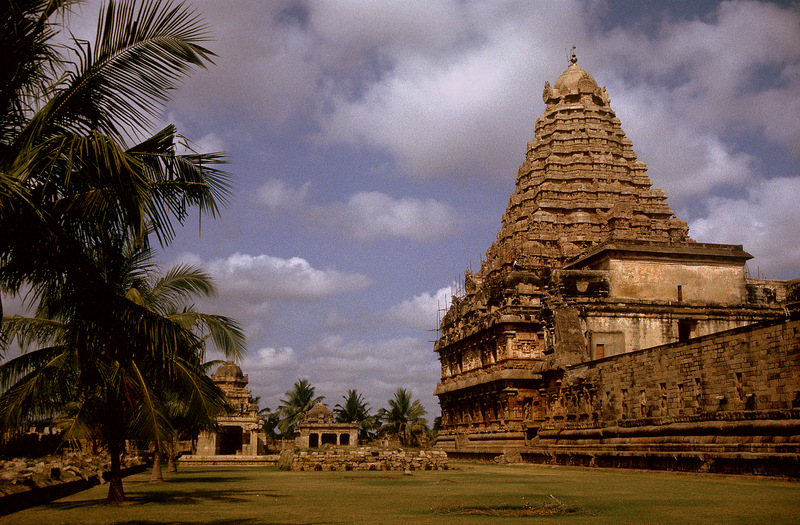
The temple Architecture The temple of Gaṅgaikoṇḍacōḻīśvara is approached through the northern entrance from the road. The passage passes through the enclosure wall and leads on to the inner court. As one steps in, the great Vimāna arrests the visitor’s sight. The Vimāna with its recessed corners and upward movement presents a striking contrast to the straight-sided pyramidal tower of Tañjāvūr. As it rises to a height of 160 feet and is shorter than the Tañjāvūr tower, it is often described as the feminine counterpart of the Tañjāvūr temple. The Vimāna is flanked on either side by small temples; the one in the north now housing the Goddess is fairly well preserved. The small shire of Caṇḍikēśvara is near the steps in the north. In the north-east are a shire housing Durgā, a well called lion-well (Siṃhakēṇi) with a lion figure guarding its steps and a late maṇḍapa housing the office. Nandi is in the east facing the main shrine. In the same direction is the ruined gōpura, the entrance tower. The main tower surrounded by little shrines truly presents the appearance of a great Cakravarti (emperor) surrounded by chieftains and vassals.
The Gaṅgaikoṇḍa Cōḻapuram Vimāna is undoubtedly a dēvālaya-cakravarti, an emperor among temples of South India. The enclosure Though the temple of Gaṅgaikoṇḍa Cōḻapuram follows the plan of the great temple of Tañjāvūr in most details it has an individuality of its own. From the remains it may be seen that it had only one enclosure wall and a gōpura while the Tañjāvūr temple has two gōpuras and enclosures. The prākāra follows the Tañjāvūr lay-out in that it had a two storeyed cloister running all around. Only a part of this has survived in the north. The stones from the other portions were utilised to build the Lower Anaicut across the Koḷḷiḍam. The pillars of cut stone are severely plain throughout as in Tañjāvūr. They have no inscription unlike at Tañjāvūr. The courtyard in 566’,9” in the length and 318’,6” width and has a transept at the west in line with the main sanctum. The cloister has a raised platform, 18’ in height. At regular intervals, bases for shrines are noticed.
These shrines should have resembled the prākāra shrines of Tañjāvūr and in all probability housed the images of the eight directional deities, in their appropriate quarters as in Tañjāvūr. However none of the images have survived. Evidently the prākāra has been laid out in the traditional Vāstu grid system called Vāstupadavinyāsa. The Gōpura The entrance tower, the superstructure of which has completely fallen down, is located in the east. It measures about 68 feet x 46 feet with a 12 feet entry way. It followed in pattern the outer gōpura of the Tañjāvūr temple, with no sculptures on its basse except for the Dvārapālas. The stones from the ruined gōpura were removed to construct the dam mentioned earlier. In the temples of Tañjāvūr, Dārāsuram and Tribhuvanam, there are two gōpuras, the outer being taller than the inner. But in Gaṅgaikoṇḍa Cōḻapuram there is only one gōpura, at the east. Besides this eastern entrance an entrance is provided in the northern enclosure, which now serves as the main entry on account of its priximity to the main road.
Dr. James C. Harle in his excellent work the ‘Temple gateways in South India’ states that “the gōpura of the great temple at Gaṅgaikoṇḍa Cōḻapuram (A.D. 1030) belongs as far as one can tell in its present ruined state to the same early phase of development as the Tañjāvūr gōpuras. It was neither as large or as complex, however, as the Tañjāvūr gōpuras. On plan, the whole edifice forms a rectangle approximately 60 feet by 33 feet. Large dvārapālas were placed on the outer facade. One of them now lies on the ground in front of the gōpura and measures atleast seven feet. The unique dvāra, as at Tañjāvūr, is on the outerside of the entryway. The vestibules have two storeys, divided by a crude and massive architrave; in the lower, an exposed stair is built against the back wall; above a doorway in the same wall may have led either to another stairway or to a circumambulatory corridor.” Dr. Harle further states that an early photograph (photo No. 2452 Indian Museum, Calcutta) shows the three upper storeys of the gōpura, in a dilapidated condition. A fairly large size bull is found on a pedestal inside the court, facing the main sanctum. It is made up of fallen stones and stucco.
It is not known whether the original one was monolithic. A bali-pīṭha is found east of Nandi. The building to the north of Nandi, called Alaṅkāra-maṇḍapa, and now housing the executive office of the temple was in all probability constructed in the 19th century. The Siṃhakēṇi To the north of this maṇḍapa is a circular well with steps provided at the western end. The entrance of the steps is adorned with a lion figure which has given the name to the well. According to tradition Rājēndra poured a part of the Ganges water, brought from his famous expedition, into the well, to sanctify it. An inscription on the lion sculpture, in 19th century characters, records that it was constructed by the Zamindar of Uḍaiyārpāḷaiyam. The Mahiṣāsuramardinī Shrine To the west of the lion-well is a shrine dedicated to the Goddess, Mahiṣāsuramardinī.
The shrine is a later structure (probably built in 14-15th Century) and did not form part of the original layout. It consists of a sanctum preceded by a maṇḍapa. The Goddess installed in the sanctum in similar to a Durgā found at Vīrareḍḍi street, in the same village and is in all likelihood, Cāḷukyan in origin. The Southern Kailāsa The shrine, south of the main Vimāna and called the southern Kailāsa has a sanctum preceded by a maṇḍapa which in turn is fronted by flights of steps from south and north of which the basement alone remains. The outer walls of the sanctum and the front maṇḍapa carry niches, housing images. The niches of the sanctum carry Dakṣiṇāmūrti in the south and Liṅgōdbhava in the west, while the niche on the north is empty. The niches on the front maṇḍapa carry in the south Gaṇēśa, Naṭarāja, Bhikṣāṭana, and Subrahmaṇya and in the north, Gaurīprasāda, Durgā, Ardhanārī and Bhairava. The inner sanctum of the shrine is now in ruins.
A little to the north-east of this temple is a granite basement, probably the ruin of a maṇḍapa. It is now called the Alaṅkāra-maṇḍapa. To the west of this is a well, probably coeval with the temple. To the south-west of the main temple, is a small shrine dedicated to Gaṇēśa. It has a sanctum preceded by a maṇḍapa. The structure could be assigned to the 13th century on stylistic grounds. The temple of Goddess (Northern Kailāsa) To the north of the main temple is a small shrine now housing the Goddess, Bṛhannāyakī, the consort of Lord Gaṅgaikoṇḍa Cōḻīśvara. The temple, as mentioned earlier, resembles the southern Kailāsa in every aspect and is called Uttara Kailāsa. It has a sanctum, preceded by a front maṇḍapa, provided with side-steps. In front of this is a bigger maṇḍapa (mahāmaṇḍapa), which is well preserved, unlike its southern counterpart. The niches on the sanctum and the front maṇḍapa carry the same sculptures as in the southern Kailāsa.
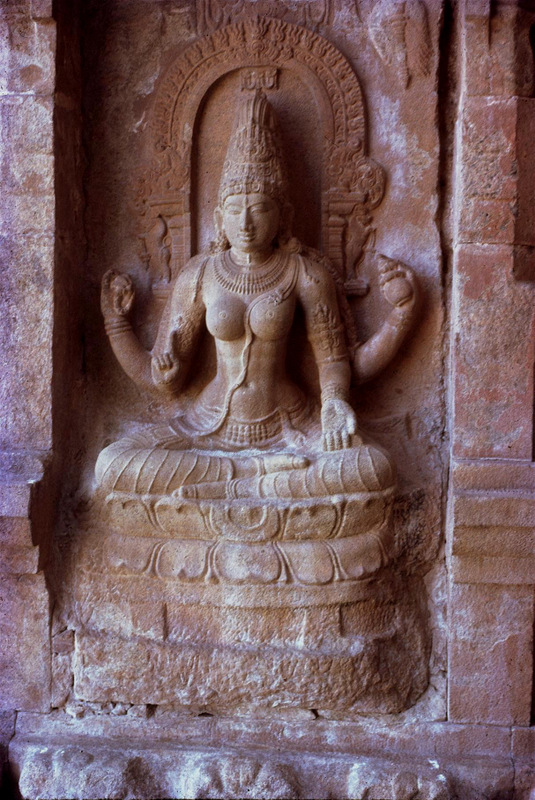
Thus Gaṇēśa, Naṭarāja, Bhikṣāṭana, Subrahmaṇya, Dakṣiṇāmūrti, Liṅgōdbhava, Brahmā, Bhairava, Ardhanārī, Durgā, and Gaurīprasāda are noticed in order, from the south, while in the southern Kailāsa, the northern niche of the garbhagṛha is empty, a sculpture of bearded Brahmā is noticed in this temple. Two gatekeepers flank the entrance. In front of the gatekeepers, in the mahāmaṇḍapa, are images of Sarasvatī in the north and Gajalakṣmī in the south. These two Goddesses, Lakṣmī and Sarasvatī, occupy the same position in the main temple and also in the great temple of Tañjāvūr. They occupy these positions to suit some ritual needs. It is significant that the mahāmaṇḍapa has steps to it only on the side. In ancient times, steps were always provided on the sides and not in front of the sanctum. The beautiful image of Goddess now enshrined in the sanctum of this temple should be a later instalation. Originally the temple should have enshrined a Śiva Liṅga, like the southern Kailāsa. Though separate shrines of Goddesses came to be built in the main temples only from the reign of Rājēndra I, no Dēvī-shrine was built originally in this temple, the present one being clearly a later institution.
The Caṇḍikēśvara shrine The little temple to the north-east of the central shrine enshrining Caṇḍikēśvara, the steward of Śiva temple is of interest. It is an all stone temple built on a raised basement, with a storeyed superstructure. The sanctum is approached by side steps. Inside the sanctum is an image of Caṇḍikēśvara, coeval with the temple. The outer walls of this sanctum have niches on all the three sides, carrying sculptures of Caṇḍikēśvara. He is the principal subsidiary deity in Śiva temples and till about 13th century A.D. all transactions relating to the temple were made in his name. Hence a separate shrine is provided for him in the temple complex. This shrine is coeval in time with the main temple. The main temple The main temple consists of a sanctum tower called Śrī Vimāna or Śrī Kōyil, a big rectangular maṇḍapa called the mahāmaṇḍapa with an intervening vestibule called mukhamaṇḍapa. The Śrī Vimāna consists of the following parts beginning with the lowest basement.
  1. The basement (upapīṭha)
  2. The base (adhiṣṭhāna)
  3. The wall (bhitti)
  4. The roof cornice (prastāra)
  5. The garland of miniature shrines (hara)
  6. The storeys (tala or bhūmi)
  7. The neck (grīvā)
  8. The crown (śikhara) and
  9. The final (stūpi).
According to architectural treatises, basements (upapīṭhas) are introduced in temples to increase the height of the main tower; to add to structural stability and to make the temple tower majestic. That these purposes are magnificently fulfilled by the basements of both the Tañjāvūr temple and Gaṅgaikoṇḍa Cōḻapuram temple, may be noticed even by a casual visitor not conversant with architectural principles. Besides the purposes mentioned above, the basement also provides, a space to walk around the tower. In this temple, the basement is ornamented with sculptures of lions and leogriffs with lifted paws.
The main base adhiṣṭhāna is decorated with well defined courses, consisting of the lotus moulding adhaḥpadma, and the kumuda moulding, topped by a frieze of leogriffs and riders. This constitute the main base, the top of which forms the flooring level of the inner sanctum. That portion of the structure rising above the main base up-to the roof cornice is called ‘the wall’ (bhitti or kal). It is the principal element that encases the main sanctum and carries on it a number of niches housing various deities. The wall in this temple is divided into two horizontal courses by an intervening cornice. The lower and upper courses have an equal number of niches, on all the three sides except the front. On the vertical axis the wall surfaces are well defined by intervening recesses forming a rectangle in the centre and squares at the corners. Each is made up of a central niche housing a deity, flanked by a group of small sculptures which in turn are flanked by pilasters simulating pillars. Thus each niche housing a deity appears as a miniature shrine.
The recessed walls in the lower courses carry a vase and pilaster ornamentation, while on the upper courses carry a vase and pilaster ornamentation, while on the upper courses, there are small niches housing deities. Thus these are five principal deities in the lower course and nine deities in the upper course on each side. Since the mukhamaṇḍapa abutts the eastern wall, only one niche is retained in the lower course. On either side of the eastern wall, the upper course retains the principal niche at the corners and smaller niches at the recessed walls. The sculptures in the lower courses, of the Śrī Vimāna depict various aspects of Śiva and also the subsidiary deities who include Gaṇēśa, Viṣṇu, Subrahmaṇya, Durgā, Brahmā, and Bhairava, supplemented by Lakṣmī, Sarasvatī, and Durgā in the niches of the great maṇḍapa. The sculptures were made separately and fitted into the niches. They are flanked by a group of small sculptures, carved in situ, illustrating the theme the niche sculpture seeks to represent. The sculptures on the upper courses represent, besides some aspects of Śiva, the guardian deities of the eight quarters.
The roof cornice consists mainly of three parts: (a) the frieze of dwarfs at the bottom, (b) the cornice forming the outer edge of the ceiling roof proper and, (c) the frieze of leogriffs on the top. The cornice is decorated with plain spade-like ornamentation topped by the head of a leogriff. A row of miniature shrines runs around the tower like a garland, and is called a hara. It consists of square pavilions at the corners, rectangular pavilions in the middle, with a nest (nīḍa) ornamentation in between. Above this rise the main tower, consisting of nine stories including the ground floor. The upper stories of the main tower carry the same type of ornamentation, consisting of square and oblong pavilions except a change; the central wagon-shaped pavilion is flanked by square ones instead of “the nests”, the whole being projected forward than the rest. This is a change from the Tañjāvūr tower, which presents a pyramidal appearance without the central projection. The neck is provided with four niches in the cardinal directions and bulls at the corners. The niches are topped by arch-like embellishment called kīrtimukhas.
The globular element on the top called Śikhara is according to tradition, made of one stone weighing many stones. But, in fact, it is made of many pieces of cut stones dressed for the purpose, as may be seen from the portion where the plaster has fallen down. The final, stūpi is a metal vase with a lotus-bud design at the top. It is gilded with gold and is said to carry an inscription named after Nallakka-tōḻa-uḍaiyār, a Poligar of Uḍaiyārpāḷaiyam. It is not known whether the stūpi is the original one and probably guilded by the Poligar or is a new one gifted by him. The sanctum enshrining the main deity, is encased by an inner wall. Between the inner wall and the outer, there is an intervening passage-called sāndhāra running all around. The two walls are joined at the top by a series of corbelling. They are provided to support the massive super-structure. In the great temple of Tañjāvūr, the outer walls have openings in the centre leading into the intervening passage. Facing the openings are sculptures of deities. The inner faces of the passage are painted with scenes depicting exploits of Śiva and his devotees.
But in the temple of Gaṅgaikoṇḍa Cōḻapuram, no painting is noticed in the inner passage. The central openings and corresponding sculptures, are also not found here. This inner passage around the sanctum is also found on the first floor. In the Tañjāvūr temple the inner wall of this passage carries 108 poses of dancing Śiva, of which 83 are fully finished and the rest are incomplete. But in Gaṅgaikoṇḍa Cōḻapuram to such sculptural representation is noticed. The inner sanctum, houses a very big Śiva Liṅga, rising to a height of thirteen feet. It is said to be the biggest Śiva Liṅga enshrined in a sanctum in any South Indian temple. The entrance to the sanctum is guarded by massive doorkeepers, dvārapālas. The maṇḍapa immediately preceeding the sanctum is approached by steps leading to it from the north and the south sides and also from the great maṇḍapa in the east. The entrances are guarded by big dvārapālas of remarkable beauty. The maṇḍapa is supported by massive plain and square pillars. The eastern walls flanking the opening to the great maṇḍapa carry groups of small sculptures illustrating Śaivite themes. The following are the themes thus represented.
The episode of Rāvaṇa travelling in his chariot; shaking the Kailāsa mountain; Śiva seated with Umā, pressing the mountain with his toe; Rāvaṇa’s anguish under the weight of the mountain and finally Śiva bestowing boons on Rāvaṇa, are depicted in three panels. The second episode on the same wall depicts Viṣṇu, worshipping Śiva with 1008 lotus flowers; finding one short he plucks his own eye and offers it as a flower; Śiva bestows grace on Viṣṇu. The panels closer to the entrance depict the marriage of Śiva with Umā. Umā, the daughter of Himavān, desirous of marrying Śiva, undertakes austerities and worships Śiva; Śiva, after testing her steadfastness as a beautiful youth, marries her; the celestials witness the marriage; Brahmā, the creator offers oblation to the sacrificial fire and Viṣṇu gives Umā in marriage to Śiva.
The east wall close to the entrance on the northern side depicts the Kirātārjuna scene; Arjuna the Pāṇḍava hero performs austerities to obtain a Pāśupata weapon; Śiva as a hunter accompanied by Umā as a huntress, tests Arjuna’s devotion; picks up a quarrel with Arjuna over a kill; Arjuna not knowing the personality behind the hunter, enters into a duel with him and is ultimately vanquished; Śiva manifesting himself bestows the weapon. At the extreme north of the same side are portrayed two episodes, one representing Śiva quelling the pride of God of death, in order to protect his devotee and the other representing Saint Caṇḍikēśvara a great devotee of Śiva, cutting off the leg of his father, who disturbed his faith and Śiva bestowing grace on both father and son. Though these group sculptures are carefully selected, they are imperfectly finished and lack the beauty and elegance of the sculptures of the main tower.
The Mahāmaṇḍapa Had the original mahāmaṇḍapa been preserved, it would have retained the grandeur of its conception and beauty. But as it is, only the portion upto the main base is original. The side walls, the pillars and the ceilings have been reconstructed, probably in the 18th century A.D. Obviously the superstructure should have crumbled due to neglect and vegetation. However a part of the original has survived upto the ceiling at the western end. From the surviving portion it may be seen, the roof (prastāra) of the mahāmaṇḍapa was in level with the prastāra of the ground floor (ādibhūmi) of the main Vimāna. Like the walls of the main Vimāna, a horizontal cornice divides the outer walls of the mahāmaṇḍapa into two parts. They carry a series of niches both in the upper and lower courses. The sculptures of Vidyēśvaras, Vasus, Ādityas and other subsidiary deities were probably enshrined in them. As mentioned earlier, the ādibhūmi of the main Vimāna has two floors inside the sāndhāra passage, the intervening cornice forming the intermediate floor level.
The mahāmaṇḍapa should have been a two storeyed pavilion, quite fitting with the mahāprāsāda of the temple. In view of the tall dvārapālas guarding the entrance to the mukhamaṇḍapa, the central passage should have had only the upper ceiling without the intermediate flooring. Thus the central passage was flanked by two storeyed structures, resembling the storeyed cloister of the enclosure. It is likely that the mahāmaṇḍapa of Tañjāvūr was also originally a two storeyed structure. They would have presented a most spectacular sight when the deities were taken out in procession through the mahāmaṇḍapa. As it stands today the inner side of the maṇḍapa has a central passage, leading from the front to the sanctum flanked by two raised platforms and a passage running around. Two massive dvārapālas are noticed at the western and guarding the entrance to the mukhamaṇḍapa. A room at the south western corner houses a beautiful Sōmāskanda image and a few other bronzes. A few sculptures and bronzes receiving regular worship are on the northern platform. The north eastern corner houses an interesting Solar altra, now worshipped as navagraha (nine planets).
The front entrance to the great maṇḍapa, is again approached by steps from north and south. The entrance to the maṇḍapa is guarded by massive dvārapālas. As the flooring of the maṇḍapa is on a high elevation, the steps rise to a considerable height forming a high platform in the front. It is said that there is a sub-terranian passage with steps under this platform. Some claim that this passage leads to the royal palace, while others assert that it leads to the river Koḷḷiḍam. Yet a third tradition says that it leads to an underground treasury wherein invaluable properties belonging to the temple are preserved. None in the living memory has set foot on this passage for fear of darkness, poisonous gas and wasps. It is not unlikely that the empty underground space below the great maṇḍapa and the space between the steps, were utilised as store houses. The original steps leading to the front entrance of the great maṇḍapa and the raised platform were probably disturbed are rebuilt as some of the stones built-in haphazardly carry fragmentary inscriptions of the 13th Century A.D.
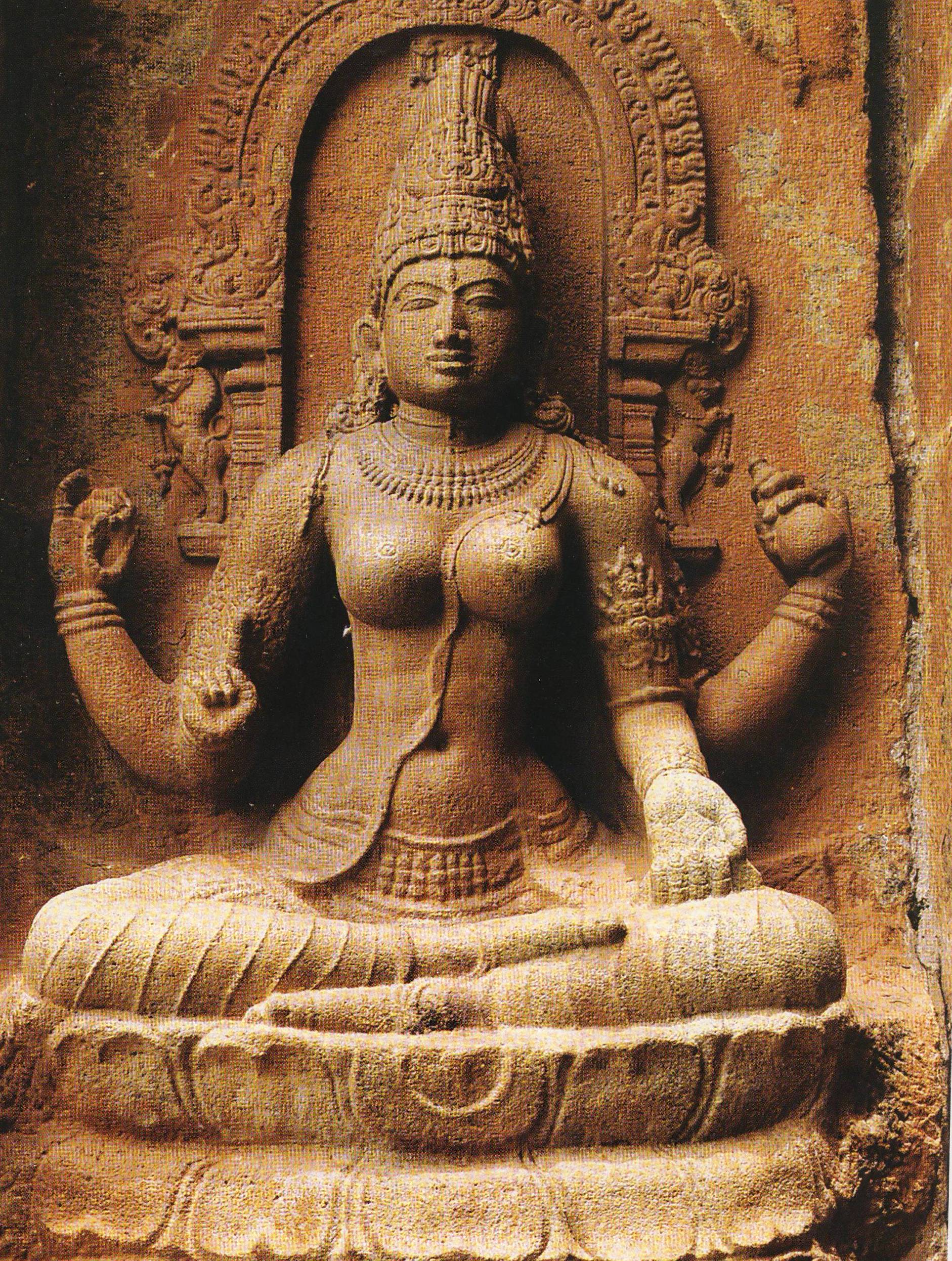
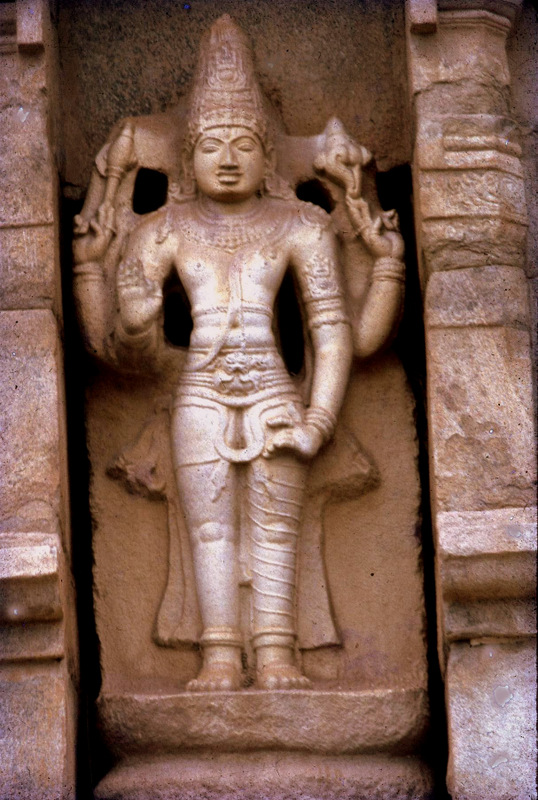
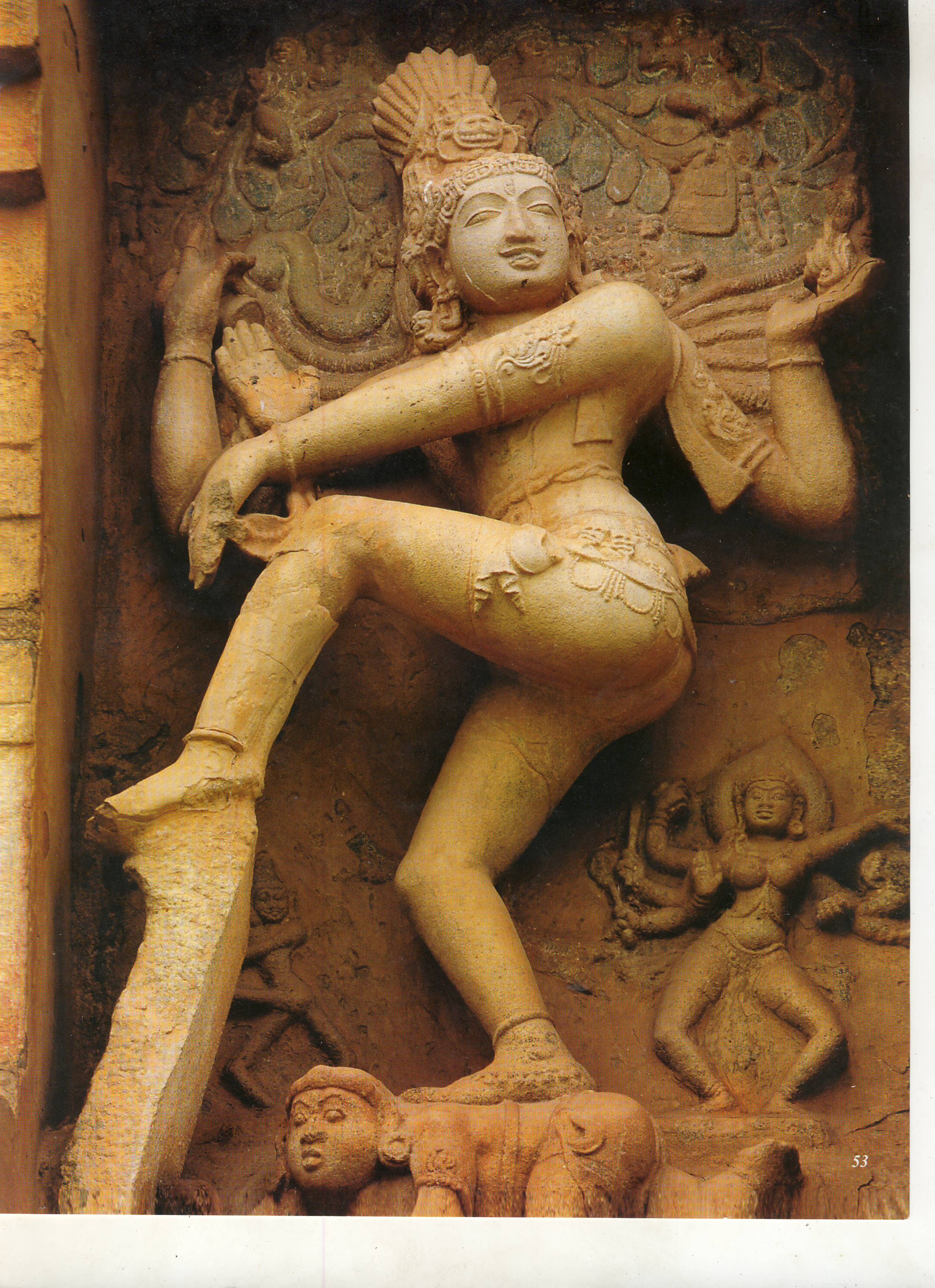
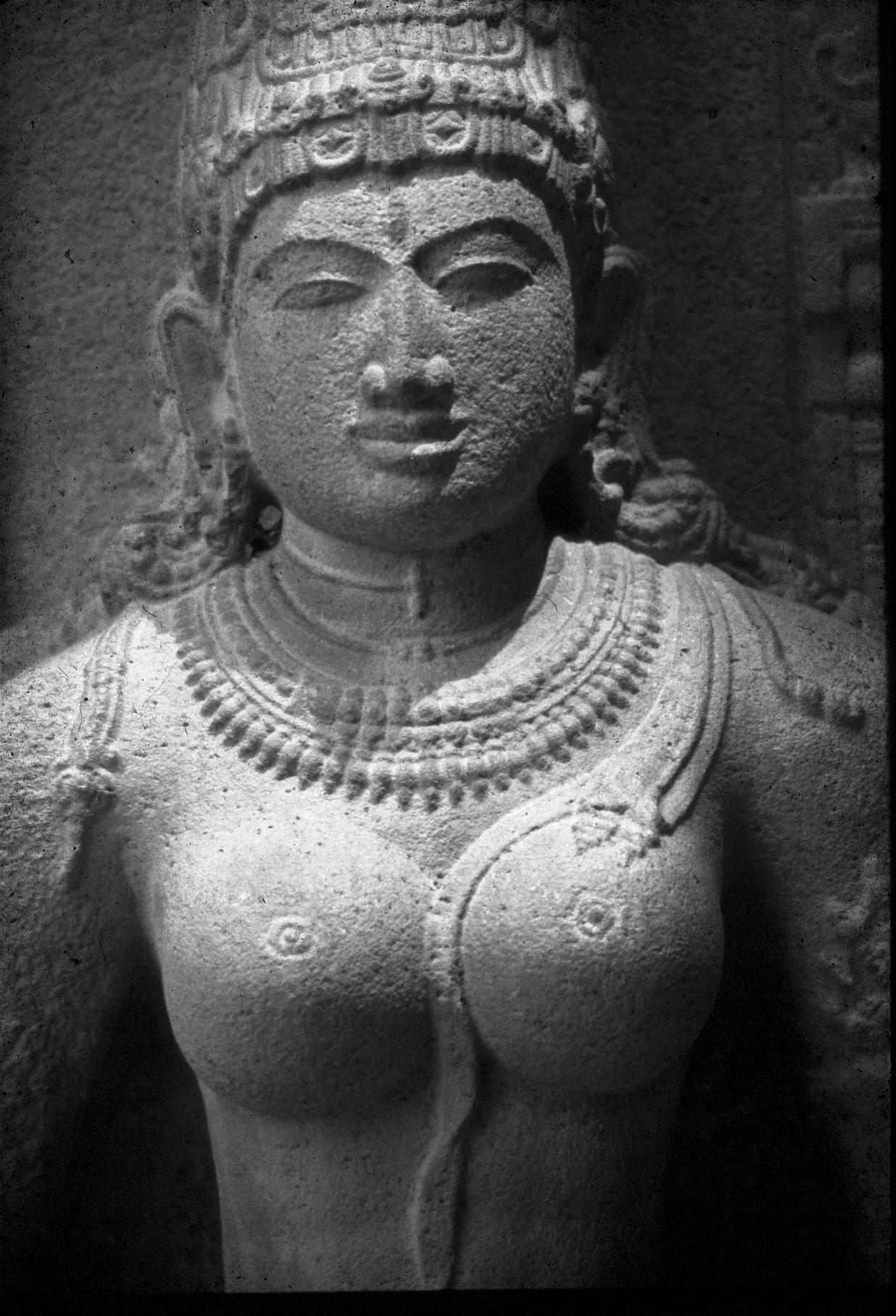
The temple Sculptures The sculptures of Gaṅgaikoṇḍacōḻēśvaram are known for their boldness of conception and excellent execution. They present pleasing and charming faces full of life and rhythm. The images of Sarasvatī, Caṇḍēśa-anugraha-mūrti and Naṭarāja ar undoubtedly from the dextrous hands of a master craftsman who has carved a permanent place for his creations in the art history of Tamilnad. The sculptures on the main Vimāna, the great maṇḍapa, and the other small shrines represent the forms prevalent at that period and occupy fixed positions to suit the needs of worship, as ununciated in the Āgamic texts. The images in the northern and southern Kailāsa shrines occupy identical positions. The main temple, being a mahāprāsāda, introduces additional images in its niches. An image of either Liṅgōdbhava or Viṣṇu is placed generally in the niche at the back of the Garbhagṛha in Śiva temples. In the great Vimāna of Gaṅgaikoṇḍa Cōḻapuram both are found at the back. Viṣṇu with his consorts is seen in the lower niche while Liṅgōdbhava is shown in the upper niche.
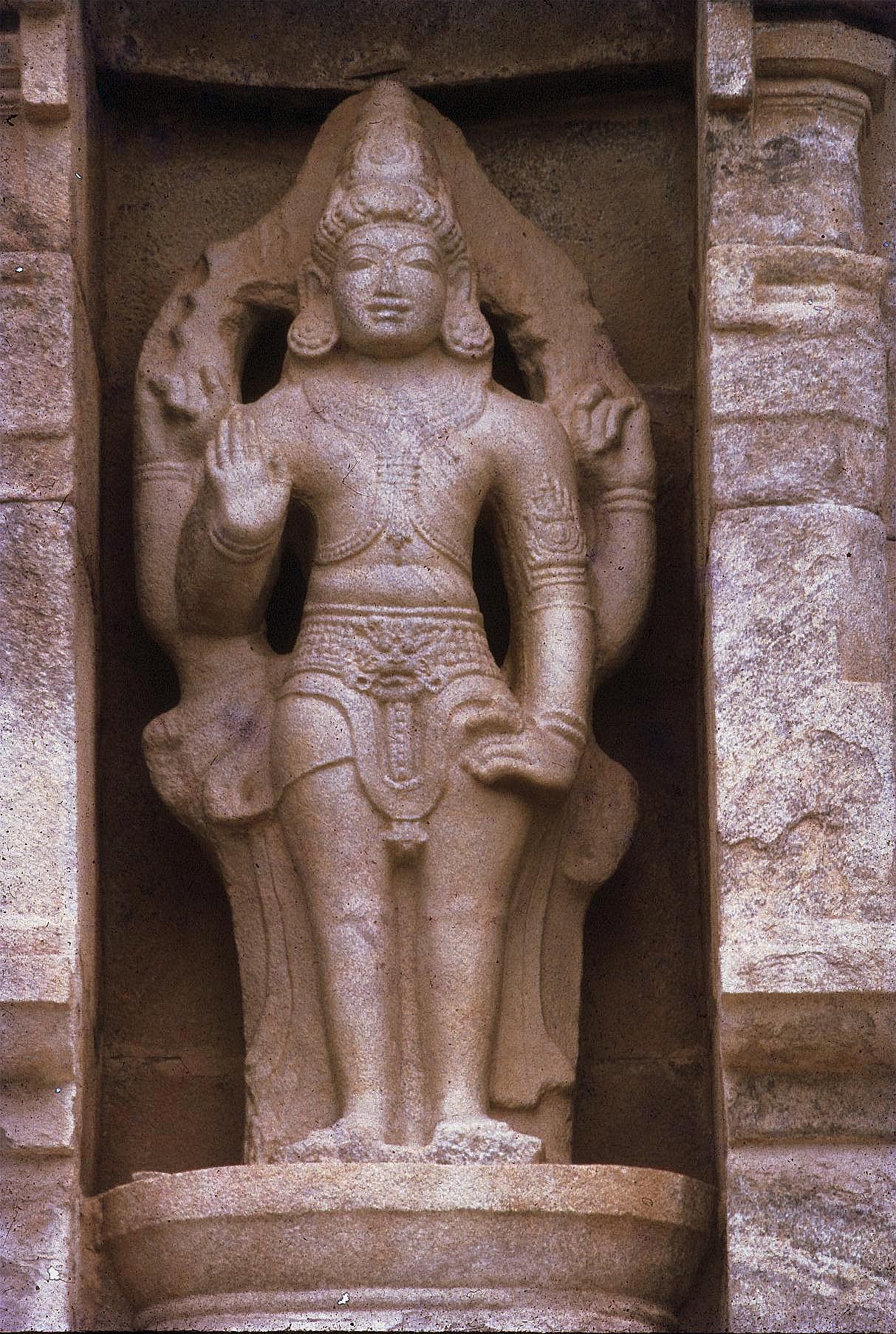
In some of the temples of the Cōḻa period, Subrahmaṇya is shown here at the back niche, especially when the temple faces west. An image of Subrahmaṇya is also shown here at the back of the Garbhagṛha. The image of Caṇḍēśa-anugraha-mūrti occupying the north eastern niche is also significant. In Pallava temples like Airāvatēśvara, Muktēśvara and Mataṅgēśvara, all at Kāñcī, Caṇḍēśa-anugraha-mūrti figures are noticed occupying an identical position. The upper row of niches in the main Vimāna carry sculptures of dikpālas and eleven Rudras, besides a few well-known forms of Śiva. Of the eight dikpālas the one occupying the northern quarter is clearly Sōma, identified by the halo behind his head. Sōma facing north is found on the third floor of the monolith, Dharmarāja-ratha at Māmallapuram. He is also found in the north on the enclosure wall of the Kailāsanātha temple of Kāñcī. Sōma distinguished by a halo behind his head, is always shown as the guardian deity of the north in Tamilnadu, unlike in the north where Kubēra is represented on the Vimāna, though both are held identical in architectural treatises.
It may be seen that besides the images identified, there are eleven images with four arms in a standing posture. The dikpālas are secondary deities called āvaraṇa dēvatās, receiving daily worship. Besides the dikpālas the eleven Rudras (Ēkādaśa Rudras), the twelve Ādityas, the eight Vasus, the eight Vidyēśvaras, the eight mūrtis (aṣṭamūrtis) and some other deities are also daily worshipped. According to Āgamic texts the eleven Rudras should be shown standing with four arms, holding paraśu and mṛga in the upper arms, while the lower ones should be in the abhaya and varada poses. Evidently the eleven images on the Vimāna at Gaṅgaikoṇḍa Cōḻapuram represent the eleven Rudras. The names of the eleven Rudras as given in texts are Sadyōjāta, Vāmadēva, Aghōra, Tatpuruṣa, Īśāna, Mṛtyuñjaya, Vijaya, Kiraṇākṣa, Aghōrāstra, Śrīkaṇṭha and Mahādēva. The great maṇḍapas at Tañjāvūr and Gaṅgaikoṇḍa Cōḻapuram carry a number of niches adorned with sculptures. In the Kailāsanātha temple of Kāñcī images of Lakṣmī, Sarasvatī, Durgā and Jyēṣṭhā are found in the maṇḍapa.
According to Mayamata, the well-known South-Indian text on architecture, these four forms of Goddesses are to be placed outside the Brahmasthāna, the place occupied by the main Vimāna. In Tañjāvūr and Gaṅgaikoṇḍa Cōḻapuram Lakṣmī, Sarasvatī and Durgā are found in identical niches on the walls of the great pavilion. Evidently they are enshrined in these niches to fulfil ritual needs. Some of the sculptures in standing posture found on the mahāmaṇḍapa have not so far been identified. It is likely they also represent the secondary deities. A series of sculptures at Tañjāvūr are shown with two arms, holding a sword and a shield. They are probably the eight Vasus, described in Āgamic texts. Unfortunately the great maṇḍapa at the Gaṅgaikoṇḍacōḻapuram has fallen down and undergone repairs. The majority of the niches are disturbed and are no more in existence. Some of the loose sculptures preserved in the enclosure may belong to this group. The representation of the guardian deities on the Vimāna, the sculpture placement in the niches of the Vimāna and the presence of Sarasvatī, Lakṣmī and Durgā in the niches of the mahāmaṇḍapa show that the builders had architectural treatises before them.
The following is the sculpture placement in the lower niches of the main Vimāna. EAST-WALL (SOUTH SIDE) KAṄKĀLADHARA : - Six armed standing figure in tribhaṅga pose. The upper right arm holds a snake; the middle one feeds the mṛga and the lower one playing on uḍukkai is broken. The upper left arm holds a trident across the back with a caurī hanging, the middle one is placed on the head of a dwarf standing by the side and the bottom holding the uḍukkai is broken. Pair of sandals adorn the feet. The plaster and painting on the figure belong to a later period. On the wall to the right of Śiva are shown Sūrya on top; Bhūtagaṇas in the middle and wives of sages at the bottom. The wall to the left of Śiva carries Candra on top, gaṇas in the middle and wives of sages at the bottom. The makara-tōraṇa above this niche carries a bas-relief of Umāmahēśvara in the middle.
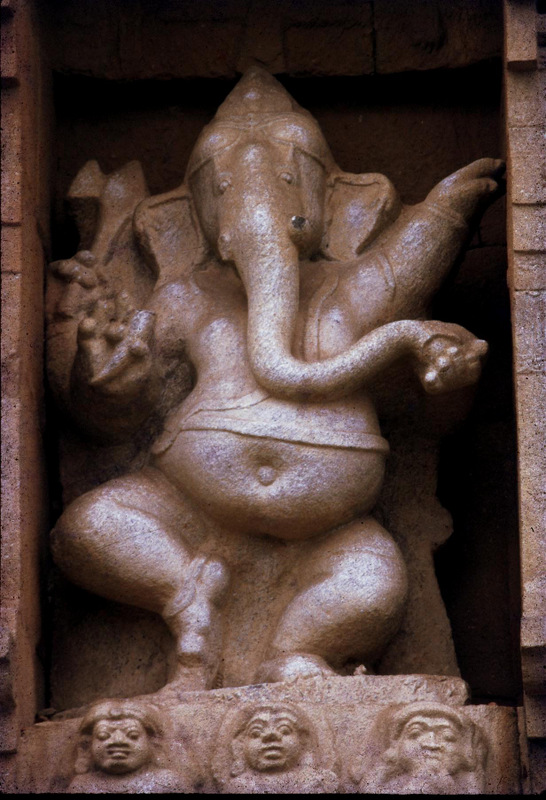
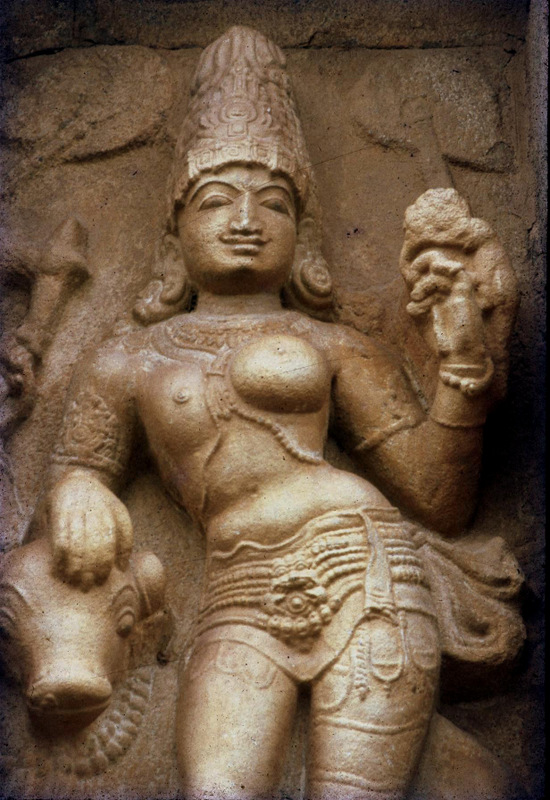
SOUTH-WALL GAṆĒŚA Gaṇēśa, dancing with four arms; upper right arm holds a paraśu; the lower right holds the broken tusk; the upper left arm is lifted up; the lower left arm holds a fruit. The right leg is lifted up in rhythmic stance. Sūrya and Candra, gaṇas and bhūtas are shown on the side walls. Below the feet are shown three gaṇas, playing maddaḷa, cymbals and conch. The Centre of the tōraṇa carries a faint carving. It represents a seated tiger, two fish and a bow which was the royal insignia of Rājēndra Cōḻa. ARDHANĀRĪ A standing figure in Tribhaṅga pose with three arms; two to the right and one to the left; The upper right holds a paraśu, while the lower right rests on the head of a bull standing besides it. The only left carries a full blown flower, probably nīlōtpala. A parrot seated on the arm is seen pecking the pollen.
The right side of the head is adorned with a jaṭāmakuṭa and the left with a kēśabandha. A lion pendant in the right ear and a roll pendant in the left are seen. A parasol above and one fly whisk on either side are shown. The breast is shown pronouncedly on the left emphasizing the feminine aspect. The left leg wears a sari extending upto the knee. The right leg wears bhṛṅgipāda. No sculpture is represented on the side walls. The middle of the makara-tōraṇa carries wavy lines. This figure of Ardhanārī is particularly charming with a captivating smile on its face. The artist has been able to bring forth masculine firmness and feminine tenderness in the same face. DAKṢIṆĀMŪRTI The original figure of Dakṣiṇāmūrti that should have adorned this niche seems to have been lost. The present one is a late figure that could be assigned 13th Century A.D. It is disproportionate to the niche and is dwarfish. It is similar to the sculptures of the period seated on a mountain with four arms. The upper right arm holds a rosary of beads.
The lower right is in a teaching posture; the upper left holds fire and the lower, a book. The right leg is planted on the back of a lying dwarf; the left is bent and placed on the right knee. One of the image of sage, wearing kuṇḍala ear ornaments seems to be original. The side walls have four rows of miniature sculptures. East-wall :- two sages and two gaṇas; five women in second row; six gaṇas in third row and four sages in the fourth row. West wall :- first row, Agastya, two dēvas and Sūrya; second row, dēvas; third row dēvas and sages; and two devotees in the fourth row. HARAHARI Four armed figure standing erect in samabhaṅga pose. The right of the figure represents Hara and the left Hari. This figure is generally called Harihara, but the Śaivite Āgamas designate this figure as Harahari. The upper right arm of the figure holds the axe and the lower right in boon bestowing (abhaya) pose; the upper left arm holds a conch and the lower arm is on the thigh. The dukūla, the lower garment on the left is shown upto the knee while the one on the right represents the skin shown above the knee.
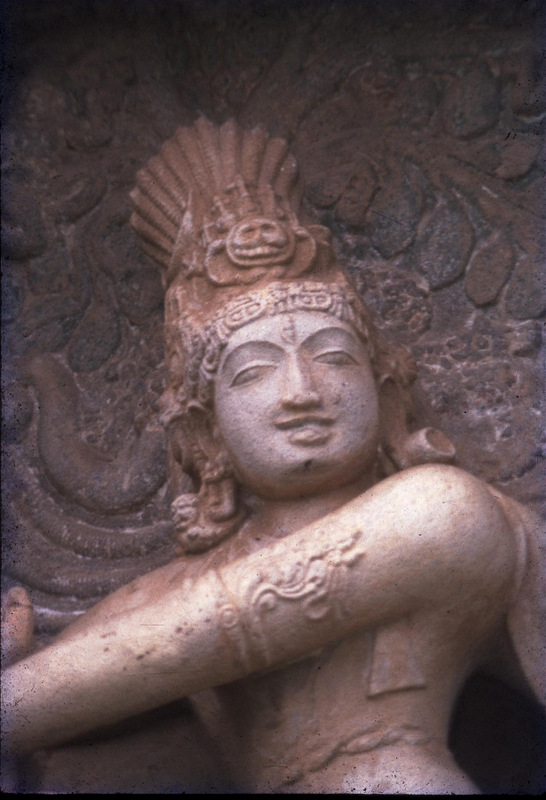
No sculptures are shown on the side walls. A lotus is shown above the niche. ĀḌAVALLĀR (Naṭarāja) A delightful figure of four armed dancing Śiva, holding kettle drum in the upper right arm and boon bestowing palm on the lower right. The upper left carries fire and the lower left is thrown across the body in gajahasta. The matted locks are flying in rhythm on either side. On the right is shown Gaṅgā. By the left side of the leg is shown an eight armed dancing Kālī, carrying drum, sword, trident, abhaya, daṇḍahasta etc. A three legged figure, probably representing Kūḷi is seen on the right. Below the feet is shown the woman-saint Kāraikkāl Ammai, who on account of her devotion, was endowed this privileged position of being seated below the seat of the Lord, singing his Greatness. Three Gaṇas are also shown playing symbols and maddaḷa. On the west side wall is shown Sūrya on top. Subrahmaṇya seated on peacock is shown flying towards the Lord while Gaṇapati moves equally briskly on his rat. Further down is four armed Nandikēśvara playing maddaḷa. Candra is shown on the top on the side wall to the east.
The armed Goddess Pārvatī is leaning on a majestically looking bull; she holds a lotus in her right arm. WEST WALL GAṄGĀDHARA Four armed standing figure of Śiva, embracing Pārvatī standing by his side. The upper right arm of Śiva receives the falling Gaṅgā in his matted lock; the lower right moves gently around Pārvatī. The upper left holds mṛga; the left is placed on the thigh. The right arm of the Dēvī is placed on the thigh while the left is bent. Three rows of miniature sculptures are noticed on the side walls. Sūrya is shown on top of the wall right of Śiva; Dēvas are in the middle and two devotees at the bottom. The left wall carries Candra at the top, devotees in the middle and Bhagīratha doing penance at the bottom. It is significant that the back wall (west wall) at the Kailāsanātha temple of Kāñcī carries a Gaṅgādhara in a separate cell-shrine.
LIṄGŌDBHAVA Four armed standing figure of Liṅgōdbhava emanating from the shaft of fire. The right upper arm holds axe and the lower is in the abhaya pose; the left upper holds antelope and the lower is placed on the thigh. The leg below the ankle is hidden. A garland of flowers is shown around the Liṅga portion at the top. Viṣṇu as a boar is shown at the bottom in an outline. Brahmā as swan is not represented. MAHĀVIṢṆU Four armed standing figure of Viṣṇu holding discus and the abhaya pose in the right arms and conch and hand-on-thigh pose with the left. On this right is shown two armed Śrī wearing a breast-band and on the left is Bhūdēvī. The side walls show Sūrya and Candra at the top, dēvas in the middle, and sages at the bottom.
SUBRAHMAṆYA A delightful figure of four armed standing Subrahmaṇya, carrying Śakti and Vajra in the upper arms while holding the lower right in abhaya, and the left on thigh. A prominent garland of flowers characteristic of Subrahmaṇya figures is shown at the root of the crown. The Deva wears channavīra. VIṢṆU-ANUGRAHAMŪRTI The God and Goddess seated on a pedestal. Śiva four armed, carrying Paraśu and mṛga in the upper arms; the lower left is placed on the thigh while the right is in the pose of holding something, probably Cakra. The figure may be taken to represent Cakradānamūrti or Viṣṇu-anugrahamūrti. The Dēvī seated to the left of the Lord holds a lilly in her right arm. A parasol and a pair of caurīs are shown above. Due to weathering, the stone has pealed off from the figure. The side wall of the left of the Lord carries an image of Candra on top; two devotees in the middle and at the bottom is shown Viṣṇu worshipping Śiva.
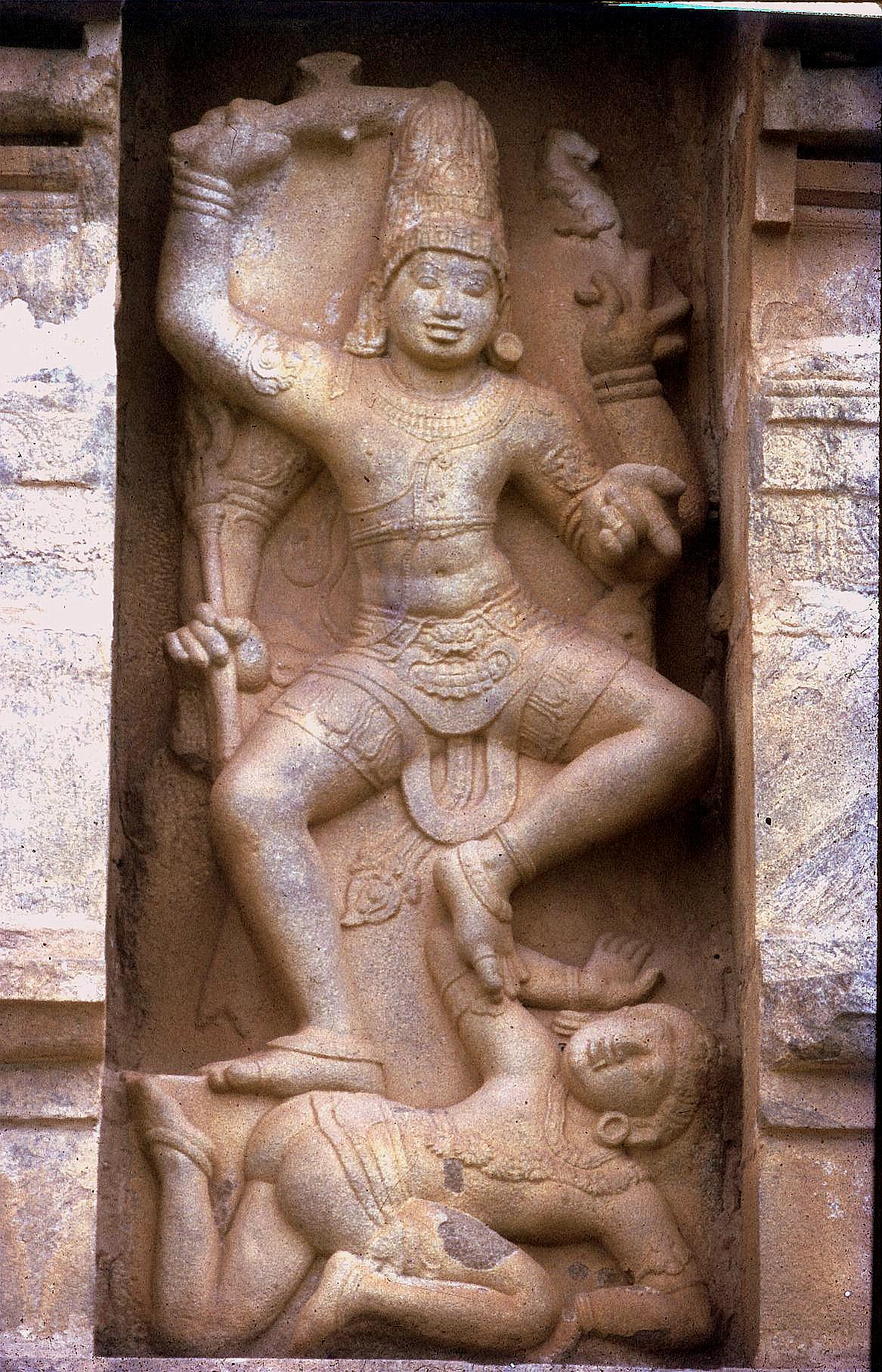
The right wall carries Sūrya at the top and devotees in the middle. The bottom figures have weathered. NORTH-WALL KĀLĀNTAKA Four armed Śiva, destroying Kāla, right leg placed on Kāla, and with the left pressing him. The upper right arm holding paraśu (axe) is about to strike; the lower right holds the trident at ease; the upper left holds a mṛga and the lower left points to Kāla. Kāla a fairly big figure, is shown struggling under the feet of the lord. Side walls carry Sūrya and Candra at the top. On one side there are devotees and on another is shown Mārkaṇḍēya, the boy-saint worshipping Liṅga and the God of death dragging him forcibly with a rope. DURGĀ Eight armed standing figure holding discus, arrow, sword and abhaya with the right arms and conch, bow, shield and hand-on-thigh pose with the left.
Below her legs is shown a buffalo head, imperfectly carved. Behind her stands a lion. BRAHMĀ Four armed standing, three headed (the fourth head at the back not being visible) and bearded figure of Brahmā in erect pose. Holds sruk and sruva in the upper right arm and a rosary of beads in the lower right. Holds a bunch of darbha grass in the upper left and a kuṇḍikā in the lower left. He is flanked by two armed Dēvīs. The Goddess to the right of Brahmā, holds a bundle of palm leaves in her left arm. Evidently she is Sarasvatī. The Goddess to the left is obviously Sāvitrī, as Brahmā is called Sāvitrīpati. The side walls carry Sūrya and Candra and Dēvas and sages. BHAIRAVA Eight armed standing nude figure, wearing a garland of skulls. A big snake coils around the thighs; round ball-like eyes, protruding teeth, flame like hairs; holding a trident, paraśu, sword and noose in the right arm; and with left, fire, kapāla, khaṭvāṅga and bell. Behind the figure is shown an imperfectly carved hound.
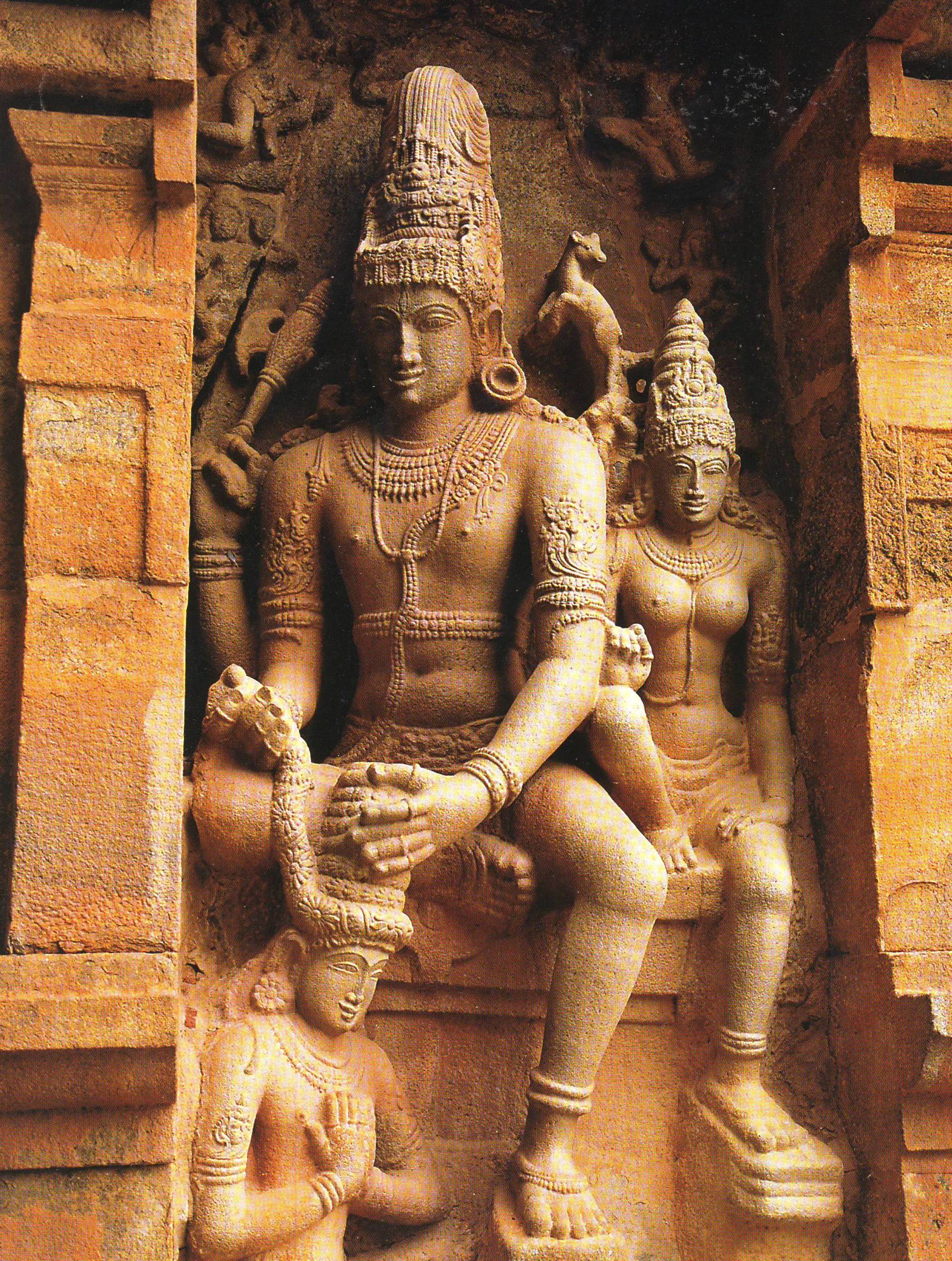
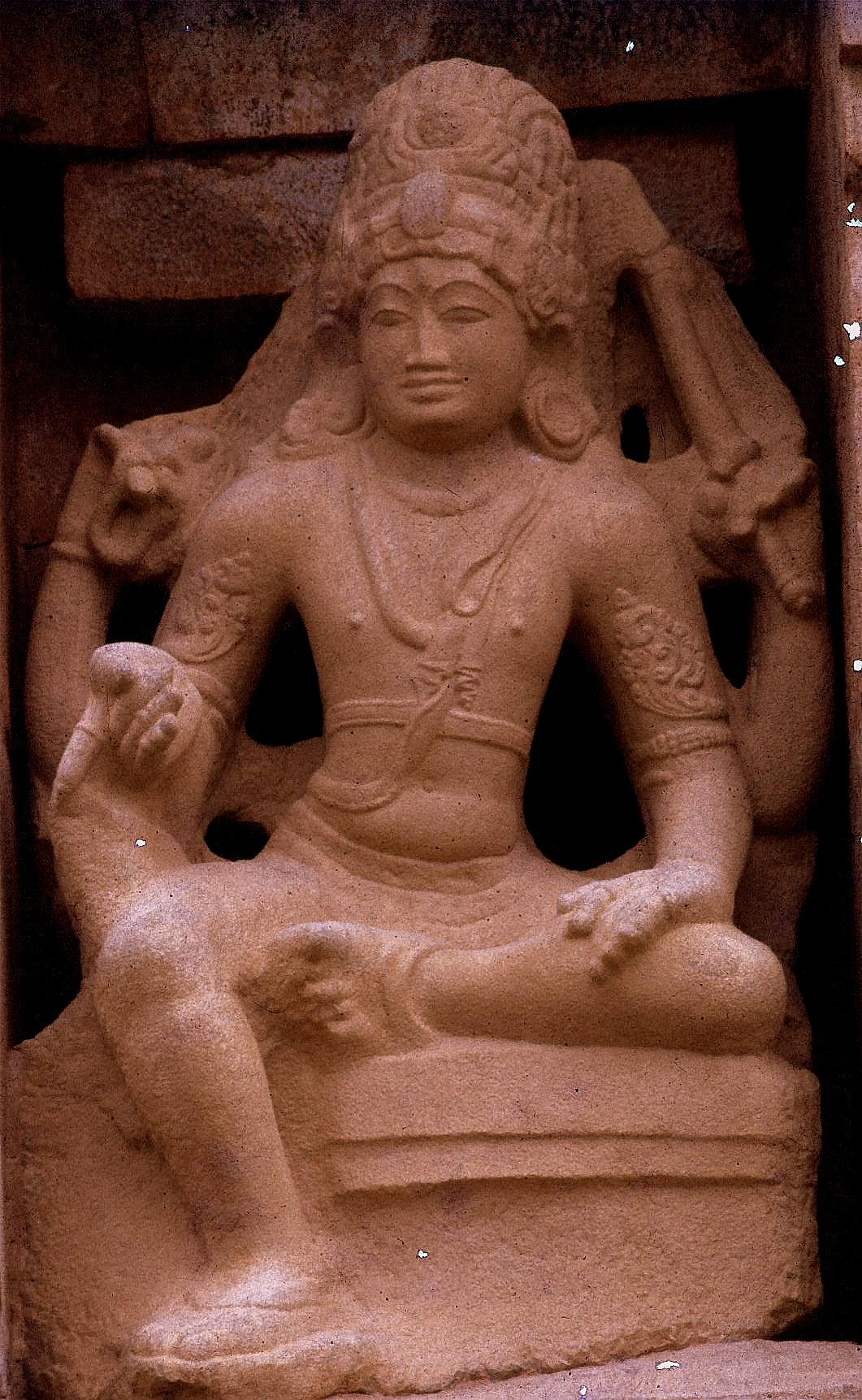
KĀMĀNTAKA Four armed seated figure; right upper arm holding a rosary of beads and the lower arm pointing down. The left upper arm holds a caurī and the lower is placed on thigh. The head dress is delightfully treated and has a distinctiveness of its own. The side wall to the right carries a figure doing penance on top; below are two devotees. On the left side at the top is shown Manmatha aiming an arrow at Śiva. Two devotees are shown in the middle and at the bottom are shown Manmatha and Rati. EAST-WALL (NORTH SIDE) CAṆḌĒŚĀNUGRAHAMŪRTI Śiva seated on a throne with four arms carries axe and antelope in his upper arms; with the lower the Lord is seen crowning Caṇḍēśa with a garland of flowers, a symbol of affection and stewardship. Caṇḍēśa is seen seated in front and with folded arms receiving the pride of place bestowed on him by his Lord.
Caṇḍēśa is the embodiment of devotion and piety and the place he attained is considered the highest, a devotee of Śiva is privileged with. It is called the Caṇḍīśa-padam, the abode of deliverance. According to Śaiva Siddhānta Śiva bestows this grace, in the company of Śakti, His consort. In the sculpture under reference, Pārvatī or Umā Paramēśvarī as she is often described, is seated by the side of her Lord. The treatment of ornaments, the portrayal of limbs and affection with which Śiva is seen taking the garland around the head of Caṇḍēśa are suggestive and truly convey the supreme message of Śaiva Siddhānta, the image seeks to depict. In the figure of Caṇḍēśa, Rājēndra Cōḻa has carved his own image. Śrī C. Śivarāmamūrti in his work ‘the Cōḻa temples’ states that “The most remarkable carving here, the Caṇḍēśa-anugraha-mūrti panel, is almost a suggestion of the laurels won by Rājēndra through the grace of Śiva and he humbly presents himself as a devotee of Lord, who blessed Caṇḍēśa”.
On the side walls is shown the story of Caṇḍēśa; Caṇḍēśa worshipping Śiva as a Liṅga; the cows standing by the side; his father watching the happenings hiding himself behind the branches of a tree; disturbing Caṇḍēśa’s worship; purturbed Caṇḍēśa throwing his axe at his father and Śiva bestowing grace on both. SARASVATĪ Facing the image of Caṇḍēśa-anugraha-mūrti, on the west wall of the Mahāmaṇḍapa is another delightful figure of Sarasvatī, the Goddess of knowledge. The Dēvī is seen seated on a lotus throne with four arms; holds a rosary of beads and an amṛta-kalaśa with the upper arms and palm leaves and teaching pose with the lower ones; behind her is shown a prabhā, aureole.
LAKṢMĪ Correspondingly on the South side of the mahāmaṇḍapa, in the west wall is an image of Goddess Lakṣmī, seated on a lotus throne with two arms. The Dēvī holds lotus flowers in her arms; unlike Sarasvatī, she is seen wearing a breast-band. Above her are shown two elephants pouring water from golden pots held in their trunks. Sculptures in the niches of the upper course of the main Vimāna. EAST-WALL (SOUTH SIDE)
  1. Sūrya standing.
  2. Bearded Agni (guardian of the south-east).
SOUTH WALL
  1. Kālāntaka Śiva.
  2. A four armed deity in standing pose
  3. A four armed deity in standing pose
  4. Yama (guardian of the south)
  5. Dakṣiṇāmūrti.
  6. Four armed deity (standing)
  7. Four armed deity (standing)
  8. Four armed deity (standing)
  9. Nirṛti (guardian of the south-west)
WEST WALL
  1. Bhikṣāṭana
  2. Three headed figure
  3. Four armed deity probably Varuṇa (Guardian of the west)
  4. Viṣṇu
  5. Liṅgōdbhava
  6. Brahmā
  7. Two armed deity probably Vāyu (Guardian of the North West)
  8. Four armed deity
  9. Four armed deity
NORTH WALL
  1. Gaurīprasāda.
  2. Four armed deity.
  3. Four armed deity.
  4. Sōma (guardian of the north; distinquished by a halo behind)
  5. Brahmā.
  6. Four armed deity.
  7. Four armed deity, Īśāna (guardian of the north-east)
  8. Bhū-varāha Viṣṇu.
  9. Subrahmaṇya.
EAST-WALL (NORTH SIDE)
  1. Gajasaṃhāra.
  2. Candra
DVĀRAPĀLAS (GATE KEEPERS) There are altogether six pairs of massive, monolithic dvārapālas guarding the various entrances to the main temple, of which four pairs are found in the east. The first pair guard the entrance tower at the east. They are now fallen down and lie upside down.
The second pair is to be seen at the eastern entrance to the mahāmaṇḍapa. The entrance from the mahāmaṇḍapa to the mukhamaṇḍapa is guarded by a third pair while the fourth guard the entrance to the sanctum. The side entrances to the mukhamaṇḍapa from the south and the north are also guarded by dvārapālas of exquisite workmanship. These dvārapālas are a class by themselves. The Āgamic texts mention four pairs of dvārapālas, each to guard a cardinal direction. Their names are given as under. East:- Nandi and Mahākāla; South:- Hēramba and Bhṛṅgi; West:- Durmukha and Pāṇḍura and North:- Sita and Asita. The Vimāna of the Tañjāvūr temple has four pairs of dvārapālas each guarding a direction. Evidently they represent the images named above. In the temple of Gaṅgaikoṇḍa Cōḻapuram the Vimāna does not carry dvārapālas except in the east. The dvārapālas guarding the entrances to the garbhagṛha are certainly Nandi and Mahākāla. In all likelihood the dvārapālas guarding the south and north entrances to the Mukhamaṇḍapa are Hēramba and Bhṛṅgi, Durmukha and Pāṇḍura respectively.
THE SOLAR ALTAR The solar altar called Saura-pīṭha in Āgamic texts is in the form of a full blown lotus on a square pedestal in two tiers. The upper tier carries eight deities portrayed at eight directions. They are considered the eight planets, which, including the central lotus representing Sūrya (sun) constitute the navagrahas, (nine planets) worshipped by the Hindus for the bestowal of good fortune and the removal of obstacles. The lower tier is modelled as a charriot with wheels on either side, drawn by seven horses. Aruṇa the Charioteer of Sūrya is shown driving the horses. The seven horses are said to represent the seven days of the week. The wheels are ornamented with twelve petals, representing the twelve months of a year. At the corners are seen flying celestials, gandharvas carrying flower garlands. The Āgamic texts specify the worship of Sūrya in the form of a lotus altar. Evidently this is a representation of Saura-pīṭha, solar altar, intended for daily worship. This elegant piece is also decidedly a Cāḷukyan sculpture, probably brought here as a war trophy.
In recent years, it has assumed great significance as a large number of devotees worship it as Navagraha for the fulfilment of their vows. When the planet Saturn changes its position once in 27 months, nearly a million people offer worship to this altar. OTHER SCULPTURES Besides the sculptures found on the walls of the shrines, a few loose sculptures are also found in the temple. A few of them have been collected and embedded on a platform by the side of the northern entrance. The following sculptures are found embedded:- Bhikṣāṭana, Liṅgōdbhava, Gaṇēśa, Subrahmaṇya, Dēvī, Vīrabhadra, Brahmā, Durgā, Candraśēkhara, Vṛṣabhāntika, Vīṇādhara, Sūrya, Sage, Dvārapāla, three figures of Nāgarāja, two images of Vīṇādhara and four figures probably representing secondary deities. On the south enclosure wall, near the southern Kailāsa, are found embedded a four armed standing Ardhanārī, a Gajalakṣmī and two images of Sūrya. By the side of the Lion-well, is found an image of Viṣṇu with Śrīdēvī standing. By the side of the Solar pīṭha, in the mahāmaṇḍapa there are, an image of eight armed Durgā and a Sūrya.
These two images are in Cāḷukyan style and probably were brought as trophies. Śrī C. Śivarāmamūrti in ‘The Cōḻa temeple’ states that the Nandi in the temple of Goddess in Cāḷukyan in style.
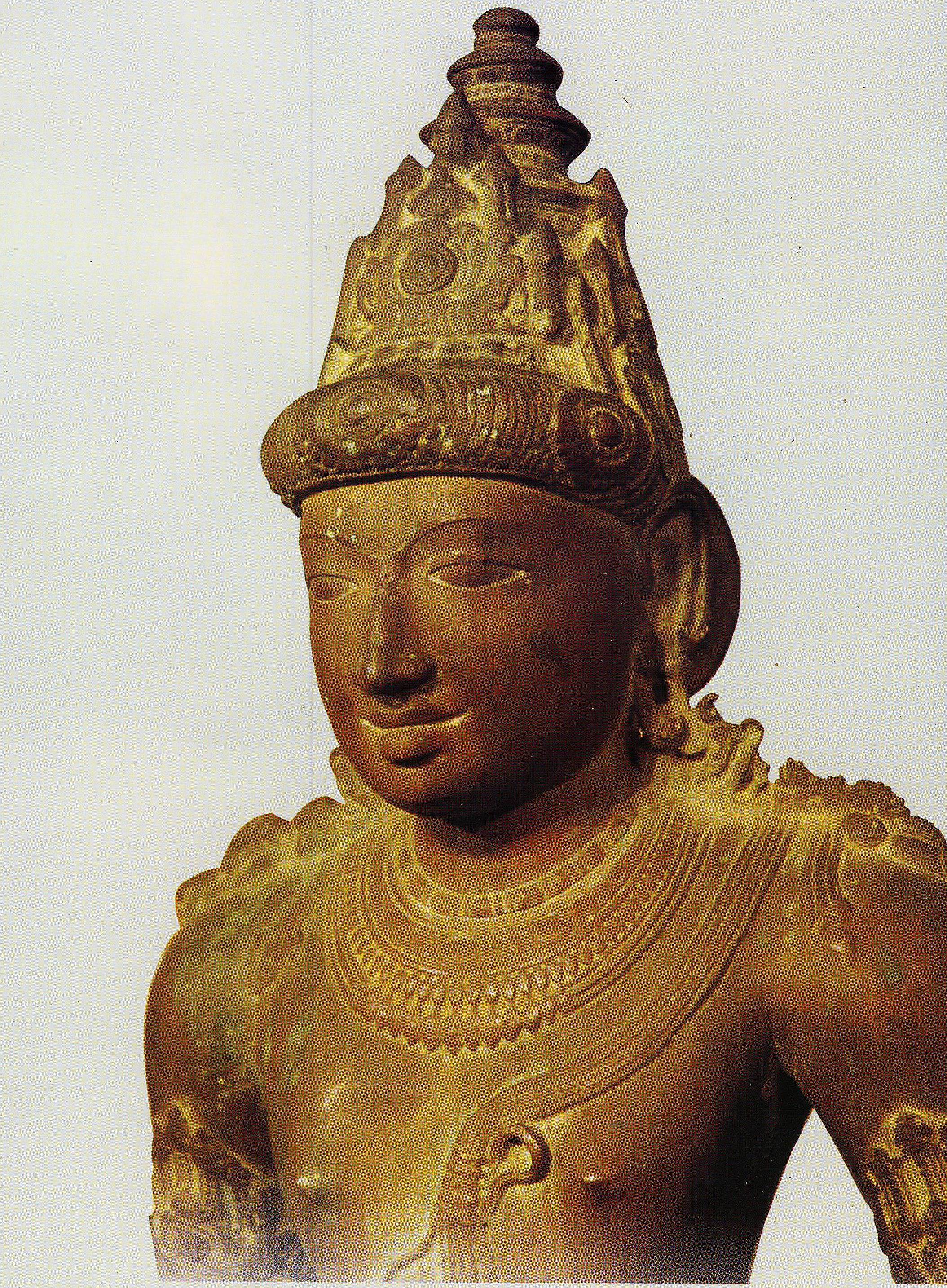
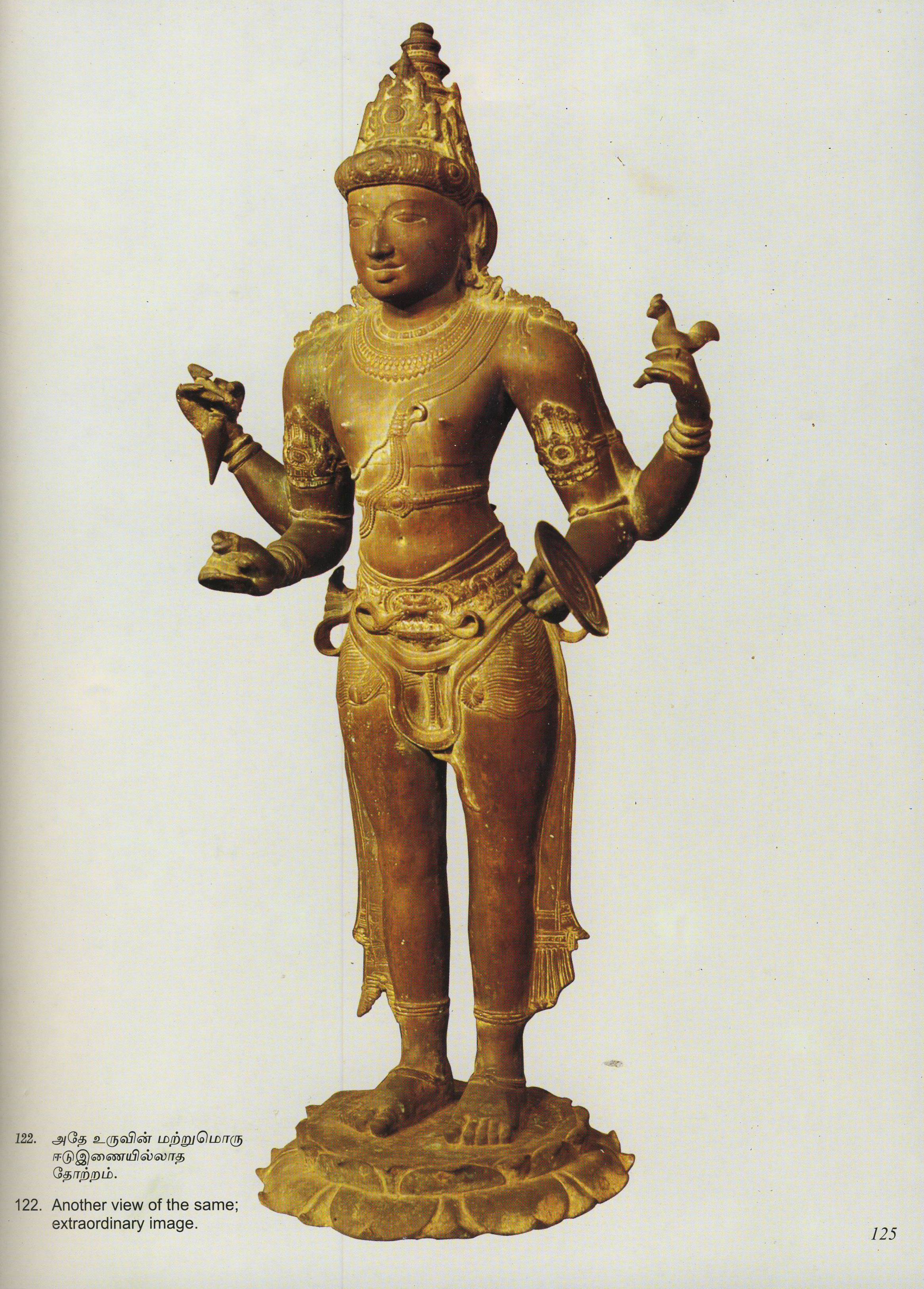
The temple Bronzes There are few bronzes of remarkable beauty preserved in the temple. They were probably gifted for worship when the temple was erected. Of the classical bronzes in the collection, Sōmāskanda, Subrahmaṇya, Durgā, Bhōgaśakti, Adhikāranandi and probably Vṛṣabhāntika are to be assigned to the period of Rājēndra I. BHŌGAŚAKTI:- A two armed standing image of Pārvatī of arresting beauty is now placed near the sanctum. DURGĀ Four armed standing figure in erect (samabhaṅga) pose; holds discus and conch in the upper arms and boon-bestowing and hand-on-thigh poses in the lower arms. The Goddess is shown wearing a breast-band; buffalo head is not represented below the feet. Appropriate with its role the figure displays firmness with which the Goddess struck the demon. The conch and discus are supported by metal pieces issuing from the back.
ADHIKĀRANANDI Four armed figure in abhaya pose, standing on a lotus pedestal. The upper pair of arms hold axe and antelope; the lower arms in añjali pose hold a garland of flower in between. This image is particularly a good specimen representing the theme. SŌMĀSKANDA Quite fitting with the great Liṅga in the sanctum and the mahāprāsāda of the temple, the group of Sōmāskanda in the temple is fairly big in size and exhibits all the classical qualities of the Cōḻa age. The group consists of Śiva seated majestically on a pedestal with four arms. A two armed Dēvī is shown by the side. The original Skanda image is missing. The figures of Śiva and Dēvī closely resemble the sculptures on the lower niches of the main Vimāna. The group could be assigned to the period of Rājēndra I and was probably the principal Sōmāskanda image of the temple. It may be mentioned that the bronze image of Sōmāskanda is the main processional deity, representing the Liṅga in the sanctum.
The Sōmāskanda image of Tiruvārūr is called Vīdhi Viṭaṅkar and the one at Tañjāvūr was called Dakṣiṇamēru Viṭaṅkar. The Vimāna of Tañjāvūr temple was called Dakṣiṇamēru by its builder Rājarāja I. The group of Sōmāskanda in the Gaṅgaikoṇḍa Cōḻapuram temple should have been the main processional deity of the temple. This is the biggest group of Sōmāskanda image of the imperial Cōḻa period now known to exist. SUBRAHMAṆYA By far the best bronze in the collection of the temple is the Subrahmaṇya image variously called Kārttikēya, Dēvasēnāpati and Muruga. The image about 3 1/2’ in height its shown with four arms standing on a lotus seat. Unlike the conventional lotus pedestals seen in most of the bronze images, the present one is realistically treated. The protrution at the bottom was probably to slide the image into a bigger pedestal which is now missing. The right upper arm holds Śakti, the top of which is broken, the lower right holds a sword of which only the handle now remains, the blade is lost; the left upper arm holds a cock and the lower left holds a shield.
The figure is elegantly proportioned and delightfully adorned with ornaments. The vigourous poise and the charming smilimg face are suggestive of youth and beauty. Subrahmaṇya as Muruga is adored as the embodiment of youth, beauty and knowledge. Muruga is the darling of the Tamil country. His exploits are celebrated in Tamil literature; Subrahmaṇya is a War God, Dēvasēnāpati the greatest commander-in-chief of the celestials. Rājēndra I was the greatest commander, the Tamil country ever saw. It is of interest to note that this great hero has chosen Subrahmaṇya as his favourite deity. The sword, Śakti, and the shield in the hands of the image symbolise Subrahmaṇya’s martial quality while the cock stands for the final victory. VṚṢAVĀHANA Four armed image of Śiva standing cross legged. The lower right arm is bent and placed on the head of a bull which is missing. The tall head dress, a Jaṭāmakuṭa is somewhat disproportionate.
Minor Shrines DURGĀ SHRINES Images of Durgā are enshrined in four cardinal directions of the palace. Tradition says that these images guarded the four gates of the fortified city. These are now at Paḷḷiyōḍai in the north, at Meykāvalputtūr in the east, and on Vīrareḍḍi street in the south. The fourth in the west was originally near the bund of the great lake but has recently been brought nearer to the palace and enshrined. DURGĀ ON VĪRAREḌḌI STREET The Durgā on Vīrareḍḍi street is a remarkable piece. Durgā is shown with eight arms, standing; right arms hold arrow from the quiver, cakra and a sword; the lower right is with a trident piercing the demon shown at her feet. The left arms hold śaṅkha, bow, shield and the dying demon, Mahiṣa. Durgā’s left leg is planted on the chest of the demon while her right leg stadies her on the ground.
Her amount is shown to the right at the bottom. The demon holding a shield and a sword is on his knees slowly sinking. A halo is shown behind the deity. A careful study of the sculpture, the arms, the weapons, the dying demon and the style and the treatment of the figure suggest that this sculpture is Cāḷukyan in origin and was brought as war trophy. KAṆAKKUP PIḶḶAIYĀR A few furlongs to the south west of the big temple is a small shrine, enshrining a seated Gaṇēśa of considerable beauty. It is four armed, holding the little axe, rosary of beads, a broken tusk, and a mātuliṅga fruit. Around the waist is seen a serpent belt. This image also seems to be Cāḷukyan in origin. KURUVĀLAPPAR TEMPLE The Viṣṇu temple about a mile to the west of the great temple is now called Kuruvālappar temple, believed to be a contraction of the term Kurugai Kāvalappar. The temple is intimately associated with the lives of two Vaiṣṇavite saints, Nāthamuni and his grand-son Āḷavandār.
Nāthamuni spent his last days here. Āḷavandār on hearing that Nāthamuni was on his death bed, hurried to this place; but before he could reach, the great Ācārya passed away. Śrī Āḷavandār erected a temple in the place where the Ācārya attained salvation. According to tradition the present temple was the one built by Āḷavandār. The main deity called Vīranārāyaṇap Perumāḷ is in standing pose. The temple is preceded by a small entrnace tower. AIYAṈĀR TEMPLE : To the south east of the palace remains, is a small shrine of Aiyaṉār. The temple faces south and houses a beautiful image of Aiyaṉār and his consorts Pūrṇā and Puṣkalā. The sculpture of Aiyaṉār is an elegant image and closely resembles the sculptures on the main temple and decidedly a sculpture of Rājēndra’s period.
Epigraphs Twelve inscriptions and a few fragments have been noticed so far on the temple. An inscription of Vīrarājēndra Cōḻa, the third son of Rājēndra I is the earliest and lengthiest running to about 216 lines. It relates to gifts of lands in a number of villages in the Cōḻa empire, the proceeds from which were to be utilised for worship and maintenance of the temple. The accuracy with which the boundaries and measurements of the lands are recorded, the taxes from which the lands were exempted, the crops that were raised in the lands, the total quantity of grains to be measured out to the temple by each village, the names of the officers who drafted the endowment, the name of those who compared the drafting the names of those who entered them in registers etc., recorded in detail in this epigraph, show the efficiency and thoroughness of Cōḻa administration. These gifts were ordered by Vīrarājēndra while he was in the royal palace at Kāñcīpuram in his fifth regnal year. Though this is a single record, it relates to more than six orders of the king.
The epigraph records that the order would take effect from the regnal years of Rājēndra I and Rājādhirāja I. The earliest regnal year of Rājēndra from which an order was to take effect, is mentioned as the 23rd. Evidently the temple was completed and consecrated before that (1035 A.D.). It is likely that Rājēndra, the builder of the temple, himself made these gifts. Probably they had not been recorded and Vīrarājēndra ordered them to be entered in the proper registers. There are two orders, that took effect from the 26th and 30th years respectively of Rājādhirāja I, the son and successor of Rājēndra. Evidently, some gifts were made in the reign of Rājādhirāja as well. From the records it is seen that more than one hundred and ten thousand bags of paddy were to be measured out to the temple every year by the villages mentioned in epigraphs. A careful study of the inscription reveals that most of the lands and proceeds recorded in this inscriptions are also recorded in the Tañjāvūr inscriptions of Rājarāja as gifts to the great temple of Tañjāvūr. It is strange that most of the lands gifted to Tañjāvūr temple by Rājarāja should have been transferred to the temple of Gaṅgaikoṇḍa Cōḻapuram by his son within twenty five years of the original gift.
The inscription is of great value. It mentions the names of the various divisions and sub-divisions of the Cōḻa empire. It also gives a long list of officers who were in charge of the administration in the reign of Vīrarājēndra. A certain Pallavaraiyaṉ is mentioned as the Tirumandira Ōlai (royal secretary) of Vīrarājēndra. He received orders verbally from the king and drafted them. The orders were scrutinised and approved by three senior secretaries (Tirumandira Ōlaināyakam) whose names are recorded as Vāṇādhirājaṉ, Madhurāntaka Brahmādhirājaṉ and Pallavarāyaṉ. Sixty four other officers are also named; their names are given at the end of this chapter. The inscription is of interest from another angle. In listing the villages gifted it gives the names of various temples, tanks, colonies, irrigation channels; cremation grounds etc., in each village, thus furnishing details for a study of the contemporary history of these villages. These details are published at the end of this chapter. The name of the temple according to this inscription is Gaṅgaikoṇḍa Cōḻīśvaraṉ.
Rājēndra is referred to as the father, the victor of Purvadesa, Gangai and Kaḍāram (Pūrvadēśamum Gaṅgaiyum, Kaḍāramum, koṇḍaruḷiṉa Ayyar). Rājādhirāja is referred to as the elder brother, the victor of Kalyāṇapura and Kollāpura who laid down his life while seated on an elephant (கல்யாணபுரமும் கொல்லாபுரமும் கொண்டு ஆனை மேல் துஞ்சின அண்ணல் — kalyāṇapuramum kollāpuramum koṇṭu āṉai mēl tuñciṉa aṇṇal). The inscription also details the victories gained by Vīrarājēndra. Another inscription of interest is a fragment found on the front steps of the great maṇḍapa. It mentions Vāṉavaṉ Mahādēvī and Ammaṅgā Dēvī. Vāṉavaṉ Mahādēvī was the name of Rājēndra’s mother (Rājarāja’s wife). One of Rājēndra’s queens was also named Vāṉavaṉ Mahādēvī. It is not known who is referred to in this inscription; but in all likely-hood it refers to Rājēndra’s queen. Ammaṅgā Dēvī, the other, was one of the daughters of Rājēndra I. She was given in marriage to the Eastern Cāḷukya ruler Rājēndra Narēndra. Their son was the celebrated Kulōttuṅga I. The next king represented in the inscription is Kulōttuṅga I (1070-1120).
A record of his dated in 49th regnal year does not pertain to this temple but relates to the gift of a village Suṅgam tavirtta Cōḻanallūr, as a dēvadāna gift, for provisions etc., to the temple of Rājēndra Cholisvara in Poṭṭālimāḍa. Probably this temple was built in the reign of Rājēndra I and was named after him. The inscription states that worship in the temple was stopped as sufficient provisions were not available. Kulōttuṅga made the gift tax free and arrnaged for regular worship. The epigraph also records that the order of the king was issued when he was seated on a throne, at the eastern porch in the ground floor of Gaṅgaikoṇḍa Cōḻa māḷigai in Gaṅgaikoṇḍa Cōḻapuram. The last Cōḻa king represented in inscriptions is Kulōttuṅga III. His inscripptions are in fragments and found by the side of the steps to the eastern entrance to the great maṇḍapa. They record the victories gained by Kulōttuṅga and the erection of a victory pillar. From the fragmentary nature of these inscriptions it may be surmised that a number of other Cōḻa inscriptions of the temple have been lost. Reference has been made to the presence of an incomplete inscription of a Gāhaḍavāla king, probably of Madanapāla.
The earliest Pāṇḍya king to be represented here is Jaṭāvarman Sundara Pāṇḍya, identical with the ruler who uprooted the Cōḻa empire. He ascended the throne in 1251. The sole inscription of his found in this temple is dated in his second regnal year. Evidently the gift was made when the Pāṇḍya emperor captured Gaṅgaikoṇḍa Cōḻapuram and paid a visit to the temple. He established a special worship called Sundara Pāṇḍyaṉ sandhi, after his name to be performed daily. For this purpose Sundara gifted lands etc, in Gaṅgaikoṇḍa Cōḻapuram. The inscription mentions a number of places, in Gaṅgaikoṇḍa Cōḻapuram like the gateway lane, Śuddhamalli lane, Rājēndra Cōḻa fort wall and Vēmbuguḍi gate. Gaṅgaikoṇḍacōḻapuram is said to lie in Poṉparappippaṟṟu of Maṇṇaikoṇḍa Cōḻa Vaḷanāḍu, a subdivision in Vaḍakarai Vikrama Cōḻa Vaḷanāḍu. The next Pāṇḍya to be represented is Vikrama who ably assisted his brother Sundara. His record is dated in his sixth year (1157). Vikrama like his brother established a special worship in the temple after his own name as Rājakkaḷnāyakaṉ sandhi for which he gifted twenty vēlis of land. The epigraph names two villages Kulōttuṅga Cōḻanallūr, and Rājēndra Cōḻanallūr.
It also mentions the boundaries of lands gifted. The river Madhurāntaka Vaḍavāṟu and irrigation channels called Āṉaiveṭṭuvāṉ kal and Adigai Nāyakaṉ vāykkāl. A highway called the Rājēndra Cōḻaṉ highway is also referred to in this inscription. Two inscriptions of Pāṇḍya Māṟavarman Kulaśēkhara who ascended the throne in 1268 A.D. are found engraved on the temple. The first one dated in his fourth year, records the purchase of lands in Dēvaṉiputtūr belonging to a certain Kumāramaṅgalam Uḍaiyāṉ, Śivataṇḍaṉ. The other inscription which is incomplete, is dated in Kulaśēkhara’s fifth regnal year. It records the sale of lands belonging to a number of individuals to the temples of Gaṅgaikoṇḍa Cōḻīśvaram. The epigraph mentions highways named the Kulōttuṅga Cōḻaṉ for wall highway; the Vilaṅguḍaiyāṉ highway and a highway through which a short elephant passed. Two inscriptions of a chieftain, Tiruvēṅkaṭamuḍaiyāṉ Ēkāmranātha Gāṅgēyaṉ of Vaippūr, who was in control of this area are recorded in this temple. One of the inscriptions gives the Śaka date 1385 (1463 A.D.). From the inscription it may be seen that this chieftain probably erected a maṇḍapa named after himself, Ēkāmranāthaṉ Maṇḍapa.
While the chieftain was seated in a maṭha of Ēkāmranātha Maṇḍapa the Mudalis, the temple priests, the tāṉattārs (those who looked after the properties of the temple), the Parikārattār (temeple attendants) and a certain Kāśmīrarāya (probably a person from Kashmir) assembled before him. The chieftain bestowed the right (probably on Kāśmīrarāja) of duties-over Tirumāḷigaikkūṟu (maintenance of the enclosure and the right to enjoy proceeds apportioned for the purpose) for fifteen days in a month and lordship over the natha for the other fifteen days of the month. For this purpose he gifted two house sites in the northern row and two in the southern row of Rājēndra Cōḻa street. A certain Kiḻūruḍaiyāṉ is mentioned as the temple accountant. The other inscription of the chieftain relates to a similar gift. Mention has been made of the inscriptions of Vijayanagara rulers in the temple. Note A The quantity of paddy measured or gold paid per annum as due to the temple by various villages mentioned in Vīrarājēndra’s inscription are given below.
As the inscription is damaged at some places, either the name of the village or the quantity measured is lost in certain cases. The total quantity of paddy measured amounted to 1,03,893 kalams (bags) per annum. As there are many gaps in the inscriptions, the total measurement should have been many thousand kalams more of paddy. The maximum measure received from a single village is 20,585 kalams. Unfortunately the name of the village is lost. Vayalūr is the next village to measure 16,900 kalams. Evidently these villages should have been the most fertile villages during the Cōḻa period.
VILLAGEPADDY PER ANNUM
Maruttuvakkuḍi2967 kalams, 1 tūṇi, 1 padakku and and 2 nāḻi.
Karuppūr49 kalams,1 kuṟuṇi, 4 nāḻi.
.......2955 kalams,.......
Pālāṟṟuttuṟaiyūr4980 kalams,.......
Iṅgaiyūr4219 kalams, 7 kuṟuṇi.
Paṉamaṅgalam4070 kalams, 1 kuṟuṇi, 7tuni.
Karimaṅgalam1083 kalams, 5nali.
Sāttaṉpāḍi..........
Parakēsarinallūr..........
Veṇbaikkuḍi4784 kalams, 2tuni, 6nali.
Māgaṇikuḍi2315 kalams, 1 kuṟuṇi, 1 nāḻi.
VILLAGEPADDY PER ANNUM
Kīḻppādiri1200 kalams,.......
Ciṟucembuṟai632 kalams........
Madhurāntakamaṅgalam...................
Kāñcivāy Kuruṅguḷam4500 kalams,......
.................galam.............
...................2300 kalams,.........
Tiraimūr...............
...................7500 kalams.
Kaḻaṉivāyil500 kalams,..........
Kōḍaṅguḍi4000 kalams,.........
.................5000 kalams,.........
VILLAGEPADDY PER ANNUM
Jayaṅkoṇḍacōḻanallūr9000 kalams,..........
Koṇḍal2500 kalams,.........
Ōlaiyaṉmaṅgalam...................
................2040 kalams.
...............940 kalams,.........
Karuppūr.................
...............20585 kalams,
Vayalūr6900 kalams, 1 Padakku, 7 nāḻi.
Pavitramāṇikkanallūr800 kalams.
Ulagalandacōḻanallūr47 kalams.
Kēraḷāntakanallūr983 kalams.
VILLAGEPADDY PER ANNUM
Maṇṇaikoṇḍacōḻanallūr519 kalams.
Maṉukulakēsarinallūr1231 kalams.
Irumaḍicōḻanallūr.............
...........Gold 340 Kaḻañju and 8 Mañjāḍi.
Kalam, Tūṇi, Padakku and Nāḻi are grain measures.
Note B The temples of various villages mentioned in Vīrarājēndra’s inscription.
VILLAGESTEMPLES
Irumaḍi Cōḻanallūr:Śrī Kōyil.
Karuppūr:Tiruvagattīśvaramuḍaiya Mādēvar Śrī Kōyil.
Aiyaṉ Śrī Kōyil.
Kāḍukāḷ Śrī Kōyil.
Kēraḷāntakanallūr:Śrī Kōyil.
Koṇḍal:Piḍāri Śrī Kōyil.
Māgaṇikuḍi :Kāḷāpiḍāri Śrī Kōyil.
Maṇṇaikoṇḍa Cōḻanallūr :Śrī Kōyil.
Maṉukula Kēsarinallūr :Śrī Kōyil.
Ōlaiyaṉmaṅgalam :Tiruvāraṇīśvarattu Devar Śrī Kōyil.
Piḍāri Śrī Kōyil.
VILLAGESTEMPLES
Kēṭṭai Śrī Kōyil.
Paṉamaṅgalam :Mahādēvar Śrī Kōyil.
Piḍāri Śrī Kōyil.
Aiyaṉ Śrī Kōyil.
Parru............Devar Śrī Kōyil.
Pavitra Māṇikka Nallūr :Śrī Kōyil.
Ciṟucembuṟai :Mādēvar Śrī Kōyil.
Tuṟaiyūr :Piḍāri Puṉṉaiccēri Naṅgai Śrī Kōyil.
Piḍāri Poduvagaiyuḍaiyāḷ Śrī Kōyil
Kāḍukāḷ Śrī Kōyil.
Aiyaṉ Śrī Kōyil.
VILLAGESTEMPLES
Kudirai Vaṭṭamuḍaiyāḷ Śrī Kōyil.
Durgaiyār Śrī Kōyil.
Kāḷāpiḍāri Śrī Kōyil.
Ulagalanda Cōḻanallūr :Śrī Kōyil.
Vayalūr :Tirukkaṟṟaḷi Mādēvar Śrī Kōyil.
.......... Varathu Mādēvar Śrī Kōyil.
Aiyaṉ Śrī Kōyil.
Piḍāri Iḷampulinaṅgai Śrī Kōyil.
Pa lli Śrī Kōyil.
Veṇbaikkuḍi :Śrī Kōyil.
Note C Divisions, sub-divisions and villages mentioned in Vīrarājēndra’s inscription.
DivisionSub DivisionVillage
Adhirājarāja Vaḷanāḍu.............Attippuliyūr
Arumoḻidēva VaḷanāḍuCeṟṟūr Kūṟṟam Kaṇḍiyūr
“Nallāmbar
Maṅgala NāḍuSūraṅkuḍai
Jayaṅgoṇḍacōḻa Vaḷanāḍu.............Arasūr
Tiruvāḻundūr Nāḍu Kaḻaṉivāyil
“Kūttaṉūr
“...........kudi
“Madhurāntakanallūr
“Te ........ ur
ViḷaināḍuKoṟṟamaṅgalam
DivisionSub DivisionVillage
“Vīrarājēndra Caturvēdimaṅgalam
Kēraḷāntaka VaḷanāḍuUṟaiyūr KūṟṟamKaruppūr
“Vayalūr
Kṣatriyaśikhāmaṇi Vaḷanāḍu...........Ceṟṟūr
...........KūṟṟamMaḻavaccēri
Paṉaiyūr NāḍuCiṟukuḍai
“elveli
Tirunaṟaiyūr NāḍuParakēsarinallūr
Vela NāḍuPerumpaṉṉūr
Madhurāntaka Vaḷanāḍu...........Irumaḍi Cōḻanallūr
“Kēraḷāntakanallūr
DivisionSub DivisionVillage
“Maṇṇaikoṇḍa Cōḻanallūr
“Maṉukulakēsarinallūr
“Pavitra Māṇikkanallūr
“Pallava Kulāntakanallūr
“Talaiccembil Nāḍu
“Ulagalanda Cōḻanallūr
“Vikrama Cōḻanallūr
“Vikrama Cholapuram
Muḍikoṇḍa Cōḻa VaḷanāḍuTiruvāḻudināḍuPuḷiṅkuḍi
Rājēndra Cōḻa VaḷanāḍuCōḻa PāṇḍiyaTirukkōṭṭiyūr Vaḷanāḍu
Nittavinōda VaḷanāḍuĀrūr Kūṟṟam Viḷattūr
DivisionSub DivisionVillage
Kiḻāṉ Kūṟṟam.............
Kiḻāṉ KūṟṟamVai ........
Pāṇḍya Kulāśaṉi VaḷanāḍuĀrkkāṭṭūr KūṟṟamKaṇḍiyūr
Puṟakkiḷiyūr NāḍuPulaṅkuḍai
...........Ciṟṟāyil
Rājādhirāja VaḷanāḍuKuṟukkai NāḍuKoṇḍal
...........Taṉiyūr Śrī VīranārāyaṇaCaturvēdimaṅgalattu Nālūr.
Veṇṇaiyūr NāḍuŌlaiyaṉ Maṅgalam.
Rājarāja Pāṇḍi NāḍuMiḻalai KūṟṟamKilk Kurrup ponparril
Rājarāja VaḷanāḍuKīḻvēṅgai NāḍuPerunallūr
Rājēndracōḻa VaḷanāḍuTirumuṉaippāḍi............ Nāḍu
DivisionSub DivisionVillage
Uyyakkoṇḍār VaḷanāḍuAmbar NāḍuJayaṅgoṇḍa Cōḻanallūr.
Ambar NāḍuPāḻaiyūr
Pāmbūr Nāḍu..........
..............Viḷattāl Maṅgalam
.........VaḷanāḍuInnambar Nāḍu Maruttuvakkuḍi
Tiruvāḻi NāḍuParakēsaripuram
......................vankudi
Vijayarājēndra VaḷanāḍuĀrvāḷakkūṟṟamMaḍukkūr
Puliyūr Nāḍu.............
Puliyūr Valkkai..Siṅgaḷāntakanallūr
Vīrarājēndra Vaḷanāḍu...............Iṅgaiyūr
DivisionSub DivisionVillage
...............Kaḻaṉivāyil
...............Karimaṅgalam
...............Kōḍaṅguḍi
......KūṟṟamParakēsarinallūr
...............Māgaṇikuḍi
...................nchivai Kuruṅguḷam
Pāccil KūṟṟamKīḻppālāṟṟuttuṟaiyūr
................Paṉamaṅgalam
PeruvaḷanallūrKīḻppādiri Kandam
................Peruvaḷanallūr
................Sāttaṉpāḍi
DivisionSub DivisionVillage
.................Tiraimūr
TiruccembuṟaiSiru Cembuṟai Kandam
.................Ūṟṟuttuṟai
.................Veṇbaikkuḍi
Jayaṅgoṇḍacōḻa Maṇḍalam
Āṉmūr KōṭṭamKumiḻi NāḍuParattaṇḍalam
Puliyūr KōṭṭamMāṅgāṭṭu Nāḍu......mangalam
Note D The following are the administrative officers referred to in the inscription of Vīrarājēndra. The posts held by them appears with brackets.
  1. Pallavarāyaṉ alias Koṅgaṉ Gaṅgaikoṇḍacōḻaṉ,
  2. Villavarājaṉ alias Vīrabhadraṉ Tillaiviṭaṅgaṉ. (Oppiṭṭup pugunda kēḷvi),
  3. Rājēndra Vairākaracōḻaṉ alias Āṇḍaiyār Vēḷāṉ of Veṇkāḍu in Pāmbūr Nāḍu a subdivision of Uyyakkoṇḍār Vaḷanāḍu,
  4. Araiyaṉ Rājarājaṉ,
  5. Vīrarājēndra Brahmādhirājaṉ alias Candraśēkhara Bhūṣaṇa Bhaṭṭaṉ of Vīranārāyaṇa Caturvēdimaṅgalam a taṉiyūr in Rājādhirāja Vaḷanāḍu,
  6. Rājarāja Kumaṇarājaṉ alias Kōṉārkōṉ Aḻagiya Pāṇḍiyaṉ of Vaḍatalaisembil Nāḍu, a subdivision of Madhurāntaka Vaḷanāḍu in Rājarāja Pāṇḍināḍu,
  7. Rājarāja Mūvēndavēḷāṉ alias Ādittaṉ Sōlai of Perunallūr in Kīḻvēṅgai Nāḍu, a subdivision of Rājarāja Vaḷanāḍu,
  8. Guṇanidhi Arumoḻi (Cōḻa) Mūvēndavēḷāṉ alias Parakēsarinallūr Uḍaiyāṉ of Tirunaṟaiyūr Nāḍu, a subdivision of Kṣatriya Śikhāmaṇi Vaḷanāḍu,
  1. Vikramasiṅga Mūvēnda Vēḷāṉ alias Konular Kūttaṉ of Tirumuṉaippāḍi Nāḍu in Rājēndracōḻa Vaḷanāḍu, a subdivision of Nittavinōda Vaḷanāḍu,
  2. Vikramacōḻa Mūvēndavēḷāṉ alias Koṟṟaṉ Sāttaṉ of Pattan Pakkanattu Vikramapākkam in Tirumuṉaippāḍi Nāḍu, a subdivision of Rājēndra Cōḻa Vaḷanāḍu,
  3. Vīrarājēndra Tamiḻadaraiyar of Perumpaṟṟūr in ...... Vaḷanāḍu, a subdivision of Kṣatriya Śikhāmaṇi Vaḷanāḍu,
  4. Rājarājēndra Mūvēndavēḷāṉ alias Puran Ādittaṉār of Pulaṅkuḍai in Puṟakkiḷiyūr Nāḍu, a subdivision of Pāṇḍikulāśaṉi Vaḷanāḍu,
  5. Tirunīlakaṇṭha Bhaṭṭar of Ēmappērūr in Vīrarājēndra Caturvēdimaṅgalam of Puliyūr Nāḍu a subdivision of Vijayarājēndra Vaḷanāḍu. (Naḍuvirukkai),
  6. Kotti Atirātra Rajiyar of Vīrarājēndra Caturvēdimaṅgalam in Viḷaināḍu a subdivision of Jayaṅgoṇḍa Cōḻavaḷanāḍu,,
  1. Kāḍavarājar of Nambaṉ Pagaiyaḍakkiyār. (Viḍaiyil Adhikāri),
  2. Vīrarājēndra Muṉaiyadaraiyar alias Kiḻavar Kāmaṉ Candraṉ Vēṅkaṭaṉār of Parattaṇḍalam in Kumiḻi Nāḍu in Āṉmūr Kōṭṭam, a subdivision of Jayaṅkoṇḍacōḻamaṇḍalam,
  3. Raṭṭapāḍikoṇḍa Cholamuvendavelan alias Āmattūr Kuṉṟiyār of Pāḻaiyāṟu in Ambar Nāḍu a subdivision of Uyyakkoṇḍār Vaḷanāḍu,
  4. Janantha Mūvēndavēḷār alias Attāṉiyār of Konda ....., in Kuṟukkaināḍu, a subdivision of Rājādhirāja Vaḷanāḍu,
  5. Mūvēndavēḷāṉ of ....., a subdivision of Rājēndracōḻa Vaḷanāḍu,
  6. Ādittacūḷāmaṇi alias Bhaṭṭāḻagaṉ Tirunīlakaṇṭhaṉ of .... Lur a subdivision of Vikramacholavalanadu,
  7. Kaḍāraṅkoṇḍacōḻa Mūvēndavēḷāṉ alias Mādēvaṉ Karayil of ... nraika in .... a subdivision of Arumoḻidēva Vaḷanāḍu,
  8. Madhurāntaka Mūvēndavēḷāṉ of Nittavinōda ..... a subdivision of Vijayarajendravalanadu,
  1. Raja Mūvēndavēḷāṉ alias Kumaran Āḍavallāṉ ...... ngudai in Kuṟukkai Nāḍu, a subdivision of Rājādhirāja Vaḷanāḍu,
  2. Kālalōkanāthaṉ ... of Jayaṅkoṇḍacōḻanallūr in Ambar Nāḍu a subdivision of Uyyakkoṇḍār Vaḷanāḍu,
  3. Gaṅgaikoṇḍacōḻa Pallavaraiyar alias Ēraṉ Selvaṉ of ..... Ciṟṟāyil a subdivision of Pāṇḍikulāśaṉi Vaḷanāḍu,
  4. Vīracōḻa Mūvēndavēḷāṉ of Arasūr, a subdivision of Jayaṅkoṇḍacōḻa Vaḷanāḍu,
  5. Rājarāja Vijayapālar alias Araiyaṉ Vināśaka of ...... Puduvūr ...,
  6. Vikrama Nārāyaṇa Mūvēndavēḷāṉ alias ..... ya Padatthan of Nīḍūr,
  7. Vaikuṇṭhaṉ of Sūraṅkuḍi in Maṅgala Nāḍu a subdivision of Arumoḻidēva Vaḷanāḍu,
  8. Viḻupparaiyaṉ alais Cōḻaṉ of Maḻavaccēri in Kṣatriya Śikhāmaṇi Vaḷanāḍu,
  9. Nṛpadivākara Mūvēndavēḷāṉ alias Maṅgalaṅkiḻār in Viḷattāl Maṅgalam, a subdivision of Uyyakkoṇḍār Vaḷanāḍu,
  1. Mūvēndavēḷāṉ alias ....... vengadan of Nallāmbar in Ciṟṟūrkūṟṟam a subdivision of Arumoḻidēva Vaḷanāḍu,
  2. Vīrarājēndra Kacciyūr Nāḍāḻvāṉ alias of .... Tirunaṟaiyūr Nāḍu,
  3. Pārthivēndra Brahmamārāyar alias Mādēvaṉ Sāttaṉ of .... a subdivision of Adhirājarāja Vaḷanāḍu,
  4. Vīrarājēndra Mūvēndavēḷāṉ ....,
  5. Kūttaṉ Surri alias Maṉukulacōḻamūvēndavēḷār of Pallava Kulāntakanallūr in Madhurāntaka Vaḷanāḍu, a subdivision of Rājarāja Pāṇḍināḍu,
  6. Rājamāṇikka Mūvēndavēḷāṉ alias Tiruvēṅkaṭattāṉ, of ..... Mangalam in Māṅgāḍu Nāḍu, in Puliyūr Kōṭṭam a subdivision of Jayaṅkoṇḍacōḻamaṇḍalam,
  7. ...... Pāṇḍiya Mūvēndavēḷāṉ of Kaṇḍiyūr, in Ceṟṟūr Kūṟṟam, a subdivision of Arumoḻidēva Vaḷanāḍu,
  8. Vīrarājēndra Malayappicholar alias Vīranāvi Māṇikkar of ..... in Kiḻār Kūṟṟam, a subdivision of Nittavinōda Vaḷanāḍu,
  9. ......,
  1. Rājavidyādhara Mūvēndavēḷāṉ alias Kōṉ Ambala Kūttaṉ of Poṉpaṟṟi of Kīḻkūṟu in Miḻalai Kūṟṟam, subdivision of Rājarāja Pāṇḍināḍu,
  2. Cōḻakula . . . . . Mūvēndavēḷāṉ Puḷiṅkuḍai in Tiruvāḻudi Vaḷanāḍu in Muḍikoṇḍa Cōḻavaḷanāḍu, a sub-division of Rājarāja Pāṇḍi Nāḍu,
  3. Udāraviṭaṅga Mūvēndavēḷāṉ alias . . . . . of Ciṟukuḍai . . . . . in Paṉaiyūr Nāḍu a sub-diision of Kṣatriya Śikhāmaṇi Vaḷanāḍu,
  4. Mummaḍicōḻa Viḻupparaiyar alias Nakkaṉ of Nelvel in Paṉaiyūr Nāḍu a subdivision of Kṣatriyaśikhāmaṇi Vaḷanāḍu,
  5. Nālūr Nārāyaṇa Bhaṭṭar of Śrī Vīranārāyaṇa Caturvēdimaṅgalam a taṉiyūr of Rājādhirāja Vaḷanāḍu. (Naḍuvirukkai),
  6. Śrī Mādhava Bhaṭṭa Sōmayājī of Karippūram, in Tirukkōṭṭiyūr of Cōḻa Pāṇḍya Vaḷanāḍu in Rājēndra Cōḻa Vaḷanāḍu, a subdivision of Rājarāja Pāṇḍi Nāḍu,
  1. . . . . . Bhaṭṭar of Vaṅgīpuram in Vīrarājēndra Caturvēdimaṅgalam, a subdivision of Jayaṅkoṇḍa Cōḻa Vaḷanāḍu,
  2. Śivadēva Bhaṭṭar of Kaṇḍiyūr in Ārkkāḍu Kūṟṟam, a subdivision of Pāṇḍikulāśaṉi Vaḷanāḍu,
  3. Iruṅkaṇḍi Vēṅkaṭa Bhaṭṭar of Vīrarājēndra Caturvēdimaṅgalam Viḷaināḍu, a subdivision of Jayaṅkoṇḍa Cōḻa Vaḷanāḍu,
  4. Viripuram Narasiṃha Bhaṭṭaṉ of the above village,
  5. Attampuram Bhaṭṭar of the above village,
  6. Dāṉavinōda Mūvēndavēḷāṉ alias Namināgaṉ Araṅgaṉ of Viḷattūr in Ārūr Kūṟṟam, a subdivision of Nittavinōda Vaḷanāḍu. (Puravuvari tiṇaikkaḷattu kaṇkāṇi),
  7. Parākramacōḻa Mūvēndavēḷāṉ alias Kūtta Raman of . . . . Niyamam in Puliyūr Kōṭṭam in Māṅgāḍunāḍu a subdivision of Jayaṅkoṇḍa Cōḻa Maṇḍalam. (Puravuvari tiṇaikkaḷam),
  8. . . . . vēndavēḷāṉ of Cōḻanāḍu a subdivision of . . . . Konda Cōḻavaḷanāḍu,
  1. Villavaṉ Mūvēndavēḷāṉ alias Aṅgi Aiyaṉ of Maḍukkūr i Ārvāḷa Kūṟṟam, a subdivision of Vijaya Rājēndra Vaḷanāḍu. (varippottagam),
  2. Mādēvaṉ Brahmamārāyaṉ of Koṟṟamaṅgalam in Viḷaināḍu a subdivision of Jayaṅkoṇḍa Cōḻa Vaḷanāḍu,
  3. . . . . . . . (variyiliḍu),
  4. Vēḷāṉ Rāmadūtaṉ of Siṅgaḷāntakanallūr of Puliyūr Vatkai a subdivision of Rājēndra Vaḷanāḍu,
  5. Mādēvaṉ Vēṅkaṭaṉ of Attippuliyūr in Adhirājarāja Vaḷanāḍu. (Varippottaga kaṇakku),
  6. . . . . . of Ceṟṟūr in Kṣatriyaśikhāmaṇi Vaḷanāḍu. (Paṭṭōlai),
  7. . . . . . in Maṅgalanāḍu a subdivision of Arumoḻidēva Vaḷanāḍu,
  8. Viḻupparaiyaṉ alias Sēṉaṉ Aṟivāḷaṉ of Aḻagiyacōḻa Marai Nāḍu in Tiṅgaḷūr Kūṟṟam, a subdivision of Rājēndracōḻa Vaḷanāḍu,
  9. Karuṇākaraṉ Thiruve . . . . . of Kalkuḍai in . . . . . per a subdivision of Adhirājarāja Vaḷanāḍu. (Paṭṭōlai Eḻudiṉa Pūccippaṭṭaṉ),
  1. Kalyāṇapuraṅkoṇḍa . . . . . . (Puravuvari tiṇaikkaḷam)
Literature A number of literary works in both Tamil and Sanskrit, refer to Gaṅgaikoṇḍacōḻapuram and its temple. TIRUVISAIPPĀ The sacred hymns (Tiruvisaippā) composed on the presiding deity of Gaṅgaikoṇḍa Cōḻīśvaram by Karuvūr Dēvar, is the earliest work to refer to this great temple. Karuvūr Dēvar, a Brahmin by birth, hailed from Karuvūr the modern Karur in Trichy District. He was a great devotee of Śiva and is believed to be a Siddha. He has composed devotional hymns on ten temples among which are included the Rājarājēśvara temple of Tañjāvūr and the temple of Gaṅgaikoṇḍacōḻapuram. Karuvūr Dēvar was a contemporary of Rājarāja I and his son Rājēndra I, the builder of Gaṅgaikoṇḍa Cōḻīśvaram. Tiru-Isaippā is a particular type of poetic composition in Tamil. The ten hymns of Karuvūr Dēvar and similar hymns of a few other Śaivite saints have been devar’s address to the deity of Gaṅgaikoṇḍa Cōḻīśvaram, is soul-stirring poetry that ought to be read in its original.
‘People in large numbers from far and near throng to the temple of Gaṅgaikoṇḍa Cōḻīśvara adoring the deity with folded arms’ says Karuvūr Dēvar. Śiva as Gaṅgādhara also comes in for special praise. VIKRAMĀṄKADĒVACARITA The historical work, Vikramāṅkadēvacarita in Sanskrit on Cāḷukya Vikramāditya, by Bilhaṇa throws valuable light on the relationship between the Cāḷukyas of Kalyāṇ and the Cōḻas and incidentally refers to Gaṅgaikoṇḍa Cōḻapuram. Bilhaṇa, the poet, was born of a Brahmin family and hailed from Kashmir. He was born and brought up in Khōṇamuṣagrāma in jayavana-highland of Kashmir. His father was Jyēṣṭhakalaśa and mother Nāgadēvī. Bilhaṇa attained distinction in Vedic learning, Sanskrit poetry (Kāvya) and Patañjali’s Mahābhāṣya (grammar). He left Kashmir in pursuit of fortunes and went to Mathurā, Bṛndāvana, and Kāśī. From there he went to Dhārā the capital of Bhōja, but before he could reach Dhārā, Bhōja the great patron of Sanskrit learning passed away.
Disappointed Bilhaṇa went to Gurjaradēśa, where he could meet only envious poets, Bilhaṇa left Gurjara and went on a pilgrimage to Rāmēśvara in the south and on his way back was fortunate enough to visit the Cāḷukya capital. Vikramāditya the Cāḷukya contemporary of Vīrarājēndra Cōḻa and Kulōttuṅga immediately appointed Bilhaṇa as his ourt poet (Vidyāpati). Vikramāṅkadēva Carita describes the exploits of Vikramāditya in eighteen chapters. It is needless to go into the details of the work. According to the work, Vīrarājēndra Cōḻa, the third son of Rājēndra I, gave his daughter in marriage to Vikramāditya after affecting a truce with him, Possibly the marriage took place on the banks of Tuṅgabhadra. Vīrarājēndra returned to his capital and soon after passed away. This plunged the Cōḻa country into chaos. Having decided to place Vīrarājēndra’s son, Adhirājēndra on the Cōḻa throne., Vikrama swiftly marched to Kāñcī and spent some days there subduing some opponents. From there he turned his eyes on Gaṅgākuṇḍa (Gaṅgaikoṇḍa Cōḻapuram) which abounded in wealth and learned men. The city was beautiful with lofty towers and resembled the veritable abode of Lakṣmī, the Goddess of Wealth. It truly resembled Amarāvatī the capital of the celestials.
Vikramāditya crowned Adhirājēndra, the Cōḻa prince after defeating the enemies. He spent about a month there and returned to the banks of Tuṅgabhadra, after subduing the forest archers (probably the Vettuars). But within a few days, the Cōḻa prince was killed by his opposing subjects (Prakritvirodhana) and the seat was occupied by Rājiga, the Vēṅgī ruler (Rājēndra Kulōttuṅga). The above account of Bilhaṇa gives the state of affairs at Gaṅgaikoṇḍa Cōḻapuram and the visit of Vikramāditya to that city. Scholars differ on the death of Adhirājēndra. Sadāśiva Paṇḍārattār, who has written an excellent account of Cōḻa history in Tamil, points out an inscription of Adhirājēndra died due to illness and was not killed by his subjects. Probably Adhirājēndra’s weakness and the opposition he met from his generals, proved fatal to his life. Vikramāditya, wanted to punish the evil doers. But Kulōttuṅga who by that time was firmly in Cōḻa throne, fomented trouble, by instigating Vikrama’s brother Sōmēśvara to attack him from behind. Though Vikrama was successful in defeating his brother and is credited with a success against Kāñcī, he never set foot on Gaṅgaikoṇḍa Cōḻapuram again.
Kulōttuṅga was strong enough to fall his attempts and was ably assisted by the experienced Cōḻa Generals. Bilhaṇa’s Vikramāṅkadēva Carita is said to have been composed in 1805 A,D. KALIṄGATTUPPARAṆI The Kaliṅgattupparaṇi a most fascinating historical work in Tamil literature, was composed by Jayaṅkoṇḍār, to celebrate the conquest of Kaliṅga by Kulōttuṅga I. Jayaṅkoṇḍār adorned the court of Kulōttuṅga I as his court poet and composed the work, Kaliṅgattupparaṇi towards the end of Kulōttuṅga’s reign. The work celebrates the exploits of Kulōttuṅga from his childhood and the greatness of his general Karuṇākara Toṇḍaimāṉ, who headed the victorious Cōḻa army on its Kaliṅga expedition. From Kaliṅgattupparaṇi, it may be seen that Kulōttuṅga was born and brought up at Gaṅgaikoṇḍa Cōḻapuram. He was also made a crown prince at that city. The city is referred to as Gaṅgāpurī. கங்காபுரியின் மதில் புறத்துக் கருதார் சிரம்போய் மிகவீழ kaṅkāpuriyiṉ matil puṟattuk karutār cirampōy mikavīḻa
No detailed description of the city is however met with in the poem. Jayaṅkoṇḍār, the poet hailed from Dīpaṅguḍi and was recognised as an eminent poet (Kaviccaṇḍitaṉ) by his contemporaries. MŪVAR ULĀ: Oṭṭakkūttar another eminent Tamil poet, adorned the courts of three successive Cōḻa emperors, Vikrama Cōḻa, Kulōttuṅga II and Rājarāja II. He has composed three quasi-historical works, (Ulās), one on each of the above rulers. These works, Vikrama Cōḻaṉ Ulā, Kulōttuṅga Cōḻaṉ Ulā and Rājarājaṉ Ulā, are probably called Mūvar Ulā, and are known for their high literary accomplishments. Each poem gives a brief summary of the Cōḻa history beginning with the mythical ancestors and details the exploits of the hero. Gaṅgaikoṇḍa Cōḻapuram is referred to by name in Kulōttuṅga Cōḻaṉ Ulā. The poet says that all the fourteen worlds were struck by the beauty and wealth of the capital. பொங்கார் கலிசூழ் புவனம் பதினாலும் கங்காபுரி புகுந்து கண்டுவப்ப --கு. சோ. உலா. 59.
poṅkār kalicūḻ puvaṉam patiṉālum kaṅkāpuri pukuntu kaṇṭuvappa --ku. cō. ulā. 59. The Rājarāja Cōḻaṉ Ulā describes the palace, entrance towers, palacial buildings, streets, pavilions, (maṇḍapas), temples, cūḷikās, tōraṇas, beautiful windows, pials (teṟṟis), māḍas, dance halls etc., that adorned the capital. கோயிலுரிமை குழாம் நெருங்கி...வாயிலும் மாளிகையும் சாலையும் ஆலயமும் மண்டபமும் குளிகையும் எம்மருங்குந் தோரணமும். . . சாளரமுந் தெற்றியும் மாடமும், ஆடரங்கும் செய்குன்றும் சுற்றிய பாங்கரும் தோன்றாமே . . . இரா. சோ. ... உலா.79-81. kōyilurimai kuḻām neruṅki...vāyilum māḷikaiyum cālaiyum ālayamum maṇṭapamum kuḷikaiyum emmaruṅkun tōraṇamum. . . cāḷaramun teṟṟiyum māṭamum, āṭaraṅkum ceykuṉṟum cuṟṟiya pāṅkarum tōṉṟāmē . . . irā. cō. ... ulā.79-81. Reference are not wanting in later literature which however are not of great interest to the present study.
Gaṅgaikoṇḍacōḻaṉ Lake The great lake, lying about two miles to the west of the temple and now called Poṉṉēri (golden lake) is of historic interest. It is intimately connected with the history of the capital. Its existence prior to the advent of Rājēndra I is not known. According to Tiruvālaṅgāḍu plates the tanke was the liquid pillar of victory that Rājēndra established to celebrate his conquest of Gangetic plains. If so, this is the biggest man made lake known to exist in this country. It is about sixteen miles in length and about three miles in breadth. At its extreme ends it has inlet and outlet channels that have gone out of use now. The lake itself has now been divided into two parts by a road running across, connecting Gaṅgaikoṇḍa Cōḻapuram with Jayaṅkoṇḍa Cōḻapuram in the west. The lake supplied water to the most running around the old fortification. Rājēndra I, cherished the conquest of Gangai as the greatest event in his life and rightly assumed the title Gaṅgaikoṇḍa Cōḻa. His capital was also named Gaṅgaikoṇḍa Cōḻapuram.
According to Tiruvālaṅgāḍu plates, the generals who headed the Cōḻa army on its Gangetic expedition brought the holy water of Ganges in golden vessels carried on the heads of vanquished rulers. Rājēndra himself went upto the banks of the Gōdāvarī river to receive his generals. The holy water was poured into the lake (a small part of its was also poured into the lion-well inside the temple) and the lake itself was named Cōḻagaṅgā, a liquid pillar of victory. (Sanskrit line) Tiruvālaṅgāḍu copper plates.
Cāḷukya and Kaliṅga sculptures in Gaṅgaikoṇḍacōḻapuram Cāḷukyan sculptures Mention has been made earlier that a few sculptures of Cāḷukya origin are found in the village of Gaṅgaikoṇḍa Cōḻapuram. The most outstandinng piece is that of Sūryapīṭha, now worshipped as Navagraha in the big temple. Images of Sūrya and Durgā, also found by the side of Sūryapīṭha in the same temple, are from the Cāḷukyan area. Another image of Durgā enshrined in the shrine of Durgā to the north of the temple, (west of the Siṃha-tīrtha) is also executed in the Cāḷukya style, but whether it actually comes from the Cāḷukya area is not known. An image of Gaṇēśa, now called Kaṇakkup Piḷḷaiyār in a temple about three furlongs to the south-west of the great temple, is also Cāḷukyan in origin. Aanother Durgā, enshrined in a temple in Vīrareḍḍi Street, is a fine specimen of Cāḷukyan art.
The presence of so many Cāḷukya sculptures at Gaṅgaikoṇḍa Cōḻapuram need not surprise us, for the Cōḻas were in perpetual war with the Cāḷukya’s of Kalyāṇ. Rājādhirāja I, the son and successor of Rājēndra I, conquered Kalyāṇ and brought as a war trophy an image of Dvārapāla from Kalyāṇapura. The image, now preserved in the Tañjāvūr Art Gallery, bears an inscription on its pedestal, mentioning that it was a war trophy brought by Udaiyar Vijayarājēndra from Kalyāṇapura. Obviously the Cāḷukya sculptures found in Gaṅgaikoṇḍa Cōḻapuram were brought as war trophies by the successors of Rājēndra I. Kaliṅga sculptures in Gaṅgaikoṇḍacōḻapuram Three beautiful images of Kaliṅga origin have been recently discovered at Gaṅgaikoṇḍa Cōḻapuram by the Tamilnadu State Department of Archaeology. The sculptures are found lying in a mound called Kīḻaicceṅgamēḍu, about one mile east of the great temple. The nearby village is Meykāvalputtūr, the ancient body-guards’ village. Mention has been made that a Durgā image which is said to have guarded the eastern gate of the palace, is at Meykāvalputtūr.
In fact, it is an image of Kālī, over seven feet in height. The entire image is covered with ant-hills. Another image of Kālī, decidedly of the period of Rājēndra, found here, represents the eight-armed Dēvī shown seated on a pedestal, holding various weapons. A dying man is shown on the seat. Near this Kālī image are seen the Kaliṅga sculptures, two representing Śiva as Bhairava and the third represnting Bhairavī. All the three sculptures are carved in red sandstone as found at Bhubanēśvar and Kōṇārak and are excellent specimens of Kaliṅga art. The representation and treatment are decidedly Kaliṅga. Bhairava Śiva as Bhairava is shown standing nude, with four arms, holding śūla and khaḍga in the right arms and ḍamaru and kapāla in the left arms. A muṇḍamālā is seen running upto his knees. The kiṅkiṇī-mēkhalā, a band of small bells, adorns the waist. The Lord wears the jaṭāmakuṭa with a garland of skulls around the head. To the left of Śiva, is shown an emaciated, nude male figure with protruding eyes. To the right is shown a two armed emanciated female figure, holding a head in the left arm. The emblem on the right is obliterated.
Bhairava Another beautiful image of Śiva as Bhairava, with four arms; the upper part of the body only upto the waist is available. The upper right arm is broken; the lower right carries a khaḍga. The left arm holds ḍamaru and kapāla. The kiṅkiṇī-mēkhalā is noticed. The kapālamālā is also found. Bhairavī Dēvī as Bhairavī standing with eight arms, holds śūla, sword a small degger and probably a caurī in the right arms. The left arms hold khaṭvāṅga, ḍamaru, kapāla and muṇḍa (head). The Dēvī is also shown nude, and wearing a long muṇḍamālā extending below the knee. To the right of Dēvī is shown a standing nude figure of a male, with two arms. To the left is shown a dog. Probably these Bhairava and Bhairavī images represent Yōgēśvara and Yōginī deities. Rājēndra as a result of his Gangetic expedition, erected a temple of Yōgēśvara and Yōginī at Kolar and arranged for offering madhyamapāna.
Rājēndra’s generals, who returned after their historic march to the Ganges through Kaliṅga, should have brought these valuable sculptures as war trophies and erected a temple in the capital. The sculptures may be assigned to 9th Century A.D. Bhairavī Another image of Bhairavī, executed in granite, on the model of Kaliṅga image is of crude workmanship and is by a local artisan. Its presence shows the impact of Yōginī cult on the local population.
Bibliography
  1. Annual Report on Epigraphy (1892)
  1. Bālasubrahmaṇyam, S. R., Four Cōḻa temples Bhulabai Desai Memorial Institute, Bombay, (1963).
  1. Bilhaṇa, Vikramāṅkadēvacarita, Edited by Maṅgaladēva Śāstrī, Benaras, (1945).
  1. Bhatt, N. R., Ajitāgama, Published by French Institute of Indology Pondichery.
  1. Harle, J. C. Temple gateways in South India, Published by Bruno Cassirer Oxford, (1963).
  1. Jayaṅkoṇḍār, Kaliṅgattupparaṇi, published by Murray S. Rajam, Madras, (1960).
  1. Karuvūrdēvar, Tiruvisaippā, published by Tiruppaṉandāḷ (1964).
  1. Nīlakaṇṭha Śāstrī, K. A., The Cōḻas, University of Madras, (1955).
  1. Oṭṭakkūttaṉ, Mūvarulā, published by U. V. Swāminātha Ayyar, Library, Adaiyar, (1957).
  1. Raṅgācārya, V., Inscriptions of the Madras Presidency, Madras. (1919).
  1. Robert Sewell, List of antiquarian Remains in the Presidency of Madras.
  1. Sadāśiva Paṇḍārattār, T. V., The History of the later Cōḻas, Annamalai University, (1967).
  1. Śivarāmamūrti, C., Cōḻa temples, published by the Archaeological Survey of India, (1960).
  1. South Indian Inscriptions Volumes.
  1. Stella Kramrisch, The Hindu temple, University of Calcutta, (1946).
  1. Tātācāri, K. T., Gaṅgaikoṇḍacōḻapuram, Madras.
Illustrations
Nṛtta Gaṇapati
Nṛtta Gaṇapati
Naṭarāja
Naṭarāja
Caṇḍēśa-anugraha-mūrti
Ardhanārīśvara
Ardhanārīśvara
Sarasvatī
Sarasvatī
Harihara
Harihara
Sarasvatī
Sarasvatī
Naṭarāja
Naṭarāja
Subrahmaṇya
Subrahmaṇya
Sarasvatī
Sarasvatī
Kāmāntaka
Kāmāntaka
Kālāntaka
Kālāntaka
Dēvasēnāpati
Dēvasēnāpati
Dēvasēnāpati
Dēvasēnāpati

Gaṅgaikoṇḍacōḻapuram

Nagaswamy R

State Department of Archaeology, Tamil Nadu, India

❦ Finis ❦