6.1. Aṣṭabhujakaram: The Temple of Eight Armed Viṣṇu
Not for away from the Temple of Thiru-vehhā (Yatotkāri Temple) on the other side of the main road, is situated this temple of yore, whose presiding deity is eight armed standing Viṣṇu, who is called “The lord with eight arms”. The temple is about two kilometers east of the Varadarāja temple. This location is associated with Thirukkacchi Nambi who was venerated by Rāmānuja. There is a sacred tank in front of the temple named Gajendra-puṣhkariṇi.
The legend of Viṣṇu, rescuing Gajendra-the elephant king from the clutches of a crocodile, as Gajendra Varada is localized in this temple. This episode is sung by one of the early Āḻvār, Peyāḻvār, who may be of sixth century CE. For example, sings this episode in a general way while praising the lord of this temple with eight invincible weapons.1
The other Āḻvār, Thirumaṅgai-maṉṉaṉ, has one hymn of ten verses, and also in a general reference in his Periya Tirumaḍal, (1118-1127) –(3815 –line 128) in which he sings the Lord of eight arms. In the hymn of ten verses, he gives the weapons held by this lord as arrow, bow, gada, sankha, sword, sun, moon and shield in hands, with eight hands.2 In this form, he is said to have killed the wild elephant, by catching its tusk , thrashing it on the ground. This was the elephant sent by Kamsa to kill Kṛṣṇa. The reference to sun and moon as weapons in this verse is interesting, as these two are not represented in Tamilnadu, while are common in Kashmir region.
In the ten verses of the hymn he praises the God as a lover by a lovelorn gopi singing his exploits. There is no reference to the story of Gajendra-mokṣa, though there is a reference to the killing of an elephant sent by Kaṁsa.
In the first verse of the hymn, Tirumaṅgai praises Narasimha manifestation in which he ripped open the bowels of Hiraṇya, even as Brahmā and Śiva stood by the side holding their hands in vismaya - this seems to be a good iconographic description.3
In the second verse the Āḻvār sings the sings the Trivikrama manifestation, first appearing as a dwarfish Brahmin boy. He also gives an interesting reference to Vedic Brahmanas who adore him with Vedic hymns, also singing at the same time in chaste Tamil poems (centamiḻ) as well.4 It is known that a family of Brahmins called Araiyar singing the Tamiḻ hymns hereditarily in Viṣṇu temples continue to this day preserving this tradition that is as old as Tirumaṅgai in 8th century. Mention has been made earlier of the verse in which his eight weapons are mentioned in the third verse.
In the fourth verse Kṛiṣhṇa is praised as Govardhanadhāri lifting the Govardhana mountain.5 Here the Āḻvār states that as Kṛṣṇa he protected the cows from torrential rains by lifting the hill, and also destroyed the false elephant that was sent by Kaṁsa to kill him. One group of animals sought refuge in him which he protected them, while the other tried to attack him and so was killed. At this stage the Āḻvār says he wielded cakra and śankha, one a symbol of annihilation while the other was a symbol protection the Pāncajanya conch Kṛṣṇā blew at the beginning of the Mahābhāratā war as the sign of protection to the Pāndavas.
The Āḻvār gives another important tradition here. He says was reciting Vedas and shone in the horizon of justice as a resplendent sun “vedam mun oduvar nīthi vānattu amcuṭar ponṟavar”. Veda and Nītti - judgment are invariable concomitance in Hindu society. The Judges in the court of justice were expected to be proficient in the Vedas in Hindu system “vedo khila dharma mūlam”. Tolkappiyam the oldest Tamiḻ grammar avaliable is said to have been approved by Adankoṭṭu Ācān, who was a Vedic reciters and administrator of justice in the court of Pāṇḍya King. From the earliest times, Justices were Vedic scholars in Tamiḻnāḍu.
The fifth verse by the Āḻvār is equally important in which the saint says that this lord gracefully tought all arts like the Vedas, judicial texts (nīthinūl), words and meanings, (grammar and nirukta) and all other branches of knowledge to the celestial and terrestrials.
The sixth verse suggests four colours of Viṣṇu namely black, green, red, and blue that appears in the clouds. It seems to refer to the four vyūha forms of Viṣṇu.
The seventh verse describes the beauty of Kṛṣṇa, his garlands and his form. All are said to be beautiful lotuses painted by an expert painters. It is a tribute to artists.
The eighth verse says, the Lord recited even as the celestials praise him always. On one side he holds śankha and on the other he holds cakra. He is coral in colour on one side and blue on the other which refers to his “Harihara” form, combining Śiva and Viṣṇu forms. Śiva is coral in colour as Rudra.
The ninth verse depicts a lovelorn lady’s infatuation. The last one is equally important. It says that this Deva of eight arms is worshipped by the king of Tondainadu, who wears a high crown, and a long garland, Vaiyirameghan who protected the city of Kāñci by his sturdy arms and great fame. The Āḻvār concludes that he himself was the king of Mangai territory (MangaiVendan) singing beautiful songs in classical Tamil and those who sing them would reach Vaikuṇṭa. Thus we find the hymn of Thirumaṅgai claims two great kings – one Vairamegha, the king of Tondainādu, and the other the king Maṅngai.
6.1.1. The Temple
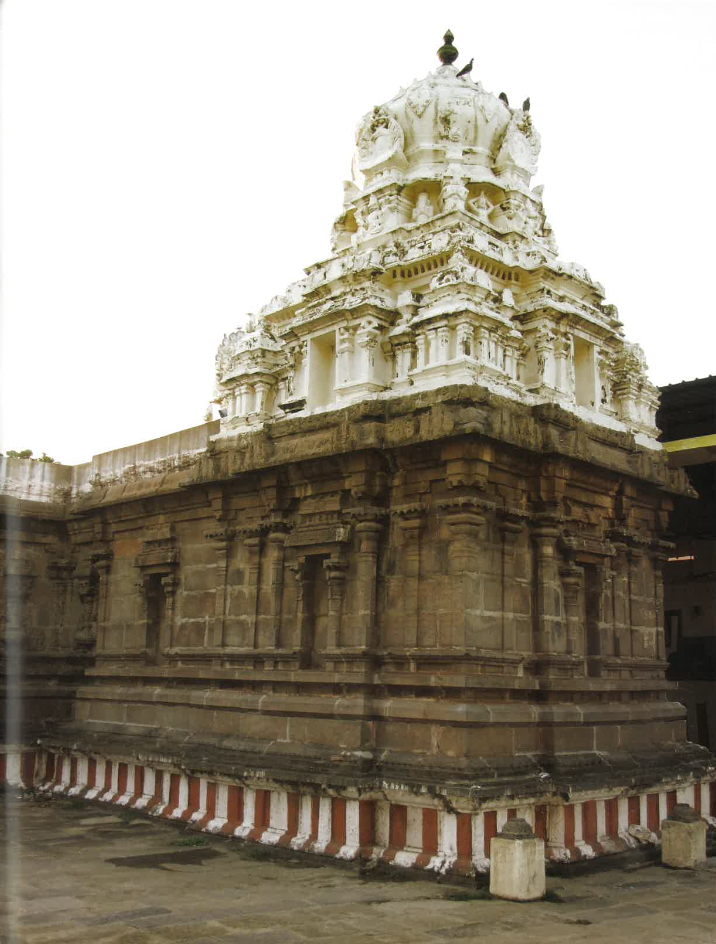
The temple is now a modest structure with a sanctum vimāna and a preceding maṇḍapa with some later additions. Viṣṇu is standing with eight arms wielding weapons. A sanctum with the preceding maṇḍapa was built in the time of Kulōttuṅga Cōḻa whose inscription is found on the south wall of the sanctum tower (figs. 6.1-6.2). Possibly, the present sanctum tower was built over a base of Rājēndra’s time which is found on the base. A preceding mahā-maṇḍapa has been added in the Vijayanagara period. There are not many sculptures, but, the bronzes belong to Vijayanagara period. The base of the front maṇḍapa has Vijayanagara inscriptions. The floor on the front yard carry sand stone blocks usually found in Pallava period. The entrance gopura of the temple is found on the northern side of the temple which shows the main population was on the northern side from the Vijayanagara times. It is possible that the main route from Kaccippēḍu to the Attiyūr (Varadarāja temple) remained the same as at present time. There is no other entrance to this temple except this north gopura. The door jambs of the gopura carry the usual latā-kanyas and sculptures encircled by creeper designs. The one on the western sides carries Balarāma and Kṛṣṇā together, while all other avatārs are shown sepertely in a sequence.
fig. 6.1. Aview of the main vimāna of the Aṣṭabhujakaram-svāmi Temple of Kāñci. The base contains an inscription of Rājēndra Cōḻa (11th century) and the wall, an inscription of Kulōttuṅga I, early 12th century.
fig. 6.2: The kumbha-pañcara motif flanked by pilasters, in the Aṣṭabhujakaram Temple.
6.1.2. Inscriptions
The north wall of the central shrine of the temple carries an inscription of Rājēndra Cōḻa I (1034) recording the gift of 1000 kuḻis by land and of 3600 kuḻis by purchase for 47 kaḻañju of gold gifted by the residents of Kāñcipuram in Eyir-koṭṭam, a district of Juyaṁkoṇḍa-cōḻa-maṇḍalam. The proceeds were to be utilized for conducting worship for food offerings, to god Aṣṭabhuja-swāmi and also for burning a perpetual lamp. ( ARE 6/1921).
Evidently, the present structure is to be attributed to the time of Rājēndra Cōḻa. On the south wall of the main temple are two inscriptions of Kulōttuṅga Cōḻa. The first one refers to the gift and sale of a land by the assembly of Rājasundari-caturvedi-maṅgalam, a Brahmadeya in Virpeḍu-nāḍu, a subdivision of Kīḻaiyūr-koṭṭam Jayaṁkoṇḍa choḻa maṇḍalam. The proceeds from this village was to be used for the expenses of kitchen. (ARE 8 of 1921)
The second inscription of Kulōttuṅga is in continuation of the above and record tax-free gift of land to the temple for the same purpose by the same villagers of Rājasundari-caturvedi-maṅgalam. This record stipulates theat no tax should be levied for two years from the date of gift, but later not more than half a kāsu should be levied for each vēli of land. (9/1921).
The front maṇḍapa carries later inscriptions of Vijayanagar period. The one on the south base of the maṇḍapa records an agreement given by Nallamaṅgai, wife Appā-aiyangār, by the temple authorities including Tiruppaṇi Siṅgayyaṅgār, the agent of Tirumalai Tāttayyaṅgār. The agreement provides for certain offerings to the god from the proceeds of land gifted by the lady mentioned above, at Naṟṟā-nallūr alias Rāmabhadra-puram.(10/1921)
The other record on the north base registers exchange of lands between the residents of Amara-maṅgalam and the residents of Naṟṟā-nallūr which were gifted to the temple through Etirāja-aiyangār, for certain offerings. (ARE 7 /1921).
The legend of Sarasvati’s quarrel with Brahmā and her attempt to destroy the yajña sacrifice of Brahmā is associated with this temple as well. She is said to have first sent a group of demons which were destroyed by Viṣṇu. Then she sent Śiva as Sarabha, a peculiar lion-bird form with eight legs and wings, but, Viṣṇu himself took a similar form and destroyed the Sarabha. It is the Vaiṣṇava version of how Viṣṇu destroyed Śiva. It seems the Vaiṣṇava’s were totally against the Goddess Sarasvati (jñāna) fighting in every Viṣṇu temple of Kāñci with her husband Brahmā who in order to save his devotees destroyed the evil designs of jñāna. The concept of prapatti i.e., total surrender to the Supreme god Vāsudeva has no use for jñāna. So, the Goddess portrayed as an antagonist of Viṣṇu.
The Sarabha form of Śiva emerges into limelight from the middle of Cōḻa age, from the time of Vikrama Cōḻa, 12th century, that portrays Śiva with multiple legs, arms, a lions face and wings, pounces on Narasiṁha who is shown caught between the legs of Sarabha. According to the legends when Viṣṇu destroyed Hiraṇya demon as Narasiṁha the fight was very severe, and Viṣṇu’s anger did not abate as he started causing havoc to the world. The Devas requested Śiva to save the world from the disasters. In response to the request Śiva took the form of Sarabha and subdued the anger of Narasiṁha. Vaiṣṇavites consider this to depict hte rivalry between Vaiṣṇavism and Saivism. But this is not the case. The Paurāṇika myth-makers used to state that when there ensued any severe fight the anger of the victor continued to overflow and needed some other force to subdue it. For example, when Kāḻi fought with the demon Tārakāsura, her ferocious anger continued and she started affecting the world. The devas requested Śiva who appeared as a child and started crying for milk. Kāli’s motherly instinct made her take the child and feed him milk with her breast. Śiva sucked her anger along with the milk. In this legend Śiva and Kāḷi belonged ot the same sect and it does not exhibit any rivalry. But, this legend, a later invention of the Vijayanagara times in the 16th century, made ti a rivalry and introduced a legend of Viṣṇu assuming the form of a monstrous bird animal and pouncing on Śiva-Sarabha in the temple of Aṣṭabhuja Viṣṇu at Kāñcipuram. Beyond Viṣṇu’s appearance, the story has no other legendary content and certainly reflects hte Vaiṣṇava-Saiva rivalry. The temple authorities at Kāñci say that there existed an image (sculpture of Sarabha) within the Aṣṭabhuja temple till recent times which they used to associate with this legend. The mere presence of a Sarabha sculpture does not justify the legend. It is not unlikely that a loose sculpture belonging to a nearby Śiva temple might have found its way to this temple that triggered the imagination of myth-maker to create the story.
Another significant aspect of this temple is the presence of a door way called the Paramapada-vāsal. According to a faith during the Vaikuṇṭa-ekādasi festival the processional deity of Viṣṇu used to be taken through this door way which is said to be the doorway to Vaikuṇṭa, the abode of Viṣṇu. The devotees believe that following the festive Viṣṇu through his way on that day will ensure the devotee to go to Vaikuṇṭha at the time of liberation. Such a door way exists in all the temples of Viṣṇu in Tamil the one at Śrīraṅgam is the most famous of such a doorway. However, strangely no other Viṣṇu temple at Kāñcipuram has this door and so this temple is considered sacred on that account.
The temple attracts considerable number of devotees at Kāñcipuram though smaller in diamension when compared to the temples of Varadarāja, Ūraham and Thiruvehhā.
6.2. Dīpa Prakāśa temple
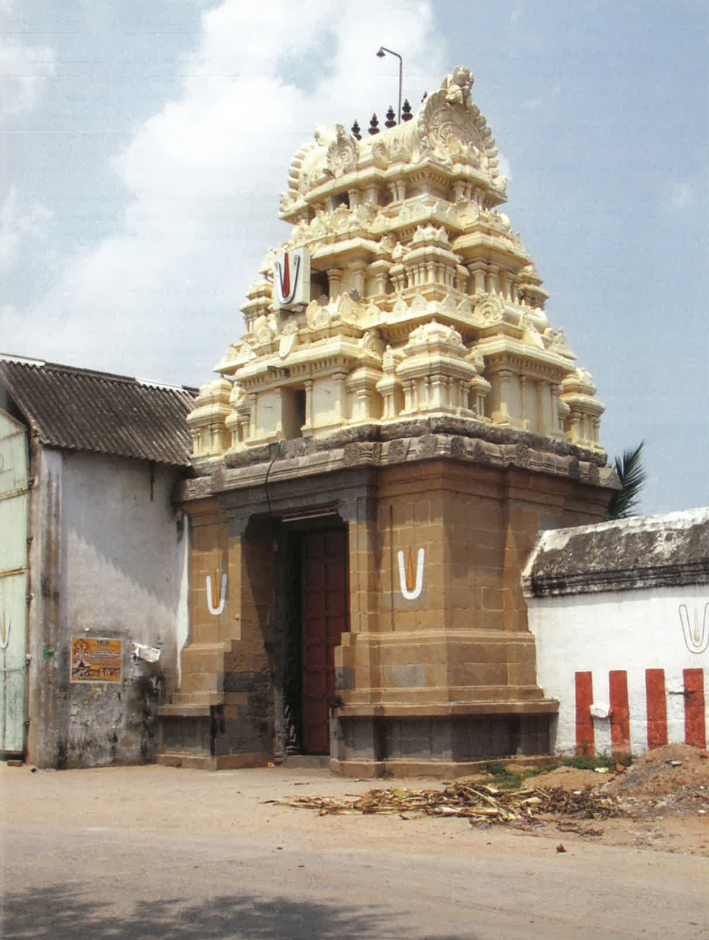
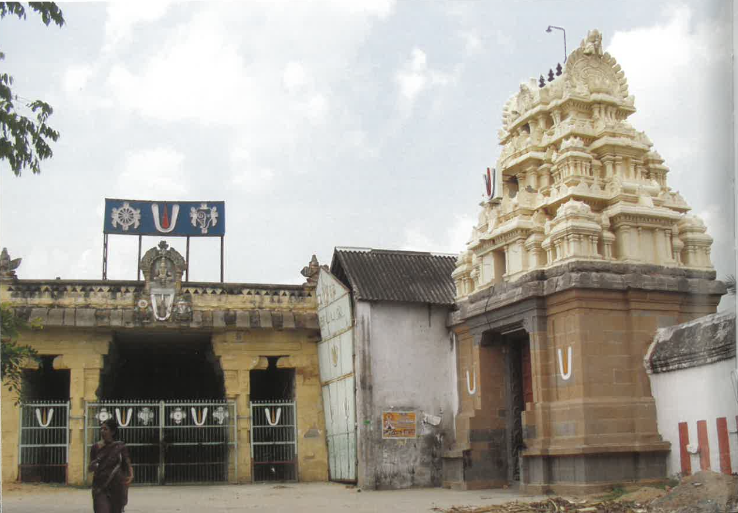
This temple also located within the old city limits of Kañci has an added attraction (fig. 6.3). Besides being a divya-kṣetra of Viṣṇu, ti has a temple nearby which was the birthplace of the great Vaiṣṇava scholar Vedānta Desikar. This Desikar temple (fig. 6.4) has the portrait of the scholar-saint in the sanctum, surrounded by a closed enclosure, he is affectionately called Swami Desikan, as his contribution is immense both to Sanskrit and Tamiḻ Vaiṣṇava literature. The Dīpa Prakāśa, i.e., “The shining lamp” is situated in the midst of an impressive enclosure but the main temple is modest, with a covered inner enclosure. Dīpa Prakāśa is a Sanskrit rendering of the Tamiḻ term “Viḷakkoḷi Perumāḷ” — viḷakku, i.e., lamp and oḷi is light. The temple is sung by Āḻvār - Tirumalai in the eighth century, and is therefore anterior to that date. The Āḻvār sings the god as Viḷakkoḷi.
fig. 6.3: The gopura of the Dīpa Prakāśa Temple, in the ancient limit Kaccippēḍu.
fig. 6.4: The gopura of the Dīpa Prakāśa Temple, Kāñcipuram. Behind the grill gate is the temple of Vedānta Deśikar.
The legend of Sarasvati’s feud with Brahmā is repeated here. She is said ot have become furious when Indra and Brahmā declared Goddess Lakṣmi as superior to Sarasvati, as Lakṣmi confers wealth and plenty. So, Sarasvati is said to have sent a terrific fire to destroy the sacrifice of Brahmā. But, Viṣṇu reduced that fire into a small lamp and hence Viṣṇu was called Viḷakkoḷi. This legend seems ot be a manifestation of attachment of Vaiṣṇava to pleasures of wealth and plenty. Noting the weakness of this story, another story is told in this temple. The furious Goddess Sarasvati sent a thick cloud of darkness that engulfed the world, when Viṣṇu appeared as a lamp and illuminated the world and hence he is called Viḷakkoḷi (“light of a lamp”). This story is an extension of Vedic idea wherein Viḷakkoḷi stands for shining - spreading brightness and this is in tune with the nature of Viṣṇu.
6.2.1. Inscriptions
Three inscriptions are found on the walls of this temple. The earliest inscription is that of Cōḻa king Rājarāja I (1223) which records a gift of lands by the residents of Viḷakkoḍu, as directed by Madhurāntaka Poṭṭāppi Cōḻaṉ. The land was situated in the same village and was to be used to meet the expenses of offerings to Viḷakkoḷi Perumāḷ and Tiru-Vēlirukkai temple in the proportion of 2:1. The present structure of the main temple is dated around CE 1200.
Another inscription that runs on the southern and eastern bases of the main temple records a gift of a village in Eṭaip-pākkam, in Venkunṟak-kōṭṭam, for carrying out repairs to the temple of Tiruttāṅgal Viḷakkoḷi Perumāḷ. It also states that repairs were being supervised by Raṅgarāya of Elaṅkuḍi in Pāṇḍi-maṇḍalam, on behalf of the king. Evidently, the region where this temple is located was called Tiruttāṅgal in ancient times.
A third record found on the left face of the entrance is in Sanskrit and states that Aḻagiya-maṇavāaḷa-jīyar constructed the prākāra and maṇḍapa in the temple. The present covered enclosure around the main shrine and the preceding maṇḍapa were probably the ones constructed by Aḻagiya-maṇavāaḷa-jīyar.
Neither the architecture nor any sculpture are of great beauty in this temple but its fame and antiquity and the proximity to Vedānta Desika shrine attracts pilgrims in large numbers.
6.3. Nilāttiṅgaḷ Tuṇḍam
Another celebrated temple of Viṣṇu in Kāñcipuram, is Nilāttiṅgaḷ Tuṇḍa, celebrated by Āḻvār Thirumaṅgai, Situated now within the inner enclosure of Ekāmra Nātha temple. this is the only Viṣṇu temple of the 108 Divya desa in Kāñcipuram, where a Śaiva priest performs the worship in the shrine. It id not a separate temple but a part of the second prākāra- enclosure. The God is standing and is of imposing height. As the temple is within the enclosure of the Śiva temple, a Śaiva priest worships the deity. As it is in the Ekāmramātha temple it is also situated within the ancient city of Kaccipedu.
6.7. Pavaḻavaṇṇar Temple
The temple of Pavaḻavaṇṇar at Kāñcipuram is another Divyadesa , where the deity is coral in colour, seated beneath a five hooded cobra Ananta. The temple faces west, and is located within the old city of Kacchipedu. It is said that the God assumed different colours in four different Yugas, the four colours being white, coral, green, and blue. The coral colour was assumed in Tretayuga by Viṣṇu. Thirumangai Āḻvār in one verse refers to Viṣṇu as Pavaḻavaṇṇar, which does not address this deity as located in Kāñci but says that lord is on the peak of Himalayas. However as a reference to Ūraha of Kāñci, the Pavaḻlavaṇṇar temple is also considered as in Kacci and included in the list of 108 Divyadesa. It is likely that among the four Vyuha forms of Viṣṇu each is given a particular colour mentioned above. The coral colour is ascribed to Saṁkarṣaṇa and this temple may be asceibed to him.
A legend states that the sage Bhrigu kicked Viṣṇu on his chest as he did not receive him respectfully. Viṣṇu got up and instead of retorting angrily asked the sage whether his leg was hurt as he kicked. So saying Krishna started massaging the sage’s foot that brought the sage to senses. It is said that the legend illustrates the kindness of Viṣṇu-[Saulabhyatā] As the sage found lord Viṣṇu full of sāttvika bhāva, he was declared Viṣṇu as the most-superior among the Trinity . However as Bhrigu kicked the Lord he wanted to atone for his sin. The Lord directed him to go to Kāñci and worship him. The temple has no pretensions to great architecture or sculpture. But the main deity seated on the couch of five hooded cobra, with four hands is majestic and attracts attention.
6.8. The temple of Narasiṁha
The temple of Narasiṁha, also called Alagiyasingar, is located in a locality called Veḷukkai, a part of Kāñci. There are confusing accounts about this temple . According to a local tradition the deity originally was in standing posture and later the present seated Narasiṁha has been installed. The original temple was in a dilapidated condition first. As the Pārthasārathi temple of Thiruvallikkeni houses Kṛṣṇa and Narasiṁha so also it is not unlikely that both the standing forms of Viṣṇu and Narasiṁha could have been in the same complex and the Viṣṇu shrine fell into ruins. One of Peyāḻvār Pāsuram (poem), refers to the God at the great town of Veḷukkai. “Veḷukkai nil nagarvāy”. The poem seems to suggest that the temple was situated at the mouth of the town of Veḷukkai. Also it seems the temple had three forms of deity standing, seated and reclining [3417] . There is no reference however to the Narasiṁha temple. However in a verse Pillai Perumāḷ Aiyyangar, who is later in point of time and who has sung verses on all the Divyadesas of Viṣṇu, sings Narasiṁha, the Lord of Veḷukkai. He does nor refer to other forms.[3417].
In another verse Periyāḻvār , sings Veḷukkai as a place with lofty turrets. (On māda Veḷukkai-3446 In another verse the Āḻvār sings Veḷukkai with Vehha of Kāñci-3409.
One inscription [ARE/1921], is on the base of the north wall of the Alagiyasinga Perumāḷ temple . It calls the place Kacci irukkai in Kauchipuram.The date of the inscription is not available but records an amount of 12 pon given to Saṭgopaiyyaugār of Thirunārāyaṇapuram, from the proceeds of the village Nallāpillaiperrāḷ and that he had to provide for some offering to the deity in the name of Tāttācārya. The temple is not in good state of preservation
1. Peyāḻvār, Third Antāti (மூன்றாம் திருவந்தாதி)
தொட்ட படைஎட்டும் தோலாத வென்றியான்,அட்ட புயகரத்தான் அஞ்ஞான்று - குட்டத்துக்கோள்முதலை துஞ்ச குறித்துஎறிந்த சக்கரத்தான்தாள்முதலே நங்கட்குச் சார்வு (2380-2)உன்னிய யோகத் துறக்கத்தை, ஊரகத்துள்அன்னவனை அட்ட புயகரத்தெம் ஆனேற்றை,என்னை மனங்கவர்ந்த ஈசனை, - வானவர்த்தம்முன்னவனை மூழிக் களத்து விளக்கினை2. Tirumaṅgai Āḻvār, Periya Tirumaḍal 1120 (பெரிய திருமொழி).
செம் பொன் இலங்கு வலங்கை வாளிதிண் சிலை தண்டொடு சங்கம் ஒள் வாள்உம்பர் இரு சுடர் ஆழியோடுகேடகம் ஒண் மலர் பற்றி எற்றேவெம்பு சினத்து அடல் வேழம் வீழவெண் மருப்பு ஒன்று பறித்து இருண்டஅம்புதம் போன்றிவர் ஆர்கொல்? என்ன-அட்டபுயகரத்தேன் என்றாரே3. Tirumaṅgai Āḻvār, Periya Tirumaḍal 1118 (பெரிய திருமொழி).
திரிபுரம் மூன்று எரித்தானும் மற்றைமலர்மிசைமேல் அயனும் வியப்பமுரி திரை மா கடல் போல் முழங்கிமூவுலகும் முறையால் வணங்கஎரி அன கேசர வாள் எயிற்றோடுஇரணியன் ஆகம் இரண்டு கூறாஅரி உரு ஆம் இவர் ஆர்கொல்? என்ன-அட்டபுயகரத்தேன் என்றாரே4. Tirumaṅgai Āḻvār, Periya Tirumaḍal 1190 (பெரிய திருமொழி).
வெம் திறல் வீரரில் வீரர் ஒப்பார்வேதம் உரைத்து இமையோர் வணங்கும்செந்தமிழ் பாடுவார்-தாம் வணங்கும்தேவர் இவர்கொல்? தெரிக்கமாட்டேன்வந்து குறள் உருவாய் நிமிர்ந்துமாவலி வேள்வியில் மண் அளந்தஅந்தணர் போன்றிவர் ஆர்கொல்? என்ன-அட்டபுயகரத்தேன் என்றாரே5. Tirumaṅgai Āḻvār, Periya Tirumaḍal 1121 (பெரிய திருமொழி).
மஞ்சு உயர் மா மணிக் குன்றம் ஏந்திமா மழை காத்து ஒரு மாய ஆனைஅஞ்ச அதன் மருப்பு ஒன்று வாங்கும்ஆயர்கொல்? மாயம் அறியமாட்டேன்வெம் சுடர் ஆழியும் சங்கும் ஏந்திவேதம் முன் ஓதுவர் நீதி வானத்துஅம் சுடர் போன்றிவர் ஆர்கொல்? என்ன-அட்டபுயகரத்தேன் என்றாரே6. Tirumaṅgai Āḻvār, Periya Tirumaḍal 1122 (பெரிய திருமொழி).
கலைகளும் வேதமும் நீதி நூலும்கற்பமும் சொல் பொருள்-தானும் மற்றைநிலைகளும் வானவர்க்கும் பிறர்க்கும்நீர்மையினால் அருள்செய்து நீண்டமலைகளும் மா மணியும் மலர்மேல்மங்கையும் சங்கமும் தங்குகின்றஅலை கடல் போன்றிவர் ஆர்கொல்? என்ன-அட்டபுயகரத்தேன் என்றாரே7. Tirumaṅgai Āḻvār, Periya Tirumaḍal 1123 (பெரிய திருமொழி).
எங்ஙனும் நாம் இவர் வண்ணம் எண்ணில்ஏதும் அறிகிலம் ஏந்திழையார்சங்கும் மனமும் நிறையும் எல்லாம்தம்மன ஆகப் புகுந்து தாமும்பொங்கு கருங் கடல் பூவை காயாபோது அவிழ் நீலம் புனைந்த மேகம்அங்ஙனம் போன்றிவர் ஆர்கொல்? என்ன-அட்டபுயகரத்தேன் என்றாரே8. Tirumaṅgai Āḻvār, Periya Tirumaḍal 1124 (பெரிய திருமொழி).
முழுசி வண்டு ஆடிய தண் துழாயின்மொய்ம் மலர்க் கண்ணியும் மேனி அம் சாந்துஇழுசிய கோலம் இருந்தவாறும்எங்ஙனம் சொல்லுகேன்? ஓவி நல்லார்எழுதிய தாமரை அன்ன கண்ணும்ஏந்து எழில் ஆகமும் தோளும் வாயும்அழகியதாம் இவர் ஆர்கொல்? என்ன-அட்டபுயகரத்தேன் என்றாரே9. Tirumaṅgai Āḻvār, Periya Tirumaḍal 1125 (பெரிய திருமொழி).
மேவி எப்பாலும் விண்ணோர் வணங்கவேதம் உரைப்பர் முந்நீர் மடந்தைதேவி அப்பால் அதிர் சங்கம் இப்பால்சக்கரம் மற்று இவர் வண்ணம் எண்ணில்காவி ஒப்பார் கடலேயும் ஒப்பார்கண்ணும் வடிவும் நெடியர் ஆய் என்ஆவி ஒப்பார் இவர் ஆர்கொல்? என்ன-அட்டபுயகரத்தே என்றாரே10. Tirumaṅgai Āḻvār, Periya Tirumaḍal 1126 (பெரிய திருமொழி).
மன்னவன் தொண்டையர்-கோன் வணங்கும்நீள் முடி மாலை வயிரமேகன்தன் வலி தன் புகழ் சூழ்ந்த கச்சிஅட்டபுயகரத்து ஆதி-தன்னைகன்னி நல் மா மதிள் மங்கை வேந்தன்காமரு சீர்க் கலிகன்றி குன்றாஇன் இசையால் சொன்ன செஞ்சொல் மாலைஏத்த வல்லார்க்கு இடம் வைகுந்தமே