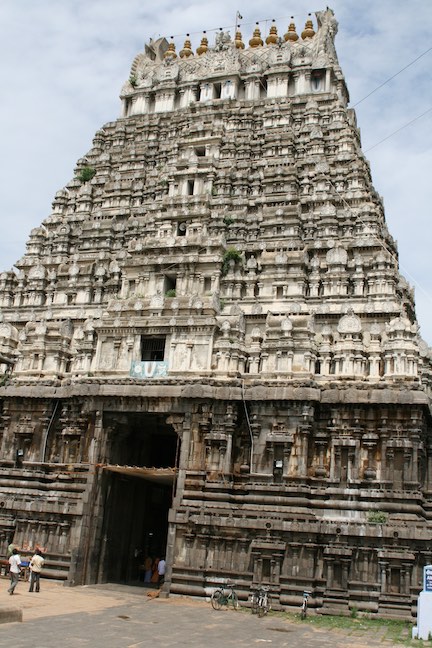
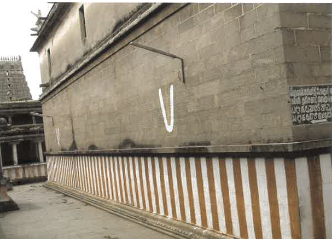
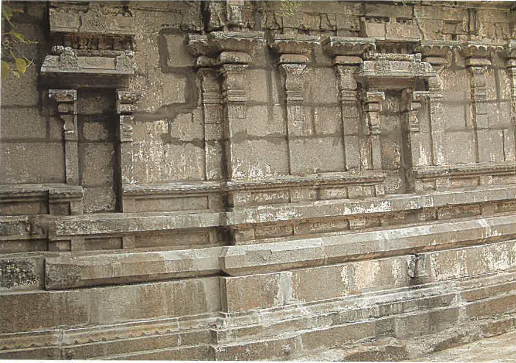
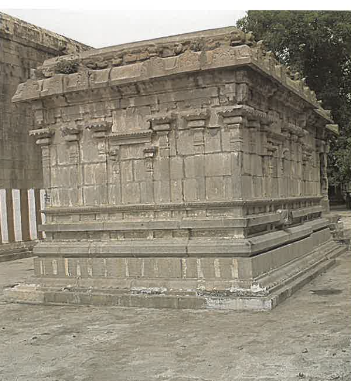
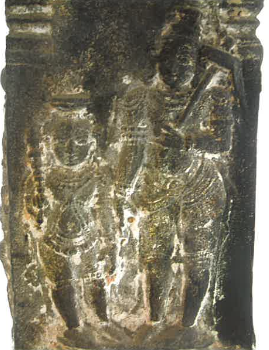
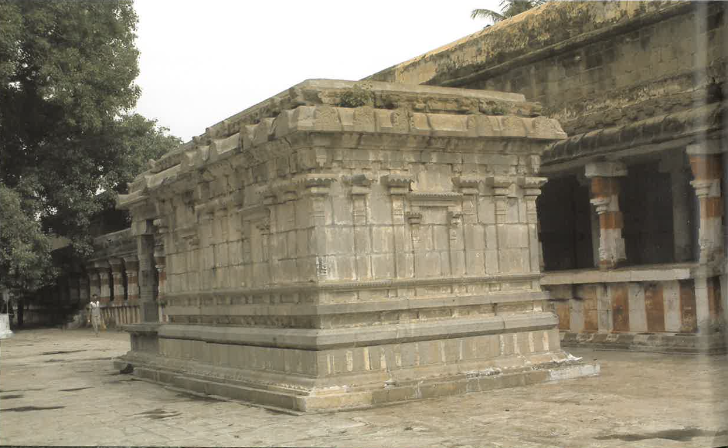
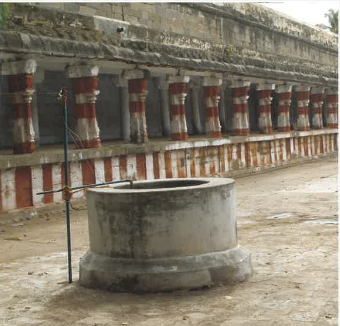
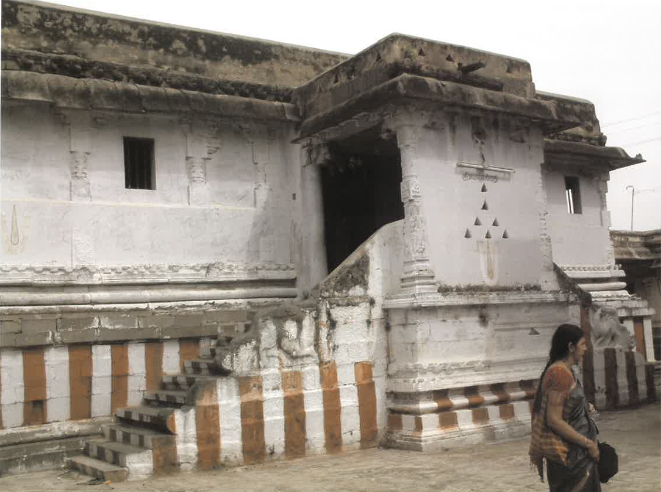
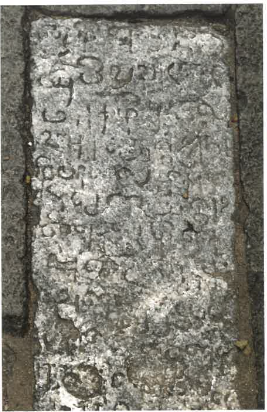
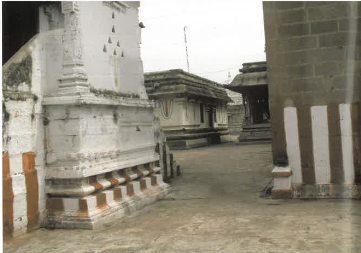
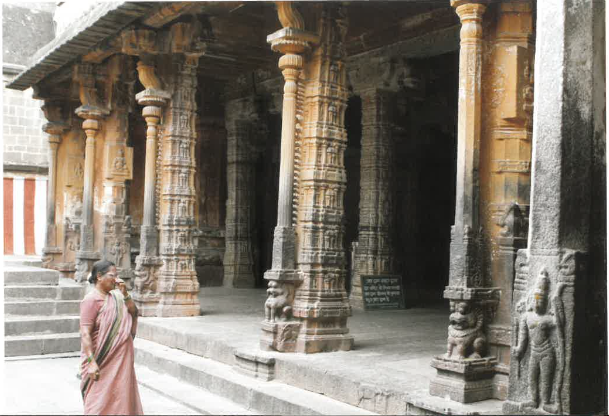
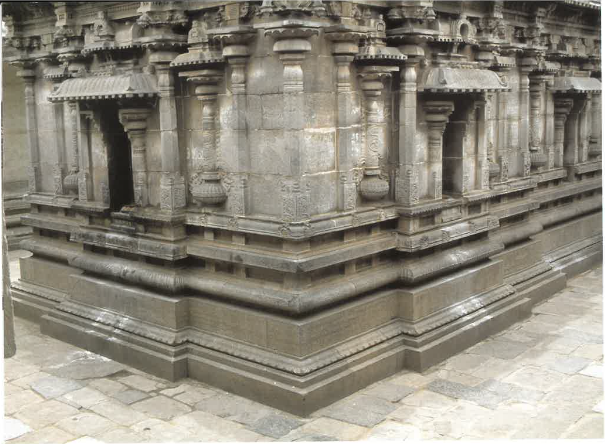
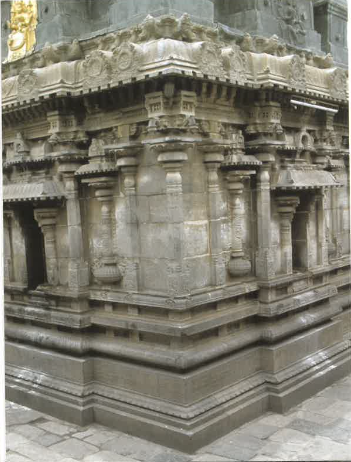
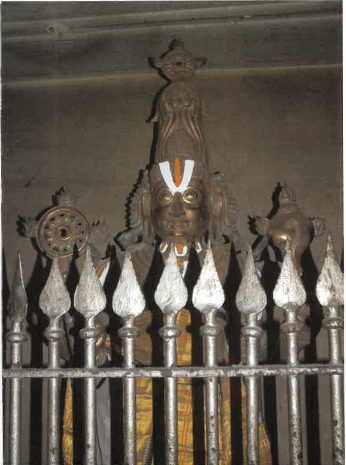
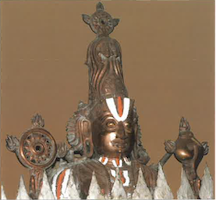
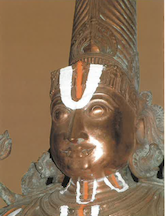
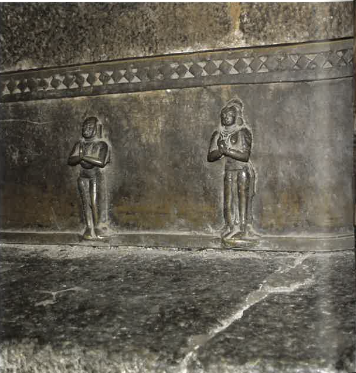
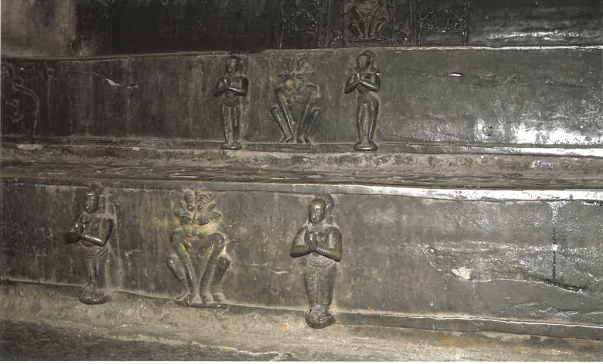
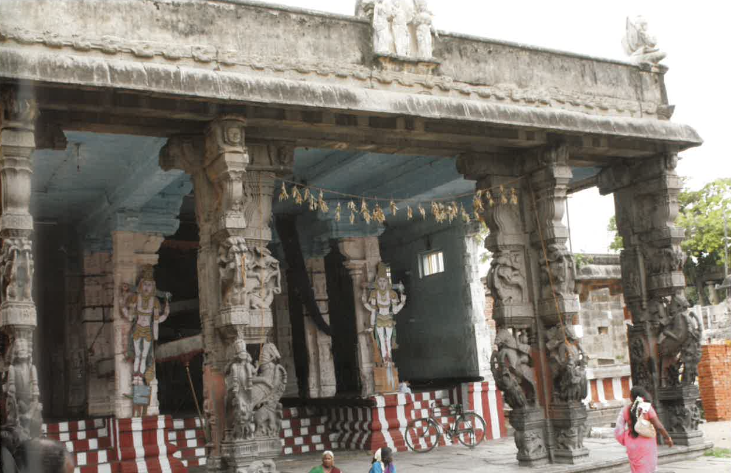
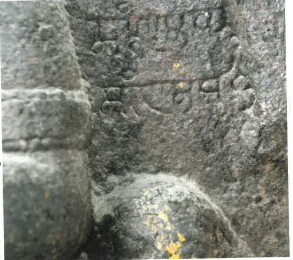
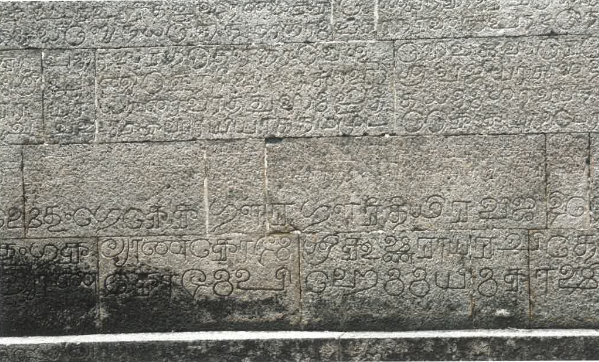
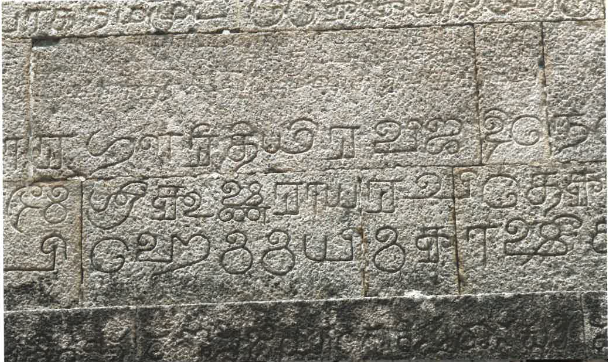
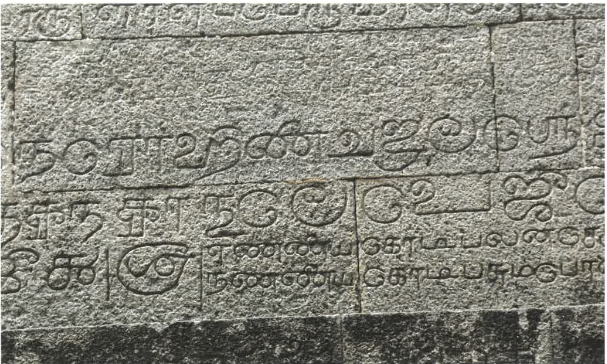
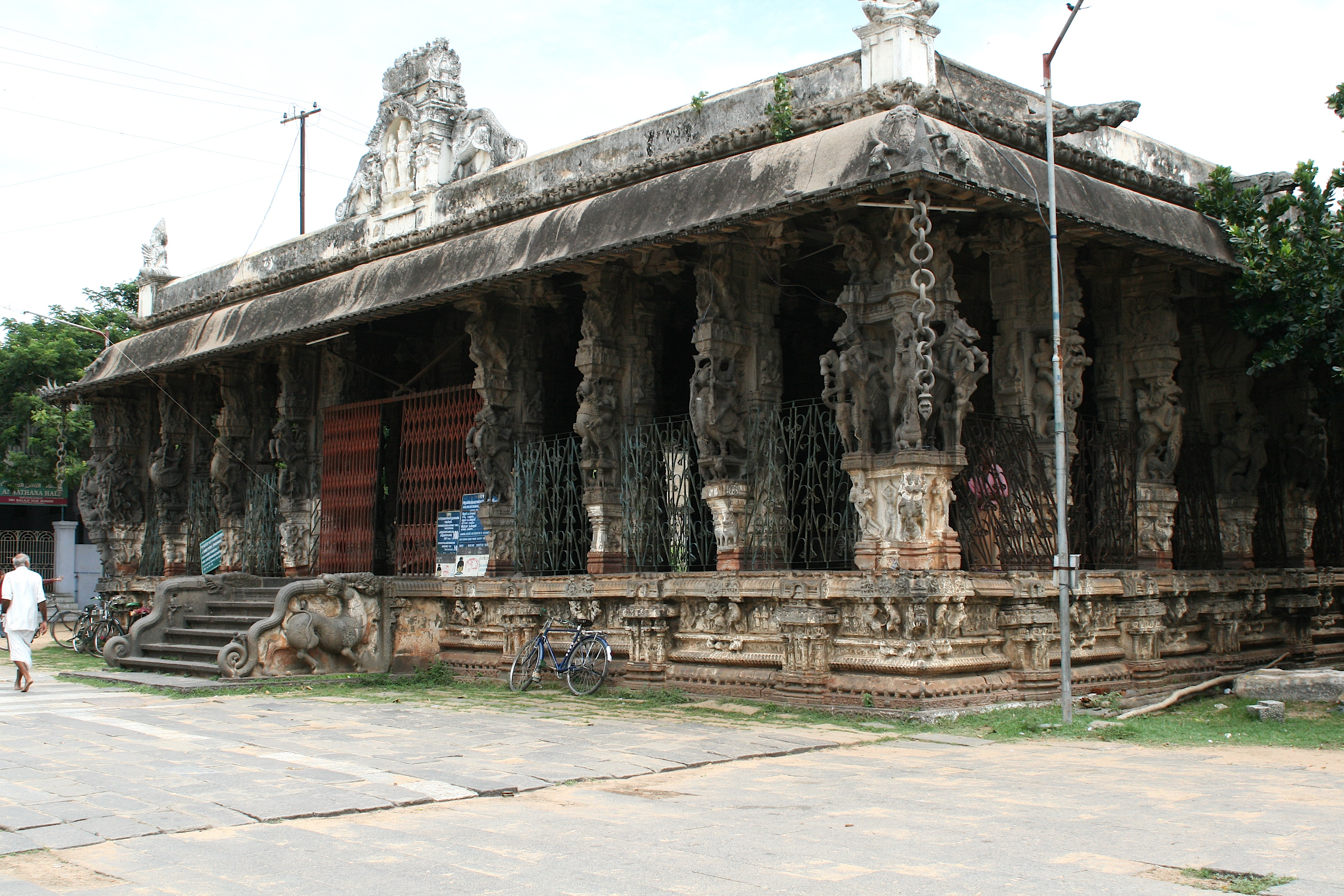
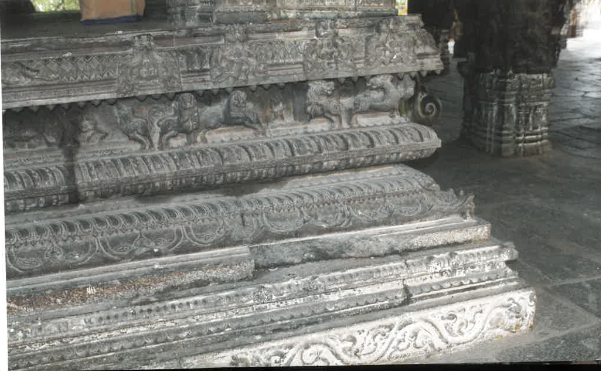
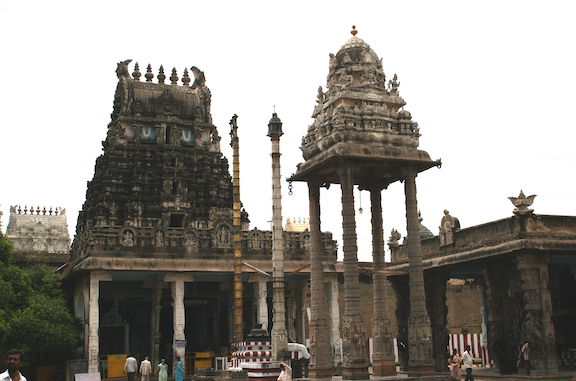
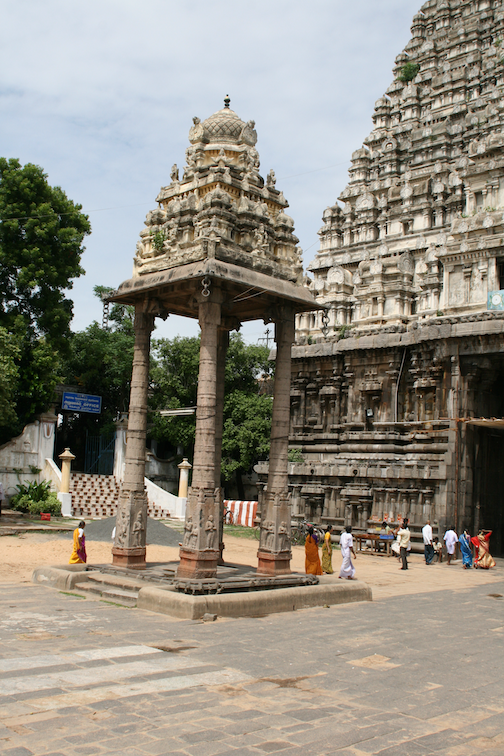
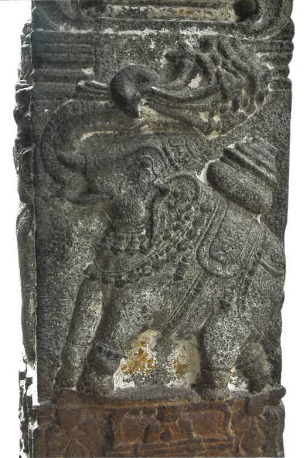
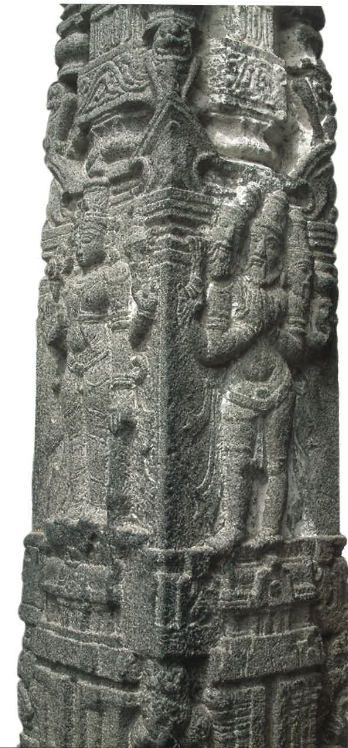
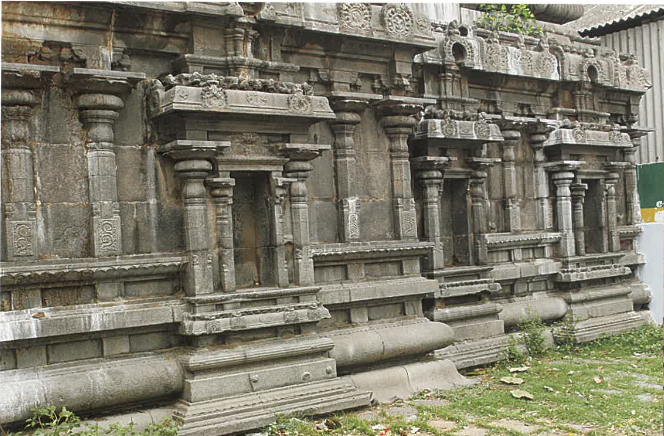
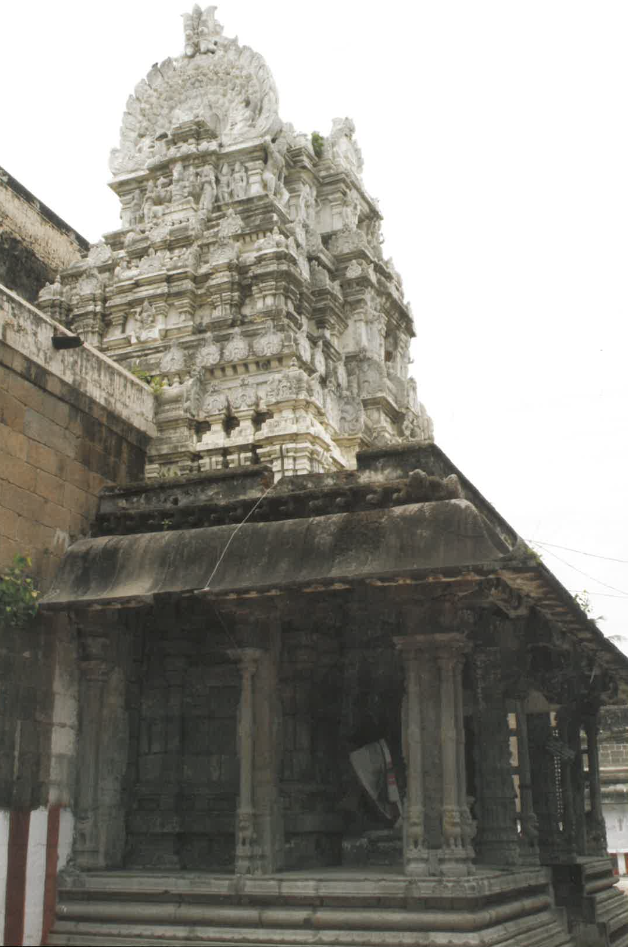
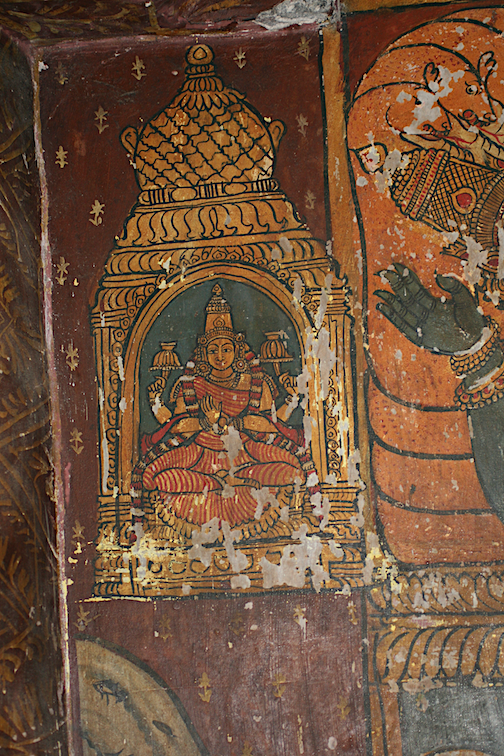
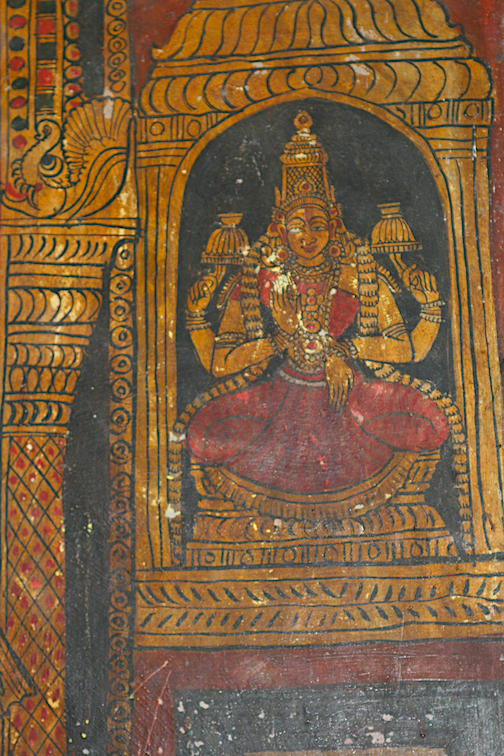
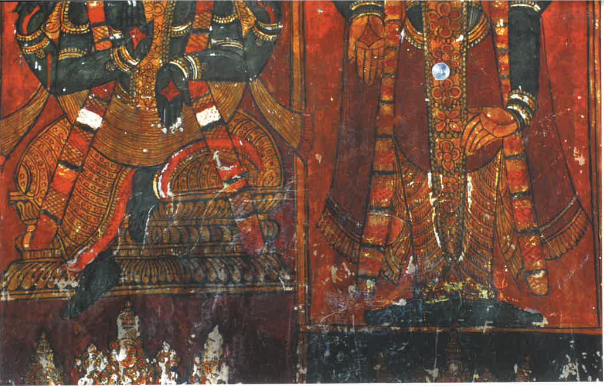
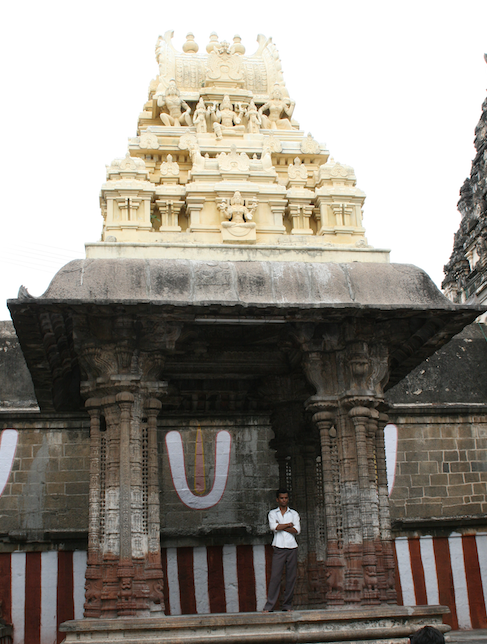
fig. 5.1: Varadarājā Temple, western gopura.
The Varadarāja Perumāḷ temple, dedicated to Viṣṇu, is the most famous Vaiṣṇava temple of Kāñci, included among the 108 divya-deśa list. It has given the region where it is located the name Viṣṇu Kāñci. The place was originally called Attiyūr, probably after the atti (fig) tree that abounded there, in the same way Kāñci was named after the Kāñci tree of the region. Interestingly, Attiyūr was only a small village outside the ancient city of Kāñci, and was an insignificant settlement. The original deity of the place was the Narasiṁha form of Viṣṇu, not the standing form of Viṣṇu as seen in modern times. Even in the time of the early Āḻvārs, it was the Narasiṁha form of Viṣṇu that received praise. However, around the 11th century, when the Cōḻa, particularly Kulōttuṅga I, built a great structure for the standing Viṣṇu, the Viṣṇu image began to assume greater importance. With the arrival of the Vijayanagara rulers and their constructions, gifts, and direct administration under the government, the temple grew in wealth, festivals, and proximity to royal power, increasing its popularity.
Another great factor that contributed to its popularity was the life of the great Vaiṣṇava Ācārya. Rāmānuja was intimately associated with it, particularly in his early years.
Further, the temple houses some remarkable architectural pieces that stand out as great achievements in modern times. The temple has received great studies in the hands of schoḻars and many publications have appeared. A very commendable work on the history, art, religion and inscriptions has been published by Prof. K.V. Raman. The temple unfortunately witnessed sectarian rivalry, and is well known for its strife between the southern and northern schools of Vaiṣṇavism, it is almost very difficult to write a book on this temple without touching the susceptibilities of either sections. But Prof. Raman has given a fine balanced account basing his conclusions on the epigraphical wealth, in that book “Śrī Varadarājāswami temple – Kāñci”, published by Abhinav Publishers, New Delhi, in 1975. Here, only an outline is given, mainly on its history and art.
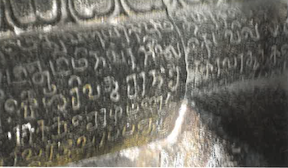
The original Narasiṁha temple, is built facing west with a garbha graha, mukhamaṇḍa and a preceding maṇḍapa, abutting a rocky boulder so much so it is a temple on a rock. Narasiṁha is brought under four categories as Bhoga, Yoga, Vīra and Ābhicārika Mūrtis, each one conferring respective benediction. But, generally the Vīra and Abhicarika forms are preferred by kings and warriors. In such cases they are installed away from the village settlement, preferably on hills or forests. It is likely that this Narasiṁha that has been installed on a hillock, away from the city of Kāñci was one such consecration. The earliest inscription to be found in the temple is that of Rājādhirāja Cōḻa I, the son and successor of Rājēndra I dated 1053 (KUR P.45). A gopura of moderate size is found in front of this Narasiṁha shrine, which has an inscription of Kulōttuṅga I dated in his 3rd year with an enclosure going around the hillock, the Narasiṁha temple serving as the centre. The Narasiṁha temple, gopura and the enclosure, were obviously built around 1050 CE in the time of the Cōḻas - probably Rājēndra I, in whose time several Viṣṇu temples were rebuilt, as at Brahmadeśam, Uttaramērūr, Ulakaḷanda Perumāḷ, and so on. The nucleus of this ancient temple consisted of this Narasiṁha temple, enclosure and the gopura. This enclosure is now called malai-pradakṣiṇam (the enclosure of the mountain). The hillock in the centre, was fully visible then.
5.2. Kulōttuṅga’s Contribution
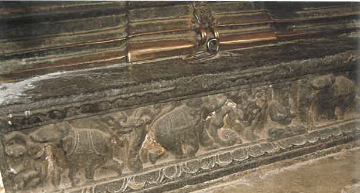
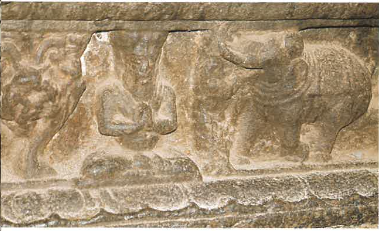
The next stage in the development of this temple is encasing the hill with granite walls and setting up a shrine for the standing image of Viṣṇu on top of the hill, probably in the time of Kulōttuṅga Cōḻa around 1100 CE. This standing image of Viṣṇu was called “aruḷāḷap perumāḷ” or “peraruḷāḷar”. In level with the summit of the hillock, a flat flooring was laid and over that was built a temple, may be with a sanctum of the present dimension. A flight of steps was provided on the south eastern part. The walls encased the hillock looked like a sanctum on top of the Narasiṁha shrine, with aruḷāḷa perumāḷ also facing west like Narasiṁha. It looked like a two storied Vimāna with Narasiṁha on the ground floor and the shrine of Aruḷāḷa on the upper floor. The shrine now encasing the hillock, was also called giri-hill. As the village was called Attiyūr, the encased rock and the God above came to be called Atti-giri-nātha. The word atti is the Tamiḻ form also for ‘hasti’ i.e., Elephant. So, the name got transformed into Hasti-giri-nātha, i.e., the lord of elephant hill.
This temple on top of the hillock began to gain greater popularity as the Cōḻa kings showed great interest in it from the time of Kulōttuṅga I and his successors. Inscriptions of Kulōttuṅga Cōḻa I, his son Vikrama Cōḻa, his son Kulōttuṅga II, and his son Rājarājā II are found on the south and east walls that encase the hillock, attesting to the fact that the temple was built earlier, during the reign of Kulōttuṅga I. Some inscriptions of Rājādhirāja, Virarājendra Cōḻa, Kulōttuṅga, and Vikrama Cōḻa are also found inside the Narasiṁha shrine below. Thus, the present central shrine and the enclosure were the works of the Cōḻas.
With growing popularity, the Cōḻa contributions began to overflow the main enclosure. It seems the third prākāra – now called maḍap-paḷḷi prākāra, also known as yamunai-turaivan prākāra – was laid and built during the time of Vikrama Cōḻa. On the northern side of this courtyard is a small temple dedicated to Viṣṇu, called Kari-māṇikka Perumāḷ. An inscription on the temple states that Vikrama Cōḻa built it for Karimāṇikka-āḻvār in 1129 CE (KVR-46). This temple also faces west.
5.3. Temple of Balarāma
In the north of this prākāra is the shrine of is Anant-āḻvār, built in the time of Kulōttuṅga Cōḻa III, in 1212 (35th year of the king), by one Sīyagaṅga, a son of Cōḻēndra Siṁha, a chief of Gaṅga family under Kulōttuṅga.
It may be mentioned that Ananta is identified with Ādiśeṣa whose sculptures are found in many Viṣṇu temples, along with the shrine of Kṛṣṇa, whose temple is some time referred to as Kari-māṇikkam. That the temple of Anantāḻvār is found in the same prākāra wherein the shrine of Kari-māṇikkam, erected in the time of Cōḻa Vikrama is also located. It is pertinent to point out that Balarāma, the elder brother of Kṛṣṇa is worshipped in his snake form as Ananta or Śeṣa. Balarāma represents bodily strength and virility and was the god of the agriculturists. Hence is shown with a plough as his emblem. Worship of Kṛṣṇa and Balarāma was very popular in Tamiḻnāḍu in the Saṅgam age as at Aḻgarkōyil. He is praised in Tamiḻ literature as the embodiment of strength (vali ottīye vāliyoṉ is a Saṅgam Tamil usage). The presence of the serpent Ananta, points out that it represents Balarāma, but for reasons unknown, the later Vaiṣṇavas seems to have eliminated Balarāma, and the snake is identified with the bed of Lord Viṣṇu. We have seen that a similar Anantāḻvār - as five hooded snake of ancient time is still under worship in the Ulakaḷanta Perumāḷ temple. It is not unlikely that the Anantāḻvār of the Varadarājā temple was also originally Balarāma, later worshipped simply as Ananta, the snake bed of Viṣṇu. There is a subtle difference between the worship of Balarāma as Ananta and the snake bed of Viṣṇu. In the former, it is the avatāra aspect of Viṣṇu along with Kṛṣṇa, while as the snake bed, will associate him with Viṣṇu in his supreme form.
On the north eastern side of the same prākāra is the thousand pillared maṇḍapa, called ‘āyirakkāl maṇḍapa’. Though this hall has not got 1000 pillars, the large member of pillars found attest to the claim. The maṇḍapa is in two stories. This was built in 1316, by the Kākatiya king Gaṇapati who occupied Kāñci for a short period in the beginning of 14th cent.
5.4. Kulōttuṅga’s Commander - Temple kitchen
There is a temple kitchen near this maṇḍapa, which is a Cōḻa structure built by the commander Naralōkavīra, who served under both Kulōttuṅga I and his son, Vikrama Cōḻa. Naralōkavīra participated in many wars waged by Kulōttuṅga I, including his Kaliṅga war. Besides being a great commander, he contributed to many temple buildings, such as the Chidambaram Naṭarāja temple, where he built the thousand-pillared hall. He also made several valuable gifts, including bronzes, cows, and lands for flower gardens, which form the subject matter of one hundred verses in both Sanskrit and Tamiḻ, inscribed on walls. Similarly, he made additions to the Tiruvadigai Vīraṭṭāṇa temple and other temples.
The fact that this great commander of Kulōttuṅga I constructed the kitchen in the Varadarājā temple shows that the animosity attributed to Kulōttuṅga I against Śrī Vaiṣṇavas is a total lie. We should not forget that most of the Viṣṇu temples of Kāñci, Śrīraṅgam, and other places received great benefactions during the time of Kulōttuṅga, as attested by his inscriptions found everywhere. We should also remember that this was the time when Rāmānuja was alive and active. We have no hesitation in dismissing the persecution of Rāmānuja by Kulōttuṅga I as a pure and simple myth, historically untenable.
Similarly, we have seen that inscriptions of Vikrama Cōḻa and Kulōttuṅga II are also found on the main walls of the Varadarājā temple, encasing the mūlasthāna rock. Some scholars suggest that the persecutor of Rāmānuja was Kulōttuṅga II. We may note that Kulōttuṅga II came to the throne in 1133 CE. All scholars categorically assert that Rāmānuja was born in 1017 and that he lived to be 120 years old. When Kulōttuṅga II wanted to persecute Rāmānuja, he is said to have migrated to Melkote near Mysore, where he stayed for 12 years, and after the death of the Cōḻa king, he returned. This is an absurd claim, for when Kulōttuṅga II ascended the throne in 1133, Rāmānuja was already 116 years old. That is, Rāmānuja lived only for three years of Kulōttuṅga II’s rule. Where is the question of Rāmānuja escaping to Melkote at the age of 116, staying there for twelve years, and then returning to Śrīraṅgam after the death of Kulōttuṅga II, and continuing to do his service for several years? These claims are absolutely impossible chronologically and would fail to convince even as fiction. The inscription of Kulōttuṅga II in the Varadarājā temple is sufficient to disprove this persecution myth.
5.5. The Cōḻa Phase
It is virtually the Cōḻa phase of the Varadarājā temple, up to the third enclosure. In addition to this structural phase and the gifts of the Cōḻas, we may mention in passing the gift of Vijaya Gaṇḍa-gopāla-deva, a Telugu ruler who served as the ruler of Kāñci under Rājarājā Cōḻa III. He seems to have been related to the ruling Cōḻa and served as the feudatory of the Imperial Cōḻa at Kāñci. He was a very great devotee of Aruḷāḷa-perumāḷ and instituted several special daily worships named after him as Gaṇḍa-gopāla-sandhi, as well as many festivals in different months of the year. There is no doubt that his contributions made this temple a great center of attraction, which was responsible for the subsequent disaster it met with in the hands of Muslim invaders in 1310 and later its re-emergence. We may say that his contribution was very much active up to 1300.
5.6. Alamkāra Maṇḍapa
As we enter the third prākāra - called the maḍap-paḷḷi māḷikai, we are in a long columned maṇḍapa, where recitation of sacred hymns take place. This hall precedes a encased maṇḍapa in which alaṅkāra of the deity (dressing and beautification of the deity) takes place and hence called the alankāra maṇḍapa.
5.7. Rāma Shrine
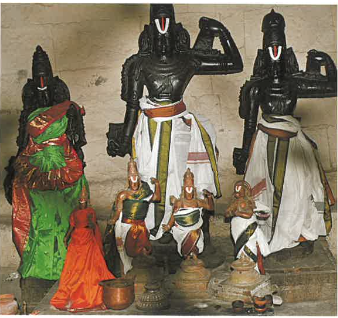
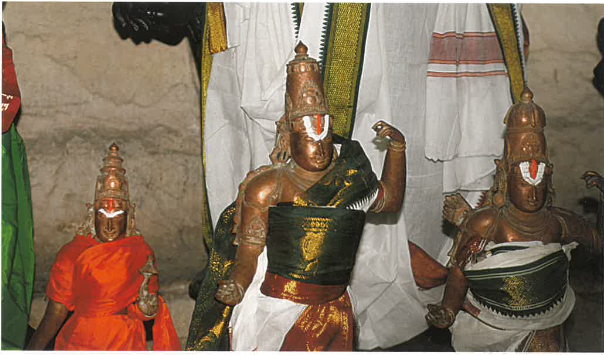
Towards the northern wing is seen the thousand pillared maṇḍapa on a raised platform. Towards the western end of this maṇḍapa is the shrine of Rāma, which houses both the stone and bronze images of Rāma, Sīta, Lakṣmaṇa, and Hanumān. The group of stone images are certainly imposing figures, about four feet in height and are of the age of Vijayanagara, late 16th cent. So are the bronze images which are about two feet in height.
5.8. Anantāḻvār’s Shrine
A part of the maṇḍapa with some architectural additions is used for Vedic sacrifices and is therefore called yāga maṇḍapa. Coming down the steps of the 1000 pillared hall, one reaches the floor of the maḍap-palli maṇḍapa kitchen. A few yards in front of the 1000 pillared hall, facing west is the temple of Anantāḻvār, consisting of a sanctum and preceding ardha maṇḍapa, all built of stone, upto the ceiling. The śikhara tower above the sanctum, is built of brick and cement in recent times. The main image in this shrine is seated on a five hooded serpent couch, with four hands, holding śankha and cakra in the rear arms and abhaya and kaṭihasta in the lower arms. He resembles seated Viṣṇu, with the addition of the serpent couch. The image is called Anantāḻvār, the serpent couch of Viṣṇu.
It is clear here Ananta is also identical with Ãdiśeṣa and the human form of the God, seated on the serpent couch represents Balarāma, the elder brother of Kṛṣṇa. It is known that in northern part of India, Balarāma worship was very popular from BCE, and that in many sculptures he is shown standing or seated with a five hooded cobra, the Ananta. It is also known that Balarāma was considered an incarnation of Ãdiśeṣa.
The adoration of Balarāma was equally popular in Tamilnāḍu, and he and Kṛṣṇa were praised together in many ancient poems of the Saṅgam age. There are pointed references to Balarāma’s invincible might (balā), while Kṛṣṇa was known for his fame. A Saṅgam poem in Puṟāṉanūru mentions these two well-known aspects of the Kṛṣṇa brothers. Balarāma was also called the white snake (veḷḷai nāgar), for whom temples were erected. There are also references to many temples where both brothers were worshipped together, such as at Aḻagarmalai and Iruṇḍavalam. It is also known that Balarāma was the god of cultivators and the pastoral community. He carried the plough as his symbol and was adored by cowherds, the Yādavas. The other group of the Vaiśyas, namely the traders, were also great devotees of Balarāma, and he is shown with a money bag. We have a famous town near Kanyakumari in the south called Nāgarkōil, where the principal god is Nāgarāja - Balarāma. This temple also houses a parallel temple to Kṛṣṇa. While Balarāma was known for his might, he was also given to drinking. Perhaps due to this trait, later Vaiṣṇava orthodoxy dropped the adoration of Balarāma. In modern times, the Vaiṣṇavas of Tamilnāḍu do not admit any devotion to him.
However, early temples of Kṛṣṇa or his other Avatārs, always houses the image of Balarāma - as a great snake - as at Ulakaḷanta Perumāḷ temple of Kāñci or as manifestation of Viṣṇu seated on the serpent couch, and worshipped him as Anantāḻvār - the personification of the snake-couch. There could be no doubt that the worship of Balarāma continues in many Tamiḻnāḍu temples in the form of Anantāḻvār.
In the Varadarājā temple, the image of Anantāḻvār is certainly Balarāma, as demonstrated by two interesting factors. Just a few yards in front of this Anantāḻvār shrine is another temple called Kariya-māṇikkam. This temple was built in the 12th century by the Cōḻa emperor Vikrama Cōḻa and is referred to as “Vikrama Cōḻa Viṇṇagar Āḻvār” in an inscription found on the base of the temple. Some gifts were also made in the 16th century under Vijayanagara rule. The old image, probably made of wood during the reign of Vikrama Cōḻa, was replaced by the present image, and the name Kariya-māṇikka Āḻvār became current. Kariya-māṇikkam is the name of Kṛṣṇa, sung as such by the Āḻvārs. Thus, it is a Kṛṣṇa temple. The presence of these two temples, one of Kṛṣṇa and the other of Balarāma, nearby in the same prākāra, points to the fact that the builders had Balarāma and Kṛṣṇa in mind.
The second point of interest in the temple is a pillar in the maṇḍapa preceding the Āṇḍāḷ shrine, in which the avatārs of Viṣṇu are sculptured. While all other avatārs are depicted as individual panels on the face of the pillars, when it represents Kṛṣṇa, both Balarāma and Kṛṣṇa are depicted in one panel, indicating that their adoration was together. It is a rare representation.
5.9. Kṛṣṇa Temple
The image of Kariya-māṇikka-āḻvār is shown standing with four hands, holding a śankha and cakra in the upper arms, and abhaya and kaṭi-hasta in the lower arms. Kṛṣṇa is flanked by his two consorts, now called ubhaya nāccimār, representing Rukmini and Satyabhāma. The inscription on the base states that Vikrama Cōḻa built the temple and called it Vikrama-cōḻa-vinṇgara-ālvār. There is also an inscription on the base dated to the Vijayanagar age. The present images in the sanctum were probably replaced during that time, as they are in the 16th-century style. This temple has no śikhara at present, which might have disappeared over time. The base, the wall, and the cornice show true Cōḻa characteristics.
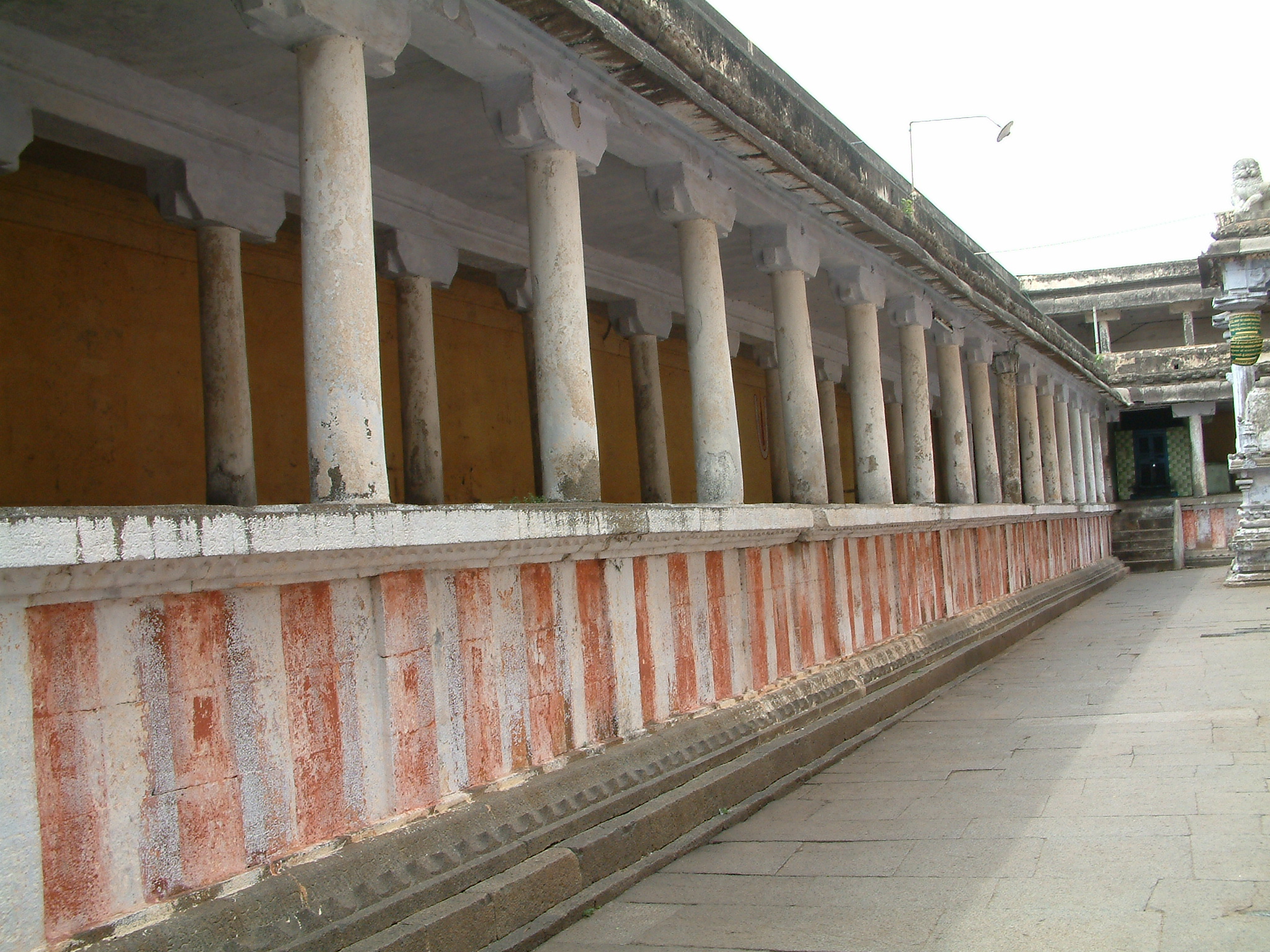
The prākāra named maḍap-paḷḷi-mālikā has a pillared cloister going around. A close study of the architectural details suggest that the portion at the back, that is the eastern prākāra, retains the Cōḻa embellishments, the northern and southern parts are some what of later date - may be 13th century. (An inscription suggests that this was built by Vijaya Gaṇḍa-gopāla, the Telugu Cōḻa, in the second half of the 13th century). The maḍap-paḷḷi (kitchen) seems to have been renovated in the 16th century.
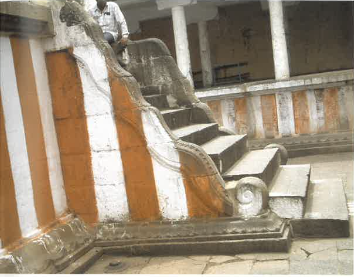
On the south-western corner the high steps of the Tāyār shrine open into this prākãra (fig. 5.22). The Tāyār shrine should have existed in the thirteenth-fourteenth century. Raman suggests that it was originally built in thirteenth century and later rebuilt in the Vijayanagara period. We shall discuss this further in the sequence.
5.10. Abhiṣeka Maṇḍapa
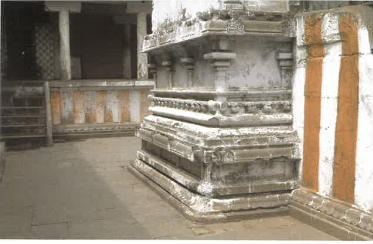
Immediately in front of the entrance gopura, is a maṇḍapa with an ornate base now caller abhiṣeka maṇḍapam. It was built by one Elambilakattu Nāyaka around 1230 CE in the region of the Cōḻa ruler Rājarājā III. It was then called Dēvamardevan. According to tradition, it was originally a shrine of Garudāḻvār, but later a portion was added in the Vijayanagara times. An inscription dated 1282 CE, refers to the Hoysala King Vīravallala and his queen seated in the maṇḍapam on a throne called Vallāla deva and listened to the hymns of Saṭagopa (Nammāḻvār). The long pillared maṇḍapa in front and side maṇḍapas were added in the 16th century.
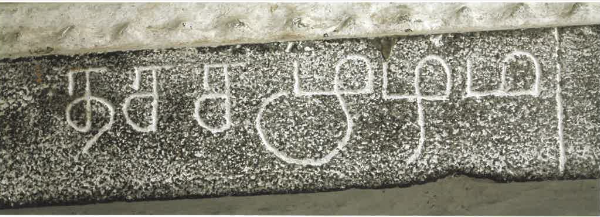
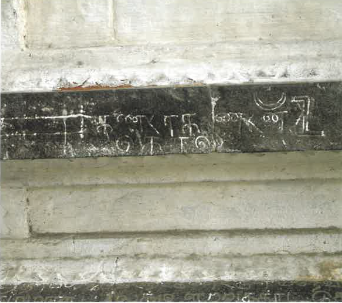
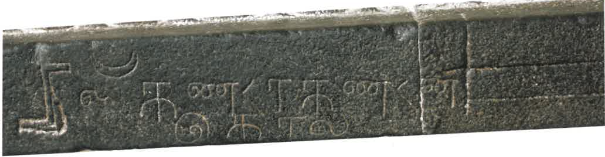
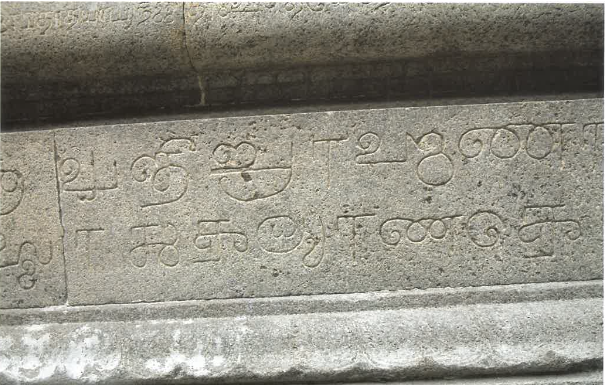
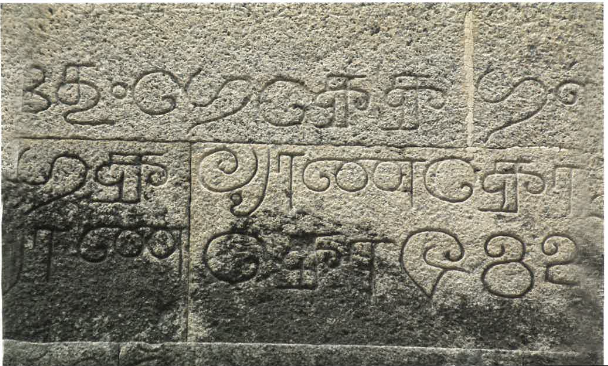
A point of interest, is on the base of the maṇḍapa there are two inscriptions one on the western base, there is a measuring rod with caliberation reading ‘Taccumuḻam’. It is the standard measuring rod used for structural construction like the maṇḍapa, vimāna, etc. On the southern base of the same maṇḍapa a long measuring rod inscribed with a name written at the beginning and end reading “kaṇḍara kaṇḍan kōl”. There are also some auspious symbols along with the name. This was the standard measuring rod for land survey, of streets, houses and cultivable lands etc. The whole city and its environments used these two measurements, in the 16th century. An inscription by the side is dated in the reign of Vijayanagara ruler in around 1530; and was inscribed when the front maṇḍapa was built.
5.11. Tāyār Shrine
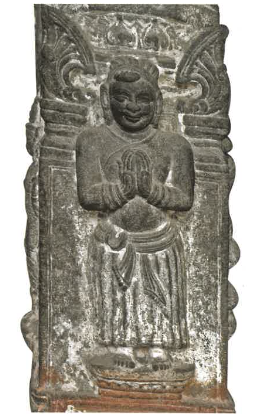
The temple of Tāyār in the third prākāra was built some time in 1235 in the time of Rājarājā Cōḻa I. In 1236, a gift of 3 cows is recorded in an inscription, for the temple of Periya-Pirāṭṭiyār. A gift is also recorded in the year 1265 ot this shrine under the Telugu Cōḻa, Vijaya Gaṇḍa-gopāla. The mukha-maṇḍapa of the shrine was built in 1259 by one Vaṅgaṉ-Kaliṅgarāyaṉ (figs. 5.29-5.30), whose portrait is also found on a pillar, with a label inscription reading ikappalūr udaiyār vaṅga kaliṅgarāyaṉ tiru maṇḍapam. Thus, the maṇḍapa was named after him. In the year 1487, the image of Perumdevi Tāyār was reconsecrated according to an inscription. It si not known whether ti refers to the rebuilding of the temple from its base, or was confined ot the image in the sanctum. The tenor of the inscription seems to suggest the work was confined to the main image of Tāyār.
It seems that the temple has been completely rebuilt from its base by Kṛṣṇadevarāya, as seen from some inscriptions on the walls that read Kṛṣṇa-mahārāja-kṛti. i.e., the work of Kṛṣṇa-mahārāja (figs. 5.31-5.38). While the Vimāna of Varadarājā was named Puṇyakōṭi when Kṛṣṇadevarāya rebuilt it and covered it with gold, the Vimāna of the Tāyār was called Kalyāṇakoṭi when he rebuilt it. The inscription in fact calls it “the one conferred one hundred auspicious things on Brahmins and hence called Kalyāṇakoṭi (figs. 5.38- 5.39).”. A little later, under Achyutarāya, his officer Eṭṭūr Kumāra Tātāchārya made more gifts.
The maṇḍapa in the front “mahānavami maṇḍapa”, with a colonade of horse rider motif and an ornamental base at the eastern end is said to have been built by a temple officer (kēḷvi) Aḻagiya-maṇavāḷa-jīyar in the middle of the 16th century. His portrait is found on one of the pillars.
We have seen that the second prākāra enclosure and the Hastigiri and a few shrines like Vikrama-cōḻa-viṇṇagar-āḻvār (Kariya-māṇikka-āḻvār)., Anantāḻvār and the second gopura and so on were the contribution of the Cōḻas and their immediate subordinates. However, we may say the 14th and 15th centuries did not witness great structural activities as the earlier Choḻa period. This was mainly due to the plundering of the temple treasures in 1310, during the incursions of Mālik Kaffur and later by Delhi Sultans. There were a few activities and gifts, but we may say they are sporadic and witnessed an age of struggle.
An important contribution in the 15th century, however deserves attention. Two dvārapālas of great height, rising to over six feet, of imposing beauty and workmanship, cast in copper, are found at the entrance to the main sanctum (figs. 5.41-5.43). A certain Vasantaraja of Reccarla, son of Anapoṭa and the younger brother Sarvajña Saṅga III, made and consecrated the two dvārapālas in the year 1437. He is said to be related to the Velama Nāyaka family. These two dvārapālas attract the attention among the metal images in the temple.
5.12. Kṛṣṇadevarāya’s Contribution
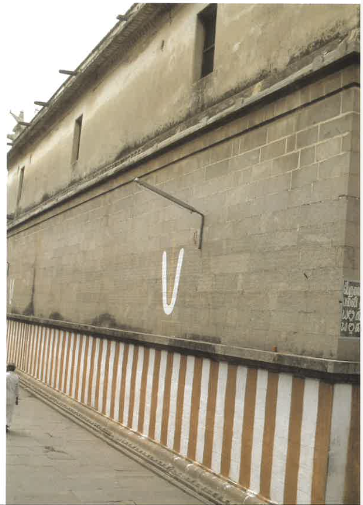
Again the revival and what may be called the golden age was 16th century, when Kṛṣṇadevarāya initiated great building activities and virtually made it a golden temple.Kṛṣṇadevarāya was an enlightened ruler, who, while enforcing his rule with great might and conquest all over the south, contributed immensely to art and literature. He was personally devoted to Viṣṇu, especially Kṛṣṇa, but like all great Hindu monarchs, worshipped Śiva with equal devotion and patronised all religions alike. The talest gopuras built in the south were his contributions. The gopura at Thiruvaṇṇāmalai, Kālahasti, Kāñchi, and Chidambaram, all dedicated to Śiva temples, are the talest structures and are of magnificant heights that formed the outermost entrance gopuras of these great temples. So much so all outer gopuras in Tamiḻnāḍu, were called “Rāyagopuras” after him (as he was called Rāya), Kṛṣṇadeva-rāya built the Eastern gopura in the Varadarājā temple as well. Though the city of Kāñci with its merchant streets and the ancient temples were to the west of the temple, a colony of considerable size was located in the east of the temple in his time. He also erected the huge compound around the Varadarājā temple as he did at the Ekāmranātha temple. Both in verticality and straight line, running to several hundred meters, the wall is a magnificant addition.
We have already noticed his contribution to the Tāyār shrine His main contribution was the rebuilding of the main sanctum, and covering the tower with gold and constructing the top enclosure by raising the height of the walls built in the time of Kulōttuṅga Choḻa I. He now called the sanctum towers of Varadarājā, “Puṇyakoṭi Vimāna”. He visited Kāñci between 1510 and 1528 frequently and worshipped Varadarājā Perumāḷ. He made gifts for the merit of his father Narasa Nāyaka and his mother Nāgala-devi. A great visionary, his inscriptions (figs. 5.55-5.58) in the Varadarājā temple are found in four languages - Sanskrit, Tamiḻ, Telugu, and Kannada. He made many gifts of jewels and appointed his own officers to control the affairs of the temple. His contributions are written in bold characters, above the inscriptions of later Cōḻas on the northern wall of the Hastigiri built by Kulōttuṅga I. His main contributions and direct administration were greatly responsible for the popularity of the temple in modern times. His period is the golden age of Varadarājā temple as both the main temple tower and the Tāyār shrine were covered with gold, and the loftiest gopura of the temple and the magnificent enclosure wall were built in his time. He also gifted many precious jewels and the temple car.
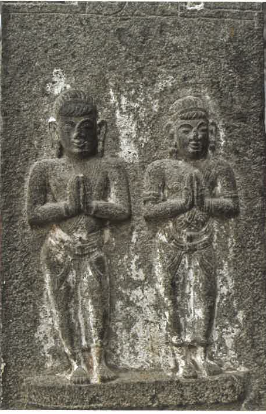
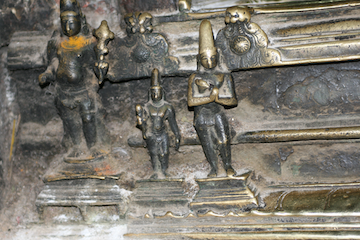
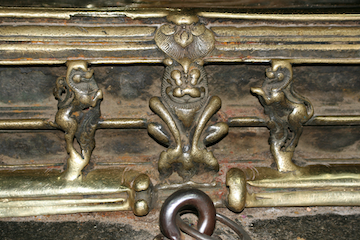
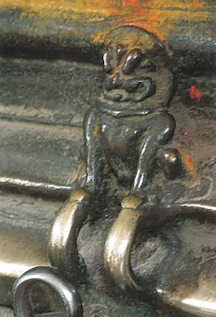
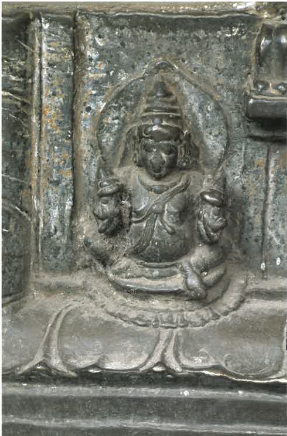
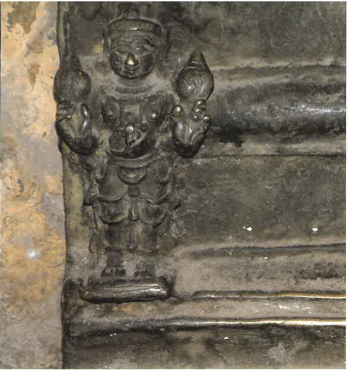
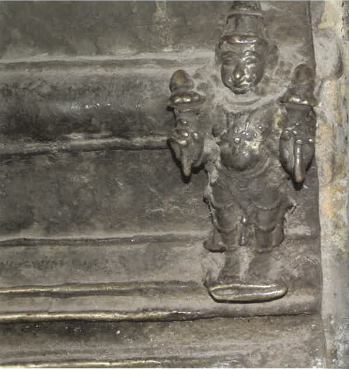
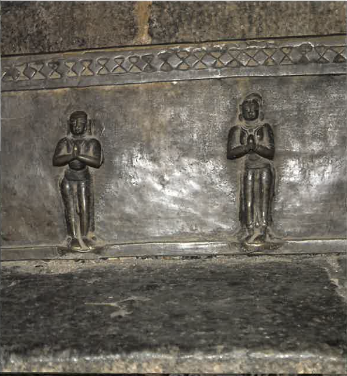
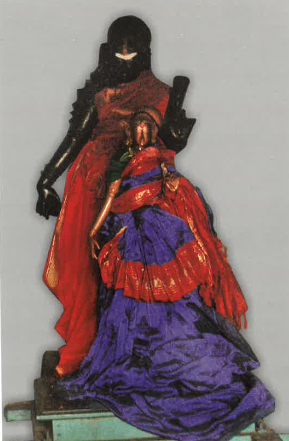
The entrance step to the inner enclosure of the Tāyār shrine is covered with a cast metal work of remarkable workmanship. It carries on the front some metal images at either ends and an image of Narasiṁha in the centre. The central figure of Narasiṁha does not show the Man-lion incarnation but fully a lion with four legs facing front. It is flanked by two makaras on either side. The end sculptures represents pair of dvārapālars. In addition it carries a pair of portraits one on either side. The one on the right side standinging in añjali pose is a royal portrait with a tall conical cap resembling the inscribed royal portrait of Kṛṣṇadevarāya at Thiruppati. He has a long bladed sword with sheath tucked under his left arms. Conceptuously, those who step inside through the steps do so under the survilence and protection of this king who was first and foremost devotee.
The vimāna wall on the south side carries an inscription of Kumāra-tātācārya that begins with the word Kriṣṇadevarāya krite, which points out that it was built by Kriṣṇadevarāya. The portrait on the metal step casing is evidently that of Kriṣṇadevarāya. The accompanying figure is that of his queen who is also wearing a long conical cap. Correspondingly on the other side is also a royal portrait also with a high conical cap. But he is without a sword. He is also accompanied by his queen. It may be Kriṣṇadevarāya’s brother Achyutadevarāya, who succeeded him. The presense of the portrait is important as they show that such tiny metal portraits of hardly two inches in height have been cast.
5.13. Kalyāṇa Kōṭi Vimāna
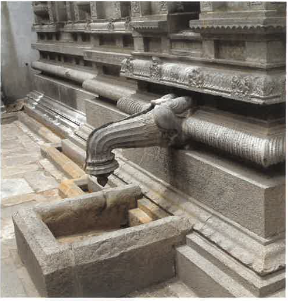
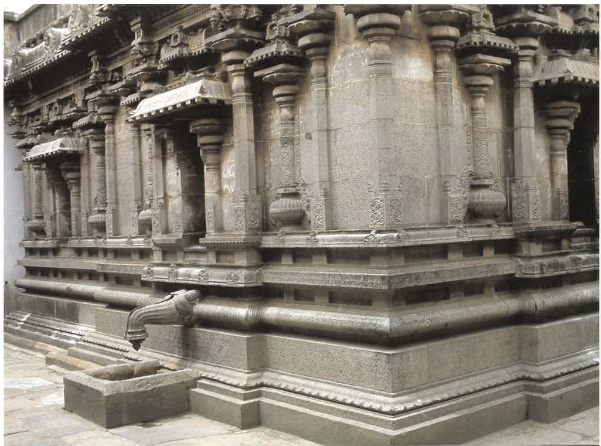
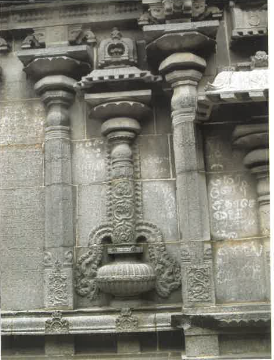
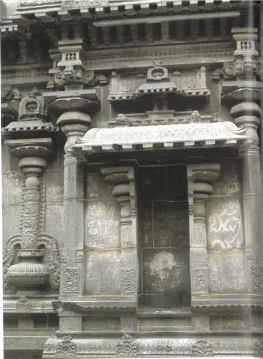
We have already examined the Tayãr temple. Dr K.V. Raman considers that this was built by Ettūr Kumāra Tātāchārya of 17th century. However, the body of the Tāyār temple has many inscriptions in Grantha script and Sanskrit language (fig. 5.31), specifically mentioning that it was the work of Kṛṣṇadevarāya (Kṛṣṇakṛte). Obviously, the Tātācarya mentioned must be Tāthaya-dēsika, the earlier ācarya of that title. The temple of Tāyār built entirely anew from base to finial is a work of Kṛṣṇadevarāya in around 1525 and is one of the finest architectural work of his. It was called Kalyāṇakoṭi Vimāna just as the main temple of Varadarāja was called Puṇyakoṭi Vimana. The inscriptions mentioning the covering of gold of both the main shrine of Puṇyakoṭi Vimāna and the Kalyāṇakoṭi Vimāna of Tāyār are also found in the main inner prakara north wall (figs. 5.65-5.68). The Tāyār temple has well articulated mouldings (fig. 5.32) on the base and a fine gomukha (figs. 5.33-5.34) for the drainage of abhiṣeka liquids. The Kumbha-pañcara motif is a fine example particularly at the top above the palaka element showing the kudu (fig. 5.35).
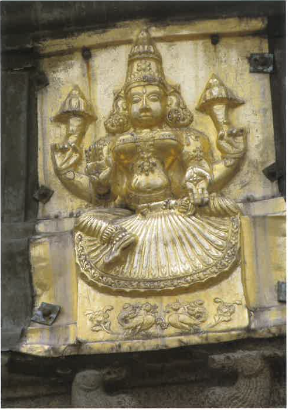
The devakoṣṭha (fig. 5.36) are provided with valabhis (fig. 5.35) which is a new architectural introduction. The superstructure of the vimāna was covered with metal plates and gilded with gold (fig. 5.37). The metal covering of the vimāna and aportion with gold gilding can still be seen (fig. 5.39). One remarkable piece of Lakṣmi image in metal fully covered with gold is still in situ. It is not known whether it is the work of Kṛṣṇadevarāya that has survived or maybe that of Kumara Tātācarya of the seventeenth century.
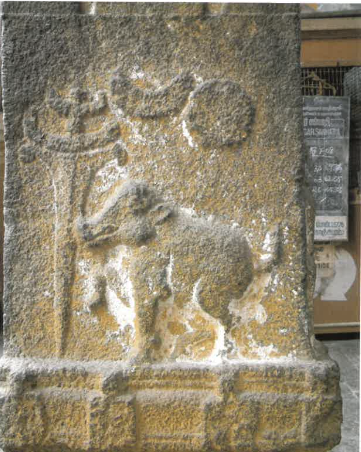
Another important piece that deserves notice is that of a metal covering to the main steps leading to the Tāyār shrine. It has two portraits one on the right of the visitor as he enters the temple. It shows a king wearing long conical cap and his hands held in añjali with long-bladed sword tugged in under his left arm (fig. 5.40). The portrait has close resemblance to the great Kṛṣṇadevarāya’s metal portrait in Tirupati and the other in Chidambaram north gopura. From the time of Kṛṣṇadevarāya we see the long conical cap worn by Vijayanagara and Nayaka kings and it is known that it was made of velvet, stitched with precious gems. There is little doubt that it represents Kṛṣṇadevarāya. That the inscriptions mention his building the Tāyār shrine would also confirm the identification. He is accompanied by one of his queens. The other side of the same metal covering shows another king Acyutarya without the sword, but having the same type of cap (fig. 5.44). He is also accompanied by one of his queens. At the extreme end are two dvārapālas fastened to the metal covering of the steps. The importance of this metal covering and the portrait of Kṛṣṇadevarāya was discovered by me recently. In the middle of this covering is a well-treated lion (figs. 5.45- 5.46) as the one found on the Narasiṁha shrine and the steps ot the main shrine on top of the hill (fig. 5.47). This also enables us to date the two Tulābhāra Maṇḍapa which are mentioned in doorjamb of the outer gopura.
5.14. Metal Covering of Steps
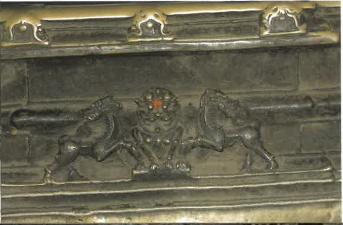
We have seen that Kṛṣṇadevarāya made many additions to the temple among which one interesting work was covering the steps leading to the main shrine on top. These were bronze coverings with images and portraits. Many dignitaries under the king seem to have participated in the work. Considerable number of them have disappeared but those which survived show images and portraits. At the bottom-most entrance Padmanidhi and Saṅkhanidhi are portrayed. The second step portrays dvārapāla images (figs. 5.48- 5.54) cast with the metal covering and further up is seen in one step a Siṁha with prancing Yāḻīs one on either side. There are three pairs of portraits of patrons further suggesting that every step leading to the shrine was covered with such metal portraits of patrons which show the art of Kṛṣṇadevarāya’s age. The main step to the Tāyār shrine also carries a pair of dvārapāla’s and also the portrait of Kṛṣṇadevarāya and his queen and probably his brother Acyutarāya (see under Tāyār shrine for details). In the centre of this covering is also seen the lion motif, also on the metal covering of the main steps leading to Narasiṁha shrine — evidently all of them were made in the time of Kṛṣṇadevarāya.
5.15. Vāhana Maṇḍapa
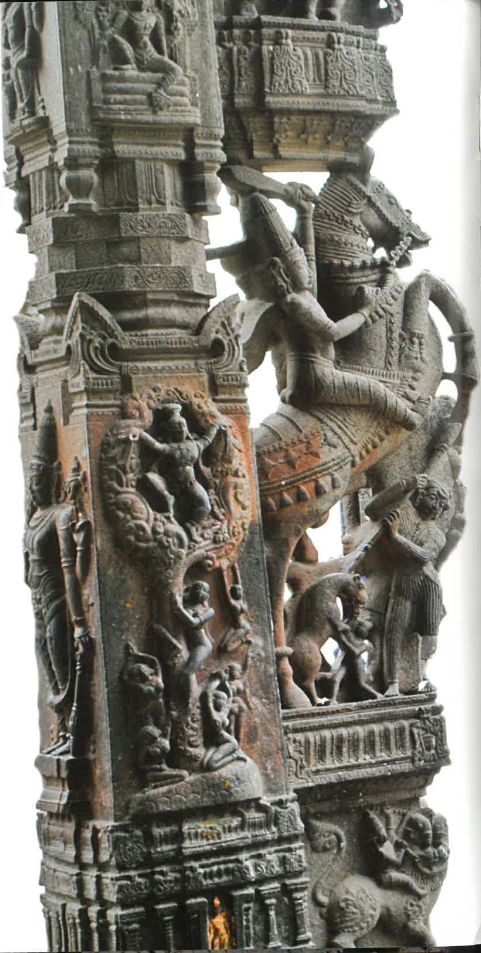
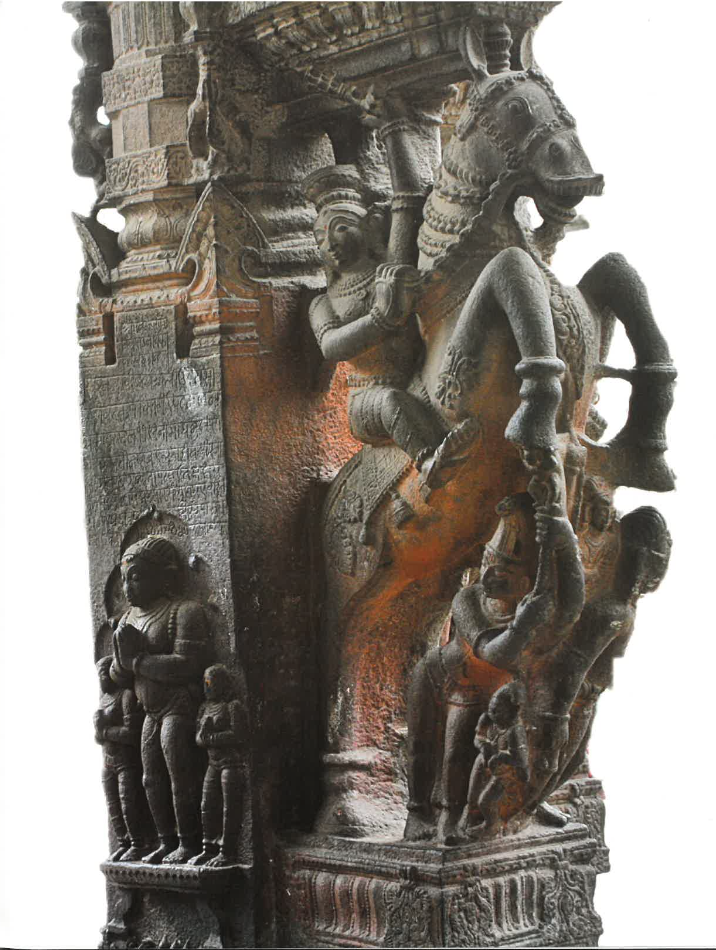
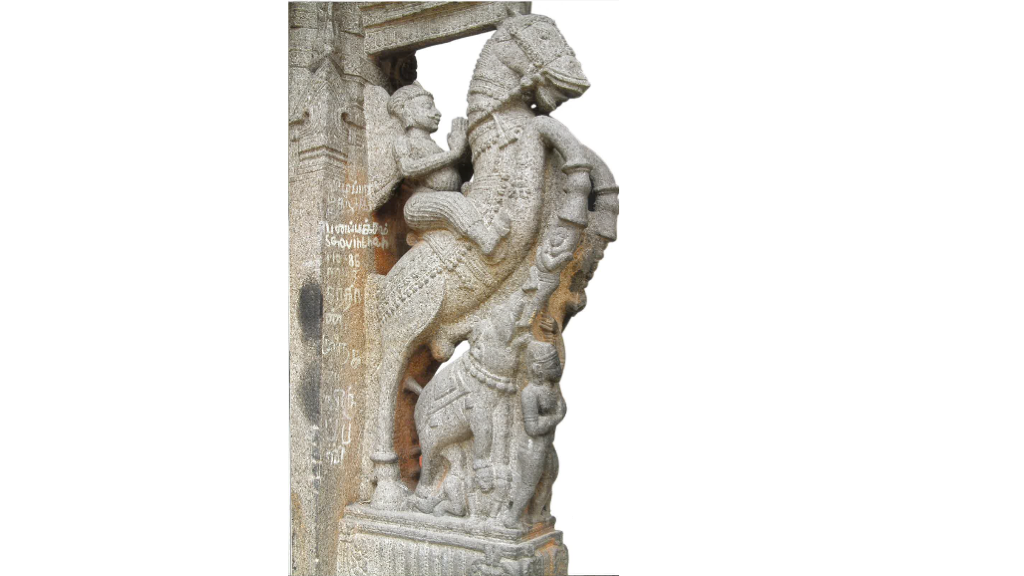
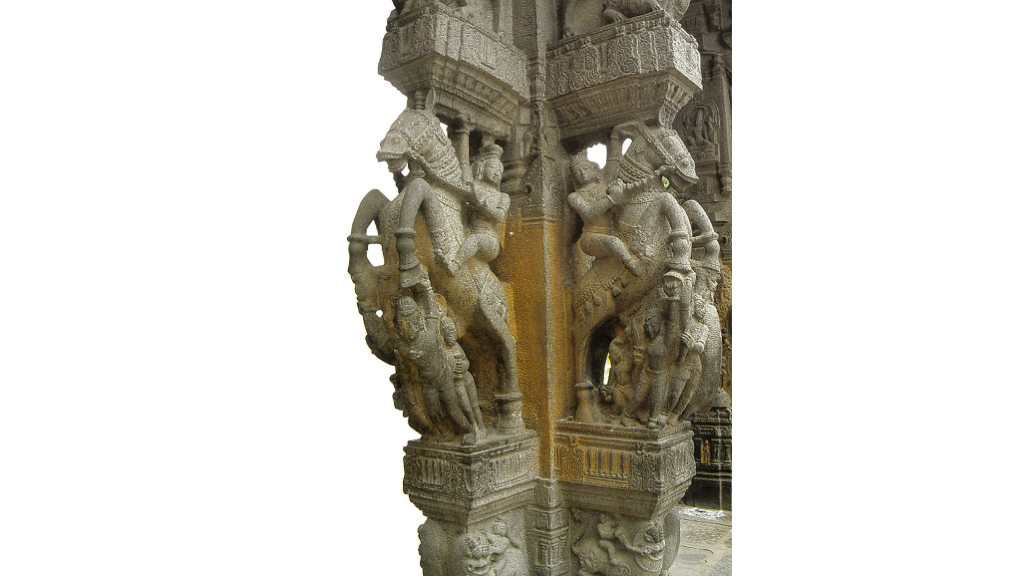
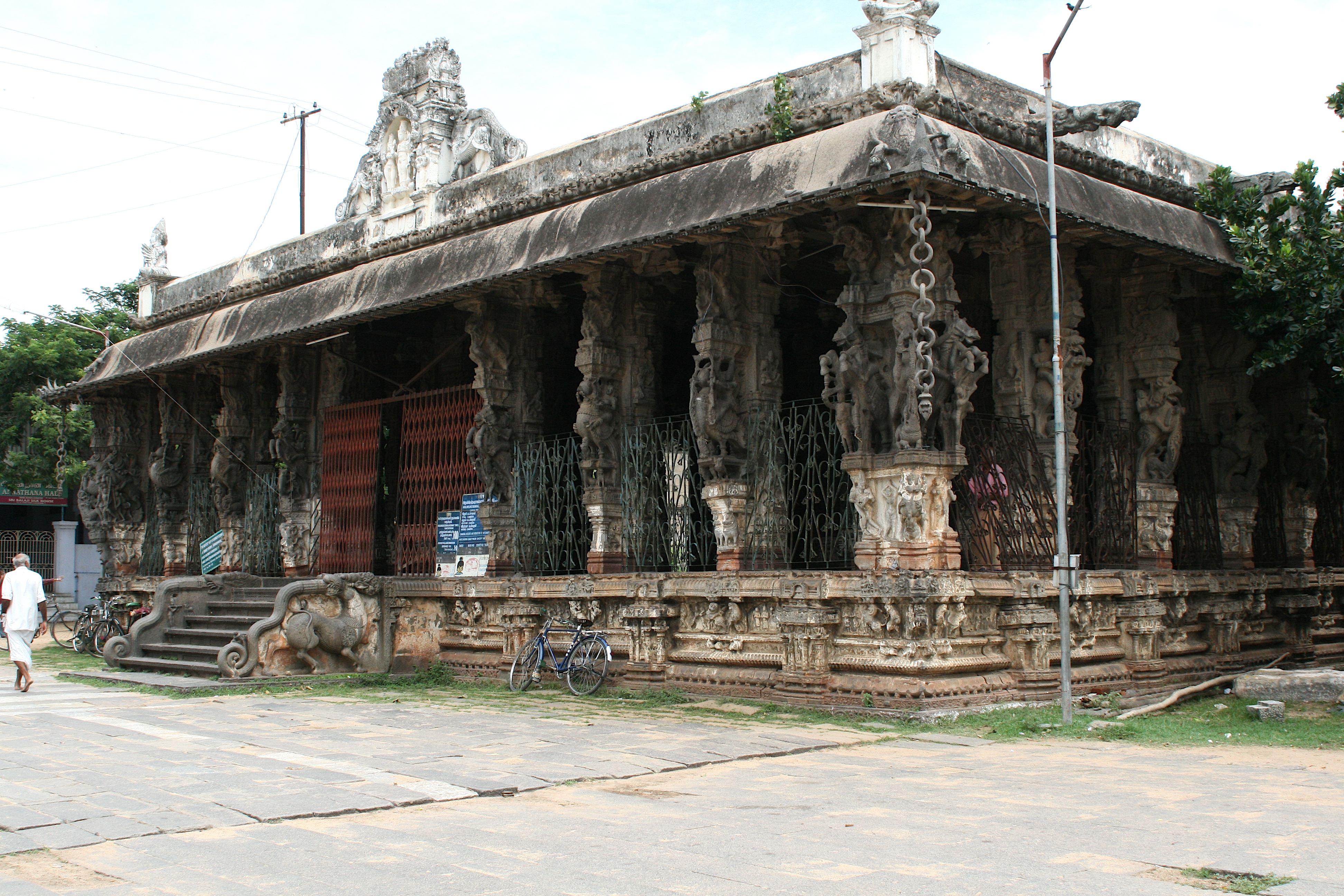
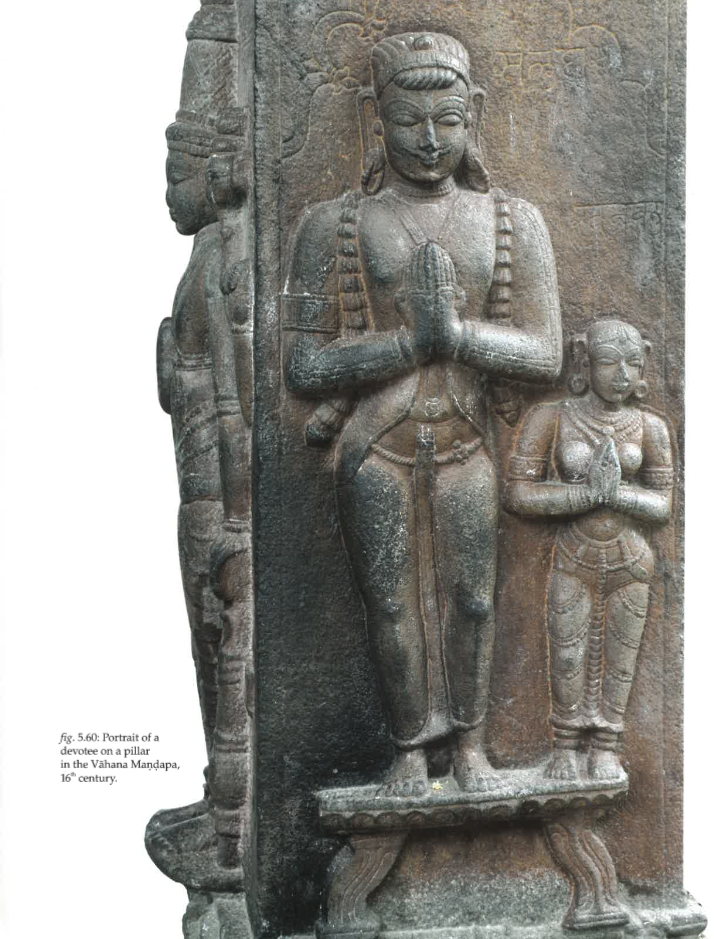
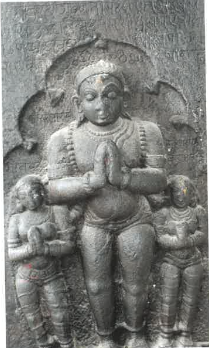
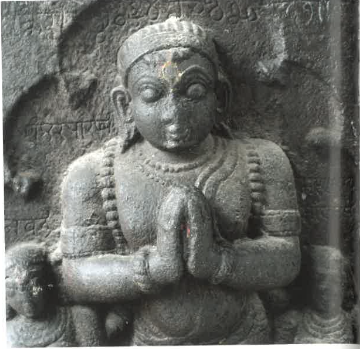
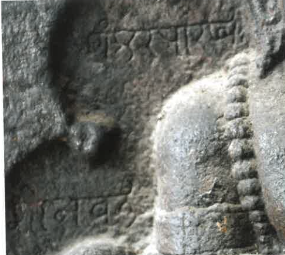
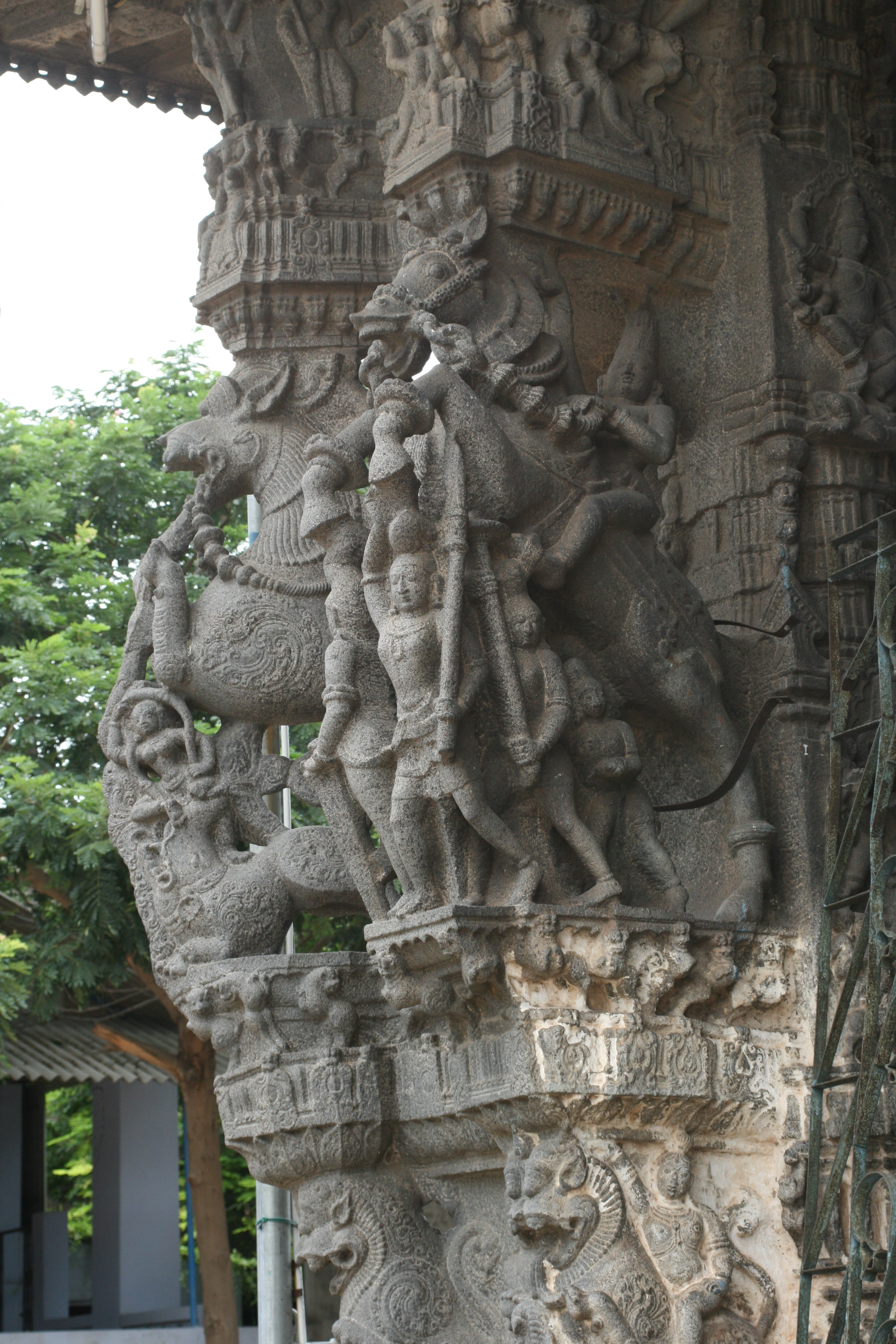
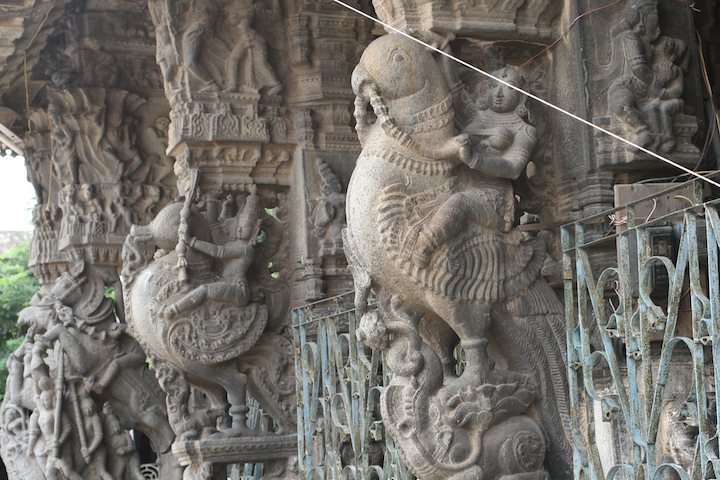
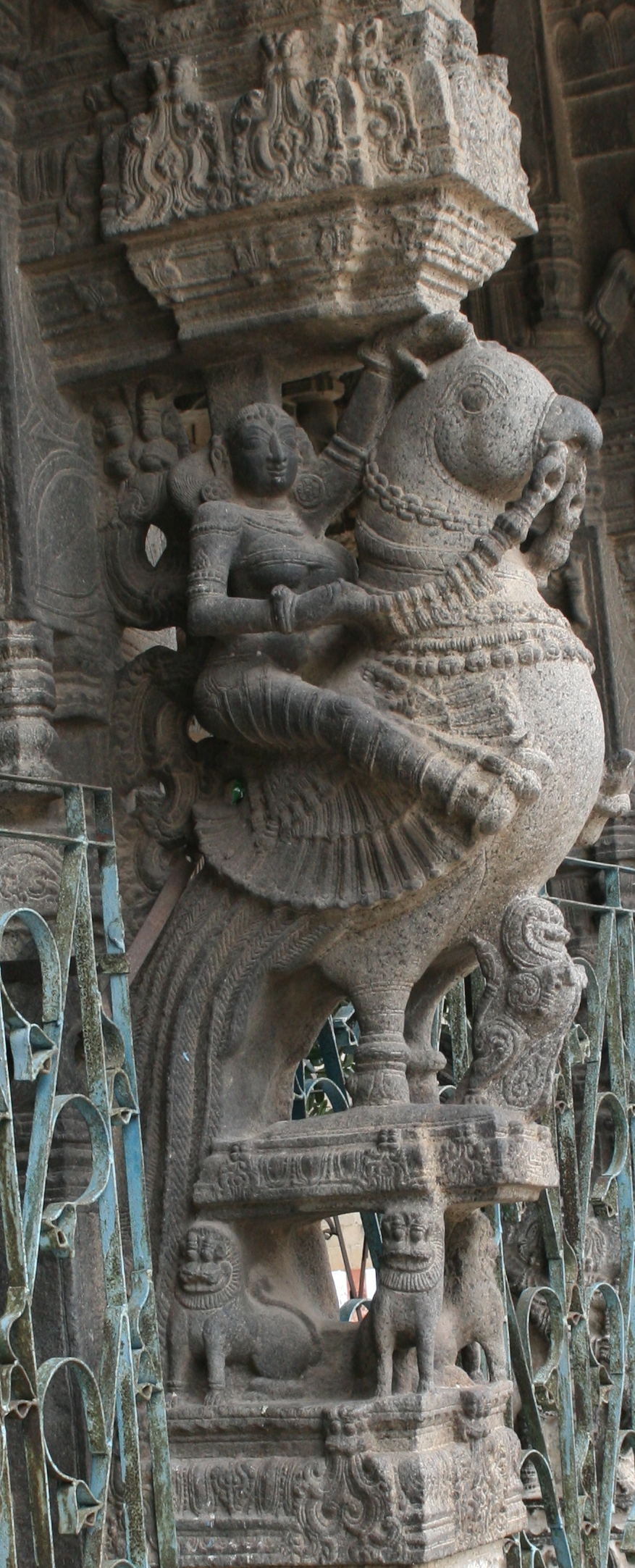
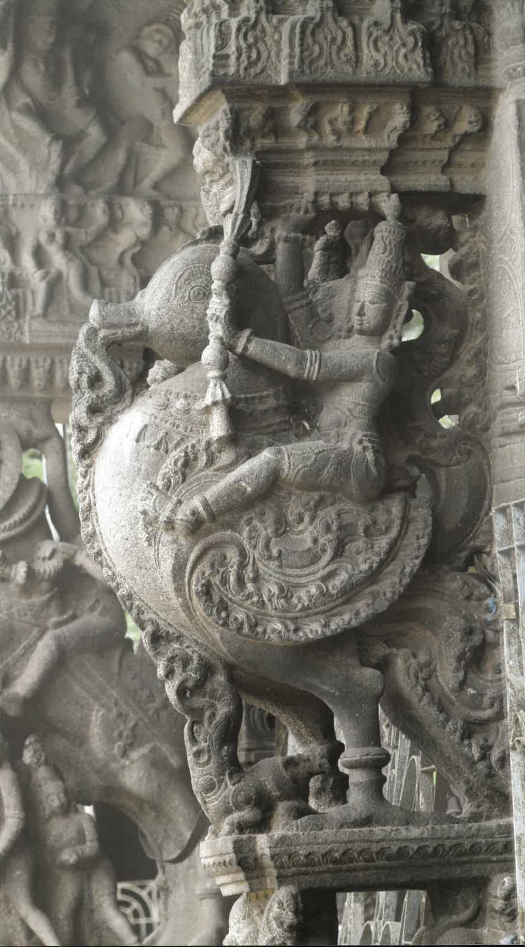
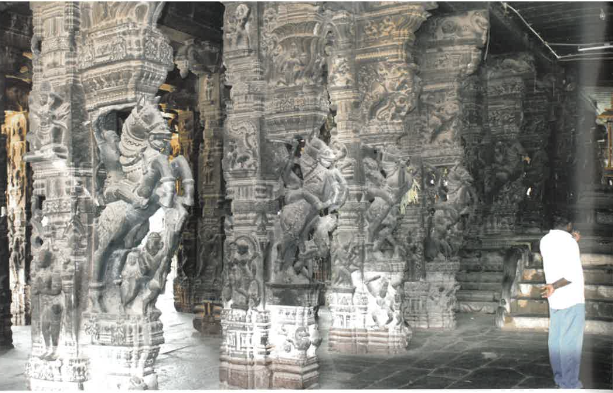
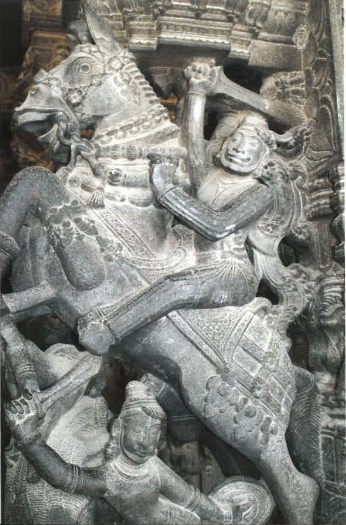
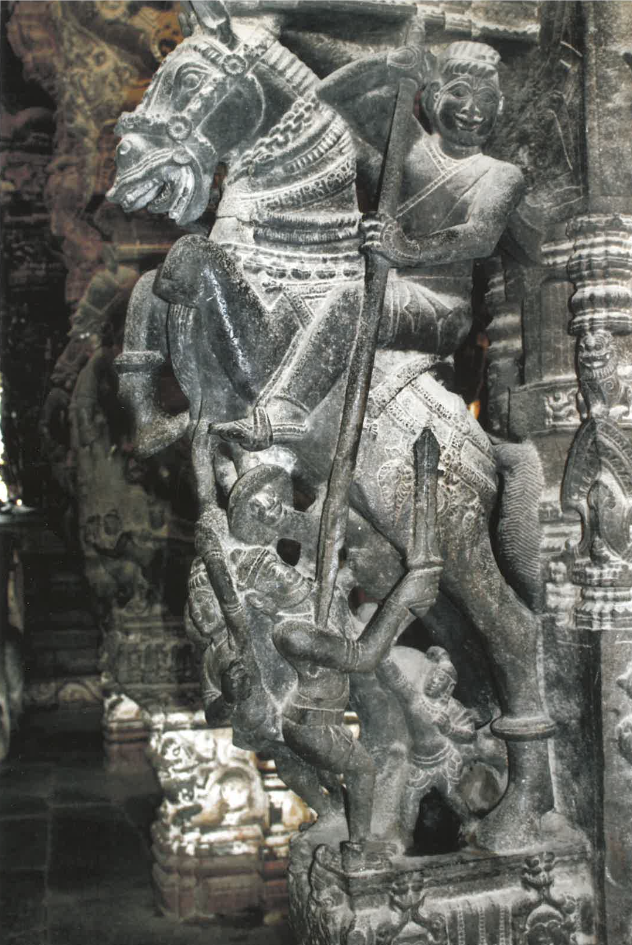
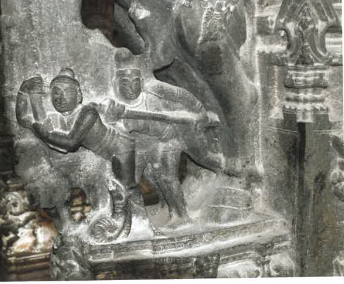
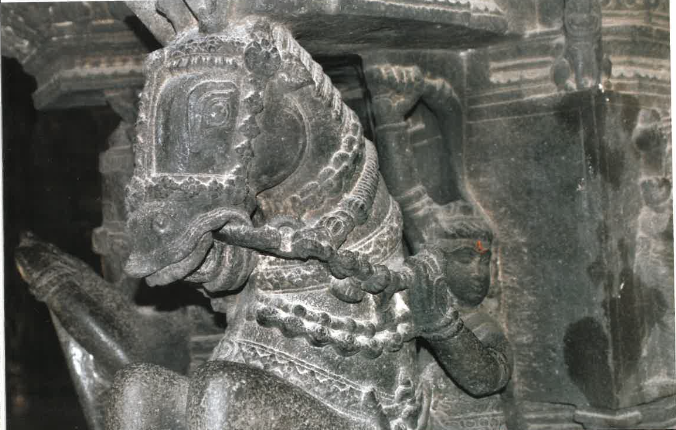
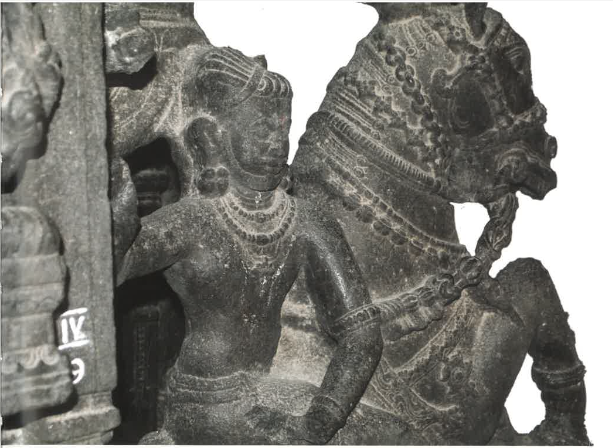
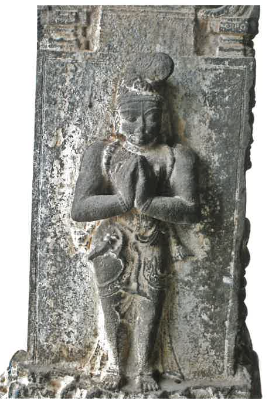
The maṇḍapa in the fourth enclosure to the south of the bali-pitha with lofty and beautiful front pillars is known as Vahana Mandapa (fig. 5.55). The most striking aspect of this mandapa is the life-size horse- rider motif on its front part (figs. 5.56-5.59). The carvings are lovely and deserve praise for the manner in which the artists have managed the lofty pillars with appropriate rider motifs and their remarkable proportions. No doubt, they are by the same artists who built hte Kalyana Mandapa and therefore should be assigned to the age of Krsnadevarya around CE 1515. Besides the exuberant pillars the other faces of the pillars are decorated with images of gods and also the portraits of the patrons. A Visnu image of Varaha on a pillar si a good example of god's image (fig. 5.59). There are at least three or four portraits. In some the patron figures are alone while the others are seen with their wives (figs. 5.60-5.64). In one the names of the patron and his wife are indicated by their labels inscribed in Nandinagari of Kṛṣṇadevarāya’s period.
5.18. Kalyāṇa Maṇḍapa
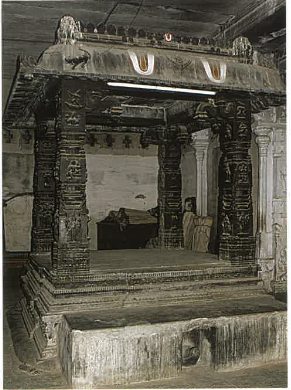
Kṛṣṇadevarāya was succeeded by his brother Achyutarāya, who continued the patronage and devotion to Varadarājā. One of the most significant contributions made by Achyutarāya was the Kalyāṇa Maṇḍapa, the loveliest structure in the temple. It is built with elaborately carved pillars and attracts the attention of international tourists for its exequisite sculptures. The facade, the central bay, the raised main platform to house the deity during the kalyāṇa-mahotsava, and the elaborate hanging cornices and its proximity to the lovely tank called ananta-saras, have attracted international admiration for the past 250 years.
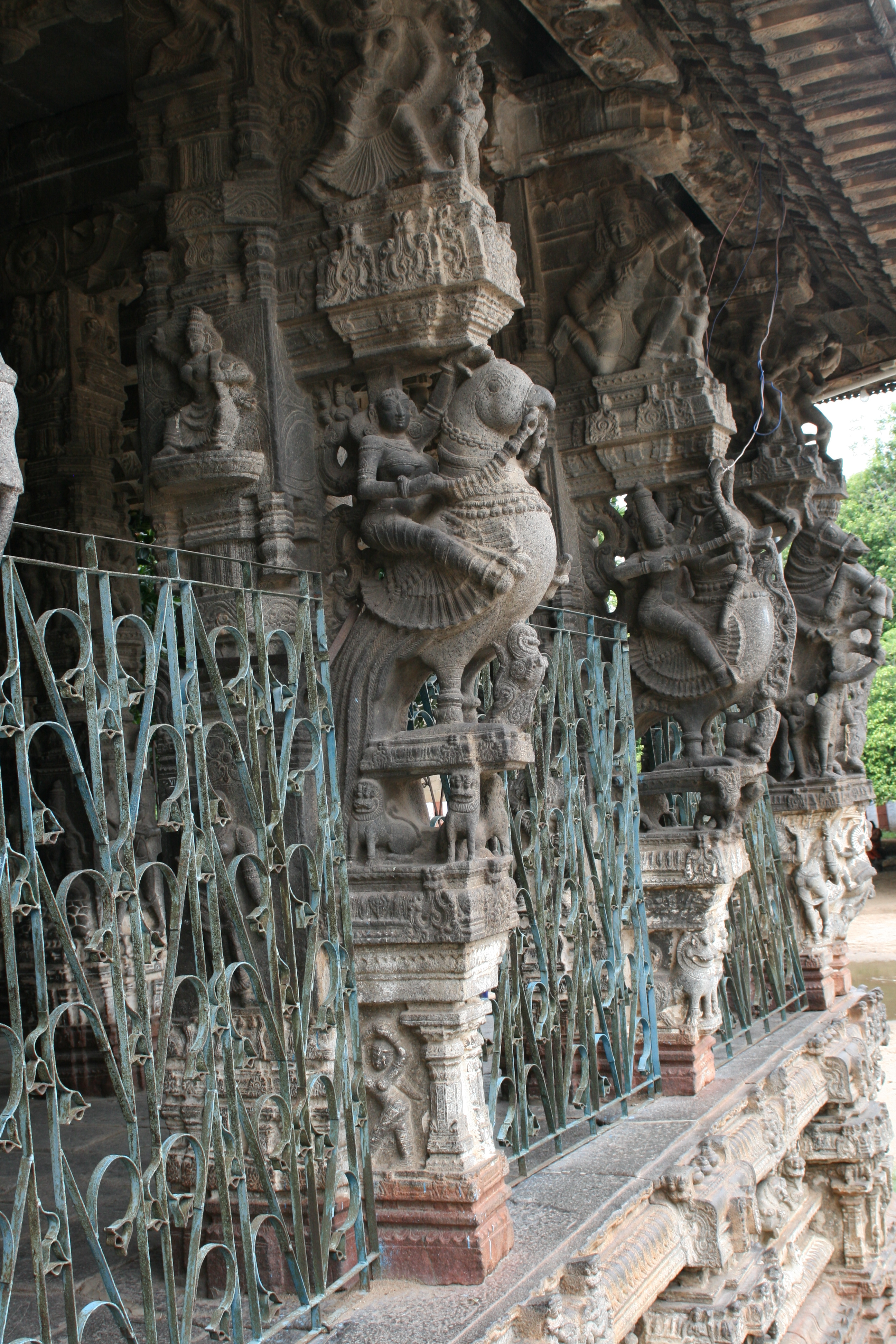
The facade facing the inner yard of the entrance and its central bay are levied with minutely carved horse rider motifs (fig. 5.70) that makes the onlooker spell bound. In addition to horses, parrots, yāḻīs are also figured, mounting which are shown soldiers and warriors and also gods and goddess like Manmatha and Rati (figs. 5.71- 5.75). Some of the soldiers are seen wearing trousers, long sleeved shirts and beards that suggest Muslim Cavaliers. It is known that there were many Muslim commanders and soldiers under the Vijayanagar rulers, and in the illfamed Talikotta war, between Vijayanagara forces and the Deccani Sultans, when the former were advancing victoriously, the Muslim commanders of Vijayanagara rulers turned against their own masters in the battlefield and massacred thousands of Vijayanagar soldiers which led to their defeat. This maṇḍapa came into existence about thirty years earlier to that disaster so there could be no doubt about their identity.
There are also some figures who are clearly foreigners, wielding muskets and wearing caps (figs. 5.76-5.78). They are probably the Portughese mercenaries in the Vijayanagar army.
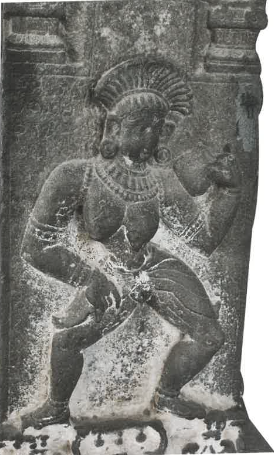
The portrayal of these riders in a row in animated poses holding spears and standing high and the like are remarkable achievements of the Vijayanagara art (figs. 5.79-5.80). Almost all the pillars carry sculptures carved in relief, at the bottom, middle and top on all their four sides and there are over one hundred pillars, the whole maṇḍapa looks like a veritable sculpture gallery. The sculptures portray puranical themes, Gods and Goddesses, portraits and artistic designs. Among the scenes may be mentioned the King being received with honours (fig. 5.81) and another temple prestly figure also received with similar honours. One theme that occurs in various forms is that of Hanumān appearing in different events. In one he is shown as the embodiment of divinity with four hands, holding śankha and cakra in the upper arms, that points to the supremacy of his cult. Also seems from Rāmāyana and Bhagavata are also seen profusely illustrated. Other figures of interest are the figures of dancing girls in various poses (figs. 5.82-5.83).
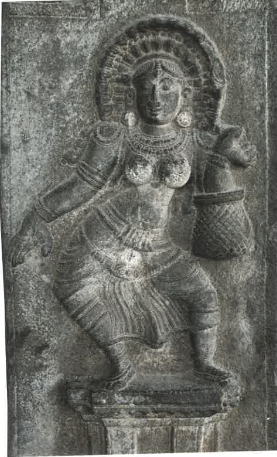
I may draw attention to two sculptures of interest among dancers. One shows a Kuratti - hunter maiden, dancer drossed with a basket tucked under her arm pit and a small stick in her hand for foretelling fortunes. There is another sculpture of a male figure with birds, and net in his hand dancing. This represent Kurava hunter as a bird catcher. It is interesting to note that from around this time a popular type of dance drama called “Kuravañci Nāṭaka” became very popular and used to be enacted in temple festivals. This recitals became very popular because of a happy blend of folk and classical styles, that became charming and very popular among the masses.
In the centre of the back square, is the raised dias (fig. 5.84) with a central throne in which the metal images of Varadarājā and Perumdēvi Tāyār are placed in audience for the “kalyāṇa mahotsava” (marriage festival). The dias has minutely worked mouldings that the stone artists have perfected in cuttings intricate designs. In his hand, the hardest material like black granite stone that is like black basalt has turned into wax, that they could chisel any design with consumate skill. It is an amazing art that attracts art connoisseurs. The corner pillars carry the images Rāmā and others.
The central throne is equally interesting. It has a huge turtle on which the whole throne is rested. This is called Kūrmāsana or Ādikūrma. Over that is the base in which are seen a series sculptures on all the four sides. They represent the eight directional elephants (dik-gajar), the eight serpants (dik-nagar), the eight kula-parvatas (dik-śikhars) and eight auspicious trees. On top of it is the seat on which the deity is placed.
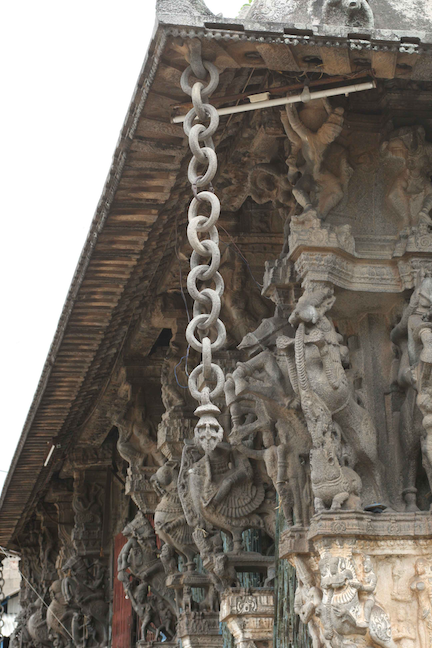
The big cornices hued out of big stone slabs are very impressive. On the corners are shown cat catching doves perched on them in a remarkably realistic manner. Also on the corners, the artists have made, a long chain hanging for about ten feet out of a single stone slab (fig. 5.85). It is another remarkable artistic skill, exhibited by the Vijayanagar artists. This maṇḍapa is the finest building in the temple complex.
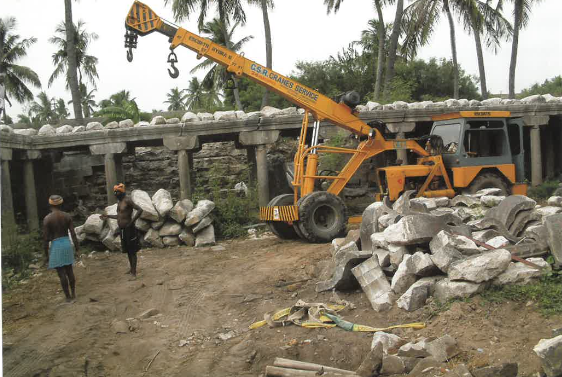
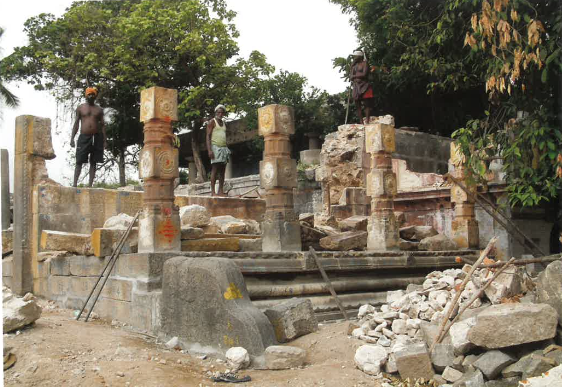
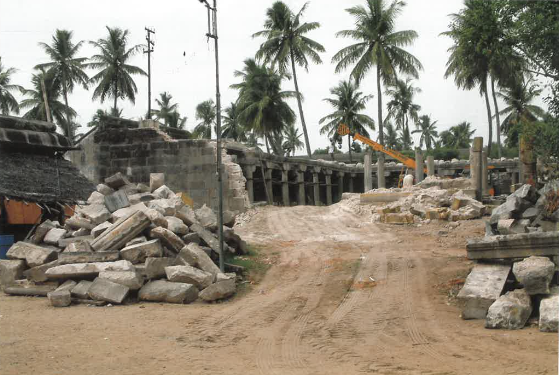
Opposite this beautiful maṇḍapa, on the southern wing is another maṇḍapa called stable maṇḍapa. It consisted of several hundred pillared pavalion, formed into a square with a central maṇḍapa and an entrance from the inner court yard. It is known that Achyutarāya gifted 1008 cows to the temple and the according to tradition this was intended to be a cow shed (go-sālā-maṇḍapa). According to another version it was used for several hundred horses to be housed and served as a stable. The entrance to this maṇḍapa had a verandah on both sides and indicates that this hall served as a great hall, but with advent of the colonial rule and the diminishing, wealth of the temple, this great hall has remained unused. Unfortunably this hall is being pulled down and totally demolished to a build a new concrete structure.
Adjacent to this structure is another maṇḍapa which is now used as the Executive Office of the temple. At the south west close to the inner gopura is another maṇḍapa also of the Vijayanagara age called Vāhana-maṇḍapa. It has lovely carved pillars.
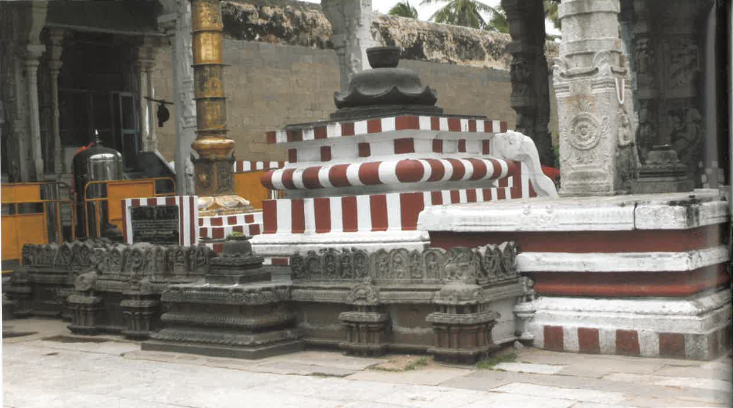
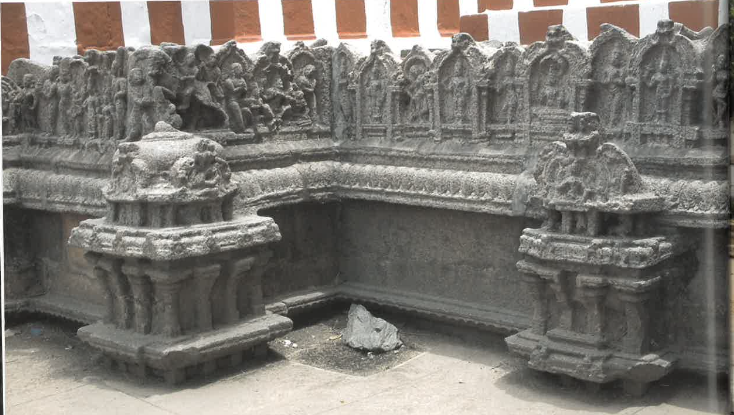
There are two lofty pillars on the court yard with the “dhvaja sthambha” for the flag of the temple, to be hoisted during festivals. This is covered with copper plate and gilted with gold. The other pillar is made of stone with ‘pañcara’ like top, used for a lamp and this is a lamp post. The bali-piṭha (fig. 5.90) is required for daily temple rituals. All the three are encased at the ground level with a fine Vedi, encircling the pillars and Balipiṭha. This Vedi is embellished with a large number of Gods and Saints carved on them. By the side of this dhvaja sthambha is a fine carved mandapa with fine carvings some of which are portraits. Some of the portraits are inscribed in Telugu Kannada script giving the name of the portraits.
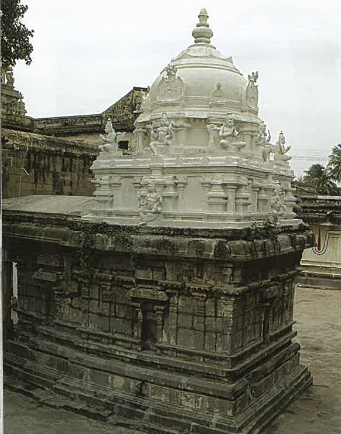
Also, in the yard are two high maṇḍapas over 12 feet in height, with towers. These are called Tulābhara-maṇḍapas (fig. 5.92) built either for the rite of Tulābhāra of the King or in commemoration of them.
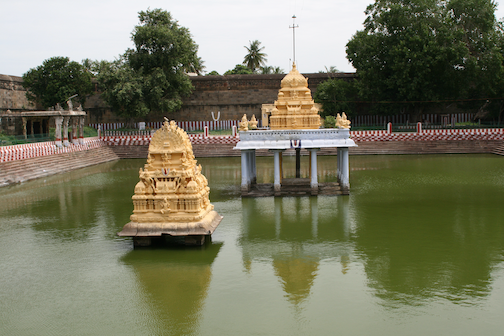
Further to the north of the Kalyāṇa-maṇḍapa, is the temple tank, with neatly stone paved steps on all the four sides and with a central maṇḍapa (mayya maṇḍapa) the base of which remains submerged in waters through out the year (fig. 5.93). In another, similar maṇḍapa remains submerged at all the time, the wooden image of Viṣṇu, made of atti wood. This image remains all the time under the waters and is taken out once in forty years in a special festival. It was probably the original Varadarājā image that stood on the main hillock in Cōḻa times, and was immersed in the tank when the present stone image of Varadarājā was installed in its place during the Vijayanagara period in the time of Kṛṣṇadevarāya.
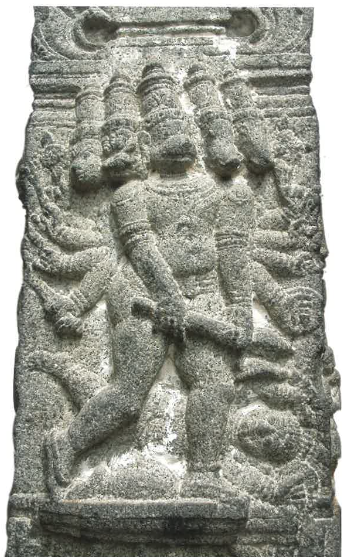
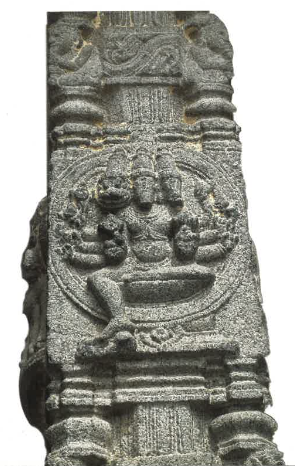
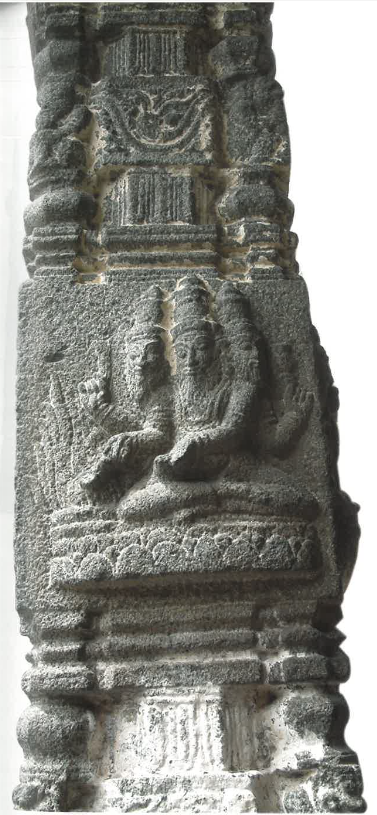
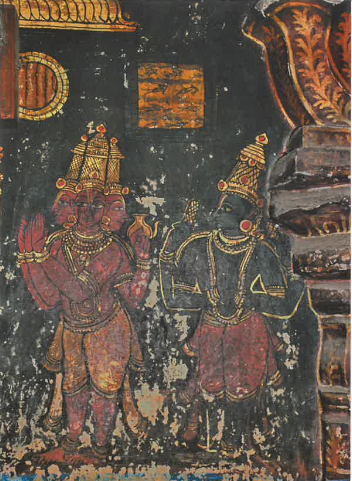
In the fourth prākāra, the shrines of Āḻvārs and Ācaryas are distributed along the periphery of the wall of the third enclosure. All these are ascribed to the 16th century, Vijayanagara period, and were probably built by Aḻagiya Maṇavāla Jīyar. One exception is that of Āṇḍāḷ, whose shrine is found in the northwest corner of the second enclosure. Nevertheless, the sculpture of Āṇḍāḷ also seems to be from the 16th century. This shrine is preceded by a pillared maṇḍapa of the 16th - 17th century. The pillars of this maṇḍapa carry square parts on which very interesting sculptures are noticed. Mention may be made of five-faced Āñjaneya (fig. 5.95), five-faced Sarabha Samhāramūrti, three-faced Sudarśana (fig. 5.97), and so on. It will be seen that the Sarabha Samhāramūrti legend and sculpture are associated with the Aṣṭabhujākara temple as well. Other sculptures of interest are Brahmā performing a sacrifice in a Vedic altar (fig. 5.98) and Viṣṇu as Varadarājā emanating from fire, with Brahmā worshipping it in an añjali pose (fig. 5.99). The story of Brahmā performing this sacrifice, and Sarasvati, his consort, coming as the river with tremendous force to destroy the sacrifice, and Viṣṇu appearing as fire and protecting the sacrifice, are described in the sthala purāṇa of this temple. The same story is associated with almost all the Viṣṇu temples of Kāñci in a slightly modified form. Patently, this sthala purāṇa is the creation of the 16th century.
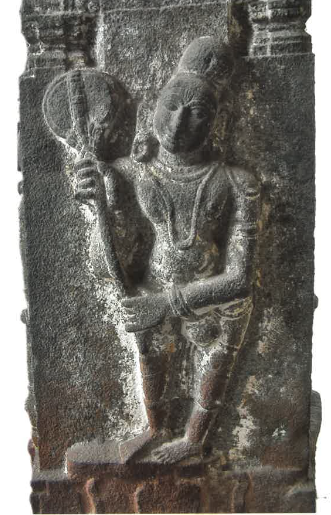
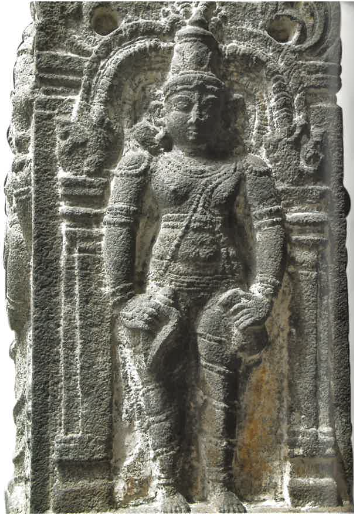
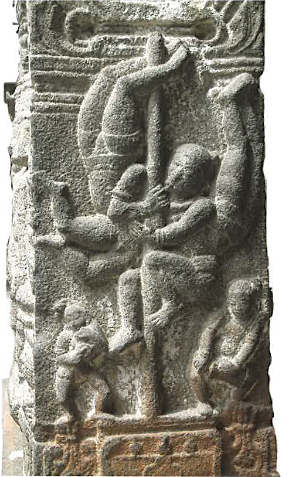
Three other sculptures of interest are a devotee holding a fan (fig. 5.100), another Balarāma (fig. 5.101), and the third, four sportsmen doing acrobatic dance on a pole to the accompaniment of music, the artist has portrayed the four, through one head (fig. 5.102).
Another set of sculptures represent the ten avatārs of Viṣṇu, in which Kṛṣṇa and Balarāma are shown in one panel while all the rest are found as single manifestation on separate panels. The significance of this two appearing together have been dealt with already while discussing the Anantāḻvār shrine.
Correspondingly on the other side (South) there is a shrine for Cērakula Nācciyār, whose shrine is considered a creation of the Cēra ruler Ravivarman Kulaśēkhara, who occupied Kāñcipuram for some time in the 14th century. Also, there were merchants and soldiers from Malaimaṇḍaḷam in Kāñci, who installed this deity.
The shrines of Āḻvār and Ācāryas in the fourth prākāra built in 16th century, have their entrnaces cut through the wall of the third prākāra. It also shows that independent shrines for Āḻvārs and Ācāryas came into existence from the 16th century would suggest that their deification became more popular from that time onwards though their hymns were recited earlier and possibly their metal images were in the temple earlier. As all the Āḻvār shrines are located in the 4th prākāra it is called “Āḻvār Thirumāligai” or “Āḻvār Thiruccuṛṛu.”
5.17. Gopuras
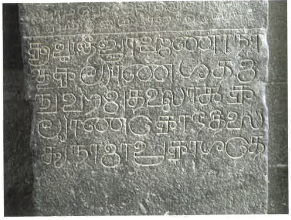
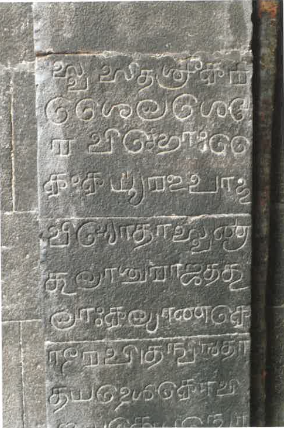
There are four gopuras in a line, the eastern-most gopura was built by Kṛṣṇadevarāya around 1525. He also built the huge enclosure around the temple that abuts the eastern gopura in the east and the main entrance gopura in the west. The main entrance gopura in the west carries several inscriptions among which the earliest seems to be of 13th century indicating that this gopura has been built in the 13th century.
The second gopura that allows entrance to the third enclosure bears an inscriptions of Kulōttuṅga Cōḻa I and was built by him in the end of 11th century. The inner most gopura that has the entrance to the second enslosure bears inscription of Vīrarājēndra Cōḻa and was probably built by Rājēndra Cōḻa, the consequeror of Gaṅgātic plain.
There is also the śala type of vimāna tower over the main sanctum which looks like a gopura, and this was built by Kṛṣṇadevarāya which was covered with gold plate in the 16th century.
5.18. Varadarãja Temple Murals
The Varadarājā temple has extensive mural paintings but most of them belong to Vijayanagara age and some later. The earlier of them disappeared even at the time of the Vijayanagara reign. The murals are found in the following buildings of the temple of Varadarājā.
On the ceilings of the Narasimha shrine maṇḍapa. (figs. 5.107-5.110)
On the walls of the top enclosure around the main shrine. (figs. 5.111-5.135)
On the ceilings of the uñjal maṇḍapa. (figs. 5.136-5.139)
On the ceilings of the maṇḍapa in front of the abhiṣeka maṇḍapa. (fig. 5.140)
On the side walls and ceilings of the entrance of the second inner gopura.
There are traces of paintings in a number of pillars of other maṇḍapas.
5.18.1. Narasimha Maṇḍapa Murals
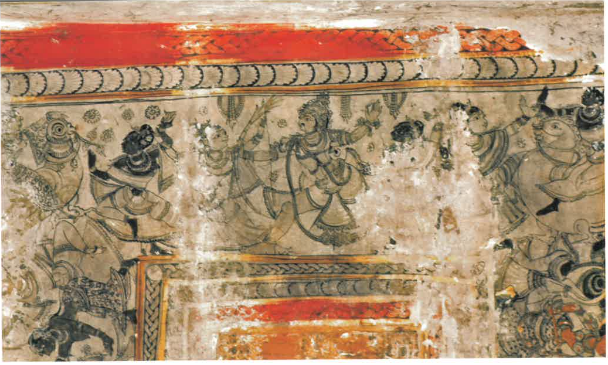
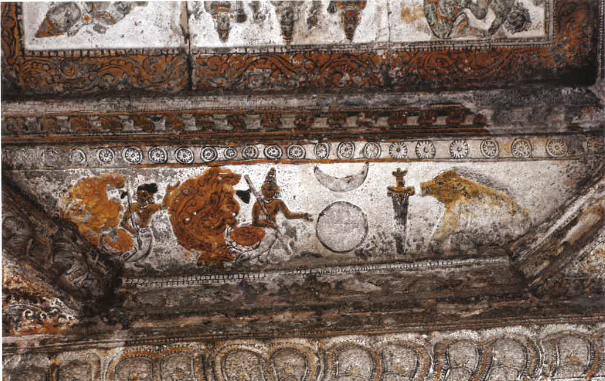
The maṇḍapa in front of the Narasiṁha shrine was built in the early years of Kṛṣṇadevarāya, that shows some lovely paintings on its ceilings representing Kṛṣṇā sporting with gopis in different poses. In one, Kṛṣṇā is shown on a swan holding a bow of sugarcane and arrow of flowers. A gopi is portrayed on a parrot on another side also aiming arrows. In between are gopis sporting in different poses (figs. 5.107-5.109). The lines of these paintings are thin but firm and the forms are classical and colours subdued. They depict an age of great aesthetic taste and are to be assigned to the beginning of Kṛṣṇadevarāya’s early period c. CE 1510. This is confirmed by the Vijayanagara emblem of “Boar, dagger, sun and mon” (fig. 5.110) found on many pillars of the mandapa.
5.18.2. Divyadeśa Murals
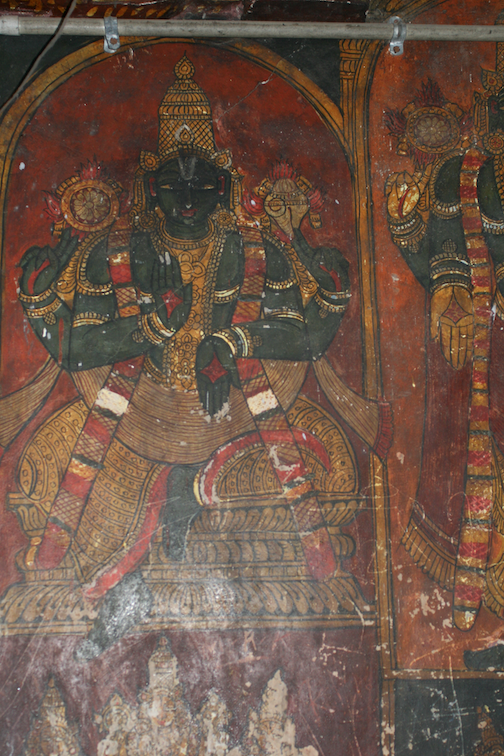
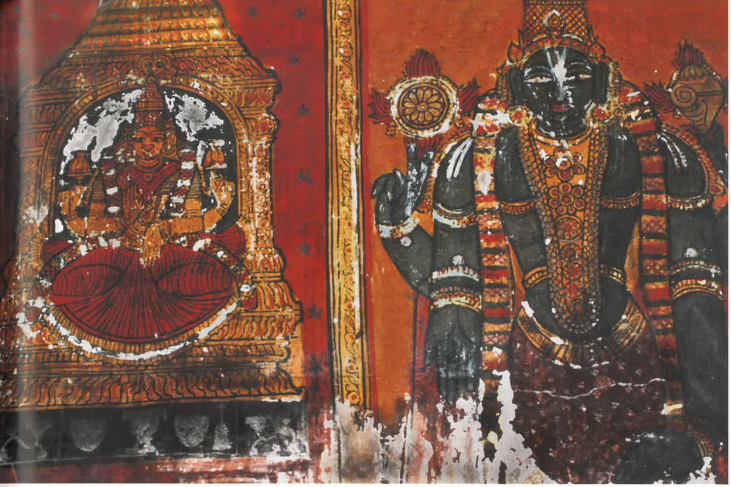
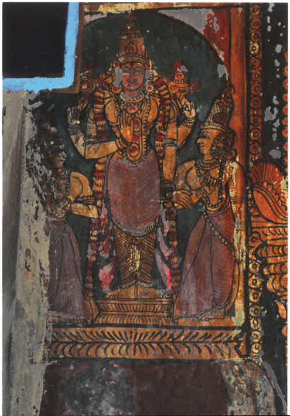
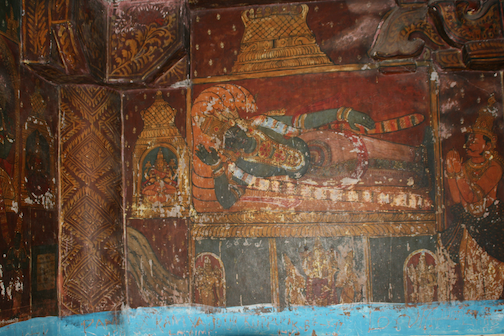
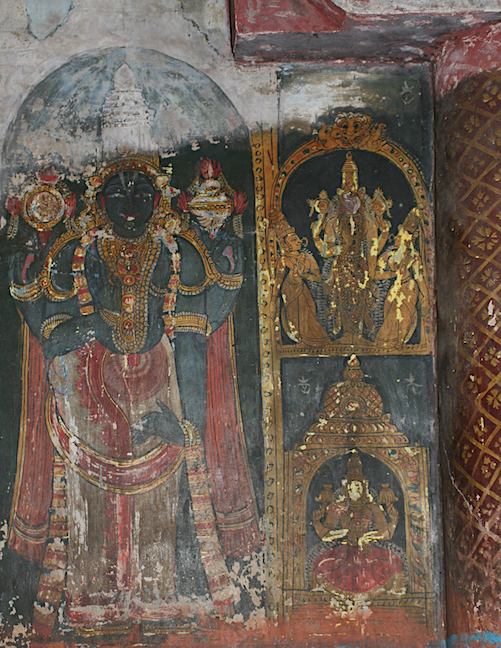
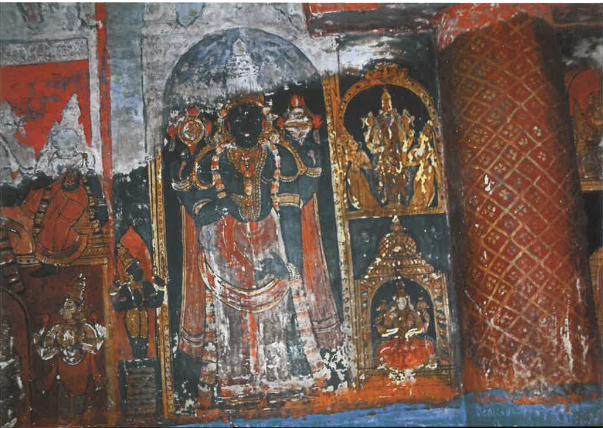
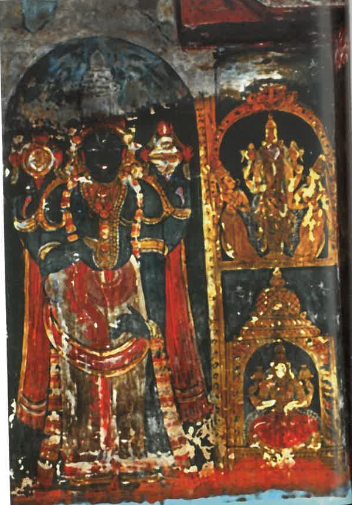
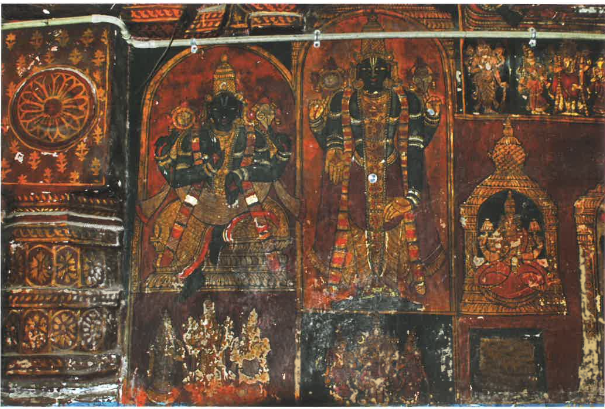
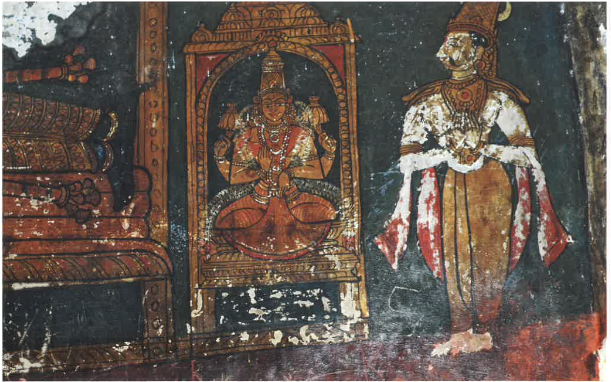
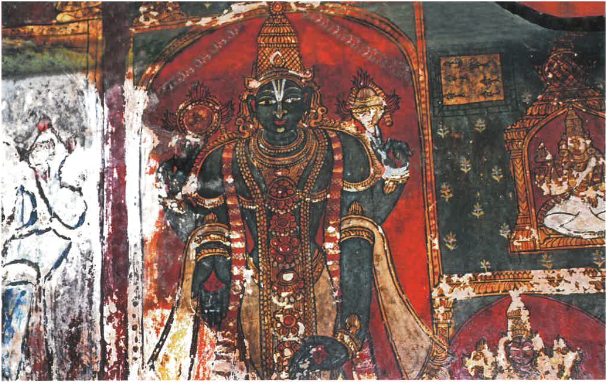
The enclosure wall going around the main shrine of Varadarājā Temple carries the portrayal of 108 divya-deśas - sacred temples — of Viṣṇu beginning from the west wall of the enclosure immediately after one enters enclosure on the north side. A visitor could see all the 108 divya-deśas as he goes around in circumambulation (clockwise direction). As he reaches the end of the enclosure on the south side he would have acquired merits of having darśana of all the Viṣṇu-kṣetras. It may be recalled that Kṛṣṇadevarāya built the present shrine of Varadarājā and gilded it with gold calling it Puṇyakoṭi-vimāna. This would have been a spiritual journey culminating at the Varadarājā.
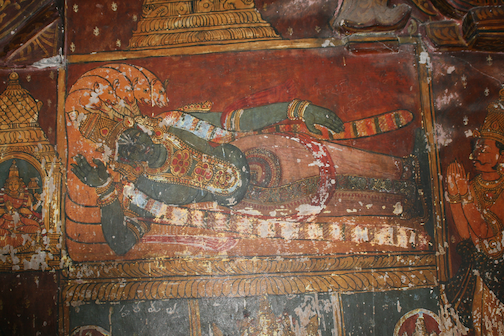
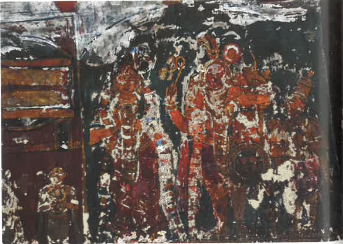
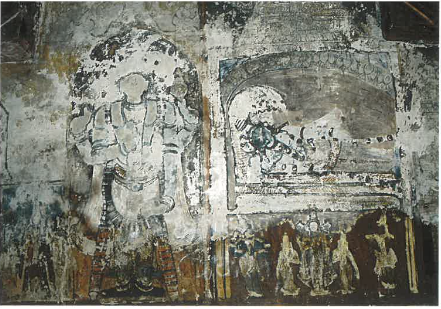
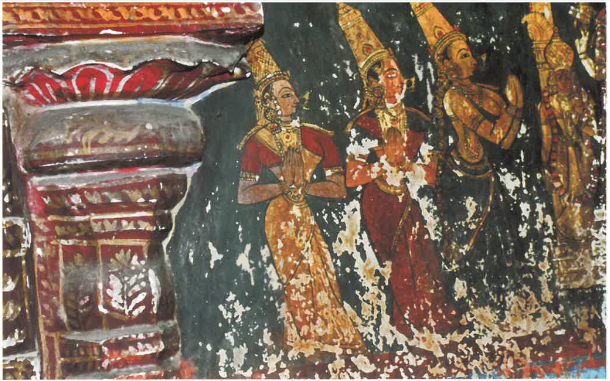
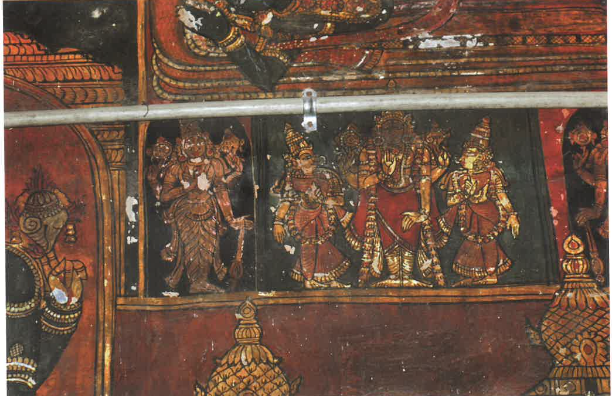
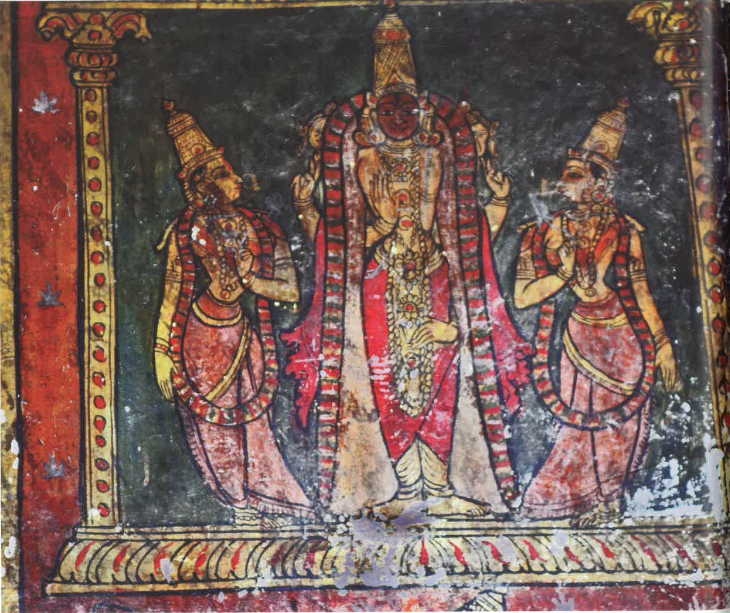
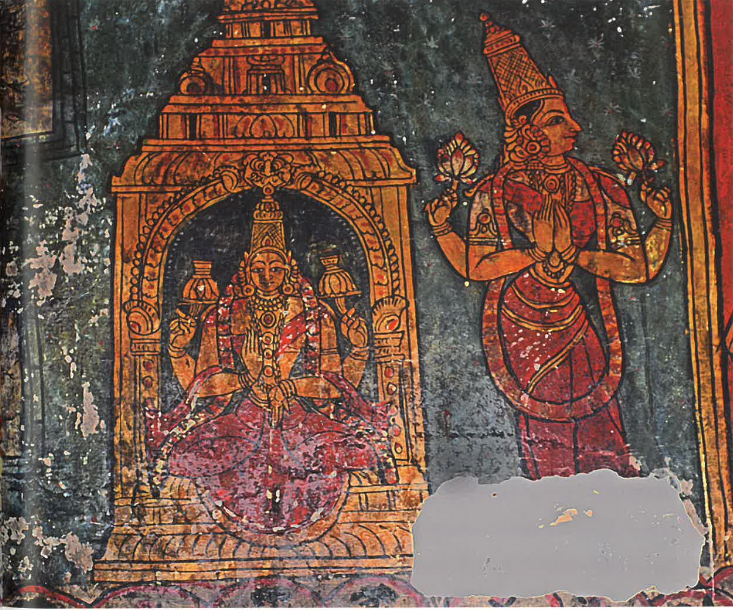
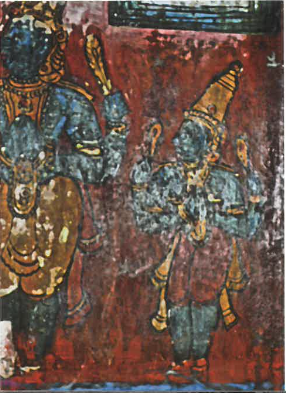
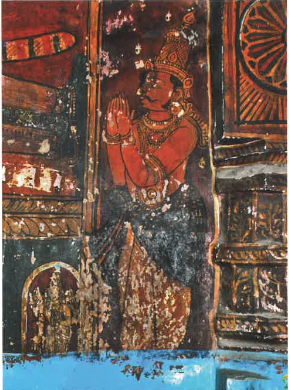
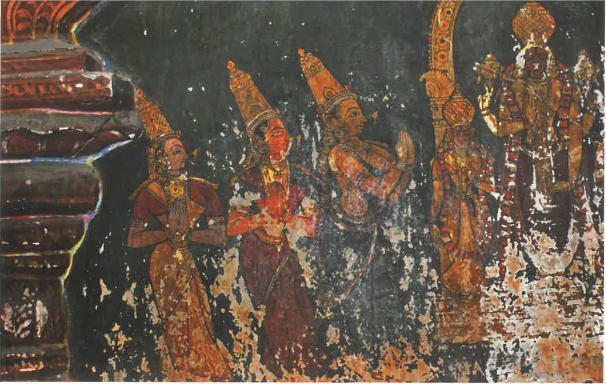
A point of great interest is that the artists who painted these temples took great care in delineating each temple true to the form. Similarly, the form of the individual deity in the respective temples like standing, seated (fig. 5.111) or reclining (fig. 5.112) and also their characteristic costumes and jewels were carefully portrayed. In all the cases, they have shown the main deity as it appeared in their temples. In some, Viṣṇu was shown standing alone in the sanctum (fig 5.113). In some instances, he is shown with two of his consorts (fig. 5.114) and in others with one consort. Shapes of the vimānas are equally faithful to the original (figs. 5.115-5.116). In most cases the Tāyār is shown in separate temple of her own and mostly seated (fig. 5.117). Further, the artists have clearly suggested the garbha-gṛha sanctum with black background and outer background with red colours (fig. 5.118), a distinction that helps immediate perception. The garlands as found in different temples are also carefully done (fig. 5.120). The jewellery is also indicative of hte respective tradition. The use of gold pigments show the importance attached to their work and certainly indicate a royal commission (fig. 5.119). The whole series is undoubtedly the commission of the great Kṛṣṇadevarāya who built the enclosure and the main shrine and may be assigned ot 1525.
In a panel, which unfortunately is in a bad state of preservation, we see Kṛṣṇā standing with a sugarcane bow in his left hand and a curved stick (like a whip) in his right hand. He has a koṇḍai turned to the left and wears a long garland that goes up to his ankle (fig. 5.121).
To his right stands Āṇḍāḷ, the lovely young girl saint who sang delightful songs about Kṛṣṇā. She has her koṇḍai styled as found in modern portrayals. She also wears a fairly long and big garland to indicate her cūṭik-kuṭuta cuṭarkoṭi. To the left of Kṛṣṇā stands what seems to be Garuda. The panel clearly shows the temple depicted is that of Śrīvilliputtūr, the birthplace of Āṇḍāḷ.
The panel also clearly suggests that Āṇḍāḷ’s love toward the Supreme was in his form as Kṛṣṇā, the youthful lover suggested by his sugarcane bow. The sugarcane bow evokes the memory of Manmatha, the cupid, and Kṛṣṇā was the cupid par excellence. While the name Viṣṇu brings to mind the ancient and old-aged Godhood, Kṛṣṇā recalls his attractive youth, ever engaged in love sports with gopis as the very embodiment of sports. So, the erotic outpourings in Āṇḍāḷ’s poems are truly towards Kṛṣṇā, as suggested by the sugarcane bow shown in this panel.
It is interesting to mention that the presiding deity of Śrīvilliputtūr is Kṛṣṇā as Raṅgamaṉṉār. It is also interesting to note that this series once served as pictorial documentation of all the 108 divya-deśas, especially of Tamiḻnāḍu. Unfortunately, such a magnificent documentation of 108 temples in paintings showing architecture, sculpture, main deities, costumes, jewellery (figs. 5.122-5.123), etc., which would have provided a running commentary on the temples, is in a very bad state of preservation.
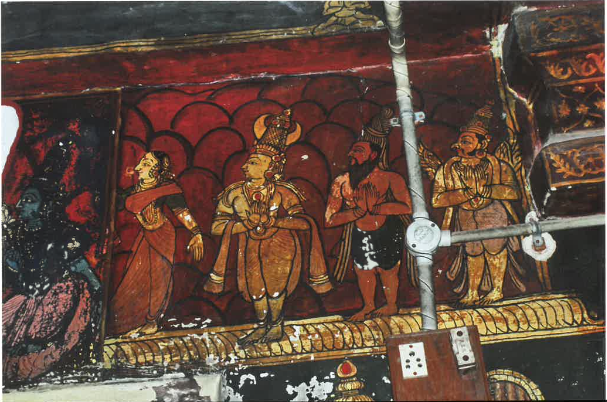
Due to seepage of water (fig. 5.124), the paintings have disappeared in many panels, leaving only the faded outlines. In other places, the pigments (fig. 5.125) have fallen off from the panels and seem to be deteriorating at a greater speed in the past few decades. Some panels have suffered due to the application of sectarian caste marks prevalent among the rival sects. Above all, total neglect of the concept and electrical wiring (fig. 5.126) and fittings have done more damage than all the natural causes put together (fig. 5.127).
What would have been an unforgettable memory (figs. 5.129-5.135) of a visit to this gallery of paintings now bears a melancholic look and is depressing to a great extent.
5.18.3. Uñjal Maṇḍapa Murals
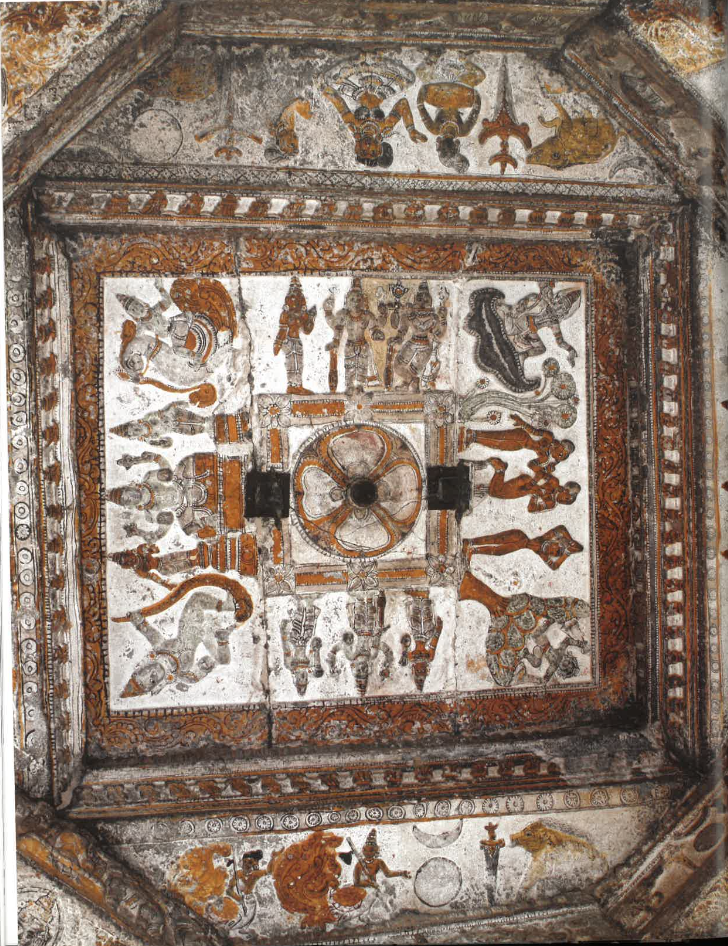
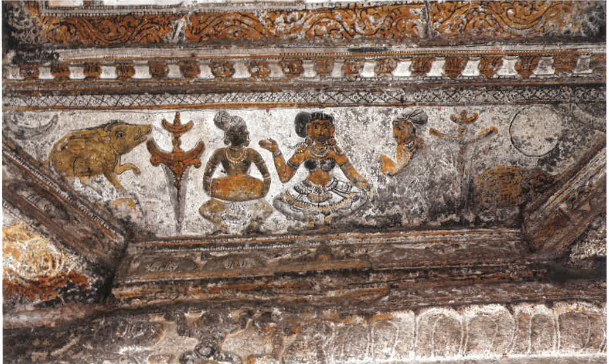
A fine maṇḍapa (fig. 5.136) carrying minutely carved pillars by the side of the Tāyār shrine is ascribed to Kṛṣṇadevarāya, early 16th century, where the swing festival is conducted annually. The maṇḍapa carries paintings on its ceiling (fig. 5.137) in the central square, depicting Viṣṇu standing with two of his consorts, another Viṣṇu seated with his consort, and the third with one consort. A Veṇugopāla Kṛṣṇā, a Kaliya Kṛṣṇā, and gopisvastrāpa-haraṇa are also seen. On the outside of this square, two border paintings are interesting. On one side, it shows a dancing girl (fig. 5.138-5.139) accompanied by instrumental musicians dancing between the royal emblem, “boar, dagger, sun, and moon.” The other one shows again the same emblem of boar, dagger, sun, and moon welcomed by two kinnara birds who were the celestial musicians.
These paintings are of interest on two counts. Firstly, the paintings are not on a flat surface but chiselled sculptures, showing that up to the Vijayanagara times, the stone sculptures were also painted. The second point is that the royal emblems were given great honour and were presented with dance and musical concerts.
5.18.4. Concealed Paintings
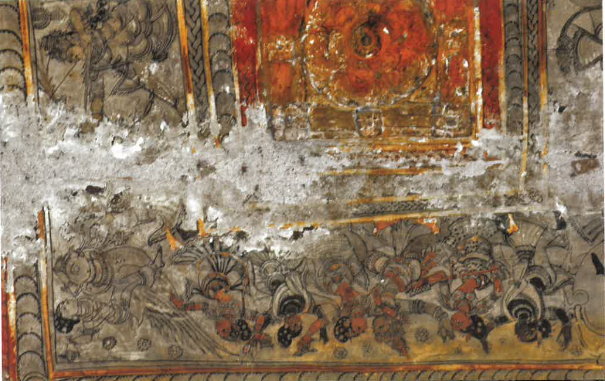
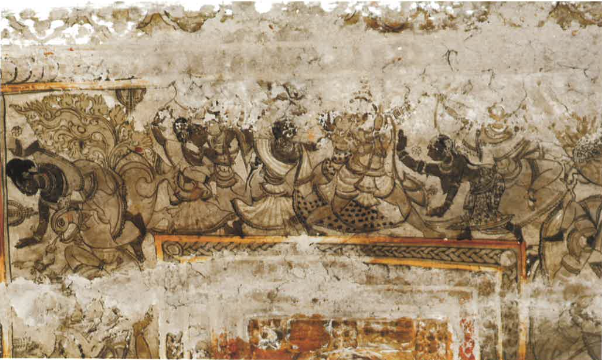
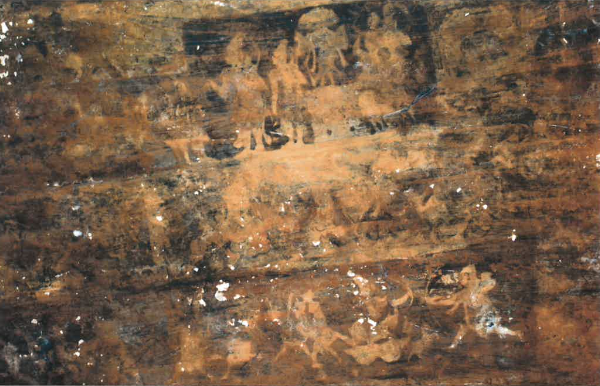
The maṇḍapa preceding the abhiṣeka-maṇḍapa was originally painted with extensive narrative paintings (fig. 5.140) probably from the Rāmāyaṇa scene. These could be seen lying beneath a coat of lime wash and seem ot have been in good condition when they were hidden behind the coat of wash. This author tried to get them cleaned but the chemist and found it difficult to remove the wash. It is hoped that one day it may still be possible ot see them in their pristine form. Judging from the line and form, they seem to date from the Vijayanagara painting of the 16th century.
5.18.5. Kṛṣṇā-Gopi Paintings
The passage through the second gopura remained painted on both side walls and its ceilings. But they remained completely whitewashed. So, I got them cleaned with the help of INTACH and as they were unveiled, it was seen they represented Kṛṣṇā and gopis sports. A number of well-preserved scenes were exposed that showed 17th century Nāyak period paintings of gopis moving through trees, etc. The costumes of the ladies were more interesting for their designs. However, some of Kṛṣṇā’s sports were vulgar and could not remain exposed as they portrayed sex. The walls on the other side showed various deities of the temple being taken out in procession during the annual festival. One panel showed the Garudotsava. However, these series were not so well preserved. On the whole, the Varadarājā temple paintings deserve more careful attention. Unfortunately, a totally unwelcome movement has now been created by the present Commissioner of State Archaeology to get all the mural paintings repainted. With the result old mural heritage is disappearing at rapid speed. The famous paintings in the Ramalinga Vilasam Palace were repainted by him and also the Thirupparuttikkunram murals repainted by the same authority. Following his example some more ancient Jaina temples have repainted their murals and more loss is ni the offing. We hope some authorities would stop this madness.
5.19. Āḻvār Hymns
The earliest reference to this temple occurs in two hymns of Bhūtattaḻvār who lived around the sixth century. In these verses the temple is said to be in “Atthiyur” (Atthiyurāṉ) ; its connection to Kāñcipuram is not mentioned. Evidently, it was not a part of Kāñcipuram, but a small village outside the city-limits then.
Bhūtattaḻvār sings that the Lord of Attiyūr resides in his heart and head and was the Maṇivaṇṇaṉ, who tore the chest of the asura (Hiraṇya, when he appeared as Narasiṁha). The whole world praises him as the wielder of cakra. He also rides on eagle, and sleeps on the serpent couch1. He is the embodiment of Vedas of the three fires - gārhapatya2, āhvaniya3 and dakṣināgni4 (vv. 95-96).
Many of the concepts and legends connected with Varadarājā in later times are found in these two hymns. For example, the earliest shrine in the Varadarājā temple is that of Narasiṁha appearing as a cave in the rock, over which the present Varadarājā sanctum is built. A number of temples in Kāñcipuram also had their bearing on these verses. The Dīpa Prakāśa temple called Viḷakkoḷi Perumāḷ, is muttī maṟai, the three fires. The Aṣṭabhujakāra temple where he appeared as the redeemer of Gajendra using his cakra to destroy the crocodile, is rooted in praise of the lord of cakra. The reclining form of Viṣṇu on the serpent couch, etc., are found in the Stala Purāṇa of Varadarājā in which Brahmā is said ot have performed a yāga in which Viṣṇu appeared as the flaming fire, as suggested by muttī maṟaiyavan (the flames of the three Vedas) and the lord of Brahmā, as nāṉmukhaṉ tanakkum irayavaṉ, in these hymns.
Thus, there is no doubt that these two verses of Bhūtattaḻvār formed the basis for subsequent development of Varadarājā cult. It must, however, be noted that none of the other early Āḻvārs have sung about this place and its lord, as no reference is found in the verses of Poigai Āḻvār, who was born near this temple, and Pey Āḻvārs and Thirumaḻisai Āḻvārs, who hailed from this region. Even other Alvārs have not sung on this temple; obviously it was a small village temple that had not attained popularity in the 16th century.
Raman in his work on Varadarājā temple has made some pertinent remarks in this connection which is worth citing.
It is rather strange that Āḻvārs like Poigai, who was born in Kāñcipuram, and Thirumaḻisai, who spent considerable time in the city (particularly at Thiru-Vehhā) have not referred to the temple of Attiyūr. Nor has it been sung by Thirumaṅgai Āḻvār who composed hymns on even the smaller temples at Kāñci such as Ūraham, Pãtakam, and Thiru-Vehhã, besides Parameśvara-viṇṇagaram. One of his verses, however, is taken to refer to Śrī Varadarājā temple. The verse occurs in his hymn on Parameśvara-viṇṇagaram (Vaikunṭatha Perumāḷ). The Āḻvār describes Kāñci as the place where resides the great boon-giver and the lord of the blue colour (varam tarum māmaṇi vaṇṇaṉ idam kacchi).5 But, here again, the reference is perhaps not specific ot the deity of our temple but only ot the general attributes of Viṣṇu who resides at Parameśvara-viṇṇagaram with which the Āḻvār is immediately concerned in his hymn. However, we find Thirumaṅgai Ālvār's description echoed by a Cōḻa epigraph at Varadarãja temple dated EC 1227, which calls the deity varam tarum perumāḷ, the lord who bestows boons. The same name occurs in an epigraph dated 1373 Śaka (CE 1451). From this we can infer that there was a long persistent tradition associating Thirumaṅgai Āḻvar's verse with Lord Varadarãja.
5.20.Some Select Inscriptions
CE 1186: The King Kulōttuṅga who also had the title Kodaṇḍarāman, gifted th e villages Pulippākkam, its hamlets and the village Vayalakkavūr, for a special worship to be performed ni the temple of Aruḷāḷanāthaṉ,named Kodandaraman Sandhi, and festivals. The villages were gifted tax free, which means the taxes levied from the villages were to be paid to the temple for the expenses of the Lord and the Sri Vaisnavas of Kancipuram.
CE 1194: A chief Thirukkāḷattideva Yādavarāya gifted a village Māṉanallür to meet the requirements of daily sources, food offerings, etc., to the God Aruḷāḷ-Perumāḷ, pleased ot stand at Thiru Attigiri. All taxes from this village were to be paid to the temple for the above purpose. The grant was made in the reign of the Cōḻaō emperor Kulōttuṅga I, the conqueror of Madurai, and the crown of Pāṇḍya king in his 16th regnal year (1147).
There are a few points of interest in this record. The lord is pleased ot stand at Atthiyūr which indicates that in the time (1200) of Kulōttuṅga III, the village was called Atthiyūr and not as Kāñcipuram or Nagaram. Subsequently, in the time of his son Rājarāja Cōḻa III, from the beginning of the 13th century, it came ot be mentioned as Thiruatthiyūr, belonging ot Kāñcipuram. That shows Atthiyūr is integrated with Kāñcipuram by the beginning of the 13th century.
This Chief is different from the other chief Gaṇḍagopāla who was a Telugu Cōḻa, while the present donor was a Yadavarāya, a branch of Chalukki family. Another interesting point is, this chief calls himself as a great devotee of the Śiva of Kāḷahasti (Sri Kāḷahasti-deva-divya Śrī Padaradhaka) and also a great devotee of Lord Viṣṇu of Tirupati (Śrīmat Veṅkaṭanātha Pādaravinda laneana). This is just fifty years after the demise of Rāmānuja. The gift is made to Varadarājāswāmi temple of Kāñci, so closely associated with Rāmānuja. Even at that period, one could be agreat devotee of Śiva and Viṣṇu together and no exclusive devotion to one god only, was to be seen in the Varadarãja temple.
CE 1205 Aḻagiya Cōḻa Sambhuvarāyan gifted the village Siru-Narinbūr, a southern hamlet of Vikrama-cōḻa-caturvedi-maṅgalam, to meet the expenses of daily services, and repair works of Aruḷāḷ-Perumāḷ temple of Atthiyūr. Al the taxes paid by the village should be paid ot the temple, for the above purpose. The gift was made in the reign of Cōḻa ruler Kulōttuṅga I, in his 27th regnal year (CE 1205).
CE 1234: The chief, who had the title Manma Siddharasan, and Madhurāntaka Poṭṭappi Cōḻaṉ, gifted the village Karaṇai, in Kacciyūr-nāḍu, north of Pālaru, for meeting the expenses of “Gaṇḍagopāla Sandhi,” “Thiru-āḍi festival,” “Puraṭṭāsi festival,” expenses for the daily services and maintenance of the God Aruḷāḷ Perumāḷ, pleased to stand in Thiru Atthiyūr. Al the taxes to be paid by this village to the royal treasury should henceforth be paid ot the temple. There were some lands in the gifted village, that were temple lands, and also gifted to Viṣṇu temple, earlier. These lands were exempted from paying any tax now to this temple. The gift was made in the reign of Cōḻa emperor Rājarāja III, in his 18th regnal year. The record shows that the festivals of Āḍi and Puraṭṭāsi were celebrated in the temple before this date. A new pūja was instituted to be conducted daily in the temple in the name of “Gaṇḍagopāla”, the donor. There were more than three chieftains - kings with the name serving as subordinates under the Cōḻas. Their names are known as Vijaya Gaṇḍagopālaṉ, Vīra Gaṇḍagopālaṉ, and Thiruk-kāḷattidēvaṉ Gaṇḍagopālaṉ. The present gift was made by the last-mentioned.
CE 1267: A chief Nalla-siddhararasan gifted 30 cows and bulls, for burning five perpetual lamps for the Perumāḷ and five for the Periya Pirāṭṭiyār, daily to the lord Aruḷāḷ-Perumāḷ pleased to stand in Thiru Atthiyūr, in the city of Kāñcipuram (nagaram kāñcipuram). Out of 330, 300 were cows and 30 were stud bulls.
These were received by the cowherds of the temple who were responsible for maintaining the lamps. They were expected to supply daily ghee for burning perpetual lamps, at the rate of two nāḻi and 1 uri. In addition, they have to supply curd for madhu-parka in daily services.
They must also serve the requirements for daily food offerings and requirements of festival days. The responsibility was entrusted to Karaṇathār who entrusted the same to two groups called Thiru-viḷakku-kuḍikaḷ - subjects attached to the temple for maintaining the temple cattle. The first group who undertook to maintain five lamps was called a Kōṇ(ar) who was also called Tuvarapati Vēlaṉ (Tuvarapati is Tamiḻ form of Dvãravati, Dvāraka). This deed was entered in the register by one Thirubhuvana Cōḻa Alarmēl Aḻagiyãr, a native of Uttaramērūr.
The gift was made in the reign of Vijaya Gaṇḍagopālaṉ in his 17th regnal year (1267). He counts the year in his own regnal year, indicating he was ruling Kāñci as an independent ruler. It may be seen that Thiru Atthiyūr is fuly integrated with the city of Kāñcipuramo by 1250 as it is mentioned as Thiru Atthiyūr, of Nagaram Kāñcipuram (nagaram kāñcipurattu tiru-atthiyūr).
The other point of interest is, the donor calls himself a descendant of Pallava-kula, and belonging ot Bhāradvāja gotra and was the lord of Kāñcipuram (kāñcipura varadhiśvara). He also calls himself a Kāḍuveṭṭi, a title assumed by the Pallavas. He also claims he received the blessing of Kāmakōṣṭāmbā (Kāmākṣi). This chief is also said to have established 700 agrahāras. We find the great devotee of Kāmākṣi Ambāḷ making a great gift to Viṣṇu Aruḷāḷ-Perumāḷ, which shows that 10 years after Rāmānuja, there was no sectarian rivalry and no bar for a devotee of one god being a devotee of another god as well.
These records do show that the temple has grown into the present position and popularity mainly due to the munificence of kings , Chiefs, men and women who have made gifts, land, cattle, wealth, jewels, most of the structures and enormous number of daily worships, festivals and stood as devotees in perpetuity and it is necessary that history of the temple should be presented in historical perspective and not shrowded in myths and legends.
5.21. Temple Car
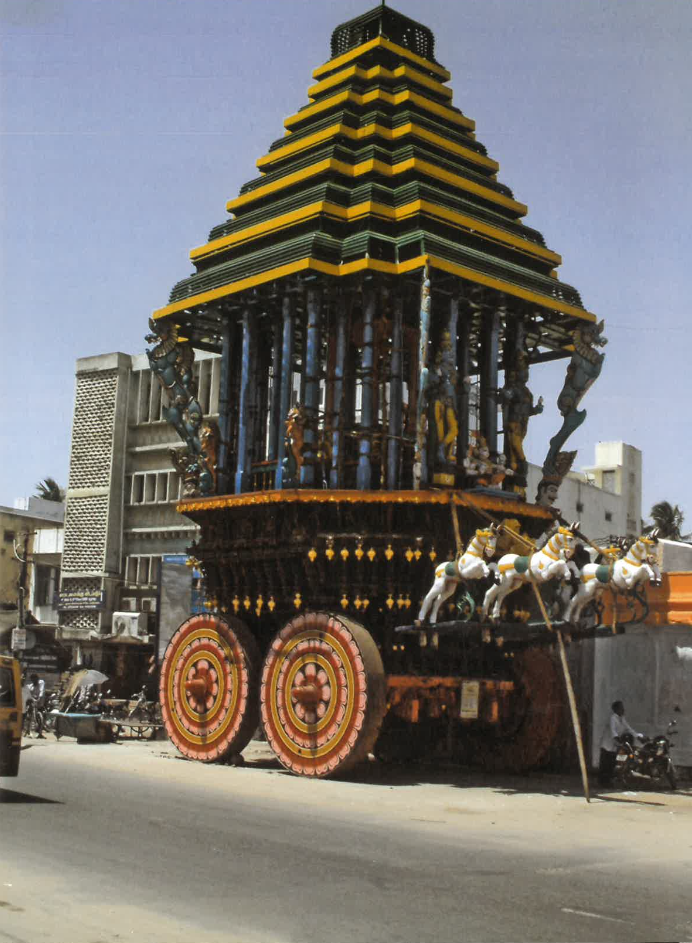
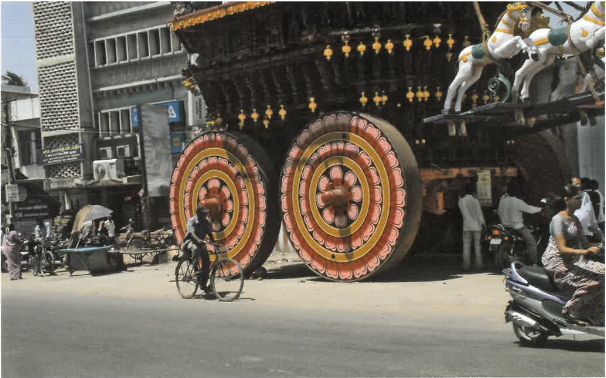
On the main road in front of the temple stands a beautiful temple car, magnificent for its wood carvings and majestic by its magnitude, that is used in this temple during annual festivals. Its wheels have been redone in recent times. The place where it stands was the original eastern boundary of the ancient Kāñcipuram city, and it now serves as a vertical dividing point between what si called Śiva Kāñci and Viṣṇu Kāñci (figs. 5.141-5.142) The Varadarājā temple is the most popular Viṣṇu temple in Kāñcipuram attracting pilgrims from al the neighbouring states like Andhra, besides Tamil Nadu (fig. 5.143).
1. Bhūtattaḻvār, Second Tiruvanthāthi.
என் நெஞ்சம் மேயான் என் சென்னியான் தானவனைவல் நெஞ்சம் கீண்ட மணி வண்ணன் முன்னம் சேய்ஊழியான் ஊழி பெயர்த்தான் உலகு ஏத்தும்ஆழியான் அத்தியூரான் (2275, 95)eṉ neñcam mēyāṉ eṉ ceṉṉiyāṉ tāṉavaṉaival neñcam kīṇṭa maṇi vaṇṇaṉ muṉṉam cēyūḻiyāṉ ūḻi peyarttāṉ ulaku ēttumāḻiyāṉ attiyūrāṉ (2275, 95)அத்தியூரான் புள்ளை ஊர்வான் அணி மணியின்துத்தி சேர் நாகத்தின்மேல் துயில்வான் முத்தீமறை ஆவான் மா கடல் நஞ்சு உண்டான் தனக்கும்இறை ஆவான் எங்கள் பிரான் (2276, 96) attiyūrāṉ puḷḷai ūrvāṉ aṇi maṇiyiṉtutti cēr nākattiṉmēl tuyilvāṉ muttīmaṟai āvāṉ mā kaṭal nañcu uṇṭāṉ taṉakkumiṟai āvāṉ eṅkaḷ pirāṉ (2276, 96)2. Gārhapatya (गार्हपत्य) - the householder’s fire (received from his father and transmitted to his descendants, one of the three sacred fires, being that from which sacrificial fires are lighted
3. Āhavanīyam (आहवनीय) - to be offered as an oblation, consecrated fire taken from the householder’s perpetual fire and prepared for receiving oblations especially the eastern of the three fires burning at a sacrifice, Cologne Digital Sanskrit Dictionaries: Monier-Williams Sanskrit-English Dictionary.
4. Dakṣiṇāgni (दक्षिणाग्नि) - the southern fire of the altar.
5. Periya Tirumoḻi, Tirumaṅgai Ālvār:
உரந்தரு மெல்லணைப் பள்ளி கொண்டான் ஒருகால் முன்னம் மாவுரு வாய்க்கடலுள்,வரந்தரும் மாமணி வண்ணனிடம் மணிமாடங்கள் சூழ்ந்தழ காயகச்சி,நிரந்தவர் மண்ணையில் புண்ணுகர் வேல்நெடு வாயி லுகச்செரு வில்முனநாள்,பரந்தவன் பல்லவர் கோன்பணிந் தபர மேச்சுர விண்ணகரமதுவே.urantaru mellaṇaip paḷḷi koṇṭāṉ orukāl muṉṉam māvuru vāykkaṭaluḷ,varantarum māmaṇi vaṇṇaṉiṭam maṇimāṭaṅkaḷ cūḻntaḻa kāyakacci,nirantavar maṇṇaiyil puṇṇukar vēlneṭu vāyilukac-ceru vilmuṉanāḷ,parantavaṉ pallavar kōṉpaṇin tapara mēccura viṇṇakaram atuvē.