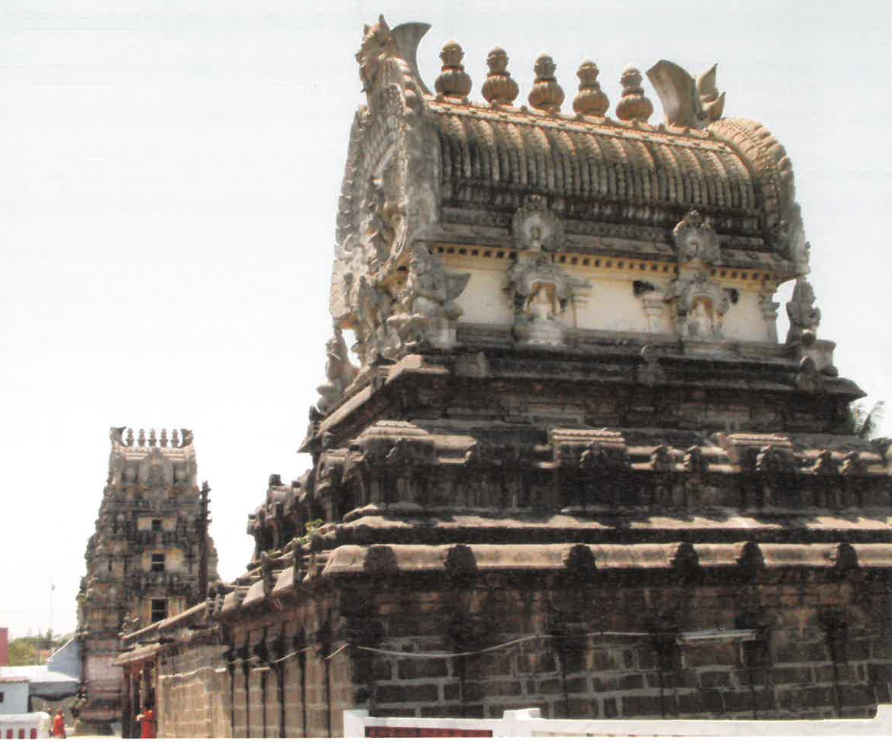
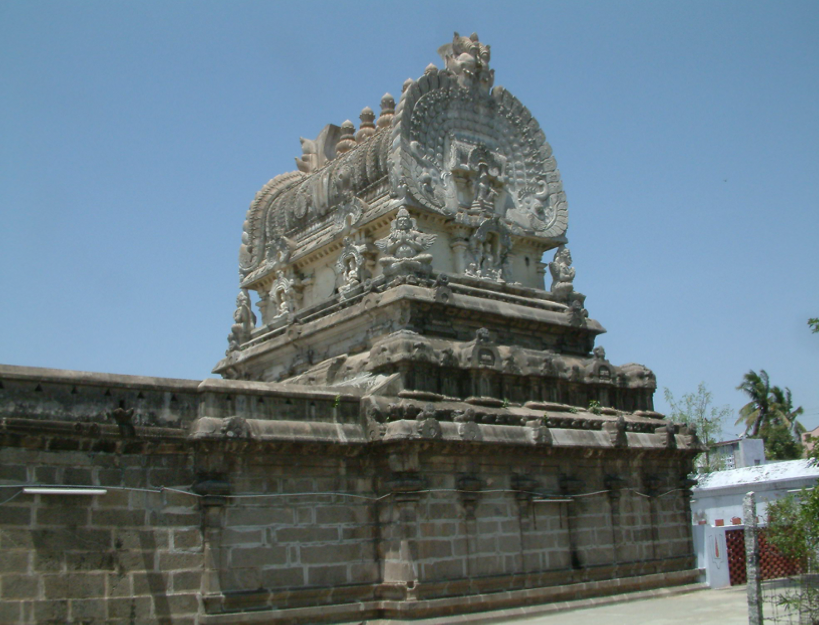
Pāṭakam, a part of Kaccippēḍu (Kāñcipuram) in ancient times, was the name of the locality and the temple dedicated to Kṛṣṇa here was called Temple of Irundar (now called) Pāṇḍava-dūtar.
3.2. Kṛṣṇa in Tamiḻnaḍu
Pāṭakam temple is one of the earliest temples of Kṛṣṇa in Tamiḻnaḍu. It may be recalled that Madurai, the capital of Pāṇḍyas was Mathura, often called southern Mathura of Kṛṣṇa. Also, the ancient temple of Aḻagarkōyil was originally dedicated to both Kṛṣṇa Vāsudeva and Balarāma found mentioned in Saṅgam literature. This Kṛṣṇa cult should have become a part of Tamiḻ culture from the beginning of historic times. The Ūraham temple at Kāñci also houses Balarāma (now called Ananta) in the form of a white snake. The cult of Kṛṣṇa and Balarāma flourished in Tamiḻnāḍu after the Mahābharata tradition and is mentioned in the Puṟanāṉūru and Pari-pāḍal poems which points out that Kṛṣṇa was known for his fame and Balarāma was known for his might amd were the two of the protectors of the world, the other two being Śiva and Muruga. The Pāṇḍyas of the south claimed that their ancesters translated the Mahābhārata into Tamiḻ. Kṛṣṇa and his other avatars like Trivikram, Varāha etc were part of Tamiḻ culture all over Tamiḻnāḍu. The Pāṭakam Temple of Kāñci is a symbol of this ancient culture.
3.3. The Temple
The main temple sanctum is a rectangular śāla-vimāna with a pāda bandha variety of adhiṣṭhāṇa built of granite. The vimāna has a very impressive string of karṇa kūṭas, sālās, and pañcaras – parapets going around indicating a form going back to the Pallava period. But the earliest inscription on the wall of the main temple is that of Kulōttuṅga I, dated in his 5th year 1075 CE. It does not refer to the construction which is likely to have been built in the beginning of Rājrāja’s time 1000 CE. The grīva of the sanctum is high, and the vimāna has stucco figures that are reminiscent of the Pallava age though the present stucco work might have been renovated later.
fig. 3.1: A view from the back of the temple of Pāṭakam and its preceding gopura. The rectangular structure is the vimãna of the temple.
fig. 3.2: The view of the ancient Pāṭakam Temple (Pāṇdava-dūta) showing the vimāna of the Cōḻa Age, preceded by an entrance gopura.
There seem to have been three phases of lateral extensions by way of maṇḍapas, in the front. But the main walls are severely plain with no niche or sculpture.
Inside the sanctum, abutting the rear wall, the image of Kṛṣṇa in a seated pose can be seen. It is perhaps the tallest sculpture in all of Kāñcipuram, rising to a height of about 35 feet. The face is so high that it is even difficult to see. The lord is shown with only two arms in abhaya and varada poses. The sculpture is made of stucco but appears black due to a coat of fragrant oil. No image of any Goddess or other deities is shown. In front of this image, on a pedestal, Viṣṇu is depicted with four arms in metal, holding cakra, śankha, abhaya, and varada mudrās. He is identified with Kṛṣṇa, who went as an ambassador on behalf of the Pāṇḍavas to Duryodhana, the Kaurava, asking him to cede at least five villages to the Pāṇḍavas so that the war between them could be averted and they could live in peace. His two consorts, Rukmiṇi and Satyabhāma, are also depicted in metal; all three are in a standing posture. There is also a metal image of Navanīta Kṛṣṇa dancing.
The priest told me enthusiastically about the Sthala Purāṇa and how Kṛṣṇa came to appear in this form. However, he was more emotionally attached to the heritage of his family, which should have originally hailed from Vinjamūr in Andhra-deśa, and later came to Kāñcipuram. One of its prominent members, Yajñamūrti, a great scholar and originally a Smārtta Brāhmaṇa of the Advaita school, met Rāmānuja and challenged him to a debate that lasted for eighteen days. For seventeen days, Yajñamūrti remained victorious, and Rāmānuja couldn’t succeed. On the 18th day, Rāmānuja prayed to Varadarājā, and as a result, Yajñamūrti accepted defeat even without the debate and became a convert to the Visisṣṭhādvaita system
The tradition of an 18-day debate in this temple of Kṛṣṇa is inspired by the 18 days of the Mahābhārata war and the 18 chapters of the Bhagavad Gīta. However, the story is located in the temple of Varadarāja and not in this temple. In fact, there is no reference at all in any of the published accounts about Rāmānuja’s visit to this temple. Nor does the Sthala Purāṇa speak of Rāmānuja’s association with this temple in any way. Obviously, this story is in the general trend of purāṇas, intended to glorify Rāmānuja. The fact that for 17 days he failed with his own masterly ability and even on the 18th day he won the debate only with divine intervention would show that it is not a historical event but fully in the realm of Purāṇa, which we call Rāmānuja Purāṇa.
Pāṭakam is one of the earliest shrines and was very popular centuries before Rāmānuja. The fact that Rāmānuja’s visit to any of these well-known Viṣṇu temples in Kāñci receives the least attention shows that the biographers of Rāmānuja were more interested in projecting the greatness of Rāmānuja and not history. The legends should be understood for the purpose for which they were created and not as historical events. What emerges from the legend is that Rāmānuja himself was originally a Smārtha Brāhmaṇa of the Vedantic school who converted many Smārtha Brāhmaṇas to his system. Even this seems to be far from the truth as Rāmānuja seems to have belonged to the Vaiṣṇava Vedantic school which was active before his time. It also appears that Rāmānuja appointed Yajñamūrti to worship his personal God, Devarāja. It is not clear at what point in time the Yajñamūrti family took over the Pāṭakam temple. However, Yajñamūrti was called “Aruḷaḷa Perumāḷ Emperumānār” which shows that the title Emperumānār was commonly applied to many in the time of Rāmānuja and later claimed only for him.
It is evident from other records that ‘Pāṭakam’ was the name of the colony of Kāñcipuram, where lived many great architects. The famous Sundaravarada temple at Uttaramerūr, built in the 8th century was designed and constructed by an architect named Parameśvara who hailed from Pāṭakam of Kāñcipuram.
The gopura in front of the Pāṭakam temple may belong to 15th cent.
3.4. Inscriptions
A merchant named Aruḷaḷadāsan, who was a resident of the market street, “Arumoḻideva Perunteru”, in the Nagaram of Kāñcipuram, in Eyilnāḍu, of Eyirkottam, purchased 2000 Kuḻi of lands in the village of Orirukkai, in Kāliyūr-paṟṟu of Kāliyūr Koṭṭam. He endowed it for rearing a flower garden, and also for the maintenance of a gardener to look after the same, along with a clothing allowance for him. The flower garden, named Aru’laḷadāsan after the donor, was situated at the back of the temple. The land purchased was in the village Orirukkai in Kāliyur Koṭṭam. From the boundaries mentioned, it is seen that the village is the one near Uttaramerūr. It was an agricultural settlement generally called ‘ūr’ and the inhabitants had their own village assembly which sold this land to the merchant of Kāñcipuram, for providing subsistence to the gardener.
The donor paid eleven gold kaḻañju, equal in weight to Madhurāntakaṉ-māḍai. The village assembly received this money and sold the land as “devatāna iṟaiyili” which mean that all tax dues would be paid to the temple and not to the royal treasury. The villagers agreed not to levy any local tax for this land. The village also agreed to measure the proceeds from the land to the temple, as per a standard measure of the temple granary. The market street was known as “Aruḷmoḻideva Perunteru” (the big street) named after one of the titles of Rājarājā I. The other streets names suggests that a new market street came into existence around 1000 CE under Rājarājā at Kaccippēḍu. Another point of interest is that the name Aruḷāḷadāsa, a name of Śrī Varadarājāp-Perumāḷ seems to have become popular by 1075 CE (as it occurs in the 5th year Kulōttuṅga – 1075 CE).
Another record dated 1109 CE in the 39th year of Kulōttuṅga I, reveals that a merchant named Nādan Soman, a resident of the market street Rājāśraya-perunteru, gifted 2½ kaḻañju of gold for worship and special food offerings to the God of Pāṭakam. The money was received by two priests who served the temples and agreed to arrange for offering curd rice daily to this God in lieu of the interest accrued from the capital deposited. They were Ninṟanārāyaṇa Bhaṭṭa, belonging to Bhāradvāja gotra, Dūtakāri Tiruvaraṅga-māṇi-bhaṭṭaṉ. They also assured that in case they were unable to provide the curd rice as stipulated, they would give the gold in the hands of those who would be able to measure. In case of relinquishment of the service, they will deposit the amount in the treasury before leaving.
This inscription is important from some angles. The priests of the temple served as reliable bankers, who agreed to pay interest on the capital deposited. In case they faulted, they had to turn it over to those who would undertake to pay the interest in kind as expected. In the event of their migration or relinquishing this service of priesthood, they had to return this amount to the temple treasury. The record points out that the priests belonged to Bhāradvāja gotra. The name “Ninṟa Nārāyaṇaṉ” is derived from the name of “Ninṟāṉ” for Ulakaḷanta Perumāḷ. The other priest had the name Dūtakāri that gave rise to the name Pāṇḍava-dūta. Kāri is a synonym of Kṛṣṇa. The donor merchant belonged to the market street “Rājāśraya perunteru”. Rājāśraya was another title of Rājarājā I. This suggests that spacious merchant quarters with several markets were established by Rājarājā at Kāñcipuram and they were devoted to the lords of this town.