2.Tiru-Vehhā

2.1. Location

Tiru-vehhā is another ancient temple of Kāñcipuram. It is now called Coṉṉavaṇṇam-ceyda-perumāḷ in Tamiḻ and Yatodkāri temple in Sanskrit. This deity also faces west. The Goddess is named Kōmaḷavalli Nācciyār and the temple tank called Poykai Puṣkariṇī.

2.2. In the Saṅgam Age

Kaḍiyalūr Rudraṉ kaṇṇaṉār, a Saṅgam poet sings about Kāñcipuram in his Saṅgam work assigned to the beginning of the current era. As the hero Toṇḍaimāṉ Iḷam-tiṟaiyaṉ was the ruler of Kāñci, the poet was conversant of deities adored in Kāñci. At the beginning itself. he speaks of Viṣṇu as Trivikrama and the originator of the Tiṟaiyaṉ family. The mention of Trivikrama suggests the god of Ūraham the Ulakaḷandār – Trivikrama the central deity of Kāñci. It also suggests that the adoration of Trivikrama is mainly to achieve fame in all the three world: இருநிலம் கடந்த திருமறு மார்பின் முந்நீர் வண்ணன் பிறங்கடை, அந்நீர்த் திரைதரு மரபின் உரவோன் உம்பல், மலர்தலை உலகத்து மன் உயிர் காக்கும் முரசு முழங்கு தானை மூவருள்ளும் இலங்கு நீர்ப் பரப்பின் வளைமீக் கூறும் வலம்புரி அன்ன வசை நீங்கு சிறப்பின், அல்லது கடிந்த அறம் புரி செங்கோல், பல்வேல் திரையற் படர்குவிர் ஆயின், கேள் அவன் நிலையே கெடுக நின் அவலம்! (28-38) irunilam kaṭanta tirumaṟu mārpiṉ munnīr vaṇṇaṉ piṟaṅkaṭai, annīrt tiraitaru marapiṉ uravōṉ umpal, malartalai ulakattu maṉ uyir kākkum muracu muḻaṅku tāṉai mūvaruḷḷum ilaṅku nīrp parappiṉ vaḷaimīk kūṟum valampuri aṉṉa vacai nīṅku ciṟappiṉ, allatu kaṭinta aṟam puri ceṅkōl, palvēl tiraiyaṟ paṭarkuvir āyiṉ, kēḷ avaṉ nilaiyē keṭuka niṉ avalam! (28-38) Another point of interest is the name Kacci by which the poet calls Kāñcipuram. This is the name used in inscriptions as Kaccippēḍu. Further, the poet also calls Kacci as Kacci-mūdūr, i.e., an ancient village. The name of Ūraham for the ancient temple remained when Kāñci was still considered a big village though called later as nagaram or mānagaram. கச்சியோனே கைவண் தோன்றல்! 420 kacciyōṉē kaivaṇ tōṉṟal! 420 விழவு மேம்பட்ட பழவிறல் மூதூர்; viḻavu mēmpaṭṭa paḻaviṟal mūtūr; The same poem speaks about Tiru-Vehhā temple where Viṣṇu remained reclining on a serpent couch. There is another line in the same poem that suggests the existence of Kārvāṉam temple. பாம்பணைப் பள்ளி அமர்ந்தோன் ஆங்கண், pāmpaṇaip paḷḷi amarntōṉ āṅkaṇ kārvaṇṇaṉ ganaṇgaḷ eṉa karuvi vantaruḷ corintānku Tiraiyaṉ, the chieftain of Kacci is a descendent of Viṣṇu referred to as: muṉṉīr vaṇṇaṉ piṟaṅkaṭai, annīrt tiraitaru marapiṉ uravōṉ umpal Tiraiyaṉ who was wafted by the sea waves was born in the family of Viṣṇu who sleeps on the sea as “nīrvaṇṇaṉ” the Lord of ocean. It reminds us of the Nīr-vaṇṇap-Perumāḷ temple in the Ūraham temple complex. The three other deities besides the main deity of Ūraham temple are Kārvāṉam, Nīraham (Nīrvaṇṇaṉ), and Kāraham (Kārvaṇṇaṉ). We have also seen the four temples are generally praised together by the Āḻvārs. We are therefore convinced that these four temples existed from first or second century BCE. We have noted earlier that two temple shrines existed on Karikālaṉ Teṟṟi within the Ūraham temple complex noticed from inscription. This reference is confirmed by the Saṅgam poem Perum-pānāṟṟṟupaḍai. It must also be remembered that Toṇḍaimāṉ Iḷam-tiraiyaṉ was the grandson of Karikāla through his son Kiḷḷi-vaḷavaṉ. Thus, the antiquity of these temples of Viṣṇu could be traced to first – second century BCE. This temple Tiru-vehhā of Viṣṇu as Anantasāyi, was well known as mentioned earlier from the poem Perum-pāṇaṟṟuppaḍai of Pattu Pāṭṭu anthology. A bard who visited Kāñcipuram and met the ruler Toṇḍaimāṉ Iḷam-tiraiyaṉ, was rewarded sumptuously. He advised another bard who was in search of a patron, to go to Kāñcipuram where he could visit first the temple of Viṣṇu reclining on serpent on the banks of a river. The place was beautiful with blooming flowers and was a sandy mound like the slopes of a hill in which elephants slept. On the banks of this perennial river with full of flowers, he should worship that invincible God singing with his great yāḻ (lute). .........................நீடுகுலைக் காந்தள் அம் சிலம்பில் களிறு படிந்தாங்கு, பாம்பணைப் பள்ளி அமர்ந்தோன் ஆங்கண், .........................nīṭukulaik kāntaḷ am cilampil kaḷiṟu paṭintāṅku, pāmpaṇaip paḷḷi amarntōṉ āṅkaṇ, இடனுடைப் பேரியாழ் முறையுளிக் கழிப்பிக் கடன்அறி மரபின் கைதொழூஉப் பழிச்சி iṭaṉuṭaip pēriyāḻ muṟaiyuḷik kaḻippik kaṭaṉaṟi marapiṉ kaitoḻū'up paḻicci The poem clearly indicates that the temple was situated on a sandy slope by the side of the river (Vegavati). Evidently, this part of Kāñci was called Vehhā. This is further confirmed by the poem of Tirumaṅgai-Āḻvār who points out that the lord was at Tiru-vehhā on the sparkling banks of the river. All the Āḻvārs sing of the place as Vehhā and there is no hint that Viṣṇu placed himself across the river to block it. An epigraphical record found in the Ulakaḷanta Perumāḷ temple specifically mentions that Tiru-vehhā temple was the eastern boundary of Kaccippēḍu and does not say that part was out of Kaccippēḍu (Kāñcipuram).

2.3. Ehhā

The name “vehhā” is derived from the Tamiḻ word “ehhā” meaning “sandy slope” which with the preposition tiru becomes tiru-v-ehhā, “Sacred Vehhā”. This is what was meant by the poet when he specifically referred to it in the same poem.
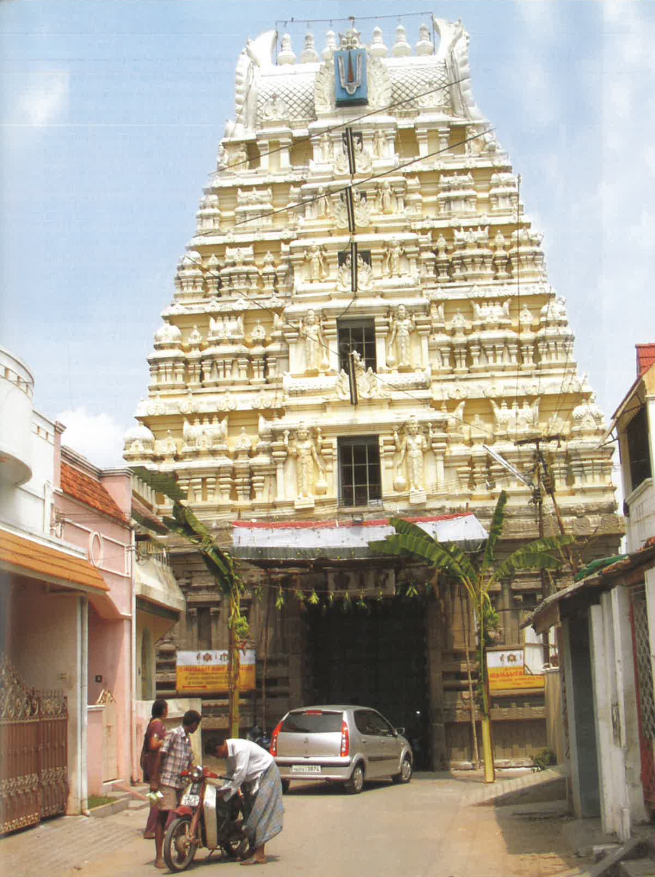
fig. 2. 1.: The outer gopura of the Thiru-Vehhã Temple (Coṉṉavaṇṇam-ceyda-perumāḷ) of the age of Kṛṣṇadeva-rāya, 16th century.
The poem further says that the river was perennial – “poyyā marapir pūmali peru tuṟai”. There was continuous flow of water in the river and there were ponds and sandy accumulation here and there. The ponds as well as sandy patches were formed when there were floods in the river. Even now, there is a place called Tiru-vīthip-paḷḷam behind this temple. Further, the poem clearly suggests that this area was within the boundaries of Kāñci. It also clearly suggests that the name “Kāñci” for this town was derived from the name of “Kāñci” tree that abounded in this place. வெயில் நுழைபு அறியா குயில் நுழை பொதும்பர்க் குறுங்காற் காஞ்சி சுற்றிய நெடுங்கொடிப் 375 veyil nuḻaipu aṟiyā kuyil nuḻai potumpark kuṟuṅkāṟ kāñci cuṟṟiya neṭuṅkoṭip 375 Neither in this ancient literature, nor in the poems of Āḻvārs, do we have this suggestion of Viṣṇu reclining across the river as a dam.

2.4. Legends

However, there is a myth evolved now, that Viṣṇu acted as a dam here for preventing the flow of the river Vehhā. The legend is narrated to give the origin of the name Tiru-vehhā to this place. According to the legend, Brahmā the creator, performed a Vedic sacrifice here in order to behold Lord Viṣṇu. He came to this place where the Tiru-atti hill (the temple of Varadarājā) is found as the northern Vēdi, Uttaravēdi. Brahmā asked the divine architect, Visvakarmā, to create a great city with lofty palaces, and a yāgaśāla here. Brahmā’s consort goddess Sarasvati was doing penance at that time on the banks of river Sarasvati in the north.
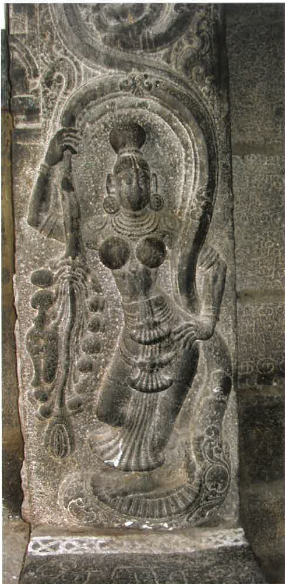
fig. 2. 2.: The river Goddess Ganga, standing on a crocodile and holding a creeper, depicted on the doorjamb of the gopura of the Tiru-vehhā, Kāñcipuram.
On an earlier occasion there had been a dispute between the devotees of goddess Lakṣhmī and goddess Sarasvati about who was superior among them. Brahmā was asked to adjudicate on the dispute. The Creator gave the verdict that Lakṣhmi was certainly superior. At this his consort Sarasvatī got angry, and refused to come down to south and officiate with Brahmā in the Vedic sacrifice. Brahmā thereupon started performing the sacrifice with other consorts. The Asuras who were supposed to receive some offerings in that sacrifice, were denied their dues as Sarasvati was not present. They approached Sarasvati and requested her to prevent the fulfillment of Brahmā's sacrifice. Goddess Sarasvati took the form of Vegavati river and came with tremendous force to wipe out the sacrifice. Those who were in the Yāgasāla saw the tremendous force and so requested Brahmā to do something to prevent the river spoiling the yajũa. Brahmā saw this as the work of the Asura-demons and prayed to Viṣṇu for help who appeared as a dam, lying across the river, preventing her force. Sarasvati was ashamed and went underground, and reached the ocean as a hidden underground River. The sages went and prayed to the Goddess who finally agreed to come out and join Brahmā to fulfill the Vedic sacrifice. Thus when the sacrifice was completed, Varadarājā appeared on the sacrificial fire and blessed all those assembled.
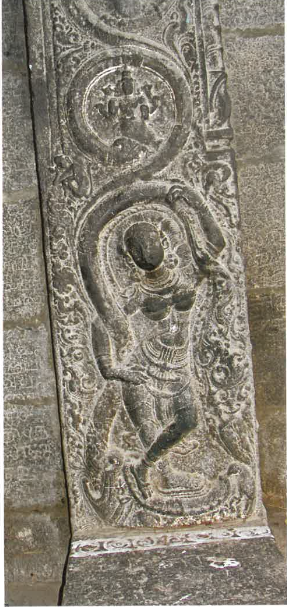
fig. 2. 3.: The river Goddess (entrance deity), standing on a turtle (kūrma) and holding a creeper, depicted on the doorjamb of the gopura of Tiru-Vehhã, 16" century.
As Viṣṇu appeared as a dam across the river Vehhā to stop the river, he is called "the one who slept across the river as a dam". This legend is trying to impart a meaning to the Tamil term aṇai "Vehh-aṇai-kiḍanta Perumāḷ" – i.e. the God who slept on a couch on the river Vehhā". Aṇai means also a couch which is its contextual meaning here. This legend bereft any historical value or relevance, is a clever allegory depicting victory of “action” (karma) over “knowledge” (Jññana). This legend was also invented to suggest the superiority of the Visiṣṭtādvaita doctrine against Advaita doctrine of jñāna over ritual action and devotion. The second segment of the story points to the parallel between Śiva stopping the river Gaṅgā and, Viṣṇu, the river Sarasvati here. The third segment highlights the superiority of Varadarājā, over all other forms of Viṣṇu in Kāñcipuram for at the.end it was He who appeared as a flame from the sacrificial fire of Brahmā. We need not comment on the first two segments of the story, as they are evidently fictions sans evn imaginative excellance. The third segment was obviously created after the Varadarājā temple achieved popularity in the Vijayanagara period, by which time – Ūraham, Pāṭakam and Tiruvehhā, had lost their importance. The legend therefore cannot claim any antiquity as well.We should abandon the legend, to pure legendary sphere.

2.5. Kanikaṇṇaṉ

According to another legend, a Tamiḻ poet Kanikaṇṇaṉ was so mystical that God granted him what ever he wished. A queen of the Pallava King, is said to have requested the poet to transform her into a young lady. But the poet refused. The king who got angry and banished him from the city. The poet and his ācārya, addressed the God saying they were leaving the city and he should also leave winding up his serpent couch. The God did as requested by the poet and as a result the whole city of Kāñci was immersed in darkness. The relenting king approached the poet and sought forgiveness. The poet forgave the king and returned to Kāñci, requesting the God to do likewise. The God obliged. Two Tamiḻ poems with a play on words are cited as to the historicity of this episode. As the God functioned as told by the poet, the local tradition calls the God “one who acted as told” – Connavaṇṇam Ceyda Perumāḷ. Such myths are many and may be sent to the sphere of miracles and myths and not treated as history.

2.6. Poykai Āḻvār

There is another historically more relevant story which says that Poykaiyār was born in a tank “poykai” near this temple and came to be called Poykaiyār or Poykaiyāḻvār. According to the legend, he was born as an incarnation of the conch pāñcajanya held in Viṣṇu’s hand, on a golden lotus in the poygai puṣkariṇi tank in the month of aippasi when the star was tiruvōṇam. There is a village near this place which is called Poykaiyūr which seems to be an ancient agricultural settlement and it is not unlikely that the saint hailed from that village and called after his native village. The legend that he was born in the tank is to give sanctity to the great saint. The earlier records do not ascribe the star tiruvōṇam as his natal star. The date of early Āḻvārs is lost in antiquity and no definite information is available about their history. The earliest version needs to be accepted as more authentic in preference to what is given five hundred years later. Also, the three stars given to the first three Āḻvārs as tiruvoṇam, aviṭṭam and satayam in later period are the order of the nakṣhatras that sounds clearly artificial. However it is possible that after the violent disturbances to worship eclipsed early records, a new calendar was to be drawn up for festivals and those who scheduled them found the three consecutive stars convenient to remember and celebrate.

2.7. The Temple

The main deity, two-armed, is sleeping on his left on the coiled snake, Ananta, which, though rare, is not unknown (In general, the Anantasāyi form is shown lying on his right side). By the side of his feet is a seated Goddess slightly in the front with her hands in añjali pose, and she is identified with Goddess Sarasvati in the guidebook. When this author asked the priest whether she represented Goddess Prithvi or Sarasvati, he angrily retorted that they have nothing to do with Sarasvati, but she represented the river Vegavati. He is not aware of the fact that in the Pāñcarātra system itself, Sarasvati is included in the entourage of Viṣṇu in the sanctum in some instances. Sarasvati is portrayed in sculpture on the ground floor and in painting in front of the reclining form of Viṣṇu on the upper floor in the Sundara-varada Perumāḷ temple at Uttaramērūr. The painting dates back to the age of Kṛṣṇadevarāya at the beginning of the 16th century. So the claim that “the image is not Saraswati” is not correct and need not be taken very seriously. But it seems to us that the Goddess seated in front of the reclining Viṣṇu is Goddess Bhūmidevi, as prescribed in texts and seen in many Anantasāyi forms.
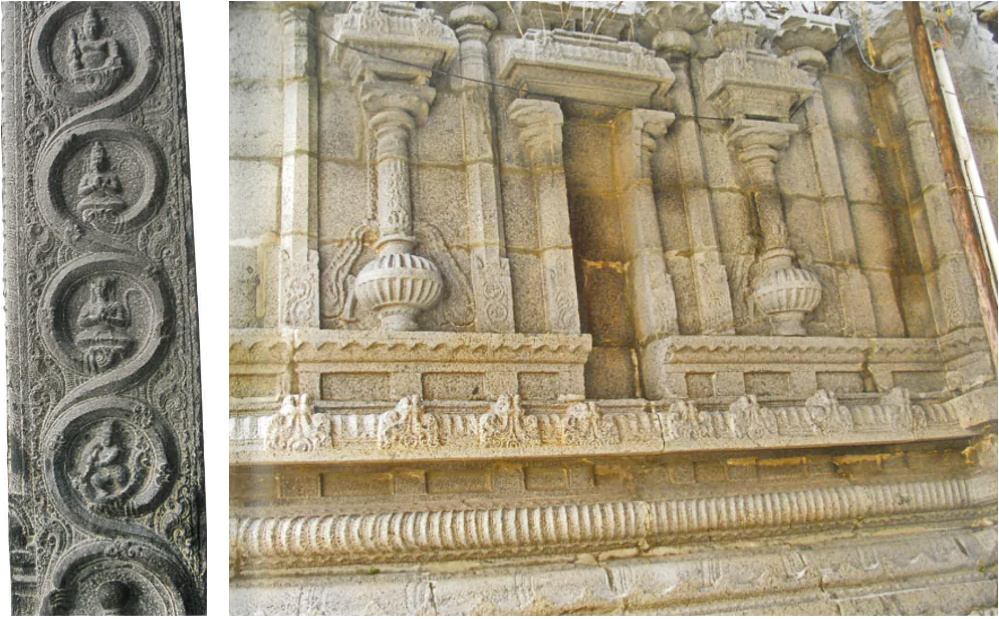
fig. 2.4: A creeper design in the same place, showing inside the circles, Hanuman, Vibhiṣaṇa and other Purāṇic deities. fg. 2.5: A view of the stone wall of the gopura of Tiru-Vehhã, showing the niches, now empty.
The garbha graha is rectangular in shape and houses the deity made of stucco and covered with fragrant oil (taila kāppu). The vimāna is called vedasāra vimāna i.e., essence of the Vedas. The garbha graha is preceeded by two or three maṇḍapas; the last one seems to be of the Cōḻa period. One of the pillars of the maṇḍapa in alignment with the sannidhi, figures a portrait.

2.8. Tirumalai Nāyak

To the south of this entrance is a shrine of the Goddess Komaḷavalli Tāyār. The pillars on front of the Goddess Sannidhi, carry portraits. The one closer to the entrance carries the portrait of a well built Nāyak king, standing in adoration, and a portrait of a woman facing him who is his queen. The close proximity of this portrait to the entrance to the sanctum shows that he was the builder of the Tāyār shrine. The next pillar carries on the right a portrait of a Nāyak, whose form, dress and head gear suggest Tirumalai Nāyak of Madurai who ruled in mid 17th century, while in front of him is a portrait of his queen also in Nāyak attire. One may wonder what Tirumalai Nāyak of Madurai had to do with this temple. The Nāyak rulers of Madurai originally hailed from Kāñcipuram and always prefixed Kāñci before their names. Kṛṣṇappa Nāyak of Madurai was called Kāñci Kṛṣṇappa Bhūpati. Tirumalai Nāyak was called Kācci Tirumalai Bhūpati. Tirumalai Nāyak was in the habit of installing his portrait in front of the deity, to which he added some construction as seen at Madurai, Aḻagarkoyil, Śrīraṅgam, Śrī-villiputtūr and other places. The one in the Tiru-vehhā temple bears close resemblance to his portrait found in all these places. The other Nāyak portrait was probably that of his father indicating that the Tāyār shrine at Tiru-vehhā was built in the first half of the 17th century. Also in the Tiru-vehhā temple there is a fine group of icons in metal of Rāma, Lakṣmaṇa, Sītā and Hanumāṉ in a separate sannidhi.

2.9. Inscriptions

The structure could be dated to the 10th century, to the time of Parāntaka Cōḻa, as the earliest inscription found on the base is that of him – 944. It refers to the God as “Anantanārāyaṇa Paramaswāmi” of Kaccippeēḍu, who was pleased to recline on a (serpent) bed, on the sandy bank of the river Tiru-vehhā (tiru-vehhaṇai mel paḷḷikoṇḍa anantamārāyṇa paramaswāmy). Some have taken it to refer to “who was pleased to lie as a dam to Tiru-vehhā” which is incorrect, and which imposes the recent legend on an early record. I have mentioned earlier how the term Tiru-v-ehhā was seen by early poets. The inscription of Parāntaka registers a sale of land in Kannamangalam, a village in Eḻilnāḍu, a sub-division of Eylirkoṭṭam, to the temple of Anantanārāyaṇa Paramaswami of Kaccippēḍu, by a certain individual for a sum of 367 kaḻañju of gold. It may be seen that the record says Kaccippēḍu, that is the main Kāñci. The modern interpretation that it was outside the city of Kāñci, found in the temple guide book is untenable. Second point that requires attention is the name Anantanārāyaṇa Paramaswami, referring to Anantasāyi Viṣṇu and not a dam. It is pertinent to point out that the Lord Śrī Ranganāta of Śrīraṅgam was also called Anantanārāyaṇa Paramaswāmi in early incriptions. The next inscription found on the south base of the main shrine is dated in the time of Rājēndra Cōḻa I records a sale of land by a merchant of Kāñcipuram, of one kuḻi of land as a tax free devatāna for 127 kaḻañju of gold to the temple of Tiru-vehaṇai-kiḍantaruḷina-paramaswāmi of Kāñcipuram (It is not known whether the original reads Kaccippēḍu or Kāñcipuram). We have seen that Rājēndra’s inscriptions are found in the Ulakaḷanda Perumāḷ temple as well. The earliest inscription so far found in the Varadarājā Perumāḷ temple is that of Rājādhirāja I, nearly one hundred years later than Parāntaka Cōḻa that then shows the Viṣṇu temples in the Kaccippēḍu region attracted more attention than, Attiyūr – Aruḷaḷa temple which was still a small village temple (23/1921). There are two inscriptions of Kulōttuṅga Cōḻa III, one is found (22/1921) on the base of the east wall of the same shrine, recording a certain house, in the Sannidhi street to “ceranai-venṟa-cōḻa-kumāra”, and “mānankāttar amudāḻvāṉ”, who had to provide for certain offerings to the god and for burning a lamp in the temple of Ananta-nārāyaṇaswāmi at Kāñcipuram. The emphasis on the name of Ananta-nārāyaṇa may be noted. Another record of the same period found on the same wall, records a gift by Ātkoṇḍa Chediyarāya of Kāritaduttūr, in Hastivāraṇa-caturvēdi-maṅgalam in Virpeṭṭu-nāḍu, a sub division of Kāliyūr Kūṟṟam a district of Jayaṁkoṇḍa-choḻa maṇḍaḷam, to 32 Brahmins. It also shows that the main deity was called Ananta-nārāyaṇa upto the end of 13th Century. The other inscription found mostly in the second prākāra and gopura, record late 16th and early 17th century. Most of them relate to transactions in which Eṭṭur Tirumalai Kumāra Tattāchārya figures. Prof. Raman writing in the context has given a good account. “Tattācārya were the descendents of Śrī Śailanātha, or Tirumalainambi, the uncle and teacher of Rāmānuja. Two of the early members were proficient in the exposition of Rāmāyaṇa, and are said to have migrated from Tiruppati to Eṭṭūr and from there to Hampi, the capital of Vijayanagar. They were highly respected by the Vijayanagara Emperors. Two scions of this family are said to have defeated the famous Advaita exponent Appayya- dīkṣhitar in schoḻarly dispute, and defended the Viśiṣhṭādvaita philosophy. Eṭṭur Kumāra Tirumalai Tāttāchārya, was the member well known of this family, and is the earliest, mentioned in an inscription of 1574 AD. He is mentioned in connection with a sale of certain services like conduct of Tiru Adhyayana festival in the Tamil month of Mārgaḻi, Śrī Jayanti and other festivals. However an inscripttion of 1582 refers to him as Managing Officer “Śrī Kārya-dhurandara” of the temple. It records an agreement by the Śrī Bhanḍārattār (treasurers) of the (Varadarāja) temple, with the Tātāchārya Ayyan along with the Dalavāy – military commandar of the Vijayanagara king, to provide for worship and offerings to PerAruḷāḷar, Perundeviyār Cherakulavalli Nācciyār, all the Āḻvārs and Ācāryas. The Ācārya mentioned were Emperumānār (Rāmānuja), Nāthamuni and Manavāḷa Mahāmuni. From another record it is known that he was the Ācārya of Tirumalai, Kumbakonam and Tirumāliruñcolai. He weighed himself against gold and silver and utilised the amount in constructing to the Kalyāṇakoṭi vimāna for Goddess Lakṣhmi in the Varadarājā temple in Kāñci. He also regilded the Puṇyakoṭi vimāna of Varadarājā built earlier by Kṛṣṇadevarāya. His benedictions include many vāhanas and jewels. He also composed a poem of twenty verses called Hanūmad stuti, inscribed on the walls of Varadarājā temple gopura.” Prof. Raman also notes that Kumāra Tātāchārya was not the sole manager of the Varadarājā temple, but there was another manager named Śrī Rama Ayyangar, as āof Varadarājā temple. “Kumāra Tātāchārya was active in Kāñci till about 1614 (pp.83-84)”. From this account the picture emerges that he was a high officer of the king appointed to look after the affairs of the temple, which would indicate that Varadarājāswami temple was also directly administered by the king through his officers, like the Śrīraṅgam temple. Eṭṭur Tirumalai Kumāra Tattāchārya also managed the affairs of this Tiru-vehhā temple as Śrī Kāryam officer. Evidently, the royal favour conferred on his family as officers by the King contributed to the popularity of this family. Nearly six inscriptions in the Tiru-Vehhā temple show him as Śrī Kāryam. One inscription records that one Kulasekhara-tirumalai-nambi obtained from the king a village Salaimaṅgalam, in the presence of Eṭṭūr Kumāra Tirumalai Tātāchārya, and distributed it to Śrī Vaiṣṇavas living near the temple of Soṉṉa-vaṇṇam-ceyda-perumāḷ. The second prākāra of this temple seems to have been built by one Maṇḍaḷaṉ, son of Śrī Raṅgarāja of Nadātūr, who founded a village, erected a maṇḍapa in the temple, and provided a water shed. Another record in the second prākāra of the temple (south wall) mentions that the king seated in the janaki-maṇḍapa, granted to Śrī Parakāla-nambi the title of “Karunākara-dāsa” besides some honours and previlges and a dwelling house. A gift registered by Eṭṭūr Tirumalai Kumāra-Tātāchārya, the son of Ayyāvayyaṅgār of the ṣaṭamarṣhana gotra and the āpasthamba sūtra, and of the family of Periya Tirumalai-nambi, refers to a gift of house sites to some Brahmins who formed a colony near the temple named Sundarāchārya-puram, and of the village of Vāraṇavāsi for the midday offerings to the God Soṉṉa-vaṇṇam-ceyda-perumāḷ (29/1921). It clearly shows that Thātacharya belonged to the family of Periya Tirumalai-nambi. The same Kumāra Thātacharya gifted the village of Poliyūr, which was in Virpeḍu-nāḍu in the sub-division of Ūttukkāṭṭuk-koṭṭam in Chandragiri-rājya in Jayamkoṇḍa-cōḻa-maṇḍaḷam (30/1921), for providing daily offerings, conducting worship and festivals to the God of Soṉṉa-vaṇṇam-ceyda-perumāḷ at Kāñcipuram. Another record registers a sale of land to one Tirumalai Ayyaṅgār for services and worship by one Aāḻagiya-siṅgar, a trustee and agent of Kumāra Tātāchārya. There are two other records that refer to the conduct of summer festival and floating festival in the temple. Tātāchārya’s management of these two temples received royal patronage which neither Ulakaḷanta Perumāḷ (Ūrakam) nor Pāṇḍavadūta (Pāṭakam) enjoyed particularly in 16th and 17th cent. This temple had a maṇḍapa named Jānaki-maṇḍapa in which the king sat and conferred titles on individual show that the shirne of Rāmā, Sītā, Hanuman and Lakṣhmaṣa found as part of it has assumed importance. The beautiful set of Rāmā, Lakṣhmaṇa, Sīta and Hanūmān now housed in the maṇḍapa perhaps belongs to this age. A large number of festivals being conducted in the temple are perhaps rooted in the 17th century flowering of the temple.

2.10. Festivals

This temple furnishes a good study of Vaiṣṇavite temple festivals. A glance at the calendar of events shows that right through the year a good number of festivals are conducted in the temple. These festivals entail special worship to the god and goddess and processions of the respective deities. They may be divided into two broad categories as:
  1. Āgamic festivals and
  2. Festivals of the southern schools or what may be called the Āḻvārs and Ācārya festivals.
The Āgamic festivals are those that are mainly prescribed in the ritual treatises called Āgamas. According to the temple authorities, the temple follows Pādma-saṁhita. They are generally related to astronomical events like full moon and New moon and so on. They are further subdivided into nityotsavas (daily festivals), māsotsavas (monthly festivals), and varṣotsavas (annual great festival). The monthly festivals in this temple are pournami (full moon), amāvasya (new moon), ekādasi (eleventh day of the month) and māsap-piṟappu (birth of the month). The other important festivals are Vasanta-utsavam (spring festival) in the month of Vaikāsi (Tune), Koḍai festival (summer festival ) in the month of Āni (July). Pavitrotsavam is an important event in which any shortcoming or blemishes in performing in the worship or festivals are rectified and purified in the month of Āvani (Aug-Sept). This is celebrated for three days and concludes with Pūrṇāhuti, the culminating offering in sacrificial fire praying for the fruition of all festivals. This is an obligatory festival as per the Āgamas. An important festival is the Brahmotsava, the ealborate annual festival. All great temples conduct this festival annually for an odd number of days, mainly for beginning with the hoisting of the flag and concluding with the lowering of the same. The festival is held when a specific star is in conjuction with the full moon of the month. When we have maka nakṣatra (star) in conjunction with the full moon in the month of Māsi, it is generally called Māsi-makam; the Chittirai star in the month of Cittirai called Cittirai festival; likewise we have Vaikāsi-Viśākam and the star mentioned above is the culminating day of the festival and the processions etc precede that day, for nine, eleven, thirteen or such odd number of days. On the final day, the deity is taken to a nearby water source like a river, tank, sea or well, when the deity or its significant weapon (āyudha) is immersed in the waters as a mark of purification. On each day from the flag hoisting day, the deity (metal) is decorated and placed on a particular vehicle or mount and taken around the main streets of the village both in the morning and evening. The mounts like horse, elephant, Garuḍa, snake etc are in a set order prescribed in the Āgamas and are reflective of the main philosophy of the temple. Each time the mount is different which also includes on the seventh day the Rathotsava Car festival which is considered a very important festival of the temple. In Viṣṇu temples, the Garuḍotsava attracts large crowds whereas in the Śiva temples the Vṛṣabha-vāhana is important. Each temple celebrates the annual festival on a particular month. In the Tiru-vehhā temple the annual festival is held in the month of Paṅguni (March) when the star is Uttaram. The annual festival is at the month of Vaikāsi-visakam in the time of May at the Varadarājā temple. It is held for ten days. The following list shows the order of Vāhanas in procession and the days on which they are carried in the TiruVehhā Temple.
Morning Evening
Flag hoisting Simha vāhana (Lion)
Hamsa (Swan) Sūrya-prabhā (Sun)
Garuḍa (Eagle) Hanumān (Monkey)
Seṣha (Snake) Candra-prabhā (Moon)
Golden palanquin (for Nācchiyār) Yāli (Leo elephant)
Cūrna utsavam (for Venugopāla) Elephant
Rathotsavam (Car) Descends from car
Sacred feet thirumanjanam Horse Veḍupari
Ala pallakku Vedasāravimāna
Tirthavāri and Dhvājāvarohana Bringing down the flag
The order of these vāhanas is common to Tiru-vehhā and Attiyūr Varadarājā, and reflects the philosophy of the temple. For example, the last of the vāhana is the Vedasāra Vimāna, which is the name of the tower in which the Lord of Tiru-vehhā has manifested. The idea is that the Lord who manifests in the vimāna comes down in various vāhanas mentioned and finally takes his abode in the Vedasāra-vimāna. Similarly, the last vāhana of the Varadarājā temple is called Puṇyakoṭi-vimāna. It is known that the name of the vimāna, the sanctum tower in the Varadarājā temple, was called Puṇyakoṭi-vimāna and was built by Kṛṣṇadevarāya. Another point of interest is that the list does not include a Vṛṣabha (Bull, which is the vāhana of Śiva). That is excluded in the Viṣṇu temple. There is a tradition that the Vṛṣhabha mount, which Śiva rides, is Viṣṇu himself and his four legs are considered the four Vedas. The idea is that Viṣṇu is the base on which Śiva manifests. As this concept is contradictory to Vaiṣhṇava faith, it is excluded. Another noteworthy point is that there is a festival on the 8th day in which the deity rides on a horse and that the festival is called Veḍupari. That is, the God appears as a hunter and catches the individual soul; he rides on a horse on this occasion. This festival is also held in Saivite temples and Śiva appears on one day as a hunter and does the same as Viṣṇu. Thus, these festivals are parallels and appear both in Vaiṣhṇavite and Śiva temples. In both cases, a local legend is enacted in which the God would appear as a hunter or highway robber to voluntarily take hold of the devotee. It is also necessary to note that the name of the sanctum tower is Veda-sāra in Tiru-vehhā and Puṇyakoṭi in the Veradarāja temple. While at Tiru-vehhā, the Lord is considered the essence of the Vedas; at Varadarājā, the Lord confers millions of Puṇyas (spiritual merits) upon the devotee. Additionally, in the Varadarājā temple, the Lord is said to manifest as Mohinī, the enchantress who lured and enticed the demons with nectar during the churning of the milky ocean. In contrast, at the Tiru-vehhā temple, the manifestation is that of Nācciyār, who is Āṇḍāḷ

2.11. Navarātri festival

A nine-day Navaratri festival is held in the month of Puraṭṭāsi, which culminates on the tenth day of “Vijaya-daśami,” the “Victorious Tenth Day.” The Vijayanagara kings were greatly attached to this festival. After worshipping their family deities, they used to hold a grand durbar where all the feudatories came to the court to receive honors and pay tributes to the king. It is the belief of Hindu kings that anything started on that day would be successfully completed by the blessing of the lord, and the performer would be victorious. In ancient times, children were sent to school for the first time on that day, which was celebrated as a great day in the life of the child. They would be taught reading, writing, and learning. Viṣhu, Ayana, and Sankramaṇa are other days bearing on astronomy when festivals are conducted in the temples.

2.12. Bhaktotsavas

The Āgamas mention that the festivals of bhaktas (the true devotees of the Lord) should be conducted on the day of their natal star in the temple. The image of the consecrated devotee receives special bath, worship food offering and his compostions are recited. Finally, his portrait is taken out in procession. It is under this classification that the festivals of Āḻvārs and Ācāryas are celebrated in the Viṣṇu temples. The Tiru-vehhā temple celebrates the festivals of all the Āḻvārs and Ācāryas as it follows the southern school of Vaiṣṇava tradition. All the Ācārya of the southern Vaiṣṇva tradition are revered during their natal nakṣatra and month. There is a pond near this temple, which is called Poykai. The early saint Poykaiyār is said to have been born on a golden lotus in the pond, and so got the name Poykaiyār. Poykaiy-āḻvār is thus a part of this temple manifestation and is worshipped right through the year in this temple. According to one inscription found in the Varadarājā temple, dated in the reign of Vikrama Cōḻa, 12th century, Poykaiy-āḻvār was born on Tiruk-kēṭṭai star. For celebrating this, a special gift was made to the temple. However, due to some unknown reason, it has been changed to Tiru-vōṇam star, and his birth star is now celebrated on the Tiru-vōṇam star each month in Tiru-vehhā temple. It is not known when this change took place. It seems to us that in the first half of the 14th century, there were Islamic invasions and lootings of the Hindu temples when the deity was carried away to safety and was brought back after several years. It is possible that the original star of the Āḻvār was forgotten, and his history was shrouded in myths with the result that the nakṣatram of Lord Viṣṇu himself was given as the Āḻvār’s star and celebrated. The earlier epigraphical reference is dubbed as wrong by the modern Vaiṣṇavites. On all the twelve months of the year, the Tiru-vōṇam star is celebrated as the day of Poykai-ālavār in Tiru-vehhā temple. One of the reasons for this change may be due to the fact that Viṣṇu’s star is Tiru-vōṇam and this Āḻvār was deified as equal to Viṣṇu. Further, it is known that Kēṭṭai is not considered an auspicious star by the modern astrologers, and so the star has been changed. In addition to the monthly festival, a ten-day festival is also celebrated for the Āḻvār in the month of Aippasi, in which the Āḻvār is said to have been born, and the festival ends on the Tiru-vōṇam day. The revised birthdays of the first three Āḻvārs, Poykaiyār, Bhutat-āḻvār, and Pey-āḻvār are celebrated on consecutive days in the stars of Tiru-vōṇam, Aviṭṭam, and Sadayam respectively. This arrangement is convenient to remember and celebrate, and so modern tradition holds these three stars as the stars of the first three Āḻvārs. As the birth of the three Āḻvārs is wrapped in mystery, modern tradition finds no compulsion to search for the original stars of the early Āḻvārs. However, according to the record of Vikrama Cōḻa, which is the earliest to mention the stars of the Āḻvārs, the natal stars of both Poykaiyār and Bhuatattār are said to be Tiruk-kēṭṭai. The natal stars of all the Āḻvārs are celebrated in this temple in their respective months. Another unique tradition of the Vaiṣṇavite temples is the recitation festivals called adhyāyanam for twenty days divided into two groups as a) ten days day recitaions (pakal-pattu) and b) nighttime recitations (irāp-pattu) for ten days. They are related to what is well known as Vaikuṇṭa-ekadasi festival most sacred to Viṣṇu temples. The “Day-ten” is recited prior to the Vaikuṇṭa-ekādasi and the “night ten” after the Vaikuṇṭa-ekadasi. In the day ten festival the Tirumoḻi recitations of all the Āḻvārs other than Nammāḻvār are recited. In this group the Tiru-empāvai of Nacchiyār Āṇḍāḷ is also be recited. In the “Night ten” group the poems of Nammāḻvār alone (called) Tirui-vāymoli are recited. In some temples like Śrīraṅgam, and Śrī-villiputtūr, a group of special devotees called araiyars used to sing and also dance the poems in front of the deity. They also used to explain the meanings of the poems through gestures, a unique tradition that has survived to this day. This service of the araiyars is called araiyar sēvai. This takes place in the month of Mārkali (Dec-Jan). The exhalted position given to prabandham singing in Vaiṣṇava temples raises the position of the Āḻvārs in the divine hierarchy and hence their deification. Besides these festivals of the Āḻvārs, the Tiru-vehhā temple also celebrates the days of Ācāryas and arranges for the recitation of their works and study of their works in the temple. The following are the Ācāryas whose festivals are held in the Tiru-vehhā temple.
  1. Nāthamuṉikaḷ
  2. Ālvandār
  3. Rāmānuja
  4. Manavālamāmuṉi
  5. Tiruk-kacchi-nambi
  6. Pillailokāchārya and
  7. Kūrattāḻvān
There is also the reading of Kaiśiki-purāṇnam in this temple.